Hypertrophic cardiomyopathy is the most common monogenic form of heart disease with a prevalence of approximately 1 in 500.Reference Maron, Gardin, Flack, Gidding, Kurosaki and Bild1 It is the most common cause of sudden death in young people and competitive athletes.Reference Maron, Doerer, Haas, Tierney and Mueller2 Hypertrophic cardiomyopathy is genetically heterogeneous and is associated with mutations in most of the sarcomeric proteins including troponin, tropomyosin, and actin. Despite being uncommon and accounting for less than 0.5% of hypertrophic cardiomyopathy mutations, mutations in the Troponin C (TNNC1) gene were previously associated with hypertrophic cardiomyopathyReference Hoffmann, Schmidt-Traub, Perrot, Osterziel and Gessner3, Reference Landstrom, Parvatiyar and Pinto4 and dilated cardiomyopathy.Reference Mogensen, Murphy and Shaw5 Notably, several mutations previously reported in Troponin C were missense mutations that increased the calcium sensitivity of contraction. We report that a novel frameshift mutation (c.363dupG) in Troponin C was associated with hypertrophic cardiomyopathy and sudden cardiac death.
Materials and methods
Studies were performed under a study approved by the Columbia University IRB. All subjects provided informed consent for genetic testing. Genomic DNA was extracted using Qiagen DNA preparation kits. All coding exons and splice junctions for 17 genes (Myosin Heavy Chain 7, Myosin Binding Protein C, Troponin T2, Troponin I, Tropomyosin1, Alpha Actin, Myosin Light Chain 3, Myosin Light Chain 2, Lysosome Associated Membrane Protein 2, Protein Kinase AMP Activated Gamma 2, Galactosidase Alpha, Caveolin 3, Mitochondrial Transfer Glycine, Mitochondrial Transfer Isoleucine, Mitochondrial Transfer Lysine, Transthyretin, Troponin C) associated with hypertrophic cardiomyopathy were sequenced using a PCR amplified library and solid-state sequencing by synthesis on an Illumina GAI sequencer according to the manufacturer's recommendations (Illumina, San Diego, California, United States of America). Sequence was assembled and analysed using Mosaik software (http://bioinformatics.bc.edu/marthlab/Mosaik). Any potential mutations were confirmed using Sanger dideoxy sequencing with PCR amplified fragments on an ABI377 according to the manufacturer's recommendations (ABI: Foster City, California, United States of America). After the familial mutation was identified, other family members were tested only for the Troponin C c.363dupG mutation by dideoxy sequencing. The reported mutation was not previously observed in 1000 reference alleles comprehensively genotyped for Troponin C. Reference Landstrom, Parvatiyar and Pinto4 Increased left ventricular wall thickness greater than or equal to 14 millimetres was considered evidence of phenotypic hypertrophic cardiomyopathy.Reference Maron6, Reference Maron, McKenna and Danielson7
Results
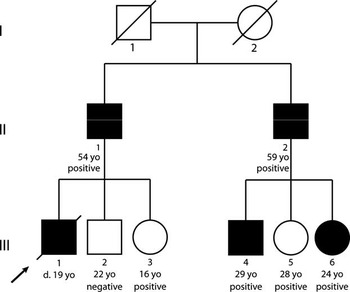
This Caucasian family came to clinical attention after III-1, previously asymptomatic, died suddenly at the age of 19 years (Fig 1 and Table 1). He was witnessed working at his computer when he collapsed. An autopsy revealed hypertrophic cardiomyopathy with asymmetric septal hypertrophy and maximum wall thickness of 17 millimetres. Histopathology showed myocyte disarray and hypertrophy. Toxicology was negative.
Pedigree. Proband is indicated with an arrow. Individuals shaded in black are phenotypically affected with hypertrophic cardiomyopathy. Age of each individual is indicated below the symbol. Genetic test results of the c.363dupG Troponin C mutation is indicated below each individual who was tested.

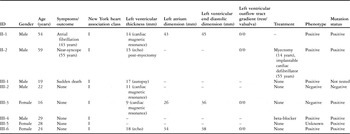
Patient characteristics in a family with hypertrophic cardiomyopathy and c.363dupG Troponin C mutation.

– = quantitative data not available
After the death of III-1, his first-degree relatives were evaluated. III-2 is his asymptomatic 22-year-old brother. Echocardiogram showed normal maximum left ventricular wall thickness of 11 millimetres in all segments of the chamber. III-3 is his asymptomatic 16-year-old sister, also without left ventricular hypertrophy (maximal thickness 9 millimetres by cardiovascular magnetic resonance). II-1 is his 54-year-old father with a history of chronic atrial fibrillation since 43 years of age. Cardiovascular magnetic resonance demonstrated mildly increased septal thickness of 14 millimetres, without evidence of left ventricular outflow obstruction by echocardiography.
II-2 is the proband's 59-year-old paternal uncle with a history of surgical septal myectomy at 14 years of age for obstructive hypertrophic cardiomyopathy and severe cardiac failure symptoms. He experienced an episode of near-syncope, and a cardioverter-defibrillator was implanted for primary prevention of sudden death at 55 years of age. There are three cousins who are genetically affected (III.4; III.5, and III.6). Of the three (III.4 and III.6), two are phenotypically affected, whereas III.5 has declined clinical evaluation. III-6 is a 24-year-old female with left ventricular thickness of 18 millimetres by echocardiogram involving the anterior septum and contiguous anterior free wall in the absence of mitral valve systolic anterior motion.
Genetic testing was performed initially on III-3 due to concern of a familial form of hypertrophic cardiomyopathy. A novel Troponin C c.363dupG mutation caused a frameshift leading to a glutamine 122 alanine substitution and a premature stop codon at position 30 of the new reading frame (p.Gln122AlafsX30). The mutation was confirmed with bidirectional Sanger dideoxy sequencing. Troponin C is highly conserved in humans with virtually no variation in the coding sequence. This mutation was not detected in 1000 alleles, including 800 Caucasian alleles, previously reported.Reference Landstrom, Parvatiyar and Pinto4 The Troponin C c.363dupG mutation was then tested in II-1, II-2, III-2, III-4, III-5, and III-6. II-1, II-2, III-4, III-5, and III-6 were found to carry the Troponin C c.363dupG mutation, whereas III-2 was found not to carry the familial mutation (Fig 1). These results produce a log of odds score of 1.2 using an affected only analysis.
Discussion
We report a novel frameshift mutation (c.363dupG) in Troponin C in a single-family causing hypertrophic cardiomyopathy and sudden cardiac death. The mutation segregates with clinical findings of hypertrophic cardiomyopathy within the family, but may demonstrate age-related penetrance with some young, ages 16 and 28 years, and asymptomatic family members who are mutation positive without left ventricular hypertrophy and who may yet develop the phenotype of hypertrophic cardiomyopathy. Despite family member III-1 who died suddenly at 19 years of age not being directly tested due to lack of available DNA, it is highly likely that he carried the familial Troponin C mutation. In addition, despite mutations in Troponin C being uncommon in hypertrophic cardiomyopathy and only six mutations being previously reported in either hypertrophic cardiomyopathy or dilated cardiomyopathy, our family supports the association of Troponin C and hypertrophic cardiomyopathy (with sudden cardiac death). All previously reported mutations in Troponin C are missense mutations, and many were studied functionally and shown to increase calcium sensitivity to force development.Reference Landstrom, Parvatiyar and Pinto4 Our reported frameshift mutation could cause a loss of function and haploinsufficiency of Troponin C through nonsense-mediated decay. However, since the premature termination codon is close to the 3′ end of the penultimate exon, an alternative possibility is that the mutant protein is translated and could exert effects on force generation. Further studies would be necessary to differentiate between these two possibilities.
Cardiac troponin is a heterotrimeric complex, which, together with tropomyosin, is located on the actin filament. Troponin is composed of the calcium binding subunit troponin C, and inhibitory subunits troponin I and troponin T. Troponin C acts as a calcium sensor. When calcium binds to troponin C, the interaction between troponin C and troponin I is strengthened, thereby releasing it (troponin C) from actin. This allows the troponin–tropomyosin complex to move into the actin groove and expose the myosin binding sites on actin making them available for contraction, the hydrolysis of adenosine triphosphate, and the generation of tension. The frameshift mutation we report is in the EF-hand 3 domain, and the frameshift destroys the H-helices of troponin C necessary for interaction with troponin I.Reference Lindhout and Sykes8 We hypothesise that the mechanism of action for our novel c.363dupG Troponin C is due to haploinsufficiency, which reduces the release of troponin I from actin.
As is often the case with hypertrophic cardiomyopathy, there is significant variability in phenotype between mutation carriers within the family we have presented. Genetic testing was helpful both in identifying a family member without the familial mutation (III-2) who no longer requires serial cardiac evaluation as well as an asymptomatic family member (III-3) who carries the mutation without left ventricular hypertrophy and requires close surveillance and possible consideration for primary prevention of sudden death with an implantable cardioverter defibrillator.Reference Maron, Spirito and Shen9
Acknowledgements
The authors gratefully acknowledge the contributions of the patients. Financial support was provided by the Children's Cardiomyopathy Foundation (Chung) and Hearst Foundation (Maron). Josue Martinez provided assistance with manuscript preparation. Drs Chung and Maron receive consulting fees from GeneDx Laboratories (Gaithersburg, Maryland, United States of America).