From the opening of treaty ports in 1843, to the Republican Era after the 1911 Xinhai Revolution, to the founding of the People’s Republic of China in 1949, to the Reform and Opening Up policies initiated in 1978, the modern history of the performing arts in Shanghai traces through more than 170 years of development. This history not only summarizes the modern development of Chinese performing arts, but is also representative of the historical development of Chinese urban space and city culture.
The primary performing arts market in early modern Shanghai (1843–1911) featured Chinese operas (xiqu 戏曲), mostly in theatre gardens (xiyuan 戏园) or on stages (xitai 戏台); kun opera troupes and other regional opera troupes from Anhui, Beijing, Guangdong, and Shaoxing in Zhejiang; and troupes of bangzi opera performed in these venues. There were Beijing-style tea gardens, such as Dangui (丹桂) and Jingui (金桂). Shanghai-style theatre gardens such as Sanya Yuan (三雅园) featured kunqu. This period saw two waves of reform when theatres were built. One was around 1870 when new construction featured imitations of Beijing-style tea gardens. The other one was around 1900, marked by the appropriation of Western proscenium staging and the building of new-style modern theatres.
The first Lyceum Theatre (Lanxin da xiyuan 兰心大戏院), built on the Shanghai Bund (riv-erfront) in 1866, featured performances of realistic dramas by the Amateur Dramatic Club of Shanghai whose actors were mostly British expatriates.Footnote 1 It was the first time Chinese people experienced Western theatre. In 1907, in the second Lyceum Theatre, the Chinese New-Style Spring Sun Society (Zhongguo xinshi chunyang she 中国新式春阳社) performed the realistic spoken drama (huaju 话剧) Black Slaves’ Cry to Heaven (Heinu yu tianlu 黑奴吁天录,Footnote 2 an adaptation of Harriet Beecher Stowe’s Uncle Tom’s Cabin).Footnote 3
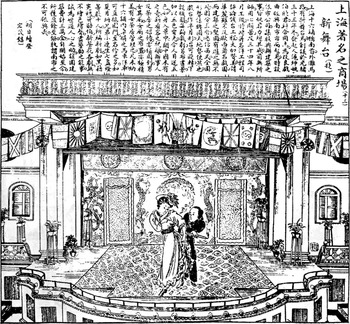
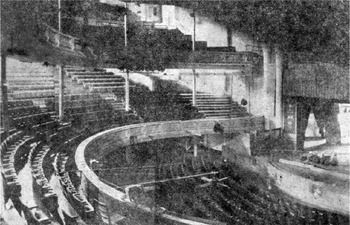
In 1908, the New Stage Theatre (Xin wutai 新舞台) was built at Shiliupu Marina on the Bund (Waitan shiliu pu matou 外滩十六铺码头) (figs. 1 & 2). This was the first theatre in China with a revolving stage—based on what a Chinese technical crew saw in Japan. The availability of Western-style stages in which the performance was viewed from an auditorium also influenced the presentation of traditional Chinese opera with the introduction of backdrops, colored lights, and other stage mechanisms. “A Brief Account of the World’s Evolution” (Shijie jinhua zhi lue ji 世界进化之略迹) published in 1907 in The World (Shijie 世界) systematically discussed theatre reforms in light of the impact on the performing arts in Shanghai brought on by the introduction of Western-style stages. The article emphasizes how Western theatre design, mechanisms, aesthetics, and culture should be a model for theatre reforms in China, from theatre lighting to the realism manifested in stage scenog-raphy; from having both male and female actors onstage (with-out gender impersonation as in traditional Chinese theatre) to the respect given to actors in Western society compared to the low social status of actors in China (Shijie 1907).Footnote 4
New Stage Theatre, 1909. (From Huanqiu she editorial team, Tuhua ribao [Pictorial Daily] 1999:151)

In 1908, the New Stage Theatre (Xin wutai 新 舞 台 ) was built at Shiliupu Marina on the Bund—the first theatre in China with a revolving stage. (From Shihi bao 时 事 报 [Current Affairs], 1908)

In the Republican Era (1912– 1949), all kinds of performances flourished in Shanghai—the period was a golden age of haipai (海派 Shanghai-style) theatre arts ranging from traditional Chinese theatre such as kun opera, Beijing opera, Canton opera, yue opera, hu (Shanghai) opera, and huai opera to Western forms such as spoken drama, Western opera, ballet, musicals, acrobatics, magic shows, and films.
In this period, a lot of performing arts spaces were built in Shanghai—almost half of what exists in all of China. In terms of scale, architecture, and stage design, these spaces were at the cutting edge of the latest trends, including the growing use of the proscenium stage in place of the more open-space traditional Chinese theatre stage, the introduction of Western theatre lighting and stage backdrops, the projection of silent films as backdrops for plays (this piqued the audiences’ interests immensely), and the development from two-dimensional painted stage backdrops towards three-dimensional stage scenography.
These spaces can be divided into three types. One was wutai (舞台 stage) or xiyuan (戏院 theatre house) for presenting traditional Chinese operas. They included new-style Beijing opera stages, old-style theatre houses, and a very small number of privately owned outdoor stages ( fushu xitai 附属戏台) attached to the gardens inside the houses of rich people.Footnote 5 More specifically, there was jing juchang (京剧场 Beijing opera theatre), kun juchang (昆剧场 kun opera theatre), yue juchang (粤剧场 Canton opera theatre), yue juchang (越剧场 yue opera theatre), hu juchang (沪剧场 Shanghai opera theatre), huai juchang (淮剧场 huai opera theatre), etc.Footnote 6 The second type comprised theatres with proscenium stages, such as hua juchang (话剧场 spoken-drama theatre), ying xiyuan (影戏院 movie theatre), or xiren juyuan (西人剧院 Westerners theatre), etc.Footnote 7 Other kinds of performances were housed in the third type of theatre, which included youyi chang (游艺场 public entertainment complex),Footnote 8 shuchang (书场 venue for quyi 曲艺, traditional Chinese storytelling-and-singing performances), litang (礼堂 auditoriums for large meetings and ceremonies), and fushu wutai (附属舞台 theatres attached to other kinds of venues).
A wide variety of performing arts flourished at this time. Not only were traditional performances available in Shanghai, reflecting the diverse regional origins of their audiences, but there were also many innovations prompted by the introduction of new venues with their modern stage technologies. The presence of Westerners and their presentations of Western theatrical forms contributed to the cosmopolitan character of semicolonial Shanghai and influenced the development of performing arts throughout China. All of this expansion gave the performing arts more prominence in the public sphere as part of Shanghai’s urbanization, marketiza-tion, and development of the popular entertainment industry.
The wave of theatre construction that took place in the golden decade of the Republican era between 1927 and 1937 most notably produced Western-style modern theatres and movie theatres. In this period, the center of the city ran along the axis of today’s Nanjing Road and Middle Xizang Road, with a cluster of theatres in this area, similar to the Broadway theatre district in New York City and the West End in London. The plentitude of theatres—extending towards the north of Suzhou Creek and the north Bund—was commonly regarded as dongfang bailaohui ( 东方百老汇 the “Broadway of the East”) by the Chinese people.Footnote 9 This flourishing contributed to making Shanghai one of the leading metropolises of the Far East and a cultural center of China and Asia.
In Beijing at that time, going to the theatre was understood as ting xi (听戏 listening to a play), whereas in Shanghai it was kan xi (看戏 seeing a play). Shanghai audiences were moving from an aural orientation toward Chinese opera to the more multisensorial mode of Western theatre. This marked the move from the bare stage of traditional Chinese opera to visually rich scenic structures of Western theatrical spaces replete with lights, sets, and amplified sound.
These spectacle-oriented changes expanded the audience, boosting the economic importance of theatre, and promoted a robust cycle of theatre production and consumption.
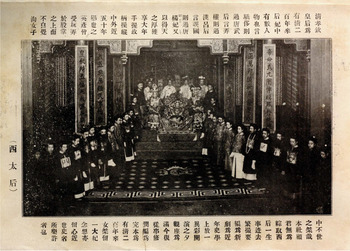
The mutual influence of Chinese opera and spoken drama on each other was strong. There was singing in the style of Chinese opera in early spoken drama; sometimes a song was the turning point within the plot of a spoken drama. Western realism figured in the appearance of liantai benxi (连台本戏 serial plays) in Chinese opera, as well as the incorporation of contemporary, realistic issues—both to increase attendance. Since the mid-18th century, the Chinese opera had evolved to feature a certain zhezi xi (折子戏), a refined act that is an excerpt or highlight of a longer play. In early-20th-century Shanghai, the theatre troupes adapted the zhanghui xiaoshuo (章回小说 classical Chinese serial novel) to create serial plays by connecting related but independent stories and performing one each day to attract more audiences.Footnote 10 An example of such serial plays was the new drama Xi taihou (西太后 Empress Dowager Cixi), which included 36 episodes performed in Shanghai from 1914 to 1915 (fig. 3). The series dramatized the central figure of political governance in the troubled late Qing period in China. Renowned Chinese opera dan actor Mei Lanfang (梅兰芳) also performed several original contemporary-costume new dramas with boldly reformist content in the 1910s, such as Nie hai bolan (孽海波澜 Waves on the Sea of Sin; 1914), which protested the sex trade; and Yi lu ma (一缕麻 A Thread of Hemp; 1915), whose tragic heroine is trapped by the patriarchal custom of arranged marriage (Goldstein Reference Goldstein2007b). Many spoken drama actors also helped to standardize the scripts of Chinese opera by recording the dialogue and lyrics. Up to that point the traditional theatre practitioners in China, who were lingren (伶人 actors) of family lineage, kept performance texts private within the family and primarily transmitted them orally—to ensure they would not be stolen by their professional competitors. Researchers began to record Chinese opera performances, transcribing and editing them to create consistent versions of the repertoire. They then began to reform traditional Chinese opera rehearsals with the methods of modern spoken drama.
An example of the early 20th-century serial plays was the new drama Xi taihou (西 太 后 Empress Dowager Cixi), which included 36 episodes and was performed in Shanghai from 1914 to 1915. (From Min ming xinju she yi zhounian jinian shu 民 鸣 新 剧 社 一 周 年 纪 念 书 [One-year Anniversary Commemoration Book of Min ming New Drama Society], January 1915)

In the early days of Chinese opera, many renowned Chinese opera actors performed in spoken dramas, influencing the development of that form. Some artists working in early spoken drama were highly educated in Chinese opera. For instance, Ouyang Yuqian (欧阳予倩), whom Tian Han (田汉), a celebrated playwright and one of the founding figures of Chinese spoken drama, deemed the most respected artist of Chinese spoken drama, performed in a very popular version of Dream of the Red Chamber (Honglou meng 红楼梦) that combined spoken drama and Chinese opera from May 1916 to the end of 1917 at Xiao wutai (笑舞台) in Shanghai.Footnote 11 New drama (xinju 新剧), a hybrid of Chinese opera and spoken drama, emerged in early 20th-century China. Actors such as Zha Tianying (查天影) and Ling Lianying (凌怜影) performed alongside Ouyang Yuqian.Footnote 12 Their performances were among the most successful of early spoken drama. Ouyang’s acting skills earned him a status comparable to Mei Lanfang’s; people said, “Ou in the south and Mei in the north” (Nan Ou bei Mei 南欧北梅). Wang Youyou (汪优游, aka Wang Zhongxian 汪仲贤), who graduated from Jiangnan Naval Academy (Jiangnan shuishi xuetang 江南水师学堂), was another renowned actor working in both new drama and Chinese opera. He was enthusiastically celebrated by audiences for his chang dao qing (唱道情), a traditional Chinese folk performance combining singing and storytelling, which he performed with the Xinmin Society (新民社) and Xinming Society (新鸣社). Soon after Wang stopped performing new dramas, he quickly joined the New Stage Theatre (Xin wutai 新舞台) where he became an important actor of Chinese opera. He later performed in both new drama and Chinese opera at the Shangyue Society (尚乐社) in Da shijie (大世界), the leading entertainment complex in Shanghai. Zhu Shuangyun (朱双云), author of the first chronicle of Chinese spoken drama, Xinju shi (新剧史 History of New Drama; 1914), was also an actor of both new drama and Chinese opera.Footnote 13 When Zhu was assisting Zheng Zhengqiu (郑正秋) in running Xinmin Society, he performed in new dramas almost every day. Later, Zheng ran a theatre by himself in Hankou, recruiting actors such as reformer Mao Yunke (毛韵珂), known for “standard Beijing opera” (Biaozhun pingju 标准平剧). In the mid-1930s, Zhu’s new drama plays, written to support the war of resistance against the Japanese invasion, included a lot of opera arias. In addition, Zhu insisted that the boundary between Chinese opera and spoken drama is not hard and fixed; that these two forms can absolutely interact with and learn from each other.
In the Republican Era Shanghai underwent a very rapid urbanization. In the 1920s and 1930s, the city was already the cultural center of China and a cultural hub of the Far East. Cultural industries and modern technologies influenced by the West were swiftly transplanted and developed. In addition to theatre and other performing arts, publishing, film, and music industries also flourished in Shanghai, contributing to a distinct urban culture of colonial modernity (Lee Reference Lee1999; Zhen Reference Zhen2005; Jones Reference Jones2001).Footnote 14 Most visibly, theatres, cinemas, coffeehouses, bars, clubs, dancehalls, and a racecourse filled the cityscape.Footnote 15 By the early 20th century, gaslights, electricity, telephones, running water, automobiles, and trams had been introduced into the city life of Shanghai (Lee Reference Lee1999). In the context of theatre, modern technologies included new forms of backdrops, lighting systems, mechanical capabilities such as revolving stages, and film projections as moving-picture backdrops for spoken dramas. Nevertheless, traditional Chinese opera was still dominant. Theatre forms from outside China had to gain a foothold in Shanghai before they could become popular elsewhere. Even regional theatre forms such as yue opera had to pass the test of the Shanghai market. Based on performance advertisements in the newspaper Shen Bao (申报) between 1873 and 1949, only Chinese opera was continuously performed regardless of the political circumstances at the time. The growth of the market for spoken drama was very slow: it was a less understood form and it was regarded as amateur theatre, very different from the highly professional Chinese opera. In addition, during the 1930s and ’40s, spoken drama was primarily political and associated with the war against Japan. Its market was limited.
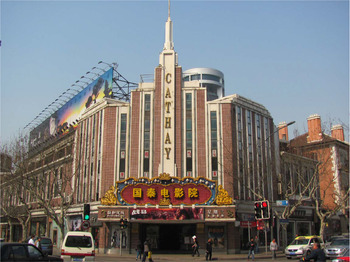
Cathay Theatre, Shanghai, 28 March 2012. Opened on 1 January 1932, it was part of the rapid urbanization of Shanghai during the Republican Era. (Photo by AddisWang, courtesy of Creative Commons)

Throughout the entire Republican Era, spoken drama had a small audience compared to popular novels and films. Beijing opera, kun opera, yue opera, huai opera, and hu opera were the dominant performance forms. Shanghai was an immigrant city and newcomers could enjoy the theatre they knew from other parts of China. They were familiar with the styles and stories of Chinese opera. This was true of both the upper echelons of the society and the descendants of farmers flooding into the metropolis. Finally, the conservative cultural tastes of the Nationalist government also favored Chinese opera over what was perceived as alien practices.
According to the statistics in Shanghai tongzhi (上海通 Shanghai Chronicle; 2005), between 1945 and 1949 the types and numbers of theatres in Shanghai are as follows:
In 1945, there were 67 theatres: 7 Beijing opera, 4 spoken drama, 2 huaji xi (滑稽戏 comic theatre), 30 yue opera, 11 Shanghai (hu) opera, and 13 jianghuai opera theatres (江淮戏, regional opera performed in Shanghai, and Jiangsu and Anhui Provinces). In 1947, there were 84 theatres: 5 Beijing opera, 1 spoken drama, 2 huaji xi, 30 yue opera, 14 Shanghai opera, and 22 jianghuai opera theatres. In 1949 there were 128 theatres, some of which served dual purposes, showing both cinema and live theatre. But, still, during the Republican Era, Shanghai—the cultural center of China—was where a wide range of cultures were showcased. In Shanghai’s diverse and liberal urban space, the traditional Chinese opera was open for innovation, absorbing new techniques from spoken drama. By contrast, ironically, spoken drama met with challenges when it came to innovation.
The advent of the People’s Republic of China in 1949 brought big changes. In the 1950s, urban spaces were reformed to comply with the mandates of the PRC. In 1956, all privately owned theatres became public with private co-ownership and co-management. Soon came the demolition of many small theatres and the merger of others. By the 1960s, there were only 36 theatres in Shanghai.
After 1949, the connection between Shanghai and the West was severed. A rapid China-for-China change occurred culturally. Shanghai shifted from being a multivalent metropolis in the Republican Era to a much more unidimensional Chinese-only city. The city was no longer a cultural hub; diversity waned along with the market-oriented creative economy. Shanghai was transformed into an industrial city supporting the whole country with its vast inland regions. In the 30 years following 1949, Shanghai saw very little added to its cultural facilities except a few recreational clubs for workers. It was not until the late 1980s that Shanghai recovered its position as the cultural center of China. With the post-Mao reforms, and China’s return to a market economy, scholars advocated for reestablishing Shanghai’s position as the country’s cultural center. They observed that “the vitality and attraction based on the entire social life of Shanghai that had been accumulated over a long time, as well as the status of it being the cultural center of China and Asia had been completely lost” (Li Reference Li2004:210).
However, throughout the early years of the PRC, spoken drama flourished. Beginning in the 1950s, professional state-sponsored spoken drama troupes were formed and professional theatre academies were established. The Central Academy of Drama (CAD) in Beijing and the Shanghai Theatre Academy (STA) used a pedagogy and curriculum based on the Soviet Union.Footnote 16 CAD and STA were state institutions of higher education directly under the Ministry of Culture. Both academies focused on spoken drama. During the same period, Chinese opera schools at the level of secondary school were established in every province, nurturing each regional Chinese opera. The first Chinese opera academy was established in 1950 as a precollege professional school, and in 1978 they developed an undergraduate curriculum (National Academy of Chinese Theatre Arts). Traditionally, Chinese opera actors began training when very young in smaller schools and went directly to performing onstage, so there was no college-level schooling for them. In practice, after 1949, Chinese opera was not given as much attention as spoken drama.
After Shanghai changed from an international metropolis to a commercial and industrial city, the city’s residents lived much more monotonous lives. The pre-1949 culture of a prosperous professionalized market-oriented economy shifted to the mass participation and collectivism of the planned economy. Due to the influence of the Soviet Union and the establishment of a small number of state-sponsored professional theatres and academies, however, there was a reservoir of theatre talent and a repertory of plays that led to the production of numerous excellent works in both Chinese opera and spoken drama. This repertory and the talent that created it became the foundation for the post-1978 era of the Reform and Opening Up.
The 1980s was a period of great liberalization in China. Western culture and discourse became widely circulated, as they were during the New Culture Movement of the 1910s and 1920s. Chinese spoken drama entered a new golden era, with Shanghai being an important part of this renaissance. At the same time, there was a lot of avantgarde theatre featuring translated plays and local experiments, such as Molière’s The Miser by Shanghai Youth Theatre Troupe (1980), Shakespeare’s Romeo and Juliet by Shanghai People’s Art Theatre (1980), Arthur Miller’s The Crucible (1981) by Shanghai People’s Art Theatre, Sha Yexin’s play Yesu, kongzi, pitoushi lienong (Jesus, Confucius, and John Lennon of the Beatles) by Shanghai People’s Art Theatre (1988), and avantgarde playwright Zhang Xian’s Shizhuang jie (Fashion Street) as the inaugural performance of the newly opened Experimental Theatre of Shanghai Youth Theatre Troupe (1989). These performances mostly impacted the cultural elite, even as they were shown in many spaces around the city, such as The Liberation Theatre, Shanghai Art Theatre (Lyceum Theatre), Chang Jiang Theatre, Ruijin Theatre, Xuhui Theatre, Experimental Theatre of Shanghai Youth Theatre Troupe, and STA.
In the 1990s, Shanghai experienced rapid socioeconomic development, accompanied by swift changes in its cityscape. During this period, Shanghai municipal planning ushered in the most extensive urban renewal and construction since the 1950s. The Pudong area (east of the Huangpu River) was developed, helping to transform the whole city. The enormous boom of the market economy eclipsed the urban cultural renewal. A lot of theatres built in the Republican Era were crushed to make way for commercial spaces. The urban renewal of Shanghai came at the cost of the destruction of many important places of cultural heritage.
If the 1950s saw the transformation of urban space channeled by the power of the municipal government, the 1990s saw the power of conjoined state and private capital. However this power did not come with knowledge of or experience with protecting historic architecture. The long-term cultural value of historical heritage mostly gave way to short-term economic profit. Lots of culturally valuable historic buildings in the former foreign concessions area and from the Republican period in the Puxi area (west of the Huangpu River) were demolished.Footnote 17 At least 12 theatre buildings were torn down beginning in the late 1980s and mostly in the 1990s.Footnote 18 Some notable sites include the Hongkew Cinema (fig. 5), built in 1908, which was recognized as the first movie theatre built in China with a formal business operation, torn down for the broadening of Haining Road in 1988; Carlton Theatre (later as Chang Jiang Theatre; 1923–1993), which was a crucial venue for spoken drama in the 1930s, having presented the canons such as Cao Yu’s Leiyu (Thunderstorm; 1934) and Richu (Sunrise; 1936), torn down in 1993 to become a high-end restaurant;Footnote 19 Palais Oriental Theatre (1926–1993) and Empire Theatre (1922–1994), both torn down to become large department stores on the now Middle Huahai Road; and Olympic Embassy Theatre (later as Roxy Theatre; 1914 –late 1990s), which claimed to have made the first public screening of sound film in China in 1929, torn down for making taller buildings (Shen Bao 1929). Many of these demolished theatres had a capacity of more than 1,000 seats; King’s Theatre (also Crystal Palace; 1930–1993), which was torn down for municipal urban construction, had two floors with 3,000 seats in total. Some of the buildings were more an entertainment complex than simply a theatre, such as the Carlton Theatre, which had a café, a billiard room, a dancehall, and a theatre house (Fang Fang Reference Fang2009:234).
Hongkew Cinema in 1915. Built in 1908 and demolished in 1988, it was the first movie theatre built in China with a formal business operation. (In Nai Gu Reference Gu2007)

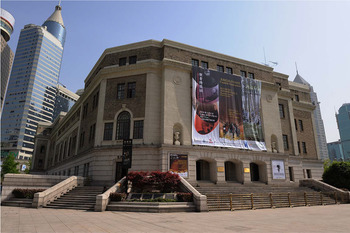
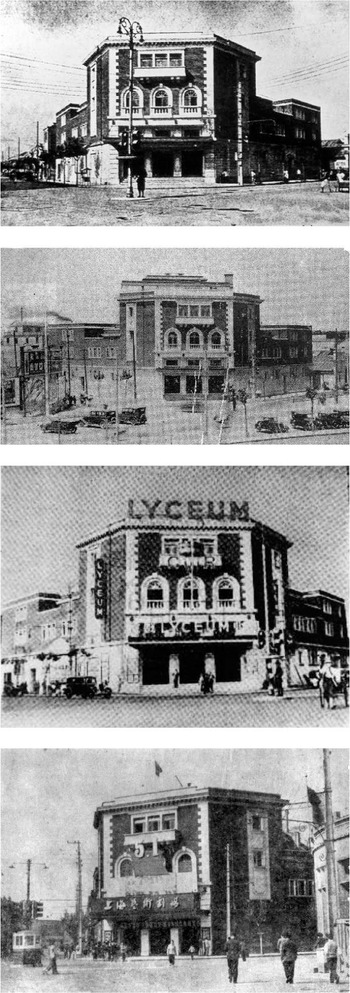
Nevertheless, some buildings were preserved. The Shanghai Concert Hall (built in 1930 as the Nanking Theatre; figs. 6 & 7) was moved to accommodate the widening of the Yan’an Road highway. The move began on 15 April 2003 and was completed on 17 June. The concert hall was lifted 1.7 meters, then moved 66.46 meters south, and then lifted another 1.68 meters to the new location. Other notable buildings that were preserved include Tianchan Yifu Theatre, built in 1926 and renovated in 1990—sponsored by Hong Kong entertainment mogul Shao Yifu—then reopened in 1994 to feature Beijing operas (fig. 8); the third Lyceum Theatre, built in 1931 and renovated by the Shanghai city government in 2003, closed at the end of 2019 for another round of renovations (fig. 9); and Great Theatre of China (1930– ), which was closed in 2008 and then renovated and reopened in 2018 and now features an annual international theatre festival headed by the newly appointed artistic director Tian Qinxin (田沁鑫), a celebrated theatre director of the National Theatre of China.
Shanghai Concert Hall in 1959. Formerly the Nanking Theatre, it was built in 1930. This photo was original printed in the newspaper Shen Bao. (From Zhongguo huitang juchang jianzhu, Department of Architecture, Tsinghua University 1960:132–33)

Shanghai Concert Hall, 29 April 2010. (Photo by Pzyhou, courtesy of Creative Commons)

Daxin Wutai (New Tianchan Theatre) interior. Tianchan Yifu Theatre, built in 1926 and closed for renovations in 1990, it reopened in 1994 to feature Beijing operas. (From Zhongguo huitang juchang jianzhu, Department of Architecture, Tsinghua University 1960:126–27)

The Third Lyceum Theatre was built in 1931 and renovated by the Shanghai city government in 2003. Shown here in the 1930s, 1940s, 1950s, and 1960s. (Source unknown; courtesy of Creative Commons)

Refracted through the rise and fall of theatres, the half century between the 1950s and the 1990s saw a historical cycle in Shanghai’s urban culture that moved from being multivalent and liberal to unidimensional and closed and back again.
The urban transformation of Shanghai was also influenced by the global rise of cultural industries, resulting in the production of more arts spaces. The 1990s saw the construction of new theatres, including the Shanghai Grand Theatre (opened on 27 August 1998; fig. 10), the first theatre in China equipped with state-of-the-art facilities. New cultural facilities were built while historic ones were destroyed.
Shanghai Grand Theatre, February 2008. The 1990s saw the construction of new theatres, including the Shanghai Grand Theatre (opened in 1998), the first theatre in China equipped with state-of-the-art facilities. (Photo by Baycrest, courtesy of Creative Commons)

To some extent, culture was attached to the economic expansion throughout China. No longer was there a dichotomy of culture versus capital. Something more complex emerged: the multiple intertwining of arts spaces and commercial spaces.
During his field visit to the arts and cultural communities of the city on 21 August 2007, Xi Jinping, then Secretary of the Municipal Party Committee of Shanghai, proclaimed that “as Shanghai was speeding up in its material construction, the city should also strengthen its cultural influence and incorporate it into its economic development, pushing cultural development forward within economic development and fully promoting the construction of a cultural metropolis [wenhua da dushi 文化大都市].” Xi elaborated on the direction of cultural development for Shanghai and its relationship to economics (in East Day Reference Day2007).Footnote 20 After the city hosted the 2010 World Exposition, the focus for developing cultural facilities shifted to Pudong and Puxi. In 2017 the Shanghai Municipal Government published a plan to hasten the development of the culture industry in the city (Shanghai Municipal Government 2017; see The Paper 2017).
The municipal government proposed developing Shanghai into a global center for TV and film, as well as the center of live performing arts in Asia.
The “golden cross” along the axis of today’s East to West Nanjing Road and Middle Xizang Road that was formed a century ago became a cluster of theatres in the center of Shanghai. In the 1990s, this area was designated as the Performing Arts Cluster Surrounding People’s Square (Huan renmin guangchang yanyi juji qu 环人民广场演艺集聚区). Theatres with nearly a hundred years of history—Huangpu Theatre, Great Theatre of China, and Chang Jiang Theatre—were refurbished. In 2008, the government of Shanghai officially named this district Show Life (Yanyi da shijie 演艺大世界). There are 39 performance and exhibition venues in this area, with 21 theatres and art galleries within 1.5 square kilometers of People’s Square, reaching the density of 14 spaces per square kilometer. The average number of performances per year in the main theatres of this area is about 3,000. This is the largest and densest theatre cluster in China, as well as the most resource-rich and influential.
Shanghai Culture Square, a major theatre in the Show Life district, primarily presents musicals. Since its opening in 2011, productions of such musicals have included Phantom of the Opera, Notre Dame de Paris, Romeo and Juliet, Mozart, Mozart l’opéra rock, A Chorus Line, West Side Story, Cats, The Producers, Carmen la Cubana, and more. These productions brought top artists from the UK, the US, France, Germany, and Cuba. In terms of its business operation, Shanghai Culture Square follows its own founding principle of “government investment, business establishment, market operation, and public service” and affirms the model of “position-ing as a public good with market operation” (SHCSTheatre.com n.d.). As a business responsible for its own income and expenses, Shanghai Culture Square spends about 100,000,000 RMB (about $15 million) per year, with operations and performance costs each taking about 50%. The company has made a slight profit for six consecutive years from 2013 to 2019.Footnote 21
Since its opening in 2011, there have been more than 2,000 performances viewed by nearly 2,500,000 people at this venue. This means that Culture Square reaches more spectators than any other Shanghai venue. In 2019, there were 50 productions and 285 performances, an average of one performance per 1.27 days, each show averaging 82% capacity. From 2011 through 2019 Culture Square collaborated with more than 10,400 Chinese and international artists, staff, and crew. In 2019, 26 musicals were presented, totaling 233 performances—82% of Culture Square’s entire program for the year. As a result of years of effort, Culture Square has expanded the appreciation and understanding of Western musicals by Chinese audiences. Five musicals were Chinese premieres. In 2019, two self-produced musicals toured to 24 Chinese cities, offering a total of 97 performances. Culture Square’s four self-produced musicals were My Bucket List, Rachmaninoff, Spring Awakening, and Maybe Happy Ending. All received good reviews and earned strong economic returns. In addition to presenting foreign musicals, Culture Square also curates a Chinese-language Musical Performance Season each year, so far having presented 36 Chinese-language musicals with 91 performances.Footnote 22 In 2019, Culture Square started the first Original Chinese-Language Musical Incubation Project in China, which attracted lots of young creators and groomed many original musical pieces and talents. It will move towards producing more works as it establishes itself in the market. All this adds up to Shanghai Culture Square being a highly recognized global performing arts venue, a key stop for world touring productions, helping Shanghai in its branding as the “city of performing arts in Asia” ( yazhou yanyi zhidu 亚洲演艺之都) as proposed in “The 50 Guidelines for Creative Industry” (Shanghai Municipal Government 2017).
Another venue of note in the Show Life district is the Great Theatre of China, built in 1930 as the Sanxing Theatre (Sanxing wutai 三星舞台). During the 1930s and 1940s, the Great Theatre and the Wenming Grand Theatre (Wenming da wutai 文明大舞台), Tianchan Theatre (Tianchan wutai 天蟾舞台), and Gong Theatre (Gong wutai 共舞台), were called Shanghai’s “Four Great Beijing Opera Theatres” (Zhu Reference Zhu2004:352). Among the many renowned Beijing opera artists from both north and south China to grace the stage of the Great Theatre were Li Huiliang (厉慧良 1923–1955, a wusheng, martial male role-type); Ma Lianliang (马连良 1901– 1966, a laosheng, old male role-type); Li Yuru (李玉茹 1924 –2008, a dan, female role-type); Gai Jiaotian (盖叫天 1888–1971, a martial male role-type); Lin Shusen (林树森 1897–1947, an old male role-type); Song Dezhu (宋德珠 1918–1984, a wudan, martial female role-type); Zhou Xinfang (周信芳 1895–1975, also known by his stage name qilin tong [麒麟童], who created the school of qi pai [麒派] performance of laosheng, old male role-type); and Mei Lanfang (梅兰芳 1894 –1961, internationally renowned master of dan roles). In May 2018, the refurbishing of the Great Theatre of China was completed. Its historic architectural features and cultural heritage make it a site of distinction. The Great Theatre of China and the Shanghai Theatre Academy together established it as the base for STA’s Youth Spoken Drama Troupe. Beginning in 2018 the renowned theatre director Tian Qinxin (田沁鑫) curated an annual international theatre festival.Footnote 23 The inaugural season featured 22 works across theatre and dance from the UK, France, Germany, Japan, Italy, Poland, Lithuania, and China, with a total of 54 performances shown between June and September 2018. Some notable works included On the Concept of the Face, Regarding the Son of God directed by Romeo Castellucci, Western Society by Gob Squad, Hedda Gabler directed by Thomas Ostermeier, the chamber music version of Farewell My Concubine featuring celebrated Beijing opera actress Shi Yihong, and 4/5 by TAO Dance Theatre of China. The 2019 season presented 16 works from the UK, France, US, Germany, Chile, and China. Six of the international works were Chinese premieres, four were Asian premieres, and one was a world premiere. Some notable works included The Bald Soprano directed by Pierre Pradinas of Théâtre au Chapeau Rouge, The Odyssey directed by Antú Romero Nunes of Thalia Theatre, and Waiting for Godot by Contemporary Legend Theatre of Taiwan featuring renowned Beijing opera actor Wu Hsing-kuo.
The other cluster of theatres is centered around the T-intersection between West Nanjing Road and Jiangning Road, with the STA and the Shanghai Dramatic Arts Center (SDAC) at its west edge. I call this cluster the Modern Drama Valley Theatre Cluster. Among them are the Majestic Theatre, Shanghai Art Theatre, Duanjun Theatre, Malanhua Theatre Shaonian gong xiao huoban juchang (少年宫小伙伴剧场 Children’s Palace and Young Friends Theatre), Shanghai Shangcheng Theatre, and STA’s and SDAC’s theatres. Many festivals take place every year in the Modern Drama Valley, including the International Experimental Theatre Festival at STA, the Rising Artists’ Works of China Shanghai International Arts Festival, and the festival of Modern Drama Valley in the Jing’an District. This last was recognized as one of Shanghai’s ten major cultural events of 2018.
As of 2018, there were 162 theatre venues with performance license in Shanghai. Constructing theatres is a priority for developing urban cultural spaces in Shanghai. The authorities recognize that theatre spaces are the living rooms of the city as well as a crucial platform for cultural exchanges between China and the world. The Show Life and Modern Drama Valley Theatre Cluster—the core of Shanghai’s theatre industry—form a dumbbell-like shape in the cityscape. Although not yet comparable to New York’s Broadway and London’s West End in some respects, these Shanghai districts are integral to the city, house a cultural-historical heritage, attract talented artists, constitute an important market, and enjoy an international reputation.
The development of Shanghai’s theatres over 170 years reflects the historical vicissitudes, cultural shifts, and transformation of the city. More is coming. A series of large, cultural facilities are being planned in the former World Expo campus in Pudong, across the Huangpu River from downtown Shanghai. These will include a high-end Western opera house; two theatre clusters along the riverbank, one in Lujiazui in Pudong and the other in Xuhui in Puxi. There is also a planned theatre cluster for the Hongqiao business and commerce zone. What is the relationship between these newly built and soon-to-be theatre clusters and the two historic theatre districts discussed above?
There are 21 state-owned theatre troupes and more than 200 private troupes in Shanghai, of which 60 are active (some exist in name only; others produce sporadically). But even this large number is insufficient, considering Shanghai’s huge population of more than 24 million. Although private theatre troupes offer many performances each year, very few troupes and artists have gained popular or professional recognition. The private organizations, intermediary companies, and performing arts agencies are still underdeveloped. In terms of theatre works presented, there is a high percentage of imported plays, especially commercial ones. There is a lack of originality and creativity. There are relatively few influential Chinese-language theatre artists on the world stage or within the Sinophone sphere.
Shanghai is an immigrant city, partly shaped by the history of foreign concessions in the 19th and 20th centuries up to the establishment of the PRC in 1949. Since then, Shanghai has seen explosive growth during and after the Reform and Opening Up. In the 21st century, one face of Shanghai shows inclusivity and cosmopolitanism; the other maintains the local and the indigenous. It is a perpetual dilemma to reconcile these two. Chinese opera, which had reached its peak during the Republican Era (1912–1949), is still facing difficulties today, at the core because of the lack of cultural confidence and the pervasive attraction to the West. Actually, we have seen how the essence of Chinese opera has been absorbed by many theatre artists from other countries, creating innovative methodologies and works. So why don’t Chinese artists learn from the Chinese classical arts? Certainly in this regard Shanghai theatre people can learn from our international colleagues.
Finally, let me bring my focus back to the Shanghai Theatre Academy. Since it was established in 1945, the STA has been integral to the growth of Shanghai; the theatre people of the city are almost all connected to this academy. The mission of STA is to educate students to become artists with both virtues and skills, while also actively contributing to society. Since STA’s founding, we have worked to present skillfully performed, polished works to the people. Before the 1990s, STA featured spoken drama; now it has developed into a multidisci-plinary arts academy offering training in drama, Chinese opera, dance, and film. In a sense, the relationship between STA and Shanghai is like that between The Julliard School, Tisch/NYU, Columbia’s School of the Arts, and the city of New York: part of, apart from, and important to the future.