Introduction
The recent Cochrane systematic review of interventions with community-dwelling older people found that falls can be prevented by regular exercise and tai chi, and – in some cases – multifactorial risk assessment and intervention, home hazard reduction, vitamin D supplementation, and gradual withdrawal of excessive or balance-impairing medications (Gillespie et al., Reference Gillespie, Robertson, Gillespie, Lamb, Gates and Cumming2009). Yet, interventions to prevent falls require older people’s participation, and so researchers and health professionals require an understanding of psychosocial factors that influence people’s engagement. Psychosocial models can be used to understand why older people may not wish to engage in falls prevention interventions and to predict under what conditions an older person is more likely to participate.
Even the most well-crafted falls prevention interventions will be rendered useless if older people decline to participate in them (Dracup & Meleis, Reference Dracup and Meleis1982; Yardley, Bishop, et al., Reference Yardley, Bishop, Beyer, Hauer, Kempen and Piot-Ziegler2006; Yardley, Donovan-Hall, Francis, & Todd, Reference Yardley, Donovan-Hall, Francis and Todd2007), and it is known for health interventions to fail because the target group has not accessed the service (Stoop, van’t Riet, & Berg, Reference Stoop, van’t Riet and Berg2004). Non-participation in interventions is costly in terms of both wasted resources and the treatment of those who have not adhered to the program (Kyngas, Duffy, & Kroll, Reference Kyngas, Duffy and Kroll2000). Some falls prevention interventions have as many as a third of older people declining participation (Shekelle et al., Reference Shekelle, Maglione, Chang, Mojica, Morton and Suttorp2003) and a response rate as low as 10 per cent (Day et al., Reference Day, Fildes, Gordon, Fitzharris, Flamer and Lord2002). Adherence rates also range from as high as 84 per cent to as low as 44 per cent at two years post-baseline (Campbell, Robertson, Gardner, Norton, & Buchner, Reference Campbell, Robertson, Gardner, Norton and Buchner1999; Day et al., Reference Day, Fildes, Gordon, Fitzharris, Flamer and Lord2002; Shekelle et al., Reference Shekelle, Maglione, Chang, Mojica, Morton and Suttorp2003).
This article, therefore, presents an overview of the various psychosocial factors that act as barriers and facilitators to older people’s engagement in falls prevention interventions. While the findings summarized in this review may be relevant to other falls prevention interventions, the focus of this review is on interventions that seek to prevent falls by increasing older people’s physical activity. Focusing on physical activity interventions is warranted because these interventions have the strongest evidence base for preventing falls (Gillespie et al., Reference Gillespie, Robertson, Gillespie, Lamb, Gates and Cumming2009), and their efficacy requires more of older people’s active engagement than do other interventions such as taking medications (Chao, Foy, & Farmer, Reference Chao, Foy and Farmer2000).
Because of the number of psychosocial factors that influence engagement with falls prevention interventions (Bunn, Dickinson, Barnett-Page, McInnes, & Horton, Reference Bunn, Dickinson, Barnett-Page, McInnes and Horton2008), the use of health psychology theory is useful in synthesizing this literature. A number of psychosocial models are used to predict health behaviors, most of which fall under the banner of social cognition models. Social cognition models are theories that assume people make reasoned decisions about engaging in health behaviors and that they do so while influenced by social and environmental factors (Ogden, Reference Ogden2000). Although a number of social cognition models could be applied to the study of increasing older people’s uptake and adherence to falls prevention interventions, the theory of planned behavior is an extensively used and validated model in health psychology, has already been used in falls prevention research, and so is used to frame the literature in this review.
Psychosocial factors that explain older people’s participation in physical activity interventions for the prevention of falls are reviewed in this article under the framework of the theory of planned behavior: (a) knowledge, (b) attitude toward the behavior, (c) subjective norm, (d) perceived behavioral control, and (e) intention. Among the variables that have been proposed as additional constructs to the theory of planned behavior to strengthen its power to predict intention to engage in a given behavior (Conner & Armitage, Reference Conner and Armitage1998), self-identity has been found to be pertinent to falls prevention and so is included in this review. Lastly, reference is made to the recommendations made by the Prevention of Falls Network Europe (ProFaNE) for promoting older people’s engagement in falls prevention interventions.
The Theory of Planned Behavior
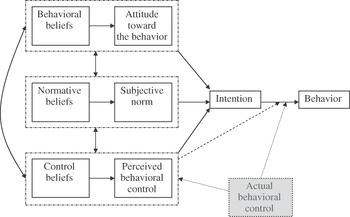
The theory of planned behavior (TPB) (Ajzen, Reference Ajzen1988) asserts that behavior change is exercised through intention: “Intentions are assumed to capture the motivational factors that influence a behavior; they are indications of how hard people are willing to try, of how much an effort they are planning to exert, in order to perform the behavior” (Ajzen, Reference Ajzen1991, p. 181). As presented in Figure 1, the TPB model asserts that intention is predicted by three variables: (a) attitude toward the behavior, (b) subjective norm, and (c) perceived behavioral control.
The theory of planned behavior. Note. From “TPB diagram”, by I. Ajzen, Reference Ajzen2006, available online at: http://people.umass.edu/aizen/tpb.diag.html. Copyright © 2006 Icek Ajzen. Reprinted with permission.

Attitude toward the behavior is the positive/negative evaluation of carrying out a behavior and its consequences, as well as the likelihood of these outcomes occurring (behavioral beliefs). Subjective norm is the anticipated social pressure from significant others (e.g., spouse, relative, close friend, doctor, caregiver, etc.) to carry out a particular behavior (normative beliefs), and degree of motivation to adhere to such pressure. Perceived behavioral control (PBC) is the level of self-efficacy and confidence a person has in whether or not they will be able to carry out a particular behavior, given the perceived presence of factors that may facilitate or hinder their performance (or control beliefs) (Ajzen, Reference Ajzen2006).
Figure 1 also indicates that behavior can be predicted by PBC directly, especially when perceived control closely matches actual control. Indeed, a person may have strong intentions to carry out a behavior but feels unable (because of low PBC) to follow through with these intentions (Ajzen, Reference Ajzen1988). Thus, actual behavioral control – whether a person has the skills, resources, and so on – is acknowledged in the model to note that perceived and actual behavioral control may not match, but when they do match, PBC can act as a proxy for actual behavioral control (Ajzen, Reference Ajzen2006).
The TPB model has successfully predicted behavior with a medium to large effect size and explained 19–38 per cent of the variance in, for example, undertaking exercise, smoking cessation, condom use, and pro-environmental choices (Ajzen, Reference Ajzen1991; Armitage & Conner, Reference Armitage and Conner2001; Downs & Hausenblas, Reference Downs and Hausenblas2005; Sutton, Reference Sutton1998). More recently, a meta-analysis of experimental studies showed that health behavior change interventions significantly increase both intention (d = .66) and behavior (d = .36.), and that intention mediated the effect of the interventions on behavior change (Webb & Sheeran, Reference Webb and Sheeran2006).
Knowledge
In social cognition models, knowledge about the behavior is a prerequisite for behavior change, though it is an insufficient motivator in itself (Ogden, Reference Ogden2000). Two lines of inquiry about knowledge warrant attention in regard to falls prevention. First, a study by Zecevic and colleagues (a) showed that older people and health professionals did not define falls in the way that has been proposed in the literature, (b) seemed preoccupied with the consequences of falls, and (c) stipulated that the term “falls” may be interpreted only in reference to injurious falls. The implication of these findings are that opportunities may be missed for talking about and preventing non-injurious falls that may help in preventing injurious falls (Zecevic, Salmoni, Speechley, & Vandervoort, Reference Zecevic, Salmoni, Speechley and Vandervoort2006). In addition, the term “falls prevention” may be unfamiliar to older people (Commonwealth Department of Health and Aged Care, 2001).
In a second line of inquiry, it appears that older people’s understanding of falls prevention centres around the reduction of extrinsic, rather than both intrinsic and extrinsic, risk factors (Commonwealth Department of Health and Aged Care, 2001; Horne, Speed, Skelton, & Todd, Reference Horne, Skelton, Speed and Todd2009; Yardley, Donovan-Hall, Francis, & Todd, Reference Yardley, Donovan-Hall, Francis and Todd2006). Reducing extrinsic risk factors entails addressing the environment, such as making home modifications, using walking aids, and changing footwear (Commonwealth Department of Health and Aged Care, 2001). Reducing intrinsic risk factors entails addressing the individual’s health, through medical examination and treatment or strength-and-balance training. In older persons, intrinsic risk factors may not be as obvious or easy to understand and accept as extrinsic risk factors (Commonwealth Department of Health and Aged Care, 2001; Horne, Speed, et al., Reference Horne, Skelton, Speed and Todd2009; Yardley, Donovan-Hall, Francis, & Todd, Reference Yardley, Donovan-Hall, Francis and Todd2006).
For example, a UK qualitative study asked in-patients of an acute elderly care ward for their views, and none of them offered physical activity as a means to prevent falls (Simpson, Darwin, & Marsh, Reference Simpson, Darwin and Marsh2003). The influence of older people’s knowledge that falls can be prevented through physical activity relates to the wider physical activity literature. It has been found (a) that there is ignorance of the recommended amount of physical activity to be undertaken (Horne, Skelton, Speed, & Todd, Reference Horne, Skelton, Speed and Todd2009); (b) that older people rarely walk at the intensity required to gain the health benefits of physical activity; and (c) half of one sample in a study was sedentary but felt that they were exercising sufficiently to receive health benefits (Skelton, Young, Walker, & Hoinville, Reference Skelton, Young, Walker and Hoinville1999). This lack of awareness of the amount of exercise required to reap health benefits – including the prevention of falls – relates to the finding that some people believe that physical activity increases the risk of falls (Horne, Speed, et al., Reference Horne, Skelton, Speed and Todd2009), which is generally untrue (Peeters, van Schoor, Pluijm, Deeg, & Lips, Reference Peeters, van Schoor, Pluijm, Deeg and Lips2010), although brisk walking has been found to increase the risk of falls (Sherrington et al., Reference Sherrington, Whitney, Lord, Herbert, Cumming and Close2008).
Thus, knowledge can influence older people’s engagement in falls prevention interventions. In particular, communication about falls and their prevention with older people may be inhibited by a lack of a shared understanding of falls. Older people are also less likely to participate in falls prevention activities if they are not aware (a) that falls can be prevented, (b) that interventions such as physical activity can prevent falls, and (c) of the type, frequency, duration, and intensity of physical activities is required to gain the health benefits that will prevent falls. However, knowledge is an insufficient motivator for falls prevention. For example, a survey in Canada with 477 participants found that although 78 per cent knew of the importance of physical activity in the prevention of falls, 52 per cent were sedentary (Zecevic et al., Reference Zecevic, Salmoni, Speechley and Vandervoort2006). Thus, additional factors such as older people’s attitudes may influence participation in falls prevention interventions.
Attitude toward the behavior
According to the TPB, older people are more likely to carry out falls prevention activities when they perceive that the activities will afford positive benefits and that these benefits are highly likely to occur. Although falls are not an inevitable part of the aging process (Daleiden, Reference Daleiden1990; Koch, Gottschalk, Baker, Palumbo, & Tinetti, Reference Koch, Gottschalk, Baker, Palumbo and Tinetti1994), some older adults may perceive falls as events that cannot be prevented. Falls may be perceived to be random events, determined by some ethereal force such as fate or God, or simply a normal part of aging. Indeed, the authors of an ethnographic study found that some of the South Asians in their sample believed a fall was God’s judgment upon people. The authors concluded that if people believe that falls are inevitable or unpreventable, then they are unlikely to engage in physical activities that prevent falls (Horne, Speed, et al., Reference Horne, Skelton, Speed and Todd2009). Dismissing a fall as either insignificant or as a random event also serves as a way to protect the individual’s self-identity because of the stigma attached to falls (Hanson, Salmoni, & Doyle, Reference Hanson, Salmoni and Doyle2009).
A particular behavioral belief that influences older people’s attitudes towards falls prevention is perceived falls risk. This refers to optimistic bias, wherein people falsely believe that they are not as vulnerable to health risks as others (Weinstein, Reference Weinstein1980). Perceived risk of falls among older people has been reported as, at best, below average (Braun, Reference Braun1998; Cameron & Quine, Reference Cameron and Quine1994; Ezendam, Alpay, Rövekamp, & Toussaint, Reference Ezendam, Alpay, Rövekamp, Toussaint, Engelbrecht, Geissbuhler, Lovis and Mihalas2005; Health Education Board for Scotland [HEBS], 2001; Hughes et al., Reference Hughes, van Beurden, Eakin, Barnett, Patterson and Backhouse2008; Nyman & Yardley, Reference Nyman and Yardley2009a; Simpson & Mandelstam, Reference Simpson and Mandelstam1995; Yardley, Bishop, et al., Reference Yardley, Bishop, Beyer, Hauer, Kempen and Piot-Ziegler2006; Yardley, Donovan-Hall, Reference Yardley, Donovan-Hall, Francis and Todd2006). For example, an Australian survey was conducted with 389 older people in which participants were asked about their chance of falling and their peers’ chance of falling in the next 12 months (Dollard, Turnbull, Newbury, & Barton, Reference Dollard, Turnbull, Newbury and Barton2008). Only 9.4 per cent felt their risk of falls was higher than their peers, whereas 48.3 per cent felt their risk of falls was lower than that of their peers. In addition, the 36 per cent who had previously experienced a fall were more likely to rate their risk of falls as lower than their peers’. Indeed, another study found that the prevalence of falls risk factors such as old age, poor mobility, and the experience of previous falls did not lead to a greater perception of falls risk (Yardley, Bishop, et al., Reference Yardley, Bishop, Beyer, Hauer, Kempen and Piot-Ziegler2006).
Although having a history of falls is a strong risk factor for further falls (Lord, Sherrington, Menz, & Close, Reference Lord, Sherrington, Menz and Close2007), secondary falls (further falls after the first fall) can be prevented even in recurrent fallers (Spice et al., Reference Spice, Morotti, George, Denta, Rose and Harris2009). Most individuals appear to understand why they fell, and this seems to facilitate engagement with falls prevention, reduce fear of falls, and enhance PBC for everyday functioning and activities (Roe et al., Reference Roe, Howell, Riniotis, Beech, Crome and Ong2008). Older people may perceive a fall to have occurred because their body is aging and has suffered a drop in functioning, termed the “body drop”. The implication is that a person who attributes their fall to an internal and unpreventable cause is likely to see little point in engaging in activity to prevent further falls (McKee, Reference McKee1998). Similarly, Kingston (Reference Kingston2000) has referred to sociological theories of status passage and preferred identities to explain how older people who fall pass from a perceived healthy stage to a frail stage of life. A fall may be interpreted by older people in one of three ways with differing passage implications. An individual may brush off their fall as a one-off incident, especially if there was no injury from the fall, with no passage implications. Alternatively, an individual may treat their fall as a warning to be more vigilant and perhaps restrict behavior, especially if they have mobility problems or chronic illnesses, with no passage implications. The final alternative is the body drop, especially among those who were physically active before they fell, a view that inhibits mobility and cooperation with rehabilitation (Kingston, Reference Kingston2000).
The body-drop theory has been supported with studies that have followed-up in-patients who were admitted to hospital from a fall. At two months post-discharge, perceived recovered activity was predicted by believing the fall to be preventable and caused by extrinsic risk factors (McKee, Orbell, & Radley, Reference McKee, Orbell and Radley1999). In addition, at six months post-discharge, ambulation was predicted by an attribution that the fall was caused by something they could identify, temporary, and had little impact on their independence and social connectedness (Borkan, Quirk, & Sullivan, Reference Borkan, Quirk and Sullivan1991).
Thus, attitudes can influence older people’s engagement in falls prevention interventions. In particular, a belief that falls cannot be prevented coupled with an optimistic bias will inhibit intention to participate in falls prevention interventions. In terms of preventing secondary falls, if an individual understands why they fell and attributes the cause of their fall to an external and preventable cause, this will facilitate their intention to participate in falls prevention interventions. Yet people do not make decisions about health behavior in isolation, and so the social context must also be considered.
Subjective norm
According to the TPB, older people will be more likely to engage in falls prevention activities when they anticipate or receive favorable opinions from significant others and when they are motivated to accept and respond to them. This notion is supported by the widespread finding that people are more likely to carry out physical activity if they are socially supported by a significant other (Buckworth & Dishman, Reference Buckworth and Dishman2002; Paxton, Browning, & O’Connell, Reference Paxton, Browning and O’Connell1997; Sallis, Hovell, Hofstetter, & Barrington, Reference Sallis, Hovell, Hofstetter and Barrington1992; Shephard, Reference Shephard and Dishman1994).
Health professionals are influential with older people’s health knowledge and behavior (Booth, Bauman, Owen, & Gore, Reference Booth, Bauman, Owen and Gore1997; Commonwealth Department of Health and Aged Care, 2001; Horne, Skelton et al., Reference Horne, Skelton, Speed and Todd2009). An overly medical approach to understanding the causes and consequences of falls can overlook the psychosocial determinants of engagement in rehabilitation to prevent further falls. For example, general-practice nurses have been found to report believing that falls are both inevitable and signal an increase in dependency on health care staff: “[a fall] marks the beginning of the end” (Thomas, Reference Thomas1997, p. 155). Such an approach to falls may inhibit older people’s attempts to prevent falls through a lack of social support or disapproving comments. A similar finding has also been found with occupational therapists and physiotherapists (Ballinger & Payne, Reference Ballinger and Payne2000).
In addition, a discrepancy in priorities can emerge between older people and health care staff. An ethnographic study with older people at a day hospital found that service providers were so concerned with physical safety that they created dependency in service users and disempowered initiative and activity. In contrast, service users were concerned with their social well-being and with threats to their independence and self-identity (Ballinger & Payne, Reference Ballinger and Payne2002). Thus, health care professionals can be both overly cautious about reducing the risk of falls, and can miss opportunities to engage older people in falls prevention by focusing on issues relating to their agenda rather than that of the older person, whose agenda may have more to do with social well-being. Therefore, a socially supportive environment will facilitate older people’s participation in falls prevention interventions, particularly those that foster and boost perceived behavioral control.
Perceived behavioral control
PBC is the degree of confidence a person has about performing a behavior, given the social and environmental context that may or may not be conducive. For physical activity, PBC has been shown to be an important determinant because adults with a high level of PBC are consistently reported as more physically active (Brassington, Atienza, Perczek, DiLorenzo, & King, Reference Brassington, Atienza, Perczek, DiLorenzo and King2002; Buckworth & Dishman, Reference Buckworth and Dishman2002; Burton, Shapiro, & German, Reference Burton, Shapiro and German1999; King et al., Reference King, Blair, Bild, Dishman, Dubbert and Marcus1992; McAuley, Jerome, Elavsky, Marquez, & Ramsey, Reference McAuley, Jerome, Elavsky, Marquez and Ramsey2003; Paxton et al., Reference Paxton, Browning and O’Connell1997; Resnick, Palmer, Jenkins, & Spellbring, Reference Resnick, Palmer, Jenkins and Spellbring2000; Rodgers & Brawley, Reference Rodgers and Brawley1993; Sallis et al., Reference Sallis, Hovell, Hofstetter and Barrington1992; Stead, Wimbush, Eadie, & Teer, Reference Stead, Wimbush, Eadie and Teer1997). PBC is also predictive of recovery of functioning in older people undergoing rehabilitation (Jacelon, Reference Jacelon2007). In contrast, fear of falling can pose a barrier to participation in falls prevention interventions that use physical activity or strength-and-balance training.
The prevalence of fear of falls in community-dwelling older people has been widely estimated at 20 to 85 per cent (Zijlstra et al., Reference Zijlstra, van Haastregt, van Eijk, van Rossum, Stalenhoef and Kempen2007). This wide range in prevalence is explained by the heterogeneity in measures used and variance in the use of such measures (Jørstad, Hauer, Becker, & Lamb, Reference Jørstad, Hauer, Becker and Lamb2005). A consequence of being afraid of falling is that individuals can prematurely restrict their lifestyle (Howland, Peterson, Levin, & Fried, Reference Howland, Peterson, Levin and Fried1993; Tinetti, Deleon, Doucette, & Baker, Reference Tinetti, Deleon, Doucette and Baker1994; Tinetti & Powell, Reference Tinetti and Powell1993; Ward-Griffin et al., Reference Ward-Griffin, Hobson, Melles, Kloseck, Vandervoort and Crilly2004; Yardley & Smith, Reference Yardley and Smith2002). A community survey in the Netherlands found that 54.3 per cent of over 4,000 older people were afraid of falling, and 37.9 per cent were restricting their lifestyles (Zijlstra et al., Reference Zijlstra, van Haastregt, van Eijk, van Rossum, Stalenhoef and Kempen2007). Fear of fall-related activity restriction has similarly been widely estimated at 15 to 55 per cent (Zijlstra et al., Reference Zijlstra, van Haastregt, van Eijk, van Rossum, Stalenhoef and Kempen2007).
Given the well-documented evidence for physical activities to bring a number of health benefits including the prevention of falls (Chang et al., Reference Chang, Morton, Rubenstein, Mojica, Maglione and Suttorp2004; Gillespie et al., Reference Gillespie, Robertson, Gillespie, Lamb, Gates and Cumming2009; Sherrington et al., Reference Sherrington, Whitney, Lord, Herbert, Cumming and Close2008), the undue restriction of activities can lead to an increase in falls (Yardley, Reference Yardley1998, Reference Yardley2003). This behavior can lead to the downward spiral of “post-fall syndrome”, whereby a person’s balance becomes impaired, they fall, and the fall leads both to further impairment of balance and to falls risk (Murphy & Isaacs, Reference Murphy and Isaacs1982). Most research has investigated the prevalence, risks, and consequences of fear of falls (Scheffer, Schuurmans, van Dijk, van der Hooft, & de Rooij, Reference Scheffer, Schuurmans, van Dijk, van der Hooft and de Rooij2008), with little work into its impact on participation in falls prevention interventions. However, studies have highlighted lower levels of activity in older people afraid of falls. Fear of falling has independently predicted lower levels of recreational physical activity in older women (odds ratio [OR] = 0.70) (Bruce, Devine, & Prince, Reference Bruce, Devine and Prince2002), and fear of moving outdoors has predicted difficulty in walking 0.5 km (adjusted OR = 4.60) and 2 km (adjusted OR = 3.10) just six months later (Rantakokko et al., Reference Rantakokko, Mänty, Iwarsson, Törmäkangas, Leinonen and Heikkinen2009). In addition, in-patients admitted due to a fall-related hip fracture who are worried about falling and have poor PBC are more likely to fall two months post-discharge (McKee et al., Reference McKee, Orbell, Austin, Bettridge, Liddle and Morgan2002).
Although fear of falls is linked with an increased risk of falls (OR = 1.29, r = 0.19) (Delbaere, Close, Brodaty, Sachdev, & Lord, Reference Delbaere, Close, Brodaty, Sachdev and Lord2010), people may be afraid of falls even if they are not at risk of a fall, and those that are at risk of a fall may not necessarily be afraid of falling (Delbaere et al., Reference Delbaere, Close, Brodaty, Sachdev and Lord2010; Fortinsky, Panzer, Wakefield, & Into, Reference Fortinsky, Panzer, Wakefield and Into2009; Yardley, Reference Yardley2003). While younger age and better health is associated with less fear of falls (Delbaere et al., Reference Delbaere, Close, Brodaty, Sachdev and Lord2010; Fortinsky et al., Reference Fortinsky, Panzer, Wakefield and Into2009), perhaps such discrepancies in fear of falls can be explained by people’s general perception of risk and personality (Delbaere et al., Reference Delbaere, Close, Brodaty, Sachdev and Lord2010). It is theorized that such people who are afraid of falls and restrict their level of physical and social activity will do so even when participating in strength-and-balance training interventions that reduce the risk of falls. Indeed, such people may restrict their activity even further so that their reduced risk of falls in the short-term post-intervention is actually because of a decrease in exposure to risk from restricted activity, and such activity restriction will actually increase their risk of falls in the long term (Laybourne, Biggs, & Martin, Reference Laybourne, Biggs and Martin2008).
Therefore, high levels of PBC will facilitate older people’s participation in falls prevention interventions. Fear of falls can lead older people to restrict their lifestyles, withdraw from participation in physical activity and strength-and-balance training that prevents falls, and therefore increase their risk of falling.
Self-identity
Self-identity refers to the level of similarity an individual perceives with themselves and with the typical person who engages in a given behavior (Conner & Armitage, Reference Conner and Armitage1998). Engagement with behavior that is consistent with self-identity validates an individual’s role and identity, whereas non-participation creates a conflict (cognitive dissonance) between their identity and actions (Festinger, Reference Festinger1957; Fielding, McDonald, & Louis, Reference Fielding, McDonald and Louis2008). Self-identity is distinguished from social identity, which refers to the shared identity an individual has when they ally themselves to a group and which influences them to adhere to group expectations and behave less like non-members (Fielding et al., Reference Fielding, McDonald and Louis2008).
In the falls literature, there is a strong indication that the preservation of self-identity is pertinent to older people’s engagement in interventions in relation to stigma. Stigma is “the situation of the individual who is disqualified from full social acceptance” (Goffman, Reference Goffman1963, p. 9). Stigma can be health related, and is characterized by exclusion, rejection, blame, or devaluation. In one study, the term “faller” had connotations of the person being frail, dependent, and possibly having an alcohol problem (HEBS, 2001). Thus, stigma is placed upon an older person or group of older people (fallers) who have or are anticipated to experience a fall that is associated with undesirable social judgment (Weiss & Ramakrishna, Reference Weiss and Ramakrishna2006). The stigma of falls is also seated within the wider issue of dependency, whereby older people appear deeply concerned with not being perceived as a burden on others (Belza et al., Reference Belza, Walwick, Shiu-Thornton, Schwartz, Taylor and LoGerfo2004; Furstenberg, Reference Furstenberg1986; Hanson et al., Reference Hanson, Salmoni and Doyle2009; HEBS, 2001; Takahashi & Asakawa, Reference Takahashi and Asakawa2005). By stigmatizing falls and distancing oneself from fallers, the older person is simultaneously able to portray him- or herself as different, as one who is competent, healthy (Buttery & Martin, Reference Buttery and Martin2009; Hughes et al., Reference Hughes, van Beurden, Eakin, Barnett, Patterson and Backhouse2008), independent (Hughes et al., Reference Hughes, van Beurden, Eakin, Barnett, Patterson and Backhouse2008), and not at risk of falling (Ballinger & Payne, Reference Ballinger and Payne2000, Reference Ballinger and Payne2002; Simpson et al., Reference Simpson, Darwin and Marsh2003).
The stigma of falls and preservation of one’s self-identity has implications on how falls prevention information and advice is communicated (Nyman, Reference Nyman2007) because older people will not readily identify with the group labelled as fallers (Hanson et al., Reference Hanson, Salmoni and Doyle2009). As falls are generally considered to be experienced by a group older and frailer than the older person in question (Braun, Reference Braun1998; Cameron & Quine, Reference Cameron and Quine1994; Ezendam et al., Reference Ezendam, Alpay, Rövekamp, Toussaint, Engelbrecht, Geissbuhler, Lovis and Mihalas2005; HEBS, 2001; Hughes et al., Reference Hughes, van Beurden, Eakin, Barnett, Patterson and Backhouse2008; Nyman & Yardley, Reference Nyman and Yardley2009a; Simpson & Mandelstam, Reference Simpson and Mandelstam1995; Yardley, Bishop et al., Reference Yardley, Bishop, Beyer, Hauer, Kempen and Piot-Ziegler2006; Yardley, Donovan-Hall, Reference Yardley, Donovan-Hall, Francis and Todd2006), older people may not identify themselves as “old” because of the negative connotations associated with old age in terms of infirmity and senility (Hanson et al., Reference Hanson, Salmoni and Doyle2009; Stead et al., Reference Stead, Wimbush, Eadie and Teer1997). This would also explain why older people may not want to make adjustments to their home that might make it look like a nursing home (Connell, Reference Connell1996).
Thus, the preservation of self-identity and avoidance of stigma influences older people’s engagement in falls prevention interventions. Older people appear much more likely to engage in interventions that fit with a positive self-identity and emphasize the positive benefits of interventions, rather than those that seek to raise older people’s self-perceived risk of falls and motivation to reduce this risk (Ballinger & Clemson, Reference Ballinger and Clemson2006; HEBS, 2001; Horne, Speed, et al., Reference Horne, Skelton, Speed and Todd2009; Hughes et al., Reference Hughes, van Beurden, Eakin, Barnett, Patterson and Backhouse2008; Nyman, Reference Nyman2007; Yardley, Bishop, et al., Reference Yardley, Bishop, Beyer, Hauer, Kempen and Piot-Ziegler2006; Yardley, Donovan-Hall, Reference Yardley, Donovan-Hall, Francis and Todd2006).
Intention
Based on the TPB, the Attitudes to Fall-Related Interventions Scale (AFRIS) has been developed and validated to measure older people’s intention to undertake falls prevention activities (Prevention of Falls Network Europe, 2006; Yardley, Donovan-Hall, et al., Reference Yardley, Donovan-Hall, Francis and Todd2007). The scale has been used in a survey that investigated whether negative or positive factors predicted intention to undertake strength-and-balance training (to prevent falls). The negative factors were health conditions that increase the risk of falls, perceived risk of falls, and fear of falls, and these factors did not significantly predict intention to undertake strength-and-balance training (regression weight = .09). In contrast, the positive factors were the constructs from the TPB (attitude, subjective norm, and PBC) plus self-identity, which positively predicted intention (regression weight = .87) (Yardley, Donovan-Hall, et al., Reference Yardley, Donovan-Hall, Francis and Todd2007). While further research is required to determine whether intention is highly predictive of falls prevention behavior such as strength-and-balance training, it is clear from this study that the positive benefits of falls prevention activities should be emphasized to engage older people in strength-and-balance training. This emphasis is supported by other studies that have identified positive factors as motivators for older people to undertake strength-and-balance training, including (a) maintaining independence, (b) social networking, (c) enjoyment, (d) weight reduction, (e) learning new things, (f) building confidence, and (g) looking and feeling good (Ballinger & Clemson, Reference Ballinger and Clemson2006; Horne, Skelton, & Todd, Reference Horne, Skelton and Todd2005; Yardley, Bishop, et al., Reference Yardley, Bishop, Beyer, Hauer, Kempen and Piot-Ziegler2006).
The AFRIS was also used in a study that compared two different formats of presenting the same strength-and-balance training advice (Nyman & Yardley, Reference Nyman and Yardley2009b). One presentation was delivered on a website, on which the advice was presented in a typically generic format for websites and leaflets in that it adopted a “one size fits all” approach (Kreuter, Strecher, & Glassman, Reference Kreuter, Strecher and Glassman1999). The other presentation also was delivered on a website, but this version tailored the advice to the individual based on (a) self-rated balance ability, (b) preferred format of activity (in or around the home, outside, and/or class-based), (c) preferred activities, and (d) falls-risk–related health conditions (for information on tailoring, see Kreuter, Farrell, Olevitch, & Brennan, Reference Kreuter, Farrell, Olevitch and Brennan2000). Nyman and Yardley (Reference Nyman and Yardley2009b) found that participants who received the tailored version reported the advice to be more personally relevant (additional measure) and that the activities would be good for them, although the overall measure and the item for intention to undertake strength-and-balance training was not significantly different than in the generically presented advice.
The study was a partial replication of an earlier study that found the tailored version was reported to be more personally relevant, and that participants reported greater PBC and intention to undertake strength-and-balance training than peers who viewed the generic version (Yardley & Nyman, Reference Yardley and Nyman2007). A meta-analysis of the two studies found the tailored version to receive higher ratings of personal relevance and intention to undertake strength-and-balance training (Nyman & Yardley, Reference Nyman and Yardley2009b).
ProFaNE recommendations
From expert consensus, ProFaNE has generated a set of six recommendations for promoting older people’s uptake and adherence to falls-related interventions (Yardley et al., Reference Yardley, Beyer, Hauer, McKee, Ballinger and Todd2007). Although suggestions have been made on how to implement these guidelines in practice (Nyman & Ballinger, Reference Nyman and Ballinger2008), it appears that awareness of these guidelines needs to be raised among those that provide falls prevention advice online. A recent qualitative study examined falls prevention websites for the image of older people implicitly projected in the advice. This study found that websites predominantly used an image of older people that was not consistent with the two ProFaNE recommendations that interventions should be promoted in a manner that (a) fits with a positive self-identity and (b) empowers individuals to be self-reliant in their health care. Older people were generally presented with advice that implied that they were victims of the aging process, with age-related declines in faculties and functioning, and were incapable of taking care of their health (Nyman, Hogarth, Ballinger, & Victor, Reference Nyman, Hogarth, Ballinger and Victor2010).
Conclusion
This overview of psychosocial factors, within the context of TPB, has identified factors that can act as barriers or facilitators for older people to take up and adhere to physical activity to prevent falls. More specifically, older people will be more likely to engage with falls prevention interventions if they are presented in a manner that fits with a positive self-identity and emphasizes the positive benefits, and if older people have a high level of PBC and a socially supportive environment. For older people who have fallen, if they understand why they fell and attribute the cause of their fall to external and preventable causes, then they will be more likely to engage in interventions to prevent secondary falls. Health professionals are advised to bear in mind these psychosocial factors and, in particular, the evidence-based recommendations made by ProFaNE. If interventions that effectively reduce falls are designed and delivered in a manner that psychosocially maximizes their appeal to older people and facilitates their sustained participation, this will make for a powerful combination that should reduce falls and increase quality of life in older people.