Introduction
New information technologies have the potential to play an important role in improving information management and communications in emergency and disaster response to mass casualty incidents.Reference Chan, Killeen, Griswold and Lenert1,Reference Gostin and Hanfling2,Reference Teich, Wagner, Mackenzie and Schafer3 Current systems for disaster response primarily rely on radio communications and paper for patient records identification and tracking. While widely available and easy to use in disaster settings, these traditional methods have significant limitations. Chief among these is the fact that paper-based systems create a static and disconnected information repository that does not allow for real-time information sharing that is critical for effective responses among providers, scene managers, and incident commanders. Newer information technologies have the potential to address many of these limitations, but must overcome a number challenges prior to adoption.
Wireless Internet Information System for medicAl Response to Disasters (WIISARD) is a multi-year project funded by the US National Institutes of Health National Library of Medicine to develop, test, and research scalable wireless Internet technologies to improve the medical care of victims arising at the site of disasters and/or terrorist attacks. The WIISARD elements include: (1) a system for establishing a reliable, wireless network at the incident site; (2) electronic tracking of patient acuity, location, and disposition; (3) emergency field responders and supervisory patient care electronic devices with a corresponding electronic health record (EHR); (4) an overall incident command and medical communication (MedCom) support system; and (5) a mechanism to transmit scene information to receiving hospitals. The WIISARD system is designed to be rapidly deployable and scalable at a mass-casualty incident site. This study sought to evaluate the effectiveness of the WIISARD system in a controlled, randomized, large-scale, mass-casualty disaster exercise involving multiple field responder agencies.
Methods
Study Design
The study design was a controlled, side-to-side comparison between emergency medical services (EMS) field responders using WIISARD compared to those using conventional (paper-based) disaster response methods at a large-scale, mass-casualty disaster exercise. This project was approved and informed consent was waived by the university’s Institutional Review Board.
Study Setting and Population
The study was conducted as a regional disaster exercise involving 100 live, simulated victims at an annual, county-wide, disaster drill as part of the US Metropolitan Medical Response System (MMRS) program. The simulation involved a terrorist takeover, explosive device detonation, and chemical release at a six-story college campus building. The MMRS exercise included multidisciplinary responses by law enforcement and tactical agencies, hazardous materials responders, and EMS agencies serving the region of 2.7 million persons. In addition, three area hospitals also participated in the exercise as receiving sites for patients.
Study Protocol and Intervention
As part of the exercise, the medical response included field triage, treatment, and transport/disposition of simulated victims. The medical area was divided into two pathways located side-by-side, each served by separate EMS responders to the incident site. Prior to the exercise, responding providers, while aware of the WIISARD technology to be deployed, did not know which pathway they would be assigned for on-site duty. These two distinct medical response pathways allowed a direct comparison between EMS providers utilizing WIISARD (intervention) and those utilizing conventional, mass-casualty, field response methods (control).
Each pathway had the same number of incident command staff, scene managers, and responding ambulances to the incident site. Fifty simulated victims were cared for using the WIISARD Pathway and 50 by the Control Pathway. Victims were identified by two different shirt colors—white and blue—provided to each victim, along with a specific clinical scenario and condition prior to the start of the exercise. Victims were matched by scenarios and moulages, such that the acuity of the patients for each pathway was exactly same. In addition, all victims were instrumented with RFID bracelets and detection mats were placed along both pathways to track the trajectory for each simulated victim.
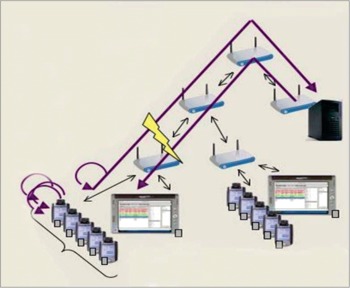
WIISARD Pathway—In the intervention WIISARD system, field responders were provided with WIISARD device applications connected to a wireless 802.11 mesh network. This network was established with multiple portable ruggedized, Linux-based Calmesh nodes deployed on-scene at the time of the exercise, formed a self-scaling, ad hoc network of wireless routers that could configure themselves into an expandable network (Figure 1). The WIISARD utilizes a client/server and publish/subscribe architecture with self-scaling features that reflect the present state of the art of system design previously described.Reference Arisoylu, Mishra, Rao and Lenert4–Reference Brown, Griswold, Demchak and Lenert5 Just prior to the start of the exercise, field providers assigned to the WIISARD pathway were given a 10-minute briefing on the devices to familiarize them with how to use and record data in the field once the exercise started. These devices included:
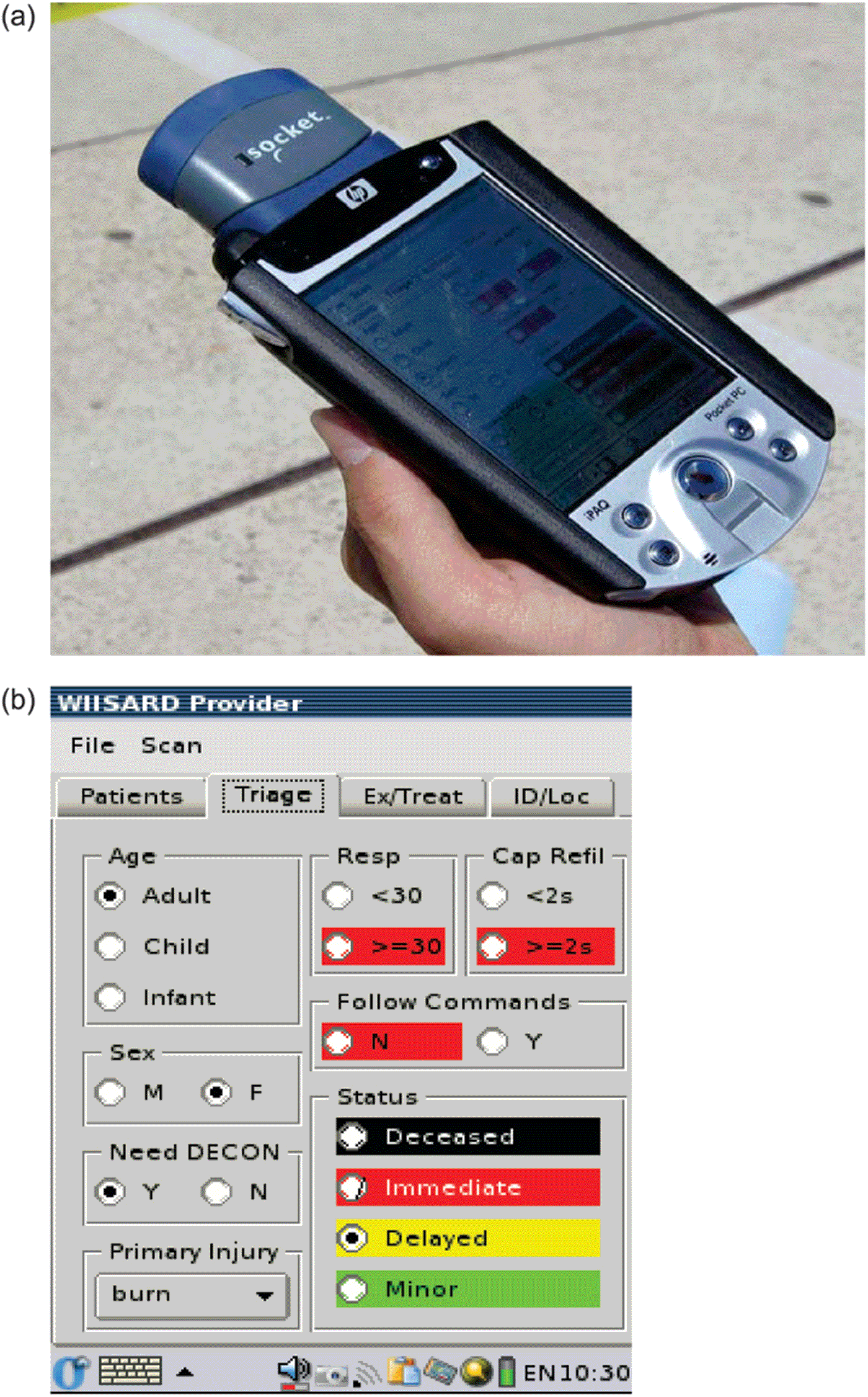
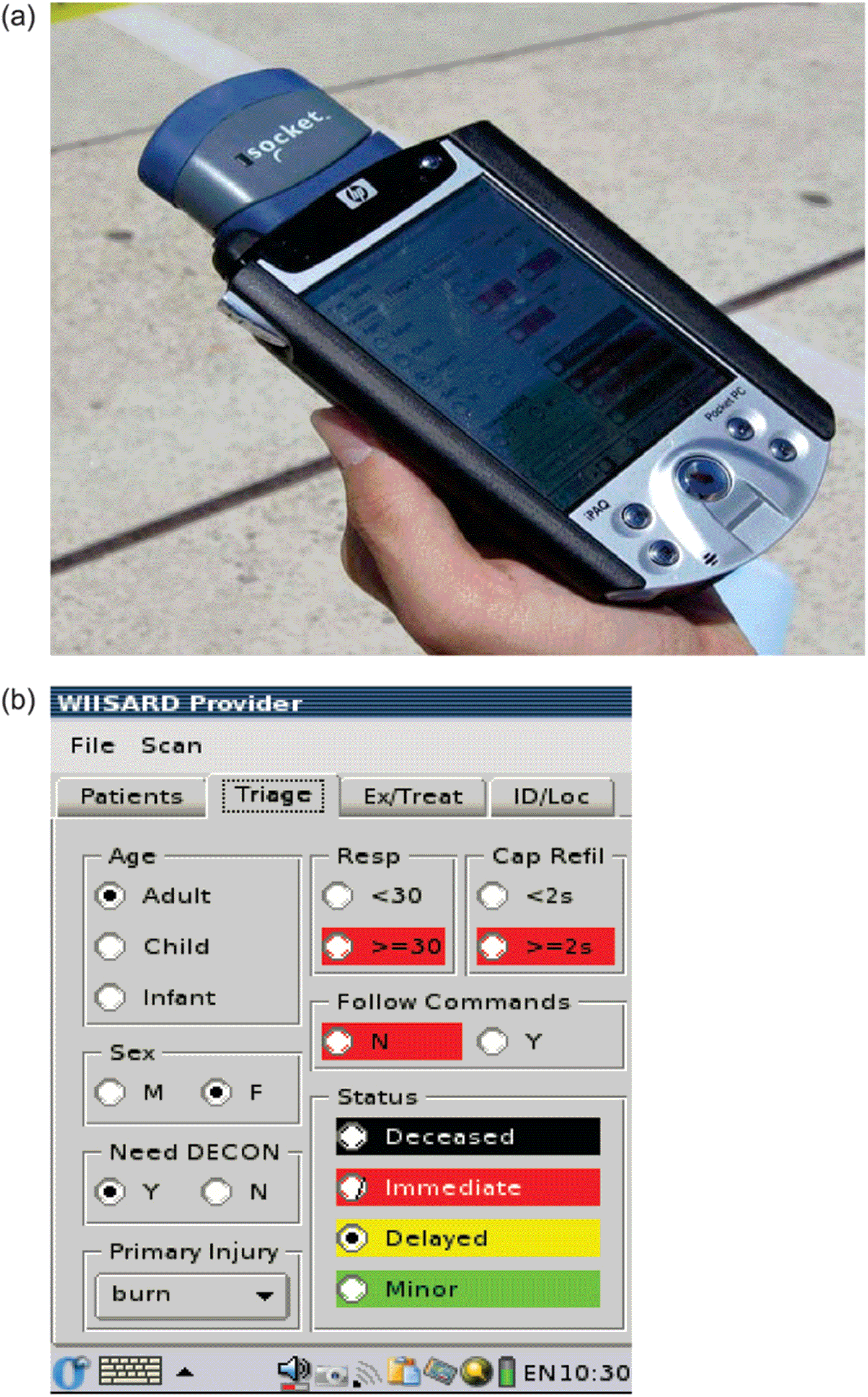
1 Field responder PDA Device—Field providers carried a hand-held, ruggedized Personal Digital Assistant (PDA) to record patient information including the Simple Triage And Rapid Treatment (START), vital signs, and medical interventions such as decontamination. The graphical user interfaces (GUIs) were designed to replicate current field documentation systems in a simplified format for ease of use. In addition, the software provided the ability to view all patients entered by the specific provider using a simple, quick tab button. The PDAs were equipped with scanning technology for rapid identification of patients using barcoded tags; intuitive, easy-to-use EHR software with bright screens for daylight visibility; and relatively long battery lives (4–6 hours; Figure 2).Reference Killeen, Chan, Buono, Griswold and Lenert6
Figure 1(Color online) WIISARD is built on a self-scaling, ad hoc group of deployable, portable, ruggedized, field wireless routers that can configure themselves into an expandable 802.11 mesh network in the field to support user devices.
 Figure 2
(Color online) (a) Field responder handheld personal digital assistant device; (b) START Graphical User’s Interface display
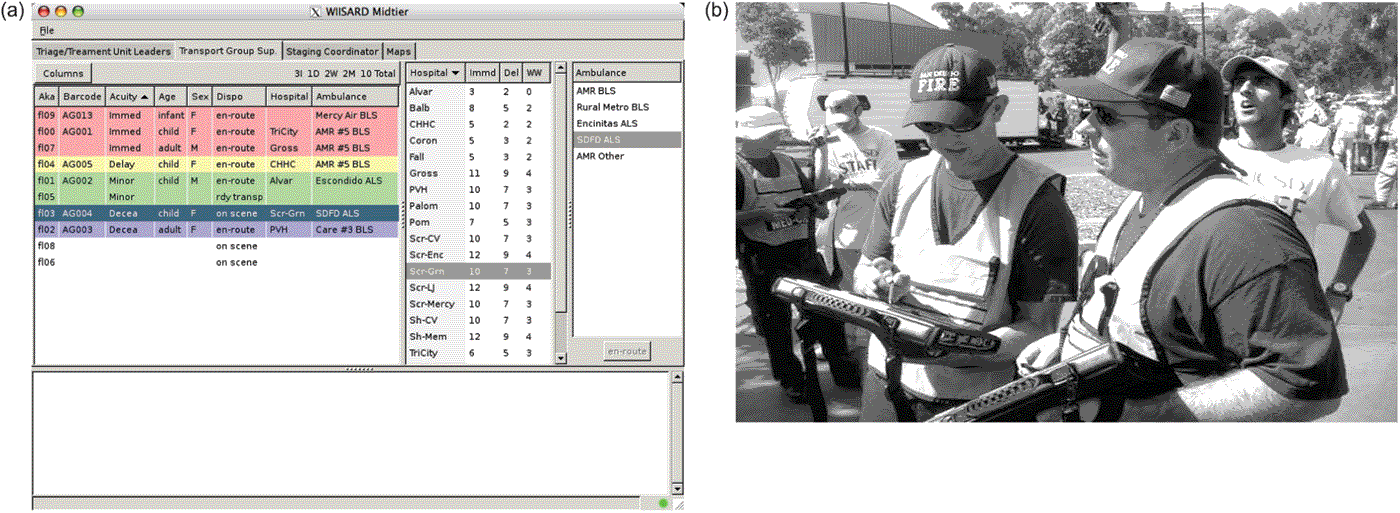
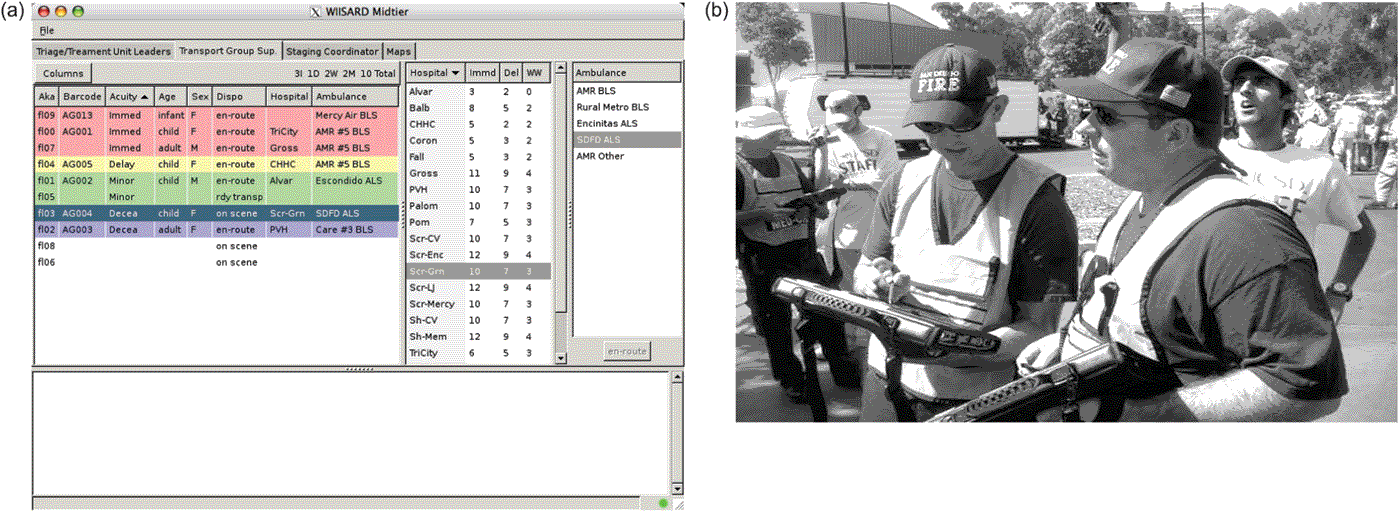
2 Mid-Tier, Supervisor, Tablet Device—Area supervisors who were responsible for the oversight of field victim triage, treatment, and transport stations were equipped with ruggedized wireless tablets connected to the WIISARD network in order to provide instantaneous data transfer, including patient lists, status, and tracking of victims from data recorded by the providers using their PDAs. The tablet GUIs were designed to provide maximum access to data on patients and resources. Patient lists were backlight by the color designating the acuity of the patient (green, yellow, red). Supervisors could sort patient lists electronically and instantaneously using any number of variables, including acuity, location, and destination. Custom software facilitated role-specific capabilities for each supervisor, such as the ability to assign patients to individual ambulances or to available hospital destinations. This information was distributed to other providers on the WIISARD network via the provider PDA or supervisor tablet devices. Each supervisor (triage, treatment, transport, etc.) could view another supervisor’s data easily via simple quick tab buttons (Figure 3).Reference Chan, Buono, Killeen, Griswold, Haung and Lenert7
Figure 3(Color online) (a) Mid-tier supervisor tablet device Graphical User Interface with acuity-based color-coded patient column, hospital resource column, and ambulance list column; (b) Mid-tier supervisor tablet device in use in the field during simulated exercise
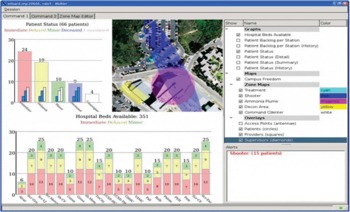
3 Command Center Laptop—Medical branch and scene managers at the incident command post had laptop computers linked to the WIISARD network, which provided a real-time, broad overview of patient information including numbers of victims, their acuity and location, on scene and available ambulances, as well as their status (en route, left the scene, number of victims in transport), and real-time hospital and emergency department bed availability and number of patients received. Hospital emergency department and base station staff had access to the network through their own desktop computers using secure Internet connection to the WIISARD server. Using this connection, hospitals were able to enter their bed status and the available resources, track patients assigned to their facility, and record arrival of victims to their respective location. This information was available to medical branch commanders at the incident command post (Figure 4).
Figure 4(Color online) Command center laptop Graphical User Interface demonstrating information regarding scene, patients, hospital resources


Control Pathway—In the traditional disaster medical response pathway, providers, supervisors, and commanders managed the incident through current, traditional disaster response practices. These practices included conventional paper patient disaster tags with pre-printed sections for documentating START and decontamination status on which providers could make additional notation; clipboards with paper log sheets for triage, treatment and transport supervisors to log and track patients once information was relayed by direct contact with other providers; or through standard radio communications and other paper notations regarding medical care and resources at the site maintained at the Incident command post by medical branch commanders.
Measurements
The use of WIISARD was compared with the conventional responses in terms of tracking of individual victims, recording of medical information, including START triage status, basic identification information, and treatment (including decontamination status and disposition) for each victim. The primary outcome measure was the proportion of victims with documentation of START acuity and its components (mental status, respiratory rate, capillary refill) for each pathway (electronic or paper). The secondary outcome measures were completeness of other medical information recorded, including basic identification information, decontamination status, and disposition (transporting ambulance unit, destination hospital). Additional measures were duration of victims on the field, as well as frequency of radio communications between providers.
For the WIISARD pathway, data were collected using a computer query of the electronic record database on the server used by the network. These data included patient identification, demographics, START triage acuity, and its components, decontamination status, and disposition as entered and recorded by providers. For the conventional pathway, data were abstracted by collecting all triage tags for any notations made providers, as well as all paper logs and forms on which providers, supervisors, and incident command personnel recorded any information regarding the victims, including their status, assessments, and disposition.
All victims for both pathways were outfitted with RFID wristbands during the exercise and RFID reader mats were placed at entry and exit paths of the field medical areas to track times victims entered and subsequently left these areas.
Data Analysis
For the primary outcome measure, data were processed to determine completeness of documentation of patient START acuity and its components. For the secondary outcome measures, similar processes were used to determine rates of completion and documentation of basic identification information (age, sex), decontamination status, disposition comparing the WIISARD database, and any documentation on either the triage tags or paper logs for the conventional pathway. Statistical operations used Fisher’s Exact Testing of proportions with differences and 95% confidence intervals reportedas appropriate (SPSS 17.0, SPSS Inc., Chicago IL).
Results
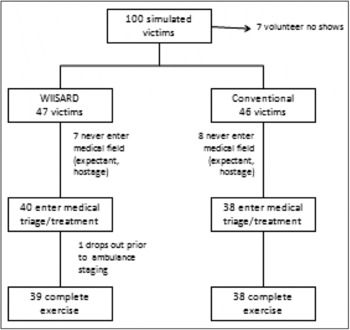
Of the 100 simulated victims at the incident scene, seven volunteers did not participate in the drill at the outset (three in WIISARD, four in conventional pathways). In addition, 15 victims never left the hot zone of the incident site because they were determined to be dead or expectant on scene or were taken hostage as part of the exercise (seven in WIISARD, eight in conventional pathways). Seventy-eight simulated victims entered medical triage, decontamination, and treatment zones at the incident site. One victim did drop out (on the WIISARD pathway) prior to entering ambulance staging for transport away from the site. Overall, 39 victims on the WIISARD pathway, and 38 on the conventional pathway completed the disaster exercise to ambulance transport off-scene (Figure 5).
Consort diagram of victim participation in simulated disaster exercise for both WIISARD and conventional pathways.

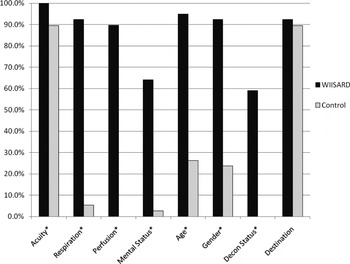
For the primary outcome measure, documentation of START acuity and its components, the WIISARD pathway performed better than did the conventional control pathway (Figure 6). For START documentation, level of acuity (minor, delayed, immediate) was documented in all of the WIISARD cases (100%), but only 34 of 38 (89.5%) conventional cases (difference = 10.5% [95%CI = 0.5–24.1%]). In terms of the components of START (respiration, perfusion, and mental status), WIISARD also outperformed the conventional pathway. Ventilatory rates were documented in 92.3% (36) compared to 5.3% (2) (difference = 87.0% [95%CI = 69.6–93.4%]), perfusion status (capillary refill) in 89.7% (35) compared to none (difference = 89.7% [95%CI = 73.6–95.9%]), and mental status (response to command) in 64.1% (25) compared to 2.6% (1) (difference = 61.5% [95%CI = 42.4–74.8%]) for WIISARD and conventional pathways, respectively.
Documentation of START triage (acuity, respirations, capillary refill, follows commands), identification information (age, gender) decontamination status, and disposition/destination.
*denotes statistically significant difference (p <0.05).

For the secondary outcome measures, improved documentation again was noted for WIISARD compared to the conventional pathway. For basic identification information, age was documented in 37 WIISARD victims (94.9%) versus 10 conventional victims (26.3%; difference = 68.6% [95%CI = 49.0–80.5%]); and gender was documented in 36 WIISARD cases (92.3%) versus nine conventional cases (23.7%; difference = 68.6% [95%CI = 48.6–80.4%]). For treatment, decontamination status was documented in 23 WIISARD victims (59.0%), but none of the conventional victims (difference = 59.0% [95%CI 40.9–72.9%]). Disposition (destination) was documented similarly for both groups (36 or 92.3% for WIISARD, 34 or 89.5% for conventional; difference = 2.8% [95%CI = -11.3–17.3%]) (Figure 6). Based on the RFID tracking of victims, there was no field time difference between WIISARD victims and conventional victims.
Discussion
Disasters are events that overwhelm a community’s emergency response and medical systems because of their magnitude, urgency, and intensity.Reference Aufderheide8,Reference Wenger, Quaranteill and Dynes9 In this setting, effective management and incident responses require rapidly available and widely accessible real-time information for moment-to-moment situational awareness on victims, providers, needs, and resources. Unfortunately, disaster and EMS providers often must respond and provide care under a setting fraught with inaccurate and unreliable information, damaged infrastructure, and hampered communications.
In this regard, the implementation of informatics solutions and information technology (IT) could have significant beneficial impact, but like IT in healthcare in general, adoption has been slow for a variety reasons, and faces a number of significant challenges.Reference Jha, Desroches, Campbell, Donelan, Rao, Ferris, Shields, Rosenbaium and Blumenthal10 These challenges include the ease of deployment (given the nature of the disaster field and potentially damaged infrastructure), provider acceptance and integration into current workflow patterns, cost of such systems in comparison to current paper-based systems, and the lack of evidence that such technologies actually make a difference in response capabilities.
It is difficult logistically to perform well-controlled experimental research at actual disasters due to the nature of such events. Large-scale exercises, however, provide an opportunity to plan and execute such studies under simulated conditions. It is in such settings that new technologies initially could be tested and deployed to assess robustness, capacity to integrate into workflows, acceptance by responders, and impact on overall effectiveness of responses.
The WIISARD project was funded by the NIH to investigate and research the role of advanced information technologies in disaster and emergency medical responses. WIISARD creates a rapidly deployable, mobile, ad hoc, scalable 802.11 mesh network at disaster sites. At the user end, WIISARD devices are imbedded within established workflows with role-tailored software and ease-of-use GUIs for the field responder providing direct patient care, mid-level supervisor responsible for the medical areas at the site, and the medical branch incident commander overseeing the entire incident. In this regard, data, such as numbers of patients and their conditions, number of ambulances, and available hospital beds, are widely available and shared among all providers in real-time, but also are organized in such a way as to meet the needs and responsibilities of the specific responder.
The results of this side-by-side comparison trial conducted during a large-scale training exercise indicate that IT can be deployed rapidly and adopted by field providers at the scene on short notice. Moreover, such technologies improve patient identification, tracking, and documentation, without creating greater delay or longer field times, and perhaps, resulting in less reliance on radio communications. In addition, the system was able to rapidly distribute real-time information not only within the field, but also to and from hospital emergency departments as to bed availability and patient destination assignments.
While WIISARD is an NIH-funded research project designed to study advanced technologies in emergency medical and disaster responses and not a vendor product, there now are a number of systems being tested and promoted for both military and commercial uses.Reference Gao and White11–15 These systems utilize similar wireless technologies to address the critical need to improve information management and distribution during emergency medical and disaster responses.
While it is reassuring and gratifying that others also believe advanced IT solutions can play a role in improving responses, it remains to be seen whether various challenges can be overcome in order to justify the widespread adoption of these systems for disaster medical responses. Technical challenges include whether such systems are sufficiently robust and reliable in disaster conditions where existing infrastructure may be damaged.
Other challenges include obstacles to responder workflow and adoption. Because such systems are designed for rare events, responders may not have the familiarity required to effectively use such systems in an actual mass casualty event. Some EMS agencies that have adopted disaster IT systems, now mandate their use periodically (e.g., one day per week) during standard, non-disaster, EMS responses in order to improve education and training, retention, and familiarity with the system on an on-going basis. Finally, new systems, particularly involving IT, can be quite expensive not only in regards to initial startup, but also ongoing operational maintenance. Emergency medical services agencies may consider such systems simply too costly to adopt and implement despite their potential benefits.
This study has a number of important limitations. First, the study was conducted during an exercise training drill and not an actual disaster. While these simulations attempt to have true fidelity, there are a number of artificialities, especially in regards to the level of disorganization and sequence of events that actually occur in real incidents. Studies have demonstrated that START triage performs quite differently during actual disasters with significant over-triage of patients (patients required less intensive medical care than was anticipated, based on initial triage categorization) .Reference Kahn, Schultz, Miller and Anderson16 Similarly, it is likely that the WIISARD would perform differently, potentially in terms of ease of user adoption and even reliability of the network architecture (particularly in the setting of infrastructure damage), which could affect the generalizability of the results to a true mass-casualty incident depending on the circumstances.
Second, the study involved a relatively small number of simulated patient victims in the comparison trial. Again, it is likely that both the WIISARD and control pathways would function very differently in the setting of hundreds of potential victims. What is concerning, however, is how poorly traditional paper systems performed in terms of tracking patients in a simulation with such low numbers. It is unlikely that this performance would improve in a setting with exponentially larger numbers of victims that might occur in a true disaster.
Third, the time duration of the incident and patient medical care in the field was compressed. Median time in the field medical areas of the incident was just under one hour for both the intervention and control pathways. It is unlikely that this short amount of time is truly reflective of what might occur if an actual sizeable mass-casualty incident were to occur as was simulated in this exercise.
Fourth, during the simulation, there was a small team of IT specialist to provide support in establishing and maintaining the wireless network architecture on site. The MMRS responders do not have personnel dedicated to IT capabilities, and the current Incident Command System (ICS), the most widely used command, control, and organizational model for emergency response in the US, does not specifically address advanced IT support.Reference Briggs17 It is unlikely that the WIISARD system could have been set up reliably without the additional technical support even for this simulated exercise.
Conclusions
In this side-by-side comparison at a large-scale disaster medical exercise, the advanced IT capabilities of WIISARD outperformed traditional paper systems in terms tracking and documentation of information on patient victims at the disaster site.
Acknowledgements
The authors thank San Diego County Metropolitan Medical Strike Team and County Emergency Medical Services agency for their participation in this study, and Edward Castillo, PhD, for his assistance with statistical data analysis.
Abbreviations:
EMS = emergency medical services
GUI = graphical user interface
MMRS = (US) Metropolitan Medical Response System
PDA = personal digital assistant
RFID = radio frequency identification
START = Simple Triage and Rapid Assessment
WIISARD = Wireless Internet Information System
This work was supported by Award Number R01LM009522 from the National Library of Medicine. The content is solely the responsibility of the authors and does not necessarily represent the official views of the National Library of Medicine or the National Institutes of Health.