Introduction
Nursing home residents experienced profound impacts from the COVID-19 pandemic, with rates of SARS-CoV-2 infection, hospitalization, and mortality frequently exceeding those observed in older adults in the general population. Reference Veronese, Koyanagi and Stangherlin1–Reference McMichael, Currie and Clark3 The inherent vulnerability of individuals of advanced age, combined with the communal living environment of nursing homes, facilitated the swift transmission of respiratory viruses such as SARS-CoV-2. Reference Bartleson, Radenkovic and Covarrubias4,Reference Ouslander and Grabowski5 Although the development of herd immunity and widespread vaccination efforts have contributed to a reduction in the overall burden of infection incidence over time, SARS-CoV-2 continues to be a significant source of morbidity and hospitalization among nursing home residents. Reference Franklin, Barbre and Rowe6
National surveillance data also demonstrated that surges in infections within nursing homes have similar trends to the infections within general population, as evidenced by the Centers for Disease Control and Prevention’s (CDC) National Healthcare Safety Network (NHSN). 7 A seasonal pattern of infection due to SARS-CoV-2 has emerged, characterized by peaks in incidence during the summer and winter months. 8 In the winter of 2021–2022, the Omicron BA.1 variant spread rapidly due to its enhanced transmissibility, infectivity, and immune evasion compared to previous variants, resulting in a wave of COVID-19 with daily case rates soaring to all-time records in the United States. Reference Mohsin and Mahmud9,Reference Ma, Shirk and Lambrou10 This wave provides a setting in which to investigate factors that might be associated with improved mitigation strategies and reduced adverse outcomes in residents. A clustering method called kmlShape can be used to cluster facility-level epidemic curves (epi-curves) based on the shape of trajectories in order to identify facilities with high levels of virus transmission. Reference Genolini, Ecochard and Benghezal11
During the COVID-19 pandemic, nursing homes implemented preventive measures and adjusted care to reduce transmission of respiratory viruses. Reference Ouslander and Grabowski5,12 However, there may be overall facility-level characteristics of nursing home facilities that are also associated with COVID-19 incidence. This study uses a novel clustering method and national surveillance data from the NHSN to explore facility-level characteristics potentially associated with surges of SARS-CoV-2 infection during the predominance of Omicron BA.1 transmission. Understanding facility-level characteristics associated with epi-curve clustering may help implementation of tailored approaches to infection prevention and control ahead of future surges of infection incidence. Reference Barnett and Grabowski13
Methods
Data sources
The CDC’s NHSN is a cloud-based surveillance system that is used to monitor healthcare-associated infections in the United States. Reference Horan, Andrus and Dudeck14 During the COVID-19 Public Health Emergency, nursing homes certified by the Centers for Medicare and Medicaid Services (CMS) were required to report weekly aggregate data concerning COVID-19 vaccination and infection among residents to NHSN from May 13, 2021, until May 11, 2023. 15 During this period, nursing homes were required to report the weekly number of incident SARS-CoV-2 infections among residents, the number of residents who were up to date with COVID-19 vaccinations, and the total number of residents in the facility. NHSN defines an incident case of SARS-CoV-2 infection as a newly positive, laboratory-confirmed SARS-CoV-2 viral test result in a resident living in a nursing home. 16 NHSN recognizes positive test results from both molecular (eg, nucleic acid amplification testing) and antigen tests for diagnosing active COVID-19 infection. 17 Based on recommendations from the Advisory Committee on Immunization Practices (ACIP) during the winter of 2021–2022, up-to-date COVID-19 vaccination among residents was defined as receipt of a complete COVID-19 primary series and at least one booster dose. Reference Mbaeyi, Oliver and Collins18
Characteristics of nursing homes were obtained from the CMS provider data catalog, an official CMS open data source available to the public. 19 The following facility characteristics were used for analysis: (i) facility ownership type (non-profit vs for-profit), with for-profit nursing homes being owned by individuals, private corporations, limited liability companies, and partnerships and non-profit nursing homes being owned by governmental organizations, non-profit corporations, and religious organizations; (ii) provider government-based insurance accepted (Medicare, Medicaid, and Dual: Medicaid and Medicare); (iii) facility size tertiles defined by the number of certified beds (small (<82 beds), medium (82–120 beds), large (>120 beds)); and (iv) staff turnover tertiles (low, medium, high). Staff turnover was calculated as the number of eligible employees who stopped working at the nursing home divided by the total number of eligible employees over a period of time. Higher percentage represents higher turnover at the nursing home. 20 The following geographical characteristics were derived based on nursing home address: (i) region (Northeast, Mountain, Midwest, Pacific, South), (ii) urbanicity (large central metro, large fringe metro, medium metro, small metro, micropolitan, noncore), (iii) social vulnerability index (facilities located in areas with a low SVI are less socially vulnerable than those located in areas with a high SVI). Reference Ingram and Franco21,22 The CMS provider data catalog and the characteristics derived based on facility address were merged with NHSN COVID-19 case and infection data for analysis.
Inclusion criteria
To establish the Omicron BA.1 variant predominance period, we applied CDC’s SARS-CoV-2 variant genomic surveillance data with a threshold of 50% estimated variant proportion share, revealing a 13-week predominance period for SARS-CoV-2 Omicron BA.1 (“Omicron wave”) beginning on December 20, 2021, and ending on March 20, 2022, Reference Ma, Shirk and Lambrou10 which was used as the study period. Within this period, 14,003 CMS-certified nursing homes reported COVID-19 vaccination and infection for residents weekly to NHSN. Facilities with less than 5 residents (n = 45) and facilities with missing data for any facility-level characteristic (n = 1968) were excluded from the analysis. A total of 11,990 nursing homes were included in the study.
Statistical analyses
A longitudinal k-means (KML) algorithm called kmlShape was used to classify nursing homes based on each facility’s weekly SARS-CoV-2 incidence rate. The kmlShape method is a variation of the classic K-means algorithm designed to analyze inherent shapes within complex time-series data. It groups trajectories based on the overall shape of their curves, effectively clustering trajectories that exhibit similar patterns. Reference Genolini, Ecochard and Benghezal11 The weekly SARS-CoV-2 case incidence rate was calculated as the number of incident cases reported, divided by the number of residents in the facility. The kmlShape algorithm determined distances between individual facility epi-curve shapes and representative facilities selected by the kmlShape algorithm. A representative facility selected by the algorithm represents multiple facilities with similar epi-curves. Based on the sample size included in the study, a total of 2000 representative facilities were selected by kmlShape algorithm and used in these analyses. Reference Genolini, Ecochard and Benghezal11 Using kmlShape analysis, facilities were classified into two categories based on the magnitude of their infection peaks during the Omicron BA.1 wave. Category labels (eg, low vs high peak groups) were assigned based on the result of kmlShape procedure outcome figure illustrating category memberships of 2,000 representative facilities and mean trajectory of each of the two categories (Figure 1).
Low versus high cluster memberships of representative nursing homes during the Omicron BA.1 variant predominance period, National Healthcare Safety Network, December 20, 2021–March 20, 2022a. a. A total of 2000 representative nursing home facilities were selected by kmlShape algorithm, with 76% representative facilities (senators) were classified as having a low infection peak, and 24% representative facilities were classified as having a high infection peak.

Figure 1 Long description
Two line graphs compare SARS-CoV-2 infection rates during the Omicron variant BA.1 wave in low peak and high peak facilities. Panel A: The left graph shows the infection rate in low peak facilities. The x-axis represents the week, ranging from 1 to 13. The y-axis represents the infection rate per 1,000 resident-weeks, ranging from 0 to 1000. The graph shows a relatively stable infection rate with a slight peak around week 6. Panel B: The right graph shows the infection rate in high peak facilities. The x-axis represents the week, ranging from 1 to 13. The y-axis represents the infection rate per 1,000 resident-weeks, ranging from 0 to 1000. The graph shows a significant peak around week 6, with infection rates reaching higher values compared to low peak facilities.
Logistic regression was used to examine the factors (eg, geographic characteristics, facility characteristics, and average weekly up-to-date COVID-19 vaccination rate) associated with nursing homes experiencing a more substantial COVID-19-related surge, as identified by a high versus low peak SARS-CoV-2 infection rate among residents. To account for uncertainty and potentially increase the external validity of the classification process, data were bootstrapped by facility. A total of 10,000 resamples were generated and utilized to obtain 95% bootstrap confidence intervals (BCI) for the odds ratios. All analyses were done using R 4.3.1. and SAS 9.4.
Results
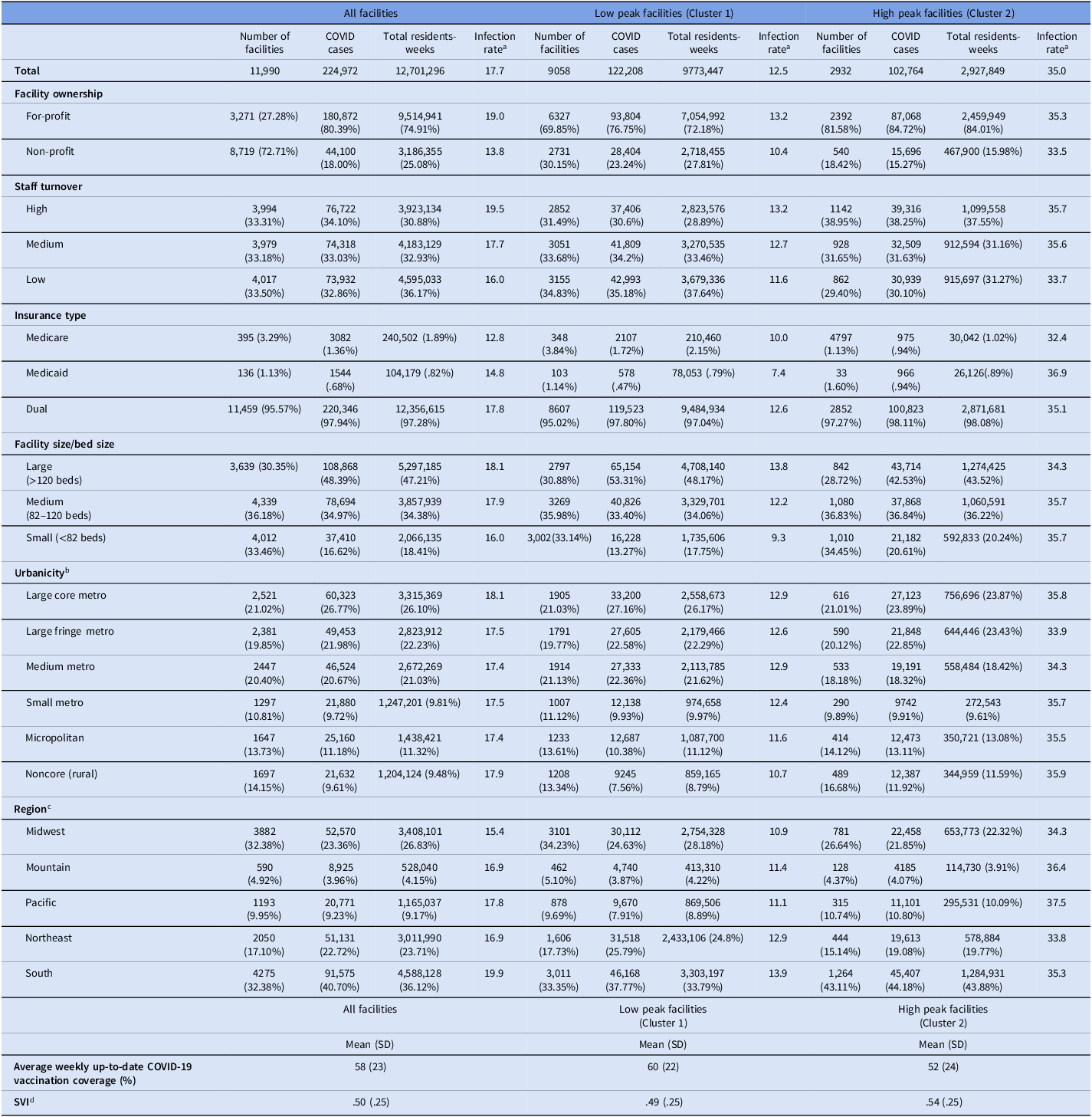
The overall pooled SARS-CoV-2 infection rate among 11,990 nursing homes from December 20, 2021, to March 20, 2022, was 17.7 per 1000 resident-weeks. A total of 9058 nursing homes were classified as having low infection peak, and 2932 were classified as having a high infection peak (Figure 1). The pooled infection rate among facilities with a low infection peak was 12.5 per 1000 resident-weeks, whereas the rate among facilities with a high infection peak was 35.0 per 1000 resident-weeks (Table 1).
Overall and stratified SARS-Cov-2 infection rates by low and high infection clustering memberships and facility-level factors among nursing homes residents during Omicron BA.1 variant predominance period, National Healthcare Safety Network, December 20, 2021–March 20, 2022

a Pooled weekly SARS-Cov-2 infection rate per 1000 residents.
b 2013 NCHS Urban-Rural Classification Scheme for Counties https://www.cdc.gov/nchs/data-analysis-tools/urban-rural.html.
c Midwest: Illinois, Indiana, Iowa, Kansas, Michigan, Minnesota, Missouri, Nebraska, North Dakota, Ohio, South Dakota, and Wisconsin; Mountain: Colorado, Idaho, Montana, Nevada, Utah, and Wyoming; Northeast: Connecticut, Maine, Massachusetts, New Hampshire, New Jersey, New York, Pennsylvania, Rhode Island, and Vermont; Pacific: Alaska, California, Hawaii, Oregon, and Washington; South: Alabama, Arizona, Arkansas, Delaware, Florida, Georgia, Kentucky, Louisiana, Maryland, Mississippi, New Mexico, North Carolina, Oklahoma, South Carolina, Tennessee, Texas, Virginia, and West Virginia.
d Social Vulnerability Index https://www.atsdr.cdc.gov/placeandhealth/svi/index.html.
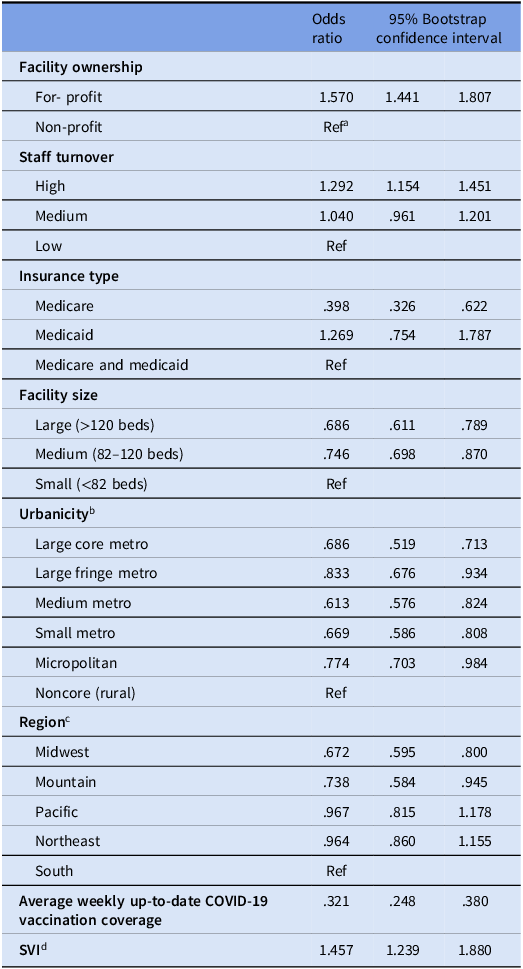
Table 2 presents the logistic regression model results examining facility-level factors associated with nursing homes experiencing a larger COVID-19-related surge during the study time frame, as identified by a high versus low peak SARS-CoV-2 infection rate among residents. Facilities were more likely to have a high infection peak if they were for-profit compared to nonprofit (OR = 1.570, 95% BCI 1.441–1.807) and if they had high compared to low staff turnover (OR = 1.292, 95% BCI 1.154–1.451). Additionally, facilities in more socially vulnerable areas were more likely to have a high infection peak (OR = 1.457, 95% BCI 1.239–1.880). Facilities were less likely to have a high infection peak if they accepted only Medicare compared to dual insurance (both Medicaid and Medicare) (OR = .398, 95% BCI .326–.622) and were located outside of, compared to, in Noncore (rural) counties. Compared to small facilities, medium-sized (OR = .746, 95% BCI .698–.870) and large facilities (OR = .686, 95% BCI .611–.789) were less likely to have a high infection peak. Facilities with higher average weekly up-to-date COVID-19 residents’ vaccination coverage were less likely to have a high infection peak (OR = .321, 95% BCI .248–.380).
Logistic regression results examining facility-level factors associated with nursing homes experiencing a high peak of SARS-CoV-2 infection rate among residents during Omicron BA.1 variant predominance period, National Healthcare Safety Network, December 20, 2021-March 20, 2022

a This category serves as the reference group in the logistic regression model.
b 2013 NCHS Urban-Rural Classification Scheme for Counties https://www.cdc.gov/nchs/data-analysis-tools/urban-rural.html.
c Midwest: Illinois, Indiana, Iowa, Kansas, Michigan, Minnesota, Missouri, Nebraska, North Dakota, Ohio, South Dakota, and Wisconsin; Mountain: Colorado, Idaho, Montana, Nevada, Utah, and Wyoming; Northeast: Connecticut, Maine, Massachusetts, New Hampshire, New Jersey, New York, Pennsylvania, Rhode Island, and Vermont; Pacific: Alaska, California, Hawaii, Oregon, and Washington; South: Alabama, Arizona, Arkansas, Delaware, Florida, Georgia, Kentucky, Louisiana, Maryland, Mississippi, New Mexico, North Carolina, Oklahoma, South Carolina, Tennessee, Texas, Virginia, and West Virginia.
d Social Vulnerability Index https://www.atsdr.cdc.gov/placeandhealth/svi/index.html.
Discussion
Findings from this study underscore the importance of a nursing home’s structural and environmental context in relation to the epidemiology of COVID-19. The facility characteristics associated with high SARS-CoV-2 infection peaks include modifiable and non-modifiable factors that should be evaluated before any respiratory virus season, such as facilities located in socially vulnerable areas and those that experience high staff turnover. These factors might be indicators of lower resiliency, affecting the ability of nursing home staff and systems to mitigate stress induced by high infection rates among residents.
A higher likelihood of experiencing a peak in infections was observed in for-profit nursing homes, as well as in those with higher staff turnover rates. Current literature suggests that low staffing levels may be associated with higher turnover due to added work burden, which may also lead to limited infection prevention practice. Reference Stall, Jones and Brown23–Reference Loomer, Grabowski and Yu24 For-profit nursing homes have been reported to be more likely to experience staffing shortages and high turnover rates, factors that may contribute to COVID-19 outbreaks by increasing the risk of transmission and impeding effective infection control measures. Reference Skinner, Yu and Unruh25–Reference Zheng, Williams and Shulman26 These findings demonstrate a need for establishing innovative strategies to retain staff and maintain a consistent workforce within the nursing home to limit virus transmissions. In addition, the likelihood of a low infection peak in facilities accepting Medicare compared with facilities accepting both Medicare and Medicaid corroborates findings from other studies, indicating that nursing homes that rely heavily on Medicaid may have lower quality of care due to lower reimbursement rates, financial strain, low staffing, and limited resources. Reference Mor, Zinn and Angelelli27 This suggests that the level of insurer reimbursement may influence infection prevention and control efforts in nursing homes, as it is associated with adequate funding for staffing, supplies, and resident care. Reference Grabowski, Angelelli and Mor28
Nursing homes located in rural and socially vulnerable areas were also found to have a higher likelihood of infection peaks. The general population in rural counties is particularly vulnerable to COVID-19, as these areas tend to have a larger proportion of older adults and health-compromised individuals, fewer physicians, limited mental health services, higher rates of disability, and fewer insured residents. Reference Peters29 These characteristics overlap with the SVI, which was developed to identify geographic areas that might need support during disasters. Reference Ingram and Franco21 Communities with a high overall vulnerability are more likely to be adversely affected by a disaster event, such as the COVID-19 pandemic. This also underscores the significance of contextual factors in evaluating the transmission of SARS-CoV-2 infections in nursing homes and in mitigating adverse events related to healthcare stress. Reference Wong, Ponder and Melix30
Vaccination against SARS-CoV-2 helps to reduce severe outcomes, particularly among residents who remain up to date with recommended vaccines. Reference Stirrup, Shrotri and Adams31 COVID-19 vaccinations have demonstrated significant effectiveness in reducing severe illness and hospitalization rates. Reference Stirrup, Shrotri and Adams31 As of December 2024, ACIP recommends both up-to-date COVID-19 vaccination coverage and additional doses in adults aged 65 and older and who are moderately to severely immunocompromised. Reference Roper, Godfrey and Link-Gelles32 Up-to-date COVID-19 vaccination coverage among residents and additional doses will continue to be an important factor in reducing the magnitude of future infection curves among nursing home residents. Reference Roper, Godfrey and Link-Gelles32
We selected the kmlShape algorithm to partition epi-curves with a goal of identifying facilities with high virus transmission. This algorithm is preferable to other longitudinal k-means algorithms when handling complex and irregular time-series data such as epi-curves of the respiratory virus transmission because the kmlShape method uses shape-respecting distance (a generalized variation of Fréchet distance) and shape-respecting means to effectively measure similarity between two curves by considering their continuous shape and alignment. Reference Genolini, Ecochard and Benghezal11 We used two clusters (k = 2) to allow for low-peak/high-peak clustering, enabling an exploratory analysis of facility-level factors potentially associated with high-level virus transmission peaks. Future studies may also provide in-depth examination of associations and interactions among these facility-level factors.
In addition, clustering analysis is sensitive to the initial cluster selected, resulting in slightly different results in every iteration. The results presented in Table 1, Figure 1, and the odds ratios shown in Table 2 were all derived from a single clustering iteration. To account for randomness in facility clustering, we employed a bootstrap method with 10,000 iterations to obtain 95% BCIs (Table 2) for the odds ratios of each factor included in the logistic regression model. This approach enhanced the robustness of our results and reduced the influence of outliers on facility clustering. However, incorporating a bootstrap method to improve the performance of the kmlShape algorithm can substantially increase computational time, which may limit the feasibility of applying kmlShape in resource-constrained computational environments.
Overall, this study serves as a novel application of a specialized longitudinal clustering method to cluster epi-curves based on the shapes of viral transmission waves. Future studies may build on these findings by exploring and employing other alternative clustering algorithms and parameter optimization strategies to further examine disease transmission patterns.
This study has a few other limitations. Nursing homes reported COVID-19 case and vaccination data directly to NHSN. Therefore, the data might reflect delays in reporting and other inaccuracies that would impact the representation of epi-curves for individual facilities. In addition, only CMS-certified nursing homes reported to NHSN and were included in the present study. These findings may not be generalizable to non-CMS-certified nursing homes. Last, because NHSN data are aggregated to the facility level, this study focused on facility-level factors and could not account for resident-level factors that could be associated with transmission of viruses, such as residents’ general health status, co-morbidities, age, and overall functional ability. Future studies could expand on our results by investigating other infection prevention measures such as the usage of personal protective equipment, enhanced barrier precautions, and implementation of environmental barriers, masking, and social distancing. Reference Murthy, Hanrahan and Advani33
Conclusions
The characteristics of a nursing home, such as the insurance coverage among residents and the social and geographic context of its location, were important factors associated with the magnitude of infection rates during a period of high transmission of SARS-CoV-2. These findings can be utilized to evaluate the resilience of nursing homes and their capacity to endure stressors that necessitate swift adaptation. Strategies should be developed to reduce attrition among staff, increase resources to strengthen infection control practices, improve resident access to preventive services, and promote the social well-being of communities.
Competing interests
We have no conflict of interest to declare.
Disclaimer
The findings and conclusions in this report are those of the authors and do not necessarily represent the official position of the U.S. Government, including the U.S. Centers for Disease Control and Prevention and the U.S. Department of State.