Introduction
Population genetic analyses using molecular markers have contributed to the elucidation of the population structure and history of agricultural pests (e.g. Pashley, Reference Pashley, Loxdale and Claridge1989; Zhang & Hewitt, Reference Zhang, Hewitt, Symondson and Liddell1996; Vialatte et al., Reference Vialatte, Dedryver, Simon, Galman and Plantegenest2005; Toda & Murai, Reference Toda and Murai2007). They sometimes unveil unexpected patterns of genetic diversity which may be relevant to the control of pest populations. For example, the European corn borer, Ostrinia nubilalis (Lepidoptera: Crambidae), has long been treated as a single polyphagous species. However, population genetic analyses using allozyme polymorphisms (Bourguet et al., Reference Bourguet, Bethenod, Trouvé and Viard2000; Martel et al., Reference Martel, Réjasse, Rousset, Bethenod and Bourguet2003) marked the beginning of a series of studies which revealed that O. nubilalis populations infesting maize Zea mays (Poaceae) and those infesting mugwort (Artemisia vulgaris, Asteraceae)/hop (Humulus lupulus, Cannabaceae) in France represent reproductively isolated host races (Bethenod et al., Reference Bethenod, Thomas, Rousset, Frerot, Pélozuelo, Genestier and Bourguet2005; Malausa et al., Reference Malausa, Bethenod, Bontemps, Bourguet, Cornuet and Ponsard2005; Leniaud et al., Reference Leniaud, Audiot, Bourguet, Frerot, Genestier, Lee, Malausa, Le Pallec, Souqual and Ponsard2006).
The Asian corn borer, O. furnacalis (Lepidoptera: Crambidae), is the Asian counterpart of O. nubilalis, in that it is a serious pest of maize. The Asian corn borer is distributed widely from East Asia to eastern Australia (Mutuura & Munroe, Reference Mutuura and Munroe1970). Among Ostrinia species inhabiting East Asia, O. furnacalis is the only one that uses plants of Poaceae as major host plants. While maize is very preferred, O. furnacalis larvae are polyphagous. Hattori & Mutuura (Reference Hattori and Mutuura1987) listed 17 species across eight families as the host plant of O. furnacalis. Preferred hosts seem to be not only maize but also sorghum Sorghum bicolor (Poaceae), ginger Zingiber officinale (Zingiberaceae), docks Rumex spp. (Polygonaceae), cockleburs Xanthium spp. (Asteraceae) (Ishikawa et al., Reference Ishikawa, Takanashi, Kim, Hoshizaki, Tatsuki and Huang1999; the authors' observation). In spite of its agricultural importance, wide geographical distribution and wide spectrum of host plants, there have been few studies of the genetic variation in O. furnacalis. Wang et al. (Reference Wang, Yan, Li and Li1995) examined the allozyme polymorphism of O. furnacalis inhabiting China and found that the local populations examined were genetically very similar. In Japan, no studies on genetic variation in O. furnacalis using molecular markers have been made; however, Huang et al. (Reference Huang, Takanashi, Hoshizaki, Tatsuki, Honda, Yoshiyasu and Ishikawa1998) reported a slight variation in the female sex pheromone among four local populations in Japan. Although the relevance of this finding to the population structure of O. furnacalis is not readily clear, it tempted us to speculate that Japanese populations of O. furnacalis are not genetically uniform.
Protein-coding regions of mitochondrial DNA (mtDNA) have been frequently used to study the population structure and history of animal species (Avise, Reference Avise1994, Reference Avise2000). The present study aimed to examine the population structure and history of O. furnacalis in Japan, using an mtDNA region encoding cytochrome oxidase II (COII). We estimated the genealogy of the COII gene and examined whether a particular mtDNA lineage is associated with a particular geographical region. We made an attempt to infer the population-demographic history of O. furnacalis, paying particular attention to molecular evidence for population growth. Two preliminary examinations of the COII sequence polymorphism were also made: (i) a comparison among Japan, the Philippines and China; and (ii) a comparison among insects infesting different plant species.
Material and methods
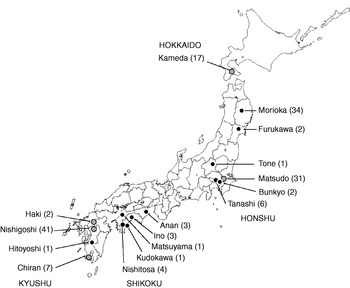
In Japan, 156 insects were collected at 16 localities covering the four main islands: Kameda (Hokkaido island); Morioka, Furukawa, Tone, Matsudo, Tanashi and Bunkyo (Honshu island); Anan, Ino, Kubokawa, Nishitosa and Matsuyama (Shikoku island); and Haki, Nishigoshi, Hitoyoshi and Chiran (Kyushu island) (fig. 1). More than 16 insects each were collected at Kameda, Morioka, Matsudo and Nishigoshi, while 1–7 insects were collected at the other 12 localities. We also included one COII sequence of an insect collected at Matsudo from a previous study (Kim et al., Reference Kim, Hoshizaki, Huang, Tatsuki and Ishikawa1999). A majority of the insects were collected as larvae in stems of plants (Z. mays, n=94; Panicum miliaceum, Poaceae, n=1; Sorghum vulgare, Poaceae, n=10; Xanthium spp., n=11; Bidens biternata, Asteraceae, n=1; Rumex sp., n=2; Z. officinale, n=2) and reared to adulthood in the laboratory. These larvae were mostly fed with plant stems which the larvae infested in the field. When feral adults were collected, they or their progeny were used. Seven Chinese individuals of O. furnacalis were obtained from a laboratory colony founded from insects collected at Gaoling County, Shanxi Province. Three feral larvae were obtained from stems of Z. mays in the Philippines.
The distribution of O. furnacalis mitochondrial lineages in Japan. Solid and shaded circles indicate collection localities where only lineage A was found and where both lineages A and B were found, respectively. Numbers of insects examined are shown in parentheses.

Genomic DNA was extracted from either whole bodies, legs or ovaries of single moths, following the method of Milligan (Reference Milligan and Hoelzel1992) with a few modifications. Single whole bodies were ground in a mixture of 300 μl of 2×CTAB buffer (100 mM Tris–HCl, pH 8.0; 1.4 M NaCl; 20 mM DTA; 2% hexadecyltrimethylammonium bromide (CTAB)), 1 μl of 2-mercaptoethanol, 0.75 μl of RNase A (10 mg ml−1) and 1.5 μl of Proteinase K (20 mg ml−1). When legs or ovaries were used, volumes of the solutions were reduced 1/3- and 1/6-fold, respectively. The homogenates were incubated at 55°C for two hours and extracted successively with chloroform, phenol/chloroform (1:1) and chloroform. A DNA pellet obtained by isopropanol precipitation was dissolved in 200 μl of TE buffer (10 mM Tris–HCl, pH 8.0; 1 mM EDTA).
A mtDNA fragment containing the COII gene was amplified by the polymerase chain reaction (PCR). The thermal profile of the PCR was 94°C for 5 min, 32 cycles of 94°C for 36 s, 47°C for 1 min, and 70°C for 2 min and, finally, 70°C for 7 min. Four primers were used for the amplification and the sequencing reaction: an external forward primer O–tLEU (Kim et al., Reference Kim, Hoshizaki, Huang, Tatsuki and Ishikawa1999: 5′–TAGTGCAATGGATTTAAACC–3′); an external reverse primer B–tLYS (Liu & Beckenbach, Reference Liu and Beckenbach1992: 5′–GTTTAAGAGACCAGTACTTG–3′); an internal forward primer COII–L3 (5′–GATATTGAAGTTACGAATATTCAG–3′); and an internal reverse primer COII–R3 (5′–CATTTATAGGGGTTATATAAGAATC–3′). The PCR products were purified from agarose gels using a Gene Clean III kit (BIO101, California) and directly sequenced using a Dye Terminator Sequencing FS Ready Reaction Kit or BigDye Terminator Cycle Sequencing Ready Reaction Kit (PE Biosystems). The sequence products were analyzed on an automated sequencer (ABI prism 377, PE Biosystems).
Sequences were aligned using Clustal W (Thompson et al., Reference Thompson, Higgins and Gibson1994). An unrooted network of COII haplotypes was constructed by a statistical parsimony approach (Templeton et al., Reference Templeton, Crandall and Sing1992) using the software TCS 1.13 (Clement et al., Reference Clement, Posada and Crandall2000), where connections for haplotypes that differed by up to eleven mutations were verified with 95% confidence (Templeton et al., Reference Templeton, Crandall and Sing1992).
Nucleotide diversity (π) and haplotype diversity (h) were estimated, together with standard deviations, according to Nei (Reference Nei1987). Tajima's D statistic was used to test the neutrality of evolution of the COII sequence (Tajima, Reference Tajima1989); in general, neutrality tests are sensitive to historical changes in population size as well as to non-neutral molecular evolution (Aris-Brosou & Excoffier, Reference Aris-Brosou and Excoffier1996). A test of F s detects an excess of rare haplotypes in a growing population as compared with the number expected in a population of constant size; a large negative value of F s indicates an excess of recent mutations and rejects a historical stasis of population size (Fu, Reference Fu1997). The statistical significance of F s was assessed by generating an empirical distribution of F s using a computer simulation program in DnaSP. These population genetic calculations were performed using DnaSP ver. 3.53 (Rozas & Rozas, Reference Rozas and Rozas1999). The distribution of the number of pairwise differences in the nucleotide sequence (the mismatch distribution) typically becomes multimodal in a large stable population; but a bottleneck and a subsequent expansion of a population, and a selective sweep on the mtDNA, would produce a Poisson-like mismatch-distribution (Slatkin & Hudson, Reference Slatkin and Hudson1991; Rogers & Harpending, Reference Rogers and Harpending1992). The mismatch distribution was computed, and the demographic model of a sudden population expansion was fitted to follow Schneider & Excoffier (Reference Schneider and Excoffier1999) using Arlequin ver. 3.11 (Excoffier et al., Reference Excoffier, Laval and Schneider2005). The goodness-of-fit of the demographic model was statistically tested using the sum of squared deviations (SSD) with 10,000 bootstrap samples.
In Japan, a small portion of O. furnacalis females are infected with a strain of Wolbachia that causes the production of all-female progeny through male-killing (Sakamoto et al., Reference Sakamoto, Kageyama, Hoshizaki and Ishikawa2007; see also Kageyama & Traut, Reference Kageyama and Trout2004). A Wolbachia infection may affect the mtDNA polymorphism of a host insect (Johnstone & Hurst, Reference Johnstone and Hurst1996; Ballard, Reference Ballard2000); however, an examination of this effect is beyond the scope of the present study. To focus on uninfected individuals of O. furnacalis, we paid attention to two points. First, 125 of 167 insects used in this study were males; we used many more males than females because Wolbachia infections in O. furnacalis males have not been found. Second, we confirmed that all the samples used in this study were uninfected with Wolbachia by conducting a diagnostic PCR assay (Kageyama et al., Reference Kageyama, Nishimura, Hoshizaki and Ishikawa2002; S. Hoshizaki, personal observation).
Results
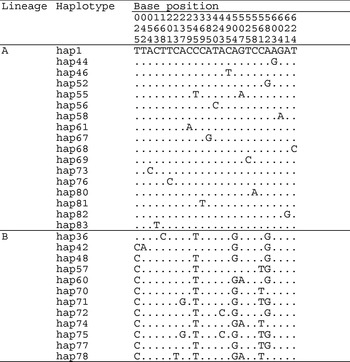
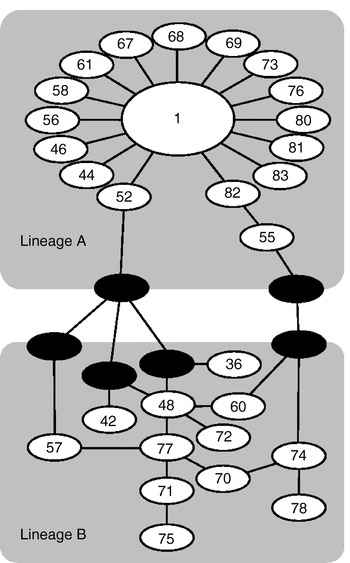
Nucleotide sequences of the COII gene (682 bp) in 166 insects (DDBJ/GENBANK/EMBL accession numbers AB029538, AB121251–121272, AB127196–127285 and AB127287–127339) revealed 24 variable nucleotide sites and were compiled into 29 unique haplotypes (fig. 2). In the parsimonious network (fig. 3), the 29 haplotypes were separated into two lineages (A and B). There were at least three nucleotide differences between haplotypes of lineages A and B. The network for lineage A had a shallow, star-like structure with hap. 1 at the center (interior haplotype), and the other haplotypes positioned around it (tip haplotypes). In contrast, lineage B showed a complex pattern of haplotype–haplotype connections.
Variable sites of the mitochondrial COII gene in O. furnacalis. Identity with the first sequence is denoted by a dot. Haplotypes are uniquely numbered together with sequences of other Ostrinia species examined in the authors' laboratory. Therefore, the O. furnacalis haplotypes are not consecutively numbered.

A parsimonious network illustrating the phylogenetic relationships among the 29 COII haplotypes (fig. 2) in O. furnacalis. Each line connecting two ovals corresponds to one nucleotide substitution. Black ovals are hypothetical haplotypes that were not found in the present samples.

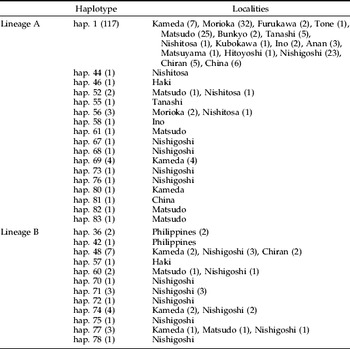
Haplotypes of lineage A were represented by 139 insects (table 1). Lineage A was found at all the collection localities in Japan and China, but was not found in the Philippines (fig. 1). The internal haplotype of lineage A was overwhelmingly dominant; it was found at 15 of 16 Japanese localities (table 1). The tip haplotypes of lineage A were found in small numbers. No clear patterns of geographical differentiation within lineage A were found.
Geographical distribution of COII haplotypes in O. furnacalis.

Numbers of insects are shown in parentheses.
Haplotypes of lineage B were represented by 27 insects (table 1). Lineage B was found in Japan and the Philippines but not in China. In Japan, lineage B occurred sympatrically with lineage A (fig. 1). Lineage B in Japan was mostly found in Hokkaido and Kyushu. In Honshu, only two of 76 insects harbored lineage B. Lineage B was not found in Shikoku.
The same haplotypes of lineage B were often found at distantly separated localities in Japan; haps 48 and 74 were both found in Hokkaido and Kyushu; hap. 60 was found in Honshu and Kyushu; and hap. 77 was found in Hokkaido, Honshu and Kyushu. All the lineage B haplotypes found in Hokkaido and Honshu were also found in Kyushu. Thus, no evidence of geographical differentiation within lineage B was found in Japan. On the other hand, two Philippine haplotypes of lineage B (haps 36 and 42) were not found in Japan.
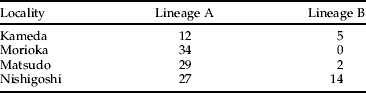
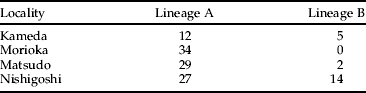
At four localities in Japan (Kameda, Morioka, Matsudo and Nishigoshi), >16 insects were sampled, allowing us to compare the ratio of lineages A and B (table 2). At Kameda and Nishigoshi, lineages A and B were found with comparable frequencies. At Matsudo, lineage B was found in only two of 31 insects. At Morioka, none of 34 insects examined harbored lineage B. The ratios of the two mtDNA lineages showed significant heterogeneity among the four localities (Chi-square test, p=0.0002).
Number of O. furnacalis individuals harboring the mtDNA lineages A and B at four localities in Japan.
In Japan, 94 insects were collected from Z. mays, and a total of 27 insects were collected from the other six plant species. Insects harboring lineage A were found in all the seven plant species examined. Insects harboring lineage B were found in Z. mays, S. vulgare and Xanthium sp. Thus, this preliminary observation did not provide evidence for particular associations between mtDNA lineage and larval host plants.
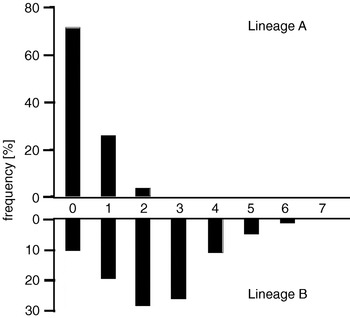
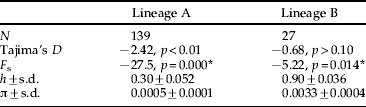
As described above, the genealogy of lineage A showed a star-like pattern, with the interior haplotype (i.e. hap. 1) predominant and the tip haplotypes occurring at very low frequencies. On the other hand, lineage B did not show such relationships among haplotypes. These haplotype patterns suggest that the population harboring mitochondrial lineage A, rather than B, has expanded in the recent past (Slatkin & Hudson, Reference Slatkin and Hudson1991). We further searched for evidence of population expansion, using population genetic statistics (table 3, fig. 4). The haplotype and nucleotide diversity indices were much smaller in lineage A than lineage B. Tajima's D value for lineage A showed a significant departure from the neutral equilibrium model of molecular evolution but that for lineage B did not. The value of F s for lineage A was highly significant, indicating an excess of rare haplotypes, while it was weakly significant for lineage B. The significance of Tajima's test in lineage A is most likely brought about by the great excess of rare haplotypes. Finally, both lineages showed a Poisson-like mismatch distribution, which supports population expansion events. Population growth models matched the data set well (p=0.508 for lineage A, p=0.429 for lineage B). The mode of the distribution occurred at the smaller nucleotide-difference in lineage A than B (fig. 4), suggesting that the lineage A mtDNA has experienced a sharper population expansion than the lineage B mtDNA even if both the lineages A and B had experienced population expansion (Rogers & Harpending, Reference Rogers and Harpending1992).
Distribution of the number of pairwise nucleotide differences (mismatch distribution) in the COII gene between individuals of O. furnacalis for lineages A and B. The numbers of pairwise differences are on the x-axis and their frequencies are on the y-axis.

Summary statistics for COII sequence polymorphism in lineages A and B in O. furnacalis.
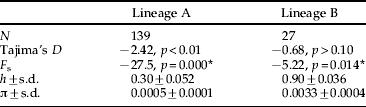
h, haplotype diversity; π, nucleotide diversity; N, number of insects; s.d., standard deviation.
*, the statistic should be considered significant at the 5% level if the p-value is below 0.02 (Fu, Reference Fu1997).
Thus, the population genetic characteristics consistently supported a population expansion event for lineage A but not for lineage B. In general, an interior haplotype in a phylogenetic network of DNA sequences within a species has a high probability of being the root in the network, especially when many gene samples concentrate there (Crandall & Templeton, Reference Crandall and Templeton1993; Castelloe & Templeton, Reference Castelloe and Templeton1994). Therefore, hap. 1 is probably the oldest haplotype in lineage A. It is most likely that hap. 1 has been increasing both in number and geographical range, concurrently differentiating into new rare haplotypes. On the other hand, because the frequency of lineage B was very low in Honshu and Shikoku, it is not very likely that the interior haplotypes of lineage B (hap. 48 and/or hap. 77) have been increasing over the Japanese main islands. If the range of lineage B expanded over the main islands, it may have occurred prior to the expansion of lineage A's range.
Discussion
Phylogeography of mtDNA lineages in Japan
The present study revealed that the mtDNA of O. furnacalis comprises two lineages. They co-occur widely in Japan. No evidence of geographical differentiation within the lineages was found. These findings do not provide evidence for a limited gene flow among geographical populations of O. furnacalis in Japan. Here, we discuss the significance of the co-occurrence of the two mtDNA lineages in Japan. Avise (Reference Avise2000) summarized intraspecific phylogeographic patterns of gene trees into five categories (categories I to V). The phylogeographic pattern of mtDNA in O. furnacalis would belong to category II, which is characterized by the presence of pronounced phylogenetic gaps in a gene tree and co-occurrence of major lineages over a wide area. In insects and related animals, reports of the category II pattern for mtDNA appear to be limited to the botfly Dermatobia hominis (Geurgas et al., Reference Geurgas, Infante-Malachias and Azeredo-Espin2000) and the spider mite Tetranychus urticae (Hinomoto et al., Reference Hinomoto, Osakabe, Gotoh and Takafuji2001). Avise (Reference Avise2000) argued that most of the category II patterns in mitochondrial phylogeography probably involve zones of secondary admixture between allopatrically evolved populations or species.
The lineage A mtDNA of O. furnacalis showed a star-like phylogeny, an unimodal mismatch-distribution, a significant excess of rare haplotypes and little diversity in haplotypes and nucleotides. These features suggest that the population harboring the lineage A mitochondria rapidly expanded in the recent past in Japan (Slatkin & Hudson, Reference Slatkin and Hudson1991; Rogers & Harpending, Reference Rogers and Harpending1992; Fu, Reference Fu1997). On the other hand, lineage B did not show clearly any features characteristic of population growth. Therefore, we infer that the category-II-like variation of mtDNA in O. furnacalis is a consequence of an expansion of lineage A's range (cf. Magoulas et al., Reference Magoulas, Tsimenides and Zouros1996).
Regarding the origins of lineages A and B of O. furnacalis, the following two findings do not support the view that these lineages evolved allopatrically. First, the lineages of mtDNA widely co-occur in Japan. If the two lineages had been found at the border of two areas occupied by single lineages of mtDNA, the allopatric evolution hypothesis could have been supported. Second, lineage B was not geographically differentiated among Japanese main islands, suggesting that it has continuously existed there. Thus, it is not clear whether the two lineages of O. furnacalis mtDNA evolved in separate or identical geographical regions.
The lineage B mtDNA of O. furnacalis was more frequent in Kyushu and Hokkaido than in Honshu and Shikoku. This suggests that the insect population with lineage A may have been winning over that with lineage B, although the present findings do not give information on the nature of the competition. If so, the expansion of lineage A in Japan may have started from Honshu or Shikoku and later spread into Kyushu and Hokkaido.
For the biological meaning of the presence of the two mtDNA lineages in O. furnacalis, at least two hypotheses are conceivable. First, if it is assumed that the mtDNA variation represents the genome-wide variation in O. furnacalis, the mtDNA lineages may represent genetically distinct populations of O. furnacalis. The two supposed populations may be more or less reproductively isolated from each other, although the present findings alone do not provide sufficient evidence for the occurrence of cryptic races. Closely related races or species of herbivorous insects often use different plants as larval hosts. Host races or host-differentiated cryptic species have been found in O. nubilalis (Frolov, Reference Frolov1998; Leniaud et al., Reference Leniaud, Audiot, Bourguet, Frerot, Genestier, Lee, Malausa, Le Pallec, Souqual and Ponsard2006 and references therein) and other crambid moths (Honda & Mitsuhashi, Reference Honda and Mitsuhashi1989; Honda et al., Reference Honda, Himeno and Yoshiyasu1994; Samudra et al., Reference Samudra, Emura, Hoshizaki, Ishikawa and Tatsuki2002, Matsukura et al., Reference Matsukura, Hoshizaki, Ishikawa and Tatsuki2006). In O. nubilalis, which is a close relative of O. furnacalis, a race infesting maize and another infesting mugwort/hop have been shown to occur. In a preliminary anlaysis in the present study, we did not find a difference in host plant utilization between the two O. furnacalis populations harboring different mtDNA lineages. This apparently does not support the view that the two mtDNA lineages of O. furnacalis represent two races infesting different host plant species. In particular, a situation where two O. furnacalis races, possessing the different mtDNA lineages, use exclusively different species of host plants is not likely. However, we cannot totally exclude the host race hypothesis for O. furnacalis, since the present samples are heavily biased toward insects feeding on maize. To statistically test associations of mtDNA lineage with particular host plant species, it would be necessary to examine insects from different major host plant species with equal efforts.
Second, it is also possible that the mtDNA polymorphism does not represent the genome-wide polymorphism. Natural selection favoring the lineage A mitochondria or a maternally-inherited element that is associated with the lineage A mitochondria may have caused the rapid expansion of lineage A (a process referred to as a selective sweep) (Johnstone & Hurst, Reference Johnstone and Hurst1996; Ballard, Reference Ballard2000 and references therein). Generally, a maternally inherited, selfish element, such as Wolbachia (Stouthamer et al., Reference Stouthamer, Breeuwer and Hurst1999) and other bacteria (Hurst & Jiggins, Reference Hurst and Jiggins2000; Hunter et al., Reference Hunter, Perlman and Kelly2003), may cause a selective sweep of the mtDNA. In natural populations of O. furnacalis, a small portion of females are infected with a strain of Wolbachia which distorts the sex ratio of their offspring toward females by male-killing (Sakamoto et al., Reference Sakamoto, Kageyama, Hoshizaki and Ishikawa2007; see also Kageyama & Traut, Reference Kageyama and Trout2004). However, the genomic DNA samples of O. furnacalis used in the present study were tested for Wolbachia and were not infected (see materials and methods). In addition, the Wolbachia infection rate in O. furnacalis is low in the field in contrast to the dominance of the lineage A mtDNA; for example, the infection rate at Matsudo was 13/79 (Kageyama et al., Reference Kageyama, Nishimura, Hoshizaki and Ishikawa2002). Thus, at present, there is no evidence for the selective sweep hypothesis, although it cannot be entirely ruled out.
mtDNA in China and the Philippines
The present study preliminarily examined COII genes of O. furnacalis in China and the Philippines. Chinese samples (n=7) harbored the lineage A mtDNA, and six of them harbored hap. 1, which was also dominant in Japan (table 1). Therefore, we speculate that lineage A expanded also in China. Such speculation should be tested by examining more COII sequences sampled from a wider range of China. Three samples from the Philippines harbored two COII haplotypes (haps 36 and 42) in lineage B. The two haplotypes were unique to the Philippines; and, in the phylogenetic network, they were positioned adjacent to the group of lineage B haplotypes found in Japan. These results imply that the lineage B mtDNA in the Philippine population is differentiated, to some degree, from that in the Japanese population of O. furnacalis.
Finally, examining nuclear DNA polymorphism and conducting crossing experiments may contribute to understanding the biological significance of the mitochondrial lineage polymorphism in O. furnacalis. If O. furnacalis populations representing mitochondrial lineages A and B are also differentiated in nuclear DNA or if they have some reproductive barrier between them, the cryptic race/species hypothesis would be supported. Moreover, if so, examining the female sex pheromone (Huang et al., Reference Huang, Takanashi, Hoshizaki, Tatsuki, Honda, Yoshiyasu and Ishikawa1998) and the host plant utilization in the cryptic races/species would become of interest.
Acknowledgements
This work was supported in part by Grants-in-Aid (Nos 12640675, 13460021 and 15780038) from the Ministry of Education, Science, Sports and Culture, Japan. We thank Daisuke Kageyama and Takuma Takanashi for assistance in rearing insects.