1. INTRODUCTION
Rural elites currently enjoy a privileged position on the research agendas of historians of late medieval Europe. Scholars considering medieval power elites first engaged with the relatively well-documented groups leading urban communities, but it was not long before they turned their sights to the study of the elite in rural societies. Two challenges present themselves in this field. First, little attention has been paid to the possible overlap between urban and rural political elites.Footnote 1 This is somewhat surprising, given that the existence of elite families which provided aldermen to different cities and shires simultaneously is well attested for the early modern era.Footnote 2 Such practices may very well have been a continuation of behaviour from an earlier era, since it has long been recognised that the acquisition of rural properties by urbanites and that of urban residences by country dwellers was well established in many regions of late medieval Europe.Footnote 3 Second, if due care is not taken, there is the danger of fragmentation within the field of elite studies. Over the years, various lines of research have been developed within this broad field of elite studies which have few points in common. In this article we hope to demonstrate the potential gains to be made by applying an integrated perspective to an analysis of the rural elites of the Liberty of Bruges (Dutch: ‘Brugse Vrije’). The city of Bruges was the gateway for international trade to and from the Low Countries until the rise of Antwerp at the turn of the sixteenth century, and the district forming the city's hinterland was known as the Liberty of Bruges, hereafter often referred to as ‘the Liberty’. Apart from probing the social ties between the civic authorities in Bruges and those in the Liberty, this case study will be framed by two debates which are seldom studied in combination, namely, the debate on state building and the debate on the commercialisation of rural society.
The older of the two debates is the long-standing concern with the social basis of state formation, which has focused increasingly on the role of the nobility, the rural elite par excellence. Monographs on the nobility of Western Europe have time and again confirmed the economic and political vitality of the nobles in the late middle ages, despite this era experiencing a supposed ‘crisis of the nobility’, which raises the question of why the noble lords tolerated or even actively supported the expansion of the fiscal and military power of various princely states from the thirteenth century onwards (e.g. England, France or Castile).Footnote 4 By the 1990s, it was clear to historians that, as a rule, princes bought the support of their nobles by continuously delegating local power and the concomitant revenues to noblemen, who consequently owed their strengthened positions to the princely state. This has had important implications for the way historians have viewed the relations between European states and the regions comprising their territories. Whereas much of the nineteenth- and twentieth-century historiography assumed that state building in western Europe implied a unilateral transfer of power and capital from the periphery to the centre of the state territory, it has become clear that the centre and periphery of European states often developed in tandem.Footnote 5 The rapid expansion of the fiscal and military might of many rulers in the fifteenth and sixteenth centuries did not necessarily come at the expense of the elites that presided over the various parts of a particular ruler's territory; more often the contrary was true. Yet, the relation between a ruler and his nobles was often fraught with tension, and could erupt into violence if the nobles tried to keep the expansion of princely authority within reasonable limits, or the ruler tried to curb the influence the nobles could bring to bear within the state apparatus. Historians distinguish two different outcomes that evolved from these tensions, pointing out that while the English crown only rarely suffered from troubles with the country's aristocracy, most ancien régime states on the continent were plagued by frequent internal crises instigated by their nobles. This difference is partially explained by the position of the English kingdom, separated from Europe by the sea, which allowed the country's fifteenth- and sixteenth-century monarchs to shield themselves increasingly from the frequent wars on the continent, freeing them from the need to surrender much of the state apparatus to noble influence in return for cash to fund the current war effort. In addition, historians have pointed out that in England rural governance, and the groups controlling it, were different from those elsewhere in Europe. From the twelfth century onwards, the administration of justice in the English shires was trusted to juries which were not only recruited from among the elite gentry, but also from among those on lower rungs of the social ladder, such as modest farmers and craftsmen. This arrangement would have engendered a deeply rooted social commitment to the state and state-based order which was absent on the continent, where the administration of justice in rural areas was always the prerogative of the elite who used their authority to shore up their own interests at the expense of lower-ranking country dwellers.Footnote 6 In England the gentry not only lacked a monopoly over the law courts, they were also an unusually open political community, showing little hostility towards the social aspirations of rural and urban notables. From the fifteenth century, the English gentry included wealthy tenant-farmers, urban dignitaries, lawyers and other individuals who would certainly not be viewed as ‘noble’ in a continental community.Footnote 7
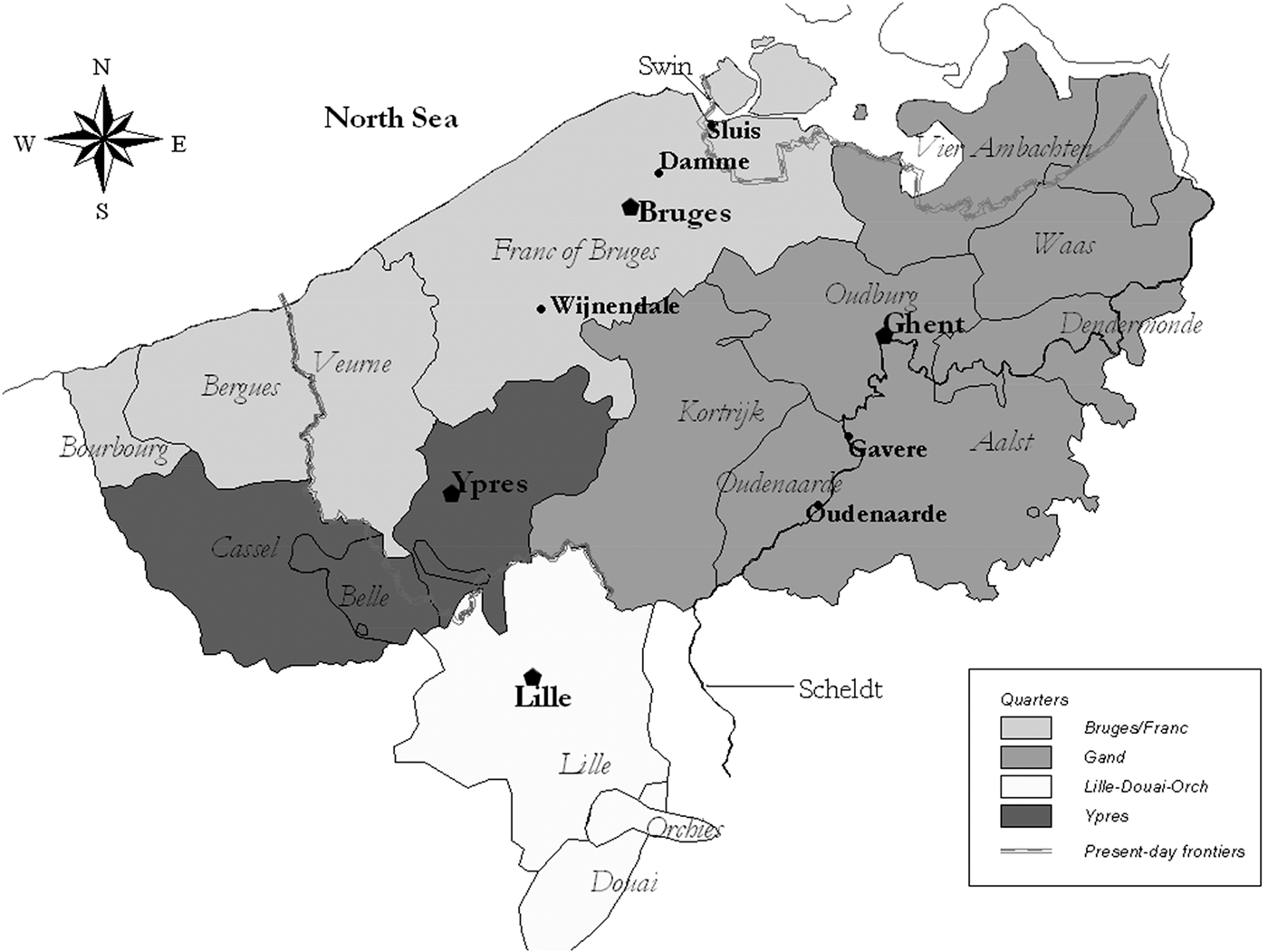
Whatever the precise causes of English political stability, historians of continental rural regions are faced with the challenge of explaining how the relations between princely states and local rural political elites could promote both fierce conflict and intense co-operation between a prince and his nobles. The Liberty of Bruges provides a rare opportunity to explore this issue within the Low Countries. For most regions of the Netherlands, the information available on medieval rural elites is patchy at best, whereas exceptionally rich sources exist for the Liberty. Furthermore, the latter is the only region which allows rural elite formation to be studied in the densely urbanised county of Flanders, the dominant principality within the Low Countries up until the sixteenth century. The Liberty of Bruges was the only one of the 15 or so rural districts of the county of Flanders that was not politically dominated by a large town (see Figure 1 for these so-called castellanies; Dutch: ‘kasselrijen’). By the thirteenth century, the large Flemish cities of Ghent, Bruges and Ypres had accumulated so much capital and military might that they increasingly dominated the surrounding countryside. Traditionally, representatives of the towns and the castellanies within Flanders treated with the Count of Flanders on behalf of their inhabitants on issues of government and taxation. Around the middle of the fourteenth century, however, the smaller towns and the rural districts found themselves increasingly excluded from such negotiations. Ghent, Bruges and Ypres, now referred to as the ‘Three Members of Flanders', were now each acting as the representatives of their neighbouring towns and castellanies. Like Ghent and Ypres, the city of Bruges sought to dominate its hinterland, but the Liberty of Bruges, by far the largest and most important of all the castellanies in Flanders, managed to retain its autonomy, in part because of the support it received from the successive Counts of Flanders who seized the opportunity this offered to curb the pursuit of power by one of the major cities under their control.Footnote 8
The county of Flanders with its castellanies, including the ‘Liberty’ or ‘Franc’ of Bruges and the neighbouring Castellany of Furnes (‘Veurne’).

By 1385, the tug-of-war over the Liberty between the Count and the city of Bruges had been settled, to the advantage of the Liberty, which became known as the ‘Fourth Member of Flanders', a fully equal partner to Ghent, Bruges and Ypres. As the only castellany that was free from the influence of the would-be city states, the Liberty is the only region for which we can investigate the ambivalent relationship between the Flemish rural elite and their rulers during a decisive phase of state formation in the Low Countries. Up to 1384, the county of Flanders was ruled as an independent principality, but it was then inherited by Margaret of Mâle, the daughter of the late Count of Flanders, and her husband Philip the Bold, Duke of Burgundy and a younger brother of King Charles V of France. In the decades that followed, this Burgundian–Flemish branch of the House of Valois inherited, purchased or conquered many other principalities close to Flanders (Brabant, Holland, Zeeland, Hainaut and so on). By the 1430s, the Burgundian Low Countries had become a new power bloc in northwest Europe, holding its own against the neighbouring kingdoms of England and France and the German Empire. We will argue that the rural elite of the Liberty of Bruges was profoundly transformed by the incorporation of Flanders into this new composite state under Burgundian rule, as the costs of frequent wars with neighbouring princely states pushed the Dukes of Burgundy, in their capacity as Counts of Flanders, to adopt a different policy vis-à-vis the elite of the Liberty of Bruges than had their fourteenth-century predecessors.
In addition to a focus on state building, the historiography on rural governance is dominated by debates over the rise of commercial agrarian economies within Europe and the presumed social and political consequences. As rural production was increasingly geared towards urban markets from the high middle ages onwards, a new group of wealthy country dwellers emerged within village communities. Socially these individuals were certainly not on a par with noble lords, but their wealth and status clearly distinguished them from the small-scale peasants who made up the great majority of the population. Current scholarship is very much concerned with the growing societal prominence of this new, elite group in fourteenth- and fifteenth-century Europe. In fact, the most recent attempts to define the ‘rural elite’ refer not to the nobility, but to the aggregate of well-to-do farmers, merchants, rentiers and local officials which formed an intermediate layer between the nobles and the peasant population.Footnote 9 According to this view, the ‘rural elites' reflect the social polarisation evident in pre-modern society, given that in some regions, the commercialisation of the economy led the class of small free-holding peasants to be transformed into a proletariat of landless wage labourers, while bringing hitherto untold wealth to an elite comprised of large-scale landowners (often absentee landlords such as nobles, ecclesiastical institutions and city dwellers), well-to-do peasants, tenant-farmers, merchants and administrators.Footnote 10 It is often suggested that this socio-economic transformation engendered political modernisation, as the newly emerging rural elites are alleged to have become an important political factor in rural Europe, shifting their allegiances between lords and peasants as they saw fit.Footnote 11 In this sense, the current debate on ‘rural elites' among medievalists mirrors an older debate among modernists on the role of the ‘rural bourgeoisie’ in the French Revolution.Footnote 12 In the context of this academic debate the Liberty of Bruges provides an interesting case study, as it was one of the first regions within the Low Countries to undergo the transition from a peasant economy to agrarian capitalism. Research has shown that between the fourteenth and the sixteenth centuries, the evolution of the Liberty resembled that of England, Guelders or the Île-de-France, with a radical shift from small farms exploited by peasants to large and middle-sized farms exploited by farmers and tenant-farmers with a workforce of waged labourers.Footnote 13 Yet, while the Liberty certainly saw the emergence of a new rural elite in the late middle ages, we will show that its political development was, in fact, arrested. Although the new group certainly came to dominate offices held at the level of the village, village politics were not terribly important to the running of the Liberty.Footnote 14 True power in the castellany resided with the individuals participating in the network of institutions which governed it: the Council of aldermen, the Count's Bailiff and the seigniorial lords, and our analysis shows that the participation of the village elites in these roles dwindled during the fifteenth century. These changes, we argue, reflect a structural shift in the relations between the nobility and the state.
2. THE PILLARS OF LOCAL GOVERNMENT
Bounded by the North Sea in the north, the Yser River in the west and the Scheldt estuary in the northeast, the Liberty of Bruges covered a substantial part of the county of Flanders (see Figure 1). As the largest rural district within the late medieval county, it had a population of about 125,000, nearly 19 per cent of the county's roughly 660,000 inhabitants in the 1470s.Footnote 15 Covering some 1,700 square kilometres (656.4 square miles) and encompassing over 100 parishes, it was by far the largest of the Flemish castellanies and also the one with the greatest fiscal weight. When the formula for the distribution of the fiscal burdens over the various Flemish towns and rural districts was updated in 1408 by the Count and the Four Members of Flanders, the Liberty of Bruges provided 12 per cent of every fiscal contribution granted to the Count of Flanders (the so-called aides). This was somewhat less than Bruges or Ghent contributed; they gave 16 and 14 per cent, respectively, but more than Ypres, which gave 9 per cent, and far more than any other of the 15 castellanies.Footnote 16 Yet, while the Liberty formed a coherent fiscal entity, it was certainly not unified politically. In terms of governance and the administration of justice, the castellany formed a composite of territories, each with its own various rights, while the castellany had rights of its own. In the late medieval period, the larger part of the territory it covered was ruled by the aldermen of the Liberty of Bruges. The Council of aldermen acted both as an administrative institution and as a court of law, and was the most important body representing the Count of Flanders within the Liberty. Nevertheless, the Liberty was sprinkled with enclaves where the authority of the Council was limited or non-existent.
There were three types of enclave. First, there were the so-called ‘appendant seigniories' (Dutch: ‘appendante heerlijkheden’), enclaves which shared in the customary laws and privileges of the Liberty. Here, the rule of law was enforced by local aldermen who could take advice from the castellany's aldermen. The latter could also hear appeals against judgements by the former. The aldermen in the appendant seigniories were appointed by the local lord – the individual who held some rights to government within a particular village as part of his private property. Usually, the local lord and his aldermen had the right to judge minor and middling infringements, whereas crimes such as manslaughter and rape would be brought before the aldermen of the Liberty. Cases of suicide, arson and murder were reserved for the judgement of the Count himself. In these seigniorial enclaves, jurisdiction was thus distributed between various institutions, according to the specific legal rights encapsulated in that particular seigniory. A second type of enclave was the ‘contributing seigniories' (Dutch: ‘contribuante heerlijkheden’), to which several of the smaller towns of the Liberty belonged. Each of these enclaves had its own customary laws, regulations and privileges, and was ruled by its own aldermen. Appeals against decisions by the latter were not lodged with the aldermen of the Liberty, but taken straight to the Council of Flanders, the Prince's court of law. Fiscal contributions from the ‘contributing seigniories' were not paid directly to the administration of the Principality, however, but via the coffers of the Liberty of Bruges. In addition to the two types of seigniories, there were also about 16 towns situated within the castellany, known as the ‘small towns' (Dutch: ‘smalle steden’), which were completely independent enclaves within the Liberty. Thus, as was the case elsewhere in medieval Europe, the Liberty of Bruges was, as remarked above, essentially a patchwork of territories in which the aldermen enjoyed a dominant position, but certainly not a monopoly of power.
In a context in which administrative and judicial authority was scattered among various institutions, many of which were in private ownership, it is no easy task to reconstruct the social networks which gave those institutions substance. Indeed, the Liberty of Bruges is uniquely important, because the sources are sufficiently rich to study the separate institutions, or pillars, of government. That is not to say that our survey is complete: only fragmented sources survive to tell of the aldermen serving the many seigniorial villages and small towns within the Liberty. Nevertheless, sufficient sources survive from the year 1501 to make it possible to glimpse the social networks behind the various seigniories in the Liberty of Bruges by combining the various references to the seigniories and their owners found in feudal registers and a plethora of other sources. Of the 51 seigniories where the owner is known, 41 were in private ownership, while the remaining 10 were the property either of the Count of Flanders himself, or of important ecclesiastical institutions, such as the chapter of St Donatian in the city of Bruges.Footnote 17 With one possible exception, all privately owned seigniories belonged to noble families, and together these formed a coherent socio-political element in the governance of the castellany.Footnote 18 As noble families tended to have a penchant for social endogamy, the lords of the Liberty of Bruges were, as a rule, either directly or indirectly connected to each other through the ties of kinship, marriage and friendship.Footnote 19 While it would be a mistake to understand the noble lineages of this region as one intensely coherent and strictly delineated social network, they certainly formed a distinct coterie from within which the large majority of the region's village seigniories, and some of the urban seigniories, were controlled.Footnote 20 Although the nobility had been ousted from roles representing the people of Ghent, Bruges and Ypres, they clearly remained a constituent part of the political framework of the various rural districts of Flanders.
Autonomous as the small towns and village seigniories often were, in total they comprised only a limited part of the Liberty's territory. The great majority of the Liberty – some 80 parishes – belonged to what contemporaries described as ‘the countryside’ (Dutch: ‘platteland’), that is, those parts of the castellany which fell under the immediate jurisdiction of the aldermen of the Liberty as the body directly representing the Count of Flanders. The aldermen thus formed the most important cornerstone of the political establishment, and their actions came under scrutiny from two different directions. On the one hand, the accounts of the aldermen were audited annually by the ‘Chambre des Comptes' – the financial administration of the government of the Principality. On the other a number of dignitaries and commoners of the Liberty convened at the ‘General Assembly’ (Dutch: ‘Generale Vergadering’), an occasion when the accounts of the aldermen again came under scrutiny, and important decisions were settled, usually whether or not the Liberty would grant or refuse a request for an aide by the Count of Flanders.Footnote 21 Although the General Assembly did not became a formal institution until around 1475, its informal existence stretched back to at least the first half of the fourteenth century. Up until the middle of the sixteenth century, however, the General Assembly seldom convened more than once per year, leaving the day-to-day governance of the region firmly in the hands of the aldermen. Thus, despite the oversight of both the General Assembly and the Chambre des Comptes, the true locus of the decision-making process within the Liberty of Bruges clearly lay with its aldermen. Furthermore, there is much evidence to suggest that the aldermen formed an unusually consistent and cohesive political body. Compared with aldermen in other rural districts within the County of Flanders, the aldermen of the Liberty of Bruges were exceptional in that they held their office for life, following a stipulation in a charter granted to the castellany in the early thirteenth century.Footnote 22 This was a remarkable state of affairs, because over the course of the twelfth and thirteenth centuries, the Counts of Flanders had forced nearly every other town and castellany to adopt a system in which the aldermen were replaced every year, new ones being appointed by a committee of the Count's officials. Often an additional restriction ensured that former aldermen had to wait at least one year before they could be appointed to a second term of office.Footnote 23 The Liberty of Bruges, however, was allowed to adhere to a system which favoured oligarchy, as the political elite turned over at an exceptionally slow rate; only when an alderman retired or died was a new alderman appointed by the Count. The only exception to this was the rare occasion when a Count died and a dynastic succession ensued. The heir had the right to dismiss his predecessor's aldermen and replace them with men of his own choosing. However, in the late fourteenth and fifteenth centuries, the succeeding Counts exercised restraint, and only replaced a minority of the aldermen when they assumed comital authority.Footnote 24
Contemporaries were fully aware that the system of appointing the Liberty's aldermen allowed a small group of the elite to control the entire castellany. Indeed, a network of aspiring politicians in the neighbouring castellany of Furnes tried to use the same system as a model: in 1411, a clique amongst the Furnes aldermen offered an enormous bribe to Duke John the Fearless to replace the system of annual elections with a system of life-long appointments, as was the rule in the Liberty. This was met with fierce resistance from many dignitaries in Furnes who saw themselves in danger of being perpetually excluded from the process of decision making. The disputes over this issue would haunt the castellany of Furnes until at least 1436.Footnote 25 In fact, the Liberty itself followed a somewhat different path; although it had been a bastion of oligarchy since the high middle ages, for reasons that will be discussed below, access to the Council of aldermen had opened up considerably in the second and third quarter of the fourteenth century. From the late fourteenth century, however, events conspired once again to concentrate political power in the hands of an increasingly small group. A uniquely exhaustive view of these events and the concomitant changes in the social composition of the rural political elites in coastal Flanders can be reconstructed from a wide range of sources, which are today mostly preserved in the State Archives of Bruges, Brussels and Lille, as well as in the Bruges City Archives. As a rule, the names of the hundreds of individuals who served as aldermen of the various castellanies of the county of Flanders have not survived, but coastal Flanders is a happy exception. For this region, more than 5,000 charters and dozens of cartularies have survived in which one or more aldermen of the Liberty of Bruges and the castellany of Furnes are mentioned by name. These mostly concern deeds in which aldermen witnessed a transaction or a formal agreement, books of account of the castellany submitted by the aldermen to the comital administration and, to a lesser extent, sentences that list the names of the aldermen who had pronounced judgement. As nearly all these documents were supposed to be legally binding, often with seals affixed by the involved parties, the names provided are certainly reliable. Through the careful collection of those names and the dates on which those men were active as aldermen, it was possible to reconstruct exhaustive lists of the aldermen of the Liberty for the entire period under discussion in this article.Footnote 26
3. THE RAPPROCHEMENT BETWEEN THE ALDERMEN AND THE SEIGNIORIAL ELITE IN THE LIBERTY
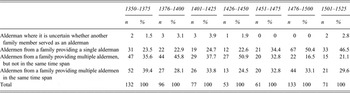
While exceptional in many ways, the aldermen of the Liberty of Bruges resembled those of any other city or castellany in Flanders in that they were a mixture of isolated individuals and members of what might be described as ‘aldermanic dynasties'.Footnote 27 Politics was very much a family affair in late medieval Flanders, and a quantitative analysis makes clear that the Liberty was no different. In Table 1, the 175 years between 1350 and 1525 are separated into seven consecutive quarter centuries, and the aldermen serving in each 25-year period are divided into those individuals who shared their family name with at least one other alderman serving between 1350 and 1525, and those who did not.
Number (and percentage) of the aldermen of the Liberty of Bruges in each 25-year period from 1350 to 1525 who came from families that provided one alderman, or multiple aldermen to the Liberty

Sources: For reasons of space, it is not possible to provide the reader with a full survey of all the sources used to reconstruct the research population, but such a survey will be included in the forthcoming doctoral dissertation of Andy Ramandt (Ghent University).
Before the last quarter of the fifteenth century, about 70 per cent of the aldermen were recruited from families who provided more than one man for this office. Some families even supplied multiple aldermen within the same quarter century. In the first quarter of the fifteenth century, for example, no fewer than four different members of the noble Van Moerkerke lineage, namely Colard, Frank, Lonis and Wulfard, served as aldermen, and their family's commitment to the Liberty's Council of aldermen can be traced back deep into the thirteenth century. That is not to say, however, that political decision making in the Liberty was completely dominated by family networks. The number of families at the core of the political elite in the castellany fluctuated and while many were noble not all were by any means. Many of the ‘core’ families, such as the Van Moerkerkes, supplied aldermen regularly; others did so much more sporadically. The non-noble Coolman family, for example, supplied two aldermen, one of whom was active in 1351–1375 and 1376–1400, while the other did not serve until 1476–1500.
Aldermen from the aldermanic dynasties were joined by individuals who could not call on a strong family network, at least not on their patrilineal line. Jan Alisen, for example, a non-noble colleague of the aldermen from the Van Moerkerke family, had no relative preceding him on the Council of aldermen, nor did any follow in his footsteps over the next century. Such lone figures were certainly not without stature; they clearly belonged to the ‘rural bourgeoisie’, being drawn from the body of wealthy farmers, merchants, administrators and rentiers which grew steadily in numbers as the Liberty evolved from being a peasant economy in the fourteenth century to a setting for agrarian capitalism in the sixteenth.Footnote 28 By cross-referencing the reconstructed lists of aldermen with feudal registers (i.e. surveys of the important fiefs in the region, which were usually held in fief from the Liberty's feudal court), it is possible to show that the non-noble aldermen often owned very respectable rural properties, often on a par with those of the leading political families in the region.Footnote 29 Thus, it would appear that in each of the quarter centuries represented in Table 1 a seat on the Council of the Liberty remained accessible to a small number of landowners, who had the personal inclination and the connections necessary to become an alderman. It is likely that the lack of a family tradition of being an alderman amongst such men was compensated for by the relevant administrative, financial or legal expertise which they could bring to the role, or by their social ties to the cluster of true ‘political dynasties' in the Liberty; particularly as they were too small in number to pose a threat to the power of the latter.
Table 1 shows that there was a marked rise in the number of aldermen without a strong family network in 1451–1475 and 1476–1500, but this does not necessarily imply far-reaching social change. The number of aldermen directly appointed by the Count increased somewhat in the second half of the fifteenth century, and the Liberty was caught up in an intense political crisis in the last quarter of the fifteenth century. Following the death of Duke Charles the Bold in 1477, the city of Bruges had aggressively asserted its political autonomy vis-à-vis the Burgundian state. As one facet of this, Bruges claimed control over its hinterland, eliminating the Liberty's role as the ‘Fourth Member of Flanders'. While the Liberty remained under the sway of the city of Bruges, the life-long appointment of aldermen was replaced by the system more common elsewhere in Flanders: the annual renewal of aldermen.Footnote 30 This explains the sudden rise in the number of aldermen between 1451 and 1475, when 61 were attested in the available sources, and 1476–1500 when 133 were attested. In the last decades of the fifteenth century, the tensions between the major cities and the Burgundian–Habsburg authorities gained in strength, and from 1482 onwards Ghent and Bruges were at war with Maximilian of Austria. During the ensuing conflict, the authority of the aldermen of the Liberty was suspended on various occasions by whichever faction was in the ascendency, to be replaced by a new body of aldermen supporting the latter's cause.Footnote 31 The Liberty only had its autonomy fully restored when the Habsburg government was victorious over the Flemish rebels in 1490–1492. The exceptionally small share of political dynasties amongst the aldermen of the Liberty in the period from 1476 to 1500, evident in Table 1, does not therefore suggest a structural trend in which the Liberty's Council of aldermen became increasingly open towards individuals unconnected to the elite families.
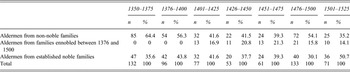
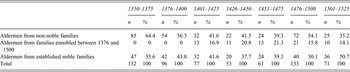
The available evidence suggests that, until the 1480s, the political elite of the Liberty was more exclusive than inclusive. First of all, the number of available seats on the Council dwindled over time. Traditionally, the Council had consisted of no fewer than 61 aldermen, an exceptionally large number. In a charter issued by the Count of Flanders in 1330, the number of aldermen of the Liberty of Bruges was reduced to 39, but this was rescinded in 1338.Footnote 32 Our reconstruction of the lists of aldermen shows that in fact, the number of aldermen only started to decline from the late 1360s onwards. The downward trend was reinforced in 1414, when Duke John the Fearless firmly restricted the number of seats on the Council to 27, a stricture that remained in force until the abolition of the Liberty during the French Revolution.Footnote 33 When combined with the unusual system of life-long mandates, this institutional reorganisation made it increasingly difficult to become an alderman in the Liberty. From Table 2 it can be seen that no fewer than 132 different individuals are known to have served as aldermen between 1350 and 1375, but this number dwindled to reach a nadir between 1426 and 1450, when it took only 53 individuals to fill all the available positions on the Council over the full quarter of a century. In the quarter century from 1476 to 1500 the number of aldermen rose again to 133 but, as discussed above, this was not a structural development, but a consequence of the coups and countercoups taking place in the Liberty during the civil war of the 1480s. By the first quarter of the sixteenth century, the number of aldermen had dropped once again to mid-fifteenth-century levels.
Number (and proportion) of the aldermen of the Liberty of Bruges who were from established noble families, families ennobled between 1376 and 1500, or non-noble families, by 25-year span, 1350–1525
Sources: For reasons of space, it is not possible to provide the reader with a full survey of all the sources used to reconstruct the research population, but such a survey will be included in the forthcoming doctoral dissertation of Andy Ramandt (Ghent University).
Strikingly, as the political arena of the Liberty contracted, marked social selection took place, with the very top of the castellany's social elite being much more likely to remain active as aldermen than individuals from the second or third rungs of the landed hierarchy. This is illustrated in Table 2 in which the noble aldermen are distinguished from those who were commoners.
Until the exceptional crisis of the late fifteenth century, the proportion of nobles amongst the aldermen of the Liberty was remarkably constant, oscillating around 40 per cent of the total in each quarter of a century. Yet, as Table 2 shows, the group of nobles was unstable in its social composition, composed of a varying mixture of old noble lineages and relative newcomers. Over time, the male line of some noble families died out, while other families acquired nobility, usually by inheriting the village seigniory and other properties left by a family which had become extinct.Footnote 34 While changing slowly, the nobility of the Liberty of Bruges remained evident amongst the aldermen; indeed, politically speaking, they became increasingly dominant, as the number of their non-noble colleagues dwindled steadily. Whereas aldermen with the status of commoner took up 65 per cent of the seats on the Council in the third quarter of the fourteenth century, they could only claim about 40 per cent of the seats available from the 1420s onwards. It is also clear from Table 2 that while the upheavals of the 1480s led to an upswing in the number of aldermen from non-noble backgrounds, this was not a lasting trend.Footnote 35
These developments cannot be interpreted as showing that the noble ‘clans' of the Liberty conducted a coup at the expense of isolated commoners. The balance between family networks and individual politicians remained essentially stable (see Table 1), and the shift towards a majority of nobles in the Council was the result of a long, gradual process: the ennoblement of some local families clearly illustrates that the nobles and commoners did not exist in strictly separate spheres; their social networks and political interests overlapped. All aldermen of the Liberty were wealthy landowners, and there were ties of kinship between the nobles and commoners forming the Liberty's political elite. Yet, despite the fluid boundaries between the nobility and the rest of the elite, by the end of the fifteenth century the noble lords as a group clearly no longer had any reason to fear a threat to its interests from its fellow aldermen who might once have wished to curtail any aspirations to local lordship or regional power harboured by the noble families.
The trend towards increasing oligarchy was probably rooted in two important events: a revolt in coastal Flanders in the years 1323–1328, and the unification of the Low Countries under the rule of the House of Burgundy in the late fourteenth and early fifteenth centuries. In the 1320s, the fiscal policy of the Count of Flanders had provoked a considerable proportion of the population of coastal Flanders to rebel against him, including several of the leading political families in the Liberty of Bruges. After the revolt was crushed, many privileges that the Liberty enjoyed were briefly revoked by the Count, one of these being the exceptional right of an alderman to serve for life.Footnote 36 Although the privileges were restored to the castellany in 1338, as part of an attempt to win its support against a new revolt which was brewing in Ghent, the Count of Flanders seems to have been careful to avoid a situation akin to that prior to 1320, when power within the Liberty had been concentrated amongst a clique of potentially rebellious aldermen, as he appointed a sizeable number of aldermen of commoner status who could not boast of extensive family networks. With the gradual pacification of the county under Count Louis of Mâle (1346–1384), this policy lost its sense of urgency, and from the 1360s and 1370s onwards, the Count was less inclined to intervene aggressively and ceased to appoint large numbers of aldermen. With politically ambitious families once again given free rein, a gradual trend towards greater exclusivity set in, and this was reinforced when the county of Flanders fell to the Dukes of Burgundy on the death of Count Louis in 1384. By the 1430s, the Burgundian dynasty had also acquired most of the other principalities situated between France and the German Empire. As the most populous and wealthiest principality up until 1500, its aides providing 25 per cent of all the Duke's fiscal revenues in 1475,Footnote 37 Flanders remained an important element of this new geopolitical entity. The Dukes of Burgundy preferred to exploit the wealth of the principality by making deals with the local elites, rather than by closely monitoring their social composition. Duke John the Fearless (1405–1419), for example, was happy to sell a privilege granting life-long appointments to a clique of aldermen in the castellany of Furnes in 1411 for 10,000 écus of 30 groats, and it is likely that the privilege restricting the number of aldermen in the Liberty of Bruges to 27 seats, mentioned above, was also the result of bribery by an opulent and ambitious network of aldermen within the Liberty's political community. Thus, it would appear that the unification of the principalities of the Burgundian Low Countries in some ways served to reinforce a trend towards political decentralisation, at least in the case of the rural districts of Flanders.
Whatever the precise cause of the increasingly elite composition of the Liberty's aldermen, some interesting contrasts and similarities can be drawn with the neighbouring castellany of Furnes where a similar situation emerged but as a result of quite different processes. In the Liberty, the interwoven noble lineages were freed from the dominant presence of a large group of commoners, partly as a result of a decline in the number of positions available on the Council. In Furnes, however, the number of available seats remained constant while the number of noble aldermen serving on the Council of aldermen at least doubled between 1350–1375 and 1475–1500. Despite the institutional intricacies of each district, however, the administration of both castellanies ended up as bastions of the seigniorial lords and their families, with wealthy commoners increasingly excluded.Footnote 38 This shift in the social composition of the political elites in these rural districts is all the more remarkable because it ran counter to the changing property relations in coastal Flanders. Between the fourteenth and the sixteenth centuries, the number of large landowners increased considerably in this region, while small-scale tenant peasants increasingly lost control of the land. As a result, the socio-economic elites of the Liberty and the castellany of Furnes acquired a much broader base, as their ranks were swelled by the increasing number of medium- and large-scale landowners who derived large incomes from the short-term lease of their properties to farmers.Footnote 39 Yet, despite their increasing numbers, these representatives of these high-ranking commoners formed a declining proportion of the aldermen of the Liberty, giving precedence to noble lords who were also remarkably successful in strengthening the size of their landholdings at the expense of the peasantry.Footnote 40
In Furnes, the attempt of some of the elite networks to monopolise the decision-making process within the castellany was fiercely contested, but we know of no evidence which suggests that there were similar reactions amongst the inhabitants of the Liberty to the increasingly oligarchic nature of their aldermen. The various strata of landed society in the Liberty may have been relatively content as a division of government evolved which saw noble lords, along with some allied families of semi-nobles and commoners, take increasing control of regional politics by serving as aldermen, while a larger group of well-to-do landowners fulfilled administrative roles in village councils and the institutions charged with the construction and maintenance of dikes (Dutch: ‘wateringen’). Tim Soens has noted that the most important landowners in the Liberty, including the nobility, withdrew from water management around 1400, just as the gradual reduction in the number of aldermen excluded an increasing number of commoners from participating in politics at the level of the castellany.Footnote 41 The Liberty thus seems to have seen a restructuring of its government in which the higher and lower rungs of the elite gradually assumed different, but complementary, roles within the political hierarchy, both groups having similar interests as large-scale landowners. As a whole, our case study of the Liberty of Bruges has shown that the rise of a ‘rural bourgeoisie’ did not necessarily encourage a more open political arena, as certain strands of modernisation theory have suggested should have been the case.
4. THE CHANGING RELATIONS OF THE LIBERTY WITH THE COUNT'S BAILIFF
That fact that the Liberty's aldermen became increasingly dominated by an ever smaller and socially exclusive oligarchy may not have been inimical to the interest of wealthy landowners who could voice their concerns at the annual General Assembly, but it was definitely detrimental for the lower social orders, particularly those who lived in a village seigniory. Common villagers who fell foul of their local lord and aldermen could appeal to the aldermen of the Liberty – except in those rare seigniories where the lord had high jurisdiction or those cases which were reserved for the consideration of the Count – but over time such an action carried an increasingly large risk of backfiring on the plaintiff. The nobles amongst the aldermen – many of whom would be related to, or at least acquainted with, the lord against whom the appeal was lodged – became less and less restrained by the presence of common colleagues, so that the Council of aldermen, as an institution, was less likely to try to prevent a local nobleman from exercising his lordly rights as he saw fit.Footnote 42 Sources referring to the day-to-day policies of the aldermen are sadly lacking, but events in 1477 make it clear that the populace was faced with abuses inflicted by an increasingly elitist clique. In the crisis that followed the death of Duke Charles the Bold in January 1477, the Liberty's council hall was ransacked by an angry group of the castellany's inhabitants, demanding that they should henceforth be tried for any misdemeanours by the aldermen of the city of Bruges, rather than by those from the Liberty. This gave ready ammunition to the authorities in the rebellious town of Bruges, who successfully demanded of Duchess Mary of Burgundy that the Liberty should be suspended as the Fourth Member of Flanders and become subject to the authority of the city of Bruges.Footnote 43 Unsurprisingly, when new aldermen were subsequently elected they were described by a contemporary chronicler as men of ‘little stature’ (‘persoonen van cleene conditie’), with no connections to the highborn individuals who had been ousted from power. This was not an isolated incident. The castellany was briefly reinstated as the Fourth Member of Flanders in October 1485, but in April 1488, Bruges once more assumed control over the Liberty until January 1490, again with the support of inhabitants of the Liberty.Footnote 44
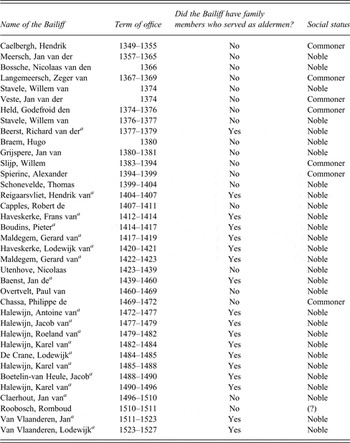
The gradual concentration of power within the political elite that set in during the late fourteenth century was greatly hastened by the changing attitude of the Dukes of Burgundy towards local government in the fifteenth century. By establishing the office of Bailiff in the high middle ages, the Counts of Flanders had developed an exceptionally strong grasp on the countryside. The Count appointed a Bailiff in each rural district, and endowed him with the authority to intervene directly, on the Count's behalf, in many important aspects of local society. Apart from prosecuting criminal suspects and upholding the rule of law in tandem with the local aldermen, the Bailiff was involved in the annual audit of the accounts of the castellany by the Count's officers. Furthermore, the Bailiff also acted as president of the feudal court of the castellany, the institution which dealt with any transactions concerning fiefs. Given that a fief could be transferred in its entirety to the oldest male heir, feudal properties were often the cornerstone of an elite family's patrimony and the Bailiff thus had oversight of the power base of the landed elites.Footnote 45 All this should have made the Bailiff a counterweight to the aldermen within his castellany, since he was appointed and dismissed by the count alone. From the late fourteenth century onwards, however, the political elite of the Liberty managed to liberate themselves from scrutiny or oversight, by colonising the office of their Bailiff. At root, the cause of this development was the absorption of Flanders into the Burgundian Low Countries. The Valois Dukes of Burgundy were constantly in need of funds to prosecute their wars, and over time, they not only succumbed to the attempts of local elites to gain privileges in return for cash, but also began to lease out local offices to the highest bidder, who often came from the very castellany where the office was to be held. Because the Bailiff was supposed to act as the Count's watchdog a man could not, in principle, serve as Bailiff in his home region, as he was likely to share the vested interests of some local family or faction. However, the Burgundian rulers were not in a position to be able to refuse the considerable sums offered, either as ‘loans' or direct leases, by individuals wishing to wield the Bailiff's powers within their own castellany.Footnote 46 Unsurprisingly, ambitious noblemen were the first to use their wealth to augment their power as local lords and large-scale landowners by taking up the role of Bailiff. This is made clear in Table 3, where those holding the office of comital Bailiff in the Liberty of Bruges, between 1350 and 1525 are listed along with their social status.
Individuals holding the post of comital Bailiff in the Liberty of Bruges 1350–1525

a Individuals who were members of the ‘core’ political families of the Liberty.
Sources: Based on the data edited in H. Nowé, Les baillis comtaux de Flandre des origines à la fin du XIVe siècle (Brussels, 1929), 370–408 and J. Van Rompaey, Het grafelijk baljuwsambt in Vlaanderen tijdens de Bourgondische periode (Brussels, 1967), 614–52 as well as on the surviving accounts listed in L. P. Gachard, Inventaire des archives des Chambres des Comptes, précédé d'une notice historique sur ces anciennes institutions II (Brussels, 1837–1851), 345–431.
In the fourteenth century commoners often served as Bailiff in the Liberty of Bruges, since competence and loyalty were the key criteria sought by the count when appointing someone to the office. However, in the fifteenth century, the office gradually became the prerogative of the nobility, and, more importantly, was increasingly assigned to members of the families who formed the Liberty's political elite. The names of the latter are highlighted in Table 3.
This development does not imply that the Burgundian Dukes completely lost interest in government at the local level. In 1464, the ducal administration imposed new regulations on the financial management of the castellany as well as on the appointment of the burgomasters (the aldermen who served as presidents of the Council of aldermen).Footnote 47 In addition, from the second half of the fifteenth century onwards, the Duke was increasingly likely to appoint a trusted courtier as an alderman of the Liberty. For example, Philip the Good appointed William of Bavaria as an alderman. William, who also served Philip as Admiral of Holland and Supreme Chamberlain, was a bastard son of the Duke of Bavaria.Footnote 48 The elite did not always object to such outsiders, as the latter often had sufficient wealth, status and useful contacts at court to integrate smoothly into elite ranks, while providing the Duke with an ear to the ground. Yet, generally speaking, the Duke of Burgundy increasingly relied on local elites who, in return for providing the state with financial and military support, were very much given a free rein to govern their home region as they saw fit. This arrangement fitted well with the image the nobility had of themselves as a group with the God-given mission of co-ruling the realm alongside the prince.Footnote 49 A prime example of this new relationship between local and central government within the Liberty is the Van Halewijn lineage. Apart from having representatives amongst the Liberty's aldermen, the family acquired the local village lordships of Capelle, Koekelare, Uitkerke, Maldegem, Merkem and Zwevezele. For almost a quarter of a century from 1472 onwards, the Van Halewijns also held the office of Bailiff of the Liberty as something close to a private fiefdom; some five members of the family holding office for a total of 21 years. In return for the Prince turning a blind eye to this situation, the family was fiercely loyal to the Habsburg government during the civil war of the 1480s, although their grasp over the office of Bailiff was temporarily broken by the rebels. In 1496, the Van Halewijns eventually lost the position of Bailiff to the equally prominent Van Claerhout clan, but this may be considered as no loss at all as, around 1500, one Catharina van Halewijn had married into the Van Claerhout family and at a later date, Jeanne van Halewijn (d.1552), the lady of Maldegem and Uitkerke, would marry Willem van Claerhout, lord of Pittem and Koolskamp.Footnote 50 The networks of the elite families were not, of course, free from dissent, antagonism or outright rivalry, but nothing in our sources suggests that this threatened the progressive concentration of power into an increasingly smaller number of hands in any fundamental way.Footnote 51 In any case, the office of Bailiff was no longer an impediment to oligarchy within the Liberty: it had become its instrument.
5. THE STRENGTHENING OF REGIONAL POLITICAL ELITES
Between 1350 and 1525, the Liberty saw a growing overlap between the groups that wielded power as aldermen, those that ruled as seigniorial lords, and the officials who represented the Count of Flanders. A further contribution to what was a fundamental transformation of the social and political organisation of the Liberty was the changing nature of the nobility itself. Between 1350 and 1500, as noble families from the Liberty became increasingly dominant within the government of the castellany, the Flemish nobility was also developing an increasingly strong involvement with urban society. Over this 150-year period, the proportion of the Flemish nobility who were involved in the governance of a town increased from 12 per cent of all noble lineages to at least 44 per cent. In addition, many nobles began to lead an urban lifestyle, even if they did not take up a post as an alderman of a town or city. Indeed, many noblemen of the Liberty, such as the lords of Maldegem, Gistel and Halewijn, not only had residences on their country estates, but also owned mansions in Bruges. This urbanisation of the nobility may have led to greater economic differentiation between the nobles and the lower ranks of the rural elites. While it would be erroneous to assume that the emerging ‘rural bourgeoisie’ limited its activities to agriculture, it is questionable whether they actively engaged in the urban economy to the extent that an increasing number of noble families did, the latter being involved in a whole range of activities in the towns ranging from commerce to export-oriented craft guild production and the lease of urban taxes. What is certain is that eventually a social barrier was erected between rich country dwellers and the nobility as the latter increasingly preferred to marry their daughters to the scions of leading urban families. As marriage was a key strategy when attempting to attain ennoblement, the nobility ceased to recruit new blood from the countryside: of the 17 families that were elevated to the nobility in the last quarter of the fifteenth century, only 1 did not with certainty belong to the elite of a Flemish town.Footnote 52
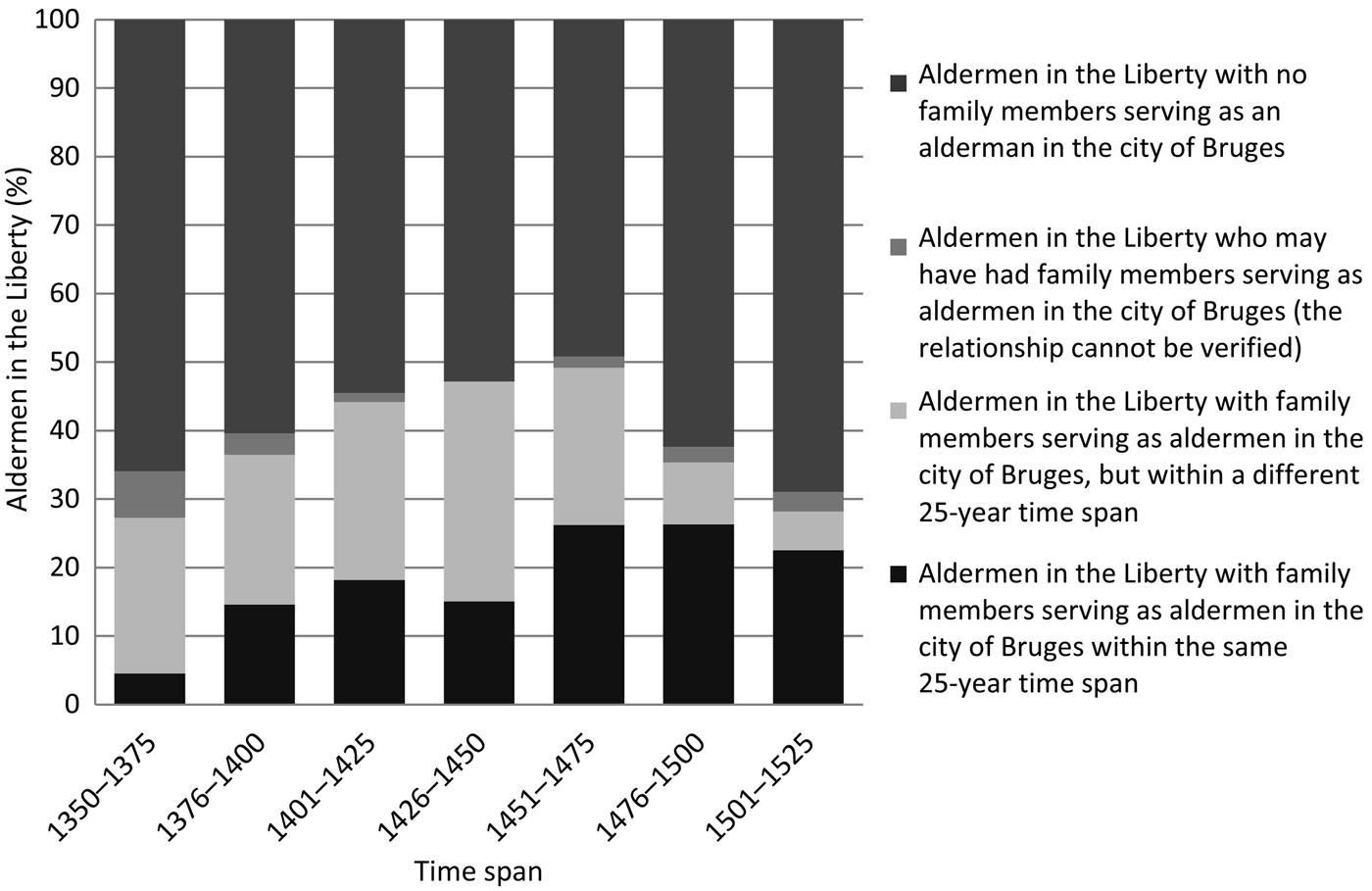
The growing dominance of a city-oriented nobility also contributed to another structural shift within the class ruling the Liberty of Bruges; namely that it became less local, and more regional in nature. Geographically speaking, the range of action of the elite widened considerably, as its members became increasingly active in political institutions situated outside the borders of the Liberty. A good measure of this development is the overlap between the aldermen of the Liberty and those of Bruges, by far the most important city in coastal Flanders. Members of the political elite of the Liberty were, by definition, familiar with the city, since the meetings of the aldermen from the castellany traditionally took place on the Burg square in Bruges, where the Town Hall housing the Bruges aldermen was situated. Over the course of the fifteenth and sixteenth centuries, increasingly imposing edifices were built on the Burg to house the administration of the Liberty.Footnote 53 Yet, as Figure 2 shows, at least some of the political dynasties of the Liberty – not all of them noble –made a point of having at least one representative on the Bruges city council, and the relative share of these families grew over time.Footnote 54
Proportion of aldermen of the Liberty of Bruges who had family members serving as an alderman in the city of Bruges, by 25-year periods, 1350–1500. The number of aldermen in each 25-year period is given in Table 1.
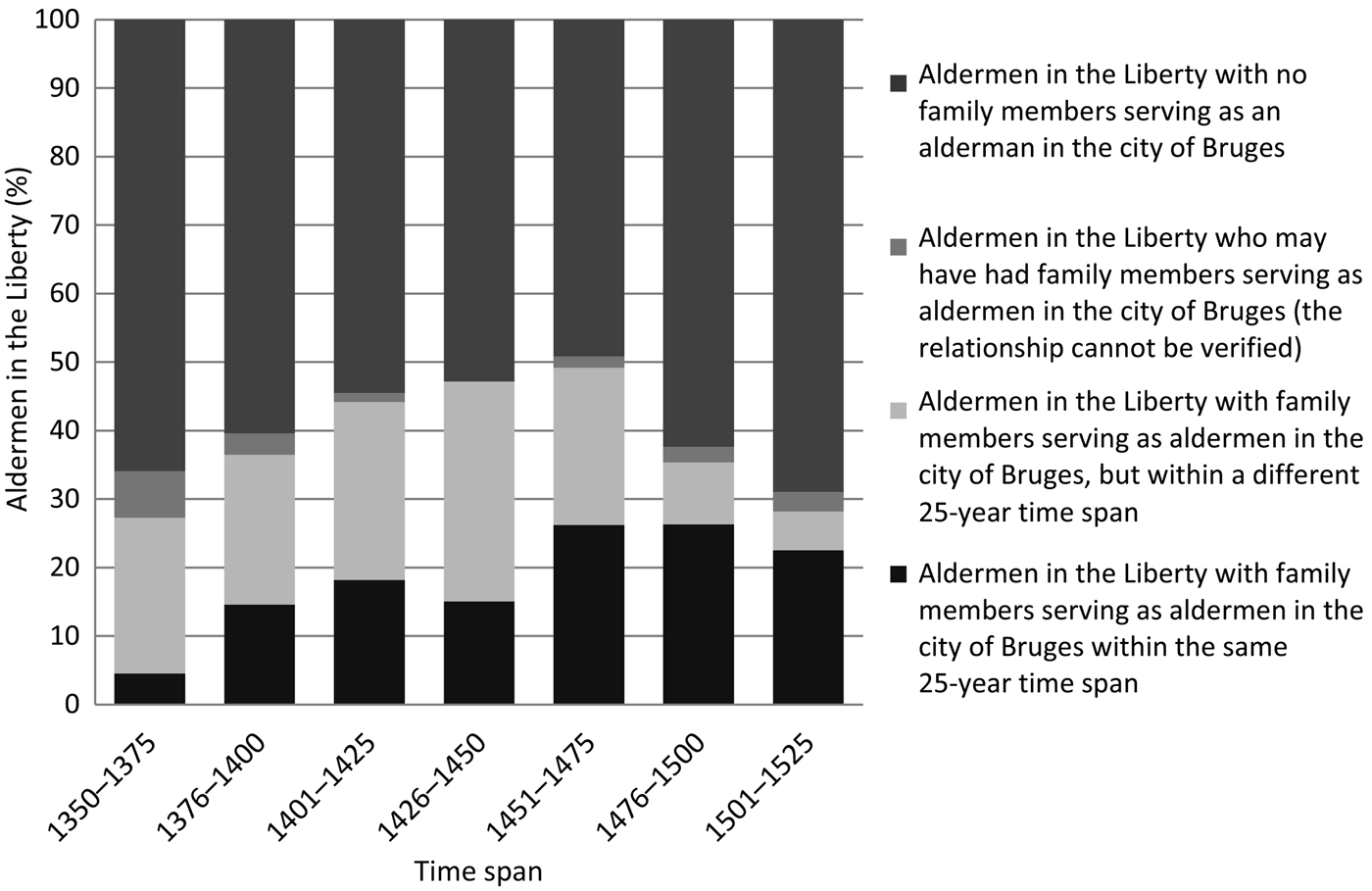
In the late fourteenth and early fifteenth century, the number of aldermen in the Liberty shrank in size but the proportion of aldermen who belonged to families which had one member holding a position in the Liberty and another family member holding a position in the city of Bruges within the same quarter century rose significantly over time, from something close to 5 per cent in the third quarter of the 1300s to over 20 per cent from the 1450s onwards. In addition, there was a significant group of families who shifted their interests over time, either moving from castellany politics to city politics or the other way around, or alternating between both arenas. All this suggests a situation in which the ruling classes of town and country were becoming increasingly entwined, particularly as greater numbers of city dwellers were acquiring rural properties, just as country dwellers were taking possession of footholds in their nearest town or nearby city.Footnote 55
Although this trend may be considered to reflect the growing concentration of various forms of power within the Liberty itself, caution is in order. Unlike the case of the office of Bailiff, the growing commitment of leading families from the Liberty to the Bruges city council did not undermine the autonomy of the urban government. Perhaps rural concerns were voiced somewhat more loudly and more regularly when the Bruges aldermen gathered, but they would never dominate urban politics. With 26 seats, the Bruges city council was quite large compared with that of most other Flemish towns. Also, an alderman could only hold office for one year and was then prohibited from serving in the role for the next year. This, together with the right of the craft guilds to provide a number of aldermen, meant that the turnover within the political elite of Bruges was very high. As a consequence, the Bruges city council was able to absorb the growing number of aldermen hailing from the Liberty without any risk of becoming overwhelmed by them. Even in 1476–1500, when the cluster of families with members simultaneously active in the Liberty and in Bruges accounted for 25 per cent of the aldermen in the Liberty, the same group provided less than 10 per cent of the Bruges city council. The effects of the growing overlap between the elites from the town and countryside were thus asymmetrical, the impact being much greater outside the city walls than within. It is likely that the situation in Bruges was exceptional, not only because it was by far the largest and wealthiest city in coastal Flanders, but also because it was one of the Four Members of Flanders. The idea of being simultaneously active in two of the Four Members must have held great appeal for politically ambitious families, particularly as it increased their importance in the eyes of the Prince, who had every incentive to woo leading figures within each of the Four Members to speak in favour of granting any aides he had requested. The Prince would have had no such incentive to ingratiate himself with the aldermen of any other city in coastal Flanders, as none of them carried any weight in the fiscal organisation of the county. Yet, the scattered evidence from the smaller towns of the Liberty shows that at least some families made a point of not only providing aldermen for the castellany, but also taking a seat, or seats, on the council of a small town. Piecemeal evidence of such behaviour survives, for example, for the noble De Baenst and Van Boneem families, from the towns of Sluis and Damme, respectively, and for the commoner van der Baerle, De Goes and Moenac families who provided aldermen to the towns of Aardenburg, Oudenburg and Gistel.Footnote 56
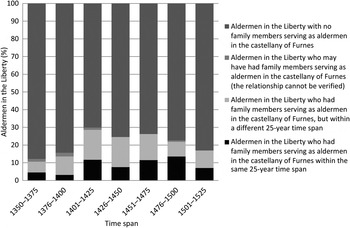
Analysis of the relations between the elites from the Liberty and from the adjacent castellany of Furnes confirms that the former increasingly diversified the basis of their power not only by integrating with the elite of the county's towns, but also with those in power in the neighbouring castellanies (see Figure 3).
Proportion of aldermen of the Liberty of Bruges who had family members serving as an alderman in the castellany of Furnes, by 25-year periods, 1350–1500. The number of aldermen in each 25-year period is given in Table 1.

Though the vast majority of aldermen in the Liberty from 1350 to 1500 came from families that had no direct interest in the governance of the castellany of Furnes, there was a small group of families which supplied aldermen to both castellanies simultaneously, along with families which switched their attention from first one castellany then to the other, or alternated between both. Such overlaps between the administrative bodies of the two castellanies were not, as yet, a frequent occurrence, but the number of families whose horizon surpassed the boundaries of a single castellany doubled in the first quarter of the fifteenth century and then remained stable at more or less 20 per cent of the aldermen for the next century. The existence of elite networks which straddled the ruling bodies of a wide range of cities and rural districts has already been documented for the early modern era but we believe we have now demonstrated, at least for coastal Flanders, that such networks can be traced back to the late middle ages, when, in the Liberty of Bruges, rural government was essentially regional, rather than local, in nature.
6. CONCLUSIONS
From a European perspective, the Liberty of Bruges is important because it sheds light on a complex facet of state formation on the continent, namely the relationship between the centre of a state and its periphery and the potential this holds for both co-operation and antagonism. Our case study has revealed one scenario in which the unification of a large number of principalities under the control of one princely state and the geopolitical competition between western European states stimulated a trend towards oligarchy in one particular region. The fourteenth-century Counts of Flanders were determined to have a strong, direct grasp on the local government of castellanies such as the Liberty of Bruges, but their fifteenth-century successors, the Burgundian Valois and the House of Habsburg, changed tack, and allowed local elites to dominate rural society as long as they were willing to support and finance the aims and objectives of their Burgundian–Habsburg rulers. The unification of the Low Countries under Burgundian rule not only forced the consecutive Dukes of Burgundy to divide their attention between an increasing number of principalities, but it also meant that they suffered from a chronic lack of funds with which to defend this new power bloc against France, England, the German Empire and so on. Some families and individuals in the Liberty of Bruges were quick to see and grasp the resultant opportunities, with far-reaching consequences. A complex mixture of noble lineages and allied families of more common status came to dominate rural government at the expense of others in the Liberty. In the long run, this reinforced the Prince's government, as the successful rural elites henceforth had a vested interest in the survival of the ruling dynasty. Yet, there was also the recurrent danger that the same elites would defend their own interests and undermine the Prince's authority. In the civil war of the 1480s, for example, Maximilian of Austria was firmly supported by the Van Halewijn family, as discussed above, whereas the De Baenst clan were rather more divided, some members supporting Maximilian, while others joined the revolt in order to secure their power base and properties.Footnote 57 When local elites became estranged from their prince through religious or ideological dissent – as would happen during the Dutch Revolt, which began in the 1560s – the central government suddenly lost its power base in the peripheral regions. If the transformation of rural government observed in coastal Flanders can be found in other parts of the Low Countries and western Europe in general, it would help to explain how in the late middle ages the central government could become stronger, but also more fragile.
The case study reported here also makes it clear that the history of the ‘rural bourgeoisie’, a subject currently at the forefront of scholarly debate, cannot be written without consideration of contemporaneous developments in urbanisation and state formation, even if well-to-do country dwellers may have had little truck with either city or state in the course of their daily lives. In the Liberty of Bruges, the nobility, the city and the state all had a decisive impact on the nature of the rural bourgeoisie as a social group. Although wealthy landowners, rentiers, tenant farmers, local merchants and officials grew in numbers, their political potential was largely sapped as processes of state formation tipped the local balance of power towards noblemen who exploited the financial and military needs of the Prince in order to maintain or to strengthen their position of power as society changed. When the nobles adapted to the rise of a strong network of urban centres by merging with the elites from the urban areas this put a final lid on the social aspirations of the rural bourgeoisie. Whereas wealthy commoners from the rural areas continuously reinforced the ranks of the English gentry or the French nobility,Footnote 58 this did not happen in the Liberty, where noble families increasingly preferred to ally themselves with city dwellers. Around 1350, the political elite of the Liberty was a socially inchoate mixture of nobles, old families of common status which provided aldermen, and well-to-do landowners, but it gradually evolved into two distinct layers. While the upper layer nourished an increasingly ‘regional’ perspective, straddling both town and countryside, the lower layer became more coherent in that its political activities were increasingly limited to the world of the parish and local water management. By the seventeenth century contemporaries clearly perceived the latter group as a specific social category, quite distinct from the regional elite.Footnote 59 Of course, the ‘upper’ and ‘lower’ strata never fully separated, as they were tied together by their shared interests as large-scale landowners. Nevertheless, few members of the landed classes would have missed the emergence at the turn of the fifteenth century of a high-status cluster of families and individuals – however vague and permeable at the fringes – that thereafter combined the powers of the aldermen, the seigniorial lords and the Count's Bailiff in ways which would have been unthinkable in the early fourteenth century.
ACKNOWLEDGEMENTS
The authors would like to thank Tjamke Snijders, Valeria Van Camp and their colleagues at Vrije Universiteit Brussel and Ghent University.