Eight components with the greatest positive impact for interventions to promote hand hygiene (HH) in healthcare workers (HCWs) have been identified in a large systematic reviewReference Luangasanatip, Hongsuwan and Limmathurotsakul 1 : system change (ensuring necessary infrastructure such as availability of alcohol-based hand rub dispensers), education and training, feedback, workplace reminders, institutional safety climate, goal setting, reward incentives, and accountability. We developed a multidimensional intervention to promote HH compliance among HCWs and to improve quality of individual HH. Briefly, a user-friendly innovative online platform including an anonymous feedback mechanism was linked to onsite training, education of staff, and microbiologic testing of HH performance measuring total hand bioburden (THB) as the monitoring end point. We integrated all but one of the identified components to design our intervention to promote HH in HCWs. System change in the sense of ensuring availability of alcohol-based hand rub dispensers was not changed by our intervention.
METHODS
The THB of participants was determined by using the whole-hand sampling technique modified from Fuls et al,Reference Fuls, Rodgers and Fischler 2 using 250 mL of 3% Tween 80 (Merck) in 0.9% NaCl solution and sterile plastic bags. After recovery of bacterial contaminants by filtration through a 0.45-µm nitrocellulose-membrane-filter (Sartorius Stedim) and subsequent culture on Columbia blood agar plates (bioMérieux) for 24 hours at 37°C, colony-forming units (CFUs) were counted and cultures were checked for growth of pathogenic bacteria. Results were categorized according to the developed categorization scheme (Supplementary Table 1). An overall average result was created, containing descriptive statistics for all participants and/or wards as well as anonymized data of comparable hospital units. Individual results were provided to the participants within 3 working days after sampling, using an online query extension based on the content management system Typo3 including the colony counts and an individual evaluation score (Supplementary Table 1). The assessments were performed unannounced both in the student as well as in the HCW group. In the hospital setting the online feedback additionally included an invitation for review of personal HH practices if colony counts were at least 1,000 CFU or if pathogenic bacteria were detected. A link to educational material for correct performance of HH, as promoted by the World Health Organization, was also provided.
In order to determine the baseline THB and effects of our intervention in untrained individuals, we performed an unannounced first test run within a cohort of 66 medical students to validate the method. After the THB assessment each participant was invited to conduct a quality assessment of his or her personal HH technique using a standard visual test. No additional training and education were offered to the students before the reassessment in order to exclude unspecific bias. The reassessment was performed 2 days after providing the results. Additionally, students were asked for their subjective rating of the quality of their individual HH after assessments using an audience response system (TED).Reference Kuhbeck, Engelhardt and Sarikas 3
Infection control nurses visited the ward unannounced and evaluated current HH performance of HCWs. Each HCW was also invited to conduct a quality assessment of his or her personal HH technique using a standard visual test. After results for all participating HCWs of the respective ward were available, overall results including the overall average grade in comparison with other anonymized wards of the university hospital, as well as a short teaching session, were provided to the participants during an information session. To evaluate mid-term and long-term effects of the multidimensional intervention, subsequent unannounced reassessments of THB, without subsequent application of feedback tool and educational measures, were performed after 4 weeks and 24 weeks, respectively.
The incidence of nosocomial Staphylococcus aureus cases is an accepted quality indicator for HH. We analyzed the impact of the multidimensional HH intervention on the number of nosocomial S. aureus cases 24 weeks before and 24 weeks after the implementation of the intervention in 1 ICU. All inpatients were screened weekly for S. aureus acquisition by using nasal and rectal swabs. All isolates detected at least 48 hours after admission were defined as healthcare-acquired.
RESULTS
The mean (SD) contamination rate on the hands of the 66 medical students without prior hand disinfection was 115,951 (188,981) CFU. The evaluation scheme (Supplementary Figure S1) was therefore adapted to a mean colony count of approximately 100,000 CFU on hands without prior performance of HH measures. The grading was adapted based on European Standard EN1500, “Chemical disinfectants and antiseptics—Hygienic handrub,” which defines a log10 reduction factor of greater than 3 and the absence of pathogenic bacteria on participants’ hands as an effective performance of HH. Thus, colony counts less than 100 CFUs (mean native CFU count /103) were regarded as optimal (grade A); less than 1,000 CFUs as acceptable (grade B); less than 10,000 CFUs as barely tolerable (grade C) but improvement and teaching is needed; and colony counts up to 100,000 CFUs as insufficient (grade D), indicating that HH was performed infrequently or without adequate technique. Colony counts greater than 100,000 CFU (grade E) thus correspond to a very high bioburden that indicated that HH was never performed routinely or sufficiently before testing. The detection of pathogenic bacteria on hands, such as pathogens commonly causing healthcare-associated infections, was regarded as intolerable and directly led to the worst grade (grade F). Interestingly, the self-evaluation results of HH performance, using the audience response system, showed that 60% of the students estimated the quality of their personal HH as rather good, whereas only 7% actually had acceptable results of less than 10,000 CFU according to our newly developed evaluation scheme.
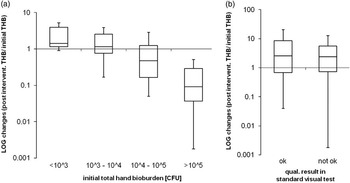
When analyzing the effects of the multidimensional HH intervention on medical students, participants with reported colony counts of higher than 105 CFU showed a significant reduction of CFU counts at the reassessment (P<.05). Participants with colony counts between 103 and 105 CFU also showed a nonsignificant trend to reduction of colony counts. Participants with initial colony counts between 0 and 103 CFU, however, showed no significant changes in bacterial counts in the reassessment (Figure 1A). In contrast, no significant improvement of colony counts in the reassessment was yielded by negative direct feedback in the standard visual tests (Figure 1B). All participants, students as well as HCWs, used the online platform to check their results.
Validation of the specific efficacy of the hand hygiene assessment tool in a cohort of untrained medical students (n=66). A. Effects of the online feedback are depicted as log-changes of total hand bioburden (THB) (individual postinterventional THB divided by initial THB prior to intervention). B. Effects of hand hygiene evaluation by standard visual test and qualitative feedback OK (both hands were completely covered with disinfectant hand rub) versus not OK (hands were only discontinuously covered with disinfectant hand rub) depicted as log-changes of THB (individual postinterventional THB divided by initial THB prior to intervention). CFU, colony-forming units.

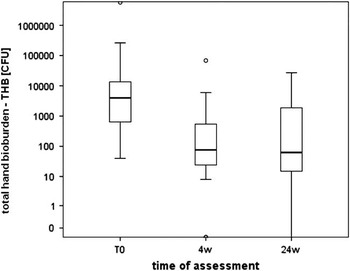
To evaluate the efficacy and applicability of the intervention in real life, 28 HCWs participated in the study. Initially, a total of 28 HH assessments were performed followed by 26 reassessments 4 weeks after the first investigation (first time after training) and 24 observations were made 24 weeks after the first assessment (second time after training) for determination of long-term efficacy. Colony counts on HCW hands were significantly (P<.05) reduced in the reevaluations. Median (interquartile range) colony counts were 40,000 (136,900) CFU, 760 (12,500) CFU, and 1,000 (22,362) CFU at time point 0, after 4 weeks, and after 24 weeks, respectively (Figure 2). The mean (SD) number of nosocomial S. aureus cases as a quality indicator for HH was significantly (P<.04) reduced after the intervention (1.35 [0.68] cases/100 screenings per month) compared with before the intervention (1.65 [1.22] cases/100 screenings per month).
Validation of the specific efficacy of the hand hygiene assessment tool accompanied by additional educational measures in a cohort of healthcare workers (n=28). Results are depicted as distribution of total hand bioburden (THB) (in colony-forming units [CFU]) of healthcare workers in initial hand hygiene assessment (T0) as well as in reevaluations conducted 4 weeks and 24 weeks after the first assessment or feedback intervention, respectively.

DISCUSSION
Our intervention including a user-friendly online platform for prompt anonymous feedback, laboratory testing, and onsite training was able to significantly improve compliance and performance of HH among HCWs even for a prolonged time. The newly developed tool seems to have a positive effect on HH compliance especially in participants with limited compliance before the assessment. Participants who already had high compliance with HH before the intervention did not show any decreasing trend. The included reward incentive, namely receiving a grade for good or bad HH compliance and quality, may provide motivation to either keep an initially received good grade or try to get a better one. However, the self-evaluation test of the medical students and the actual results of the HH performance test clearly indicated a discrepancy between self-evaluation and objective quality level of HH. Continual education can be successful only if it is linked to feedback mechanisms integrating both quality and compliance measures. Automated feedback systems based only on continuous monitoring of disinfectant consumption are lacking such quality data.Reference Marra, Sampaio Camargo and Magnus 4 Effects of direct observation or personal feedback, on the other hand, are problematic since they usually have only short-term effects.Reference Lehotsky, Szilagyi and Ferenci 5 , Reference Walker, Sistrunk and Higginbotham 6
Our whole-hand sampling method to assess bacterial bioburden on hands removes limitations of other commonly used methods. However, our study has some minor limitations. First, no breakpoints for colony counts and detection of pathogenic bacteria on hands for evaluation of HH performance were available so we had to develop a new arbitrary grading system (Supplementary Table S1). The evaluation scheme proposed by our study therefore has to be implemented in other hospitals to validate its effects. Second, even though wards were visited unannounced, once at the wards, HCWs obviously knew that they were tested. Thus, we cannot completely rule out the Hawthorne effect. Since our test does measure qualitative and quantitative outcomes, however, it does provide feedback of the HCWs’ typically performed HH performance technique. Third, when assessing the number of S. aureus cases as a quality indicator for HH, we did not include colonization pressure as a variable because a simple and consistent method to quantify colonization pressure to accurately assess the effect of colonization pressure on cross-transmission is still missing.Reference Ajao, Harris and Roghmann 7
In conclusion, our newly developed multidimensional intervention on HH yielded promising efficacy results in short- and long-term evaluation and in the immediate improvement of the total bioburden on HCW hands. Our intervention fills the gap of standard interventions to improve HH compliance because it also provides individual feedback of the actual quality of the performed HH. This emphasizes that the new tool might represent a powerful option for interventions in HH improvement.
ACKNOWLEDGMENTS
Financial support. None reported.
Potential conflicts of interest. All authors report no conflicts of interest relevant to this article.
SUPPLEMENTARY MATERIAL
To view supplementary material for this article, please visit https://doi.org/doi:10.1017/ice.2016.238