





Introduction
Testing practices for respiratory viral illness in nursing homes (NHs) vary widely and are shaped by differences in staffing capacity, provider training, and facility-level protocols. Rapid antigen tests are commonly used because of their operational simplicity and short turnaround times, enabling timely infection control decisions. When clinical suspicion remains high despite a negative antigen result, respiratory specimens are sent to off-site laboratories for reverse transcription polymerase chain reaction molecular testing. However, off-site testing may delay results by days, during which residents may remain in isolation or receive empiric treatment, potentially contributing to unnecessary medication use, or delayed pathogen-specific interventions.
The increasing availability of CLIA-waived point-of-care (POC) molecular diagnostics has expanded access to more sensitive and specific respiratory virus testing directly within NHs. Despite this progress, rapid molecular testing remains inconsistent. Regulatory requirements, staffing constraints, and cost considerations may contribute to the limited adoption in these settings.
Enhanced surveillance that includes symptom observations has the potential to support earlier outbreak recognition, inform targeted infection prevention responses, and improve clinical and public health decision-making in this high-risk population. The objective of this pilot study was to gather preliminary data on symptoms, short-term outcomes, and selected resident characteristics, using POC molecular testing integrated into routine care, to inform further investigation into the burden of viral respiratory infections among NH residents.
Methods
This pragmatic cohort study enrolled U.S. nursing homes (NHs) across six states (Ohio, Missouri, Indiana, Rhode Island, Virginia, and Pennsylvania). Eligible facilities were Medicare-certified, had at least 50 long-stay residents (defined as residence ≥ 90 days), and agreed to integrate POC molecular testing into routine clinical care.
Each participating NH was provided with and received specialized training on the CLIA-waived multiplex molecular assay (Cepheid® GeneXpert Xpress) capable of detecting influenza A/B, SARS-CoV-2, and respiratory syncytial virus (RSV) with a single anterior nasal swab, along with sufficient testing supplies. Testing was performed as part of standard clinical care, by trained nurses at the discretion of healthcare providers and according to manufacturer instructions. Indications for testing included evaluation of staff-observed or resident-reported symptoms and contact tracing during suspected outbreaks.
At the time of testing, NH staff entered structured symptom selections into the testing interface, which were electronically linked to test results. Results were displayed on-screen after about 34 minutes and transmitted to a secure, manufacturer-managed cloud database. The device displays an error reading if the test is not valid due to incorrect procedures or insufficient testing media. Devices were available for testing all residents and staff. Facilities received testing devices between November 2023 and February 2024, with testing continuing through January 2025.
Thirteen participating NHs in Ohio, Rhode Island, and Virginia retained residual nasal swab respiratory specimens following POC molecular testing for subsequent expanded multiplex respiratory pathogen testing using the NxTAG® Respiratory Pathogen Panel (Luminex®), which detects 22 respiratory pathogens. These findings are summarized descriptively as “Other” pathogens in Table 1.
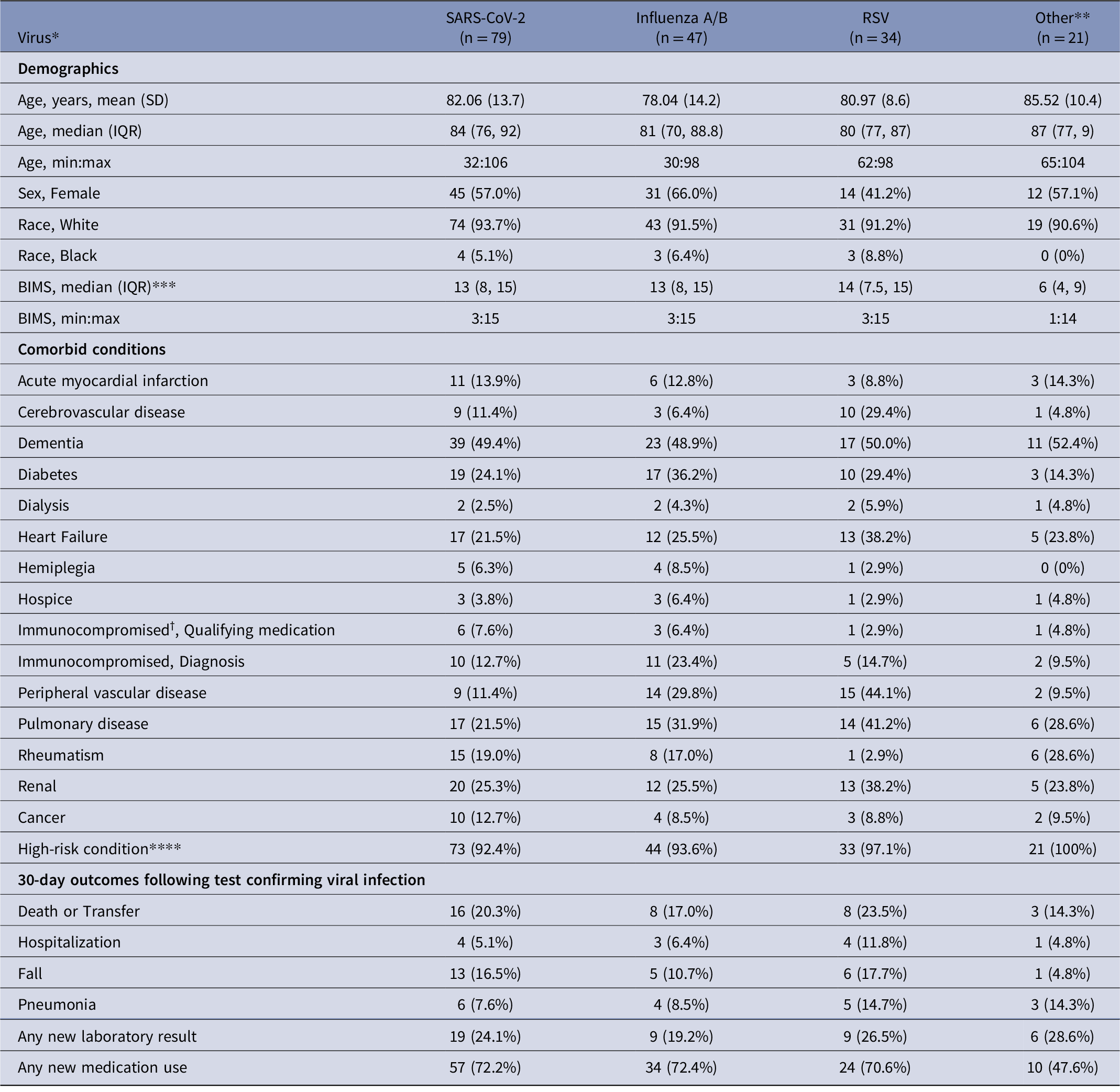
Demographics, comorbid conditions, and 30-day outcomes among long-stay nursing home residents with positive viral testing using expanded panel testing (n = 170)

Long description
The table compares demographics, comorbid conditions, and 30-day outcomes among long-stay nursing home residents with positive viral testing for SARS-CoV-2, Influenza A/B, RSV, and other viruses. It has 28 rows and 5 columns. Column headers are Virus, Demographics, Comorbid conditions, and 30-day outcomes following test confirming viral infection. Row 1: Virus, SARS-CoV-2 (n = 79), Influenza A/B (n = 47), RSV (n = 34), Other (n = 21). Row 2: Age, years, mean (SD), 82.06 (13.7), 78.04 (14.2), 80.97 (8.6), 85.52 (10.4). Row 3: Age, median (IQR), 84 (76, 92), 81 (70, 88.8), 80 (77, 87), 87 (77, 9). Row 4: Age, min:max, 32:106, 30:98, 62:98, 65:104. Row 5: Sex, Female, 45 (57.0%), 31 (66.0%), 14 (41.2%), 12 (57.1%). Row 6: Race, White, 74 (93.7%), 43 (91.5%), 31 (91.2%), 19 (90.6%). Row 7: Race, Black, 4 (5.1%), 3 (6.4%), 3 (8.8%), 0 (0.0%). Row 8: BIMS, median (IQR), 13 (8, 15), 13 (8, 15), 14 (7.5, 15), 6 (4, 9). Row 9: BIMS, min:max, 3:15, 3:15, 3:15, 1:14. Row 10: Acute myocardial infarction, 11 (13.9%), 6 (12.8%), 3 (8.8%), 3 (14.3%). Row 11: Cerebrovascular disease, 9 (11.4%), 3 (6.4%), 10 (29.4%), 1 (4.8%). Row 12: Dementia, 39 (49.4%), 23 (48.9%), 17 (50.0%), 11 (52.4%). Row 13: Diabetes, 19 (24.1%), 17 (36.2%), 10 (29.4%), 3 (14.3%). Row 14: Dialysis, 2 (2.5%), 2 (4.3%), 2 (5.9%), 1 (4.8%). Row 15: Heart Failure, 17 (21.5%), 12 (25.5%), 13 (38.2%), 5 (23.8%). Row 16: Hemiplegia, 5 (6.3%), 4 (8.5%), 1 (2.9%), 0 (0.0%). Row 17: Hospice, 3 (3.8%), 3 (6.4%), 1 (2.9%), 1 (4.8%). Row 18: Immunocompromised, Qualifying medication, 6 (7.6%), 3 (6.4%), 1 (2.9%), 1 (4.8%). Row 19: Immunocompromised, Diagnosis, 10 (12.7%), 11 (23.4%), 5 (14.7%), 2 (9.5%). Row 20: Peripheral vascular disease, 9 (11.4%), 14 (29.8%), 15 (44.1%), 2 (9.5%). Row 21: Pulmonary disease, 17 (21.5%), 15 (31.9%), 14 (41.2%), 6 (28.6%). Row 22: Rheumatism, 15 (19.0%), 8 (17.0%), 1 (2.9%), 6 (28.6%). Row 23: Renal, 20 (25.3%), 12 (25.5%), 13 (38.2%), 5 (23.8%). Row 24: Cancer, 10 (12.7%), 4 (8.5%), 3 (8.8%), 2 (9.5%). Row 25: High-risk condition, 73 (92.4%), 44 (93.6%), 33 (97.1%), 21 (100%). Row 26: 30-day outcomes following test confirming viral infection, Death or Transfer, 16 (20.3%), 8 (17.0%), 8 (23.5%), 3 (14.3%). Row 27: 30-day outcomes following test confirming viral infection, Hospitalization, 4 (5.1%), 3 (6.4%), 4 (11.8%), 1 (4.8%). Row 28: 30-day outcomes following test confirming viral infection, Fall, 13 (16.5%), 5 (10.7%), 6 (17.7%), 1 (4.8%). Row 29: 30-day outcomes following test confirming viral infection, Pneumonia, 6 (7.6%), 4 (8.5%), 5 (14.7%), 3 (14.3%). Row 30: 30-day outcomes following test confirming viral infection, Any new laboratory result, 19 (24.1%), 9 (19.2%), 9 (26.5%), 6 (28.6%). Row 31: 30-day outcomes following test confirming viral infection, Any new medication use, 57 (72.2%), 34 (72.4%), 24 (70.6%), 10 (47.6%).
* Columns sum>170 because of concomitant infections; 11 samples were positive for more than one pathogen.
** Parainfluenza = 10; human metapneumovirus = 9, Coronavirus 229/OC42 = 9, Bocavirus = 1, C. pneumoniae = 1.
*** BIMS = Brief Interview of Mental Status (scored as 13–15 cognitively intact, 8–12 moderate cognitive impairment, 0–7 severe cognitive impairment).
**** CDC “high-risk” conditions associated with poor health outcomes with COVID-19 infection.2
† Based on CDC guidance.1
For long-stay residents with confirmed viral infection, demographic characteristics, comorbid conditions, symptom documentation at the time of testing, immunosuppressive medications, new medication prescriptions, vital signs, laboratory results, diagnoses, and Minimum Data Set (MDS 3.0) assessments and outcomes were abstracted from individual resident electronic health records. Residents were considered immunocompromised if they met the criteria outlined in CDC guidance.1 All data were entered into a harmonized REDCap database managed by the Ohio and Rhode Island study sites. Analyses were descriptive, reflecting the pragmatic study design and variability in testing practices. The study protocol was reviewed and approved by an Institutional Review Board and determined to be minimal risk (WCG:210234056).
Results
Twenty-three NHs participated in the study. Between November 20, 2023, and January 31, 2025, 1,745 point-of-care (POC) molecular tests were performed, of which 360 (20.7%) detected at least one respiratory virus, including SARS-CoV-2 (n = 160, 9.2%), influenza A (n = 111, 6.4%), influenza B (n = 4, 0.2%), RSV (n = 81, 4.7%), and coinfections (n = 4, 0.2%). Of the 360 positive tests, 170 occurred in long-stay residents; demographic and clinical characteristics of these residents are shown in Table 1. The remaining 190 tests were for short-stay residents and staff members, for whom expanded demographic and clinical data collection was not feasible.
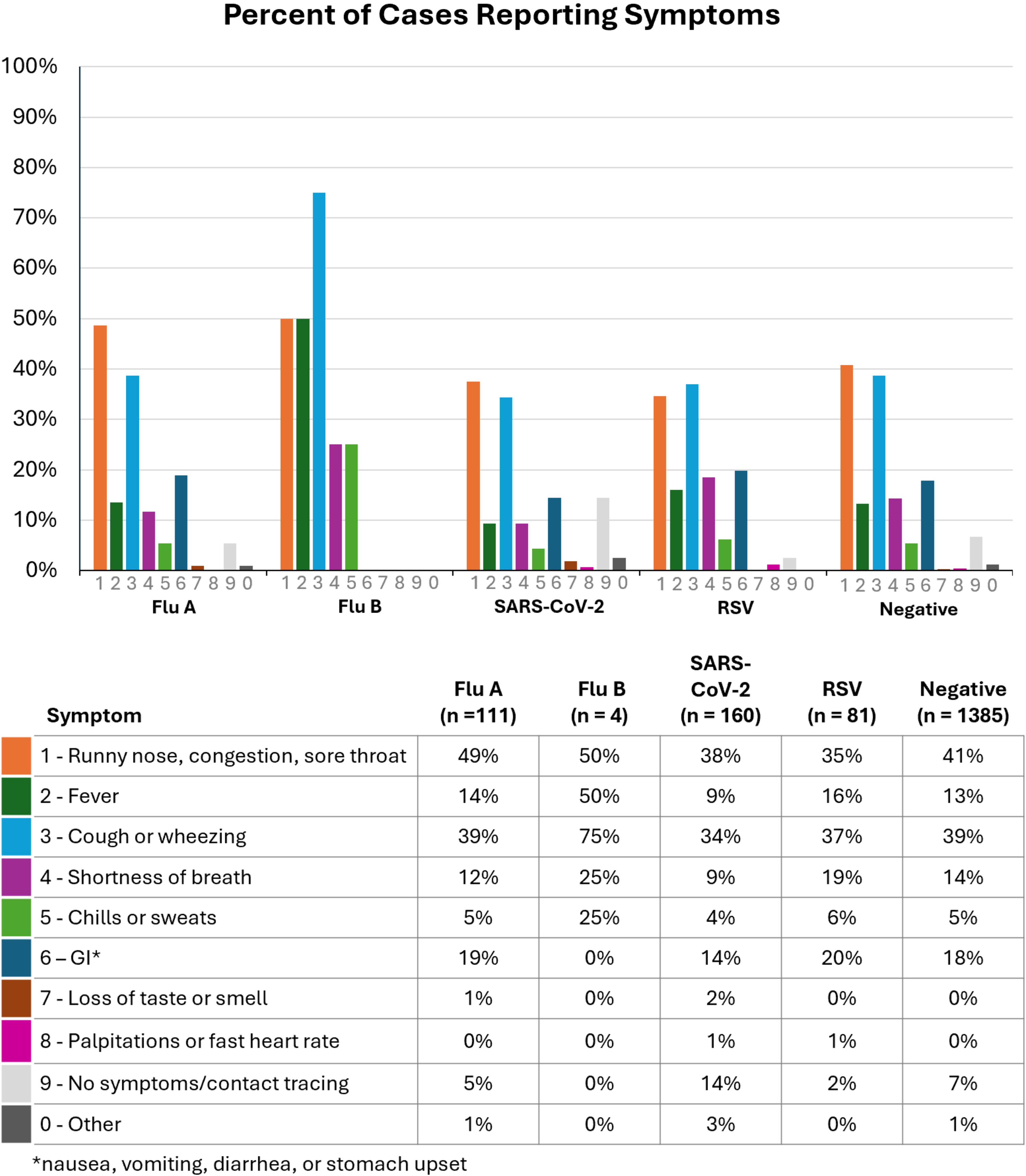
Symptom data were documented for 99.9% of all valid tests and reflected cross-sectional assessment at the time of testing (Figure 1). Symptom patterns overlapped substantially across viral etiologies. Cough/wheezing and runny nose/sore throat were pervasive across all pathogens, limiting their discriminatory value. Fever was infrequently documented overall but occurred more often among residents with influenza (15%) and RSV (16%) than among those with SARS-CoV-2 infection (9%). Loss of taste or smell was rarely reported among SARS-CoV-2 cases (2%). Shortness of breath was most frequently documented among RSV infections (19%). Gastrointestinal symptoms were reported least frequently among SARS-CoV-2 cases (14%) and most frequently in RSV cases (20%). Fourteen percent of SARS-CoV-2 positive residents had no symptoms recorded, consistent with testing performed for contact tracing.
symptoms reported by pathogen detected using POC molecular testing (n = 360).

Residents with confirmed infection had a mean age of approximately 80 years (range, 30–104 years) and were predominantly white (Table 1).
Discussion
Integration of POC molecular testing into routine workflows proved feasible and operationally sustainable across diverse facilities. Over 14 months, testing identified SARS-CoV-2, influenza, and RSV among residents, demonstrating that real-time pathogen detection can be embedded within standard operations. POC molecular testing was relatively quick (approximately 34 minutes). However, the need to run several tests simultaneously during early stages of respiratory outbreaks led facilities to use a hybrid testing approach, using POC molecular testing for initial cases followed by faster and less expensive rapid antigen tests for subsequent suspected infections, particularly for SARS-CoV-2. The device can be configured to run up to 4 tests at a time, but at an additional expense. These findings show that POC diagnostics can strengthen surveillance in settings where delays and limited resources hinder timely infection identification.
Residents with confirmed infection reflected typical U.S. NH populations, with high rates of dementia and chronic cardiopulmonary disease. Over 90% met CDC criteria for severe respiratory risk,2 underscoring the importance of timely pathogen identification in this setting.
Symptom data captured at the time of POC testing represented operational decision points, the initial clinical information available to guide testing decisions, and does not reflect complete characterization of an individual’s illness trajectory. Overlapping symptom patterns across pathogens reinforces limits on symptom-based screening to distinguish viral etiologies in older adults. Fever was infrequent, consistent with IDSA guidelines that highlight that older adults often manifest infection with absent or blunted febrile responses,Reference High, Bradley and Gravenstein3 and chemosensory symptoms were rare among SARS-CoV-2 cases, reflecting reduced and evolving discriminatory value.Reference Reiter, Coelho, French and Costanzo4 RSV infections more often involved shortness of breath, aligning with prior observations.Reference Nguyen-Van-Tam and Martin5,Reference Panozzo, Walsh and Yang6
Integrating structured symptom documentation with POC molecular testing represents a pragmatic approach to syndromic surveillance within NHs, where traditional reporting mechanisms are often delayed or aggregated. This study has limitations, including clinician-directed testing, cross-sectional symptom capture, and limited expanded pathogen testing. Despite these constraints, our findings demonstrate the operational value and feasibility of POC molecular diagnostics in strengthening surveillance, supporting earlier outbreak detection, and informing clinical decision making in high-risk long-term care settings.Reference van den Wijngaard, van Asten and van Pelt7–Reference Bourgeois, Olson, Brownstein, McAdam and Mandl9
Financial support
This study was supported by a collaborative study grant from Moderna.
Competing interests
LFH, IP, HED, EAS: Research grant funding from Moderna, Sanofi, GSK, Janssen/J&J.KWM: Research grant funding from Seqirus, Sanofi, Moderna, Pfizer, GlaxoSmithKline, and Genentech. DHC: Research grant funding from Pfizer, Moderna, Seqirus, GSK, and Sanofi. SG: Honoraria and consulting from AstraZeneca, GSK, Icosavax, Janssen/J&J, Moderna, Novavax, Pfizer, Sanofi, Seqirus, and Shionogi. Grants from Abt-CDC, Genentech, GSK, Janssen/J&J, Moderna, Pfizer, Sanofi, and Seqirus. YA: Research grant funding from Abt-CDC, Sanofi, Moderna, Shionogi, Brown Physicians Inc. Pfizer and consulting fees from Pfizer and GlaxoSmithKline, YA also reports serving as an adjudicator for clinical trials sponsored by DualityBio and BioNTech through Clario. CN, TW, LH, HED, OO, DK: Research grant funding from Moderna.
Disclaimer
The views expressed in this article are those of the authors and do not necessarily reflect the position or policy of the US Department of Veteran Affairs or the US government.
Authorship and manuscript preparation
Moderna collaborated with the study team in the design, methods, and offered suggestions to the final manuscript.
Related publications
Portions of this work have previously appeared in abstract form (see below). These abstracts describe preliminary findings that are expanded upon in the present manuscript. No full-length manuscript containing these data has been published or is under consideration elsewhere.
-
1. Davidson HE, Han L, McConeghy K, et al. A pilot study to establish a nursing home syndromic surveillance network. Open Forum Infect Dis 2025;12(Suppl 1):ofae631.2483. doi: 10.1093/ofid/ofae631.2483.
-
2. Davidson HE, Han L, McConeghy K, Abul Y, et al. A pilot study to establish a nursing home syndromic surveillance network. Open Forum Infect Dis 2025;12(Suppl 1):S1367.
-
3. Abul Y, Davidson HE, Han L, et al. Bridging the gap in RSV detection: nursing home respiratory pathogen detection and reporting with enhanced surveillance. Am J Respi Crit Care Med 2025;211:A4203. doi: 10.1164/ajrccm.2025.211.Abstracts.A4203.

 Open access

