The 2000 presidential election was an historic election. Many Americans revisited that institution given its perfunctory three paragraphs in their high school civics texts—the Electoral College. The closeness of the election and the ambiguity of electoral versus popular votes made many question how presidents are chosen. The realization that citizens vote not for candidates, but for electors further complicated understanding. Although many experts detailed the reasons for the Electoral College, the problems associated with it, and the infamous elections resulting from it, little was said about those for whom we actually cast our ballots. Simply put, we know surprisingly little about those who serve as electors. The conventional wisdom is that electors are chosen for their party service and/or their financial contributions. Beyond this impressionistic understanding, a great vacuum of knowledge exists.
This essay seeks to address the seemingly simple question of who serve as electors. Although our system has been in place for over 200 years, few scholars (if any) have attempted to systematically answer this question. Through a mail survey of the 2000 Electoral College, we provide the first snapshot of the 2000 presidential electors. This analysis provides an understanding of who actually selects the president of the United States.
Background
After the 2000 presidential election, many citizens questioned what the Framers of the Constitution were thinking when they created the Electoral College. It is important to recognize that the delegates were dealing with much different circumstances than exist today. Obviously, their world was one without the communication amenities of the new millennium. The Founders sought to guard against regionalism between the states. Consequently, a goal of the delegates was to tie the 13 states together, while maintaining elements of self-rule for each. This tension of federalism has been at the root of many conflicts of American politics.
The Electoral College is one of the many compromises in our federal system. After much debate, the delegates settled upon the indirect election of the president through a body of electors. The Electoral College would not convene in any one location. Instead, electors would meet in the confines of their respective states. This, in turn, would prevent the tyrannizing by more heavily populated states of lesser-populated states. Additionally, the reliance upon electoral votes, rather than upon popular election, was a means to insure candidates would possess broad appeal across the country. Basing the distribution of electoral votes upon congressional representation exhibited a compromise between popular and federal governance.
In Federalist 68 Alexander Hamilton proclaimed that if the manner of selecting the president “be not perfect, it is at least excellent.” Clearly, Hamilton was proud of his handiwork. Despite Hamilton's exultation, the Electoral College has not received similar praise from the citizenry. Public opinion polls have consistently held the institution in low esteem and over 700 proposals have been introduced in Congress to amend or abolish the Electoral College. In any case, the Founders believed that electors should be chosen among society's most distinguished citizens. Electors were to be above politics. However, the rise of political parties quickly changed these expectations.
The Constitution provides that each state may determine how electors are selected. It further prohibits any “Senator or Representative, or Person holding an office of trust or profit under the United States” from serving in the Electoral College. State legislatures have granted a great deal of control over the nomination of electors to the political parties. Each political party or candidate submits a list of electors to each state's election officials. Although most state statutes require that parties choose their electors in the same fashion, parties in a few states choose their electors differently. In 2000, 34 states chose their electors at their party's state convention. Twelve states and the District of Columbia used party committees to select electors. Most believe that electors are chosen due to their party service, loyalty, or campaign contributions. Electors receive no financial compensation other than a modest per diem to pay for their travel to and from their state capitol. The actual Electoral College consists of 51 individual meetings where electors cast their votes in their respective states (and the District of Columbia). The Electoral College convenes on the Monday following the second Wednesday of December. Most states' electors meet in their state capitols and usually convene in their state houses. These ceremonies are replete with pomp and circumstance whereby public officials comment upon the importance of the democratic process and the wisdom of the country's forefathers. Once electors cast their ballots and sign the “Certificates of Vote,” their duties are completed. Electoral votes are then tabulated in a joint session of Congress on January 6.
One of the most intriguing features of the Electoral College is whether electors are bound to specific candidates. Today, the parties call on electors to pledge their votes for candidates prior to the actual election. The intention of these pledges is to minimize the possibility of the “faithless elector.” Parties appear to have been quite effective in choosing loyal electors. Only eight electors have broken their pledges since the 1948 election. No federal law requires electors to remain faithful to their pledges. In an effort to guard against these electors, 29 states and the District of Columbia have laws directing electors to vote for the winner of the popular vote in their state. Five states go further by providing sanctions for electors who deviate from their pledges. However, these laws have never been enforced and rest upon questionable constitutional grounds. Many believe that the best way to prevent a faithless elector is to reward the most loyal of partisans. Consequently, some observers contend that the body is typically made up of “political hacks and fat cats” (Longley and Peirce 1999, 105). Nonetheless, little empirical evidence has been offered to validate such claims.
Data and Methods
To systematically study electors, we conducted a mail survey of all electors from the 2000 presidential election. The first wave of the survey was sent in February, 2004, and a second wave of surveys was sent to non-responders five weeks later. In all, we received 292 completed surveys. This resulted in a robust response rate of 61%. We received completed surveys from every state except for South Dakota. Additionally, we completed a number of phone interviews and received numerous written responses from electors commenting beyond the scope of our initial survey. Our survey respondents differ little from non-respondents along known dimensions.1
Among known characteristics of the Electoral College population, our sample is within 1% of the population regarding gender and within 2% of the population among campaign contributors. Interestingly, our sample is split almost as the actual Electoral College was—145 Democrats to 147 Republicans.
Our strong response rate leads us to conclude that our respondents reflect the population of electors.
We asked electors about their demographic characteristics, their political activities, their attitudes toward the Electoral College, and their attitudes toward the election of 2000. In order to better understand who electors are, we also examined their campaign contributions during the 2000 campaign cycle.2
We recorded whether and to what extent electors contributed to presidential candidates, house candidates, senate candidates, the political parties, and political action committees. We were able to obtain this information for the population of electors. By using both survey data and FEC data we believe we can most accurately understand who serve as electors.
How “Representative” is the Electoral College?
Some maintain that electors are chosen to represent “an ethnically or politically balanced elector slate” (Longley and Peirce 1999, 104). We sought to better understand how reflective the Electoral College is of the electorate. Consequently, we asked a number of questions gauged to examine demographic characteristics of the Electoral College. It follows that if electors are chosen to represent the parties, then we should see that the electors of each party mirror their respective base constituencies. Our results indicate that the typical elector is well-educated, middle-aged, white, and male. This is not unlike the typical member of Congress.
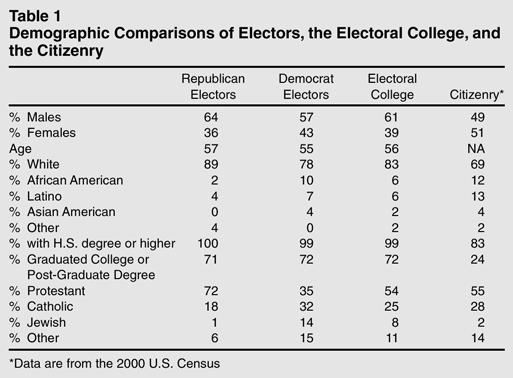
Table 1 compares the demographic characteristics of Republican electors, Democrat electors, the Electoral College as a whole, and the American citizenry. While we see that in some instances electors are reflective of the citizenry, clearly there are areas where they diverge. We see a gender bias in the Electoral College as females are under-represented. Similarly, minority presence in the Electoral College does not echo what we find amongst the citizenry. For instance, both African Americans and Latinos are found in about half the numbers that they are in the electorate. We also find an Electoral College that is far more educated than the general populace. All but one of our respondents had at least a high school education. Perhaps more telling is that 72% of electors have a college or post-graduate degree, compared to only 24% of the citizenry. We find that over 42% of electors report household incomes of over $100,000 a year. Finally, we see that the average age of electors is 56. Electors fluctuated a great deal in age. The youngest was only 18 and there were at least two electors who were 86.
In comparing the different parties to the citizenry, several issues stand out. Democrat electors appear to more closely resemble the American populace than do Republican electors. Although Democrats can claim more female and minority electors, their numbers still do not equal these groups' respective numbers among the citizenry. On the other hand, several Republican stereotypes are met as Republican electors are overwhelmingly white (89%) and Protestant (72%). We further see that Democrat electors appear to reward their base supporters with service in the Electoral College. For instance, African Americans and Catholics are well represented in the Electoral College amongst Democrats. Similarly, 14% of Democrat electors are Jewish, compared to only 2% of the U.S. population. Our findings provide some evidence that electors do represent key bases of their respective parties. And while these bases do not mirror the population, they do comprise the voters each party relies on to gain elective office.
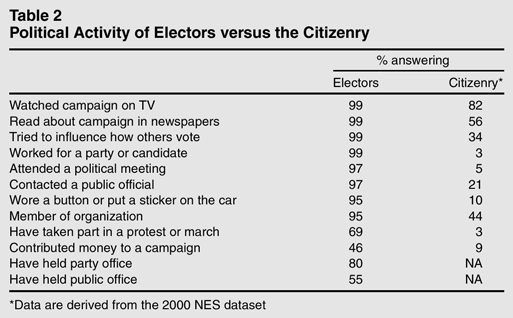
Moving beyond demographic characteristics, it is presumed that electors are chosen due to their party loyalty and their subsequent political activity. The data reveal that electors are exceptionally active in the political system. Table 2 compares the political activity of electors with those of the citizenry. Simply put, the level of activity displayed by electors is remarkable! We find that nearly all of the electors follow campaigns in the media, attend political meetings, try to influence how others vote, and work for their party or preferred candidate. We also find substantial differences with the general populace regarding the number of electors who wear campaign buttons, are members of organizations, or have taken part in a public protest. Although less than half of electors donated to political campaigns, they are still four times more likely to do so than are individuals in the electorate. Finally, 80% of electors report serving in an elected party position and 55% have held public office, thus providing further proof of their party activity.
Electors and the Electoral College
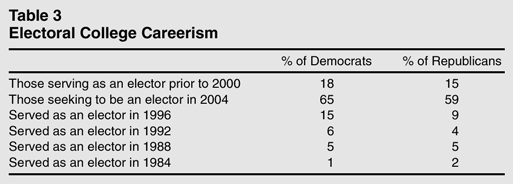
Table 3 depicts what we have called “Electoral College careerism.” Only a small number of electors report having served in the position previously. For instance, less than a fifth of electors from either party report they had held the position in the past. Though more Democrats than Republicans have previously served as electors, this may be attributed to the Democrat presidential victories in the 1992 and 1996 elections. We further find that when asked whether they would like to serve again, a majority of electors noted that they would. Democrats were slightly more likely to covet the position than Republicans. Interestingly, the primary reason electors gave as to why they would not seek the position in 2004 is that they thought the honor should be shared with other partisan faithful.
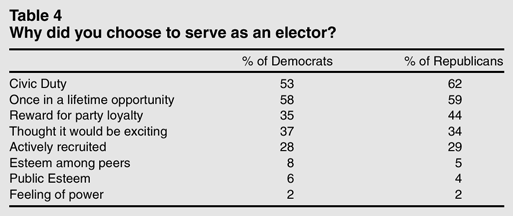
Table 4 describes why one would choose to be an elector. Reasons for service appear to be divided into three tiers. The two most often cited reasons for serving in the Electoral College are civic duty and that it provided a once in a lifetime opportunity. The notion of civic duty particularly seems to affect Republican electors. In the second tier, we find that a number of electors see their service as a reward for party loyalty, thought it would be exciting, and/or were actively recruited for the position. Perhaps not surprisingly, we find that many more minorities report being actively recruited than whites. For instance, while 41% of African Americans say they were recruited, only 27% of whites report the same. However, females do not report much difference from males relative to their recruitment. This may help explain why they are under-represented in the Electoral College. Interestingly, one Republican elector noted some embarrassment that his delegation consisted primarily of older white men. He vowed that the same thing would not happen in 2004.3
Interview with Robert Alexander, April 29, 2004.
Hence, it is likely we will see a more demographically balanced slate of electors in 2004. Finally, it does not appear that electors seek power or prestige in their service. Only a handful suggested these were salient reasons for their service to the Electoral College.
Clearly, the 2000 presidential election was peculiar. The closeness of the election and the anomalies in Florida sharply brought the Electoral College into the nation's focus. Much political discourse centered upon the rationale supporting the need (or lack thereof) for the Electoral College. Consequently, we asked electors what they thought about the election as well as how they view the Electoral College as an institution. We expected one of two things. First, because they were selected and subsequently chose to be electors, they might be more protective of the institution. Second, because electors are theoretically so partisan, it would be reasonable to hypothesize that their answers would be divided along partisan lines. That is, Democrats would be more critical of the institution and Republicans would be more willing to sing its praises. We found evidence supporting each of these expectations.
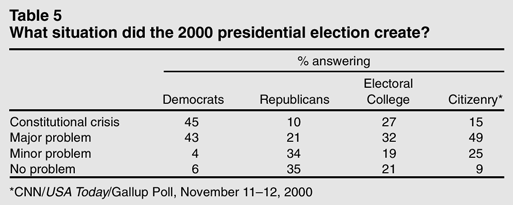
When asked what (if any) problems arose from the 2000 presidential election, the responses revealed considerable unease with the result. Table 5 illustrates that among Democrats, nearly half felt the election created a constitutional crisis, while about the same proportion felt it was a major problem. Republicans, on the other hand, were much more divided in their opinions. Over a third of Republicans responded that the election caused no problem. Another third of Republicans felt the 2000 election caused either a major problem or a constitutional crisis. In all, both the Electoral College and the citizenry are somewhat ambivalent concerning the 2000 election.
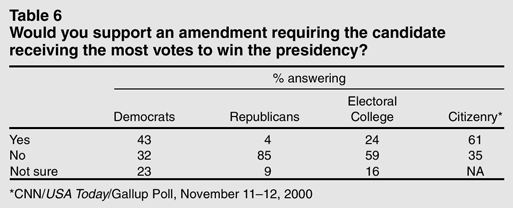
Though the popular vote is often noted as an alternative to the Electoral College, electors from both parties are skeptical of an amendment to that effect. Table 6 illustrates that electors show much greater support for the institution than does the general public. Republicans overwhelmingly oppose a move to a popular vote. Democrats are not as united. A full third of Democrat electors support the Electoral College, while 22% remain unsure. A number of electors noted that they understood the compromises made by the Founding Fathers and believe that the federal nature of the Electoral College was important and needed. In essence, while many Democrats were not pleased with the outcome of the 2000 election, they still respected the institution that ultimately selected the president. This sentiment is amplified by looking at whether or not electors believed President Bush was elected legitimately.
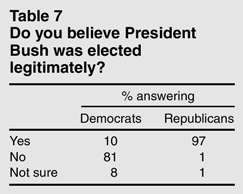
The issue of President Bush's legitimacy splits electors down party lines. Table 7 reveals the truly partisan nature of the Electoral College. Nearly every Republican elector feels the president was elected legitimately. It is worth noting that two Republican electors answered the question in the negative and two more said they were unsure. Immediately following the election, Democrats undertook a concerted effort to persuade Republican electors to change their votes. Although none did, given the closeness of the election, one wonders how much thought these few Republican electors gave to the idea of becoming an infamous “faithless elector.” As the 2004 election appears to be just as close, it is imperative that political parties select their electors wisely in order to avoid any such problem.
In any event, Democrat electors are almost as united in believing President Bush was not elected legitimately. While 81% of Democrat electors questioned Bush's legitimacy, among those supporting the maintenance of the Electoral College, 66% questioned Bush's legitimacy. That is, even those Democrat electors supportive of the Electoral College did not believe Bush was elected legitimately. This finding is somewhat paradoxical. Therefore, we also asked whether electors thought the situation in Florida affected President Bush's legitimacy.
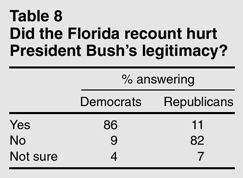
When asked whether the Florida recount hurt President Bush's legitimacy, the partisan nature of the Electoral College continues to hold. Table 8 reveals that while 82% of Republican electors believe President Bush's legitimacy was unharmed, 85% of Democrat electors feel the president's legitimacy was damaged by the recount. On the question of the recount, we find that Democrat electors are more unified than their Republican counterparts. When asked whether or not President Bush was elected legitimately, we find that Republican electors are virtually unanimous. However, when evaluating the recount, we see that nearly 20% of Republican electors believe the situation in Florida may have affected President Bush's legitimacy.
The answers are mixed when trying to assess what electors think about the Electoral College. Clearly, the Electoral College is a highly partisan compilation of individuals. However, electors are also much more knowledgeable concerning the institution's function as well as its purpose. Overall, this produces a more positive portrait of the Electoral College among electors than among the rest of the citizenry.
Money and the Electoral College
The preceding analysis indicates that electors are far different from the rest of America. We have further illustrated that electors are quite partisan. However, we have not yet determined whether electors earn their positions due to their financial generosity. In order to address this issue, we examine financial contributions of all electors during the 2000 election cycle.
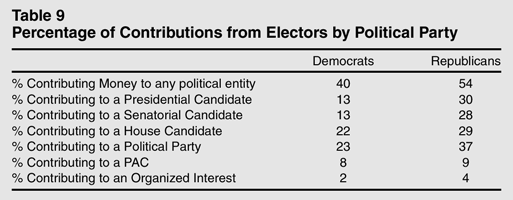
Table 9 denotes the percentage of contributions made by all electors. Several issues arise from the data. First, we find that Republican electors are much more likely to donate than are their Democrat counterparts. While a majority of Republican electors contribute something, only 40% of Democrat electors contribute. Second, between both parties, electors contribute most often to political party organizations. The ability to utilize independent expenditures likely accounts for some of this giving. We further find that political parties receive the highest average contribution by electors ($5, 913). Finally, we see that Republicans are far more likely to give to presidential and senatorial candidates than are Democrats.
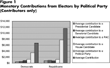
Figure 1 graphically depicts the average contribution of electors according to their party affiliation. Republican electors contribute far more on average to political parties than do Democrat electors ($7,726 to $3,464). This pattern continues to hold when examining contributions to presidential ($776 to $400) and senatorial candidates ($926 to $523). However, some parity exists for contributions to House candidates ($1,197 to $1,224) and to Political Action Committees ($757 to $871).
Monetary Contributions from Electors by Political Party (Contributors only)
Overall, Republican electors contribute nearly twice the amount of Democrat electors. Moreover, we must keep in mind that far fewer Democrats contributed than did Republicans. As a consequence, Republican electors donated nearly $1.7 million to various political campaigns, while Democrat electors donated just over $700,000. If campaign contributions played a role in the selection of electors, it most likely affected the Republicans. In fact, four of the top five contributors were Republicans. The top contributor donated over $208,000 (Republican), the second highest contributor donated over $191,000 (Democrat), and the third highest contributor donated over $184,000 (Republican).
Conclusion
We have learned a great deal about those who serve as electors. Like the candidates they are pledged to, electors are quite different from the rest of America. They are far more educated and politically active than the electorate. We also find that a number of electors contributed vast sums of money to political candidates in 2000. However, our findings clearly indicate that selection as an elector is not solely based upon one's financial contributions. Nevertheless, due to the spotlight the 2000 presidential election placed upon the Electoral College, we expect that the 2004 assemblage may be demographically more representative than the 2000 edition. It may be that the parties will promote greater representation for both females and minorities. In any event, it is likely that the 2004 Electoral College will also count a large number of extremely partisan individuals among its membership. We hope to have provided some insight into this “highest college” in the land. There is no doubt that the great civics lesson learned in 2000 will indeed be revisited in future elections. Shedding light on the electors themselves adds to our knowledge of the Electoral College.
We would like to acknowledge the research assistance from the following individuals: Rebecca Boler, Jessica Brasee, Zachary Bushatz, Alexis Cobb, Jennifer Jameson, and Brad Stoll. We would further like to express our gratitude to Pi Sigma Alpha for providing funding for our survey through a chapter activity grant. Please direct all correspondence to Robert Alexander, r-alexander@onu.edu.