The title of Britten's first chamber opera, The Rape of Lucretia, lays the matter out clearly.Footnote 1 We are invited to focus our critical attention on a rape. It is an uncomfortable subject, to say the least, and in the two millennia of the story's existence in Western culture there have been many attempts to translate or conceal the central idea to make it more palatable – the Britten–Duncan collaboration being no exception. They wrote in the programme note for the Glyndebourne première that the work was written ‘after the play Le viol de Lucrèce by André Obey and based on the works of Livy, Shakespeare, Nathaniel Lee, Thomas Heywood and F. Ponsard’.Footnote 2 There is a mildly boastful, scholarly tinge to this statement, which may be typical of twentieth-century operatic collaborations.Footnote 3 Whatever its posturing, the note is an invitation to the audience to reflect with critical awareness on the history of the story and the constructions of gender and sexuality that it engages in and reflects.
The opera has never established itself in the repertory, less I think because of failings in the music than because of its difficult subject-matter. I was invited to speak at a conference in Copenhagen in 2009 organised around a new production of the work at the Danish Royal Opera. The production there was, significantly, styled simply Lucretia. The rape was portrayed as an act of deepest love at the centre of a sugary, romantic concoction – a travesty of the opera, as it seemed to me. The conference, which included papers by art historians and classicists as well as musicologists, was focused solely on the Lucretia myth and most (though not all) of the speakers played down the role of rape in the story, suggesting that there was a long tradition of considering Lucretia to have been complicit in her sexual abuse. This may be a fair summary of an interpretative tradition but I found and find it troublingly close to the classic defence of the rapist in court: ‘She was no angel; she wanted it really’. Having been advised of the nature of the new production some months before the conference, I became interested in Britten's original reshaping of the Lucretia myth, which revealed something of his attitude towards women's roles in 1940s Britain, in respect of their interaction with the men around them, their right to self-define as individuals, and their relation to constructions of gender. Discussion at the Copenhagen conference led me to believe that in 2009 the debate had not significantly advanced, particularly insofar as it avoided the human reality – rather than what seemed to strike some people as the figurative interest – of rape. This article is the result of that engagement and concern.
The opera comprises two acts, each of two scenes divided by an interlude.Footnote 4 It begins with a historical introduction to the stage action by a Male and Female Chorus. Scene 1 proper opens in a bivouac outside Rome. Three men – Collatinus (the husband of Lucretia), Junius (her kinsman) and Tarquinius (who will rape her) – drunkenly discuss the virtues and uses of women.Footnote 5 They resolve to test the chastity of their wives or lovers by calling on them unexpectedly. Lucretia, it is noted, is more chaste than any. An interlude narrated by the Male Chorus portrays Tarquinius's ride to Rome. His horse has two symbolic functions in the opera, being both a sign of Tarquinius's (patriarchal) chivalry and of his rape. A sudden change of location and tone ushers in scene 2, Lucretia's house. In great but comical solemnity Lucretia and her maids welcome Tarquinius and take him to his room.
Act II opens with the Male and Female Chorus narrating the social tensions and anti-Etruscan feeling in Rome (observations that will hit home at the end of the opera, when Junius seeks retribution against Tarquinius, an Etruscan). The first scene opens with some of Britten's most delicate and touching ‘nescient’ music, a C major lullaby sung by the Female Chorus over Lucretia's sleeping body. Tarquinius enters, lustful, and when he kisses Lucretia the act is incorporated into her dream as the kiss of her husband. She wakes, and in a scene of horrible intensity she attempts to repel Tarquinius's advances.
There is some – but not much – suggestion that she half-welcomes this sexual attention. Specifically, when asked whether she would have willingly given the kiss he stole from her in sleep, she replies in terms that suggest it might only be a commitment to monogamy that prevents her, rather than specifically a repulsion of the current sexual advance: ‘How could I give, Tarquinius, / Since I have given to Collatinus[?]’. Tarquinius retorts: ‘Yet the linnet in your eyes / Lifts with desire / And the cherries of your lips / Are wet with wanting. Can you deny your blood’s dumb pleading?' Eliding her answer with his last word, Lucretia answers ‘Yes, I deny, I deny’, and we are likely to agree with her, given that her eyes, lips and blood are probably a comment on the subconscious reality of her dream, in which (as the libretto makes clear) she desires Collatinus. It is, in any case, grotesque male fantasy to suggest that a woman desires a rape, and even if on most days she desires Tarquinius, the point is that at this very moment she does not. She says ‘No!’, ‘Never!’, ‘I deny!’, ‘You lie!’, ‘I refuse!’ and ‘Please go!’ a total of twenty-six times before the rape, all but four of them in the first minute of her awakening, and these are merely the most obvious of her negative signals. It is an incoherent reading to argue that she is complicit in her rape.Footnote 6
The rape takes place during an interlude, with sexual equine symbolism in the libretto (a quartet for Lucretia, Tarquinius, and the Male and Female Choruses).
Lucretia rises to find her maids arranging flowers. She is distraught and says that she has woken from a nightmare.Footnote 7 When she is presented with an orchid she flies into a rage and demands that a message be sent to summon Collatinus to her. The flower is important. Orchids take their name from the Greek óρκις, meaning testicle. This recondite allusion may have been intended by Duncan and Britten solely for the attention and intellectual delight of a classically educated, and therefore almost completely male, section of the audience. Upon the arrival of her husband Lucretia tells of her rape, and he attempts to relieve her of guilt (‘If spirit’s not given / There's no need of shame'). She rejects his balm and kills herself. In a mourning epilogue Junius triumphantly seizes her body, which he can use both as proof of Tarquinius's infamy and to foment the revolution that will give him control of Rome. The Male Chorus ends the opera with a promise of a Christian redemption, in the C major of Lucretia's last sleep before her rape.Footnote 8
The rape in the opera is presented at least in part as a consequence of social structures that give women the function of protecting the political hierarchies of the men who possess them. Lucretia's suicide, occasioned by her rape, is seized upon by the Roman general Junius as a means of supplanting his hated rival, the Etruscan Tarquinius, who raped her. In a vile gesture, her twice-molested body, bloodied at breast and genitals, is paraded through the streets of Rome as a sign of the infamy of a man rather than the suffering of a woman. She, or rather her cadaver, is made politically potent in this culminating act but the agency still remains with men: it is Junius, not Lucretia, who issues the order that her corpse be used for political ends.
Other and deeper thoughts are explored in the Britten–Duncan opera, as they are in the literary sources that they cite as inspirations. Many of these themes have a root in Shakespeare's interpretation, which Obey follows closely. An examination of themes drawn from this principal literary influence on most modern retellings of the tale of Lucretia will therefore open a critical space for investigation of the opera, one that focuses especially on the currently rather sidelined figure of the woman at the centre of it.Footnote 9
Three themes adapted from Shakespeare's The Rape of Lucrece
1 Chastity
When Shakespeare has Juliet ask ‘What’s in a name?' the implied answer is ‘practically everything’. Lives are made and destroyed by the use of proper nouns like Montague and Capulet and epithets like ‘honest’ Iago; it is no different in The Rape of Lucrece, Shakespeare's 1594 narrative poem in rhyme-royal.Footnote 10 The crucial epithet for Lucrece is ‘chaste’, introduced in the first stanza and then, as Joel Fineman notes in a virtuoso reading of the poem, interrogated and implicated in the tragedy that follows:
In the first line of the second stanza, the poem makes a point of mentioning its use of ‘chaste’ in the last line of the first, but this remarking or citation of its own language, when the poem for the first time recalls its own speaking, is how the poem manages to raise a merely ordinary adjective into something extraordinary, effectively translating ‘chaste’ into ‘“chaste”’ within implicitly remarked quotation marks, or what the poem here properly calls a ‘name’, as though the poem intended by such self-quotation to repeat or to reenact at its beginning the original event of epideictic designation it recalls.
Naming, we will see, is a central theme of ‘The Rape of Lucrece’.Footnote 11
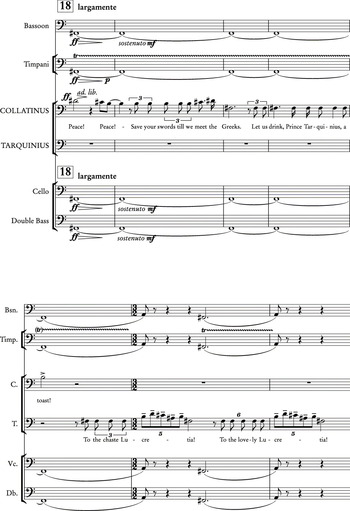
Lucretia is named frequently in the course of the opera, both by men and by herself, and this naming is also picked up musically. One motif in particular seems to fix the boundaries of her personality in relation to Tarquinius's. It is the motif first introduced at Fig. 18 in Act I. Two features are significant: that it is a pointed introduction of B minor (cancelling the D♯s of the preceding bars), and that this first extended mention of Lucretia is prefaced by the epithet ‘chaste’ (see Ex. 1).Footnote 12
The Rape of Lucretia, introduction of ‘Lucretia motif’.

Peter Evans identifies this ‘Lucretia motif’ as one of the two principal ideas of the opera; it is stated so often in this form that he says it ‘becomes an irritating labouring of the obvious’.Footnote 13 Yet through this ‘irritating’ repetition we feel both the immutability and the persistence of Lucretia's label. She is, in a word, essentialised by this musical motif as a ‘chaste woman’, and this shorthand is turned to a variety of ends.Footnote 14 In the work's patriarchal context Britten's presentation of Lucretia is perhaps not misogynist, but as we shall see it is certainly not feminist either.
Lucretia is called chaste several times in the opera, and always in contexts where that chastity has a positive function for the invoker of it. At work here is a mechanism dissected by Judith Butler in Gender Trouble. Butler observes, carefully utilising a continuous present tense, that ‘woman [in this case “chaste woman”] itself is a term in process, a becoming, a constructing that cannot rightfully be said to originate or to end . . . Gender is the repeated stylization of the body, a set of repeated acts within a highly rigid regulatory frame that congeal over time to produce the appearance of substance, of a natural sort of being.’Footnote 15 The repetitions of the word ‘chaste’ in this opera are one of the text's principal means of naturalising her sexual and personal character and function.
Lucia associates Lucretia's chastity with the foundation of her joie de vivre when she says in Act I scene 2 that ‘the chaste Lucretia gives life to her Lucia’.Footnote 16 Junius refers to her virtue twice: first when noting her value to Collatinus (‘Collatinus will gain my fame with the Roman mob, Not because of battles he has won but because Lucretia's chaste’) and later when he resolves to use her corpse as a marker of political (not sexual) infamy in his part of the mourning quartet (‘Here lies the chaste Lucretia, dead. / And by Tarquinius ravished. / Now let her body be borne through our city. Destroy’d by beauty. / Their throne will fall! / I will rule!'). In suggesting that she was ‘destroy’d by beauty' he strongly implies that, as far as Junius was concerned, she brought it on herself. The quarrel between Junius and Tarquinius that hinges on Lucretia's chastity is chiefly important to Tarquinius because sexually easy women are to him no opportunity to display his manly powers of aggression: he says he will ‘prove Lucretia chaste’ because it will afford him an opportunity for display among his men. The remaining allusion to chastity comes when Lucretia resolves to kill herself, declaring her chastity variously dangerous (‘all men love the chaste Lucretia’), false (‘flowers alone are chaste’) and terminal (‘now I’ll be forever chaste'). Lucretia's ‘chaste’ utterances are, to take Butler's view, performative acts that through their gender-forming iterations continue her infinite ‘becoming’ as ‘a chaste woman’. They are repetitive actions that she has always already had to perform since her first naming as ‘chaste’, with all the weight that that term carries for her social, sexual and existential situation. But when she is raped Lucretia realises that her performative repetitions of ‘chasteness’ cannot continue. It is an essential part of a woman's gendering as virtuous that she has no agency, yet she responds to the rape by raging at the orchids, commanding her husband to come to her, and ultimately killing herself. Such a performance puts her in an impossible situation in relation to the performative ‘chastity’ that was her chief behaviour before the rape. Now she is no longer free to perform the role of ‘chaste woman’ – hence her reflections on the chastity of flowers and her dead body (unpolluted once again, if only by virtue of the ontological change from life to death). Any attempt to reclaim the performative space she had occupied before would be refused. She has no further options.
Coppélia Kahn has argued that Lucretia's chastity – which specifically means the dedication of her body to her husband – becomes, in Shakespeare's hands, ‘so rarified and sanctified … that she seems virginal or even unsexual’.Footnote 17 This reconstruction of the sexual status of a virgin is by design: Kahn notes that in the context of the story ‘marriage has invested sex with a prelapsarian sinlessness, and herein lies its psychological value for man. It is his defense against sexual desire.’Footnote 18 The significance of this will not be missed by viewers of Britten's opera, since the first scene of dramatic action after the Male and Female Choruses have introduced the story centres on a drinking song concerning the sexual roles of women, in which the man with the most chaste wife holds the sexual and political high ground. And here in a more general sense than the specific references to the chastity of Lucretia we see that woman's chastity has a specifically male benefit. Women are chaste in order to preserve the political and moral condition of men, not primarily for any benefit that it may bring to women themselves (though in a world shaped by the Christian myth heavily overlaid onto the opera, chastity would also bring rewards in the afterlife).
2 A childlike body
A remarkable aspect of Lucretia's poetic treatment by Shakespeare concerns the nature of her body. As Kahn notes, the two descriptions of Lucretia in the poem are wholly non-erotic. Even when Tarquinius stands over her naked body immediately before the rape, she is described in terms that make her a pious abstraction as ‘a virtuous monument’, her head ‘entombed’ on its pillow.Footnote 19 Her bodily form is idealised as a work of art. Like a statue of the Virgin or some other sexually edifying subject, the purity of sculptural form symbolises a sexual status that is without stain or blemish, untouched – and, because it has an implied artistic value, untouchable. The sexual innocence implied by this presentation is of course a preliminary to the abhorrent sexual violence to follow, but it also taps directly into a broader tradition of equating women and children through their supposed sexual innocence. In its total lack of response to the touch of another, Lucretia's statuesque sexlessness is in addition the perfect performance of her ‘chastity’. In representations of adult women it is often the regenerated ‘virginity’ of a wife's chastity that governs the symbolism; with children the ‘fact’ of their pre-sexual nature has been central to their value as symbols of purity, goodness and hope at least since the seventeenth-century ‘invention’ of childhood that has been illuminated by Philippe Ariès, among others.Footnote 20 Inasmuch as she is portrayed in a state of sexual innocence, Lucretia is presented as a childlike archetype, and this has implications both for her sexuality and for her potency in the opera, as well as for how we are to understand Britten's treatment of children in operas such as The Turn of the Screw and Death in Venice.
In two books on the subject, James R. Kincaid argues that what constitutes attractiveness in ‘the child’ and erotic appeal in ‘woman’ are coincident:Footnote 21
We see children as, among other things, sweet, innocent, vacant, smooth-skinned, spontaneous, and mischievous. We construct the desirable [e.g. in adult women] as, among other things, sweet, innocent, vacant, smooth-skinned, spontaneous, and mischievous. There's more to how we see the child, and more to how we construct what is sexually desirable – but not much more. To the extent that we learn to see ‘the child’ and ‘the erotic’ as coincident, we are in trouble. So are the children.Footnote 22
Kincaid's ‘we’ here is a cultural ‘we’, the ‘we’ of Western societies that broadcast their constructions of the desirable in films, fashion modelling and pornography. His ‘we’ need not include specific men or women, but his conception of the desirable has a definitely masculinist bias. Of course, ‘we’ live in a masculinist society, where this construction of the desirable seems to be dominant, and so it seems not unreasonable to apply Kincaid's normative definitions to Britten's opera too.
In other operas by Britten, including Peter Grimes, The Turn of the Screw and Death in Venice, the blurred distinction between childlike innocence and adult sexuality takes on a controversial aspect quite different from the scandal at the heart of The Rape of Lucretia, but the musical means of establishing both childlike innocence and the intrusion of the erotic are remarkably similar. I shall demonstrate Britten's musical means shortly.
Returning to the story itself, one can see how in the ideological framework of the tale this desexualised representation of Lucretia should be appropriate. After all, by virtue of her marriage she is the sexual possession of Collatinus, her body cold, marmoreal, unresponsive to the touch of others. But an inevitable consequence of this infantilising presentation of a body devoid of any markers of adult feminine form is that the opera's audience has only one way of understanding why Tarquinius could find her attractive, unless it shares the views of the desirable evinced by Kincaid's ‘we’. It is the mere fact of Lucretia's virtue that makes her irresistible to the man's conquering impulse. His desire is comprehensible only to those who believe that a woman's resolve to shape her existence in any way at all – in this case, to be chaste – exists merely as a barrier for men to break down. She is only attractive, that is, if the idea of abuse is itself attractive.
3 Pollution
The cleanliness of Lucretia's body and the legal sex that she enjoys with her husband Collatinus are both polluted by her rape. This is the last essential thematic preliminary to an understanding of Britten's opera. Kahn observes that Shakespeare's Lucretia is
the perfect patriarchal woman, content to be but an accessory to the passage of property and family honor from father to son; she has no sense of herself as an independent moral being apart from this role in marriage. Thus she views her chastity as a material thing, not as a moral attitude transcending circumstances.Footnote 23
There is, as the anthropologist Mary Douglas notes, little subtlety to primitive pollution rules such as those understood by Lucretia. The intentions of the victim of pollution are irrelevant since ‘the only material question is whether a forbidden contact has taken place or not’.Footnote 24 Tarquinius has raped her, and despite Collatinus's defensive protestations, set by Britten to the words ‘If spirit’s not given there is no need of shame', according to the pollution rules this is immaterial. She is – and this is another crucial word – ‘stained’, no longer a suitable defence against sin or a guarantor of Collatinus's political and social standing.
Collatinus's forgiveness is double-edged. Although his wife's new status places him at a distinct social disadvantage, he offers a forgiveness that might associate him in spirit if not in historical fact with the Christian message that ends the opera: ostensibly he is putting Lucretia before himself. Yet to consider Lucretia's guilt as a hypothesis worthy of refutation is a possibility afforded only by the regulative conceptual force of patriarchy; feelings of guilt are common even today among rape victims. As a result, Collatinus's forgiveness of Lucretia's ‘pollution’ is itself part of the patriarchal game, whether Christian or not. That Lucretia is presented as being incapable of responding gratefully to the magnanimity of his gesture (in however qualified a sense such a compromised magnanimity must be conceived) might be read as an indication of her primitiveness, both as woman – the protected object of men – and, since she is (and performs herself as) a myth and archetype of chastity, as an unenlightened pagan who is a stranger to the limitlessness of Christian forgiveness.
Since the patriarchal script gives Lucretia no alternative to being a chaste wife, the irrecoverable loss of that core of her being can only lead to suicide. Kahn is surely right to note that ‘the tragedy of Lucrece is that only by dying is she able to escape from marginality and regain her social and personal identity as a chaste wife’.Footnote 25 Her death is her last performative iteration of her ‘chastity’, senseless and brutal though it is. It transplants a violence that we might expect to be externally directed back onto the abused individual.
Suppressing female retribution
To the modern mind, the suggestion that a woman's only response to rape is to commit suicide to regain (as nearly as possible) the role of ‘chaste woman’ will appear perversely to avoid the ideal recourse to some form of retributional justice. Were it possible, we would expect a raped woman in the twenty-first century to pursue her rapist through the courts and see him committed to jail, as difficult as that is to achieve even in a country whose laws are broadly sympathetic to women. The possibility that rape might be met with retributive action was well known to the authors, cited as sources by Duncan and Britten, who treated the Lucretia myth. Although Lucretia herself is never violent, during the course of the myth's development in the literary tradition her role undergoes a gestalt switch in terms of her agency.
In Livy's account, Tarquinius forces the rape after threatening Lucretia first with death and then dishonour.Footnote 26 Lucretia asserts her innocence (the sentiment given to Collatinus in the opera) but adds a call for retribution:
My body only has been violated. My heart is innocent, and death will be my witness. Give me your solemn promise that the adulterer shall be punished – he is Sextus Tarquinius. He it is who last night came as my enemy disguised as my guest, and took his pleasure of me. That pleasure will be my death – and his, too, if you are men . . . What is due to him … is for you to decide. As for me I am innocent of fault, but I will take my punishment. Never shall Lucretia provide a precedent for unchaste women to escape what they deserve.Footnote 27
She thus kills herself for honour's sake, but not before calling for Tarquinius to be punished. According to Rebecca Langlands, this gives Lucretia agency.
At the beginning of the tale Lucretia is the ornament of her husband's household, a means to his glory – she is observed and judged and unwittingly kindles lust in one of her observers. However, from the moment that Tarquinius enters her room … she blooms into subjectivity and activity: her decisions and courageous implementation of these decisions drive the course of the tale … She summons the men, speaks out to tell them what has occurred and how the situation should be interpreted, demands that they formally pledge to avenge her, and then plunges a knife into her own heart.Footnote 28
We shall see that the agency Lucretia obtains through her actions is profoundly qualified by the patriarchal structures that she self-oppressingly upholds, but even the qualified strength that Lucretia exhibits in this presentation is limited in the Duncan–Britten opera to the self-defeating agency of her suicide. Her call for revenge is, however, retained in other literary retellings.
In the third item in the programme-note list, Nathaniel Lee's play Lucius Junius Brutus (first performed 1680), Lucretia calls to Brutus (Junius in the opera) for succour:
The major literary name in the list of influences, Shakespeare, also raises the possibility of vengeance, and not in a gentle form. The manner in which this possibility is subsequently dismissed is of considerable interest because it is reflected clearly in Obey's play and somewhat more obliquely in the Duncan–Britten opera.
In Shakespeare's Rape of Lucrece another Classical rape victim, Philomela (whom Shakespeare styles ‘Philomel’), asserts a strong marginal presence, as Jane Newman demonstrates.Footnote 30 Philomel, the bird-woman (in the literary tradition she is often said to have been turned into a nightingale) appears in Lucretia's set-piece addresses to Night, Opportunity and Time.Footnote 31 Her inclusion in Shakespeare's poem transforms our understanding of female ‘agency’ by showing that there is an alternative to Lucrece's ‘script that blames the victim, allows her to internalize guilt, and defines her as an agent of political change solely in terms of a male's ability to avenge her’.Footnote 32 It is easy to see why Philomel's story, which would have been familiar to Shakespeare's audiences from Ovid's Metamorphoses Book VI, presents a view of gender relations that is profoundly uncomfortable for the patriarchal orthodoxy of his time.
Philomela, in the same way as Lucretia, is a chaste woman. When she is raped by her brother-in-law, the tyrant king Tereus, she threatens to run through the world and scream his guilt. In response he cuts out her tongue and chops off her legs. She is, therefore, a raped woman who seeks redress through her own means and is prevented by a second brutal assault from doing so. Yet she tells the king's wife Procne of her assault, and it is this second woman who achieves a rich and sanguinary vengeance. Procne kills the king's (and her own) son Itys, cooks his butchered body, and serves it to the king, thus achieving both the sacrificial offering of a male body for the female one that was broken and destroying the rapist's legally begotten son in the aftermath of his potential violent impregnation of another woman.Footnote 33
The Lucrece of Shakespeare's poem ‘invokes but then immediately dismisses the alternative form of violent female reprisal’, and by so doing underlines the reversal of political action that Shakespeare's (and Obey's and Duncan–Britten's) tale presents in relation to the literary tradition.Footnote 34 Lucrece's rejection of the woman's call for retribution, violent or otherwise, is an explicit resubmission to the patriarchal structures that established the basis for her suffering in the first place, and another performative repetition of the actions proper to the gender role of ‘chaste woman’.
Britten's women in twentieth-century context
The question of whether a wronged woman who acts violently in her own defence (or else for revenge) is acting reasonably or under the sway of unruly passion is an ancient one that also played out in modern ways in changing attitudes towards women in twentieth-century Britain. In essence, this is the difference of opinion between Plato and the Stoics concerning Euripides's Medea, whose protagonist kills her own children when her husband, Jason, betrays her for another woman. The Platonic understanding is that her reason was overwhelmed by passion, the Stoic that she acted with perfect clarity and in line with her ideals of pride and honour even when this meant performing actions that clearly harmed both herself and others.
Medea was not staged in English in England until 1907, when it appeared as the fourth in a series of Euripides's dramas put on by the scholar Gilbert Murray and the producers Harley Granville Barker and Paul Vedrenne.Footnote 35 Earlier productions, including Trojan Women, which was ‘widely interpreted as a protest against the inhuman conditions in which Boer women and children had been incarcerated by the British during the Boer War’,Footnote 36 were recognised for their propagandist intent, and Medea was taken up by the suffragettes, who recited monologues from it in public meetings across London.Footnote 37 Even its theme of maternal infanticide did not deter early twentieth-century feminists from regarding Medea as a positive character. Murray thought her child-killing was realistic, and the prominent theatrical suffragette, Cicely Hamilton, wrote in Marriage as a Trade that in discussions she had overheard between women concerning punishment for maternal fratricide, ‘sympathy “invariably and unreservedly” lay on the side of the mother’.Footnote 38
Clearly, these Classical women were exemplary figures to the newly emergent (putatively) ‘equal’ women, just as the litany of man- or boy-loving thinkers, artists and public figures were to the as-yet still suppressed voice of gay men (and, mutatis mutandis, gay women).Footnote 39 The widespread homosexual apologia for Greek love of the first half of the twentieth century is evidence of the powerful resonances of fabulated Classical stories in the subcultural discourses of oppressed groups at this time. Britten knew as well as anyone the importance of coded forms of expression, and it is remarkable that in the Duncan–Britten opera Lucretia's violent response, which is raised as a possibility by Shakespeare, is not even allowed a moment's thought. The significance to women of this decision may have escaped the work's male collaborators but it should not escape us.
Aside from the more radical implications that might have been carried by an expression of violent action, Lucretia's passivity reabsorbs her into her role as sign for a generic suffering womanhood. It is noticeable that in this opera Britten generally refuses to mark out women from one another: he gives them interchangeable rather than highly differentiated lines, the opposite of his treatment of the men. In the context of contemporaneous women's concerns, of which one would hope Britten might at least have been aware, this could be seen as revealing. When the work was written in the 1940s, the focus of the struggle for women's emancipation had switched from suffrage to employment. The Second World War had brought women to the workplace in huge numbers in both civilian and military roles. In the years leading up to and beyond the National Assistance Act (1948), which revoked the old Poor Laws and had the interesting effect of relieving a husband of his financial responsibility for his spouse or any children over sixteen years of age, poorer families needed second incomes. Eric Hobsbawm suggests that another explanation for the increase in women's involvement in the workplace was the new financial need occasioned by the fact that there were fewer children to work.Footnote 40 Middle-class families needed additional income less than in poorer sections of society, particularly when the income would be provided by a woman whose salary could be guaranteed to be even smaller in relation to a man's (in the same work) than is the case today. But in that class, Britten's class, the desire for self-definition through the late 1940s and particularly in the 1950s and 1960s led increasing numbers of middle-class married women to pursue social freedom and individuation from their husbands through work. Britten's refusal to mark the women out from one another in this opera suggests at the very least that he considered them an undifferentiated mass.Footnote 41 It is revealing of his view of women's place in a male-ordered society, which is reflected in his other operas, too.
Lucretia stands behind only Elizabeth I, another famously chaste woman, as the most amply characterised female character in Britten's operas. Despite giving her name – or rather her rape, which is the subject both dramatically and grammatically – to the opera, Lucretia has a surprisingly small part in the work. She has an ensemble role in Act I scene 2 and only one aria to add to her two conversational duets in Act II. She sings a descending passage in thirds, not a grand pathetic aria, at the point of her death. It is the men around her who have the expansive characterisation and whose property ‘the rape of Lucretia’ really is.
Britten had already presented Ellen Orford as a patriarchal cipher in support of a male character in Peter Grimes. Her third line in the Prologue, ‘Peter, we shall restore your name’, establishes her in this role, and her most significant moment of solo expression, ‘Let her among you without fault cast the first stone’, is couched entirely as a defence of a man of ambiguous moral standing. The words, being a recasting of Christ's, are not even her own: she is doubly a cipher. It is unclear what is to happen to Ellen after Grimes's suicide, because without the need to be a guarantor of a man's honour the opera provides her no existential clue. Britten's ‘church parable’ Curlew River, however, may give some indication. Having lost the defining core of their being as patriarchal props, in this case by losing a son, we seem to be told that women go mad. Alternatively, as in the controversial presentation of the queen in Gloriana, they die through longing for a lost male love, here one that Elizabeth I has been compelled to have executed.
In The Turn of the Screw women have perhaps the cruellest role of any of Britten's characters. For all his apparent ability to pervert the boy Miles, it is not Quint's efforts but the suffocating cosseting of the Governess and Mrs Grose that kills Miles by forcing a confession out of him.Footnote 42 Here women are presented as negatively impacting upon male honour, both dead (Quint) and alive (Miles).
In other operas, including Albert Herring, A Midsummer Night's Dream and Death in Venice, women play only an ensemble part or virtually none at all, and it may therefore seem obvious that one should not turn to Britten to learn about women.Footnote 43 But the opposite is the case. Britten's near-silence on women's character as individuals or even as a self-defining sex is eloquent. It may be that a general study of Britten's women could be taken as an index of his own attitudes to cultural shifts between the sexes in mid- to late twentieth-century Britain. For the purposes of this essay, however, Britten's musical and dramatic handling of the figure of Lucretia is suggestive enough. Indeed the music he produced to tell this tale is one of the most intriguing and compellingly designed symbolic structures of all his operas.
Sex, innocence and the ‘stain’ in Britten's opera
The naming of Lucretia, fixed in its insistence on her chastity and codified explicitly as a function of men's honour and prestige, as well as the desexing, disembodying and infantilising of her as a physical object, are all woven into the musical language of Britten's opera in subtle ways.
Several of the principal techniques have been understood for some time. Eric Walter White, writing in 1970, observed that what Philip Brett would later call the ‘male and female principles’ in the opera are represented respectively by scalar passages and passages in thirds.Footnote 44 At the crucial moment of rape the two gestures are superimposed in an explicit image of vaginal rape, with ‘the brassed horn frenziedly attempting to fill the open interval of the cor anglais's minor third’.Footnote 45
Peter Evans observes an essential difference between the presentation of the music for the men and women. The women generally sing together but the men sing in sharply differentiated musical styles except when joining in a drinking song.Footnote 46 The men are individuals; the women are ideal types. Britten's revision of the opera actually intensified this polarisation of male and female styles, as White notes. In the first version Lucia was a ‘young, frivolous and slightly over-sexed maid servant’, but her charming new arioso for the revision restores her ‘not yet lost innocence’.Footnote 47 In other words, the childlike sexuality of the women is encapsulated in their underdeveloped and non-individualised musical personae, reflecting the fact that, as Kincaid notes, ‘the constructions of modern “woman” and modern “child” are very largely evacuations, the ruthless distribution of eviction notices’.Footnote 48
Act I opposed the vigorous, highly sexed masculine world of the first scene with the pure, chaste, unformed, but biddable feminine world of the second. This establishes the opposition at the heart of the second act, on which I shall now offer a few analytical comments before presenting possible conclusions that we should draw.
The first of the three pointers in Shakespeare's tale was the quality of ‘naming’ that aligns this opera with Peter Grimes. In Britten's Musical Language, Philip Rupprecht focuses attention on the various acts of ‘naming’ in that opera.Footnote 49 Drawing on the ‘speech-act theory’ of the linguistic philosopher J. L. Austin, Rupprecht argues that certain ‘illocutionary forces’ – which is to say utterances that at the same time constitute actionsFootnote 50 – establish Peter in ‘a discourse of “hate speech” founded on his own name’.Footnote 51 From the Prologue through the choruses of Act I to what Rupprecht calls Grimes's ‘self-sentencing’, his cry of ‘So be it, and God have mercy upon me!’ in Act II scene 1, the course of Grimes's tragedy is traced by dramatically and musically spotlit illocutionary statements of his name. When the Borough cries ‘Grimes!’ it hunts, damns and effectively kills him; when Grimes cries his own name, as he does repeatedly in his ‘mad scene’ towards the end of the opera, he appeals to a sense of self that finally fractures beyond repair. Elsewhere I discuss the tonal symbolism with which Britten invests these illocutionary moments. It hinges on the semitone distance between E♭ (the key in which the Borough views him) and E♮ (the note first offered to him by Ellen during their bitonal duet in the Prologue, which eventually ends on that note, and the keynote of his ‘Great Bear and Pleiades’ soliloquy in Act I). At the point that he takes his decision to accept the Borough's branding of him as an outcast, he slips irrevocably to their E♭ and abandons the hope that Ellen had offered.Footnote 52
Butler too draws on Austinian speech-act theory in the development of her central notion of ‘performativity’ (a term taken directly from Austin). Gendered naming, for instance ‘girling’, as she calls it, is the imposition of differences between men and women.Footnote 53 In The Rape of Lucretia this performative work is focused by the contrasting musical representations of men and women (men, individual; women, identical). Once initiated, this requires the ‘chaste’ Lucretia, and those who want to preserve and use her quality, to continue to perform according to that gendering. As Butler writes, ‘This is a “girl” … who is compelled to “cite” the norm in order to qualify and remain a viable subject’.Footnote 54
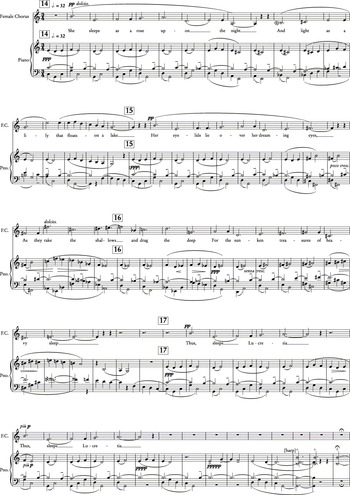
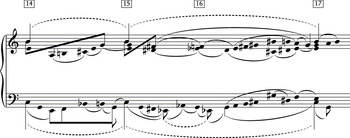
Lucretia is ‘named’ in two fundamentally unvarying ways: first by her identifying motif, given in Example 1, and second by the key of C major, which provides the complementary thematic element of childlike innocence. Example 2 shows the crystalline C major melody sung over Lucretia's sleeping form, and, as Example 3 shows, the melody prolongs the melodic B that both opens and closes the passage. In traditional tonal harmony B is of course the leading note of C major, although in the present context the vocal line seems almost to operate in its own tonal sphere (a trick Britten probably learnt from Stravinsky). But on either a traditional or context-specific reading, the note B is an aberration next to the C major instrumental lullaby. Given the interpretation of this B-focused ‘impurity’ that Tarquinius is about to make we might as well call it, from his horribly distorted perspective, Lucretia's ‘leading-on note’. She does not lead him on, but he finds her chastity and the opportunity to abuse her a turn-on so it has the same effect: being ‘led on’ by what to an objective viewer might seem to be innocent behaviour is one of the recognised defences of the rapacious male.
The Rape of Lucretia, Lucretia sleeping.

The Rape of Lucretia, Lucretia sleeping, analytical sketch.

Around Fig. 15, as part of an arpeggiation of the minor mode in the bass, E♭ is treated enharmonically as D♯ to underpin a brief focus on B major, a tonicisation of the ‘leading-on note’ that gains in significance in scene 2. The insertion of B into this C major context is, most immediately, a foretaste of the B–C–D–E♭ collection that features prominently in the rape scene and represents the most potent mapping of Tarquinius's motif, which those notes compose, onto Lucretia's. But instead of speaking of White's scales and thirds it may clarify the musical process (rather than just its superficial signs) to regard the essential male/female dichotomy as represented musically by the significant opposition of octatonic and diatonic scales respectively. When twinned with the construction of the acts as pairs of strophically developed scenes, the benefit of this opposition of diatonic and octatonic scales is that small changes introduced in successive repetitions can result in massive effects from the beginning to the end of the process. A motion from a scale associated with the male principle can therefore imperceptibly infect and overwhelm a scale associated with the female principle.Footnote 55 Yet it is not wholly satisfactory to talk about ‘male and female principles’ in this way because one diatonic area in particular, the C major of Lucretia's ‘innocence’, is very much a male construction. Women desire sex every bit as much as men, but in the patriarchal worldview of this story and opera their sexuality is pure, innocent, childlike and a protection for men against the sin of their own desire. C major is the fantasy space for Lucretia's projected lustlessness. When she is raped it is she, not Tarquinius, who is changed. Philip Brett means something similar when he speaks of Tarquinius's horrible success in ‘mak[ing] his desire her crime’.Footnote 56 So both the pollution of Lucretia's pure C major by the B that operates antagonistically alongside it and its juggernaut restatement in the epilogue are functions of the patriarchal discourse that shapes the whole.
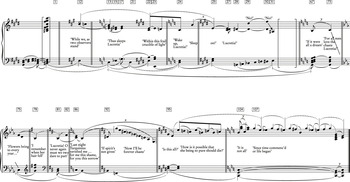
A glance at Example 4, a graphic representation of the main tonal developments of the second act, will sufficiently demonstrate the means by which the B becomes the ‘stain’ on Lucretia's chastity that will lead ultimately to her suicide, and how the revalorising of her innocent C major in the epilogue continues the act of repression beyond the grave.
The Rape of Lucretia, Act II, analytical sketch.

B has two melodic functions in Act II: to provide the sense of a perfect cadence into E (marked x in Ex. 4 at Fig. 25 and between Fig. 86 and Fig. 95), and to rise as a leading note to C (marked y in Ex. 4 at Figs. 67–73 and Fig. 104). Since E and C are the principal key areas of the act, linked through a nineteenth-century transformational chromatic relationship, this fact alone would make B's melodic function interesting. As Example 4 demonstrates, for most of the act the music rocks between these two key areas, often using B either as a link or, when the key is Lucretia's ‘innocent’ C, as a marker of the stain on her chastity, which Tarquinius will use to his advantage (as indicated by the x at Fig. 13 in Ex. 4).
As the textual cues given in Example 4 show, E major is the tonal area that opens up the rape scene following the Female Chorus's forlorn cry of ‘Sleep on!’. In broader structural terms, indicated by the bracketed slurs beneath the first system, it may be interpreted in a prolongational sense within a broader motion in C major, with the bass rising C–E–G from Fig. 13 through Fig. 24 to Fig. 67. The implied  linear progression in C from Figs. 22 to 24, which folds the first passage of E back into C, adds further weight to the sense of Cs prolongation. The dominant reached at Fig. 67, with the first resolution of the melodic B to C in motif y, closes into C minor at Fig. 75 for Lucretia's lament over the flowers. It is during the course of this long progression, of course, that Lucretia is raped – or to express it in terms she would understand, ‘stained’ or ‘polluted’ – and her view of her own nature is
reshaped under the name of ‘unchaste’. The structural motion from C major to C minor is a speech act as eloquent as the men's frequent recourse to her identifying motif.
The melodic B, never long out of focus, returns at Fig. 81 for a tonicisation that turns out, after Lucretia's suicide, to have been a substantial dominant preparation for a now much stronger E at Fig. 95. There are three phases of the prolongation of B here, each of which throws light on an aspect of Lucretia's ‘stain’. First the duet between Collatinus and Lucretia, with the latter's bitter reflection that ‘there is no sea deep enough to drown my shame … no night dark enough to hide this shadow’. The second phase is Lucretia's chillingly obsessive singing of the note B – seventy-four iterations without interruption – as she tells of her rape. The third, Collatinus's attempt to exculpate Lucretia, switches the mode to the major as he attempts to transplant her stain onto her attacker. But in the patriarchal logic of Lucretia's mind this will never be a persuasive argument, and in any case we now see that this moment was horribly foreshadowed at the start by Tarquinius, whose promise to ‘prove [her] chaste’ now seems to add a dark tinge to Collatinus's mental exertions to erase the ineradicable. Rejecting his interpretation utterly, Lucretia kills herself to her chain of descending thirds with a terminal fall of a fourth. Now, she says, she will be forever chaste, and with this reclaiming of her original nature, at least in her own eyes, Lucretia sets in motion the tonal fulfilment of the possibility held out with her first naming in Act I, namely that her ‘chaste’ motif, whose key we have been in for several minutes, can close into E, the act's double-tonic partner to C.
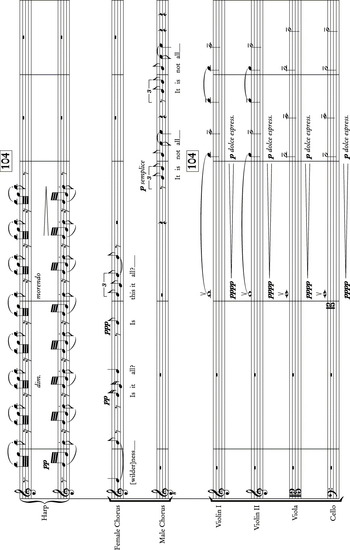
During this final presentation of E major for the mourning ensemble from Fig. 95 there is the most powerful sequence of tonal events. First, as the ensemble asks ‘how is it possible that she being so pure should die?’, the E major harmony underpins the act's second strong linear progression in C major. If C major, bound up with her chastity, directly focuses the ‘staining’ nature of the B, then E major, which follows as tonic in response to B's dominant, allows the epilogue to stand back from the issues that have driven the opera so far. Having opened up a separate tonal space between Figs. 95 and 104 through a reinterpretation of this B, the opera's Christian viewpoint can now potentially find intellectual space as an ‘objective’ reflection on the meaning of Lucretia's tragedy, occasioned by her ‘staining’ B. So the music returns, as the Male Chorus sings ‘It is not all’ with the most poignant resolution of the melodic B to C in the entire opera (see Ex. 5), to the question of what Lucretia's suffering indicates, now with a Christian gloss. Yet structurally this is ‘not all’, because B lingers in the harmony and it is only in the closing bar that the ‘stain’ of Lucretia's ‘leading-on note’ is finally resolved upwards to C. The Christian redemption seems to come at last, and Lucretia's shame is washed away by the Christian God. This final gesture has disappointed critics who do not share Britten's faith (if even he had it), but in closing I should like to offer two opposing interpretations of this conclusion.
The Rape of Lucretia, Act II, B–C resolution, ‘It is not all’.

It could be that the Christian epilogue was introduced by Britten, whether devoutly or not, as a means of highlighting the very unchristian nature of Lucretia's decision to turn her violent response to rape back onto herself in suicide. The framing device – a prologue with Male and Female Chorus situating the story long before ‘our’ Christian present and the promise of Christian redemption in the epilogue – might be Britten's way of asserting authorial commentary on the whole. In this light, the epilogue's promise that the Christian god can redeem any situation of extreme suffering might mean to suggest that Lucretia's decision to kill herself could have been prevented had she known that Christian promise, or else to draw a firm connection between the particular suffering of Lucretia and the general sharing of humankind's suffering that is the Christian god's assurance to the faithful. It may not be a convincing closing statement, but it could be an honestly meant presentation of Christian hope, as well as a negative authorial judgement of the sexual and gendered violence of the foregoing tale. If we are to argue that Britten had forward-thinking views of women's slow and still unfinished emancipation (and it is not clear that a Christian epilogue achieves that), then this is the reading to make. But for such a reading to hold water a critic would need to explain why so much of the music in the opera – in the very moments where the composer could allow for critical authorial commentary on the story he is presenting – seems to support the gender essentialisms of the text, with identikit women subject to more interesting and powerful men. Is the pervasive Christian colouring of the libretto sufficient to distance the joint authorial voice from the gendering of the pagan situation? And what is to be gained by demonstrating that the authors were as enlightened as we are? This seems like hagiography rather than criticism.
A much grimmer reading is possible. It may be that the epilogue offers exculpation for the audience and nothing more, although in musical terms it effects a pleasing tonal resolution, which is our invitation to find its sentiments persuasive through a sense of logical fittingness. We have witnessed the rape of a woman whose sole function is to preserve the honour of her husband; a woman who internalises her abuse as ‘shame’ and ‘shadow’ because she can conceive no life for herself but as a symbol of aspects of men, and kills herself; a widower who mourns because her passing leaves an emptiness in his life; and a politician who parades her corpse as a means of securing power for himself to usurp a hated (male) enemy. A more foul presentation of the brutal stupidity of patriarchy one could not hope to find. The Female Chorus asks whether the pain of Lucretia's tragic death will simply be repeated – evincing a touch of sensitivity, perhaps, to the reality of a patriarchal system that will never stop creating female puppets like this to die for men's benefit – and the Male Chorus answers that another man, Christ, ‘is all’. The Female Chorus seems to take up the Male's point and they end the opera in duet.
Britten insisted on adding a Christian ending, which will allow a hagiographical critic to hope that he found the foregoing narrative uncomfortable. Yet any discomfort Britten felt was not sufficiently disabling to prevent him from writing the opera in the first place, and to fail, as I have just noted, to offer progressive authorial commentary on the experience of women in his tale at any point before this extremely ambiguous epilogue. In sum, the work's rather pat conclusion carries a coarse sentiment that may leave a bitter taste as we walk away from the opera house. Instead of inviting the audience to reflect on its complicity in the general subjugation of women that Lucretia's portrayal makes clear, and to work for an amendment of the system, Britten and Duncan provide a get-out-of-jail-free card. We are reassured that humankind sins but a man, Christ, forgives. We need not correct our errors in this fallen world because there is a true world to come in which all our childish mistakes (into which comfortable category, it seems, we are to fit the subjugation, rape and killing of women) will be forgiven.
We should both acknowledge that works like The Rape of Lucretia offer an analysis of an intolerable system, and be grateful to Britten for laying the ideological structures of that sex prejudice so clearly open to view. For it is by reflecting on the motivations of Collatinus, Tarquinius and Lucretia, as Britten's musical setting of their drama sharply focuses, that we can be aided in the vital task of locating and dismantling the same prejudices in our own criticism and broader social lives.