INTRODUCTION
English parish churches and cathedrals contain a vast wealth of funerary monuments, many of the highest artistic quality: marvellous medieval sepulchres that miraculously survived iconoclasm;Footnote 1 loudly coloured Elizabethan and Jacobean tombs;Footnote 2 Baroque extravaganzas;Footnote 3 exquisite Georgian memorials; tender expressions of affection in early nineteenth-century memorials; and immense outpourings of Victorian grief.Footnote 4 Well might the poet Thomas Tickell (1686–1740) lament:
Oft, let me range the gloomy aisles alone:
(Sad luxury! To vulgar minds unknown)
Along the walls where speaking marbles show
What worthies form the hallow’d mould below…Footnote 5
Ancient churches are places of entombment for generations comforted by the proximity of their mortal remains to altars and, therefore, to the relics of saints. Even after the Reformation, tradition died hard, and English churches long remained desirable residences for the dead until well into the nineteenth century,Footnote 6 so funerary monuments to the dead deposited in vaults beneath may have given scope for creative imagery that had not been encouraged in ecclesiastical art under Protestantism. It is not simply for artistic pleasure that the legacy of church monuments left to us deserves our respect and understanding.
Despite this, funerary sculpture of the late years of the eighteenth and the first half of the nineteenth century has been sorely under-valued, and is even now a minority interest. This is extraordinary, given that there is an abundance of post-Renaissance church monuments in England, especially in churches near great country houses, and this art form was peculiarly English, much more so than portrait-, landscape- or animal-painting.Footnote 7
This paper will consider variations on a select range of sculptural themes in figurative late-Hanoverian and early-Victorian funerary monuments in England, Ireland and India, all handled with great ‘tact and skill’,Footnote 8 by an English master whose works displayed not only iconographical coherence, but fell stylistically, to a greater or lesser degree, within what we call Neo-Classicism. The term, Neo-Classicism,Footnote 9 refers to a style or movement once dominant in European and American art and architecture. It was essentially an attempt to return to the Classicism of Graeco-Roman Antiquity at a time when there was a reaction against what some perceived as the ‘excesses’ of Baroque and Rococo, and a perception that the Renaissance had not produced paradigms that were true to the spirit of Antiquity. During the Enlightenment, there was a greater appreciation of the importance of archaeology and scholarship in the creation of art and architecture more informed by Antique exemplars. Therefore, expeditions were mounted to carry out surveys of extant Greek buildings, resulting in numerous publications.Footnote 10 The most important of these was The Antiquities of Athens,Footnote 11 which started to appear from 1762.Footnote 12
The arrival in London of a group of Antique Greek sculpturesFootnote 13 also had a profound influence on style and, together with the superbly illustrated publications of Greek details and buildings that soon became available, informed numerous sculptors. Most notable of these included the Englishman John Flaxman (1755–1826), the Dane Bertel Thorvaldsen (1770–1844), the Italian Antonio Canova (1757–1822), the Germans Christian Daniel Rauch (1777–1857), Johann Gottfried Schadow (1764–1850) and his son Rudolf (1786–1822), and others, all associated with Neo-Classicism.Footnote 14
FRANCIS CHANTREY
Each funerary monument discussed here is, in its own way, a distinguished piece of work. Taken together, the monuments demonstrate a developing shift in taste, from severe Neo-Classicism to Early Romanticism, in their depictions of recumbent, reclining and kneeling figures, with especial reference to episcopal commemoration. Moreover, they are all the result of one man’s genius – that of Francis LeggattFootnote 15 Chantrey (1781–1841).Footnote 16 Chantrey was among the most accomplished masters of funerary sculpture in his time. Nevertheless, he was highly critical of much European sculpture, and his own work, though possessing many Neo-Classical features, especially ornament, tends to a greater naturalism and perhaps warmth compared with the oeuvre of many European artists, although he successfully avoided mawkish sentimentality, unlike some of his contemporaries.Footnote 17 We know that Chantrey himself was not particularly noted for his piety; indeed, his conversation was often ‘larded with profane expletives’, according to his biographer, John Holland (1794–1872).Footnote 18
Born in Jordanthorpe, Norton, in Yorkshire,Footnote 19 to a tenant-farmer, Francis Chantrey (1748/9–93) and his wife, Sarah, née Leggatt (1745/6–1826), in 1797 young Chantrey was apprenticed to Robert Ramsay (1754–1828), the Sheffield-based carver of decorations, gilder, and dealer in prints and casts after the Antique. However, with the encouragement of John Raphael Smith (1752–1812), Chantrey became a portrait-painter, and worked (1802–7) as such and as a stone-carver. Around 1808 he gave up painting to focus on sculpture, moving permanently to London. He soon achieved fame, and George iii sat for him in 1809. This royal Imprimatur was the start of an illustrious professional life, for examples of his work may now be found all over the British Isles, in parts of the former British Empire and even in the United States of America.Footnote 20
In 1809 Chantrey married his cousin, Mary Anne Wale (1787–1875), whose parents were, respectively, butler and housekeeper to Mrs D’Oyley, granddaughter of Sir Hans Sloane (1660–1753),Footnote 21 whose legacies included the foundation of the British Museum. Miss Wale’s dowry enabled Chantrey to set up house and a studio in Eccleston Street, Pimlico. Thereafter, his career took off at a spectacular pace. He exhibited at the Royal Academy and prestigious commissions followed, bringing him respect as an artist as well as financial success. In order to meet the demand for busts, statues and church monuments, Chantrey employed a skilled team of craftsmen, several of whom went on to work as independent sculptors. Appointed in 1830 as Sculptor-in-Ordinary to William iv, Chantrey’s standing led to a knighthood five years later, and, when he died, he left a considerable fortune, part to the Royal Academy, and part for the support of his widow, who long outlived him.Footnote 22
THE SLEEPING CHILDREN
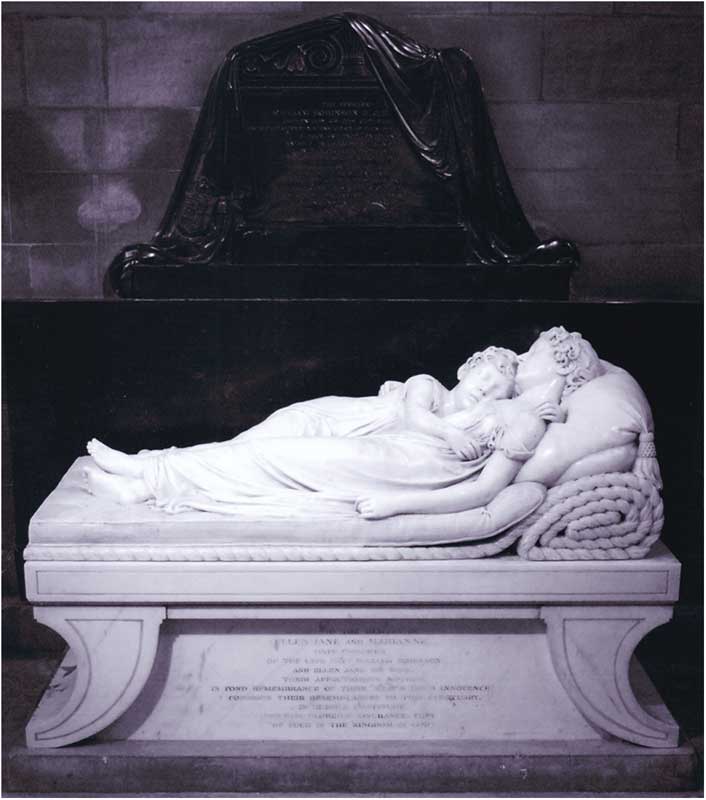
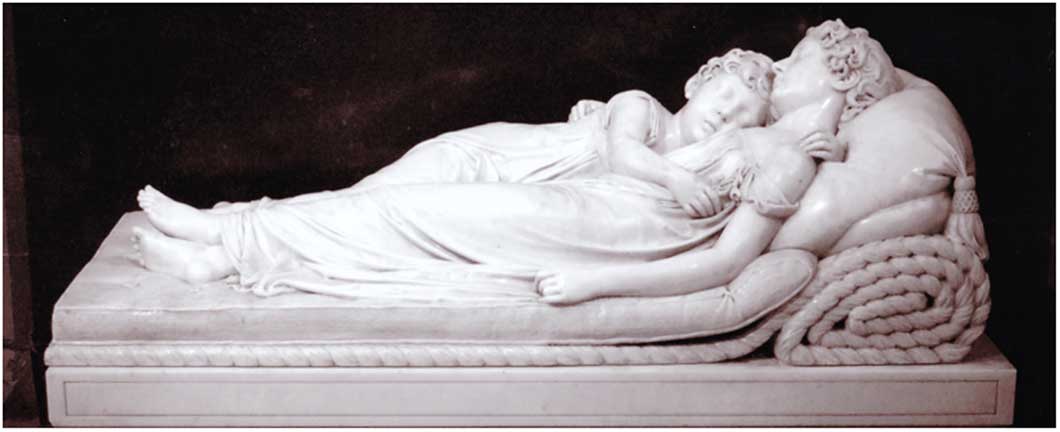
Early fame arrived with his touching funerary monument (fig 1), ‘beautifully carved and full of pathos’Footnote 23 in Carrara marble, known as ‘The Sleeping Children’ in the south choir aisle of the Cathedral Church of the Blessed Virgin Mary and St Chad, Lichfield, Staffordshire (1815–17): it was rapturously received when exhibited in 1817 at the Royal Academy.Footnote 24 Although the tomb chest is a severe Neo-Classical couch, the lifelike character of the entwined effigies verges on Early Romanticism, and it appears that the engraver, Thomas Stothard (1755–1834), may have played some part in the composition.Footnote 25 The childrenFootnote 26 were daughters of the Reverend William Robinson (c 1777–1812), prebendary of Lichfield, and his wife, Ellen-Jane (née Woodhouse), and are shown on a mattress over a rush-mat of the type upon which corpses were laid.Footnote 27 On the wall behind the monument, also by Chantrey, is a black marble tablet enveloped in a mantle, with the Arms of Robinson impaling Woodhouse, commemorating Robinson himself, who succumbed to tuberculosis aged 35.Footnote 28
‘The Sleeping Children’ in Lichfield Cathedral, with (behind) the black marble memorial to their father. Photograph: taken 2016 © the author

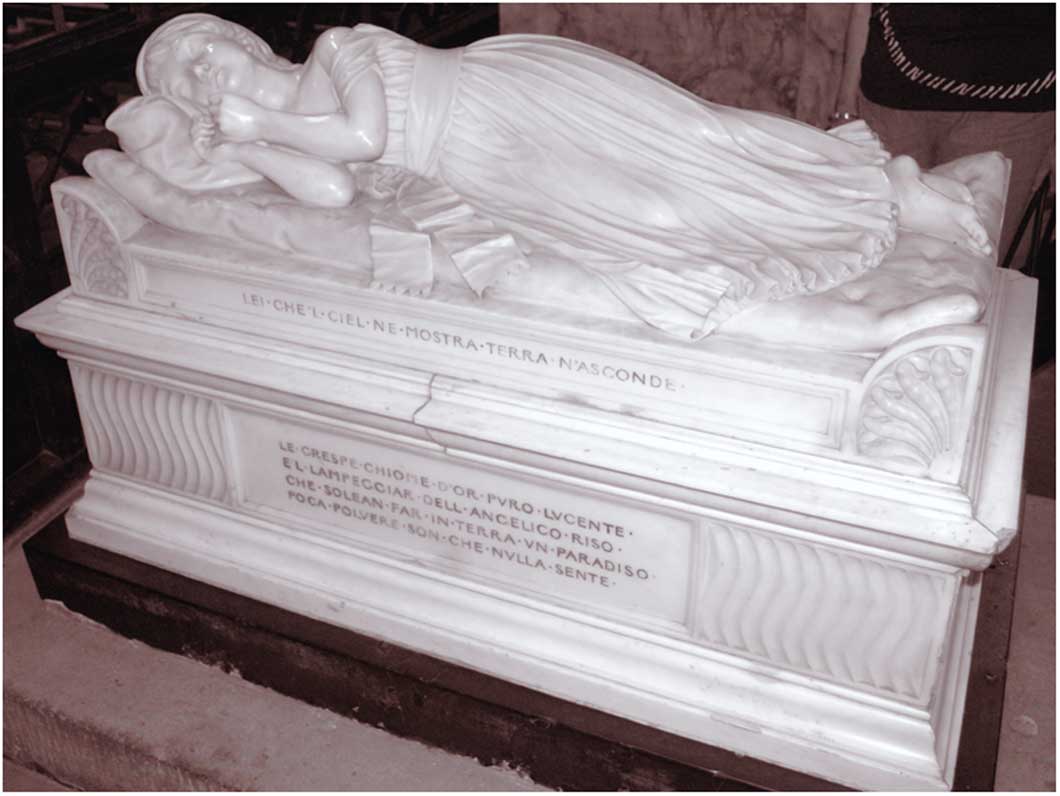
The depiction of the Robinson children as though asleep (fig 2) was probably suggested by the charming monument to Penelope Boothby (d. 1791 aged five)Footnote 29 by Thomas Banks (1735–1805) in the north transept aisle of St Oswald’s church, Ashbourne, Derbyshire.Footnote 30 Commissioned and exhibited at the Royal Academy in 1793,Footnote 31 it is Neo-Classical, with strigillations and stylised honeysuckle within the acroteria, and inscriptions in English, French, Italian and Latin. A ribbon-sash, the ends of which, leading from a twisted knot at the waist (signifying pain, perhaps?), are spread out, and fall over the side of the mattress on which the effigy lies (fig 3).
‘The Sleeping Children’, Lichfield Cathedral. Photograph: taken 2016 © the author

The monument to Penelope Boothby, St Oswald’s, Ashbourne, Derbyshire. Photograph: taken 2012 © the author

KNEELING FIGURES
The success of ‘The Sleeping Children’ made Chantrey a fashionable choice for the provision of funerary monuments, and his first commission for a kneeling bishop was not long delayed. Kneeling figures are, of course, commonly found from the latter part of the sixteenth century as small rows of mourning relatives on the fronts of tomb chests on which lie full-length recumbent effigies of the deceased, then recur as symmetrical rows of children segregated by gender beneath kneeling larger figures, husband and wife, who face each other on either side of a prie-dieu.Footnote 32 The fashion for kneeling figures (with a few exceptions) seems to have palled from around 1660 onwards, but from the closing years of the eighteenth century kneeling women began to be depicted in an attitude of mourning, usually associated with a funerary urn, as in Chantrey’s monument of 1834Footnote 33 to Admiral Sir Richard Hussey Bickerton (1759–1832) in the south choir aisle of the Abbey Church of Saints Peter and Paul, Bath, Somerset.
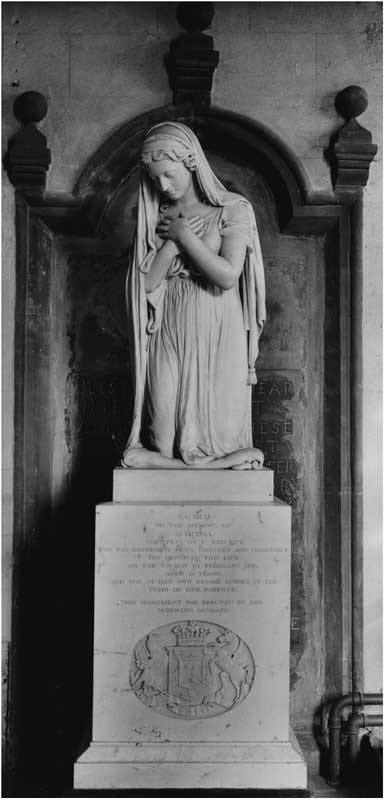
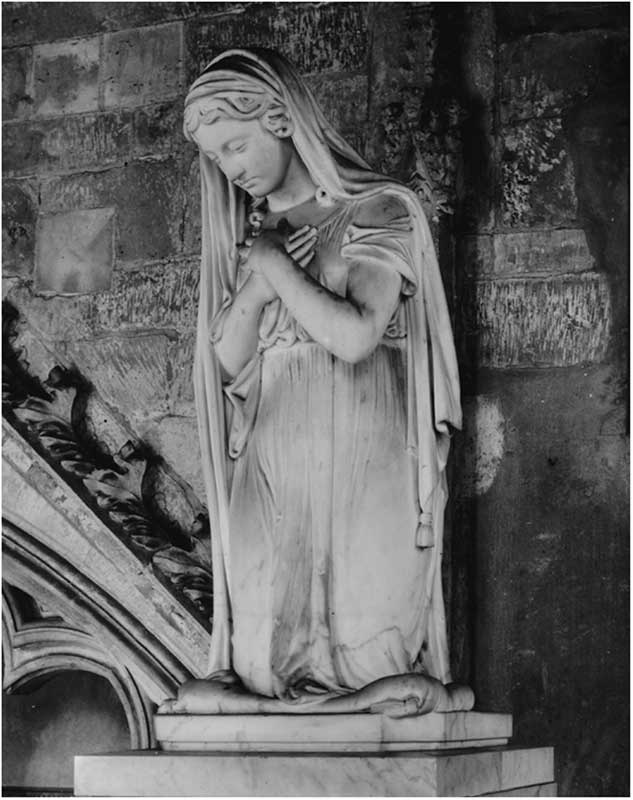
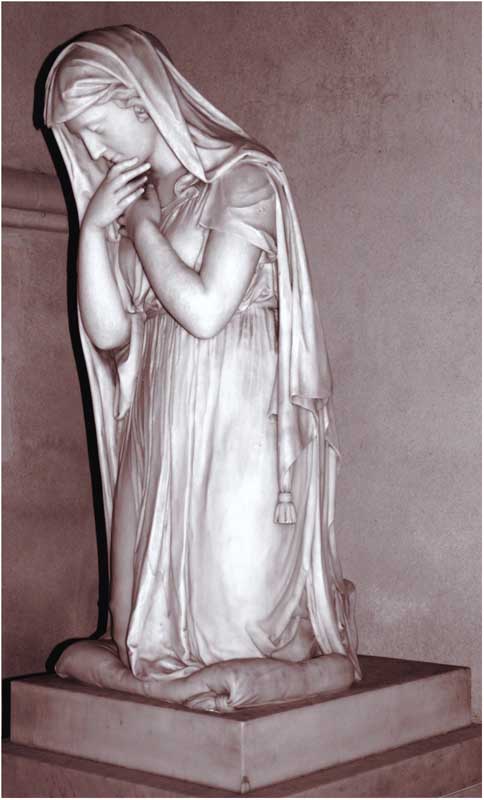
Although Chantrey continued the convention of women (perhaps personifications?) kneeling by urns, he revived another – that of portraying graceful young females at prayer.Footnote 34 One of his first essays in this form, from 1816 to 1818, was the monument to Martha, Countess St Vincent, née Parker (1741–1816),Footnote 35 in St Peter’s church, Caverswall, Staffordshire (fig 4). The countess was elderly when she died so this figure shows her idealised in her youth, with her hands crossed over her bosom.Footnote 36 Even if the countess had been much younger at the time of her death, we might still doubt whether we could consider this an accurate portrait taken from life because the sculptor used similar youthful figures in other memorials, and it has been suggested that they represent something other than reality.Footnote 37 This formula was repeated, with minor variations, in several of Chantrey’s monuments, including that commemorating Frances Puleston Cooke (1765–1818) in All Saints’, Owston, near Doncaster, Yorkshire (created 1818–23; fig 5),Footnote 38 and Lady Charlotte Finch, née Fermor (1725–1820) in Holy Cross, Burley-on-the-Hill, Rutland (created 1817–24; fig 6) even though she had been buried in Buckinghamshire.Footnote 39 Given Lady Charlotte’s very advanced age at the time of her death, the exquisite figure of a very young woman, with hands crossed high, just under the chin,Footnote 40 follows Chantrey’s skilful portrayal of tender youthfulness:Footnote 41 the Cooke figure was described by Chantrey’s biographer as ‘Veneration’.Footnote 42
The monument to Martha, Countess St Vincent, in St Peter’s church, Caverswall, Staffordshire. Photograph: taken 1959 © Historic England Archive AA60/00419

The monument to Frances, wife of Bryan Cooke of Owston Hall, in All Saints’, Owston, Doncaster. Photograph: taken 1910 © Historic England Archive DD81/00028

The Finch monument, Holy Cross, Burley-on-the-Hill, Rutland. Photograph: taken 2017 © the author

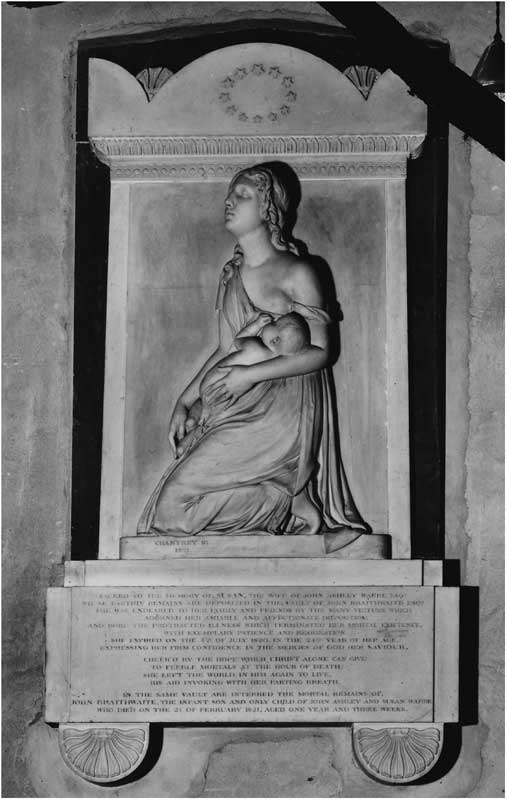
Chantrey also executed a number of monuments on the same theme, but showing the figures in high relief. Among these may be mentioned the monument of 1825 in St James’s, Weybridge, Surrey, commemorating Frederica Charlotte Ulrica Catherina, née Princess Frederica of Prussia (1767–1820),Footnote 43 Duchess of York.Footnote 44 Also, the monument dated 1821 of Susan Cornwall Warre (1796–1820), this time holding a baby, the figures set against a representation of the end of a massive Grecian sarcophagus, in St Martin’s, Epsom, Surrey (fig 7).Footnote 45 Worthy of note, too, is the monument of the same year of Octavia (née Stewart),Footnote 46 Lady Ellenborough (1792–1819), in St James’s, North Cray (formerly in Kent, but now in Bexley, London).Footnote 47 The sculptor’s tender, resigned and emotionally powerful creations are invariably beautiful and very touching. Moreover, they seem to convey private introspection in piety and prayer that is almost painful to witness.
The monument to Mrs Warre, holding her baby, John Braithwaite Warre (1820–1), St Martin’s, Epsom, Surrey. Photograph: taken 1943 © Historic England Archive AA44/05037

THE BROWNLOW NORTH MONUMENT
Brownlow North (1741–1820) was the son of Francis North (1704–90), 1st Earl of Guilford, and his second wife, Elizabeth, née Kaye (1707–45), widow of George Legge (c 1704–32), Viscount Lewisham. Educated at Eton as an oppidan (1752–9),Footnote 48 he matriculated in 1760 as a fellow commoner of Trinity College, Oxford, graduating with a BA in 1762 before being elected a Fellow of All Souls College in 1763, proceeding to an MA in 1766 and DCL in 1770. Appointed rector of Lighthorne, Warwickshire, thereafter he accumulated rapid preferment through family connections and influence with George iii. In 1768, he was presented with a canonry at Christ Church, Oxford, which he held for only two years before being installed as dean of Canterbury and acquiring the profitable vicarages of LyddFootnote 49 and Bexley in Kent, both of which he retained in commendam Footnote 50 with his first bishopric (that of Lichfield and Coventry), obtained through his half-brother, Frederick (1732–92).Footnote 51 Translated to Worcester in 1774, North became bishop of Winchester in 1781, and remained there for the rest of his life.Footnote 52 A cultivated man, he promoted the Three Choirs Festival, was a Fellow of the Society of Antiquaries of London (elected in 1773) and elected an Honorary Member of the Linnean Society in 1800.Footnote 53
In 1822, Chantrey had produced for the Linnean Society a marble bustFootnote 54 of Sir Joseph Banks, FRS (1743–1820), followed by a statue in 1826, and it is possible that the sculptor met North through that body, for we know that Chantrey made use of scientific clubs to meet clients.Footnote 55
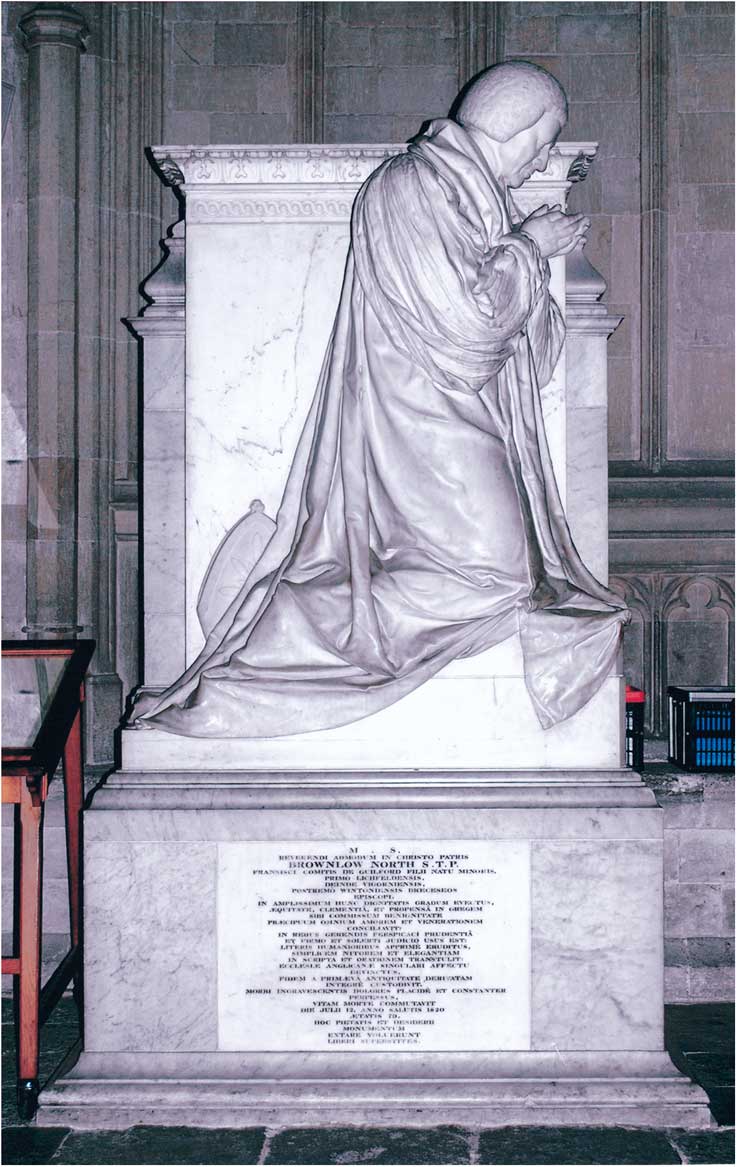
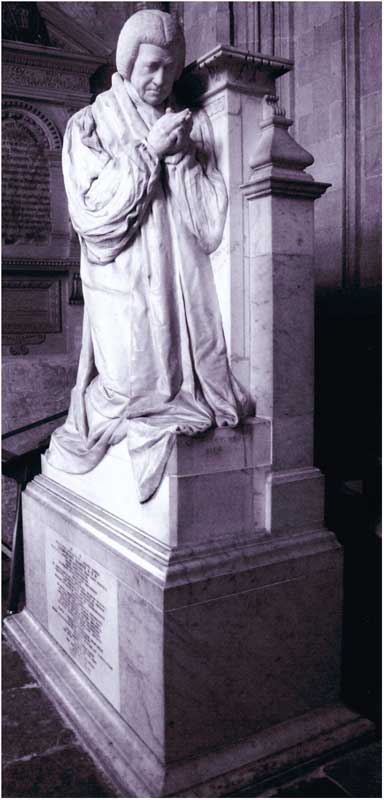
Chantrey was commissioned to make North’s marble monument, and he completed it in 1825 (fig 8).Footnote 56 The bewigged figure is kneeling in prayer, the left side attached, from the shoulder downwards, to a Neo-Classical structure. Now in the south presbytery (or choir aisle) of Winchester Cathedral, the monument was formerly in the lady chapel, then placed near Waynflete’s chantry chapel: it certainly deserves a better location than it has now, where it can be easily overlooked. It consists of a simple inscribed plinth on which the bishop kneels beside an altar-like architectural background, the entablature of which is decorated with guilloche and crowned with a coved cornice embellished with stylised foliage. The finely cut inscription reads:
M . S . [ Footnote 57 ]
REVERENDI ADMODUM IN CHRISTO PATRIS
BROWNLOW NORTH S . T . P. [ Footnote 58 ]
FRANCISCI COMITIS DE GUILFORD FILII NATU MINORIS,
PRIMO LICHFELDENSIS,
DEINDE VIGORNIENSIS,
POSTREMÒ WINTONIENSIS DIŒCESEOS
EPISCOPI.
IN AMPLISSIMUM HUNC DIGNITATIS GRADUM EVECTUS,
ÆQUITATE, CLEMENTIÂ, ET PROPENSÂ IN GREGEM
SIBI COMMISSUM BENIGNITATE
PRÆCIPUUM OMNIUM AMOREM ET VENERATIONEM
CONCILIAVIT:
IN REBUS GERENDIS PERSPICACI PRUDENTIÂ
ET FIRMO ET SOLERTI JUDICIO USUS EST:
LITERIS HUMANIORIBUS APPRIMÈ ERUDITUS,
SIMPLICEM NITOREM ET ELEGANTIAM
IN SCRIPTA ET ORATIONEM TRANSTULIT:
ECCLESIÆ ANGLICANÆ SINGULARI AFFECTU
DEVINCTUS,
FIDEM A PRIMÆVÂ ANTIQUITATE DERIVATAM
INTEGRÈ CUSTODIVIT.
MORBI INGRAVESCENTIS DOLORES PLACIDÈ ET CONSTANTER
PERPESSUS,
VITAM MORTE COMMUTAVIT
DIE JULII 12, ANNO SALUTIS 1820
ÆTATIS 79.
HOC PIETATIS ET DESIDERII
MONUMENTUM
EXTARE VOLUERUNT
LIBERI SUPERSTITES.Footnote 59
The North monument, Winchester Cathedral, from the south. Photograph: taken 2015 © the author

From this, we learn essential biographical factsFootnote 60 and also that North carried out his duties with dignity, justice and kindness; that he commanded love and reverence; that he was erudite, expressing himself elegantly in both written and spoken form; that he was singularly attached to the Anglican Church; that his faith was derived from true ancient sources; that his final illness brought constant pain and suffering, which he endured quietly until his death on 12 July 1820, aged seventy-nine;Footnote 61 and that the monument (signed CHANTREY, SC. 1825) was erected through duty and grief by the wishes of his surviving children.
This inscription was composed by the then dean of Winchester, Thomas Rennell (1754–1840), under whose aegis restoration works were carried out at the cathedral, including some shifting of monuments between 1815 and 1820.Footnote 62 In 1816, Rennell’s only son, also Thomas (1786–1824), was appointed vicar of Kensington and, in 1823, to the prebend of South Grantham in Salisbury Cathedral.Footnote 63 Thus, it is no surprise when, in 1828, Chantrey was chosen to make his monument in the form of a bust (costing £200), now in St Mary Abbots, Kensington.Footnote 64 He has also been creditedFootnote 65 with another monument to Rennell, that on the west wall of the south transept in the Cathedral Church of the Blessed Virgin Mary, Salisbury, Wiltshire, although that handsome Grecian composition has also been attributed by some to John Flaxman.
The North monument has a particularly successful depiction of drapery, and the manner in which the bishop’s left side is joined to the Classical altar-like structure behind is well handled (fig 9). The drapery, as it falls behind the bishop, partly obscures a mitre set against the background. Chantrey’s Scots foreman and long-term pointingFootnote 66 assistant (from 1814), Allan Cunningham (1784–1842),Footnote 67 recorded in the ledger-book that North’s memorial was to be a ‘monument containing a devotional figure’ – a stipulation that does not appear in any previous commission.Footnote 68 The work was commissioned by two individuals: North’s daughter, Henrietta (1771–1847), and her husband (from 1797), the Reverend William Garnier (1771–1835), prebend of Winchester and rector of Droxford, appear to have suggested the symbolism and the pose, requesting initial drawings showing the bishop as finally sculpted. So realistic and expertly carved is the drapery, it is not unlikely that Chantrey himself brought it to its final state.
The North monument, from the east, showing the figure joined to the Classical architectural background. Photograph: taken 2015 © the author

It may also be significant that William Garnier’s brother, the Reverend Thomas Garnier (1776–1873), who had been ordained in 1800 by Bishop North (after which a ‘steady flow of lucrative preferment came his way’Footnote 69 ), and who, in 1840, succeeded Dr Rennell as dean of Winchester, had been elected a member of the Linnean Society in 1798. From 1807, when he became rector of Bishopstoke (a post he held for over sixty years), he was able to indulge his taste for botany by considerably extending the rectory gardens.Footnote 70
North ‘extracted maximum familial advantage from his long episcopate’,Footnote 71 which is putting it mildly. His elder son, Francis (1772–1860), took holy orders, was rector of St Mary’s, Southampton (1797–1850) and master of St Cross Hospital (1808–60), having been presented with that position by his father. In 1827, he became the 6th Earl of Guilford. His younger son, Charles Augustus (1781–1825), was rector of Alverstoke and prebendary of Winchester, and his son, Brownlow (1810–75), while still an infant, was named by his grandfather the registrar of the Diocese of Winchester, a lifelong sinecure. ‘Apart from’ his ‘immediate family’, the bishop’s ‘stepchildren and in-laws all benefited from his patronage; … twenty-six individuals received about seventy appointments to fifty churches through North’s influence between 1785 and 1820’.Footnote 72
Nicholas Penny has pointed out that ‘Chantrey’s kneeling figures seem to be, without exception, women or bishops’, yet ‘the last monument’ he ‘erected to a bishop – that to Bishop Bathurst[Footnote 73 ] in Norwich Cathedral – shows the figure seated’.Footnote 74 Penny speculated if ‘this old-fashioned Whig’ disliked ‘the new fashion of kneeling’ captured by Chantrey as ‘the characteristic attitude for an episcopal monument between 1820 and 1845’.Footnote 75 North’s monument was the first essay in kneeling bishops by Chantrey, a conscious innovation, prompted no doubt by the Garniers, but all the more startling when compared with the semi-recumbent figure of Richard Willis (1664–1734), bishop of Winchester, by Sir Henry Cheere (1703–81) in the south nave aisle. Supported by a cushion and a pile of books, Willis reclines on a veined, black-marbled sarcophagus, eyes turned heavenwards (though looking west), framed by a ‘portentous aedicule’Footnote 76 featuring a Composite Order and pediment.Footnote 77 The Baroque language is theatrical, restless, showy and exaggerated, but North’s monument could not be more different: it is still, suggesting piety, reflection and humility before God. It is unquestionably rooted in Neo-Classicism, especially in the treatment of the architectural background, yet the overall effect is Romantic Neo-Classicism in which a characteristic naturally posed figure is incorporated within a religious monument. Chantrey seemed to be expressing devotion without metaphysics or melodrama in naturalistic sculpture that nevertheless hints at something greater and unspoken – perhaps the essence of well-mannered High Church Anglicanism without histrionic ‘enthusiasms’. We know that Chantrey was violently opposed to allegory,Footnote 78 so his bishops in attitudes of prayer must be seen in this context.Footnote 79
CHANTREY’S MONUMENT TO WILLIAM STUART
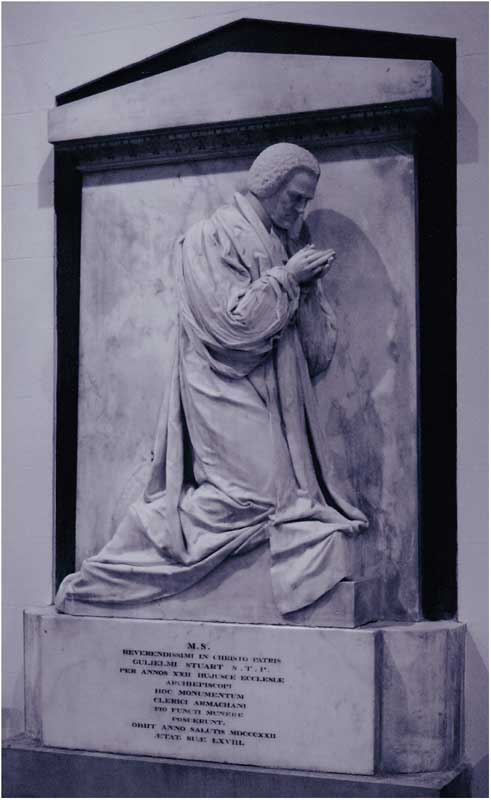
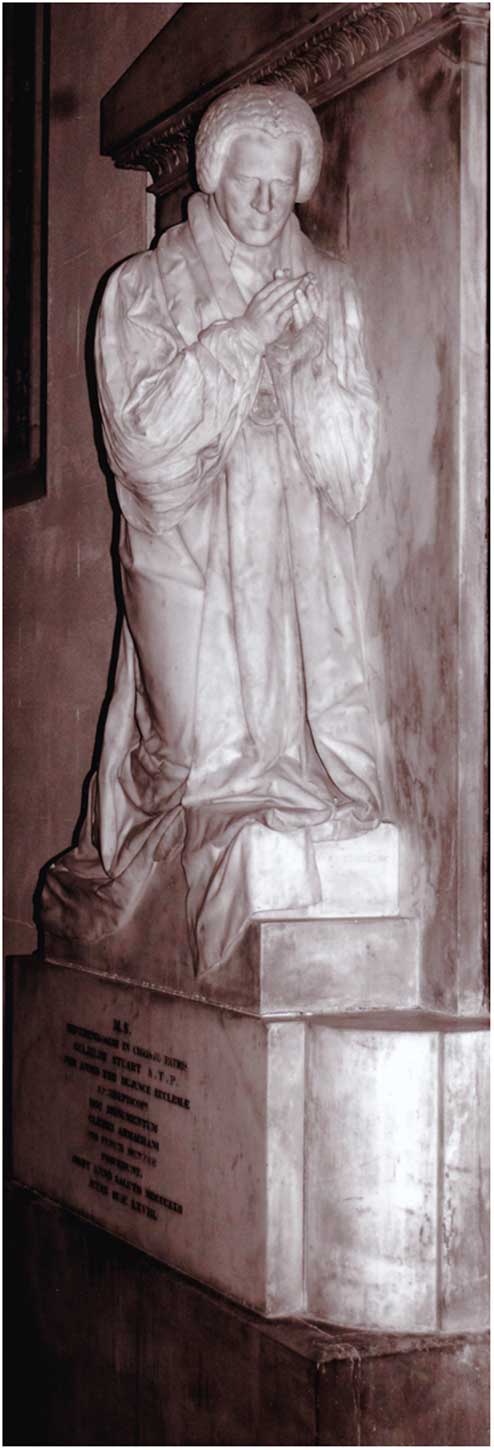
Very soon after the North monument, Chantrey was commissioned to produce another (1824–6), to be erected in the Anglican Cathedral of St Patrick, Armagh, Ireland.Footnote 80 Chantrey’s splendid memorial there, a serene masterpiece of Neo-Classicism, is very similar in composition and style to those adopted for the North memorial, except that the architectural background to the kneeling figure is taller, more severe and massive.Footnote 81 As the figure’s head does not rise above the background, the overall effect is perhaps more satisfying (fig 10).
The Stuart monument, from the south east. Note how the drapery is similar to that on the North monument (see fig 8). Photograph: taken 2012 © the author

It commemorates William Stuart (1755–1822)Footnote 82 – the fifth sonFootnote 83 of John Stuart (1713–92), 3rd Earl of Bute and prime minister from 1761 to 1763Footnote 84 – and his wife, Mary Wortley Montagu (1718–94).Footnote 85 Educated at Winchester and St John’s College, Cambridge, William Stuart graduated with a BA in 1772, gained his MA in 1774, was ordained in 1779 and had the degree of Doctor of Divinity conferred on him in 1789, in which year he also became a canon of Christ Church Cathedral, Oxford. In 1793 he was appointed as bishop of St David’s; a year later, and again in the winter of 1799–1800, he was invited to preach at Court, where his serious homilies were greatly admired by George iii.Footnote 86 In 1796, Stuart married Sophia Margaret Juliana Penn (d. 1847), daughter of Thomas Penn (1702–75)Footnote 87 and Lady Juliana Fermor (1729–1801),Footnote 88 and they had two sons and two daughters.
In July 1800 Stuart was nonplussed (not least because he feared for the quality of upbringing and education of his children in a land widely regarded in metropolitan circles as a cultural and social backwater) to receive a request from George iii to consider assumption to the office of primate of Ireland. He was not the first choice for this position: there appears to have been a great deal of haggling. However, by October Stuart had assented to the appointment, and was translated from St David’s to the archbishopric of Armagh by Royal Letters Patent dated 22 November 1800. Perceived in certain quarters as an example of undue royal interference, in 1801 this appointment was a contributory factor in the resignation of William Pitt (1759–1806) as prime minister.Footnote 89
As archbishop, Stuart was indiscreetly critical of bishops in the Irish Church, largely because of their failure to promote education. Nor did he have much help from English bishops, who showed little interest in Irish affairs. He saw lack of clerical zeal as not only endangering the Church, but weakening its influence in Ireland and threatening the Establishment: in particular, he deplored the incidence of non-residence among the clergy. Even so, he did not practise what he preached in this respect, and although he attempted to enforce the duty of residence for clergy in his diocese, he was often absent in England, not least because he entertained hopes of further translation to enable him to sit on the English Bench.Footnote 90 Nevertheless, he set in motion many reforms, and drew upon the resources of the Board of First FruitsFootnote 91 to promote improvements. Even then, his efforts were not entirely successful.Footnote 92 He chaired the Irish Board of Education Inquiry and, under his aegis, that organisation issued fourteen influential reports between 1809 and 1813.Footnote 93 In short, he endeavoured to push for innovations in the teeth of apathy, suspicion and opposition, but some antipathy directed towards him may have been partly due to his constant fault-findingFootnote 94 and contributed to what must be regarded as the ultimate failure of his primacy. He also presided over some very poorly conceived ‘restoration’ and re-ordering of Armagh Cathedral in 1802, including the placing of an altar at the west end of the nave.Footnote 95 By the late 1830s, such travesties of ecclesiastical arrangements were seen as unacceptable, and had to be comprehensively unpicked and remedied (1834–41) under the direction of the Gothic Revivalist Lewis Nockalls Cottingham (1787–1847).Footnote 96
Stuart had an unfortunate and premature death, thanks to a mix-up between a bottle of embrocation and a bottle of laudanum. The embrocation was administered by mouth to him in error, seemingly by his daughter, at his home in Hill Street, Berkeley Square, London.Footnote 97 The mistake proved fatal. His body was entombed at Luton Park, Bedfordshire. His monument was ordered in 1824, completed in 1826 and erected in June 1827.Footnote 98 Costing a thousand guineas,Footnote 99 there was the added expense of transporting it to Armagh: the packing-case alone cost £19 10s; the outlay on travelling, board and lodgings came to £17 7s.; and there was a further charge for erecting it. Records show that Chantrey received payment of £1,115 17s. 9d.Footnote 100 Rennison’s Manuscript Notes record that ‘Mr Chantrey’s Man’ had arrived to do the work, and that a place for the monument had been ‘fixed on’,Footnote 101 but this was after much discussion about exactly where it might be sited, as is shown in Primate Beresford’s correspondence.Footnote 102 Like the North monument, Stuart’s was moved subsequently at least twice: a photograph in the Armagh County Museum shows Stuart’s monument on the wall of the south aisle, facing west, so the primate would have ‘greeted’ visitors entering from the west once Cottingham had re-ordered the cathedral.Footnote 103
Chantrey’s completed work attracted some criticism: the ‘stiffness of the arm or rather shoulder which adjoins the wall’ was noted (fig 11).Footnote 104 William Makepeace Thackeray, however, visited Armagh in 1842 when collecting material for his Irish Sketch Book,Footnote 105 and described the ‘spick and span’ gilding and general ‘neatness’, freshness and handsomeness of the cathedral. In particular, he singled out the ‘beautiful’ Stuart monument for praise and admired the building as a whole.Footnote 106 This would have been after the very considerable works of refurbishment, re-casing and other interventions of Cottingham, a major project to which Primate Beresford generously contributed more than half the total amount.Footnote 107
The Stuart monument, from the east, showing the figure attached to the sarcophagus-like form. Photograph: taken 2012 © the author

The Vestry Meetings reveal that there was also some re-ordering and moving of monuments in the 1840s.Footnote 108 Later, in 1886,Footnote 109 Alexander James Beresford Beresford Hope (1820–87), politician, author and Ecclesiologist,Footnote 110 wrote a letter recommending the appointment of the architect Richard Herbert Carpenter (1841–93), son of the early Gothic Revivalist Richard Cromwell Carpenter (1812–55),Footnote 111 to carry out new works of restoration. At that time, Carpenter was in partnership with Benjamin Ingelow (fl. 1872–1925), and Beresford Hope described him as a ‘man full of genius and taste’:Footnote 112 their work at Armagh is outlined in their report, published in 1886,Footnote 113 although they are less than clear about what they did to the monuments. That they carried out some moves is clear from a spoof letterFootnote 114 purporting to be from the ‘Spirit of William Stuart DD’, deploring the fact that he was now facing east, having been removed from the ‘south isle’ where he ‘looked at the children’ of his ‘people as they entered’ the church, so we can deduce that Stuart’s monument was moved to the north aisle at the time of the Carpenter–Ingelow re-ordering of 1888.
The entire monument is executed in marble. There is a plain unadorned plinth over which is a simple block inscribed with excellent lettering, and above this is a slightly battered plain panel against which the kneeling figure of the archbishop is set. This battered element is capped by a block, the top of which is pitched, and under this is an elegant cyma moulding enriched with repetitive carved decoration (the only concession to ornament in the whole composition). Indeed, the entire architectural background to the kneeling figure represents an Antique sarcophagus,Footnote 115 complete with pitched lid, but we see only the ‘end’ of this sarcophagus, as it were, enhanced and set off by a black background. As for the inscription itself, it reads:
M . S . [ Footnote 116 ]
REVERENDISSIMI [ Footnote 117 ] IN CHRISTO PATRIS
GULIELMI STUART S. T. P. [ Footnote 118 ]
PER ANNOS XXII HUJUSCE ECCLESIÆ
ARCHIEPISCOPI
HOC MONUMENTUM
CLERICI ARMACHANI
PIO FUNCTI MUNERE
POSUERUNT.
OBIIT ANNO SALUTIS MDCCCXXII
ÆTAT. SUÆ LXVIII.
Thus, we gather that the monument (which is signed and dated) is sacred to the memory of the Most Reverend Father in Christ, William Stuart, Doctor of Divinity, for twenty-two years archbishop of ‘this Church’, who died in 1822 in his sixty-eighth year.
Chantrey’s Winchester and Armagh memorials are fine examples of work in the Neo-Classical style, one of the characteristics of which was a tendency to avoid frippery and excessive decoration, but it is a Neo-Classicism tempered by the devotional poses of the realistically carved kneeling figures. In both, the drapery is handled in a masterly way, but similarities in treatment of that drapery cannot be ignored, for Stuart’s was clearly modelled on that created for North, and even the positioning of the partly obscured mitre (despite the fact that Church of Ireland bishops and archbishops do not wear mitres) is the same. Nevertheless, Stuart’s monument cost more than North’s, the difference probably reflected in the size (Stuart’s is bigger) and the expense of transporting it to Ireland. The church historian Mrs Esdaile perceptively noted that the ‘devotional Bishop is best represented by Chantrey at Winchester and Armagh’.Footnote 119 This author has no quarrel with that judgement.
THE BARRINGTON MONUMENT
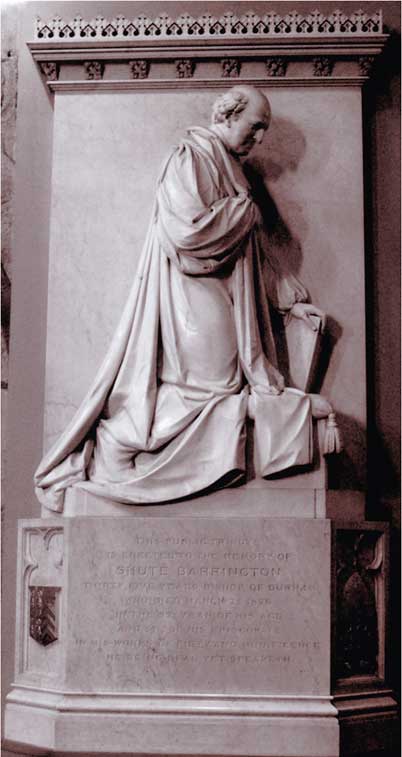
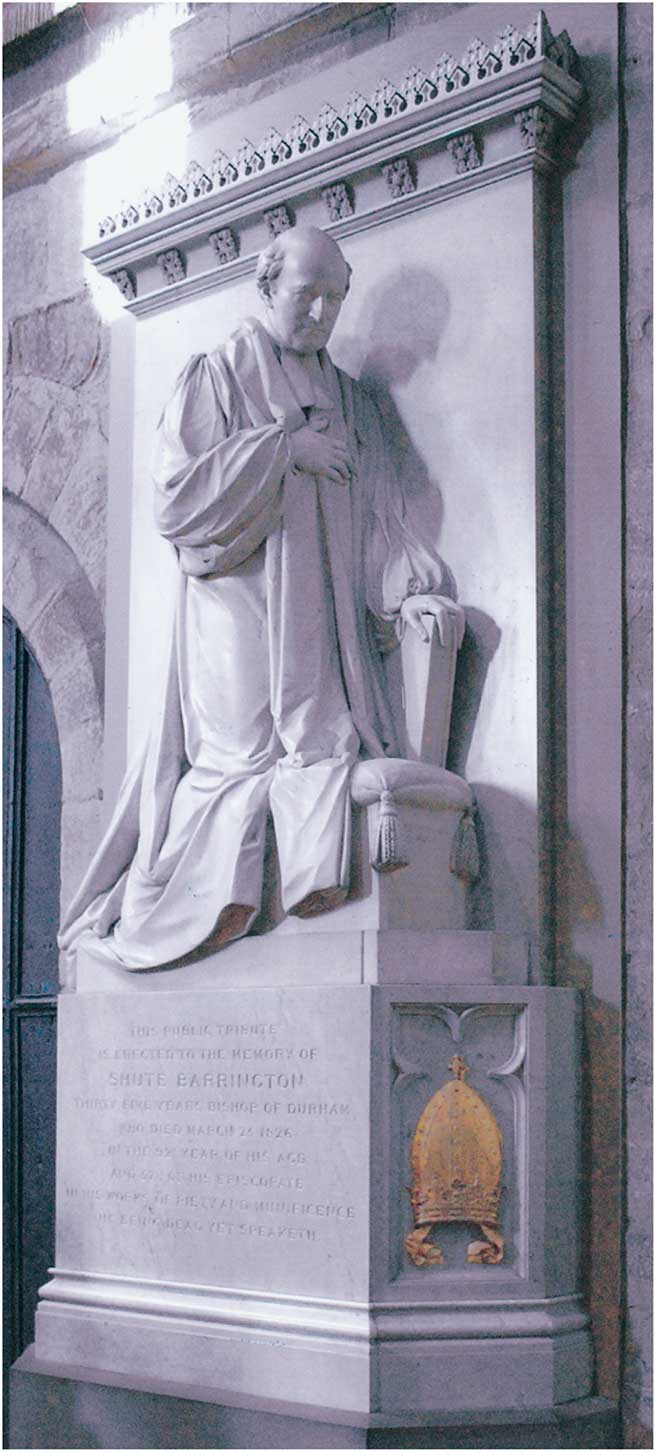
Archbishop Stuart, like Bishop North, is shown wearing a clerical wig: painted portraits of Bishops Barrington, North and Ryder (see below) all depict the sitters wearing such wigs, but Shute Barrington (1734–1826) is thought to be the first bishop to discard this accessory,Footnote 120 and is shown bare-headed by Chantrey on his monument (created 1832–3) fixed to the west wall of the south transept of the Cathedral Church of Christ, Blessed Mary The Virgin and St Cuthbert, Durham (fig 12).Footnote 121
The Shute Barrington monument, Durham Cathedral, from the east. Photograph: taken 2016 © the author

Barrington was the sixth son of the politician, John Shute Barrington (1678–1734), Viscount Barrington of Ardglass, County Down, in the Irish Peerage, and his wife, Anne.Footnote 122 While Barrington was still an infant, his father died after being thrown from a carriage, so he was brought up by his eldest brother, William Wildman Barrington (1717–93), 2nd viscount, until old enough to go to Eton. In 1752, he matriculated as a Gentleman Commoner at Merton College, Oxford, graduated with a BA in 1755 and became both a Fellow of Merton and a student of Christ Church. Ordained in 1756, he proceeded with an MA in 1757. By 1759 his brother, William Wildman Barrington, was Secretary at War, the first in the Duke of Newcastle’sFootnote 123 administration, in which capacity he promoted his younger brother’s interests.Footnote 124 As a result, in 1760 Barrington was appointed Chaplain-in-Ordinary to George iii. The following year he was awarded a Hereford prebend and a Christ Church canonry was then added, enabling him to graduate DCL in 1762. Political upheavals led to his failure to became dean of Windsor, but in 1768 he received the prebend Consumpta-per-mare Footnote 125 of St Paul’s Cathedral, London,Footnote 126 and was consecrated bishop of Llandaff (1769), resigning his Hereford prebend while retaining that of St Paul’s until 1776, when he obtained a Windsor canonry.
During the 1770s and 1780s, Barrington brought out an edition of his father’s essays on Biblical scholarshipFootnote 127 and contributed to the third edition of Critical Conjectures and Observations on the New Testament.Footnote 128 During this period, he stirred political controversy as he became critical of Dissent, reflecting a more conservative position. In 1772, he preached a sermon commemorating the martyrdom of Charles i.Footnote 129 Through the influence of George iii, in 1782 he was appointed bishop of Salisbury, where he won for himself a reputation for generosity and set up a fund for the relief of impoverished clergy. Even so, he expressed himself more and more sceptical of Evangelical and Nonconformist positions, stating that the Holy Spirit was ‘not manifested in fancied impulses or imaginary calls, but in the more certain of its fruits, a good life’.Footnote 130
Barrington supported many of the causes espoused by William Wilberforce (1759–1833) – notably a hostility towards the slave trade. In 1791, he was translated to Durham, where, as prince-bishop, he devoted himself to moral reform and philanthropic causes. A founder in 1796 of the Society for Bettering the Condition and Improving the Comforts of the Poor, he encouraged the formation of Sunday schools and promoted the building and financing of schools throughout his diocese, notably in mining communities. The Barrington School, established in Bishop Auckland in 1811, became the National Society’s first model school, and the Barrington Fund was set up to augment small benefices and help to support needy widows and orphans of diocesan clergy. Indeed, Barrington ‘was the most important ecclesiastical figure aligned with both the evangelical reformers and their high-church counterparts, known as the Hackney Phalanx’.Footnote 131 He supported the interdenominational Religious Tract Society and the British and Foreign Bible Society; and helped exiled French Roman Catholics who had fled from Douai College after the French Revolution (Rennell had also championed French refugees),Footnote 132 even though he was to cause controversy when he placed part of the blame for the revolution on the Catholic Church itself, claiming that ‘Popish’ corruption of the pure faith had crippled French Catholicism’s abilities to resist and counteract rationalist scepticism. In particular, he denounced ‘image worship’, ‘multiplying mediators and intercessors’, Transubstantiation, devotions focused on the Host and withdrawing the cup from the laity.Footnote 133 He also urged the Roman Communion to reform and be reunited with the Catholics of the Church of England.Footnote 134 Although many of his views stirred animosities, his combination of personal piety, pastoral zeal, practical philanthropy and concern for the poor, expressed in an extraordinary level of public charity and unobtrusive private generosity and fearlessness in debate, won him many admirers.Footnote 135 He frequently came into conflict with radical politicians; yet, after his death the local press said of him that nobody ‘better understood the true value of money, or employed it more judiciously as the instrument of virtue’.Footnote 136
His monument follows the general formula Chantrey established with the earlier works in Winchester and Armagh, but there are major differences, not least the fact that the bishop is shown wigless. The inscription eschews Latin (in accordance with his own antipathy to the use of that language), and reads, in sans serif lettering:
T H I SP U B L I CT R I B U T E
I SE R E C T E DT OT H EM E M O R YO F
S H U T EB A R R I N G T O N
T H I R T YF I V EY E A RSB I S H O PO FD U R H A M
W H OD I E DM A R C H2 51 8 2 6
I NT H E9 2 .DY E A RO FH I SA G E
A N D5 7 T.HO FH I SEP I S C O P A T E
I NH I SW O R K SO FP I E T YA N DM U N I F I C E N C E
H EB E I N GD E A DY E TS P E A K E T H .
Like the Stuart monument in Armagh, the architectural background is taller than the figure, but stylistically the change of taste is dramatic. For although the horizontal mouldings are still Classical, much of the detail is Gothic – not least the elaborate crowning entablature with superimposed brattishingFootnote 137 of the type normally found on top of rood screens or canopies over Perpendicular funerary monuments, and the fleuronsFootnote 138 (or stylised four-leafed square floral ornaments in the cavetto moulding beneath the crowning cornice). Unlike Brownlow or Stuart, Barrington sat for a bust from Chantrey in his lifetime, and is not shown in an attitude of hand-clasped prayer, for his left hand rests on a large tome (presumably the Bible) and his right over his heart. Modelling of the draperies is entirely new. The base is canted: the front (facing east), containing the inscription, is plain, but the canted parts are treated as Gothic panels; that to the south contains the Barrington Achievement of Arms on the sinister side impaled with, on the dexter side, the Arms of the office of the See of Durham; and that to the north contains the ducally gorged mitre of the bishops of Durham (fig 13). In the Barrington monument, Chantrey clearly re-thought the composition, just as he re-thought the ‘Resignation’ type of monument between the Digby and Boulton exemplars (see next section).
The Shute Barrington monument, Durham, from the north east. Note the gilded bishop’s mitre shown in relief. Photograph: taken 2016 © the author

Barrington’s monument was erected by subscription, and cost slightly more than had either the North or Stuart memorials. It should be seen as an updating and refinement of the two earlier sculptures featuring kneeling bishops. A model for the Barrington exemplar was held in the Ashmolean Museum, Oxford, until the authorities there cut off the head and threw away the rest of it in 1939: it was illustrated in an engraving.Footnote 139 The architectural background of the realised monument did not form part of the original concętto.Footnote 140 Some have suggested that architectural backgrounds would have been decided with the clients according to the settings into which the new sculptures would be placed, but if that were the case, the Barrington design would have paid respect to Romanesque rather than Gothic, for Durham Cathedral is overwhelmingly Romanesque. In fact, Chantrey combined his figures with Gothic architectural elements in several commissions, as will be outlined next.
OTHER MONUMENTS AND REPEATED MOTIFS
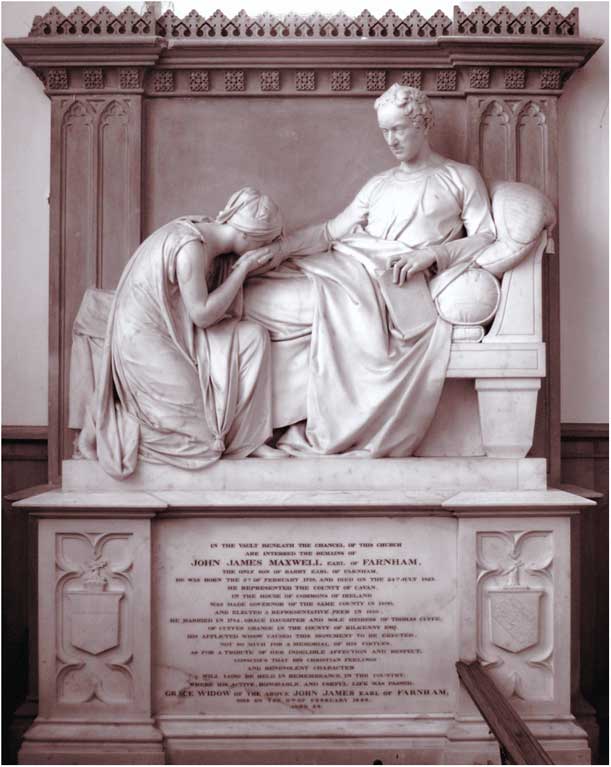
The stylistic mix of Classicism with Gothic also occurs in Chantrey’s splendid monument to John James Maxwell (1759–1823), 2nd Earl of Farnham, erected in 1827Footnote 141 by his widow, Grace, née Cuffe (c 1767–1856), the sole heiress of Thomas Cuffe, of Cuffe’s Grange, County Kilkenny. Set against the south wall of the chancel in Urney parish church, Cavan, the monument is some six or seven years earlier than the Barrington memorial, yet the similarities stand out (fig 14). In Urney, the Gothic architectural background to the marble figure is of limestone, and has brattishing and fleurons similar to those employed at Durham, except that the fleurons are more closely spaced. The base of the monument has two Gothic panels flanking the inscription, that to the east containing the Maxwell Achievements (with the buck’s head crest), and that to the west the Cuffe (with the crest a cuffed hand holding a pole-axe). Now, those two foliated panels are very similar to those on the base of the Barrington monument in Durham, and bear a striking resemblance to those on the base of another Chantrey monument – that of James Harris (1746–1820), 1st Earl of Malmesbury, erected in 1823 on the west wall of the north transept in Salisbury Cathedral.Footnote 142 That is not the only resemblance: the Farnham and Malmesbury memorials each have pilaster strips on either side, supporting the crowning entablatures, and those strips each have two recessed panels with foliated heads; the figures are shown reclining on their Neo-Classical deathbeds, supported by cushions, with their left hands resting on books. Malmesbury’s right hand is upturned, and he appears to be discoursing upon the text he has been reading. Farnham, however, looks down at the charming kneeling female figure kissing his right hand in a touching farewell. Another variation on this death-bed theme occurs in Chantrey’s almost melodramaticFootnote 143 monument, created between 1817 and 1826, to David Pike Watts (1754–1816) in the memorial chapel attached to Holy Cross church, Ilam, Staffordshire. Here Watts, leaning up from his robust Neo-Classical couch, his left hand resting on an open book, blesses with his right hand his daughter, who is accompanied by her three children. The daughter kneels, in a pose very similar to that of other kneeling female figures by Chantrey, her drapery beautifully carved.Footnote 144
The Farnham monument, Urney parish church, County Cavan. Photograph: taken 2017 © the author

Foliated panels similar to those on the bases of the Barrington, Farnham and Malmesbury monuments can also be found on the plinth (or tomb chest) of the free-standing, very beautiful memorialFootnote 145 for Charlotte Elizabeth Digby (d. 1820). Constructed between 1823 and 1825, it can be found beneath the north arcade in the lady chapel of the Cathedral Church of Christ and the Blessed Virgin Mary, Worcester. The poem inscribed on the base invites the visitor to view the dying young woman, the ‘earthly vessel of a heavenly mind …’ ‘to dust resign’d’ as she holds her hands half-joined in prayer, and looks upwards in an attitude of resignation, perhaps emphasised by the kneeling angels in relief at either end of the tomb chest.
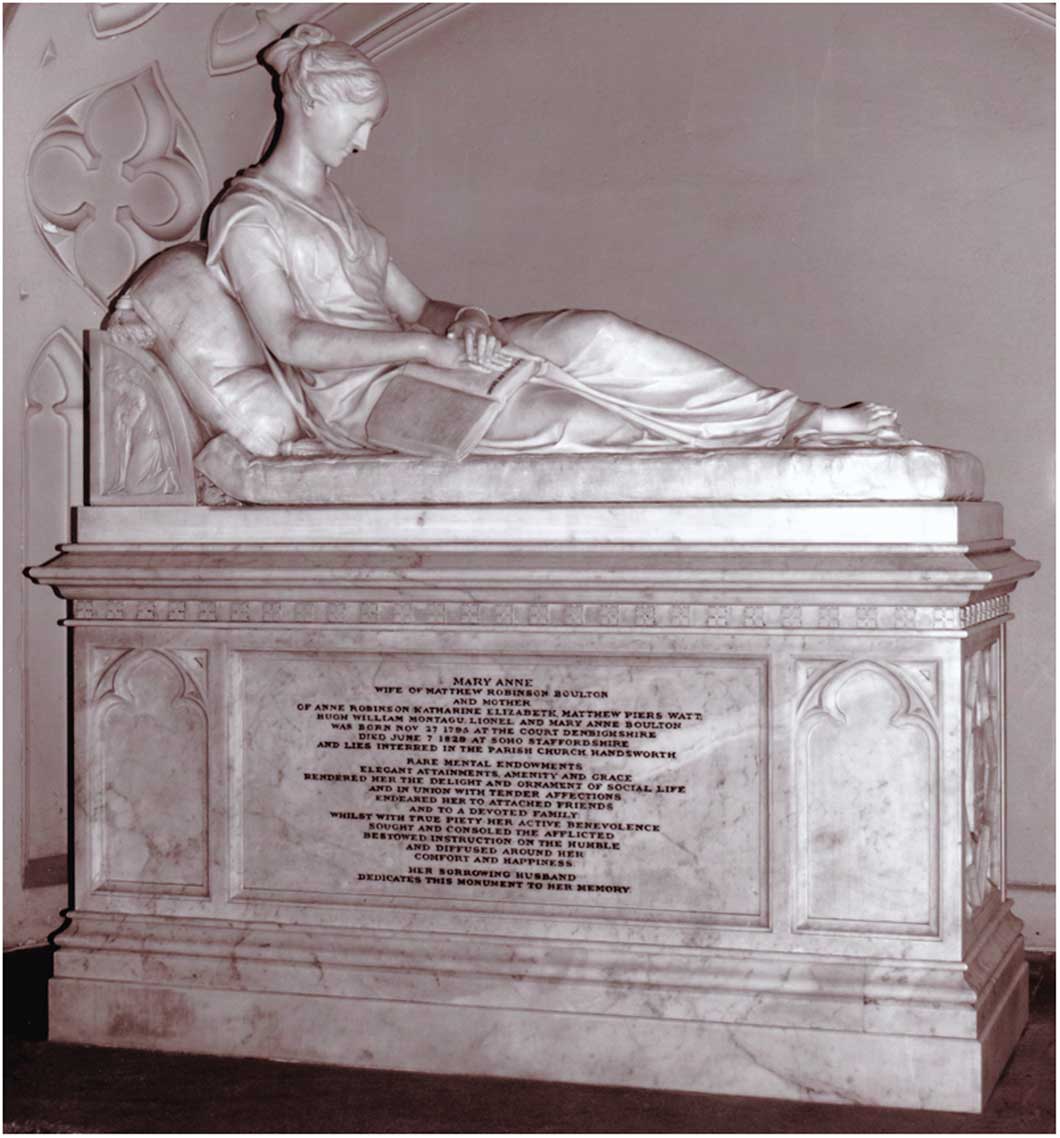
In the 1820s, Warton’s Death-Bed Scenes and Pastoral Conversations Footnote 146 enjoyed great success and ran into several editions. It stressed the ‘Good Death’, as viewed through Anglican spectacles, with resignation. There were several instances during that time when reclining female figures appeared on funerary monuments, awaiting death, but quietly resigned to this fate with calmness and dignity. Chantrey produced a variation on the Digby memorial in the funerary monument to Mary Anne Boulton, née Wilkinson (1795–1829),Footnote 147 signed and dated 1834, in St Michael’s church, Great Tew, Oxfordshire (fig 15). The tomb chest also has fleurons or tablet-flowers under the crowning cornice, the panels flanking the rectangular inscription-panel have foiled heads with two cusps, and the elegant figure, on a kline, holds a book beneath her folded hands. The figure looks more comfortable than does that of Mrs Digby, for Mrs Boulton’s back is supported on an ample cushion that is, in turn, propped up on a fulcrum Footnote 148 decorated with kneeling angels in relief at the ends.Footnote 149
The monument to Mary Anne Robinson Boulton, St Michael’s, Great Tew, Oxfordshire, with kneeling angel in relief on the fulcrum. Photograph: taken 2017 © the author

THE HEBER MONUMENTS
With the monument to Reginald Heber (1783–1826), Chantrey set the unwigged figure in the same pose he selected for the Barrington memorial (left hand resting on a large book, right hand placed over the chest). This time, however, the whole sculpture was conceived as a free-standing object, not set against an architectural background fixed to a wall (although in one variation that was set up in Madras, the formula of the kneeling figure in relief was employed).
Heber was born in Cheshire, where his father was co-rector of Malpas. He received his early education at Whitchurch and Neasden, before proceeding in 1800 to Brasenose College, Oxford, where he became celebrated as a minor Romantic poet, and was elected four years later a Fellow of All Souls.Footnote 150 He set out on a Grand Tour (1805–6) that included Scandinavia and Russia. He was especially taken by the Muslim Tartar communities in the Crimea, and returned to England through Central Europe.Footnote 151
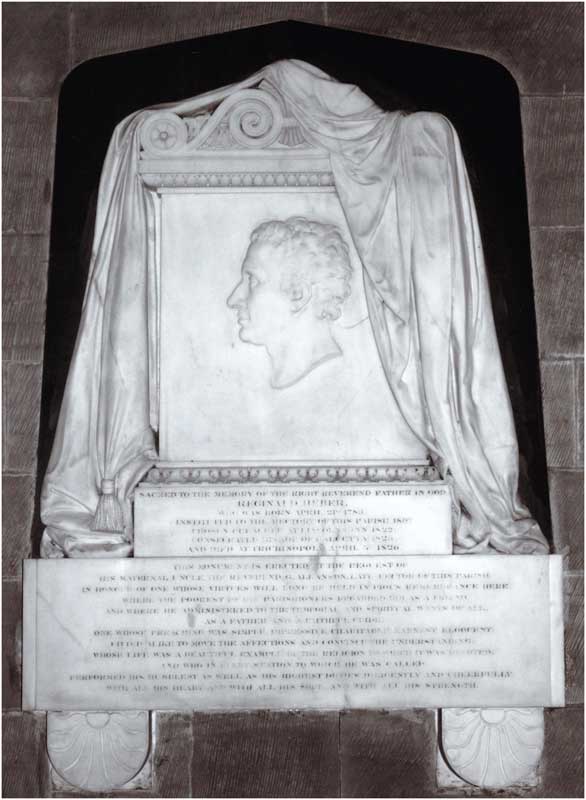
The following year, he was ordained, and then appointed to the rectory of Hodnet, Shropshire, where there is a portrait head of him carved by Chantrey on a representation of the elegantly draped end of a Grecian sarcophagus (erected in 1829) in the north (Heber-Percy) chapel of St Luke’s church (fig 16).Footnote 152 It is inscribed:
SACRED TO THE MEMORY OF THE RIGHT REVEREND FATHER IN GOD,
REGINALD HEBER,
WHO WAS BORN APRIL 21ST 1783,
INSTITUTED TO THE RECTORY OF THIS PARISH 1807,
CHOSEN PREACHER AT LINCOLN’S INN 1822,
CONSECRATED BISHOP OF CALCUTTA 1823,
AND DIED AT TRICHINOPOLY APRIL 3 1826.
THIS MONUMENT IS ERECTED AT THE REQUEST OF
HIS MATERNAL UNCLE, THE REVEREND G. ALLANSON,[ Footnote 153 ] LATE RECTOR OF THIS PARISH,
IN HONOUR OF ONE WHOSE VIRTUES WILL LONG BE HELD IN PIOUS REMEMBRANCE HERE,
WHERE THE POOREST OF HIS PARISHIONERS REGARDED HIM AS A FRIEND,
AND WHERE HE ADMINISTERED TO THE TEMPORAL AND SPIRITUAL WANTS OF ALL,
AS A FATHER AND A FAITHFUL GUIDE,
ONE WHOSE PREACHING WAS SIMPLE, IMPRESSIVE, CHARITABLE, EARNEST, ELOQUENT,
FITTED ALIKE TO MOVE THE AFFECTIONS AND CONVINCE THE UNDERSTANDING,
WHOSE LIFE WAS A BEAUTIFUL EXAMPLE OF THE RELIGION TO WHICH HE WAS DEVOTED,
AND WHO IN EVERY STATION TO WHICH HE WAS CALLED
PERFORMED HIS HUMBLEST AS WELL AS HIS HIGHEST DUTIES DILIGENTLY AND CHEERFULLY
WITH ALL HIS HEART, AND WITH ALL HIS SOUL, AND WITH ALL HIS STRENGTH.
The Heber monument, Heber-Percy chapel, St Luke’s, Hodnet, Shropshire. Photograph: taken 2017 © the author

In 1809, Heber married Amelia Shipley, daughter of William Davies Shipley (1745–1826), dean of St Asaph, through whose influence Heber was appointed a prebendary of St Asaph Cathedral in 1817. Heber is probably best known today as a pioneer of Anglican hymnography: among his works are ‘Holy, Holy, Holy, Lord God Almighty’. As an active member of the Church Missionary Society, and with an interest prompted by his earlier travels, he was an obvious choice in 1823 as bishop of Calcutta, and was active in the ordination of Indian clergy, especially through Bishop’s College at Sibpur, and he expended much energy in travelling to minister to the scattered Anglican communities that existed in India and Ceylon. He kept a record of his travels, which was published in 1828, edited by his widow, with several later editions: it is of exceptional value as an historically accurate description.Footnote 154
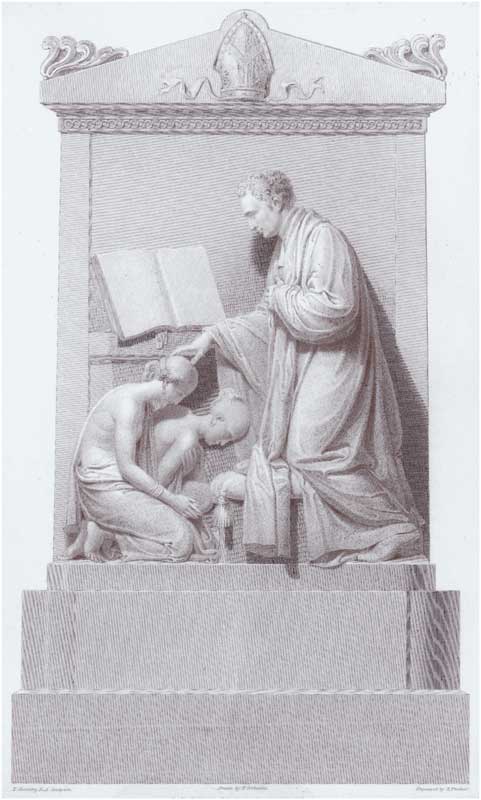
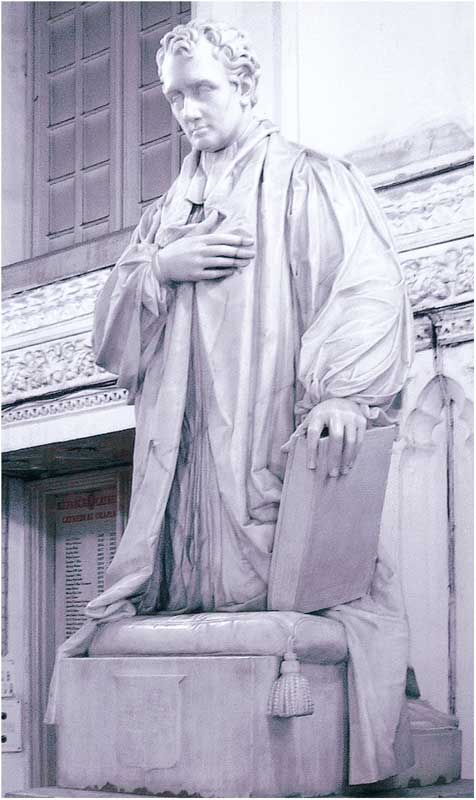
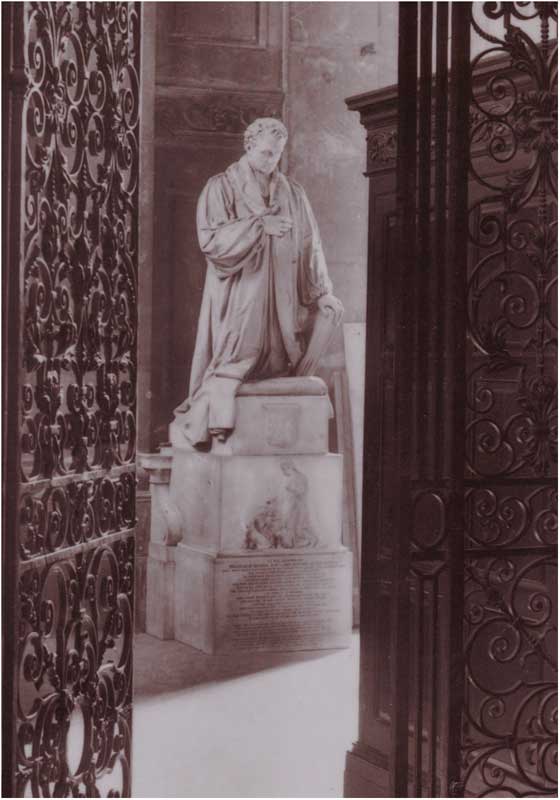
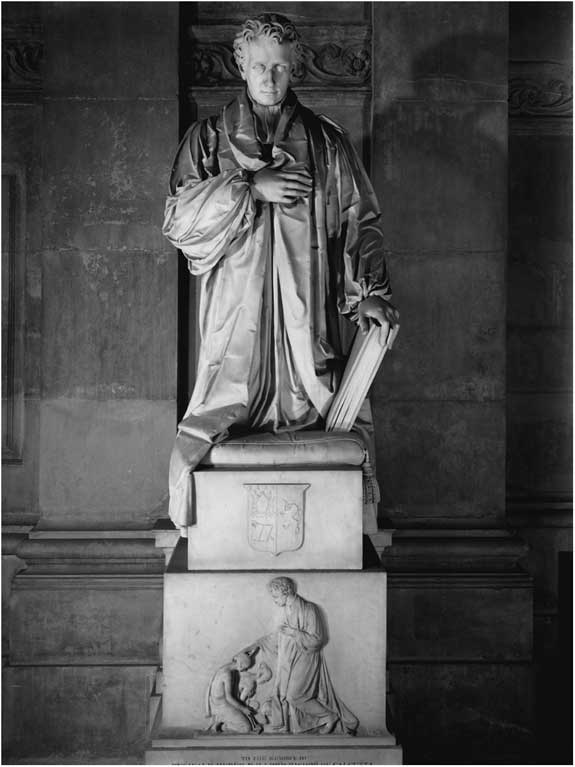
Heber was interested in all manner of aspects of India, including its architecture and its topography, and was friendly towards other churches, notably the Armenian and Syrian: he even formed good relationships with Dissenting missionaries. He died suddenly at Trichinopoly (now Tiruchirappalli), where he was entombed in St John’s church. At meetings in 1826 in Madras (now Chennai) and Calcutta (now Kolkata) and in the following year in Oxford and London, arrangements were made to open subscriptions in order to raise monuments to him. Commissions for three such monuments were given to Chantrey, and these were documented in an appendix to Amelia Heber’s Life Footnote 155 and in Chantrey’s ledgers.Footnote 156 The last and largest of the three was erected in 1835 in the crypt of St Paul’s Cathedral, London;Footnote 157 the others were placed in St John’s (removed in 1847 to St Paul’s Cathedral), Calcutta, and St George’s Chapel (now St George’s Cathedral), Madras. This St George’s monument appeared in an engraving used as the frontispiece to Amelia Heber’s Life (fig 17). Commissioned in 1827 and completed and exhibited at the Royal Academy in 1830, it cost £1,500.Footnote 158 It shows Heber’s figure in relief, kneeling on a footstool, facing left rather than right, with a Neo-Classical architectural background, blessing (or baptising) two young Indian converts, one male, one female.Footnote 159 The long inscription on the plinth was in Latin. The St John’s monument was also ordered in 1827, but was not completed until 1835 (fig 18) due to a mix-up over the fee (Chantrey expected 2,000 guineas, but was paid only £2,000).Footnote 160 The large statue in St Paul’s Cathedral, London, was ordered in 1828, completed in 1835, and cost £3,000.Footnote 161 It is an almost identical composition to that which originally stood in St John’s (fig 19).
Bishop Heber blessing two young Indian converts, shown in relief on the monument erected in St George’s Chapel (now Cathedral), Madras, with guilloche ornament under the crowning cornice and mitre on the representation of the end of a sarcophagus-lid. The image was drawn by Henry Corbould (1787–1844), engraved by Edward Francis Finden (1791–1857), and used as the frontispiece to The Life of Reginald Heber, DD (Heber Reference Heber1830). Image: collection of the author

The Heber monument in St Paul’s Cathedral, Calcutta, India. Photograph: taken 2013 © Jacqueline Banerjee

The Heber monument in the crypt of St Paul’s Cathedral, London, as originally assembled, with the three parts of the plinth intact and photographed (c 1925) by Walter Scott of Bradford. Photograph: London Metropolitan Archives, City of London, photographic collection no. SC/GL/PHO/A/460/3/5

The London monument is certainly impressive. It is a ‘colossal figure of the bishop, kneeling on a pedestal in the attitude of devotion, with one hand on his bosom and the other resting on the Bible’, as his widow described it.Footnote 162 Heber is actually kneeling on a tasselled cushion set on top of a plain three-stepped pedestal (fig 20): the upper step has his Arms on the sinister side of the shield, and on the dexter the Arms of the See of Calcutta; on the front of the middle step of the pedestal is a relief similar to the imagery shown on the monument in St George’s, Madras, depicting the bishop blessing the two young converts; on its lowest step is cut a fulsome inscription:
TO THE MEMORY OF
REGINALD HEBER, D.D. LORD BISHOP OF CALCUTTA,
THIS MONUMENT WAS ERECTED BY THOSE WHO LOVED AND ADMIRED HIM.
HIS CHARACTER EXHIBITED A RARE UNION
OF FERVENT ZEAL WITH UNIVERSAL TOLERANCE,
OF BRILLIANT TALENT WITH SOBER JUDGMENT
AND WAS ESPECIALLY DISTINGUISHED BY CHRISTIAN HUMILITY
WHICH NO APPLAUSE COULD DISTURB NO SUCCESS ABATE.
HE CHEERFULLY RESIGNED PROSPECTS OF EMINENCE AT HOME,
IN ORDER TO BECOME
THE CHIEF MISSIONARY OF CHRISTIANITY IN THE EAST;
AND HAVING IN THE SHORT SPACE OF THREE YEARS
VISITED THE GREATER PART OF INDIA
AND CONCILIATED THE AFFECTION AND VENERATION
OF MEN OF EVERY CLASS OF RELIGION,
HE WAS THERE SUMMONED TO RECEIVE THE REWARD OF HIS LABOURS
IN THE XLIIID YEAR OF HIS AGE MDCCCXXVI.
THOU ART GONE TO THE GRAVE BUT WE WILL NOT DEPLORE THEE,
THOUGH SORROWS AND DARKNESS ENCOMPASS THE TOMB;
THY SAVIOUR HAS PASSED THROUGH THE PORTAL BEFORE THEE,
AND THE LAMP OF HIS LOVE IS THY GUIDE THROUGH THE GLOOM.
THOU ART GONE TO THE GRAVE BUT WE WILL NOT DEPLORE THEE,
WHOSE GOD WAS THY RANSOM THY GUARDIAN AND GUIDE;
HE GAVE THEE, HE TOOK THEE, AND HE WILL RESTORE THEE,
AND DEATH HAS NO STING, FOR THE SAVIOUR HAS DIED.
The Heber monument, crypt of St Paul’s Cathedral, London, photographed in 1942 by Helmut Gernsheim (1913–95). Photograph: Red Box Collection, Historic England, WAR01/01/0129 © The Warburg Institute

Regrettably, this splendid work has been ‘shamefully dismantled’.Footnote 163
THE RYDER MONUMENT
Henry Ryder (1777–1836) was born in Surrey, the youngest son of Nathaniel Ryder (1735–1803), 1st Baron Harrowby, and his wife, Elizabeth, née Terrick (1739–1804). He was educated at Harrow before being admitted in 1795 as a fellow Commoner at St John’s College, Cambridge, graduating with an MA in 1798 and DD in 1813.Footnote 164 Ordained to the curacy of Sandon in 1800, the following year he was presented with the rectory of Lutterworth, Leicestershire (held from 1805 with the neighbouring vicarage of Claybrook). In 1802, he married Sophia (d. 1862), daughter of Thomas March Phillipps (d. 1817) of Garendon Park, Leicestershire, with whom he had ten sons and three daughters. Pluralism in Georgian times has often been held up to have led to pastoral neglect, but Ryder took his duties seriously, especially in relation to the poor, the sick and catechising of the young, and he chose his curates with care. Steeped in learning, especially regarding the early Fathers of the Church, he soon gained preferment, being presented in 1808 to a canonry at Windsor, where his sermons were admired by George iii.
Ryder was great friends with Thomas Robinson (1749–1813), vicar of St Mary-de-Castro, Leicester, where a handsome funerary monument by John Bacon junior (1777–1859) was set up on the wall of the Trinity aisle there in his memory. Influenced by his friendship with Robinson, Ryder began to identify more with the Evangelical wing of the Anglican Church, lecturing in factories and greatly extending his parochial ministry. Appointed dean of Wells in 1812, he further identified with Evangelicalism by preaching the annual sermon of the Church Missionary Society and, in 1815, was elevated to the See of Gloucester, the first Evangelical to be appointed, in the teeth of opposition, to the Bench of Bishops. However, he adopted a non-partisan approach, endeavoured to unite all shades of opinion within his diocese, placed a high value on personal devotion, demanded punctilious performances of all the established offices of the Church and urged the importance of catechetical lectures and Sunday schools for the benefit of the poor.
His work to improve the lot of curates, reduce non-residence among the clergy and promote voluntary societies to educate the poor, gained him respect, and in 1824 he was translated to Lichfield and Coventry, a diocese then being rapidly transformed by urbanisation and industrialisation. He established a Church Building Society, enabling additional seats for thousands of people to be created, and again he was behind significant improvements in education. He devoted much personal attention to his work, was a liberal benefactor and personally endowed parish churches from revenues of his sees. He often stood in for indisposed clergy, and his early death was very likely due to overwork.
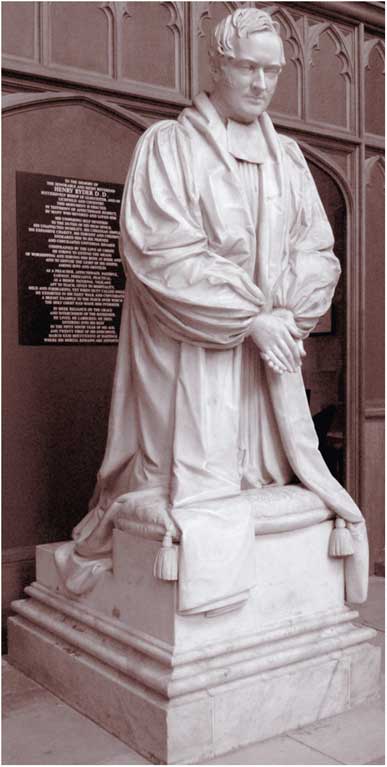
In his memory, a monument was commissioned from Chantrey that closely resembles the kneeling figure of Bishop Heber in that the wigless prelate kneels on a tasselled cushion on a plain, stepped pedestal, but this time both hands are held together, and Ryder’s ‘concentration appears to be directed inwards’ (fig 21).Footnote 165 The positioning of the hands – held downwards rather than up in prayer or treated separately (one resting on a Bible and the other on the bosom) – has made the sleeves ‘puff out sideways, making the figure heavier’.Footnote 166 It is interesting that this last example of a kneeling bishop monument is the simplest: it is as if Chantrey were consciously moving to a purer conception, with no books, hands together and draperies slightly more symmetrically disposed around the base.
The Ryder monument, Lichfield Cathedral, from the north west. Photograph: taken 2016 © the author

Ryder’s statue was exhibited at the Royal Academy in 1841.Footnote 167 In Lichfield Cathedral, it stood in the north choir aisle,Footnote 168 a ‘white kneeling figure without any setting’.Footnote 169 However, it has since been moved to the north transept, where it stands before a screen to which is affixed an inscription informing us that the monument was erected in ‘Testimony of Affectionate Respect, by Many who Revered and Loved Him’.
CODA
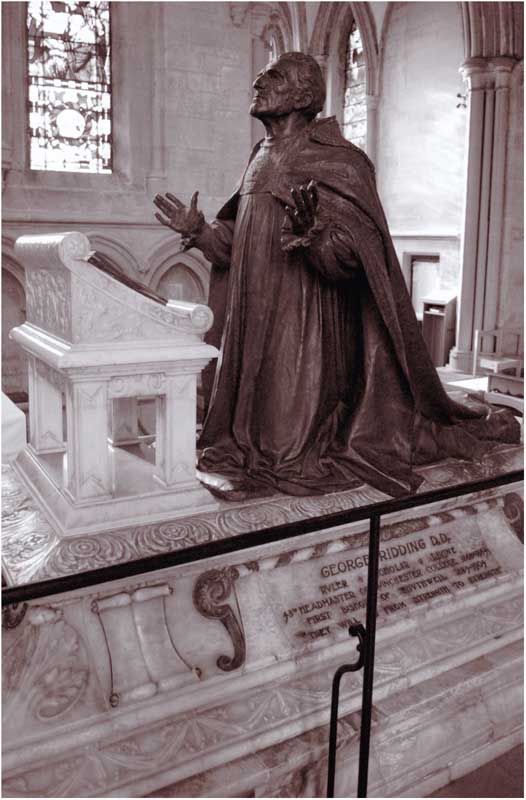
This paper has touched upon variations on kneeling figures in sculptures by Chantrey that seem to combine realism with intense but controlled emotions, Neo-Classicism with Romanticism, and exquisite craftsmanship with a refinement of taste. However, from 1845 onwards, until around the end of the nineteenth century, bishops were usually shown recumbent, reflecting the impact of the Gothic Revival, Ecclesiology, and the study of medieval funerary monuments, all of which tended to reject the aesthetic adopted by the great late-Hanoverian sculptors among whom Chantrey was an outstanding protagonist. Nevertheless, the fine bronze figure (1907) of George Ridding (1828–1904), bishop of Southwell, in the cathedral and parish church of The Blessed Virgin Mary, Southwell, Nottinghamshire, by Frederick William Pomeroy (1856–1924), based on a design by William Douglas Caröe (1857–1938),Footnote 170 is a splendidly robust Edwardian revival of the kneeling bishop type (fig 22). A powerful, dramatic and forceful monument, quite different in character compared with the quiet, idealised Classically inspired statuary of Chantrey, it is a magnificent, late variation on a great theme so long either ignored or under-valued.
The monument to George Ridding in Southwell Minster, from the north east. Photograph: taken 2015 © the author

ACKNOWLEDGEMENTS
Simon Carter, Head of Collections, St Paul’s Cathedral, London; Rembrandt Duits, The Warburg Institute; Scott McMaster, ITFIX; Jeremy Smith, London Metropolitan Archives; and Nigel Wilkins, Archive Services Officer, Historic England, helped with illustrations. Lucas Elkin and Colin Clarkson, of Cambridge University Library, generously assisted with queries. Thanks are due to Canon Mark Lidwill and Kevin V Mulligan regarding the Farnham monument, Cavan; to Janet Myles Spencer, for reading through my text and correcting clangers; and to Lavinia Porter of the Society of Antiquaries of London, for her patience.
ABBREVIATIONS AND BIBLIOGRAPHY
Abbreviations
- APL
-
Armagh Public Library
- Bodl
-
Bodleian Library, Oxford
- BL
-
British Library, London