Introduction
This study focuses on the residential neighbourhoods of Johor Bahru city, the administrative and business centre of the Johor Bahru region and the Malaysian state of Johor. Johor Bahru is a border town, located in the very south of peninsular Malaysia, less than one mile away from Singapore. According to City Population (2018), the Johor Bahru region has a multi-ethnic population of almost 1.4 million, comprised of native ‘Bumiputera’ (52%), Chinese (37.4%), Indian (9.9%) and ‘other’ (0.6%) citizens. Hutchinson and Bhattacharya (Reference Hutchinson and Bhattacharya2019: 1) describe economic links with Singapore as ‘long standing, far-reaching, spanning trade in goods and services, as well as foreign direct investment (FDI) and movement of people’; both countries are one another's ‘second most important trading partner, in both cases surpassed only by China and outranking traditional commercial allies such as the United States and Japan’.
The present study focuses on linguistic landscapes within Johor Bahru city's residential neighbourhoods. Typically, linguistic landscape studies uncover the patterns of language use on warning signs, instructions, public road signs, advertising billboards, posters, street names, graffiti and notices on government and non-government buildings (Landry & Bourhis, Reference Landry and Bourhis1997). The examination of linguistic landscapes can be traced back to the Reference Masai1972 work of Yasuo Masai and his analysis of the scripts used in metropolitan Tokyo's shop signage to assemble a ‘living map of Tokyo’. The work of Rosenbaum et al. (Reference Rosenbaum, Nadel, Cooper, Fishman, Fishman, Cooper and Conrad1977) along with Tulp's (Reference Tulp1978) work, exploring the politically and socially contested use of language on public signage, began the first wave of linguistic landscape research. More recently, Ben Rafael et al. (Reference Ben-Rafael, Shohamy, Hasan Amara and Trumper-Hecht2006) undertook a study on East Jerusalem and other cities in Israel's east, documenting the linguistic variation observable between top-down signage, created by public bodies such as government or municipal agencies, and bottom-up signage, erected by commercial bodies and private individuals. Much more recently, Selvi (Reference Selvi2016) examined the influence of English in the multilingual shop-naming practices of business owners in Ankara, Turkey. Alomoush (Reference Alomoush2019) revisits the consideration that English threatens Arabic in Jordan by examining the functions of English in the linguistic landscape crafted by shopping bags. These studies demonstrate the typical concern of linguistic landscape research - the pervasive use of English observed in urban regions around the world and the relationship between its usage and that of local languages.
Malaysian linguistic landscapes have been the subject of multiple studies. Ariffin and Husin (Reference Ariffin and Husin2013) contrasted language use in the shop signage of a metropolitan city (Kuala Lumpur), a big town (Bandar Raya Melaka), a small town (Cheng), and a provincial town (Bandar Jengka). Manan et al. (Reference Manan, David, Dumanig and Naqeebullah2015) undertook a largely qualitative study of government and private signage within five largely commercial neighbourhoods of Kuala Lumpur. Coluzzi and Kitade (Reference Coluzzi and Kitade2015) focused on Kuala Lumpur's religious linguistic landscape. David and Manan (Reference David and Manan2015) examined the case of Petaling Jaya and its shop owners’ general adherence to Malaysia's top-down language policy on signage. Coluzzi (Reference Coluzzi2017) compared the presence of Italian against other languages in one of Kuala Lumpur's largest and most well known malls.
There has been a limited amount of linguistic landscape studies on border towns. Marten et al. (Reference Marten, Lazdina, Poseiko, Murinskam, Hélot, Barni, Janssens and Bagna2012) researched the roles of English and Russian in six tourist towns close to international borders in the Baltic states of Lithuania, Latvia and Estonia. Lai's (Reference Lai2012) study focused on the Hong Kong Special Administrative Region (SAR), which shares a border with Shenzhen, China, to uncover the largely English–Chinese bilingual profile of the city and its rising use of simplified Chinese.
My main motivation to research into the residential neighbourhoods of Johor Bahru city is that previous linguistic landscape research has not focused on residential areas, nor has it focused on a Malaysian border town. Further motivation for the research comes from an understanding of the status of English and Bahasa Malaysia (henceforth, BM) in the area. In Singapore, English is an official language, the language of administration, the medium of education and the city-state's inter-ethnic lingua franca. In Malaysia, BM was adopted as the official national language in 1957 as the nation gained independence. However, English in Malaysia has maintained importance as a second language considered appropriate for many modern domains including administration, international business and knowledge acquisition. In Johor, important political figures often voice support for the English language. For example, Sultan Ibrahim Sultan Iskandar called in 2015 (MalayMail.com) for Malaysia to emulate Singapore by reviving English-medium schools, a desire which according to The Star Online (2017), 82% of Johoreans agree with. Despite many government attempts to promote and strengthen the status of BM in the country, Malaysia maintains a pragmatic attitude towards the use and learning of English (Thirusanku & Yunus, Reference Thirusanku and Yunus2014).
The status of English is rather low within law relating to public signage in Malaysia. According to Ariffin and Husin (Reference Ariffin and Husin2013: 6), by law, BM ‘must be used for the public signboards and road names’. According to David and Manan (Reference David and Manan2015), law stipulates:
(1) the national language shall be used for all advertisements whether by itself or together with any other language, (2) If the national language is used with any other language in an advertisement, the words in the national language shall be – (a) Thirty percent larger than the other language in measurement; (b) Prominently displayed; and (c) Grammatically correct
The present research explores for the languages used within the studied linguistic landscape and accounts for varying visible levels of language vitality. Language vitality is defined here as languages' survival from one generation to another, through continued usage in varied communicative domains (UNESCO Ad Hoc Expert Group on Endangered Languages, 2003). In order to establish linguistic vitality, the current paper establishes which languages are used in the linguistic landscape, which languages are used more and less frequently, and who the users of those languages are. I categorise the users as either top-down authors, who are governmental and public bodies, organisations which deliver a public service, or bottom-up authors, who are private individuals and commercial bodies. By categorising authorship as such, I highlight any differences in linguistic practice between those with institutional power and those without it.
Research methodology
Four centrally located neighbourhoods, Kampung Mahmoodiah, Gertak Merah, Kim Teng Park and Tanjung Puteri, were selected for study on the basis that they are largely residential, safe and easy to access, and within the Johor Bahru inner ring road (Jalan Lingkaran Dalam; Federal Route 188). The areas are ethnically and linguistically diverse. Informants local to the area consider the neighbourhoods largely working class, with parts of Gertak Merah and Tanjung Puteri more middle class. I walked the streets of each neighbourhood on a single day in September 2018. I took a photo of each sign using my digital camera, carefully framing one sign into one shot. The photographs, and so the signs, were later tagged for the languages used within them, the apparent author and for top-down or bottom-up authorship. For example, a sign warning of danger on an electricity substation was tagged ‘BM; National Power Company; top-down’. Review, cross-referencing and counting of these tags formed the basis of the quantitative data analysis. It enabled me to understand which languages were used in the linguistic landscape, which were used more or less frequently, and which were used more or less frequently with top-down and bottom-up authorship. This quantitative analysis was then contextualised with a qualitative analysis of the signage which locates the signage in various semantic domains, ‘an area of meaning in a language’ (Ottenheimer, Reference Ottenheimer2006), such as hospitality, or education.
Quantitative data analysis
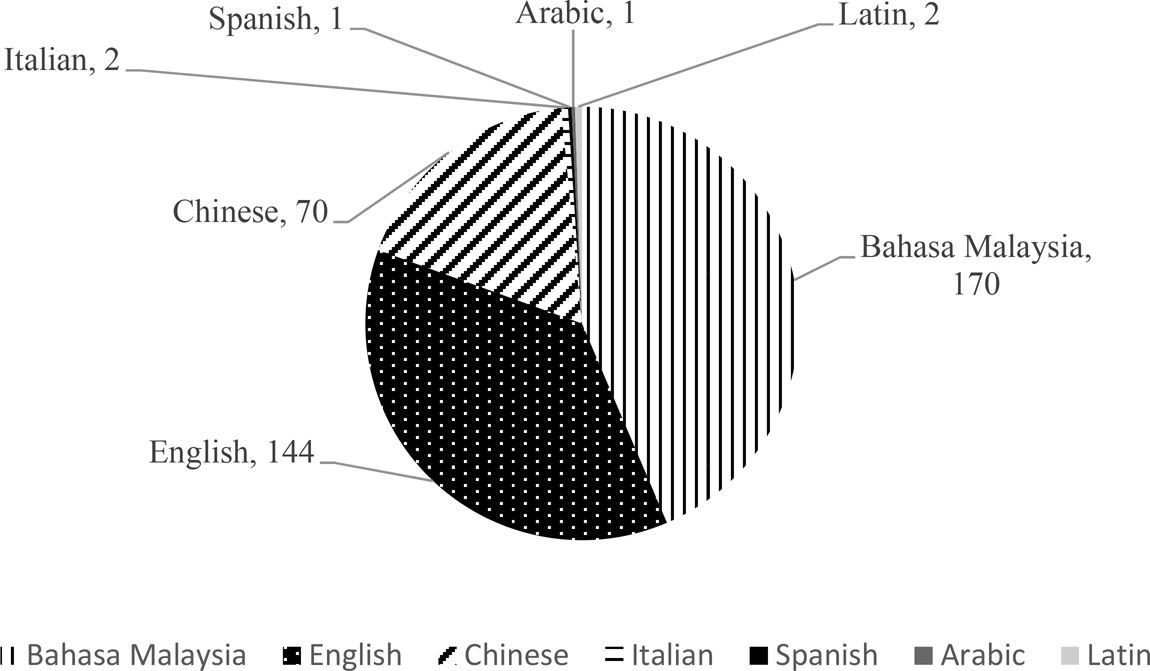
I found that seven languages were used in Johor Bahru. These languages and the number of signs in which they appear are presented in Figure 1.
Languages and their quantified usage in the linguistic landscape of Johor Bahru city's residential neighbourhoods

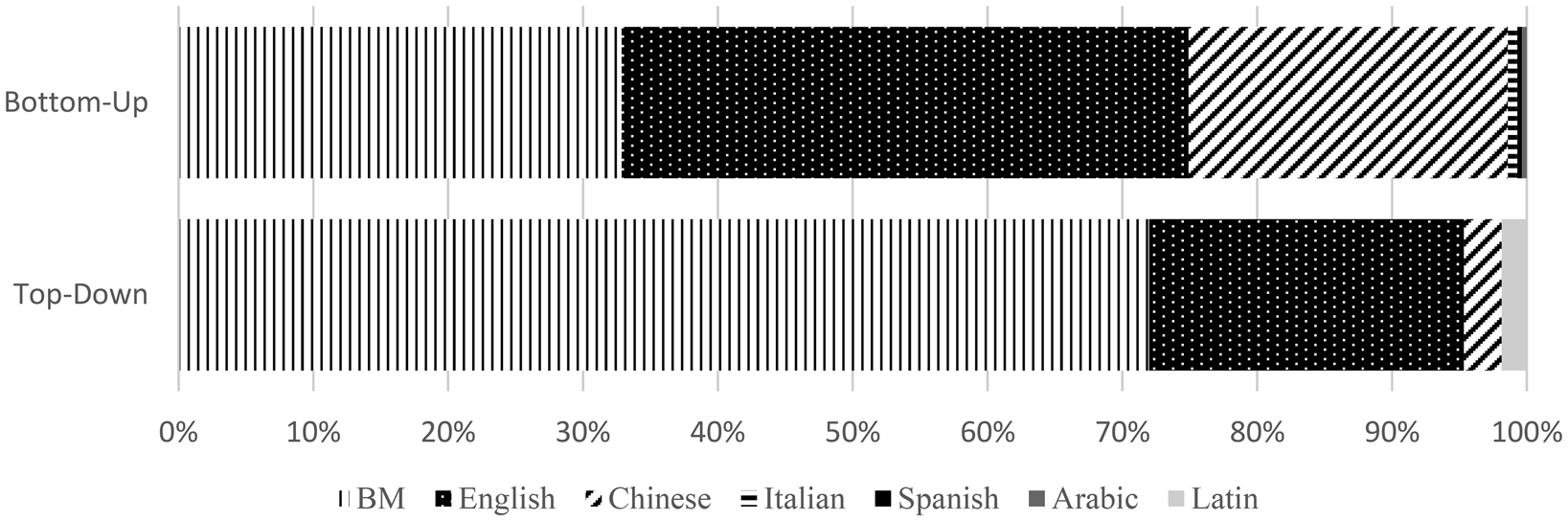
Figure 1 highlights that the most commonly used language in the analysed neighbourhoods is BM, found to be used in 170 instances within the examined signs. English closely follows with 144 instances of usage. Chinese is the third most commonly used language with 70 instances. Other European languages (five instances) and Arabic (one instance) can also be found in the linguistic landscape. The usage of English in the linguistic landscape of Johor Bahru city's residential areas accounts for 37% of all language use. Usage of BM accounts for 44% of all language usage whilst Chinese accounts for 18%. Italian, Spanish, Arabic and Latin account for a little over 1% of other language usage. Figure 2 shows the distribution of these languages across top-down and bottom-up usage.
The usage of languages across the bottom-up and top-down signage of Johor Bahru City's residential neighbourhoods

Figure 2 highlights that English has a much higher status in bottom-up signage, in which it accounts for 42% of language usage, than it does in top-down signage, in which it accounts for only 23%. The figure also highlights an imbalance of BM usage across top-down and bottom-up signage. In top-down signage, BM accounts for 72% of all language used, but in bottom-up signage it accounts for 33%. Data on the usage of Chinese shows a similar pattern. The language is used much more frequently in bottom-up signage (24%) than in top-down signage (3%). Whilst BM dominates top-down signage, English dominates bottom-up signage.
From this quantitative analysis, it can be seen that BM dominates the linguistic landscape. Usage of BM dominates top-down authored signage. English dominates bottom-up authored signage. The following section presents a qualitative analysis of the collected data in order to explain the quantitative findings, uncovering who the users of these languages are and why they might use them.
Qualitative data analysis
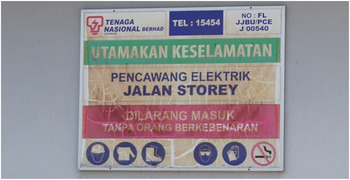
It seems to be the case in Johor Bahru city's residential neighbourhoods that top-down signage puts government policy into practice. Figure 3 shows that the national power company, ‘Tenaga Nasional Berhad’ (National Power Limited), affords BM prominence by its exclusive usage in their signage.
Tenaga Nasional Berhad (National Power Limited)

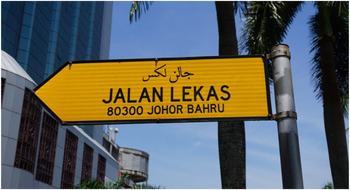
In street signage, BM is featured most prominently by its exclusive usage in two scripts, i.e. Jawi and the Roman alphabet. Rumi Malay is located centrally on the signage, employing the Roman alphabet, below a transliteration which employs the more traditional, culturally valuable and now endangered Jawi script (Yaacob et al., Reference Yaacob, Zainab, Mahmud and Edzan2001) (see Figure 4).
Jalan Lekas (Lekas Street)

Similarly, government-erected signage that celebrates the anniversary of the Sultan of Johor's coronation gives prominence to BM through the language's exclusive usage, as illustrated in Figure 5.
Daulat Tuanku (Long live the King)

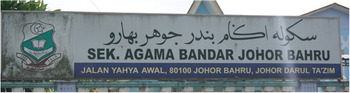
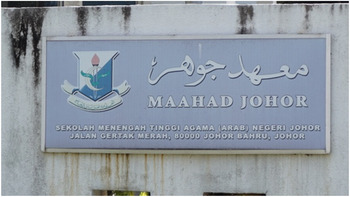
The signage of educational bodies can also be considered to be top-down. Signage erected by educational bodies with an association with Islam give prominence to BM, as the city's street signage does, through its exclusive usage in two scripts. This is visible in Figure 6, which presents the Johor Bahru City Religious School's main sign, and Figure 7, which presents the main sign of The (Arabic) Religious Secondary School of Johor.
Sekolah Agama Bandar Johor Bahru (Johor Bahru City Religious School)

Sekolah Menengah Tinggi Agama (Arab) Negeri Johor (The [Arabic] Religious Secondary School of Johor)

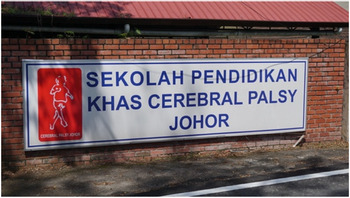
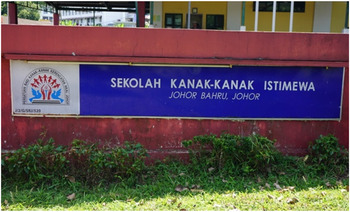
Educational bodies which provide especially for learners with special educational needs also seem to adhere to government policy in their main signage, displaying a preference for BM. See the main signage of the Johor Special Education School for Cerebral Palsy and the School for Special Children, which is visible in Figures 8 and 9.
Sekolah Pendidikan Khas Cerebral Palsy Johor (Johor Cerebral Palsy Special Education School)

Sekolah Kanak-Kanak Istimewa (Special Children's School)

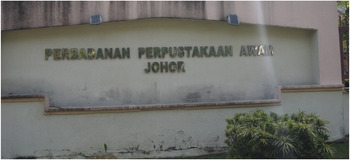
Similarly, the public library corporation display their signage exclusively in BM, as below in Figure 10.
Perbadanan Perpustakaan Awam Johor (Johor Public Library Corporation)

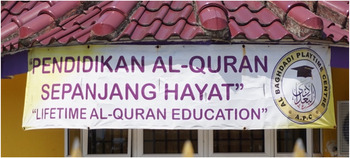
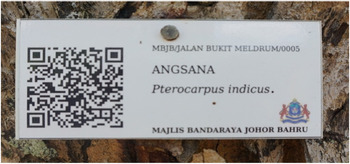
Two exceptions were found to the common observation that education-related signage uses BM exclusively. In Figure 11, a children's play school with an affiliation to Islam displays Rumi BM most prominently, alongside English. The English content is presented less prominently by being printed in a smaller font, below the Rumi BM content. Jawi script BM is also used, but less prominently than the Rumi BM and English by its very small size to the right of the sign, in the centre of the logo. In Figure 12, the city council is seen to use BM with Latin, with equal prominence, to provide the scientific naming of a tree in an internationally conventional manner.
Pendidikan Al-Quran Sepanjang Hayat (Lifelong Quranic Education)

Majlis Bandaraya Johor Bahru (Johor Bahru City Council)

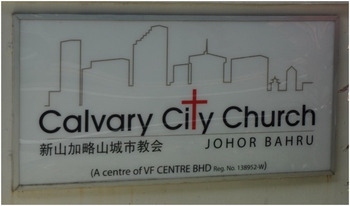
The linguistic landscape crafted by religious bodies affiliated with Christianity commonly displays a preference for English and Chinese, as illustrated in Figures 13 and 14.
St. Christopher's Church

Calvary City Church

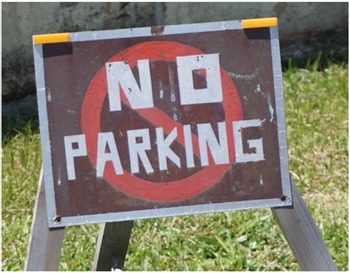
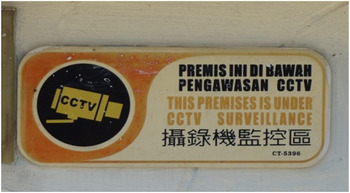
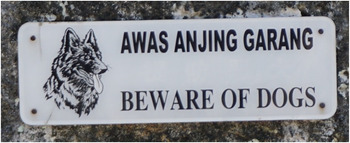
Bottom-up signage was found to be less demonstrative of government policy. A distinct category of bottom-up signage stood out in the linguistic landscape of Johor Bahru city's residential neighbourhoods which I term neighbourly warnings, ‘signs erected by the public to carry a warning message’. Within neighbourly warnings, English was found to be the most commonly used language. In some cases, English was used exclusively, as in Figure 15. In other cases, as in Figures 16, 17 and 18, English was used in parallel to BM and Chinese to convey a similar warning. When collecting data, I was able to ask the author of the ‘NO PARKING’ sign in Figure 15 as to why he chose to employ English within it. He answered: ‘Because I use English, everyone can understand, everyone can stay off my grass’. This anecdote suggests that the author perceives other languages, perhaps BM and Chinese, as not being universally understood in the area and that perhaps English is the area's lingua franca.
No parking

This premises is under CCTV surveillance

Beware of dogs

Beware of dog

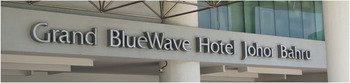
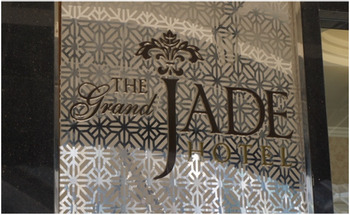
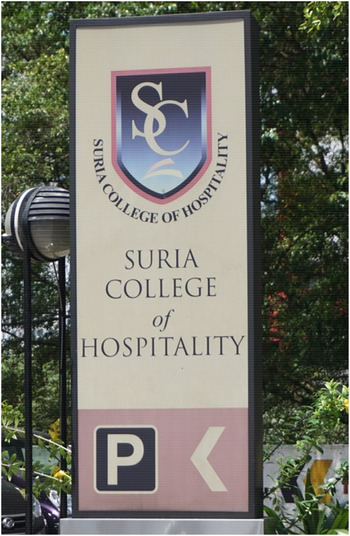
Signs used within contexts related to hospitality seemed to display a clear preference for English. In most cases, English was found within monolingual signage, as in the examples presented in Figures 19, 20 and 21.
Grand BlueWave Hotel

The Grand Jade

Suria College of Hospitality

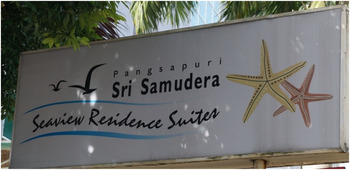
Signage in the context of hospitality was infrequently bilingual. English was always used in hospitality-related bilingual signage, and it was always used more prominently, by being presented in a larger font size or being positioned on top. English was sometimes used with BM and Chinese, as in the examples in Figures 22 and 23. It seems that English is used in the semantic domain of hospitality with connotations of luxury and sophistication that the BM used does not have. Review of Figure 22 demonstrates this well. BM's ‘pangsapuri’ (apartments) denotes the building type and connotes that the dwellings are small. However English's ‘seaview residence suites’ suggests that the apartments are spacious, impressive and have a desirable perspective.
Seaview Residence Suites

Erica Hotel

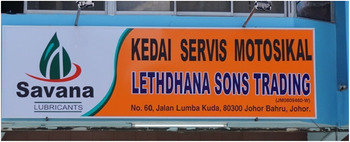
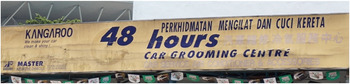
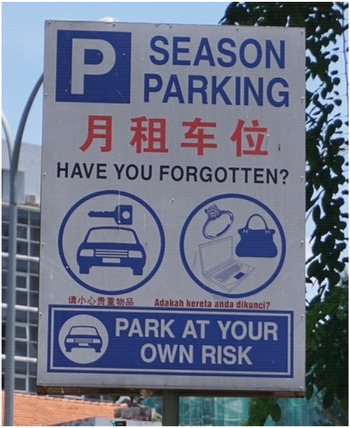
Signage relating to semantic domains of motoring were a common occurrence. These signs demonstrated a strong preference for the use of English, as presented in Figures 24, 25, 26 and 27.
Lethdhana Sons Trading

48 hours

Silverstone

Season parking

Figure 24 provides a typical example of a motoring-related shop sign. The display of an English business name, ‘Lethdhana Sons Trading’ is found alongside a description in BM of the shop type and its services ‘Kedai Servis Motosikal’ (Motorcycle Service Store). Figure 25 demonstrates a similar pattern of language usage.
Figures 24, 25 and 26 also display an English-language product name, a common feature in motoring-related signage. Figures 25 and 27 display English as the most prominent language but also employ Chinese and BM. In Figure 27, Chinese is used more prominently than BM by being printed in a large red font, towards the top of the sign, below the English writing. BM is only used in a small dark red font, towards the bottom of the sign, above the ‘PARK AT YOUR OWN RISK’ writing.
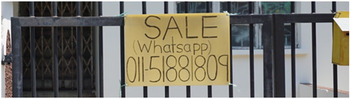
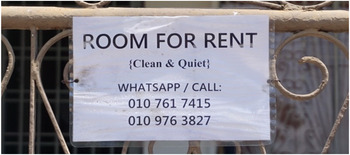
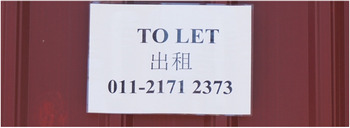
Another common signage context was real estate. Monolingual signage in English was the most common. Examples can be found in the advertisement of a property for sale in Figure 28 and the advertisement of a room for rent in Figure 29. That said, bilingual signage in which English featured with BM or Chinese could also be found, but less frequently. An example is given in the advertisement of a property available to let in Figure 30.
Sale

Room for rent

To let

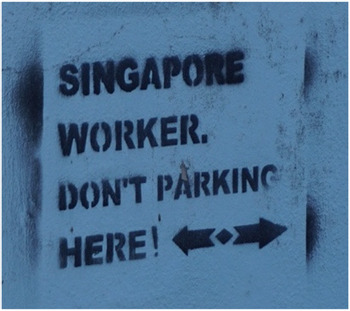
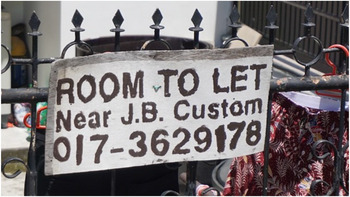
Signage addressing people with an association with nearby Singapore was commonly found. In Figure 31, English is employed to explicitly address people who work in Singapore. In Figure 32, English is employed again but implicitly addresses those associated with Singapore, by stating that the available room is close to the Johor/Singapore customs border.
Singapore worker. Don't parking here!

Room to let

Conclusions
In the linguistic landscape of residential Johor Bahru city, BM, English, Chinese, Italian, Spanish, Arabic and Latin are used. English accounts for 37% of all language usage. BM accounts for 44% of all language usage whilst Chinese accounts for 18%. Italian, Spanish, Arabic and Latin account for a little over 1% of other language usage. The high frequency of English is largely attributed to its common bottom-up usage in neighbourly warnings and in attempts to address those associated with Singapore, and by businesspeople in hospitality, motoring and real-estate contexts. English is also used by top-down authors associated with educational bodies and Christianity. English is not used by bodies of the Malaysian state. Usage of BM can be attributed to its exclusive usage in top-down signage authored by government-associated bodies, in line with official policy, but also partly to its widespread usage in bottom-up contexts in which it is used to produce neighbourly warnings and in promoting motoring businesses. It is noteworthy that in top-down signage, BM is not always used most prominently, particularly when used in multilingual signage, and when in competition with English and Chinese. Chinese usage can be largely accredited to Christian religious bodies in top-down signage and by the public's neighbourly warnings given in bottom-up signage. Chinese was not observed to be in use by government-associated bodies. In addition, Arabic, Spanish and Italian are used by the public and not the government.
The linguistic landscape of Johor Bahru city's residential neighbourhoods may be considered different to that of the largely commercial neighbourhoods of Kuala Lumpur, as observed by Manan et al. (Reference Manan, David, Dumanig and Naqeebullah2015), because English was found to be most commonly used in Kuala Lumpur whilst BM was found to be most commonly used language in Johor Bahru city. Similarly, it may be considered different to the linguistic landscape of Kuala Lumpur produced by religious bodies, as observed by Coluzzi and Kitade (Reference Coluzzi and Kitade2015), where English is the most used language and usage of BM is minimal. Furthermore, it may be perceived as different to the linguistic landscape produced by business owners’ shop signs in Kuala Lumpur and Bandar Raya Melaka, where English is the most commonly used language, but similar to the linguistic landscape of Cheng and Bandar Jengka, where BM is the most frequently used language, followed by English (and Chinese, in Cheng) (Ariffin & Husin, Reference Ariffin and Husin2013). The linguistic landscapes of Johor Bahru city's residential neighbourhoods, where bottom-up language users frequently break government guidance on the display of language within signage, might be considered different to that produced by shop owners in Petaling Jaya, where David and Manan (Reference David and Manan2015) observed a general adherence to government policies. It may also be perceived as dissimilar to that of shop signs within one of Kuala Lumpur's largest and most well known malls for its much less frequent usage of Italian – present in less than 1% of signage, compared with 7.8% in Coluzzi's (Reference Coluzzi2017) study.
In Johor Bahru city's residential neighbourhoods, the language of the state, BM, holds the most vitality in the linguistic landscape generally. However, English enjoys very high status alongside BM, particularly in bottom-up contexts. Perhaps this observation on the usage of English can be explained by Johor Bahru city's multi-ethnic composition, its proximity to Singapore, and the political support for English from Johor's leadership. Seemingly, in this multi-ethnic part of Malaysia, where the Sultan and others promote the use of English, adjacent to Johor's closely tied, English-speaking economic partner Singapore, the English language is allowed to thrive in the linguistic landscape, outside of the law.
 THOMAS MCKIERNAN graduated with his master's degree in linguistics from the University of Manchester in 2016. Originally from Manchester, he currently resides in Singapore. Thomas has spent most of his time over the past ten years in English language teaching. However, today he manages learning programmes across the Asia–Pacific region for a UK-based corporate education provider. Although not presently in academia, Thomas maintains an interest in the field of linguistics. Email: mckiernantmm@gmail.com