Introduction
The terrorist attacks by hijacked airliners on the twin World Trade Center (WTC) towers on September 11, 2001, precipitated the largest full-scale evacuation of any high-rise building in the United States.Reference Galea, Hulse, Day, Siddiqui and Sharp1 Although the attacks resulted in 2,752 immediate deaths,Reference Li, Kennedy, Kelley, Sun, Maduro and Hartman-O'Connell2 an estimated 87% of the 17,400 building occupants survived by evacuating the buildings in a timely fashion.Reference Shyam-Sunder3 Because delays in evacuation may increase risk of injury and death, it is important to identify and, where possible, to quantify factors that delay or inhibit evacuation and their impact on building evacuation.
Factors contributing to successful evacuation of the WTC towers have been reported in a number of studies. Based on telephone and face-to-face interviews and other sources, Averill et al concluded that, after accounting for delays in deciding to evacuate, stairwell travel speed in WTC 1 was affected most by environmental cues described as “visual, auditory, or other sensory perceptions that indicated danger on September 11, 2001.”Reference Averill, Milet and Peacock4 In the UK 9/11 High-Rise Evacuation Evaluation Database (HEED) study, Galea and colleagues used interviews with 271 evacuees from the two towers, along with computer modeling, to study the role of “information seeking” and “action tasks” on evacuee response times and the adverse impact of stairwell congestion and frequency of rest stops on travel time.Reference Galea, Hulse, Day, Siddiqui and Sharp1 In the Columbia University World Trade Center Evacuation Study, Gershon and colleagues used survey data from a sample of 1,444 evacuees to identify barriers to, and facilitators of, initiation and evacuation of the WTC towers at the level of the individual (eg, sensory cues, group behavior, and leadership), organization (eg, preparedness and communication), and environment (eg, smoke, flames, and congestion).Reference Gershon, Magda, Riley and Sherman5
Studies of WTC evacuation must take into account the configuration of the buildings, the attack sequence, and the so-called impact zones struck by the hijacked aircraft. The WTC complex consisted of WTC 1 (North Tower), WTC 2 (South Tower), and five other buildings that totaled 10.4 million square feet of office space. The two buildings actually struck, WTC 1 and WTC 2, each had 110 stories, with three central stairwells running from top to bottom, and 99 elevators.6 Damage to stairwells obstructed exits for occupants on floors above the impact zone of each tower. In WTC 1, the first building attacked, the impact of the plane cut through floors 93 to 99, collapsing all three stairwells and completely disrupting elevator service. The majority of survivors (99%) were below the zone of impact when the building was struck, requiring virtually all occupants to evacuate via stairs.Reference Averill, Milet and Peacock4 In WTC 2, the impact of the plane cut through floors 77 to 85, collapsing two of the stairways, damaging the third stairway, and stopping elevator service in the building.6 Fortunately, after WTC 1 was struck, the majority of the 2,900 people originally above the impact zone in WTC 2 had started to evacuate before WTC 2 was struck, many by elevator, and most survived. The collapse of both WTC towers that resulted from the initial airplane strikes also caused extensive damage to many nearby buildings, which then had to be evacuated, providing further obstacles to evacuees who successfully reached street level. Experiences of evacuees from these buildings have not been previously reported. The present study builds on previous qualitative and quantitative studies by analyzing evacuation experiences of 1,652 evacuees from the two WTC towers and 1,810 evacuees from other damaged or destroyed buildings in the immediate vicinity of WTC 1 and 2, focusing on persons who evacuated exclusively by stairs, and on the effects of structural and behavioral barriers, as well as limitations of personal mobility, on evacuation.
Methods
The World Trade Center Health Registry (WTCHR) is a cohort study of physical and mental health outcomes among individuals directly exposed to the attacks on September 11, 2001, or its aftermath. The WTCHR consists of four overlapping eligibility groups: 1) rescue/recovery workers and volunteers; 2) Lower Manhattan area residents; 3) area workers, commuters, and passersby on 9/11; and 4) school staff and attendees. Enrollees were drawn from lists of potentially eligible individuals obtained from Lower Manhattan employers, government agencies, and organizations (list-identified enrollees), and local and regional media campaigns were used to encourage other potentially eligible persons to enroll (self-identified enrollees) by calling a toll-free telephone number or by registering online. In 2003 and 2004, 71,434 eligible persons completed the baseline (Wave 1) survey that gathered extensive exposure and health data. In 2006 and 2007, 46,322 of the original adult enrollees (68.1% response rate) completed the Wave 2 survey that updated their health status and gathered additional exposure information. Registry methods are described in additional detail elsewhere.Reference Farfel, Digrande and Brackbill7, Reference Brackbill, Hadler and DiGrande8 Questions relevant to this evacuation study were included in the Wave 2 survey and are shown in Figure 1. The institutional review boards of both the Centers for Disease Control and Prevention and the New York City Department of Health and Mental Hygiene approved the WTCHR protocol.
World Trade Center Health Registry Survey Questions on Building Occupant Evacuation

This analysis focuses on Wave 2 participants who were ≥18 years of age on 9/11 and who evacuated buildings south of Chambers Street that were damaged or destroyed in the attacks between the time of the first plane impact and noon on September 11, 2001 (N = 6,956). World Trade Center evacuees were categorized by building: WTC 1, WTC 2, or other WTC collapsed buildings (eg, WTC 7), and within each WTC tower by floor groups.Reference DiGrande, Neria, Brackbill, Pulliam and Galea9 Other buildings were categorized using Federal Emergency Management Agency (FEMA) designations: totally collapsed, partially collapsed, noncollapsed with major damage, and noncollapsed buildings with moderate damage.Reference Brackbill, Thorpe and DiGrande10 A total of 1,323 rescue and recovery workers were excluded because most were present in order to assist evacuation efforts and were not initially attempting to evacuate themselves. In addition, 610 persons were excluded who did not evacuate, who said they evacuated from a building not included in the FEMA designations, or who were missing data for Wave 2 evacuation barrier questions, leaving a final sample of 5,023 building evacuees.
Two broad categories of barriers to evacuation were infrastructure and behavioral. Infrastructure barriers are those inherent in the structural environment and architecture of the building, and include number and spacing of floors, configuration of stairways and exits, and damage-related conditions hindering or preventing exit such as fire and water conditions. Behavioral barriers include crowding, panic, perception of danger, and communication problems. The impact of both types of barriers on evacuation time in a subset of 3,462 participants who evacuated exclusively using the stairs was assessed, and in order to avoid possible confounding effects of elevator use, analysis was further restricted to those who reported evacuation times of two hours or less, consistent with the maximum time reported by Gershon et al.Reference Gershon, Magda, Riley and Sherman5 A multinomial logistic regression was carried out in this subset to determine the effects of both types of barriers on total evacuation time (>30 to ≤60 minutes, >1 hour to <2 hours relative to the reference time of ≤30 minutes).
Number of infrastructure barriers and number of behavioral barriers were the primary predictors for the model, which was adjusted for recruitment source (list- vs self-identified), gender, income in 2002, building damage category, time of initiation of evacuation, and location/floor within the building. The possibility that the barrier-evacuation time relationship might vary by starting floor was examined by comparing results of separate multinomial analyses for five separate floor strata (0-1, 2-9, 10-26, 27-48, and ≥49), adjusted for the same covariates. Because evacuation may be especially difficult for people with mobility impairment, the possible effect of impairment on evacuation time was studied by comparing results of the multinomial regression model with and without a binary response variable for the baseline question “On September 11, 2001, did you have a disability or a health condition that limited your ability to walk down a large number of stairs?” (Figure 1). All analyses were conducted using SAS Version 9.2 (SAS Institute Inc., Cary, North Carolina USA).
Results
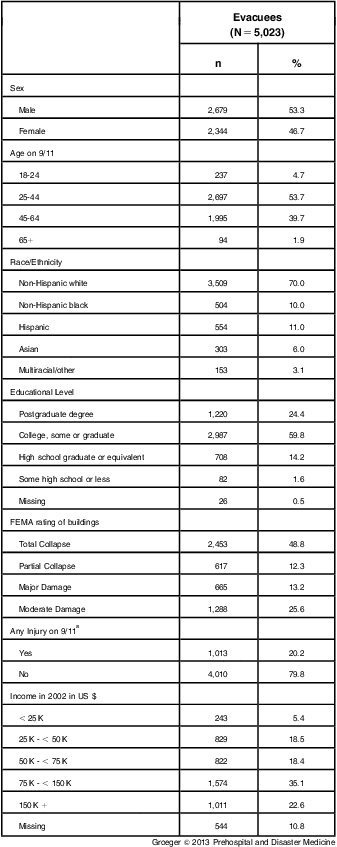
Characteristics of the sample are displayed in Table 1. Just over half (53.3%) of the participants were male, and 53.7% were 25-44 years of age, with the next largest age group being 45-64 years of age (39.7%). Evacuees were mainly non-Hispanic white (70.0%), with at least a college education (59.8%). Nearly half (48.8%) evacuated buildings that totally collapsed, and one-quarter (25.6%) evacuated buildings that were moderately damaged; 20% of evacuees sustained at least one injury. There were no meaningful demographic differences between the 5,023 evacuees who responded to the Wave 2 evacuation questions and the 2,602 evacuees who participated in Wave 1 but not in Wave 2. Importantly, there were no exposure differences between Wave 2 participants and nonparticipants as measured by building damage category and number or type of injury experienced on 9/11.
Selected Characteristics of 5,023 Evacuees from World Trade Center-Damaged Buildings
aReported experiencing any of the following World Trade Center- related injuries on September 11, 2001: cut, sprain, burn, broken bone, concussion, other.
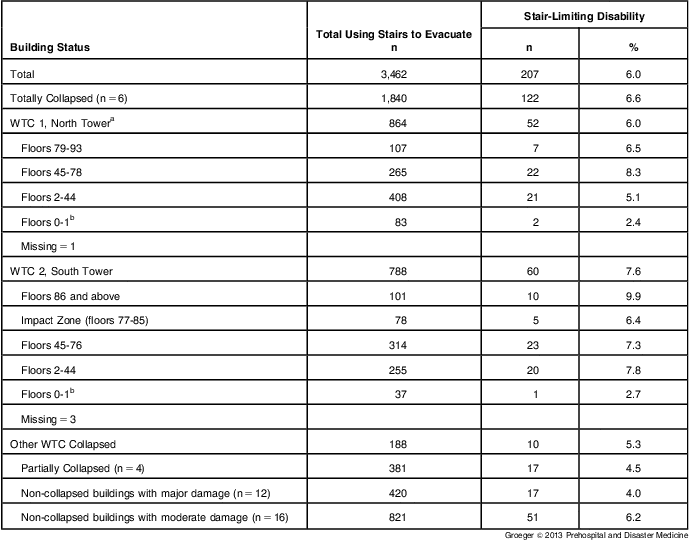
Nearly 70% of this study's sample exclusively used stairs to evacuate (68.9%) (see Figures 2 through 4 for distribution of method of evacuation by floor strata for WTC 1, WTC 2, and other buildings). Evacuation modes other than stairs, elevator, or escalator largely pertain to persons in the lobby or near a building entrance, a handful of people who were carried out, and those who escaped through openings created during the building collapse. Only 10.5% of participants reported using the elevator only, while 5.5% reported using the stairs in combination with the elevator and/or escalator. The highest percentage reporting stair use only was among the evacuees leaving from floors 2-93 of WTC 1 (range: 95.1%-97.7% by floor group) (Figure 2), due to the fact that it was attacked first and without warning, immediately disabling its elevators. A high percentage of stair-only use was reported by evacuees leaving from floors 2-85 of WTC 2 (range: 75.0%-80.9%) (Figure 3). High percentages of evacuees leaving other WTC buildings that were collapsed, partially collapsed, noncollapsed with major damage, or noncollapsed with minor damage, also reported stair use only (81.8%, 86.0%, 68.9%, and 74.5%, respectively) (Figure 4). The highest percentages of evacuees reporting elevator use only were located in floors 86 and above in WTC 2 (30.3%) and in noncollapsed buildings with either major damage (23.7%) or with moderate damage (22.5%). The highest percentages of evacuees reporting a combination of stair with elevator and/or escalator use were those leaving from the second floor or above of WTC 2 (range: 12.4%-23.4%). Among individuals who reported evacuating by stairs, six percent reported a stair-limiting disability with little variability by building damage category (Table 2). Within the towers, the highest percentages of evacuees reporting a stair-limiting disability were on higher floors (9.9% on floors 86 and above in WTC 2, and 8.3% on floors 45-78 in WTC 1).
Method of Evacuation (stairs only, elevator only, or combination of stairs, elevator, or escalator) by Floor on Which Evacuation Started, WTC 1 Evacuees
Abbreviations: WTC, World Trade Center
Method of Evacuation (stairs only, elevator only, or combination of stairs, elevator, or escalator) by Floor on Which Evacuation Started, WTC 2 Evacuees
Abbreviations: WTC, World Trade Center
Method of Evacuation (stairs only, elevator only, or combination of stairs, elevator, or escalator) by Floor on which Evacuation Started, Evacuees of Damaged or Destroyed Buildings other than WTC 1 or WTC 2
Abbreviations: WTC, World Trade Center
Prevalence of Stair-limiting Disability among Stair-only Evacuees from WTC 1, WTC 2, Partially-collapsed Buildings, and Non-collapsed but Damaged Buildings
Abbreviations: WTC, World Trade Center
aImpact zone is not reported here because there were no survivors from the impact zone in the Registry.
bIncludes lobby, mezzanine, walking bridge, basement, concourse, path, subway, “somewhere else.”
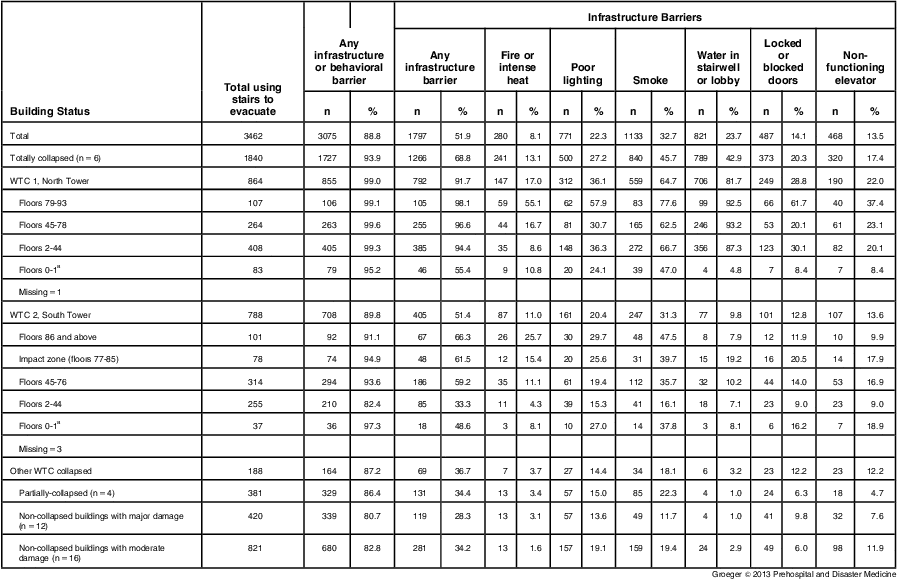
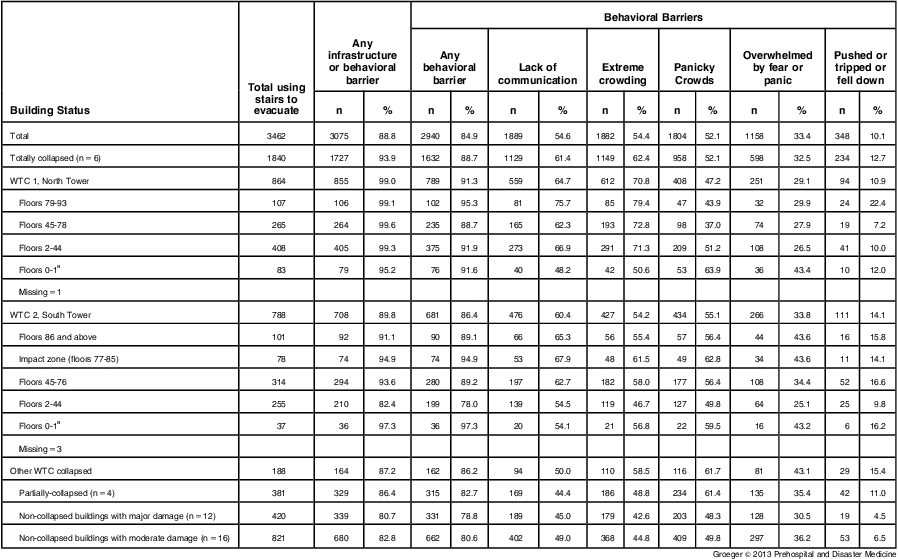
Overall, 88.8% of stairs-only evacuees reported encountering at least one infrastructure or behavioral barrier (Tables 3 and 4, respectively). Over 99.0% of evacuees from WTC 1 reported at least one barrier, followed by evacuees from WTC 2 (89.8%), other WTC buildings (87.2%), and from partially-collapsed (86.4%) and non-collapsed buildings that suffered major damage (80.7%) or moderate damage (82.8%) (Table 3). With the exception of WTC 1, evacuees who reported comparable numbers of behavioral (91.3%) and infrastructure (91.7%) barriers, behavioral factors were cited more often than infrastructure factors (84.9% for behavioral; 51.9% for infrastructure). Greater proportions of WTC 2 occupants who evacuated from above the lobby and mezzanine levels reported behavioral (by floor strata: 78.0%-89.1%) than infrastructure (33.3%-66.3%) barriers (Table 4). Evacuees from other buildings also reported proportionally more behavioral (78.8%-86.2%) than infrastructure (28.3%-36.7%) barriers. Among evacuees from buildings other than WTC 1, a higher percentage of evacuees reported encountering at least one behavioral barrier (85%) than reported at least one infrastructure barrier (52%).
Distribution of Infrastructure Barriers Encountered during Evacuation of WTC 1, WTC 2, Partially-collapsed Buildings, and Non-collapsed Buildings Among Persons Who Exclusively Used Stairs to Evacuate
Abbreviations: WTC, World Trade Center.
aIncludes lobby, mezzanine, walking bridge, basement, concourse, PATH train, subway, “somewhere else.”
Distribution of Behavioral Barriers Encountered during Evacuation of WTC 1, WTC 2, Partially-collapsed Buildings, and Non-collapsed Buildings Among Persons Who Exclusively Used Stairs to Evacuate
Abbreviations: WTC, World Trade Center.
aIncludes lobby, mezzanine, walking bridge, basement, concourse, PATH train, subway, “somewhere else.”
Specific infrastructure barriers encountered by evacuees from the two WTC towers differed from those encountered by evacuees of other buildings. For evacuees from WTC 1, water in the stairwell or lobby was the most frequently-reported infrastructure barrier to evacuation (81.7%). For evacuees from WTC 2 or other buildings, smoke and poor lighting were the most frequently-reported infrastructure barriers (31.3% and 20.4%, respectively, Table 3). Other than water and smoke or poor lighting, locked/blocked doors and nonfunctioning elevators were the next most commonly-reported infrastructure barriers, affecting 14.1% and 13.5% of all evacuees, respectively. Fire and intense heat were the least frequently-cited infrastructure barriers (8.1% overall).
The three most commonly-reported behavioral barriers were lack of communication with officials, extreme crowding, and being surrounded by panicked crowds/others (54.6%, 54.4%, and 52.1%, respectively). These frequencies remained consistently high compared with reported frequencies of other behavioral barriers; approximately 50% of evacuees reported encountering each of these barriers regardless of degree of damage to their building (Table 4). Overall, 33.4% of individuals reported having been overwhelmed by fear or panic. Consistently lower percentages of evacuees reported being pushed, tripped, or having fallen (overall 10.1%).
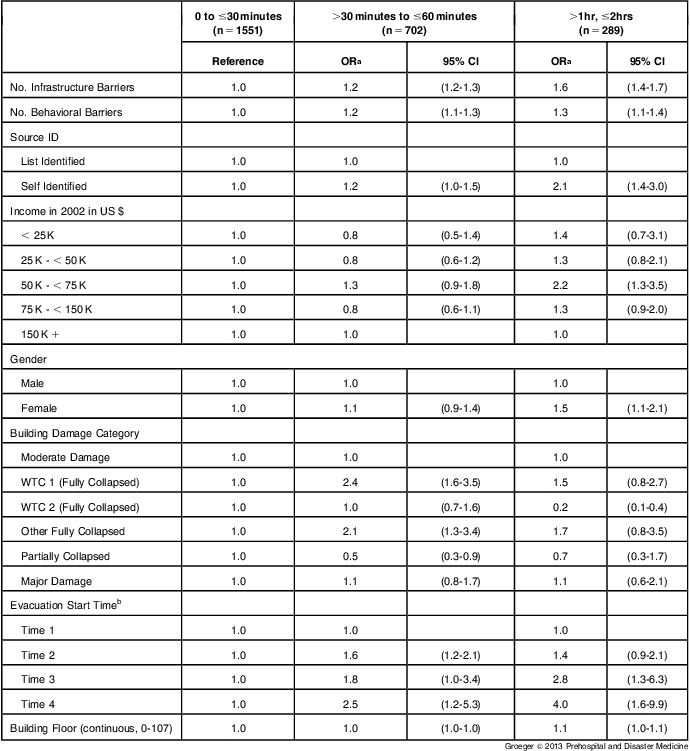
After adjusting for recruitment source, gender, income in 2002, building damage category, time of initiation of evacuation, and floor, both infrastructure and behavioral barriers were significant predictors of increased evacuation time (Table 5). The odds of evacuating in 30-60 minutes compared with <30 minutes were increased by 20% per infrastructure barrier and 20% per behavioral barrier. The odds of evacuating in one to two hours compared with <30 minutes were increased by 60% per infrastructure barrier and 30% per behavioral barrier. Evacuation time was significantly greater for women than for men. Evacuation time was also significantly greater for those who began their evacuation after the collapse of WTC 1 and 2, with an odds ratio (OR) of 2.5 (95% CI, 1.2-5.3) to exit within 30 minutes to one hour and 4.0 (95% CI, 1.6-9.9) to exit in one to two hours. Inclusion of a personal mobility impairment in the final model produced no material changes in any of the odds ratios and was not itself associated with increased evacuation time after adjustment.
Multinomial Odds Ratios for Associations Between Number of Infrastructure and Behavioral Barriers in Relation to Time to Evacuate Among Stair-only Evacuees
Abbreviations: WTC, World Trade Center
aAdjusted for recruitment source, gender, income in 2002, building damage category, time of initiation of evacuation, floor. Number of infrastructure barriers is adjusted for number of behavioral barriers and vice versa.
bTime 1: Between first plane impact and during second plane impact; Time 2: Between second plane impact and during collapse of WTC 2; Time 3: Between collapse of towers and during collapse of WTC 1; Time 4: After collapse of WTC 1.
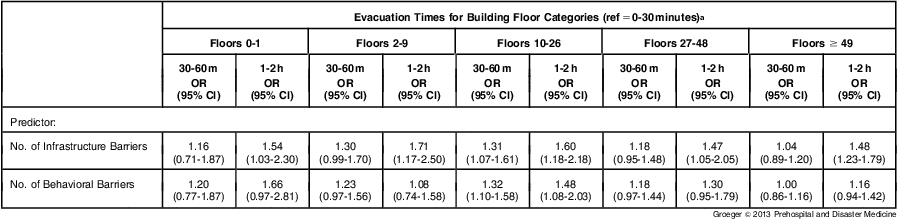
Both infrastructure and behavioral barriers were predictive of increased total evacuation time after stratification by floor (Table 6, end of the paper): ORs were between 1.00 and 1.71. The greatest contrast was on floors 2-9 between infrastructure barriers and behavioral barriers: the odds of evacuating in one to two hours compared with <30 minutes were increased by 71% per infrastructure barrier, but by a statistically non-significant eight percent per behavioral barrier. Comparable differences were not seen in the rest of the stratified analysis, and two of the floor categories (floors 0-1 and floors ≥49) were populated by small numbers of respondents. It therefore seems justifiable to generalize from the non-stratified models in Table 5.
Adjusted Odds Ratios for Associations of Number of Infrastructure and Behavioral Barriers with Time to Evacuate Among Stair-only Evacuees, Stratified by Building Floor
aAdjusted for recruitment source, gender, income in 2002, building damage category, time of initiation of evacuation.
Discussion
In the present study, both infrastructure and behavioral barriers were associated independently with increased evacuation time and should be considered distinct factors in developing building evacuation policies and procedures. Most occupants of damaged or destroyed buildings on September 11, 2001 were forced to use stairs to evacuate, especially from WTC 1, the first building struck. Almost all evacuees from WTC 1 reported encountering at least one infrastructure and one behavioral barrier. In all other buildings, including WTC 2, where elevators remained functional until it, too, was attacked, evacuees were more likely to experience behavioral than infrastructure barriers. Smoke and poor lighting were the two most frequently-reported structural barriers, except in WTC 1, where water in the stairwell or lobby was the most frequent, (due, in part, to activation of sprinkler systems triggered by attack-generated fires, as well as eventual rupturing of the water system.Reference Bonneau, O'Rourke and Palmer11) After water, smoke, and poor lighting, locked or blocked doors in exit stairwells or nonfunctioning elevators were the next most frequently reported barriers in WTC 1. The latter were encountered by high percentages of evacuees from WTC 2 and from buildings not directly attacked. This is consistent with the HEED study, which found structural factors that hindered evacuation included debris, smoke, heat, and water on the stairs during descent, as well as poor lighting, the disrupted public address system, flames, and confusing signals.Reference Galea, Hulse, Day, Siddiqui and Sharp1, Reference Gershon, Magda, Riley and Sherman5 The most common behavioral barriers were extreme crowding, lack of communication, and being surrounded by panicked individuals, consistent with Gershon et al who previously reported “communication failures” and overcrowding as factors hindering evacuation.Reference Gershon, Magda, Riley and Sherman5
Multivariate models showed significant and independent associations between the number of both infrastructure and behavioral barriers with evacuation times. These associations are consistent with previous studies that dealt exclusively with survivors of WTC 1 and 2,Reference Galea, Hulse, Day, Siddiqui and Sharp1, Reference Averill, Milet and Peacock4, Reference Gershon, Magda, Riley and Sherman5 and extends those earlier observations to include survivors from over 30 additional buildings that were damaged or destroyed as a result of the attacks. Results from both the HEED study and the Columbia University WTC Evacuation Study indicate that seeking information and performing action tasks (such as collecting/securing items before initiating evacuation) delayed evacuation from the towers. Once evacuation started, congestion was the most frequent cause of stopping, while uncertainty about building layout was a behavioral factor that also impeded evacuation. It should be noted that crowding was treated as a behavioral barrier, whereas Gershon et al classified it as a structural barrier since it is determined, in part, by the physical dimensions of the stairwell.Reference Gershon, Magda, Riley and Sherman5
The results from this study concerning behavioral and structural barriers to evacuation may apply not only to terrorist attacks, which are rare, but also to high-rise building fires, which are much more common (more than 15,000 per year reported in 2005-2009Reference Shields, Boyce and McConnell12), even though the two events may entail different evacuation methods.
Personal level variables have been also found to affect evacuation. In this study, six percent of those who evacuated by stairs reported a stair-limiting disability, consistent with the National Institute of Standards and Technology report that “about 6 percent of survivors describe themselves as mobility impaired.”Reference Averill, Milet and Peacock4 However, a stair-limiting disability was not found to be associated with total evacuation time after adjusting for other factors, consistent with the HEED study, which found no correlation between Body Mass Index, fitness, and speed of descent, and which reported that six mobility-impaired individuals were safely evacuated with “remarkable” descent speeds between 0.4 and 1.4 floors per minute.Reference Galea, Hulse, Day, Siddiqui and Sharp1 By contrast, individual-level limitations in the WTC Evacuation Study, ranging from inappropriate footwear to disabilities and other medical conditions, were associated with longer evacuation times. Nearly one-third of the 23% of respondents in that study who indicated they had a medical condition or disability also reported that their condition affected their ability to descend stairs, while another seven percent reported an existing health issue that affected mobility.Reference Gershon, Magda, Riley and Sherman5
There are several reasons why this study might not show an effect of a stair-limiting disability on evacuation time. First, the nonspecific term “mobility impaired” may not be a good descriptor of evacuation capability, and impaired persons in general may benefit from previous, possibly targeted, evacuation preparedness.Reference Shields, Boyce and McConnell12 Also, when participants stopped due to congestion or other factors, this “forced rest” may have masked an effect of a stair-limiting disability such as overweight or poor fitness. If, as has been conjectured, some disabled individuals perished while waiting in so-called rest stations (eg, the 20th floor of WTC 1) to which they were brought, then such individuals would be underrepresented among WTC survivors.
An important strength of the World Trade Center Health Registry is its large and diverse population of over 5,000 evacuees, including more than 2,200 from damaged or destroyed buildings other than the WTC towers. In the present report, it was learned for the first time that infrastructure barriers such as smoke and poor lighting, as well as behavioral barriers, were encountered with high frequency in the buildings that were not directly attacked. An additional strength is that the many covariates gathered in two Waves of Registry surveys allow for control for important co-factors when modeling the impact of the barriers on total evacuation time.
Limitations
Limitations of this study include selection and recall bias. Building occupants who enrolled in the Registry may not be representative of all occupants of the buildings that were damaged or destroyed on 9/11. A greater percentage of respondents were self-identified rather than list- identified; in prior Registry studies, self-identified enrollees were more likely to report some illnesses than list-identified enrollees. Individuals with the most difficulty evacuating may have been more likely to remember and report these experiences. While recall bias can never be fully eliminated, it is worth noting that Wave 2 respondents and non-respondents did not differ significantly with respect to important exposure variables (building damage category and injury). Registry participants were presented with a list of pre-defined barriers with no option to specify an “other” response, suggesting that this study's data may underestimate the effect of behavioral and structural barriers on evacuation time.
The role played by injuries in impeding evacuation needs further clarification. Both injured evacuees and ascending rescue workers could have contributed to stairwell crowding. Galea et al have suggested that injured evacuees contributed to 17% of descent stoppages, although it is unclear whether reports obtained from individuals refer to obstacles created by their own injuries or to those of others.Reference Galea, Hulse, Day, Siddiqui and Sharp1 Gershon et al noted that 37% of their sample reported sustaining an injury on 9/11.Reference Gershon, Magda, Riley and Sherman5 A more detailed description of risk factors for 9/11 injuries was presented by Brackbill et al, who found similar injury rates among survivors of WTC 1 and 2 (46.2%) and survivors of other collapsed and damaged buildings (43.6%), but that survivors of collapsed buildings had a higher risk for fractures and head injuries compared with survivors of damaged buildings, and that survivors who evacuated floors 76 and higher of WTC 1 and 2 had a nearly two-fold risk of any type of injury compared to evacuees from floors 10-42. It is also unclear to what extent delays can be attributed to injuries sustained during the evacuation itself or during subsequent exposure to dust cloud-related debris after leaving the immediate vicinity of the collapsing buildings.
Finally, this study's questionnaire gathered data only on evacuation barriers and not potential facilitators. In other studies, behavioral factors that aided evacuation included leadership and communication, positive social milieu, and group support during the descent down the tower stairs, while handrails and reflective tape also aided evacuation.Reference Gershon, Qureshi, Rubin and Raveis13
Conclusion
Evacuation of a severely-damaged high-rise building is challenged by both behavioral and infrastructure barriers; both can contribute substantially to evacuation time. Planners of evacuation need to address the structural layout of the building, possible evacuation routes, and how to deal with physical barriers. Emphasis also should be placed on the behavioral aspects of a mass evacuation, along with clear and consistent communication. Mitigation of behavioral barriers also requires thorough training of employees in cooperation with their employers, building organization, and public safety officials.Reference Gershon, Rubin, Qureshi, Canton and Matzner14 A renewed emphasis on evacuation plans in the workplace, and frequent evacuation drills in an environment of emergency preparedness programs that address behavioral as well as structural barriers to evacuation can significantly decrease evacuation times from high-rise buildings, thereby decreasing the risk of death and injury to their occupants during an emergency.