In a meeting of APSA's international committee in September 2003, APSA
President Susanne Rudolph suggested the need for a “mutual
de-parochialization” in our knowledge practices. She meant a closer
interaction between American and non-American political scientists and a
greater cross-fertilization of their substantive and methodological
concerns. Margaret Levi, the President-elect of APSA, also emphasized the
need for a greater internationalization of American political science, with
special emphasis paid to the so-called international public realm.
This note is a response to their concerns. It incorporates the comments made
by the International Committee in its meeting on January 23, 2004, held at
APSA's national office in Washington D.C.,1
The current members of the International Committee are: Karen
Beckwith, John Odell, Allan Rosenbaum, Richard Simeon, and
Toni-Michelle Travis. Rosenbaum was unable to participate in the
January meeting, but commented later on our ideas. Timothy Colton,
the previous chair of the International Committee, was in attendance
by special invitation. Michael Brintnall, Bahram Rajaee, Sylvia
Bronson, and Linda Lopez represented APSA in the discussion. I thank
all of the participants, as well as Susanne Rudolph and Margaret
Levi, for their comments on earlier drafts of this memo.
as
well as the subsequent suggestions made by Susanne Rudolph and Margaret
Levi. Our aim at this point is to submit this draft to the Administrative
Committee for feedback—before a formal document is placed for the
consideration of the Council in its meeting on April 17. The final document,
if approved by the Council, will constitute a new mandate for the
international committee.
In the discussion below, I first discuss why internationalization of APSA is
desirable. It is followed by the international committee's understanding of
how it might best be carried out.
Why Internationalization?
Should APSA be concerned only with our U.S./North American colleagues, or
should it widen its search of ideas, methods, concerns, and
collaborations? Will American political science and American political
scientists be better off if we pursue internationalization more
vigorously? These questions require thought and reflection.International
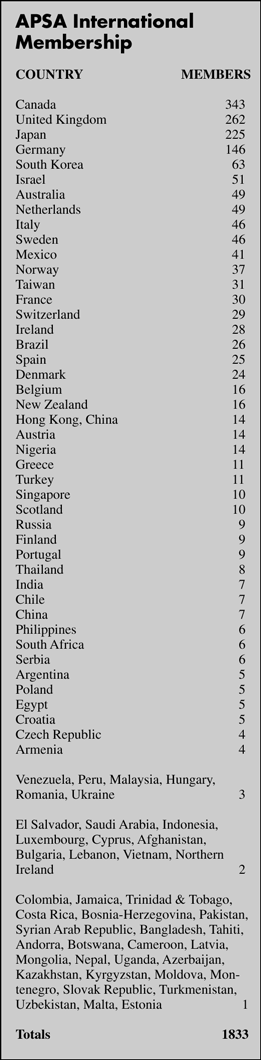
members already constitute about 10% of the total membership, about
1,400 APSA members. Predictably, the proportions are higher in some
subfields, especially comparative politics, than in others. As explained
by Michael Brintnall at the January meeting of the International
Committee, legally speaking, APSA is not a national, but a dues-based
organization, responsible to its members wherever they might exist.
Thanks to a new survey conducted by APSA last fall, we now have a better
sense of the needs and aspirations of our international members.
Opinions differ on whether an association should, or can, pay special
attention to every particular group of its membership. That is not our
main argument in favor of greater internationalization. In our view, a
more compelling argument—and one that we advance below—is that
internationalization is mutually beneficial. Whatever its benefits to
international political scientists, a more internationalized APSA will
be rewarding for political scientists based in the U.S./North America as
well.
To illustrate this latter point, let us recall what greater sensitivity
to non-American political materials and intellectual interventions of
political scientists with non-American backgrounds have already done to
theory building in our discipline. Many examples can be cited from the
last few decades. Consider just a few, necessarily selective,
instances.
Democratic Theory
In the 1950s and 1960s, after the influential scholarship of Seymour
Martin Lipset, democratic theorists argued that democracies were
possible only in wealthy countries. The stability of democracy in
poorer countries (India, Botswana, Costa Rica, Trinidad, Papua New
Guinea, and Mauritius, to name a few) has seriously challenged this
orthodoxy. The major new formulation, developed by Adam Przeworski
et al. (Democracy and Development, Cambridge, 2000), is
based on a global dataset, including developing countries. It rests
on a distinction between emergence and survival: democracies can
emerge at any level of income, but the odds that they will survive
at low levels of income are low. Other scholars of democracy, such
as Arend Lijphart, have also extensively used non-American
materials. In fact, Lijphart's consociational theory was originally
based on the Dutch experience, and was only later extended
further.
Theories of Nationalism
One of the most influential works in the field of ethnicity and
nationalism is Imagined Communities (Verso, 1983) by
Benedict Anderson, a Southeast Asia specialist, whose basic ideas
emerged from Asia and Latin America (“Creole Pioneers”). Emphasizing
the role of technology and vernacular forms of communication in the
formation of nations, Anderson showed how all nations were imagined
and constructed in modern times. This argument has led to a dramatic
reordering of the literature on nationalism in Europe as well, where
scholarly discussions of nationalism, untouched by these ideas, had
first emerged. Linda Colley's Britons (Yale, 1992) is a
good example of the latter.
More instances can be cited. The recent emphasis on the role of civil
society in democracies was spurred by Robert Putnam's examination of
Italian materials in the 1970s and 1980s. The theory of the
developmental state had its roots in the East Asian
government-business relations of the 1970s and 1980s, highlighted in
the works, among others, of non-American scholars such as Robert
Wade. The idea of bureaucratic authoritarianism was born in Latin
America and noticed first in Guillermo O'Donnell's writings. Making
a major impact on the work on rationality and politics, the
rational-moral debate on peasant behavior between Samuel Popkin and
James Scott in the late 1970s was based on Southeast Asian empirical
materials.
Finally, Samuel Barnes and Max Kaase's cross-national study of mass
participation (Political Action, Sage, 1979), Barbara
Nelson and Najma Chowdhury's collection, Women and Politics
Worldwide (Yale, 1994), involving 61 scholars from 43
different countries, and Russell Dalton and Manfred Kuechler's
volume Challenging the Political Order (Oxford, 1990) are
products of international collaborative efforts that have provided a
foundation for cross-national research on citizen-state linkages
across a wide range of political systems, and on the interaction
between conventional and unconventional citizen participation in
electoral politics and social movements
These examples make it clear that a systematic engagement with
non-American materials makes our discipline, our political
understandings, and our theories better. The era of globalization
and its concomitant communication revolution, by producing a
remarkable flow of ideas, people, technology, arms, goods, and
capital across geographical borders, and the post-9/11 shocks to the
international system, are making the need to understand the larger
political world still more urgent and desirable. Even U.S. politics
longer remains untouched by rather distant questions, such as why
the Taliban and Al Qaeda prospered in Afghanistan and Pakistan and
whether those conditions can re-emerge there or elsewhere. Left in
recent years on the margins of the discipline, such questions have
become all too global in their political implications and can only
be ignored at our peril. The remarkable political and economic rise
of China, with India not far behind, and the steps towards democracy
and market-oriented economies in Eastern Europe and Russia are also
matters of great international political significance. Despite the
global thrust of the last two decades, the empirical possibility of
a thoroughly Americanized world is not a serious one. Do we need a
fuller engagement with non-U.S./North American scholars to make a
better sense of how these developments are changing our political
universe? Will a better political science, responding to changes in
the real world, develop more easily if scholarly experiences, not
simply research concerns, are systematically broadened and
globalized?
All scholars, to a substantial extent, are shaped by their training.
As arguments within the philosophy and methodology of the social
sciences show, inherited or institutionally practiced methods,
perspectives, and approaches make one more naturally inclined toward
a certain regime of facts, toward a specific mode of reasoning,
toward a particular style of argumentation. Systematic encounters,
exposures, collaborations across trainings, methods, and
perspectives not only present exciting intellectual challenges,
worth undertaking on their own, but also bring greater depth,
authenticity, and relevance to knowledge and theory-building.2
Humility is an additional—and not an
entirely insignificant—intellectual gain. It should also be
noted that several scholars cited above explicitly
acknowledge the contribution of the more locally rooted
scholars and/or knowledge to the evolution of their
theories. Putnam mentions Leonardi and Nanetti; Anderson and
Scott's works repeatedly cite Asian scholars; Pzreworski's
team was multinational; Lijphart has a Dutch background;
O'Donnell lived in Argentina for much of his life, with his
Argentinean experiences in the 1960s shaping his theories
enormously.
But why burden APSA with the task of encouraging border-crossings?
Why can't such endeavors be left to individual scholars or
universities? Individuals and institutions, after all, can form
partnerships, if they so choose. Two arguments come to mind. When it
comes to collaborations with foreign scholars, not all individuals
and institutions are equally well-placed. Second, after 9/11,
movement of individual scholars across borders is becoming
increasingly difficult. An organization like APSA can attack both
problems more effectively than can individual scholars. APSA
represents a broader constituency.
In summary, the following arguments support the idea and desirability
of a more internationalized APSA:
- Greater
internationalization will benefit APSA members and their
scholarship by enriching our theories and research
intuitions and by broadening our perspectives. More
international collaboration is desirable, as is the freer
movement of scholars.
- APSA's approval of this idea
would be a good signaling device, with important
implications for the profession.
- Individuals can
strike collaborative exchanges, but such opportunities are
not equally accessible to all, and even those who benefit
from particular exchanges would benefit from more
generalized opportunities. An APSAmediated crossing of
borders will be more effective and beneficial than would
leaving such partnerships solely up to individuals or
departments.
- Post-9/11, crossing borders has
become increasingly difficult, thus further hindering the
ability of individual scholars to form fruitful
international exchanges. APSA's role will be highly
significant in the new international
atmosphere.
How Should We Promote Internationalization?
- Changes at the Annual Meeting: (1) Set up an “international
night” on the Thursday of the Meeting to facilitate
network-building and to promote comparative discussions; (2)
recommend to the Program Committee that an annual plenary
session be established on a matter of international salience
with a major public figure as our featured speaker, or a
presentation by a major scholar working on an issue of great
international importance. Examples are: Nelson Mandela on South
African democratic transition; Bill Clinton or Dominica de
Villepin on American foreign policy after 9/11; Lee Kuan Yew on
whether Asian, or non-Western, democracy must be an illiberal
democracy; Amartya Sen on democratic theory for the 21st
century; Joseph Stiglitz on the right kind of globalization;
Jeffrey Sachs on why Sub-Saharan Africa's development problems
have serious international implications; Jurgen Habermas on the
European Union and the Nation-State; Paul Krugman on the
migration of service sector jobs out of the U.S.; Charles Taylor
on democracies and multiculturalism, etc.
- Funding: The committee supports (1) increasing the
“International Scholars” funds targeting non-OECD scholars to
receive the substantial proportion of the funding increase; (2)
creating a new program for international scholars to stay beyond
the four days of the Annual Meeting for research and networking
purposes. In support of (1), the committee would like to make
five grants of $3,000 each for foreign scholars to attend APSA
annual meetings, and in support of (2), five grants of $2,000
each. A grand total of $25,000 for the two programs would not
constitute a significant increase in the APSA funding already
available for the International Scholars Program, while at the
same time symbolically demonstrating that APSA is serious about
giving greater preference to its international activities and a
stronger mandate to its International Committee. Once some
additional funds are available from APSA, the committee will
work to attract greater program funding in the future,
essentially by approaching individuals and foundations for
possible contributions.
- Public Presence: To support Margaret Levi's efforts to increase
the public presence of the discipline, the committee would (1)
work with her to promote policy-relevant research where and as
appropriate; (2) collaborate with APSA's existing Committee on
Difference and Equality in Developing Countries; and (3) select
from each annual meeting 5 to 10 papers that are important for
the international public realm, and distribute a press release
(as well as use prior contacts) to the editors of the New
York Times, the Economist, and the
Financial Times. These periodicals have been
selected for their seriousness and global reach.
- Web site revisions: (1) Offer onlineonly access to APSA
journals for international members at a cheaper rate; (2)
Ask/Help the Organized Sections to put their section journals
online after a six-month lag. The six-month lag ensures that the
revenues of organized section do not decrease, even as the ideas
discussed in section newsletters enjoy greater international
access.
- Formation of partnerships with the British Policy Studies
Association, Japanese Political Science Association, and
Canadian Political Science Association: Create a resource to
help other countries strengthen or build national associations,
focusing particularly on non-OECD countries. These three
associations have been selected due to their longstanding
working relationships with APSA.
- Governance: (1) Ask that at least one representative on the
Council come from outside the U.S.; (2) recommend that the APSA
president and Nominating Committee use a principle of
proportionality regarding the international dimension in all
appointments, while ensuring that this does not alter
proportionality goals in other forms, such as gender. We
certainly do not want a quota for international members on each
committee, but we think more international members on APSA
committees on the whole would represent international concerns
more effectively.
- International Committee Makeup: Ask that the International
Committee always have two international members.
- Membership: Examine various options including, (1) allowing
departments to be members of Organized Sections; (2) creating
new individual and departmental international membership
categories with reduced benefits and lower prices; (3)
researching impact of eliminating the international postage fee.
Individuals in non-OECD countries often find it financially
difficult to subscribe individually, even at the lower
income-based subscription rates that APSA allows. These
individuals can benefit from, and contribute to, our discussions
if they can access our publications through departmental
subscriptions. The International Committee will work closely
with APSA staff to strike a balance between APSA's revenue needs
and its goal of increasing international membership.
- Organized Sections: Ask the Sections (1) to put their journals
online for easier international access; (2) to allow
international departments from non-OECD countries to join
Sections; (3) to be more aware of the impact of increases in
section dues on international membership; and (4) to help the
committee set up individual liaisons to IPSA research groups, as
well as to other national associations.
- PROL (Political Research Online): The committee agreed to
extend the invitation to participate to other national
associations, in order to facilitate research feedback and
themebased international networking.
- Publications: The committee supports (1) bolstering
international submissions to APSA journals; (2) creating a
“special edition” of Perspectives on Politics or
PS on a specific theme, such as different
traditions of studying politics, solicited directly from the
membership; (3) touching base with Perspectives and
PS editors on international participation and
possibilities for special editions; and (4) considering and
reporting on the international implications of the upcoming
review of the APSA publishing agenda.
- Teaching and Learning: The committee will research the
possibility of holding the Teaching and Learning Conference
overseas and of building a connection with EPSnet.
APSA-PSA Strengthen Ties
The latest iteration of the bilateral exchange between APSA and the
Political Studies Association of the United Kingdom took place in April.
Bahram Rajaee, director of Institutional Research and Support, attended
the PSA's Annual Conference on behalf of APSA. The Conference took place
from April 5–8 at the University of Lincoln in Lincolnshire. The PSA was
founded in 1950 and is the leading association for the study of
political science in the United Kingdom. Its membership currently stands
at approximately 1,400, an all-time high.
From L to R: Bahram Rajaee, Paul Furlong (chair, PSA External
Relations Committee), unknown, Wyn Grant (chair, PSA
Executive Commitee), Neil Collins (editor, PSA
News).
The PSA is currently engaged in a number of interesting and important
activities in addition to its member services, annual conference, and
the publication of four journals (British Journal of Politics and
International Relations, Political Studies, Politics, and
Political Studies Review). In the past year, these have
included:
- Lobbying the British government for reforms
regarding the manner in which research funds are distributed
across departments;
- Holding a high-profile annual
awards lunch each November to recognize the achievements of
academics, journalists, and other contributors to the study and
conduct of politics. 2003 award winners included Robin Cook
(Parliamentarian of the Year), Ken Livingstone (Politician of
the Year), Lords Plant and Smith (Lifetime Achievement in
Political Studies), Polly Toynbee (Journalist of the Year), and
Jeremy Paxman (Political Broadcast of the Year);
- A
robust, ongoing effort to increase the public profile of the
Association and political science research through media
relations workshops for members and an active press release
campaign.
APSA and PSA are discussing ways in which to expand their relationship,
including collaboration on more broad-ranging sessions at the APSA
Annual Meeting and participation in PROL—the pre-publication server for
political science conference papers
(www.politicalscienceresearch.org). PSA will be
co-sponsoring a reception in honor of APSA's centenary celebrations at
the APSA Annual Meeting in Chicago. For more information on the PSA or
the APSA-PSA relationship, visit the PSA web site at
www.psa.ac.uk, or contact Bahram Rajaee
(brajaee@apsanet.org).
The APSA Committee on International Political Science has prepared a
statement for review by the Council regarding steps the Association
might take to strengthen international partnerships and enhance
cross-national perspectives across the Association. The Committee's
statement lays out a rationale for this effort and recommends a series
of immediate and future action steps. The APSA Council voted unanimously
at its spring meeting in Chicago this April to enthusiastically endorse
the statement. The Council increased funding for international travel to
the annual conference for scholars from non-OECD countries, reduced
foreign postage fees for APSA journals, and called for greater attention
to ways to increase external funding for international initiatives.
This summer APSA staff will examine a comprehensive range of actions
regarding membership options, the creative use of technology, and
funding that would allow APSA to offer more tailored services for
overseas members. For more information on the Committee on International
Political Science or related APSA activities, please contact Bahram
Rajaee (brajaee@apsanet.org), director of Institutional
Research and Support.