

Introduction
Farmers face trade-offs in their land-use decisions between sustainable cropping practices, such as agroforests, and input-intensive monocultures. While the former can provide habitat for native plants and animals and enhance soil fertility (Beer et al. Reference Beer, Muschler, Kass and Somarriba1998, Reitsma et al. Reference Reitsma, Parrish and McLarney2001), the latter are usually more profitable, especially in the short term, but tend to provide fewer or different environmental services (Byiringiro & Reardon Reference Byiringiro and Reardon1996). Many farmers choose to maintain their agroforests because of the environmental and use benefits they can receive, in spite of forgoing the potential to earn additional income from monoculture practices (Scherr Reference Scherr2000, Dinda Reference Dinda2004, Waldron et al. Reference Waldron, Justicia, Smith and Sanchez2012, Useche & Blare Reference Useche and Blare2013). Understanding what factors led to the conservation of these ecologically friendly farming practices can provide insights into increasing their adoption in future interventions.
Women and men often play different roles in the use of natural resources and have distinct land-use preferences. Women are more likely to be involved in the collection of firewood, food, medicinal plants or other non-timber forest products, while men are more likely to be involved in commercial activities such as the harvesting of timber or the sale of commodity crops (Kaur Reference Kaur1990, Velázquez Gutiérrez Reference Velázquez Gutiérrez and Rivera1999, Campbell et al. Reference Campbell, Chicchón, Schmink, Piland and Colfer2005, Cronkleton Reference Cronkleton and Colfer2005, Porro & Stone Reference Porro, Stone and Colfer2005, Tendayi et al. Reference Tendayi, George, Nguiébouri and Colfer2005). In Bolivia (Bolaños & Schmink Reference Bolaños, Schmink and CJP2005) and the state of Pará, Brazil (Shanley et al. Reference Shanley, Da Silva and MacDonald2011), men identified economically lucrative species with an established market as the most important in the forest, while women listed many multiuse trees and other plant species as the most valuable species. In El Salvador (Kelly Reference Kelly2009) and Ecuador (Blare & Useche Reference Blare and Useche2015), women placed a higher value on agroforests than men did, particularly because these agroforests provided fruits that are important in meeting households’ nutritional needs. While this research has provided an indication of gender-differentiated preferences for agroforests and other sustainable production methods, little evidence has emerged to show whether these preferences translate into gender differences in use of environmentally beneficial farming practices. In particular, research has yet to show gender differences in preferences in the production of cacao and other important commodity crops; crops that in many societies are regarded as men’s domain (Bussolo et al. Reference Bussolo, De Hoyos, Wodon, Bussolo and De Hoyos2009, Nakazibwe & Pelupessy Reference Nakazibwe and Pelupessy2014).
When compared to monoculture cacao production, traditional cacao agroforests provide more ecological services and livelihood benefits. Cacao agroforestry systems ameliorate soil erosion, which is critical in the sustainability of crop production (Beer et al. Reference Beer, Muschler, Kass and Somarriba1998). The dense planting of trees and plants in cacao agroforestry systems provides a large volume of litter and organic matter to be recycled into the soil to maintain its fertility and sustain it long term. These agroforestry systems also have larger amounts of organic matter and higher levels of calcium and magnesium in the soil than secondary forests (Duguma Reference Duguma2001). Soil decomposition rates and the abundance of soil arthropods are greater in shaded cacao agroforestry systems as compared to practices that provide less shade (Steffan-Dewenter et al. Reference Steffan-Dewenter, Kessler, Barkmann, Bos, Buchori, Erasmi and Faust2007). Furthermore, diversified cropping systems also act as a type of insurance against price drops, as a farmer can sell another crop from the agroforest (Beer et al. Reference Beer, Muschler, Kass and Somarriba1998, Ramirez et al. Reference Ramirez, Somarriba, Ludewigs and Ferreira2001).
Ecuador provides a good case in order to understand how gendered preferences influence cacao production and the conservation of agroforests. Cacao production has played an important role in the economy of rural Ecuador. Cacao sales helped finance Ecuador’s independence movement in the early 1800s. It has continued to be an important source of income in Ecuador, globally the fourth largest cacao producer in 2016 and the source of over 70% of the world’s fine flavour cacao (Asociación Nacional de Exportadores de Cacao 2019, United Nations Food and Agriculture Organization 2019). The sale of the crop has been seen as an opportunity for rural development, as it is grown in regions with high rates of rural poverty, and it is grown almost exclusively by smallholders (Bentley et al. Reference Bentley, Boa and Stonehouse2004, Franzen & Borgerhoff 2007, International Fund for Agricultural Development 2014). According to Corporación de Promoción de Exportaciones e Inversiones (2009), 90% of Ecuadorian cacao was produced on landholdings with <50 ha, and over 30% of cacao came from farms of <10 ha. Cacao agroforests also provide critical habitats in a country with a high degree of biodiversity. In fact, Ecuador’s main cacao-producing region is located within the Chocó/Darien biodiversity hotspot (Myers et al. Reference Myers, Mittermeier, Mittermeier, Fonseca and Kent2000, Cuesta et al. Reference Cuesta2006, Waldron et al. Reference Waldron, Justicia, Smith and Sanchez2012).
This study examines whether women’s inclusion in the ownership or the management (involvement in land-use decisions) of land in coastal Ecuador can influence the use of cacao agroforests or monocultures. While land ownership may increase a woman’s bargaining position within the household, it does not necessarily translate into her participation in decision-making. Involvement in decisions is what is considered a key indicator of women’s empowerment (Kabeer Reference Kabeer1999). Moreover, gender roles in the ownership and management of land can vary greatly across plots in a given household (Udry et al. Reference Udry, Hoddinott, Alderman and Haddad1995, Twyman et al. Reference Twyman, Useche and Deere2015b). Thus, we analysed these gender roles at the plot level using a revealed preference model (RPM) based on the households’ actual land-use practices. The RPM allowed us to isolate the effect of gender in relation to plot-level factors (profits made on the plot, land title and years of ownership) and to household-level factors (educational level, age and wealth of the owners or managers of the plot). The interviews that provided the input for the RPM were conducted jointly with both the female and male household heads in order to replicate the joint decision-making process that is followed in Ecuadorean households (Deere & Twyman Reference Deere and Twyman2012, Alwang et al. Reference Alwang, Larochelle and Barrera2017). The results provide insights into how changing gender roles in land ownership and decision-making may affect land uses in general, and how efforts to promote women’s inclusion in land ownership and land-use decisions may influence a household’s adoption or conservation of agroforests in particular.
Study site
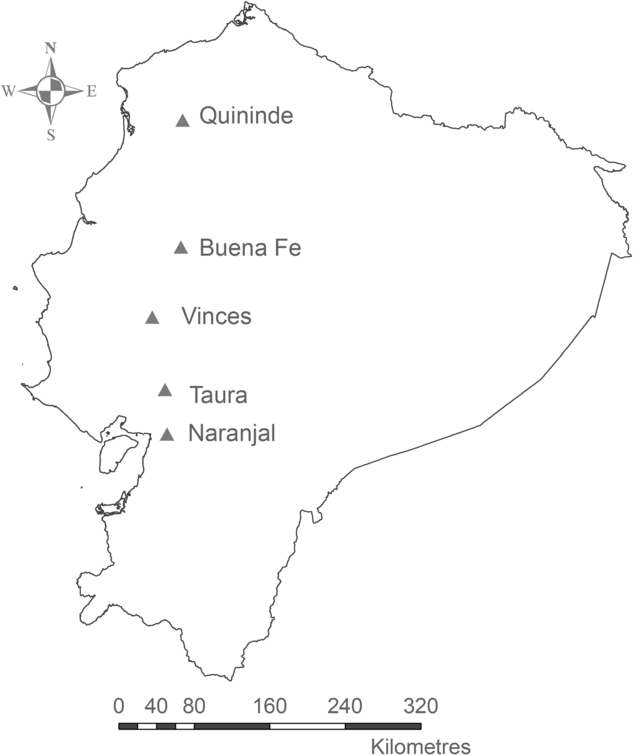
Data were collected from March through July 2013; 340 structured interviews were conducted with households that produce cacao in coastal Ecuador. We visited five communities distributed across the three Ecuadorian provinces of Guayas, Los Rios and Esmeraldas (Fig. 1). Three of the study sites – Naranjal, Taura and Vinces – were located near a cacao-processing facility located in Guayaquil, a region with a tropical savannah climate that has distinct rainy and dry seasons. The farms in these communities were relatively small, averaging 6 ha, with cocoa plots from 2 to 4 ha. The area used to be dominated by large farms created during Ecuador’s colonial era; however, land reforms in the 1960s and landless peasant movements in the 1970s and 1980s led to the breakup of many of these large farms (Gondard Reference Gondard1988). Many of these farms continued to maintain the traditional cacao agroforests grown by these large farms, some of which were >150 years old (Instituto Ecuatoriano de la Properidad Intelectual 2014).
Location and coordinates of research sites in coastal Ecuador from north to south including the communities of Quininde (0.322722, –79.473381), Buena Fe (–0.885637, –79.488846), Vinces (–1.554694, –79.763503), Taura (–2.244575, –79.640558) and Naranjal (–2.669039, –79.621448).
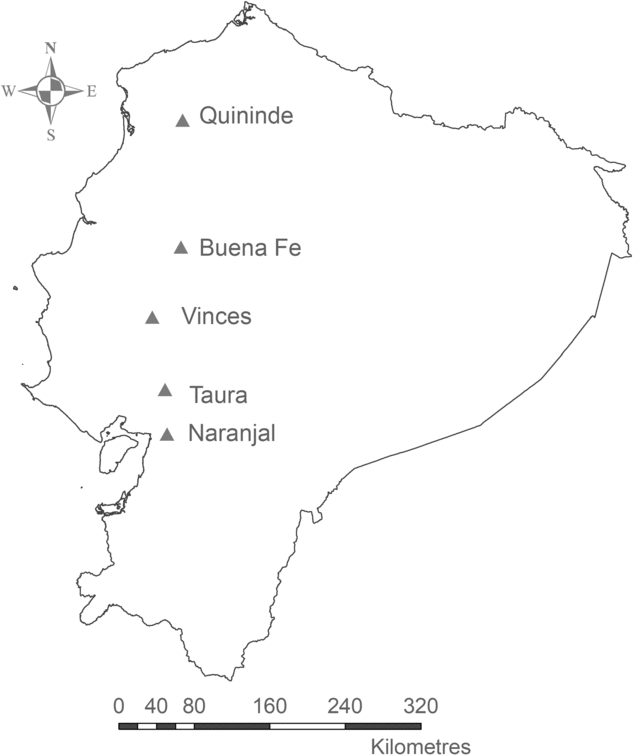
The other two research sites in Buena Fe and Quininde were located in the northern region of Ecuador, which has migrants from other regions of Ecuador and Colombia, who arrived in these previously forested regions 50 years ago (Bromley Reference Bromley1981). The farms in these northern sites were much larger, with the average smallholder owning 17 ha. The cacao plots were also slightly larger than in the southern sites. Cacao plots averaged 8 ha in Quininde and 6 ha in Buena Fe. These northern sites were more diverse both in the varieties of trees, averaging between four and six species in the northern sites versus between one and three species in the southern sites, and associated crops, averaging between four and six crops in the northern sites compared to between two and three crops in the southern sites. Quininde and Buena Fe also have a wetter tropical rainforest climate.
Methods
Survey design
Survey instruments contained sets of questions on: demographics (gender, age, educational attainment); who owned major household assets; which household members were involved in on-farm and off-farm employment; how household income was distributed among members; who owned and managed each plot; cacao production; and who had access and participated in technical assistance and trainings related to cacao production. The land-use section provided details on: who owned and managed each plot; how long they had owned or managed it; and the crops and other plants included in the plot. The production section included questions on: time spent on each productive activity (planting, weeding, application of inputs, harvesting and post-harvesting); and costs for the inputs (agro-chemicals, fertilizers, planting materials and labour).
The households also provided data on the cacao yield for each plot over the past year and prices received for their cacao over the past year. Household data were collected on the types and numbers of animals the household members owned and the native animal species found in their plots. Few farmers kept detailed production records. Thus, the farmers provided recall information on costs, production and revenue over the past year. Often, the farmers provided an estimate of the average harvest, which was used to calculate yearly production. Farmers also sold their cacao in different forms – dry, semi-dry or wet – using different types of volume and mass measurements. These values were standardized to dry weight in kilograms for the analysis.
Data collection
Ecuador’s largest cacao exporter, Transmar, facilitated interviews in communities where it purchases cacao in four buying stations. The households included in the interviews were nearly evenly distributed between the five communities. The interviews were conducted when the farmers came to the buying stations or as the buying agents visited the farms. In order to ensure the enumerators’ safety, they were rarely allowed to visit farms alone without a buying agent, who was familiar with the region and the farmers. Although this strategy could introduce social desirability bias, whereby the participants may give answers that they think the buyer would like to hear (Bennett et al. Reference Bennett, Kerrigan, O’Reilly, Lee and Sargeant2011), we reduced the presence of this bias by not allowing the buyer to participate in the interviews; they simply introduced the enumerators to the households. This method also allowed the farmers to be more willing to participate in the interviews, as the buying agents are well trusted in the communities.
Joint interview process
For this study, most household heads were asked together who owned and made the management decisions on each plot in terms of what was planted and when and what agronomic practices were used on the plot. This method was chosen to reflect the reality of household decision-making in Ecuador, where household decisions are often made jointly in households with a principal male and female couple, the husband and wife (Deere & Twyman Reference Deere and Twyman2012, Twyman et al. Reference Twyman, Useche and Deere2015b). Rather than considering these households as being singly headed by a man, as was traditionally done, the perceptions of both household heads needed to be included in order to gain an accurate understanding of the decision-making process (Quisumbing Reference Quisumbing and Chant2010). Because of this reality, other decision-making research in Ecuador has shown the joint interview method to be the most accurate approach (Alwang et al. Reference Alwang, Larochelle and Barrera2017).
While concerns exist with both methods, the choice of having joint versus separate interviews should be made depending on the context and the goals of the study. While a joint interview could lead to bias as a stronger household member may influence the responses of the other one, it can also help elicit information from a process that more closely resembles the real decision-making dynamics that take place within a household. Similarly, the concern regarding separate interviews is that often the two household heads provide different answers. It is not clear how to interpret these differences in responses and reconcile this information for integration in empirical analysis (Alwang et al. Reference Alwang, Larochelle and Barrera2017).
In order to provide a gender balance in the interviews, a female and a male enumerator conducted the interviews together. Given the restrictions on the enumerators’ travel, both household heads could not always be interviewed together, as a household member often travelled alone to sell the household’s cacao harvest. Of the 340 households interviewed, 275 were jointly headed by a man and a woman, 20 were made up of single men, 17 were households with a single male head and 28 were households with a single female head. For 120 jointly headed households, only one of the household heads was interviewed. The female head was interviewed alone in 38% of these jointly headed households. In the rest, the male head was interviewed alone. Even though the logistical constraints limited the ability to conduct joint interviews with all of the households, there was no significant difference in the answers related to the women’s involvement in the management of the plots between the households where both household heads were interviewed together and those where they were interviewed separately.
Empirical model
The random utility theory provides a framework for understanding smallholder farmers’ choice for cacao agroforests or a monoculture production practice in our RPM. This theory explains how an individual makes a selection to maximize her or his utility given the attributes of each option, the personal characteristics of the person making the selection and her or his time and budget constraints (Adamowicz et al. Reference Adamowicz, Swait, Boxall, Louviere and Williams1997). We utilized observational data applied in an RPM to empirically model the choice for cacao agroforests. The RPM uses the choices made by the actor in real-life scenarios in order to determine her or his preferences, and therefore it does not suffer from hypothetical bias, the main drawback associated with stated preference experiments (Adamowicz et al. Reference Adamowicz, Louviere and Williams1994, Reference Adamowicz, Swait, Boxall, Louviere and Williams1997).
The RPM allows for a comparison of the conservation of cacao agroforests between plots owned or managed by men to those that are owned or managed by women. The choice between utilizing an agroforest or a monoculture practice on a given plot is dependent on the attributes of each practice (i.e., earnings, ecological services), the desirability of these attributes according to the characteristics of the plot i (plot size, secure land title and length of ownership) and the demographic characteristics (gender, age, education, wealth and household size) of those who are involved in the ownership and management (involved in the land-use decisions) of the plot. Given these different characteristics, the probability that a given plot is conserved as an agroforest can be modelled as Eq. (1), where the β coefficients reflect the importance of each explanatory factor to the conservation or adoption of an agroforestry system in a specific plot. Considering that there are many definitions and classifications of agroforests (Leakey Reference Leakey1996), we defined the dependent variable in Eq. (1) accepting that a cacao agroforest consists of having at least one woody plant species in addition to cacao.
 $$\Pr \left( {agroforest = 1} \right) = {\alpha _i} + {\beta _1}\,gender\,manager + {\beta _2}\,gender\,owner + {\beta _3}\,profit + {\beta _4}\,plot\,size + {\beta _5}\,years\,of\,possession + {\beta _6}\,title + {\beta _7}\,age + {\beta _8}\,education + {\beta _9}\,children + {\beta _{10}}\,roof + {\beta _{11}}\,employment + {\beta _{12}}\,location $$
(1)
The main coefficients of interest in the model are β 1 and β 2, which reflect the importance of women’s inclusion in land-use decisions and land ownership, respectively, on agroforestry conservation/adoption. These variables took the value of 1 if women were included in the ownership or management of the plot either alone or jointly. These variable definitions reflect the reality of decision-making in Ecuadorian households. Even though in Ecuador more women are included in land-use decisions in dual-headed households than they were several decades ago, very few women make these decisions alone, especially in a dual-headed household (Twyman et al. Reference Twyman, Useche and Deere2015b, Alwang et al. Reference Alwang, Larochelle and Barrera2017). Indeed, very few women managed plots alone in this study (only in the 28 female-headed households). This definition of women’s involvement in the ownership and management of the plots also avoids the issue of determining the difference between individual and joint decision-making, which is unresolved in the literature, and its examination is beyond the scope of this paper.
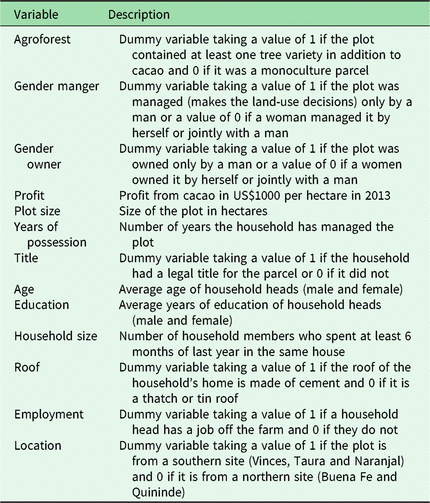
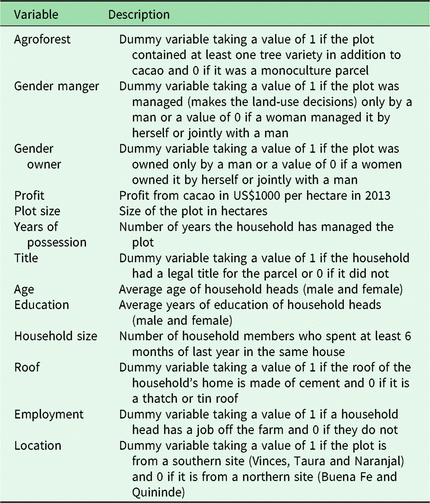
We included as additional controls or explanatory variables the plot- and household-level characteristics in the model that have been shown to be important in land-use decisions by smallholders. For example, sustainable production practices are more likely to be used on small plots (Byiringiro & Reardon Reference Byiringiro and Reardon1996, Pattanayak et al. Reference Pattanayak, Mercer, Sills and Yang2003, Mercer Reference Mercer2004). Farmers may be more likely to implement agroforests the longer they have owned their farms or have experience farming (Adesina et al. Reference Adesina, Mbila, Nkamleu and Endamana2000) and if they have secure land rights, particularly a clear title to the plot (Thacher et al. Reference Thacher, Lee and Schelhas1996, Suyanto et al. Reference Suyanto, Pandu Permana, Khususiyah and Joshi2005). Furthermore, household wealth, age, years of education, number of young children and off-farm employment were all included in the model, as these demographic characteristics are important in the decision to use agroforests or other sustainable farming practices (Alavalapati et al. Reference Alavalapati, Luckert and Gill1995, Neupane et al. Reference Neupane, Sharma and Thapa2002, Useche & Blare Reference Useche and Blare2013). Ethnicity was not included, as 96% of the participants in the study were of the same ethnic group – mestizos. A Wald test found this variable to be insignificant at the 1% level of significance. The type of housing, measured by the roofing material used, was included as a proxy for household wealth, a common wealth indicator utilized in other studies in developing countries (Scoones Reference Scoones1995, Khudri & Chowdhury Reference Khudri and Chowdhury2013). Due to the differences in agroforestry practices and climates in the study sites, a variable was included in the fixed-effects model to control for these differences between the northern study sites of Buena Fe and Quininde and the southern sites of Naranjal, Taura and Vinces (Table 1).
Description of the variables used in the empirical model.
Estimation procedure
In order to control for the systematic differences of study sites and to test for the robustness of the coefficients, we used fixed- and random-effects approaches to estimate the equation. Both methods control for correlated unobservable characteristics within study sites. The fixed-effects method captures the correlation by adding variables to the model representing the parcels located in a specific site for each site. Holding these unobserved group characteristics fixed, other coefficients in the model can be calculated. The main disadvantage of this model is that observed variables with little variation or that do not vary within sites cannot be included in the model. The random-effects approach omits these fixed effects and models the correlation structure of the error terms (common and random within study sites), assuming exogeneity of all the other regressors (no correlation with the error structure) (Mundlak Reference Mundlak1978, Baltagi et al. Reference Baltagi, Bresson and Pirotte2003).
The probit regression was used in this study, as it allowed for the inclusion of methods to control for endogeneity (correlation) between the choice for the practice and income received from each practice (Bascle Reference Bascle2008). Reverse causation likely exists between the income variable and the choice of the practice (an agroforest or monoculture), as this choice would influence the income earned from it. To correct for this endogeneity, we estimated the probit model with the price of cacao as an instrumental variable, since price is correlated with profit but is exogenous to the decision to adopt the agroforestry or monoculture practice. The Wald test of exogeneity of the model with the instrumental variable of price was 1.32, failing to reject the null hypothesis. Thus, the instrumental variable of price fully corrects for the endogeneity. We also clustered the estimation of the plots by household to control for the households that owned more than one plot.
A drawback of the RPM that needs to be considered in the interpretation of the results is that the results only provide a lower bound of a person’s preference because of the constraints that the individual faces in making her or his selection, particularly budget and time constraints (Sen Reference Sen1973). Furthermore, the RPM cannot measure future or planned actions; it only measures current actions or historical choices. So, the revealed actions of an individual do not demonstrate the optimal actions preferred by her or him, but show what choices were made given the constraints the person faced at the time of the choice (Adamowicz et al. Reference Adamowicz, Louviere and Williams1994, Reference Adamowicz, Swait, Boxall, Louviere and Williams1997). Thus, the RPM may provide an underestimation of the preference for the good.
Results
Smallholders and their plots
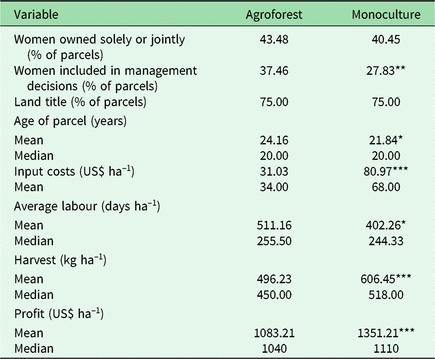
Households that had adopted cacao agroforestry practices were similar to households that had monoculture plots. The household heads from both groups were on average 47 years old and had 6 years of education. These households also had similar levels of wealth and on average had five household members. However, the households that had agroforest plots were less likely to have off-farm employment: 15% versus 19% of households. There were several variables that were significantly different between plots with cacao agroforests (n = 357) and those with monoculture production (n = 248). Women were more likely to be included in the management – the making of production and land-use decisions – of the agroforest plots than they were of the monoculture plots. Women were included in the management of 37% of agroforest plots, but were only included in the management of 28% of monoculture plots. However, the gender of the owner did not predict whether a given plot would be an agroforest or not. Women had ownership rights, either solely or jointly, of 43% of agroforestry plots and 40% of monoculture plots. The agroforest plots were older, averaging 24 years of age, than the monoculture plots, averaging 22 years of age. Both agroforestry and monoculture plots were as likely to have legal land titles; 75% of both of plots in both of these groups had legal land titles.
The plots were also significantly different in their productivity. The monoculture plots were more productive, with an average harvest of 606 kg ha–1 of dry cacao compared to 496 kg ha–1 for agroforestry plots. The farmers on average spent more on inputs (fertilizers, herbicides and pesticides) on the monoculture plots (US$81) than on the agroforestry plots (US$31). However, the households on average dedicated more time to their agroforestry plots: 511 days ha–1 versus 402 days ha–1 in their monoculture plots. Because of the productivity advantage for the monoculture plots, the households earned more for cacao on these plots. Profit from cacao sales averaged US$1351 year–1 on the monoculture plots and US$1083 year–1 on the agroforest plots (Table 2).
Characteristics of the monoculture and agroforestry plots.
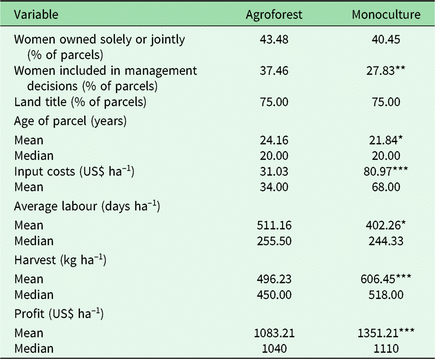
Significant difference at ***p < 0.01, **p < 0.05, *p < 0.1.
Which factors affect the decision to use agroforests?
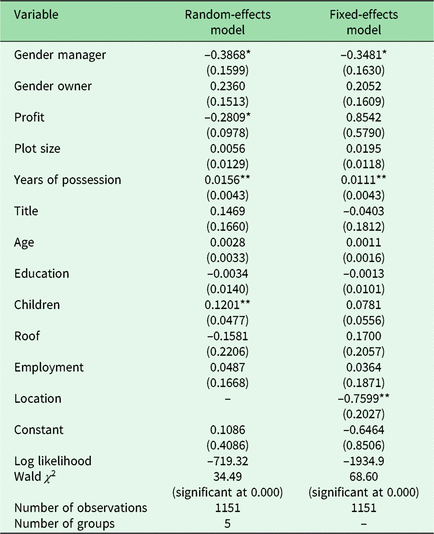
The random-effects model estimates provided interesting results regarding the key variables of interest (Table 3). The gender of the manager was significant for both models, but the gender of the owner was not, which indicated that the owner does not necessarily make the decisions on the plot. Since the direction of significance for the gender of the manager was negative, women farmers were estimated to be more likely to manage agroforests than men farmers, as gender was a dummy variable, having a value of 0 if women were involved in the management of the plot and having a value of 1 if men exclusively managed it. This gender difference was borne out in the responses that many of the women gave about their preferences for agroforestry practices, which were different from many men whose main concern was profits. Women, on the other hand, often commented on how they were more concerned about meeting their household’s nutritional needs than earning a profit. For instance, one middle-aged women in Vinces stated, ‘We can’t eat money.’ Another woman in Naranjal showed this concern for food security when she asked, ‘What can I do if I don’t have plantains and fruits to feed my family?’
Coefficients of the random-effects and fixed-effects models for the estimation of the probability of having an agroforest on a plot.
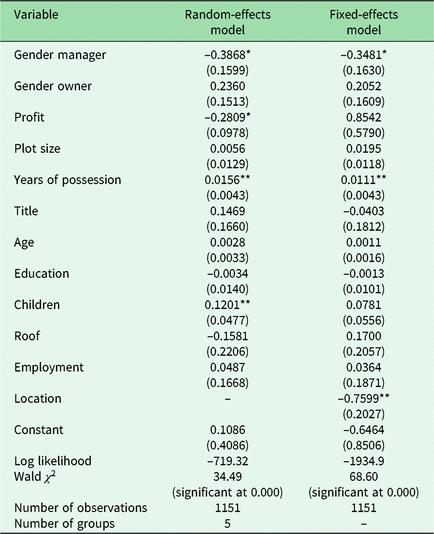
Significance of the coefficients and marginal effects: **p < 0.01, *p < 0.05.
In addition to the gender of the manager, profit, length of time the household owned the plot and number of children in the household were statistically significant in determining whether a household used agroforestry practices on a given plot. The gender of the manger and the length of time the household owned the plot were the only variables also found to be significant in the fixed-effects model. The variable representing in which region the plot was located, in the north or south, was also significant in the fixed-effects model, but not in the random-effects model. Even though neither the coefficients nor the marginal effects could be directly interpreted in these regressions, the direction of significance provided insights into how the significant variables affected the decision to conserve the cocoa agroforests (Cameron & Trivedi Reference Cameron and Trivedi2010).
A positively significant variable for years of possession demonstrated that the longer the household owned the plot, the more likely it was to maintain the plot as an agroforest. The profit variable was also negatively significant for the random-effects model, indicating that those who managed agroforestry plots were willing to forgo profits in order to conserve these plots. The negative direction of significance on the location variable demonstrates that plots located in the northern sites (Quininde and Buena Fe) were more likely to be agroforests.
Discussion
These findings bolster the understanding that, when compared to men, women have a preference for multiuse trees and agroforestry and other sustainable practices (Bolaños & Schmink Reference Bolaños, Schmink and CJP2005, Kelly Reference Kelly2009, Shanley et al. Reference Shanley, Da Silva and MacDonald2011, Blare & Useche Reference Blare and Useche2015). The results also demonstrate the importance of using methodological approaches that include the consideration of joint decision-making on household resources and conduct analysis at the plot level rather than assuming that household decisions are made collectively for all landholdings. A focus on the managers of the plot rather than on just the owners also proves helpful in order to gain a better picture of the decision dynamics and activities undertaken on the land. Our results are consistent with findings in the literature by Deere and Twyman (Reference Deere and Twyman2012) and Twyman et al. (Reference Twyman, Muriel and García2015a, Reference Twyman, Useche and Deere2015b).
To further advance understanding on how differences in gender roles, social norms and legal tenure could influence women’s ability to have a voice in land-use decisions, similar studies in other contexts (e.g., in countries with different marital laws) using diverse methods are needed. Ethnographic and participant observation methods could provide insight into the intricacies of the joint decision-making process in order to better understand the different shades of joint decision-making and the degree of women’s involvement in them. Furthermore, games that recreate production decisions could allow for the examination of these intra-household land-use decision-making dynamics and test gender-inclusive interventions.
This study had limitations. First, gender dynamics are context specific and depend on the institutional landscape. In Ecuador, as in the rest of Latin America, because of changing social norms and the legal regime, especially laws that promote equality in inheritance and marital property rights, women now have a larger role in agricultural production and decision-making (Deere et al. Reference Deere, Oduro, Swaminathan and Doss2013, Twyman et al. Reference Twyman, Useche and Deere2015b). These changes may have empowered Ecuadorian women to be involved in land management and enabled men to realize the importance of women’s involvement in production and decision-making more than would be the case in other countries that do not have laws promoting gender equity. In other contexts, the results could differ. For instance, women in Indonesia preferred monoculture palm oil plantations more than men did, possibly because extension programmes promoting agroforestry practices were targeted at men (Villamor et al. Reference Villamor, Desrianti, Akiefnawati, Amaruzaman and Van Noordwijk2014, Reference Villamor, Akiefnawati, Van Noordwijk, Desrianti and Pradhan2015). Women’s value of agroforestry practices may not be completely due to women placing a greater value on agroforestry practices. Rather, women may have less capital to invest in their farms and in costly modern monoculture production practices (Peterman et al. Reference Peterman, Behrman, Quisumbing and Raney2014). Women may be excluded from certain markets where they would earn a higher return on their cacao or have less bargaining power than men in negotiating higher prices for their cacao, so they do not have as much of an incentive as men to enhance cacao production (Potón Cevallos Reference Potón Cevallos2005).
Conclusion
Smallholders face difficult choices in balancing their families’ subsistence and income needs with environmental protection. Agroforestry production has been promoted in Ecuador and throughout the tropics as an opportunity for smallholders to meet these needs while providing important services to the ecosystem (e.g., habitat for native plants and animals, soil conservation and carbon sequestration). Our research, based on an RPM from data collected from joint interviews with male and female household heads in coastal Ecuador, demonstrated that many smallholders placed a high value on their cacao agroforests. They were willing to forgo the additional income that would come from using monoculture practices to conserve their agroforestry plots. Furthermore, the longer a household had owned a plot, the more likely they were to value the agroforests and conserve them. Stability in land rights allows smallholders to invest in conserving or planting trees in order to diversify their cacao plots.
When women were included in the management – making of land-use decisions – on a plot, the households were even more likely to have agroforestry plots. This outcome was only significant for the gender of the manager of the plot and not the gender of the owner. Thus, gender-equitable land titling, the joint titling of plots of married couples and equitable inheritance practices may not ensure that women will have the authority to make decisions regarding the land use on these plots. On the other hand, programmes that promote women’s voices along with the growing social acceptance of women’s inclusion in household decisions may lead to the use of more sustainable land-use practices.
Acknowledgements
We are grateful to Andrea Bohn for her assistance with the project implementation, and we thank Transmar Ecuador, S.A., Roberto Granja, Gema Sanchez, Johanna Villagomez, Luisa Izquierda, Emilio Mosquera and Cristian Noboa for assisting us in the project design and data collection. We owe a debt of gratitude to the field assistants, Katherine Mendez and Edgar Dominquez, and the research assistants, Xavier Haro, Anuar Heinde and Daniel Zurita, who helped to create the databases. We are very grateful to the reviewers and editors of this issue, whose useful comments and insights greatly improved the paper.
Financial support
The Modernizing Extension and Advisory Services (MEAS) project in the United States Agency for International Development (USAID) supported the fieldwork, while the CGIAR Research Program on Forest Trees and Agroforestry (FTA) and the University of Florida funded staff time to analyse the data. We thank the donors who support FTA through their contributions to the CGIAR Fund.
Conflict of interest
None.
Ethical standards
The authors assert that all procedures contributing to this work comply with applicable ethical standards of the relevant national and institutional committees on human experimentation and with the Helsinki Declaration of 1975, as revised in 2008.