Introduction
The goal of depression treatment is to help individuals achieve symptomatic remission and normal functioning. However, partial and non-response to existing treatments, such as antidepressant medications, remains a significant problem. For example, in a large, naturalistic study of depression treatment in which 77% of participants received ‘adequate’ or ‘aggressive’ pharmacotherapy, 46% of participants were classified as non-responders after 6 months, and 32% were considered to have responded but not remitted (Corey-Lisle et al. Reference Corey-Lisle, Nash, Stang and Swindle2004). Similarly, in the Sequenced Treatment Alternatives to Relieve Depression trial, the remission rate after initial antidepressant treatment was 37%, and the cumulative remission rate with up to four successive treatment steps was 67% (Rush et al. Reference Rush, Trivedi, Wisniewski, Nierenberg, Stewart, Warden, Niederehe, Thase, Lavori, Lebowitz, McGrath, Rosenbaum, Sackeim, Kupfer, Luther and Fava2006b ). Thus, there is a need to test innovative adjunctive interventions to further improve outcomes in this group of patients who do not fully respond to traditional treatments.
Yoga is an ancient Indian system of philosophy and practice (Iyengar, Reference Iyengar1993). Approximately 5% of US adults practise yoga (Barnes et al. Reference Barnes, Powell-Griner, McFann and Nahin2004). Most practise hatha yoga, which involves training the body with the ultimate goal of promoting good physical and mental health. Hatha yoga includes breath control (pranayama), physical postures (asanas) and meditation (dhyana). Hatha yoga can combine mindfulness practice (i.e. non-judgmental attention to present-moment experience) and physical activity in a way that is internally consistent. Increased mindfulness may improve depression by reducing rumination, increasing self-compassion, or promoting the view that thoughts and feelings are transitory cognitive contents rather than self-defining (i.e. meta-cognitive awareness) (van der Velden et al. Reference van der Velden, Kuyken, Wattar, Crane, Pallesen, Dahlgaard, Fjorback and Piet2015). Exercise has been demonstrated helpful for depression as well (Cooney et al. Reference Cooney, Dwan, Greig, Lawlor, Rimer, Waugh, McMurdo and Mead2013).
A recent meta-analysis of 12 randomized controlled trials of yoga for clinical depression reported that yoga was significantly better than usual care, relaxation exercises, or aerobic exercise in decreasing depressive symptoms (Cramer et al. Reference Cramer, Lauche, Haller and Dobos2013). Yoga may also improve physical health outcomes co-morbid with depression, particularly pain. However, studies of yoga for depression have numerous methodological limitations, including small sample sizes, lack of assessment of instructor fidelity to the yoga protocol, lack of outcome assessment by blind raters, lack of intent-to-treat analyses, and insufficient documentation of randomization procedures (Uebelacker et al. Reference Uebelacker, Lavretsky, Tremont, Khalsa, Cohen, McCall and Telles2016).
The purpose of this study was to examine whether hatha yoga is efficacious for depression when used as an adjunct to antidepressant treatment. We enrolled individuals with current or recent major depression who were receiving antidepressant medication and continued to have elevated depressive symptoms. We randomized participants to participate in yoga classes v. an attention control group (i.e. a health education class entitled Healthy Living Workshop; HLW). We encouraged all participants to continue to take their antidepressant medications. The intervention phase lasted 10 weeks; participants were then followed for 6 months afterwards. We hypothesized that yoga participants would show lower depression severity over time as assessed by the Quick Inventory of Depression Symptomatology – Clinician Rating (QIDS) (Rush et al. Reference Rush, Trivedi, Ibrahim, Carmody, Arnow, Klein, Markowitz, Ninan, Kornstein, Manber, Thase, Kocsis and Keller2003), as well as better social and role functioning, better general health perceptions and physical functioning, and less physical pain relative to the control group. A priori, the 10-week QIDS assessment was designated as the primary outcome.
Method
The Institutional Review Board of Butler Hospital approved the study. All study activities occurred at the hospital, which is a psychiatric hospital in Providence, RI. We recruited participants from the greater Providence area from July 2011 to June 2014, and some participants were active in the study until March 2015. Participants were not required to be receiving any other psychiatric treatment at the hospital, and most were not. Advertisements presented study interventions with equipoise, using the rationale that both yoga and HLW were designed to promote good physical and mental health. The trial is registered at clinicaltrials.gov (identifier: NCT01384916).
Interested individuals underwent a telephone screen and, if potentially eligible, attended an in-person interview (baseline 1) where they provided written informed consent, completed interviews to determine eligibility, and completed other assessments. Subsequently, study staff requested medical clearance from each participant's primary care provider. Once staff received clearance, a research assistant called the participant (baseline 2), administered a QIDS by telephone, and randomized the participant.
We randomized participants to groups using a 1:1 ratio with a computer program that employed urn randomization (Stout et al. Reference Stout, Wirtz, Carbonari and Del Boca1994). We stratified participants on three variables: depression severity (QIDS ⩽10 v. QIDS ⩾11), current psychotherapy with visits more often than once per month (yes or no), and gender. Study staff had no way of knowing to which arm the next participant would be randomized.
Subsequent to randomization, participants were enrolled in the intervention phase of the study for 10 weeks and then in the follow-up phase of the study for 6 months. During the intervention phase, participants were invited to attend classes in their assigned arm. The follow-up phase included assessment only. Staff attempted to contact all participants for all assessments regardless of whether they were attending classes.
Participants
Inclusion criteria were: (1) met criteria for major depressive disorder within the prior 2 years assessed via the Structured Clinical Interview for DSM-IV (SCID; First et al. Reference First, Spitzer, Gibbon and Williams2001); (2) QIDS score ⩾8 (mild depression) and ⩽17 (moderately severe depression); (3) no history of bipolar disorder, schizophrenia, or psychotic symptoms, assessed via the SCID; (4) no current hazardous drug or alcohol use assessed using the Alcohol Use Disorder Identification Test and Drug Used Disorders Identification Test (Babor et al. Reference Babor, Higgins-Biddle, Saunders and Monteiro2001; Berman et al. Reference Berman, Bergman, Palmstierna and Schlyter2005); (5) no suicidal ideation or behavior requiring immediate attention; (6) currently taking an antidepressant at a dose with demonstrated effectiveness according to American Psychiatric Association practice guidelines (Work Group on Major Depressive Disorder, 2010) for at least 8 weeks; (7) antidepressant dose had not changed in the previous 4 weeks and no plans to change the dose in the next 10 weeks; (8) if in psychotherapy, therapy frequency had not changed in the past 6 weeks and no plans to change it in the next 10 weeks; (9) medically cleared for moderate physical activity; (10) not pregnant or planning to become pregnant; (11) no more than four yoga, tai chi, mindfulness-based stress reduction or health education classes or home practice sessions in the previous year, no more than eight yoga classes in the previous 2 years, and had not practised yoga weekly for 8 weeks or more in the previous 5 years; (12) no weekly meditation practice; (13) fluent in English; and (14) aged 18 years or older.
Interventions
Yoga
Based on expert opinion (authors L.T.G. and G.T.; also Weintraub, Reference Weintraub2004), feedback from pilot research participants (Uebelacker et al. Reference Uebelacker, Tremont, Epstein-Lubow, Gaudiano, Gillette, Kalibatseva and Miller2010), and existing literature, we developed a manualized hatha yoga program. Each participant received an introductory 20–30 min individual meeting with a yoga instructor. We offered group classes twice per week; participants were expected to attend at least one class per week with the option of attending two per week for 10 weeks. Classes were 80 min in duration. Classes included breathing exercises (pranayama) and seated meditation; warm-ups and half sun salutations; standing postures (asanas); seated postures; an inversion and a twist; shavasana (relaxation); and wrap-up and discussion of home practice. Instructors had a list of asanas and other practices from which they chose. Similar to many community classes, classes accommodated rolling admission. Instructors were asked to encourage mindful attention to the present moment throughout class, and to repeatedly guide participants through the connection between breath and movement. Instructors tailored the pace of class to the participants present; generally, the class occurred at a gentle pace. To facilitate home practice, we gave each participant a yoga mat, descriptions of suggested practices, two videos featuring study instructors, and a commercial yoga DVD (LifeForce Yoga® to Beat the Blues – Level 1 by Amy Weintraub).
All yoga instructors were Registered Yoga Teachers® with the Yoga Alliance. Yoga instructors also received study-specific training. Using audiorecordings and a structured tool, yoga supervisors G.T. and L.T.G. rated a subset of 55 classes throughout the duration of the study for instructor manual fidelity. Fidelity was excellent for class content (mean fidelity = 95%) and teaching style (mean fidelity = 94%). Yoga instructors met monthly for peer consultation. Yoga supervisors provided feedback about any observed manual deviations.
HLW
Group HLW classes were concurrent with yoga classes. Instructors used a detailed manual adapted from previous work with psychiatric patients and smokers (Abrantes et al. Reference Abrantes, McLaughlin, Greenberg, Strong, Riebe, Mancebo, Rasmussen, Desaulniers and Brown2012, Reference Abrantes, Bloom, Strong, Riebe, Marcus, Desaulniers, Fokas and Brown2014). HLW included an initial individual orientation meeting between the instructor and participant. Subsequently, participants were invited to attend at least one and up to two HLW classes per week for 10 weeks. Classes were 60 min long. Instructors followed a detailed manual. There were 20 different class topics that repeated every 10 weeks. Topics included: alcohol, nicotine, and caffeine; being a smart patient; brain diseases; cancer prevention; diabetes; nutrition (three classes); germs, colds, and the flu; physical activity (two classes); sleep; physical pain, prevalence and causes of depression; and protecting your heart. Classes included slides, audio or video clips, and demonstrations. Classes were interactive, but instructors avoided focusing on personal problems of participants. To facilitate home learning, we gave each participant a book about nutrition, handouts at each class, and lists of websites with relevant information. Instructors encouraged participants to read materials each week at home.
HLW instructors were post-doctoral fellows in clinical psychology and a master's-level nurse, with supervision by A.M.A. Using audiorecordings and a structured tool, A.M.A. and a trained research assistant rated a subset of 53 classes for instructor manual fidelity. Fidelity was excellent for both class content (mean fidelity = 97%) and teaching style (mean fidelity = 95%). HLW instructors met monthly for peer consultation.
Assessments
Assessment schedule
Assessments occurred at baseline 1 (eligibility assessment), baseline 2 (randomization), 3.3 weeks, 6.6 weeks and 10 weeks (endpoint of intervention phase). Baseline 1 and baseline 2 were a mean of 7.6 (s.d. = 4.5) days apart. Follow-up assessments occurred 3 months and 6 months after endpoint. The baseline 2 assessment and 3- and 6-month follow-up assessments occurred by telephone; participants returned self-report instruments by mail at these assessments.
Diagnoses
To assess psychiatric diagnoses, we used the SCID (First et al. Reference First, Spitzer, Gibbon and Williams2001). Raters included Ph.D.-level psychologists and a trained research assistant who reviewed ratings with a psychologist.
Primary outcome
We assessed the primary outcome, depression symptom severity, using the QIDS (Rush et al. Reference Rush, Trivedi, Ibrahim, Carmody, Arnow, Klein, Markowitz, Ninan, Kornstein, Manber, Thase, Kocsis and Keller2003) at all assessment time points. Scores of 6–10 reflect mild depression symptoms, 11–15 reflect moderate depression symptoms, and scores 16 or greater reflect severe or very severe symptoms. QIDS interviewers were trained research assistants blind to treatment assignment. Participants were instructed not to reveal their intervention assignment to interviewers. We assessed reliability of interviews by having a second rater rate a random selection of 61 interviews; reliability was excellent (intraclass correlation coefficient = 0.96). Versions of the QIDS have been administered by telephone in previous trials (Rush et al. Reference Rush, Bernstein, Trivedi, Carmody, Wisniewski, Mundt, Shores-Wilson, Biggs, Woo, Nierenberg and Fava2006a ; Wang et al. Reference Wang, Simon, Avorn, Azocar, Ludman, McCulloch, Petukhova and Kessler2007) and the telephone version shows good psychometrics and concordance with self-reports of depression symptoms (Rush et al. Reference Rush, Bernstein, Trivedi, Carmody, Wisniewski, Mundt, Shores-Wilson, Biggs, Woo, Nierenberg and Fava2006a ).
Secondary outcomes
We used the Patient Health Questionnaire, 9 items (PHQ-9; Kroenke et al. Reference Kroenke, Spitzer and Williams2001) to assess self-report of depressive symptoms. Scores range from 0 to 27, with higher scores corresponding to more symptoms. We used the physical functioning, bodily pain, and general health perceptions subscales from the 20-item Short-Form Survey (SF-20; Ware et al. Reference Ware, Snow, Kosinski and Gandek1993). Scores range from 0 to 100, with higher scores indicating better health. We administered the PHQ-9 and SF-20 at all time points except baseline 2. We used two subscales from the World Health Organization – Disability Assessment Schedule (WHO-DAS II; World Health Organization, 2004): the ‘Getting along with people’ subscale (social functioning) and ‘Life activities’ subscale (work and role functioning). Scores range from 0 to 20 on ‘Getting along with people’, and from 0 to 32 on ‘Life activities,’ with higher scores indicating more disability. We administered the WHO-DAS II at baseline 1, 10-week intervention endpoint, and 3- and 6-month follow-up time points.
We defined depression ‘response’ as a decrease of 50% or greater on the QIDS from baseline 1 to follow-up. We defined ‘remission’ as a QIDS score of ⩽5 (no depression symptoms). We assessed response and remission at 10 weeks, 3 months and 6 months.
Other assessments
We assessed demographics via self-report. For race, we asked participants to choose as many as applied from a list of options. We assessed amount of physical activity with the International Physical Activity Questionnaire (IPAQ; Craig et al. Reference Craig, Marshall, Sjostrom, Bauman, Booth, Ainsworth, Pratt, Ekelund, Yngve, Sallis and Oja2003). IPAQ data were used to calculate metabolic equivalent of task (MET) min per week (IPAQ Research Committee, 2005) over the previous week. We added questions to the IPAQ to assess amount of time spent in yoga practice either in class or at home; these were not used in the MET score calculation. We administered the modified IPAQ at all assessment points except baseline 2. We assessed adverse events every 3 weeks during the intervention phase with a single question about injuries related to study participation, and at 10 weeks with the Systematic Assessment of Treatment-Emergent Events, General Inquiry (SAFTEE-GI; Levine & Schooler, Reference Levine and Schooler1986).
Statistical methods
Baseline characteristics, class attendance, minutes of yoga per week, and other treatment during study participation
We summarized variables using descriptive statistics, and compared differences between treatment groups (yoga v. HLW) using either a χ2 test or t test.
Continuous outcome variables
As a general strategy, we included outcome assessments from all randomized participants in linear mixed effects (LME) models assessing continuous outcomes with a dummy coded index included in each model to represent treatment assignment. Because participants with missing covariates (n = 5) or fewer than two follow-up assessments for the primary outcome (n = 10) would be removed from LME models, we used a multiple imputation approach (van Buuren & Groothuis-Oudshoorn, Reference van Buuren and Groothuis-Oudshoorn2011) to ensure inclusion of all allocated cases (n = 122). Our data analytic strategy involved multiple imputation (m = 50) of missing values with multivariate imputation by chained equations using all independent, dependent and covariate terms in the multiple estimations of missing values.
The baseline value for the outcome variable was not included as part of the dependent variable; rather, the baseline value was included as a covariate. Thus, a significant main effect for the treatment assignment variable indicates significant differences between groups in average score on the outcome variable across all non-baseline time points (i.e. weeks 3.3, 6.6, 10 (endpoint), and 3- and 6-month follow-ups), demonstrating that treatment assignment (yoga v. HLW) has a significant impact on that outcome while controlling for the baseline value of that outcome. We also tested models that included a group × time interaction. Planned covariates included age, gender and time. We included as covariates baseline values of general health perceptions and level of physical activity given the potential for influence on physical aspects of yoga practice.
Our a priori hypothesis for group differences in QIDS at the end of treatment was tested using multiple imputation and a regression model with 10-week QIDS score as the dependent variable and covariates including baseline QIDS and other covariates described above. As an index of effect size, we computed between-group effect sizes in standard deviation units (Feingold, Reference Feingold2009).
Consistent with previous studies, limitations in physical functioning (i.e. the SF-20 physical functioning scale) were counted regardless of duration and were scored to reflect the number of limitations present (Stewart et al. Reference Stewart, Ware and Brook1981). Thus, for this variable, we used a negative binomial mixed-effects model because it provided the best fit to the skewed data.
Categorical outcome assessments
We included outcome assessments from all participants with relevant follow-up data (i.e. with data at 10 weeks, 3 months, or 6 months) in LME models assessing continuous outcomes and generalized LME assessing categorical outcomes (i.e. response, remission). We included baseline QIDS as a covariate. We did not use multiple imputation for these models.
Statistical package
All analyses were conducted using R 3.2 (R Core Team, 2015) and tools within the nlme (Pinheiro et al. Reference Pinheiro, Bates, DebRoy and Sarkar2015), lme4 (Bates et al. Reference Bates, Maechler, Bolker and Walker2015) and mice (van Buuren & Groothuis-Oudshoorn, Reference van Buuren and Groothuis-Oudshoorn2011) packages.
Power
Power analyses were based on a priori determinations of minimally clinically significant differences. Using recommendations on depression from the National Institute for Clinical Excellence (2007) in the UK and descriptions of effect size (Cohen, Reference Cohen1988), we set a minimum clinically significant difference for depression treatments at an effect size of d = 0.40 (approximately 2–3 points difference on the QIDS). Using an empirical power analysis, we found that, assuming a group size of 75 (including a 20% dropout rate), and setting α at 0.05, we would have >80% power to detect an effect of d = 0.40 at endpoint. However, we were ultimately only able to recruit 122 participants during the funding period.
Ethical standards
All procedures contributing to this work comply with standards of the relevant national and institutional committees on human experimentation and with the Helsinki Declaration of 1975, as revised in 2008.
Results
Cohort
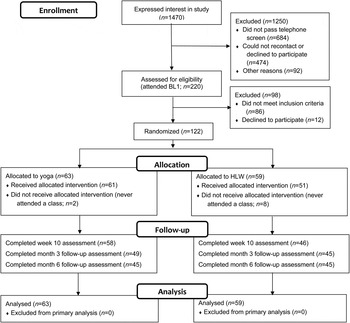
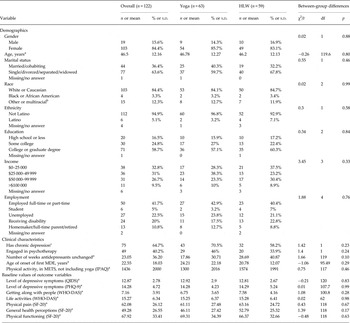
We recruited 122 participants and allocated 63 participants to yoga and 59 to HLW (Fig. 1). Table 1 shows demographic and clinical characteristics at baseline. Almost two-thirds of our sample had chronic major depression. Average depression severity was in the moderate range. Participants reported, on average, a moderate level of physical activity (IPAQ Research Committee, 2005). Table 1 also provides information about baseline values of outcome variables, including means and standard deviations. There were no significant differences between groups on baseline variables.
Consolidated Standards of Reporting Trials (CONSORT) flow diagram. BL1, Baseline 1; HLW, Healthy Living Workshop.

Baseline demographic and clinical characteristics, and baseline values of outcome variables

HLW, Healthy Living Workshop; s.d., standard deviation; df, degrees of freedom; MDE, major depressive episode; METS, metabolic equivalent of task min per week; IPAQ, International Physical Activity Questionnaire; QIDS, Quick Inventory of Depression Symptomatology – Clinician Rating; PHQ-9, Patient Health Questionnaire, nine items; WHO-DAS, World Health Organization Disability Assessment Schedule; SF-20, 20-item Short-Form Survey.
a Continuous variables. Differences between groups were compared using t tests. Other variables are categorical.
b Other or multiracial included people who were multiracial (n = 5), Hispanic/Latino (n = 4), Cape Verdean (n = 3), Indian (n = 1), Native American (n = 1), and chose not to respond (n = 1).
c All participants had a current episode of major depression or an episode in the previous 2 years. To assess whether their depression would be considered chronic, after assessing the depressive episode, we asked whether they had experienced depressed mood and other symptoms discussed for at least 2 years, more than half the days, with no more than 2 months of feeling okay.
Other treatment during the study
At the 10-week, 3-month and 6-month assessment time points, 95–100% of participants reported that they continued to take an antidepressant medication, and approximately 40% reported engaging in psychotherapy. There were no significant differences between intervention arms on either variable (all p values >0.25). Please see online Supplementary Table S1.
Adherence and yoga ‘dosage’
Yoga participants attended a mean of 8.9 classes (s.d. = 5.1) throughout the 10-week intervention phase; HLW participants attended an average of 7.0 classes (s.d. = 5.7; t 120 = 1.88, p = 0.06). As a manipulation check, we examined time per week engaged in yoga (either in a class or at home) in both arms in the intervention phase. As expected, the average total time practising yoga was significantly higher in the yoga arm than in the HLW arm during the intervention phase (i.e. at weeks 3.3, 6.6 and 10; all p values <0.001). In the yoga arm, mean time practising yoga per week ranged from 113 to 123 min (s.d.s ranging from 76 to 170 min), whereas in the HLW arm, mean time practising yoga per week ranged from 1 to 5 min (s.d.s ranging from 5 to 27). There was a consistent difference between groups during the follow-up phase as well. At 3 months, average time of yoga practice per week was 36 min (s.d. = 74 min) and 2 min (s.d. = 10 min) in the yoga arm and HLW arm, respectively (t 91 = −2.98, p = 0.004). At 6 months, average duration of yoga practice per week was 34 min (s.d. = 64 min) and 2 min (s.d. = 11 min) in the yoga arm and HLW arm, respectively (t 89 = −3.29, p = 0.001).
Outcomes
First, we conducted an analysis of group differences in change in the primary outcome (QIDS) at week 10. There was no significant difference between groups at this assessment point (b = −0.89, s.e. = 0.85, p = 0.30). Average change in QIDS was −3.15 (s.d. = 5.09) and −3.93 (s.d. = 3.90) for the HLW and yoga conditions, respectively. To estimate effect size, we divided the difference between groups in average change in QIDS by the raw standard deviation of the baseline QIDS. This yielded an effect size of 0.29, favoring the yoga arm. This is a small-to-medium effect size (Cohen, Reference Cohen1988).
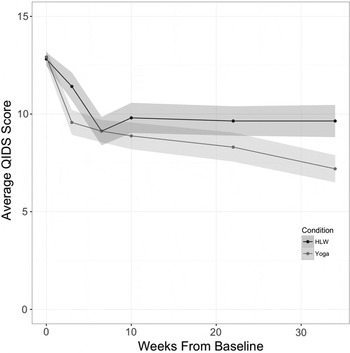
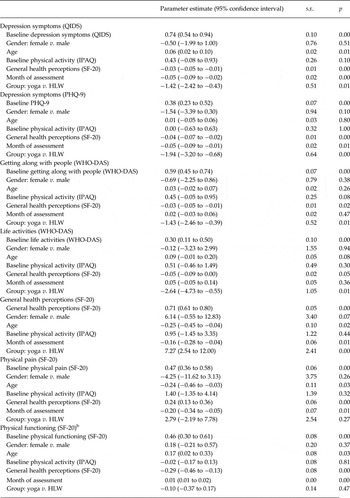
When we examined QIDS scores over the entire intervention and follow-up period while adjusting for baseline QIDS, we did observe a significant difference between groups, with yoga participants demonstrating lower depression severity than HLW participants (Table 2). On average across all (non-baseline) time points, the difference between groups was approximately one half of one standard deviation – a medium effect size (Cohen, Reference Cohen1988). The treatment × time interaction was not significant (b = −0.041, s.e. = 0.03, p = 0.17), indicating that there was no significant difference between the non-baseline time points in the magnitude of the difference between groups. See Fig. 2 for a graphical depiction of QIDS scores over time.
Mean unadjusted Quick Inventory of Depression Symptomatology – Clinician Rating (QIDS) scores for yoga and Healthy Living Workshop (HLW) participants across assessments. Shaded areas represent standard errors.

Regression model results comparing yoga and HLW on primary and secondary outcomes across all follow-up time pointsa

HLW, Healthy Living Workshop; s.e., standard error; QIDS, Quick Inventory of Depression Symptomatology – Clinician Rating; IPAQ, International Physical Activity Questionnaire; SF-20, 20-item Short-Form Survey; PHQ-9, Patient Health Questionnaire, nine item; WHO-DAS, World Health Organization Disability Assessment Schedule.
a Because baseline is included as a covariate and not included as part of the dependent variable, the “Group: yoga v. HLW” parameter represents differences between groups at all non-baseline time points, adjusted for the baseline score. A statistically significant difference on this parameter indicates that the study arm (yoga v. HLW) has a significant impact on that outcome. We also tested models that included interactions between time and group for each of the outcome variables. These interaction terms were not statistically significant for any of the outcomes. Thus, the magnitude of the difference between groups was not statistically significantly different across the non-baseline time points.
b For the physical functioning subscale, we reversed the scale (so that higher values = poorer functioning) prior to analysis in order to fit a negative binomial mixed-effects model.
Similarly, we observed a statistically significant difference between arms across non-baseline time points for self-rated depressive symptoms, with yoga participants showing lower PHQ-9 scores (Table 2) on average across the intervention and follow-up phase. Social functioning, work and role functioning, and general health perceptions were also better in the yoga arm across non-baseline time points, adjusting for baseline. We did not observe differences between groups in physical functioning or pain. Group × time interactions were not statistically significant and therefore not included in final models.
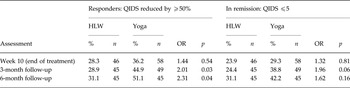
Table 3 includes the percentage of participants who met criteria for response or remission. There were significantly higher odds of treatment response for yoga (v. HLW) across 3- and 6-month follow-up assessments. There was not a statistically significant difference in the odds of participants in yoga compared with HLW meeting criteria for full remission.
Percentage of participants in yoga and HLW classified as responders or in remissiona

HLW, Healthy Living Workshop; QIDS, Quick Inventory of Depression Symptomatology – Clinician Rating; OR, odds ratio; LME, linear mixed effects; CI, confidence interval.
a Generalized LME with adjustment for covariates and baseline QIDS supported a significantly higher odds of treatment response for yoga v. HLW (adjusted OR 2.46, 95% CI 1.12–5.37, p = 0.03) across end-of-treatment and 3- and 6-month follow-up assessments. Generalized LME evaluation did not support a statistically significant difference in the odds of participants in yoga compared with HLW meeting criteria for full remission (adjusted OR 1.88, 95% CI 0.88–4.02, p = 0.10).
There were no serious adverse events related or possibly related to study procedures in either study arm.
Discussion
A recent meta-analysis demonstrated efficacy of yoga for the treatment of depression (Cramer et al. Reference Cramer, Lauche, Haller and Dobos2013). We did not replicate the acute treatment effect documented in this meta-analysis. There are several possible reasons. First, much of the prior work was limited by significant methodological weaknesses, as described in the Introduction and in previous work (Uebelacker et al. Reference Uebelacker, Lavretsky, Tremont, Khalsa, Cohen, McCall and Telles2016; Cramer et al. Reference Cramer, Lauche, Haller and Dobos2013). The current study was designed to address these weaknesses. Second, in the current study, we focused on a potentially difficult-to-treat group of participants, i.e. people with persistent depressive symptoms despite antidepressant treatment. No prior studies of yoga for depression focused on a comparable group. Third, we employed a control group that was matched for time and controlled for non-specific factors such as scheduled time to focus on one's own health, an opportunity to leave one's home, and social support from both an instructor and from peers with depression. This is a more rigorous control than frequently employed control conditions such as minimal treatment or treatment as usual. Consistent with our findings at end-of-intervention (10 weeks), Cramer et al. (Reference Cramer, Lauche, Haller and Dobos2013) reported that although they found various styles of yoga to be superior to usual care, relaxation and aerobic exercise in their meta-analysis, single trials failed to show that yoga was superior to some of the more active control groups such as group therapy, a social support group, massage or pharmacological treatment.
Although we did not see an acute treatment effect in the current study, we did find that participants who had received yoga showed lower levels of depression, improved general health perceptions, and improved social and work and role functioning over the entire follow-up period. They were also more likely to show a treatment response at 3 months and at 6 months. That is, it appears that yoga had an enduring effect when compared with health education. This is particularly notable given the rigorous control group and the focus on a difficult-to-treat population. In our yoga intervention, teachers did repeatedly focus on the importance of and options for home practice. This was reinforced by the fact that we gave participants materials and tools for home practice. Thus, we hypothesize that yoga taught participants skills for coping with depressed mood and cognitions, and, as they continued to practise these skills even outside of class, the beneficial effects accumulated over time. Similarly, data suggest that cognitive–behavioral therapy is more likely to prevent relapse than medications after an acute treatment period, perhaps because the therapy teaches patients a different way to relate to negative cognitive content even when they are no longer in therapy (Bockting et al. Reference Bockting, Hollon, Jarrett, Kuyken and Dobson2015).
In this study, at 3-month and 6-month follow-up assessments, the odds ratios for response to yoga v. HLW were 2.01 and 2.31. These odds ratios compare favorably with those obtained in a meta-analysis of 2–14 weeks of pharmacological augmentation strategies for people with treatment-resistant depression (Zhou et al. Reference Zhou, Ravindran, Qin, Del Giovane, Li, Bauer, Liu, Fang, da Silva, Zhang, Fang, Wang and Xie2015). Augmentation with aripirazole or quetiapine was demonstrated to be superior to placebo for treatment-resistant depression, with odds ratios of 1.85 and 1.92, respectively, although it is unknown if the response rate would be diminished, the same, or increased with a longer-term follow-up more similar to the follow-up in the current study. It is notable that these medications were less well tolerated than placebo (Zhou et al. Reference Zhou, Ravindran, Qin, Del Giovane, Li, Bauer, Liu, Fang, da Silva, Zhang, Fang, Wang and Xie2015), with significant negative side effects. Although there is a risk of physical injury with yoga – as with any type of physical activity – there is no evidence that yoga causes weight gain or other serious side effects associated with atypical antipsychotics. Therefore, hatha yoga may be a more acceptable option for some patients.
A limitation of this study is the predominantly female sample. Although women are more likely than men to experience major depression (Kessler et al. Reference Kessler, Berglund, Demler, Jin, Koretz, Merikangas, Rush, Walters and Wang2003), women are disproportionately represented in our sample. It is possible that the interventions appealed more to women than to men. Women are more likely to engage in mind–body therapies in the community than men (Barnes et al. Reference Barnes, Powell-Griner, McFann and Nahin2004). Another limitation of this study is that most participants were white and non-Latino. There may be cultural differences in who finds yoga acceptable. However, researchers have had success recruiting non-white and Latino participants (Roth & Robbins, Reference Roth and Robbins2004; Dutton et al. Reference Dutton, Bermudez, Matas, Majid and Myers2013) for a related intervention, mindfulness-based stress reduction. Finally, as with all behavioral interventions, we were unable to keep participants blind to treatment assignment, although we did make efforts to present both arms to participants with equipoise.
There are several areas for future research. One of the key questions is how much yoga each week, and over what period of time, is needed to cause a clinically significant change in depression symptoms. At the dosage we provided in the intervention phase, 10 weeks may not have been enough. However, we did see important differences over longer periods of time. Second, what are the moderators and mediators of the impact of yoga on depression? Understanding of mechanisms may contribute to answering yet another question: what are the active ingredients of yoga that have an impact on depression? There are many styles of hatha yoga available in the community; classes can be gentle or vigorous, can differentially emphasize postures, breathing, and meditation, and can include or not include teaching on yoga philosophy. In this study, we provided a balanced hatha yoga class that emphasized breathing and postures and was suitable for people who may not have been physically fit. However, in order to make the recommendation that a depressed patient engage in yoga, clinicians and patients will need to know what to look for in the variety of yoga classes available.
This is the largest study of yoga for depression to date. Using rigorous methodology, we did not see differences between groups at 10 weeks. However, yoga was superior to our control group when we examined outcomes 3 and 6 months after the intervention period, thus suggesting that the impact of participating in yoga may grow and endure over time. Effective and tolerable adjunctive treatments, such as yoga, are clearly needed to address the high symptom burden among individuals with partial response to conventional treatments.
Supplementary material
The supplementary material for this article can be found at https://doi.org/10.1017/S0033291717000575
Acknowledgements
We would like to acknowledge the assistance of Monica Broughton, B.A., Brown University School of Public Health; Morganne Kraines, M.A., University of Oklahoma; and Richard Liu Ph.D., Brown University School of Medicine for their assistance with data collection. All were compensated for their work.
Research reported in this publication was supported by the National Institute of Nursing Research of the National Institutes of Health under award number R01NR012005. The content is solely the responsibility of the authors and does not necessarily represent the official views of the National Institutes of Health.
Declaration of Interest
L.A.U.’s spouse is employed by Abbvie Pharmaceuticals. B.A.G. receives book royalties from Oxford University Press and Routledge and has been paid as a consultant by McKesson Health Solutions. The other authors have no conflicts of interest to disclose.