“The history of science, like the history of all human ideas, is a history of irresponsible dreams, of obstinacy, and of error. But science is one of the very few human activities—perhaps the only one—in which errors are systematically criticised and fairly often, in time, corrected. This is why we can say that, in science, we often learn from our mistakes, and why we can speak clearly and sensibly about making progress there”.
Karl Popper, Conjecture and Refutations: The Growth of Scientific Knowledge (1963), p. 216.
Like much other scientific work conducted on the study of language, historical Chinese phonology in general, and early Chinese reconstruction in particular, are pioneers of this academic discipline.Footnote 1 While linguistic reconstruction in East Asia (including Tibeto-Burman) has generally followed the same lines of development as reconstructions in other parts of the world, the situation in China appears to be different. Here reconstructions of earlier forms of Chinese have not been based on the traditional comparative method, but on a genuine native tradition of identifying and assessing particular phonological classes. Nevertheless, although these reconstructions differ in principle and in method from ‘reconstructions’ as intended in the Neogrammarian sense, a living range of transcriptionsFootnote 2 did appear at the beginning of the nineteenth century,Footnote 3 and a fragmented reconstruction of early Chinese can be seen in the writings of Reverend Joseph Edkins (1823–1905). While Edkins was not the first scholar to describe early Chinese, he was the first to prove—with corroborative details—that the systematic correspondences among the sound systems of modern Chinese dialects, mainly based on the corpus of readings which he gathered and published in his works (most notably in William's 1874 Syllabic Dictionary), pointed towards the existence of a common source. Moreover, as a consequence of this, he demonstrated that evidence could be used to learn about the common ancestor and to ‘recover’ its lost sounds. The first though only partial, reconstruction of the sound system of early Chinese, intended as a de facto linguistic unity, was made possible by a crucial discovery: the implicit discovery of Sinitic, a family of related dialects.
The discovery of Sinitic: an historical overview
A discussion about the identification—implicit or explicit—of the Sinitic family, and likewise an historical account of the early ‘comparativist’ approach, lies beyond the scope of the present article. Nevertheless, a short introductory overview of these developments is required, so as to provide the context for the intellectual step forward that lay at the basis of Edkins's reconstructionist approach.Footnote 4
Almost every Western scholar, since the time of Francis Bacon (1561–1626), has become fascinated with the Chinese writing system: they have concurred in their view of the Chinese language as identical to sinographs, while some have even speculated that the Chinese language was an artificial one, created ad hoc by a group of philosophers:
Iacobus Golius in additamentis Atlantis Sinici existimauit, linguam Sinicam non e veteri mortalium sermone dućtam, sed artificio et ingenio cuiusdam sapientis viri construćtam esse.Footnote 5
Jacobus Golius in the appendix of Atlantis Sinici estimated that the Chinese language is not a livingFootnote 6 language, but an ingenious artefact somehow created by [a group of] wise men.
(Chinese scripts) …durch Gottes Verhängniss vom Teuffel eingeführet, damit er die elende Leute in der Finsterniss der Abgötterei destomehr verstricket halte.Footnote 7
(Chinese scripts)… were introduced, through God's fate, by the devil, so that he may keep those miserable people ever more entangled in the darkness of idolatry.
In other works, Chinese was placed near South Asian languages on the basis of a number of areal features, such as tones or syllable structure (monosyllabism). In many nineteenth-century linguistic publications, Chinese was considered to be related to languages such as Siamese, Tibeto-BurmanFootnote 8 and VietnameseFootnote 9 because they all exhibited typological and structural similarities. Little attention was given to Chinese dialects in general.
With the emergence of the first comparative tables—which included Chinese—at the beginning of the nineteenth century,Footnote 10 we can see that a distinction between Mandarin, on one side, and Chinese dialects, especially Southern dialects, on the other, was well known to Western scholars. For example, Sir John Barrow arranged a comparative table of the Peking and Cantonese names for numerals from one to ten.Footnote 11 The views of Joshua Marshman (1768–1837), however, seem to have been more sophisticated. First of all, Marshman, showing awareness regarding the idea of ‘cognatehood’ between Chinese and (un)related languages, noted similarities between Chinese numerals and their equivalent in Siamese and Tibetan.Footnote 12 But, most importantly—in his description of the regular differences between Mandarin and Cantonese—he was the first scholar to identify that the two dialects belonged to a common, extrinsic metasystem,Footnote 13 in this case the system of the second set of rime tables of the Kāngxī Dictionary.
Following Marshman,Footnote 14 other Western scholars compiled primitive comparative tables showing mostly Cantonese syllables and their Mandarin equivalents,Footnote 15 highlighting more or less systematic phonetic correspondences between Chinese dialects. Nevertheless, these attempts appeared ignorant of the principle of regularity of sound change, and, as rightly pointed out by Branner,Footnote 16 their raison d’être had no historical component.
Edkins and the discovery of Sinitic
Before exploring in greater detail how Edkins elaborated his ideas with respect to the existence of a Sinitic family, it is first necessary to set out what is known about Edkins's time in China, and through what means he encountered spoken Sinitic languages.Footnote 17 In December 1847, at the age of 24, Edkins was ordained in the Stepney Meeting House, London. The following year he offered himself to the London Missionary Society (LMS) to serve as a missionary in Shanghai.Footnote 18 He probably had his first contact with the Shanghai dialect when he worked at the LMS Press under the supervision of Walter Henry Medhurst (1796–1857). In 1880 he resigned from the LMS to become a translator for the Chinese Maritime Customs Service, where he edited and translated many Western scientific works into Chinese. He studied the dialect of Amoy with Reverend John Stronach (1810–88), and the Hakka dialect with Hóng Réngān 洪仁玕 (1822–64), cousin of the famous rebel Hóng Xiùquán 洪秀全 (1814–64). Edkins passed away in Shànghǎi in 1905 at the age of 81.
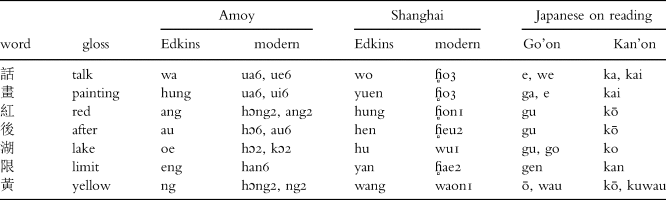
In his investigation of Southern dialects, Edkins acknowledged that these exhibited a wide range of systematic correspondences, while noting at the same time that they agreed most with the sound classes of rime dictionaries. For example, he understood that a number of Chinese words in the Shànghǎi and Amoy dialects were in accordance not only each other but also with Cantonese and Go'on readings.
Table of correspondences between Shànghǎi and Amoy dialects, and Japanese readings. Modern Shànghǎi forms are taken from the on-line dictionary digitalised at wu-chinese.com, with minor revisions, such as ɦ̻- for gh-. Modern Amoy forms are taken from Zhōu Chángjí, Mǐnnán Fāngyán Dà Cídiǎn 閩南大詞典 [Great Dictionary of Southern Min Dialects] (Fújiàn, 2006), pp. 832–837, 839, 1044. Japanese readings are taken from tangorin.com. Edkins's forms (colloquial readings) are taken from Transactions (1879–1880), p. 476.

By looking at Medhurst and Douglas’ dictionaries of Amoyese,Footnote 19 Edkins noted that words in the lower series, which presumably go back to voiced initials in medieval Chinese, tend to drop the initial glottal fricative h-. Most important, both the Amoy and the Shànghǎi dialects (and especially their colloquial readings) seem to agree with Go'on readings in preserving voiced initial consonants, which was a “peculiarity of the old Woo [i.e., Wú] dialect”.Footnote 20 Nor were correspondences between Shànghǎi and other dialects confined to initial phonemes, as they also involved final stops, especially stop codas in the entering tone:
Thus in Shánghái [sic] usage, á, u, ó, o, take k in the short tone, a, e, ö, admit no terminating consonant, while i remains common.
This law is much simpler than that of the Fúh-kien and other dialects of the south of China. But while in those dialects, there are found as in the dictionaries three terminating consonants, k, t, p, similar affinities to vowels are traceable. In the Fúh-kien with the exception of a, which all three share between them, k usually prefers one set of vowels, and t and p another.Footnote 21
I soon found that k final in Shanghai was a sure index to k final in the Amoy dialect. […] the old pronunciation with finals m, k, t, p, and the initials b, p, g, k, d, t, are the remain-debris in the south-eastern provinces of what the early language was everywhere.Footnote 22
There are two lessons to be learned from this. The first is that Edkins proved that someone working on a problem about, for instance, final consonants in the Shànghǎi dialect might find the solution to it by looking at the finals of the Amoy dialect. This is so because the Shànghǎi (Wú group) and the Amoy (Southern Mǐn) dialects belong to the same family (Sinitic), and share a common ancestor (early Chinese). The second lesson is that the various correspondences among Chinese dialects must be regarded as a proof of the existence of an early language (early and medieval Chinese), which might explain their sound systems.
Early Chinese and the Medieval Chinese Diasystem
As pointed out in Branner, Edkins was interpreting historical phonology “as a kind of diasystem that would account for the phonetics of both Shànghǎi and Amoy”.Footnote 23 The ‘early language’ was the key to explain the systematic correspondences between these and other dialects. For example, Edkins was aware of the fact that the traditional dìng initials 定母 (MC *d-Footnote 24) and duān initials 端母 (MC *t-) had merged into t- in Cantonese, and were distinguished in that dialect only by tonal behaviour.Footnote 25 The Shànghǎi dialect, on the other hand, still preserved the contrast between voiced and voiceless initials.Footnote 26 In other words, Edkins ‘discovered’ that the language (i.e. the diasystem) reflected in rime dictionaries could explain the phonetics and, in particular, the peculiar features and ‘anomalies’ exhibited by Chinese dialects, and, in turn, that these sources of evidence about the shared origin of the dialects could be used to learn about the common ancestor:
D changes to t and to the aspirated t in proportion as the area of the northern and western Mandarin trenches gradually more and more on the region of the central dialects. In the translations of Hiuen tsang, who after his return from India twelve centuries ago lived at Chang an, in the modern Shen si, the sonant initials are found distinct and unquestionable. At present the dialect of that province has no trace of them so far as has yet been discovered. They have merged into the unaspirated and aspirated letters of the surd series.Footnote 27
That this was not a solitary instance, may be shown by reference to the Amoy dialect, in which several words have initial k which in other dialects have h : e.g. hien “district city,” is there kwain; hing “walk,” is kiang. The Amoy people in reading these words change k to h.Footnote 28
We know that final m only disappeared entirely in north China from an immense mass of words which retained it after the Mongol conquest, as shown by inscriptions in the Baschpa writing.
The change of m final to ng final is one of great importance for clearing up much of the obscurity of Chinese etymology.
In modern China the final ng appears in the place of final n and m in the whole region occupied by the Old Middle Dialect, extending from the mouth of the Tang tsi kiang to the city of Fu cheu in Fukien province.Footnote 29
In the native system of finals, this limitation is found indeed, but is not rigidly adhered to. Some words in t are placed under ng as well as n. Others in k occur under vowel finals. The cases of conformity however, are so much more numerous than the exceptions, that the rule is indubitable. Since here only k is in use, the modern seat of the old pronunciations of the dictionaries must lie in part farther south. It embraces indeed the seaboard provinces, from Shanghai to Canton with parts of Kiang-si and Hu-nan.Footnote 30
The dialects of Amoy and Chau-cheu, in the provinces of Fuh-kien and Canton, contain some anomalies on which light is thrown by the hypothesis of progressive changes in tones. At Amoy the words 老 lau, old; 有 you, have; 五 ng, five; 兩 liang, two; 瓦 wa, tiles; 雨 ü, rain; 耳 ri, the ear; 網 wang, a net; are all read as book words in the second tone-class, but in colloquial use they are in the seventh. These words all belong to the sixth tone-class in dialects where that subdivision exists. Supposing that it formerly existed at Amoy, and was gradually merged in the second, these and a few other words, preferring the low pronunciation they had originally, passed for a time into the seventh tone-class, where they could conveniently retain it.Footnote 31
A comparison of this ancient pronunciation with several modern dialects will now lie nude, so far as seems necessary to explain their origin, and to shew what portions of them belong to the old language of the country, and what are of local growth.Footnote 32
The foregoing investigation has been earned farther back, than was needed to shew the characteristics of the dialect that immediately preceded mandarin. The pronunciation contained in the national dictionaries, and expressed there by means of the Fan-t'sieh, is that of the period embraced between the fifth and the eleventh centuries. It is from this that mandarin and the other dialects sprang.Footnote 33
A description of this medieval language was contained, in his opinion, in the second set of tables in the Kāngxī zìdiǎn 康熙字典,Footnote 34 as well as in Sinoxenic material.Footnote 35 Thus, it appeared to Edkins that “[t]he existing dialects which agree in final letters most closely with the old classical pronunciation are those of Canton, Swatow [Shàntóu], Tiechiu [Cháozhōu], Amoy and some in Kiang si [Jiāngxī]”.Footnote 36 He even stipulated a list of rules and principles to follow for ‘recovering’ the old sounds, which perhaps might be regarded as a general attempt to pave the way for a more unified outline of early Chinese reconstructions:
At least the principles of such a restoration can be stated in something like the following manner. Join the first and fifth tone-classes, changing the hard and aspirated initials of the latter into the corresponding soft consonants; e.g. t′ to d, and s to z. Restore the lengthened juh-sheng words to their short form, and affix to them the final consonants k, t, p, using as authorities the dictionaries and dialects. Change the hard initials of a certain part of the words in the third and fourth classes to the corresponding soft initials; e.g. t to d, and ch to j, relying for aid as before on the dictionaries and dialects. Transfer a part of the words having soft initials from the third to the second class, following the guidance of the dictionaries.Footnote 37
In other words, recognition of this diasystem was crucial for explaining the linguistic diversity of China. Nevertheless, we must not overlook the fact that this common ancestor does not portray a real language, as it has no grammar and no attestations. Its phonemic structure is reflected by rime dictionaries, but it is widely accepted that they embody an artificial mixed phonological system based on reading pronunciations from different traditions.Footnote 38
While identifying a set of hypothetical sound classes recorded in rime dictionaries as a living language might seem Procrustean in principle,Footnote 39 Edkins was convinced that rime dictionaries effectively indicated a real language. Hence, even though many attentive scholars—at least since ParkerFootnote 40—have recognised that early and medieval Chinese were not likely to have ever possessed that degree of unity, in Edkins's opinion the early version of Chinese that he described was a uniform linguistic unity that had gradually differentiated into a portmanteau of dialects, some of which (especially those in the southernmost part of the mainland) were local survivals of portions of it:
I incline to the view that the northern and southern dialects of old China were not distinguished by any such great variations as exist at present, and that so far as the Go on and Kan on of Japan differ from each other, they represent with considerable accuracy the amount and nature of the variations.Footnote 41
The Chinese is the only living language in which through the phonetic element in the writing, joined with the poetry of all ages, written during 4,000 years, and preserved in rhymes for our examination, we have open to our investigation 4,000 years of continuous linguistic development.Footnote 42
No other hypothesis seems possible, and the Buddhist translations reveal no dialectic variations in pronunciation of the Chinese scribes who helped the Hindoo translators in their work, yet these translations were made in the North, South, East, and West portions of China proper.Footnote 43
As Latin, was once spoken over all Western Europe, became the mother of several modern languages, so the dialects of modern China may be supposed to have grown out of an older colloquial language spreading over the whole country.Footnote 44
There is no information in the common books on sounds of any local differences in pronunciation, till after the T′ang dynasty. They must have existed to some extent, but they are probably beyond the reach of inquiry. In the absence of such information, there is room for the hypothesis that in the first centuries of the Christian era, a common dialect was spoken throughout China with trifling local differences.Footnote 45
Edkins recognised that there were local variations, and even hypothesised that they spread by imitation,Footnote 46 but the early language was one, and it was highly uniform.Footnote 47
To sum up, Edkins was the first scholar to discover, on the basis of systematic correspondences among dialects, the existence of a medieval and an even older version of Chinese (early Chinese) which could account for the diversities that he and others had recognised in Sinitic languages. Sources of information about early Chinese could be obtained by surveying Chinese dialects, rime dictionaries and Sinoxenic materials.Footnote 48 Southern dialects—especially those of Canton, Cháozhōu, Shànghǎi and Amoy—retained many archaic features. As he explained, “The syllabic spelling gives the standard for the language from AD 300 to AD 800. The Canton pronunciation is a local survival of portions of that old language”.Footnote 49
Steps forward in Comparativism and the rise of ‘Reconstructionism’
In what significant way then, was Edkins's ‘discovery’ of Sinitic different from Marshman's first implicit recognition of a metasystem embracing the many varieties of Sinitic? It arguably takes nothing away from Marshman's great achievements to argue that Edkins's approach contained a number of intellectual steps forward. First of all, Marshman never himself actually reached China, as he worked mainly in his mission compound in Serampore (Bengal). Thus, it seems that he only knew, in addition to Mandarin, the Cantonese dialect as spoken in Canton and Macao; in contrast, Edkins showed familiarity with many Sinitic languages. Second, although Marshman demonstrated a certain degree of familiarity with the orthographic ideas of Sir William Jones (1746–94) or with the work on phonetics by Sir John Herschel (1792–1871) and Charles Orpen (1791–1856),Footnote 50 he did not—unlike Edkins—seem to possess significant knowledge about European linguistics, though Edkins could also depart (at his own peril) from the general principles of Indo-European linguistics.Footnote 51 Third, Marshman commented on regular correspondences between Mandarin and Cantonese, and not between non-Mandarin varieties as Edkins did (e.g. Shànghǎi and Amoyese, Cantonese and Hakka, etc.). Fourth, and most important, Marshman took the received sounds in rime charts for-the-most-part as they were heard in Mandarin, while Edkins sought to ‘recover’ their old pronunciations, something that allowed Edkins to compare Chinese (i.e. Sinitic) with other languages, including Mongolian, Indo-European and Dravidian.Footnote 52
However, it would appear that German scholars such as Carl Richard Lepsius (1810–84) and Wilhelm Grube (1855–1908) had independently arrived at conclusions not very different from those reached by Edkins. For example, as his rejection of ‘monosyllabism’ testifies, Lepsius was familiar with the idea that a relationship between Mandarin and southern dialects such as Hokkien and Cantonese (which he rightly acknowledged as more conservative) was likely to exist:
Es ist schon bemerkt worden, daſs die Tibetische Sprache dadurch in lautlicher Beziehung fast auf dem Standpunkte der Chinesischen Dialekte von Fu-kjen und Kwaṅ-tuṅ (sic) angekommen ist. Diese weichen von dem Mandarinischen Dialekte vornehmlich dadurch ab, daſs sie nicht nur eine gröſsere Mannigfaltigkeit der consonantischen Hauchklassen, namentlich auch Mediae oder tönende Buchstaben, sondern auch noch andere als vokalische oder nasale Auslaute haben. Consonantische Auslaute, wie pat, kap, kik u.s.w. modificiren schon wesentlich das strengste Princip der Monosyllabität, wie es im Kwan-hwa ausgebildet ist.Footnote 53
It has already been remarked that the Tibetan language has thereby arrived in a phonetic relation almost on the standpoint of the Chinese dialects of Fu-kjen and Kwaṅ-tuṅ (sic). These mainly deviate from the Mandarin dialect in that they not only have a greater variety of aspirate consonants, including medials or voiced sounds, but also other than vocal or nasal finals. Final consonants, such as pat, kap, kik, etc., already modify substantially the strictest principle of monosyllable, as it is found in Mandarin.
He also recognised some regular correspondences between Mandarin and other dialects, especially in tones and consonants:
In Bezug auf ž ist noch zu bemerken, daſs dieser Laut im Mandarinischen Dialekte nur mit dem vierten Tonaccente vorkommt; wo die drei andern Tonaccente eintreten, haben zwar andre Dialekte gleichfalls den Laut ž, der Mandarinendialekt setzt aber dafür den scheinbar ganz fremdartigen l̥ oder r̥, von dem schon oben die Rede gewesen ist.Footnote 54
With regard to ž it is to be remarked that this sound appears in the Mandarin dialect only in the fourth tone; other dialects likewise have the sound ž also in the other three tones, but the Mandarin dialect substitutes it with the quite strange l̥ or r̥, which we have already mentioned above.
Doch kann auch diese Frage hier nicht weiter behandelt werden; ebensowenig wie die noch wichtigere über die S c h l u ſ s c o n s o n a n t e n (sic), welche genau dieselben sind, wie in den Chinesischen Dialekten, mit Ausnahme des s, welches im Tibetischen nicht allein für sich auslauten, sondern sogar nebst d andern Schluſsconsonanten noch angehängt werden kann.Footnote 55
But even this question can not be dealt with here; just as little as the more important one about the e n d i n g c o n s o n a n t s (sic), which are exactly the same as in the Chinese dialects, with the exception of s, which in Tibetan does not appear alone, but can also be attached to other final consonants.
Similarly, Wilhelm Grube (1855–1908) noted systematic correspondences between labialised velar stops /kw/~/gw/ in the Amoy dialect and the palatal initials /j/ in Mandarin or Cantonese. That the former were relics of an older consonantism was shown by comparisons with a number of languages of the same area (not necessarily related to Sinitic) which exhibited similarities with the Amoy dialect:
Gewiss nicht minder interessant ist auch folgende Erscheinung. Dem chinesischen yuet, Mond, welches im Amoy-Dialekte gwat lautet, entspricht im Tibetischen zla-ba, Thulungya khlye oder kle, Khyeng khlau, Kumi hlo. Derselbe Lautcomplex yuet hat im Chinesischen aber noch die Bedeutungen: sagen und überschreiten, wofür das Tibetische im ersten Falle auch zla-ba (Siamesisch klāu) und im zweiten Falle neben zla-ba noch 'da-ba bietet (wobei zu beachten ist, dass zla in den meisten Mundarten da lautet). Dem Chinesischen yuet, sich freuen, entspricht offenbar das tibetische 'dod-pa begehren, Lust, Begierde, ebenso wie sich das tibetische 'dun-pa begehren mit dem chinesischen yuen und das tibetische zlum-pa mit dem chinesischen lün, Kad, Kreis, und yün, im Kreise drehen, Kreislauf, deckt (im Siamesischen und im Ahom heisst klom rund). Alle diese Formen weisen auf ein ursprüngliches kl oder gl im Anlaute hin. In gleicher Weise lassen die Parallelformen: chines. hiuet Blut = tib. Frag, chines. kiü sich fürchten = tib. skrag-pa, chines. kiap Panzer = tib. k'rab, chines. hien weise, klug = tib. sgrin-po auf eine anlautende Consonantenverbindung schliessen, und wenngleich die Frage sich auch noch nicht endgültig entscheiden lässt, so ist doch der Grad der Wahrscheinlichkeit für das ursprüngliche Vorhandensein von Consonantenverbindungen im Anlaute ein sehr hoher.Footnote 56
Certainly no less interesting is the following phenomenon. The Chinese yuet, moon, which is gwat in the Amoy dialects, corresponds in Tibetan zla-ba, ThulungFootnote 57 khlye or kle, Khyeng khlau, Kumi hlo. But the same phonetics yuet in Chinese has the meanings of: say and exceed, for which Tibetan has zla-ba (Siamese klāu) for the former, and zla-ba or 'da-ba (note that zla appears there in most dialects) for the latter. Turning back to the Chinese yuet, [it] evidently corresponds to the Tibetan 'dod-pa craving, desire, yearn for, just as the Tibetan [form] 'dun-pa, craves, corresponds to the Chinese yuen, and the Tibetan zlum-pa with the Chinese lun, circle, and yin, to rotate, circle, cover (in Thai and Ahom is klom, round). All these forms indicate [the existence of] an original kl or gl in the initial. In the same way, the parallel forms: Chinese hiuet blood = Tib. Frag, Chines. kiü be afraid = Tib. skrag-pa, Chines. kiap armour = Tib. k'rab, Chines. hien sage, clever = Tib. sgrin-po suggest an initial consonant connection, and although the question cannot yet be finally solved, the degree of probability for the initial presence of consonant connections is very high.
Incidentally, the above passage represents the first explicit statement about consonant clusters in early Chinese, something routinely—and erroneously—attributed to Edkins.Footnote 58 It is clear that Lepsius and Grube implicitly assumed the existence of an older, common Sinitic language. However, both Lepsius and Grube's discussions dealt with comparisons between guānhuà vs fāngyán, and not with comparisons between fāngyán A vs fāngyán B vs fāngyán C vs rime tables, in Edkins's fashion.
Based on this evidence, it would seem that Joseph Edkins should be credited with the implicit discovery of Sinitic as a linguistic family. His finding was a crucial one not simply because it rendered feasible more refined, scientific comparisons between Sinitic and other languages,Footnote 59 but also because it stimulated the growth of a ‘reconstructionist’ approach, represented by the first (though partial) reconstruction of the sound system of early Chinese.
Edkins and the first partial reconstruction of the sound system of Early Chinese
According to a famous anecdote, the Franco-American linguist Du Ponceau (1760–1844) said that—in the opinion of the Lutheran missionary Karl Gützlaff (1803–51)—“nothing has so puzzled the learned world, in Europe, as the Chinese language”.Footnote 60 In fact, notwithstanding the success and progress that accompanied the endeavours of competent sinologists and linguists to dismiss the uncomprehending and ignorant accounts that were commonplace, the results of more scientific investigation mean that the field of historical Chinese phonology in general, and early Chinese reconstruction in particular, remains in a puzzling impasse.Footnote 61
As explained earlier, unlike Old Greek, Old Latin and Old German, etc., reconstructed early Chinese is not properly a language, but rather a set of hypothetical sound classes drawn from later periods and ‘recreated’ on the basis of pieces of evidence that are far from being contemporary with each other. Traditionally, Qīng scholars believed that the so-called gǔyīn 古音 ‘old sounds’ indicated the sound system of the language spoken during the Zhōu (1046–256 bce) and Qín (221–206 bce) dynasties.Footnote 62 However, probably on the basis of the accounts of Zhèng Xuán 鄭玄 (127–200) and Liú Xī 劉熙 (160 - ? ce) regarding sound changes that occurred during Late Hàn epoch (25–220 ce), modern scholars tend also to include the Western Hàn (206 bce –9 ce) period within the definition of shànggǔyīn 上古音 ‘Old Chinese’. This is the view to which Pān Wùyún and other Chinese scholars subscribe,Footnote 63 and it was roughly the opinion of Bernhard Karlgren.Footnote 64 Recently, Baxter and Sagart have instead pointed out that “it is difficult at this stage to make a meaningful distinction between Old Chinese and Proto-Chinese (= Proto-Sinitic)”.Footnote 65
Edkins convinced himself (and others) that not only could a variety of Chinese reflected by the sound classes of rime tables be reconstructed, but that it was also possible to reconstruct a much older stage of Chinese. The problem is that Edkins did not link early and medieval Chinese to the emergence of new textual evidence, nor did he conflate linguistic history with political history. Instead, he believed that there was an inevitable and preordained hierarchy of developmental stages that lay at the basis of linguistic evolution: languages at first possess nasal sounds and then change or include labial sounds, dental sounds, ‘guttural’ sounds, and so on.Footnote 66 A more detailed discussion of Edkins's reconstructing technique is now offered in the following section.
Edkins's reconstructing technique and the reconstruction of Early and Medieval Chinese
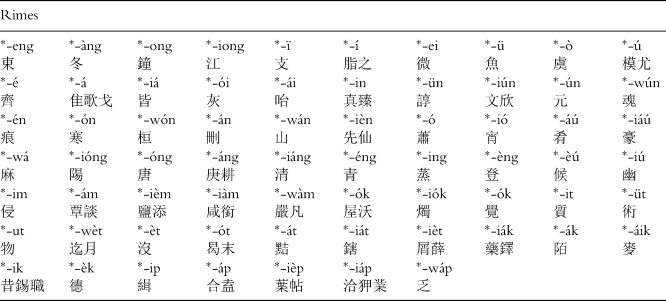
As it has been correctly pointed out elsewhere, Edkins's linguistic theory (such as it was) formed a uniform organic whole that should not be broken down into disconnected parts.Footnote 67 Hence, his reconstructing technique is not properly understandable without knowledge of his linguistic ideas and beliefs. Evidently, Edkins did not adhere to strict neogrammarian orthodoxy, and his ‘reconstructions’ are different in principle (and quality) from Schleicher's first reconstruction of the Indo-European sound system. Moreover, though Edkins apparently came to China prepared to discover a family of related dialects there (and he did recognise the important point mentioned above about the implied early Chinese diasystem), most scholars now believe that he did not set about serious reconstructive work to recover the full diasystem.Footnote 68 This is true but only in part. In fact, medieval Chinese initial onsets and rimes were clearly reconstructed by Edkins, as shown in Table 2 (above) and Table 3:
Reconstructed medieval Chinese initials. Taken from Edkins, “The Old Chinese Language”. China Review 21, 6 (1895), p. 414; “Introduction” in S. W. Williams, A Syllabic Dictionary (Shanghai, 1874), p. xxviii; J. Edkins, A Grammar of the Chinese Colloquial Language Commonly Called the Mandarin Dialect (London, 1864), p. 74.

Reconstructed medieval Chinese rimes. Data taken from J. Edkins A Grammar of the Chinese Colloquial Language Commonly Called the Mandarin Dialect (London, 1864), p. 90.

Edkins was aware of the fact that many sound changes occurred during the transition from early to medieval Chinese. Accordingly, he used the structure of sinographs and, above all, his theories about language evolution to recover these old sounds. For example, Edkins recognised that many words with the initials sh- and l- in Mandarin often shared a common phonetic part (shēngfú 聲符), e.g. shēng 生 ‘life, birth’ and lóng 隆 ‘prosperous’, or shù 數 ‘number’ and lóu 婁 ‘to wear’.Footnote 69 Edkins's belief that ‘dental stops’ somehow had to be older than alveolar lateral approximants or subapical retroflex sibilants must have convinced him of the fact that both /l/ and /ʂ/ were derived from early Chinese initial /*d/. On other occasions, Edkins grouped words merely on the basis of semantic congruity. For example, sik 息 ‘interest’, li 利 ‘interest’, te/tik 得 ‘gain’ are similar in meaning. The fact that te 得 had a dentalveolar stop initial was taken as a proof of the fact that the other two sinographs were derived from it.Footnote 70 Here is not the place to enter upon a detailed discussion regarding Edkins's methodological mistakes, but unfortunately this is an eloquant indication of the linguistic problems created by his reconstructing technique at the very outset of his approach. To cite a parallel, the fact that Latin has centum, Old Greek has ἑκατόν but Vedic has śatám and Old Church Slavonic has sŭto does not imply that Vedic śatám comes from Latin centum, or vice versa—as Edkins would have implied—but rather that both are later, changed, forms of an earlier *dḱm̥tóm ‘hundred’. Instead, Edkins would have taken śatám as an example of ‘corrupted form’ (of centum), and would have reconstructed initial *k- for these two isoglosses.
Nevertheless, despite such shortcomings, we can see from the examples above that Edkins used semantic proximity and sinograph structure to reduce two ‘cognate forms’ to a common proto-form. This internal alternation of linguistic elements may well be considered a form of ‘internal reconstruction’, the ancillary procedure of the comparative method, which involves reducing allophonic alternations to an underlining phoneme. Of course, Edkins's reconstruction was a ‘reductio ad phoneticum’, but then so was Karlgren's reconstructed system, Karlgren being an opponent of phonemics.Footnote 71
Hence, it is correct that Edkins did not recover the full diasystem that he had implicitly recognised, but it is also true that a reconstructive procedure similar to internal reconstruction can be seen in Edkins's writings.
The Karlgrenian method: continuation or revolution?
With morphophonological fine-tuning provided by the intellectual activity of contemporary scholarship, such as that of Starostin, Baxter, Wu, Sagart, Zhèngzhāng, Jīn, Schuessler, and Baxter and Sagart,Footnote 72 and consolidation of material into not only dozens of roots (in Edkins fashionFootnote 73) but hundreds of reconstructed words,Footnote 74 reconstructed early Chinese may well be regarded as a great achievement of both Trans-Himalayan and historical comparative linguistics.
The great Swedish sinologist Bernhard Karlgren (1889–1978) is often credited with being the first scholar to apply the comparative method to the study of historical Chinese phonology,Footnote 75 and the reconstruction of the sound systems of medieval and early Chinese. But this is arguably a misconception with respect to both the comparative method and Karlgren's reconstructing technique. Indeed, Karlgren himself rejected the idea that the comparative method could allow the complete reconstruction of all phonetic contrasts in medieval and early Chinese:
Je crois que «the comparative method» permettrait très difficilement d'obtenir un résultat positif à l’égard des phonèmes 知 etc. et 照 etc. Tandis que beaucoup de dialectes présentent des initiales bien compatibles avec yod, p. ex. le dialecte de Foochow, d'autres en ont qui sont directements hostiles à yod (le tch et le ch pékinois changent i en ï). Et même si, parmi ces indications contradictoires, on choisit celle qui fait supposer des sons compatibles avec yod – je ferai voir plus bas que certaines raisons autorisent un tel choix – il n'en résulte pas que ces sons doivent être précisément les d, t dentals, yodisés.Footnote 76
I believe that “the comparative method” would make it very difficult to obtain a positive result with regard to phonemes 知 etc. and 照 etc. While many dialects have initials that are well compatible with yod, i.e., the Foochow dialect, others are directly hostile to yod (tch and ch change into i and ï in Pekingese). And even if, among these contradictory indications, we choose the one that makes sounds compatible with yod – I will show below that certain reasons allow such a choice – it does not follow that these sounds must be precisely the same yodised dentals d and t.
Was Karlgren's system, however, more scientific than any other system of his time? If ‘scientific’ meant that hypotheses concerning early Chinese are supposed to stand or fall in correspondence to linguistic facts, and not that they were formulated, as Popper would have insisted, by zeroing in on possible ‘falsifiers’, then reconstructions by Edkins, VolpicelliFootnote 77 and SchaankFootnote 78 were as scientific as those of Karlgren or of any other.Footnote 79
In the view of the above discussion, is it safe to consider Karlgren a ‘revolutionary’, or it would it be more accurate to consider him a synthesiser of the ideas of his predecessors and contemporaries (such as MasperoFootnote 80)? If the response to the first question is yes, then why was it Karlgren and not Edkins who first discovered and partly reconstructed early Chinese? Again, a detailed discussion about this is beyond the scope of the present article, but although the Karlgrenian method appeared to be more a culmination of nineteenth-century historical Chinese phonology than a foundation of ‘modern historical Chinese phonology’, there are good reasons to believe that it was effectively a ‘revolution’. In his hugely important essay on Gyarmathi and the discovery of Finno-Ugrian, János GulyaFootnote 81 distinguishes five conditions which must be taken into account as necessary and sufficient for a revolution or the establishment of a new paradigm, as expounded by Kuhn:Footnote 82 (i) Aufgabe, the putting of a problem; (ii) Methode fur gute Resultat, methods adequate to the complexity of the problem; (iii) Materiale, sufficient new material; (iv) Resultate, previous results; and (v) Forscher mit bestimmte moglichkeit, an ingenious researcher. Some of these criteria are also covered by other pre-Karlgrenian workers. However, just as Mounin believed that Bopp was the founder of comparative linguistics, (not for the discovery of Sanskrit or of grammatical comparison,Footnote 83 both of which were already known before him, but “for using them to pose and solve new problems concerning languages”)Footnote 84, Karlgren might well be considered the founder of historical Chinese phonology. This is not because he was the first scholar to propose a reconstruction of early Chinese (which was already provided by Edkins, Volpicelli or Schaank): instead, it was because he pursued the study of historical Chinese phonology to obtain information about the origin and evolution of what he believed was a concrete natural language, rather than with the aim of solving a formal problem like the identification of the phonological classes of rime dictionaries.Footnote 85 Edkins was certainly not a ‘formalist’ like Chalmers,Footnote 86 Kühnert,Footnote 87 Schaank,Footnote 88 or OgawaFootnote 89 and Igari,Footnote 90 but though he was a ‘reconstructionist’ in a similar fashion to Karlgren, there was a fundamental difference between them. As explained by Edkins in his defence of the ‘old sounds’:
Philology can help Ethnology and throw light on early humans’ history when it is treated by serious writers conducting research on sound principles.Footnote 91
My belief is that the philologists will soon feel compelled to accept the identity of the vocabularies of the languages I have mentioned. This identity will be accepted as corollary to the Darwinian philosophy. That philosophy, from whatever side it is approached, points to unity.Footnote 92
Edkins was spurred on and influenced by his belief in the Biblical account of the diversification of languages; Karlgren, on the other hand, focused only on the analysis of early Chinese per se, and showed no interest in glottogonic speculations.
By surveying the linguistic activity of nineteenth century, it is clear that a great amount of linguistic material was accumulated by Edkins and other missionaries, methodical works on the reconstruction of early and medieval Chinese were accomplishedFootnote 93 and hypotheses were formulated in a ‘scientific’ way. Nevertheless, a revolution in this particular branch of learning was affected only when Karlgren used this accumulated knowledge to pose and solve new problems concerning early Chinese per se. The identification of a forerunner, or likewise of a new ‘paradigm’, is inevitably a matter of weighing criteria on arbitrary basis, but it would seem that modern scholarship, especially in China (with few notable exceptions), has been overly concerned with questions of hierarchy and priority (i.e., was Edkins superior to his contemporaries?). This discussion might consequently be improved by shifting attention away from questions of priority to knowledge regarding the growth of the methodologies and practices on which historical Chinese phonology more broadly, and early Chinese reconstruction in particular, have depended.
The “Old Sounds” (古音) in Chinese Sources
Edkins was not the first scholar (not even the first Western one) to describe an earlier version of the Chinese language. While studies on grammar and morphology appeared in China quite late compared to other parts of the world,Footnote 94 China had possessed skillful philologists since at least the Spring and Autumn period (771–456 bce). The study of Chinese phonology, or shēngyùnxué 聲韻學 in the indigenous terminology,Footnote 95 has always been a part of the traditional xiǎoxué 小學 ‘small learning’, together with the wénzìxué 文字學, i.e. the study of the structure of the sinographs, and the xùngǔxué 訓詁學, i.e. the study of the meaning of sinographs.Footnote 96 That the sound system of medieval Chinese (jīnyīn 今音) was somewhat different from the sound system of the so-called ‘old language’ (gǔyīn 古音) was foreshadowed by Yán Zhītuī 顏之推(531–91) and later by Yè Mèngdé 葉夢得 (1077–1148). In the opinion of Watters,Footnote 97 the first systematic distinction between the two terms appears in the Tángyùn 唐韻 of Sūn Miǎn 孫愐 around the second half of the eighth century. Nevertheless, it seems that we have to wait for Wú Yù 吳棫 (1100-54) in order to see a deeper awareness of this difference. Wú Yù was also one of the first Chinese scholars to realise that words in different tones rhymed with each other in the Book of Odes. Of much more interest is the late Míng (1368–1644) scholar Yáng Shíwěi 楊時偉 (?–?), who revised and corrected the Hóngwǔ zhèngyùn 洪武正韻. Yáng took the sound classes from sources such as Yùnbǔ 韻補 and Gǔyīnkǎo 古音考, and attached them to each rime of the new version of the Hóngwǔ zhèngyùn. He called these rimes ‘old sounds’ (gǔyīn 古音). One of the greatest figures in historical Chinese phonology is Chén Dì 陳第 (1541–1617), author of many treaties on language, such as Dōng fān jì 東番記, Shìshàntáng cángshūmù 世善堂藏書目, Yī zhāi jí 一齋集, Dúshī zhuōyán 讀詩拙言, Qūsòng gǔyīnyì 屈宋古音義, Máo shī gǔyīn kǎo 毛詩古音考, etc. In addition to a difference between ‘old sounds’ and ‘new sounds’, Chén Dì also recognised the existence of local varieties.Footnote 98 The famous quote “shí yǒu gǔjīn, dì yǒu nánběi 時有古今, 地有南北” ([regarding the] time, [we] have past and present, [regarding the] place, [we] have south and north) is routinely attributed to Chén Dì. Another great scholar who studied the ‘old sounds’ was Gù Yánwǔ 顧炎武 (1613–82). Gù is cited in Chinese sources as having posited that the ‘old language’ had no tonal distinctions (gǔyǔ wúshēng zhī bié 古語無聲之別).Footnote 99 Duàn Yùcái's contributions are well known in the West, and they are often quoted in Edkins's works.Footnote 100 However, in the opinion of the present writer, it is Qián Dàxīn 錢大昕 (1728–1804), easily the greatest Chinese phonologist of his time, who made the most remarkable contributions to the study of the ‘old sounds’. Most notably, Qián indicated four key points for the study of old initialsFootnote 101 (gǔniǔ 古紐): (i) early Chinese had no ‘weak labial sounds’ (gǔ wú qīng chúnyīn 古無輕唇音); (ii) early Chinese had no ‘coronal sounds’Footnote 102 (gǔ wú shéshàngyīn 古無舌上音); (iii) [the language of the] ancient people had more ‘lingual sounds’ (gǔrén duō shéyīn 古人多舌音); and (iv) in early Chinese yǐng 影, yù 喻, xiǎo 曉, xiá 匣 were homophonousFootnote 103 (gǔ yǐng yù xiǎo xiá shuāngshēng 古影喻曉匣雙聲). The first key point means that medieval Chinese classes fēi 非 [*fFootnote 104], fū 敷 [*fʰ], fèng 奉 [*v], wēi 微 [*ɱ], commonly referred to as qīng chúnyīn ‘weak labial sounds’, did not exist in early Chinese, where only zhòng chúnyīn 重唇音 ‘strong labial sounds’ (i.e. bāng 帮 [*p], pāng 滂 [*pʰ], bìng 并 [*b], míng 明 [*m]) could be found. The second key point is meant to indicate that in early Chinese there was no difference between coronal sounds (duān 端 [*t], tòu 透 [*tʰ], dìng 定 [*d] classes) and apical consonants (zhī 知 [*ʈ] or [*ȶ], chè 徹 [*ʈʰ] or [*ȶʰ], chéng 澄 [*ɖ] or [*ȡ] classes). Traditionally, ní 泥 [*n] and niáng 娘 [*ɳ] or [*ȵ] initials belong to the same class of sounds, but were apparently overlooked by Qián. We have to wait until Zhāng Bǐnglín's 章炳麟 (1869–1936) work Gǔyīn niáng rì èr niǔ guī ní shuō 古音娘日二紐歸泥說 to learn that niáng and rì [*ɲ] initials are the same as ní initials (“niáng rì guī ní 娘日歸泥”).Footnote 105 The third key point is also known as gǔ wú zhèngchǐyīn 古無正齒音 (early Chinese had no ‘coronal fricative/affricates’), and tells us that medieval Chinese zhào èr 照二 (viz. zhuāng 莊 [*tʂ], chū 初 [*tʂʰ], chóng 崇 [*dʐ], shēng 生 [*ʂ] initials) and zhào sān 照三 (viz. zhāng 章 [*tɕ], chāng 昌 [*tɕʰ], chuán 船 [*ʑ], shū 書 [*ɕ], shàn 禪 [*dʑ] initials) did not exist in early Chinese, but were the equivalents of shétouyīn 舌頭音, i.e. duān 端, tòu 透 and dìng 定 initials. The fourth key point means that early Chinese did not distinguish yǐng 影 initials from yù 喻 initials, and xiǎo 曉 initials from xiá 匣 initials.Footnote 106
More works were dedicated to the study of the ‘old sounds’, and they all reveal a certain degree of awareness towards linguistic change. Nevertheless, no Chinese scholar recognised that the diasystem reflected in rime dictionaries could explain the phonetics of the various Sinitic languages. The very notion of ‘linguistic family’, let alone that of ‘linguistic reconstruction’, was clearly unknown to Chinese scholars. In other words, the recognition of an early language that might account for linguistic diversity and which, at the same time, could also be reconstructed by means of different sources of evidence was a ‘discovery’ ascribable only to Edkins. Surely, Edkins's early Chinese was a breakthrough dictated by his practical necessity of explaining different phonetic inventories, and thus it was more an ‘invention’ than a true discovery, as early Chinese was not a real language with a grammar, or written documents that could attest its existence or that could clarify its nature. Nevertheless, it is worth noting that such developments as the discovery of early Chinese and its first partial reconstruction made the field of historical Chinese phonology more ‘scientific’, in the sense that hypotheses are intended to stand or fall by their correspondence to linguist facts (somewhat paradoxically given that proto-segments and proto-phonemes are not physically recoverable), and that these hypotheses—or elements of them—are revised or falsified by new discoveries (e.g. unearthed material) or new experimental data (e.g. investigations on related languages and Chinese dialects).
Conclusions
From the above discussion, the following conclusions can be posited. First, Edkins was the first scholar to hypothesise and further demonstrate systematically the independent existence of Sinitic as a linguistically definable group. Second, the ‘discovery’ of a common diasystem was dictated by the practical necessity of explaining the sound systems of Chinese dialects. Third, the sound system of early Chinese was recoverable by looking at conservative dialects, rime dictionaries, Sino-Xenic material and related languages. And finally, though Edkins did not adhere to strict Neogrammarian orthodoxy, his writings reveal a first attempt to recover the phonetics of the earliest stages of the Chinese language by investigating the internal alternation of linguistic elements.
Appendix
Comparative table of Edkins's reconstructed medieval Chinese initials with other pre-modern systems