Introduction
Culex pipiens s.l. and related taxa have received much attention due to their great medical and veterinary importance as vectors of various bacterial, filarial and viral pathogens (Vinogradova, Reference Vinogradova2000; Becker et al., Reference Becker, Petrić, Zgomba, Boase, Dahl, Lane and Kaiser2010). For instance, members of the Cx. pipiens complex, which includes Culex quinquefasciatus, are competent vectors of Wuchereria bancrofti (Farid et al., Reference Farid, Hammad, Hassan, Morsy, Kamal, Weil and Ramzy2001) that cause lymphatic filariasis, St. Louis encephalitis virus (Richards et al., Reference Richards, Lord, Pesko and Tabachnick2009), Sindbus virus (Lundstrom, Reference Lundstrom1999), Dirofilaria repens and Dirofilaria immitis (Latrofa et al., Reference Latrofa, Montarsi, Ciocchetta, Annoscia, Dantas-Torres, Ravagnan, Capelli and Otranto2012), and bird malariases such as Plasmodium relictum (Atkinson et al., Reference Atkinson, Woods, Dusek, Sileo and Iko1995; Fonseca et al., Reference Fonseca, LaPointe and Fleischer2000). More importantly, Cx. pipiens s.l. is a primary vector of West Nile encephalitis virus (WNV) in Europe (Hubalek & Halouzka, Reference Hubalek and Halouzka1999) and America (Kilpatrick et al., Reference Kilpatrick, Meola, Moudy and Kramer2008). Outbreaks of WNV have been reported in several countries in Europe since 2008 (Pradier et al., Reference Pradier, Lecollinet and Leblond2012). Culex pipiens s.l. is one of the most widespread and abundant mosquito vectors in Serbia (Vujić et al., Reference Vujić, Stefanović, Dragićević, Matijević, Pejčić, Knezević, Krasić and Veselić2010) and has been confirmed to be the main vector of WNV (Petric et al., Reference Petric, Hrnjakovic Cvjetkovic, Radovanov, Cvjetkovic, Jerant Patic, Milosevic, Kovacevic, Zgomba, Ignjatovic Cupina, Konjevic, Marinkovic and Sánchez-Seco2012; Kemenesi et al., Reference Kemenesi, Krtinić, Milankov, Kutas, Dallos, Oldal, Somogyi, Nemeth, Banyai and Jakab2014; http://www.biocidi.org.rs/). Indeed, large outbreaks have occurred in Serbia in 2012 (70 cases) and 2013 (302 cases) (http://www.ecdc.europa.eu/en/healthtopics/west_nile_fever/West-Nile-fever-maps/Pages/index.aspx).
Culex pipiens s.l. comprises two distinct forms: biotype pipiens (‘rural’) and biotype molestus (‘urban’), discriminated by physiological and behavioral characteristics, as well as differences in structural genes. Forms of the Cx. pipiens complex have different vector capacities, due to their different feeding preferences: the pipiens biotype is ornithophilic, while the molestus biotype is mammophilic, and hybrids are opportunistic (Osório et al., Reference Osório, Zé-Zé, Amaro, Nunes and Alves2014). For better understanding of WNV epidemiology and improved risk assessment, local distinction between these forms is essential. In northern Europe, Russia and northeastern USA, these forms occupy different habitats (see Osório et al., Reference Osório, Zé-Zé, Amaro, Nunes and Alves2014). The molestus form occurs in underground areas in urban settings, whereas the pipiens biotype lives aboveground (Byrne & Nichols, Reference Byrne and Nichols1999; Fonseca et al., Reference Fonseca, Keyghobadi, Malcolm, Mehmet, Schaffner, Mogi, Fleischer and Wilkerson2004; Bahnck & Fonseca, Reference Bahnck and Fonseca2006). In southern Europe, sympatric occurrence of both biotypes has been observed in surface habitats (Chevillon et al., Reference Chevillon, Eritja, Pasteur and Raymond1995; Gomes et al., Reference Gomes, Sousa, Novo, Freitas, Alves, Côrte-Real, Salgueiro, Donnelly, Almeida and Pinto2009; Osório et al., Reference Osório, Zé-Zé, Amaro, Nunes and Alves2014).
Taxonomic resolution of Cx. pipiens complex members is of primary importance for gaining better insight into their biology, ecology and vectorial capacity. The taxonomic status of these two biotypes is still a matter of study and discussion, ranging from distinct species (Miles & Paterson, Reference Miles and Paterson1979; Weitzel et al., Reference Weitzel, Collado, Jöst, Pietsch, Storch and Becker2009) to physiological forms with considerable genetic introgression (Harbach et al., Reference Harbach, Harrison and Gad1984; Chevillon et al., Reference Chevillon, Rivet, Raymond, Rousset, Smouse and Pasteur1998; Vinogradova, Reference Vinogradova2003; Gomes et al., Reference Gomes, Sousa, Novo, Freitas, Alves, Côrte-Real, Salgueiro, Donnelly, Almeida and Pinto2009; Farajollahi et al., Reference Farajollahi, Fonseca, Kramer and Kilpatrick2011). Since Cx. pipiens s.l. biotypes differ in larval niches, morphological adaptation at the larval stage shapes diagnostic traits of the respiratory siphon. Vinogradova et al. (Reference Vinogradova, Reznik and Kuprijanova1996) found siphon characters to be a valuable tool for separation of urban molestus and rural pipiens forms. Specifically, the number, size and shape of pecten spines (which are important for cleaning larval mouthparts) (Vinogradova & Ivnitsky, Reference Vinogradova and Ivnitsky2009) are of taxonomic importance (Gutsevich et al., Reference Gutsevich, Monchadskii and Shtakel'berg1974; Becker et al., Reference Becker, Petrić, Zgomba, Boase, Dahl, Lane and Kaiser2010). Similarly, the siphonal index (SI, ratio of siphon length to width) was found to be a valuable diagnostic character for the separation of biotypes (Vinogradova, Reference Vinogradova2003; Krtinić et al., Reference Krtinić, Ludoški and Milankov2012). However, data concerning variations in siphonal characters, with the exception of siphonal index, are still fragmented (Vinogradova, Reference Vinogradova2000).
A sharp discontinuity between the habitats of larval and adult stages inevitably influences differences in their biological, physiological and morphological characters. Hence, during ontogenetic transition from aquatic (pre-adult stage) to terrestrial (adult) habitats, mosquitoes are subjected to different selection regimes. In addition, different traits have different genetic basis, meaning that characters with low heritability are more influenced by environmental changes and vice versa. For example, it has been suggested that wing size variation is more influenced by environmental factors, whereas wing shape variation has a stronger genetic component (Dujardin, Reference Dujardin and Tibayrenc2011).
To address these issues, we implemented a local study to gain insight into microevolutionary processes underlying morphological variations in Cx. pipiens s.l. biotypes. To study phenotypic variations in traits of adaptive importance (larvae – respiratory siphon; adults – wings), we collected larvae of this species from urban and rural areas. Urban collection sites included both underground (street manhole and basement) and aboveground (draining ditch and pond in the city) habitats, while a local Special Nature Reserve ‘Koviljsko-Petrovaradinski rit’ served as the rural collection site. The goal of our study was to assess phenotypic variations at larval and adult stages in ‘urban’ and ‘rural’ biotypes of the species by complementary use of meristic, univariate and multivariate traits analyzed by traditional and geometric morphometrics. Additionally, given that sexual dimorphism is crucial for assessing disease transmission capacity (including feeding preference, feeding behavior, longevity and susceptibility to parasite and/or virus infections; Magnusson et al., Reference Magnusson, Mendes, Windbichler, Papathanos, Nolan, Rizzi, Christophides and Crisanti2011), we were interested in determining whether the sexes of these biotypes differ with respect to siphonal traits (in larvae) and wing traits (in adults).
Materials and methods
Mosquito collection
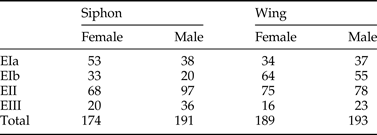
Larvae of Cx. pipiens s.l. were collected from a broad area of the city of Novi Sad (45°15′N; 19°50′E) (Autonomous Province of Vojvodina, northern Serbia) in 2009 and 2010, from four different habitats: (1) a street manhole (underground urban habitat; biotype EIa); (2) a basement (underground urban habitat; biotype EIb); (3) drainage ditch and city pond (aboveground urban habitat; biotype EII); and (4) a rural pond/swamp (aboveground rural habitat; biotype EIII). Larvae of EIII were collected at the Special Nature Reserve ‘Koviljsko-Petrovaradinski rit’, which contains a complex of marshes and forest ecosystems. At the time of sampling, numerous adults and larvae were present at each locality, suggesting that sampled larvae were obtained from many females. From each breeding site, approximately 300 third- and fourth-instar larvae were collected and individually reared in the laboratory in their original water without feeding. After adult eclosion, exuviae were preserved in 96% ethanol. Since exuviae (not larvae) were used for studying siphonal traits and all individuals were at the same point of development, we were able to record the sex of each larva based on the sex of the corresponding adult. A total of 382 adults (189 females and 193 males) and 365 larval exuviae (174 females and 191 males) were used for wing and siphon analyses, respectively (table 1). Note that these 365 exuviae included 144 exuviae which were previously included in a pilot study of the usefulness of different measures of siphon length and width as a standard measure of SI (Krtinić et al., Reference Krtinić, Ludoški and Milankov2012). Left and right wings were removed from all adults, and specimens were subjected to genetic analysis based on 13 isozyme loci, which confirmed identification based on morphology (Krtinić, in preparation).
Sample size of Culex pipiens s.l. from three biotypes (underground urban habitat: EIa – street manhole; EIb – basement; aboveground urban habitat: EII; aboveground rural habitat: EIII).

Methods
In the present study, three methods for quantifying phenotypic variation were implemented: linear (SI of the fourth-instar larva), geometric (siphonal size and shape, wing size and shape) and meristic morphometrics (number of pecten spines on the siphon). Prior to analyses of intra- and inter-biotypic variation, sex dimorphism was examined across all traits and samples. Since significant intersexual differences were observed (see the Results section), each sex was considered separately in further analyses.
Each larval exuviae was laterally positioned in a watch glass (in a drop of water), and photographed with a digital camera (Leica DFC320) mounted on a stereo microscope (Leica MZ12.5). Recorded images were then used in further morphometric analysis. Exuviae were not mounted in order to avoid deformation due to flattening. The number of pecten spines was recorded (fig. 1a). Furthermore, using the Leica Application Suite Measurement Module (ver. 2.4.0) width (W) and length (L) of siphon (W1 and L1 measurements according to Krtinić et al., Reference Krtinić, Ludoški and Milankov2012) were measured (fig. 1b) and the siphonal index (SI), representing the ratio of linear distances SI = L/W (SI1 according to Krtinić et al., Reference Krtinić, Ludoški and Milankov2012) was calculated.
Siphon of fourth-instar larva of Culex pipiens s.l. (a) pecten spines; (b) length, L and width, W, of siphons used for calculation of siphonal index (SI), and locations of landmarks (black dots) selected for geometric morphometric analysis.

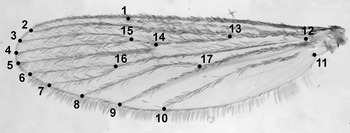
The landmark-based geometric morphometric method (Bookstein, Reference Bookstein1991; Rohlf & Marcus, Reference Rohlf and Marcus1993; Marcus et al., Reference Marcus, Corti, Loy, Naylor and Slice1996; Adams et al., Reference Adams, Rohlf and Slice2004) was employed to analyze size and shape variation of both siphons and wings. Prior to isoenzyme analysis, left and right wings were removed and mounted in Hoyer's medium between microscope slides. Wing images were captured using the same equipment as described above for recording images of larval siphons. For analyses of wing trait variations, images of left wings were used. For each specimen, 4 and 17 homologous landmarks were used for siphons (fig. 1b) and wings (fig. 2), respectively, using TpsDig 2.17 (Rohlf, Reference Rohlf2013) and expressed as x, y coordinates in Cartesian space. Size variation was examined using centroid size (the square root of the summed squared distances of each landmark to the centroid). Shape variables (w matrix; Rohlf et al., Reference Rohlf, Loy and Corti1996) were extracted from the landmark data. Namely, the raw landmark coordinates were superimposed using a generalized Procrustes analysis in order to remove variation due to scale, position and orientation of landmark configurations (Rohlf & Slice, Reference Rohlf and Slice1990; Zelditch et al., Reference Zelditch, Swiderski, Sheets and Fink2004). Then, thin-plate spline analysis was conducted and the w matrix was extracted (Rohlf et al., Reference Rohlf, Loy and Corti1996). Both centroid size and w matrix were obtained utilizing TpsRelw 1.49 (Rohlf, Reference Rohlf2010). To visualize shape differences, thin-plate spline deformation grids were computed with TpsRegr 1.38 (Rohlf, Reference Rohlf2011).
The locations of landmarks on the left wing of Culex pipiens s.l. selected for geometric morphometric analysis.

Statistical analyses
All statistical analyses were done using Statistica 12 (Stat Soft, 2012) and PAST (Paleontological Statistics) version 2.17b (Hammer et al., Reference Hammer, Harper and Ryan2001). Differences in the number of pecten spines across biotypes were tested using Kruskal–Wallis non-parametric analysis of variance followed by pairwise comparisons. Also, within each biotype, differences between sexes were tested with the Mann–Whitney U-test. One-way analysis of variance (ANOVA) and post hoc pairwise comparisons were used to test for differences between biotypes and sexes in SI and centroid size of siphons and wings. To analyze variation in both siphon and wing shape among sexes and biotypes, canonical variate analysis (CVA) on the w matrix was conducted. Pairwise comparisons between all biotypes were performed with a permutational test followed by Bonferroni correction. In addition, squared Mahalanobis distances were calculated and cluster analyses were done to quantify phenetic relationships.
Results
Sexual dimorphism
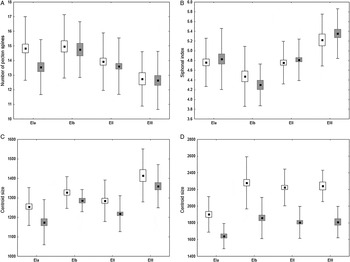
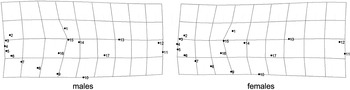
We found no sexual dimorphism in the number of pecten spines (Mann–Whitney U Test: P > 0.05 all but EIa biotype) (fig. 3a), SI (ANOVA P > 0.05 in each biotype) (fig. 3b) and siphon shape (MANOVA P > 0.05 all but EII biotype), but a significant difference was found between sexes for siphon size (ANOVA P < 0.05 all but EIII biotype) (fig. 3c), wing size (ANOVA P < 0.001 in each biotype) (fig. 3d) and wing shape (MANOVA P < 0.001 in each biotype). We found that in each biotype, females had larger siphon and wing centroid sizes than males (fig. 3a, d). In addition, clearly distinct wing shapes differences were observed: females had slightly wider and shorter wings, while males had narrower and longer wings. Thin-plate spline visualizations revealed strong intersexual differences in wing shape associated with differences in the relative positions of landmarks 11, 12, 15 and 16 (fig. 4). Because of the above sexual dimorphism, subsequent analyses comparing variation of both larval and adult traits among biotypes were conducted separately for each sex.
Box plots of the number of pectin spines (a), siphonal index (b), siphon centroid size (c) and wing centroid size (d) of females (white boxes) and males (gray boxes) with the mean, standard error and standard deviation.

Deformation grids of wing shape differences between females and males. Changes have not been amplified. Numbers in the deformation grids refer to landmarks shown in fig. 2.

Variation between biotypes
Larval pecten spines, siphonal index, siphonal size and shape
Significant differences in the number of pecten spines were observed among biotypes in both females (Kruskal–Wallis ANOVA: H (3,174) = 23.03; P < 0.001) and males (H (3,191) = 14.56; P < 0.01). Multiple comparisons revealed significant differences between females of EIa/EII (P < 0.05), EIa/EIII (P < 0.001) and EIb/EIII (P < 0.001) biotype pairs, and males of EIb and EIII (P < 0.01) biotypes. Biotype EIII had the smallest number of pecten spines in both sexes, but EIb males possessed a larger number of pecten spines (fig. 3a).
The siphonal index differed significantly between biotypes of both sexes (females: F (3,170) = 9.14, P < 0.001; males: F (3,187) = 21.42, P < 0.001). The Tukey's test showed that, in females, EIII had significantly larger SI in comparison with EIb (P < 0.001), EIa and EII (P < 0.05), whereas in males all pairs differed significantly (EIII vs. EIa, EIb and EII P < 0.001; EIa/EIb and EIb/EII P < 0.01) except EIa/EII (fig. 3b).
Among females, ANOVA analysis of siphon centroid size revealed significant differences between specimens from the various collection sites (F (3,170) = 12.86; P < 0.001); post hoc test showed significant differences between biotype pairs EIa/EIb (P < 0.05) and EIII vs. EIa, EIb and EII (P < 0.001, P < 0.05 and P < 0.001, respectively). Likewise, in males, centroid size varied significantly between biotypes (F (3,187) = 26.48; P < 0.001), and multiple comparisons shown significant differences between EIa/EIb (P < 0.01), EIa/EIII (P < 0.001) and EII/EIII (P < 0.001) (fig. 3c).
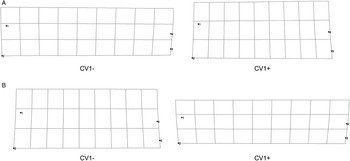
CVA performed on siphon shape variables with biotypes as a grouping variable found significant overall differences between females (Wilks’ Λ = 0.68; F (12,442) = 5.86; P < 0.001), with 50% correct classification. Pairwise comparisons of all biotypes assessed by the permutational test showed significant differences (EIa/EIb P < 0.05; EIb/EII P < 0.01; EIII vs. EIa, EIb and EII P < 0.001) except for females of EIa/EII. Three canonical axes were extracted, and only the first one, which accounted for 84.6% of total shape variation, was significant (χ2 test P < 0.001) and partially separated EIa and EIb from the EIII biotype. Similarly, significant differences between biotypes were observed for males (Wilks’ Λ = 0.56; F (12,487) = 9.88; P < 0.001). Except for EIa/EII, pairwise comparisons revealed significant differences between biotype pairs (EIII vs. EIa, EIb and EII P < 0.001; EIb/EII P < 0.001; EIa/EIb P < 0.01). Correct classification was 58%. Of three extracted roots, the first two were significant (χ2 test P < 0.001) and separated specimens from EIb and EIII. In both sexes, deformation grids indicated that inter-biotype differences resulted from displacement of all four landmarks which affected the length and width of the siphon (fig. 5).
Deformation grids of siphon shape differences between biotypes for females (a) and males (b). Changes have not been amplified. Numbers in the deformation grids refer to landmarks shown in fig. 1b.

Wing size and shape of adults
Wing centroid size was significantly different among biotypes for both females (F (3,185) = 18.26; P < 0.001) and males (F (3,189) = 8.88; P < 0.001). A pairwise comparison test revealed that in biotype EIa wing centroid size was significantly smaller in both sexes (females: vs. all biotypes P < 0.001; males: vs. EIb P < 0.001, EII P < 0.01, EIII P < 0.05) compared to the other three biotypes (fig. 3d).
CVA revealed significant differences in wing shape between biotypes among females (Wilks’Λ = 0.18; F (90,467) = 4.10; P < 0.001) and males (Wilks’ Λ = 0.26; F (90,479) = 3.05; P < 0.001). Except for EII/EIII in females and EIb/EIII and EII/EIII in males, pairwise comparisons showed significant differences between biotypes (P < 0.001). Two out of three extracted canonical roots in females and all three roots in males were significant (χ2 test P < 0.001) and partially separated biotypes (fig. 6). Correct classification was 81% for females and 70% for males. Deformation grids suggested that landmarks 1, 9, 10 and 16 in females and 1, 9, 10, 15 and 17 in males provided the largest contribution to shape changes among biotypes along the first root (fig. 6).
Scatterplot of individual scores from the CVA showing wing shape differentiation between biotypes for females (a) and males (b) of Culex pipiens s.l. The amount of variation explained by each axis is in parentheses. Shape changes are shown as deformations using thin-plate splines. The changes have been amplified 3 × for easier visualization.

Phenotypic diagnostic traits and divergence among biotypes
Using a multi-character approach, siphonal traits (SI, SS and SSh) were found to be exclusively diagnostic for distinguishing both females and males of EII and EIII, as well as males of EIb and EIII. The number of pecten spines has low diagnostic value in males (except pair EIb and EIII), whereas for females it can be used for distinguishing EI from EII and EIII. However, SI, SS (except in males of EIb and EIII) and SSh are diagnostic for delimitating EIII from the other biotypes. Wing size and shape in both sexes were found to be valuable for distinguishing EIa from the other biotypes. In addition, in both sexes, EIb and EII were delimited based on the wing shape. Diagnostic significance of adult wing traits was not noted for EII and EIII (table 2).
Diagnostic traits between Culex pipiens s.l. biotypes (females above diagonal, males below diagonal).

Larval traits are in bold: PS, number of pecten spines; SI, siphonal index; SS, siphonal size; SSh, siphonal shape. Adult wing traits: WS, wing size; WSh, wing shape.
Inter-biotype phenotypic divergence was evaluated by squared Mahalanobis distance calculated from shape variables (tables S1 and S2). In both sexes, the highest phenotypic siphon divergence was found in EIb and EIII, and for wings in EIa and EIb. All pairs of biotypes (except EIa/EIb for siphon) differed significantly in squared Mahalanobis distances in both females and males (tables S1 and S2).
Based on siphon shape, UPGMA cluster analyses grouped EIa and EIb in females and EIa and EII in males as the most similar within one clade, whereas EIII in males and clade EII/EIII in females were the most divergent (fig. S1A). In contrast to the siphon, the UPGMA tree derived from wing shape variables grouped EII and EIII within one clade in both sexes, whereas EIa was the most divergent clade for males and EIb for females (fig. S1B).
Discussion
Using traditional and geometric morphometrics, in the present study we quantified phenotypic variation for pecten spines (PS), siphonal index (SI), siphonal size (SS) and siphonal shape (SSh) among larvae; and wing size (WS) and wing shape (WSh) in adults. Since larvae collected from three different urban and rural areas were reared under the same laboratory conditions, traits estimated during specimen ontogeny provide deeper insight into variations among life stages, males vs. females, and biotypes. In addition, application of a multi-character approach helped us better understand variations in the adaptive traits of Cx. pipiens s.l. biotypes.
Sexual dimorphism
In the present study, statistically significant sexual dimorphism was observed with respect to siphonal size, wing size and wing shape among biotypes of Cx. pipiens s.l. Females were found to have a generally larger siphon than males, which had been reported earlier for this species by Eritja & Aranda (Reference Eritja and Aranda1995). Similarly, female biased wing size presented herein was observed for the majority of mosquitoes (e.g. Henry et al., Reference Henry, Thongsripong, Fonseca-Gonzalez, Jaramillo-Ocampo and Dujardin2010; Loetti et al., Reference Loetti, Schweigmanna and Burronia2011; Schneider et al., Reference Schneider, Chadee, Mori, Romero-Severson and Severson2011). Since a number of studies have shown a positive relationship between female mosquito body size and egg production (McCann et al., Reference McCann, Day, Allan and Lord2009 and references therein), it seems reasonable to expect female-biased size measurements such as siphon and wing size in Cx. pipiens s.l. as well. Larger female size is considered to be favored by fecundity selection (Stillwell et al., Reference Stillwell, Blanckenhorn, Teder, Davidowitz and Fox2010) and thus by traits of adaptive importance.
Moreover, clear sexual differences in wing shape were found in all studied samples of Cx. pipiens s.l. The most important differences in wing shape were the inner landmarks (15, 16), and those defining the proximal part (11, 12) of the wing, which resulted in a narrowing of the central part of the wing among males. Our findings are in general agreement with sexual dimorphism in wing shape reported for different Culex species worldwide (Manimegalai et al., Reference Manimegalai, Arunachalam and Udayakumari2009; Vidal et al., Reference Vidal, Peruzin and Suesdek2011; Dhivya & Manimegalai, Reference Dhivya and Manimegalai2013) as well as for other mosquitoes (Jirakanjanakit et al., Reference Jirakanjanakit, Leemingsawat, Thongrungkiat, Apiwathnasorn, Singhaniyom, Bellec and Dujardin2007, Reference Jirakanjanakit, Leemingsawat and Dujardin2008; Aytekin et al, Reference Aytekin, Aytekin and Alten2009; Henry et al., Reference Henry, Thongsripong, Fonseca-Gonzalez, Jaramillo-Ocampo and Dujardin2010; Vidal et al., Reference Vidal, Carvalho and Suesdek2012).
Association between variations of larval traits
We observed contrasting variation of PS vs. SI and SS for both sexes among EIII. Siphons of the ‘rural’ biotype larvae (collected in a rural marsh and forest ecosystem outside of an urban area), were found to be the largest (SI and SS), but possess the smallest number of pecten spines. These findings are likely to be related to the quality of larval habitats. The siphon is connected with feeding since larvae use their pecten spines for cleaning their mouthparts (Vinogradova & Ivnitsky, Reference Vinogradova and Ivnitsky2009). In addition, an association between siphonal traits and larval habitat has already been suggested (Vinogradova et al., Reference Vinogradova, Reznik and Kuprijanova1996). For example, a correlation between mean SI and certain types of larval habitat (open reservoirs and underground water bodies) and with latitude and longitude for larvae from open breeding sites (Vinogradova et al., Reference Vinogradova, Reznik and Kuprijanova1996) has been observed. Furthermore, in addition to genetic factors, the concentration of organic matter in water has a certain influence on the number of pecten spines.
An integrative approach is essential for delimitation of Culex pipiens s.l. biotypes
By studying the variation of multiple traits, we found differences in their diagnostic significance. For instance, the ‘rural’ biotype (EIII) can be distinguished from EII (aboveground urban habitats) and EIb males (urban basements) exclusively by siphonal traits. Regarding adult traits, WSh was successfully used to distinguish the other biotypes. However, WS was found to be non-informative for delimitation of EIb from EII and EIII forms. Such inconsistencies in the diagnostic value of adult and larval traits is likely connected with differences in environmental factors influencing different mosquito life stages, as well as different developmental canalization of morphological traits.
Among all traits studied, SI has been commonly used to determine the taxonomic status of Cx. pipiens s.l. biotypes (Vinogradova, Reference Vinogradova2003). For the same specimens used in the present study, we previously obtained a slightly higher mean SI value (Krtinić et al., Reference Krtinić, Ludoški and Milankov2012) than those recorded for biotypes molestus (3.08–5.14) and pipiens (4.4–6.4) (Gutsevich et al., Reference Gutsevich, Monchadskii and Shtakel'berg1974; Eritja & Aranda, Reference Eritja and Aranda1995; Vinogradova et al., Reference Vinogradova, Reznik and Kuprijanova1996; Vinogradova, Reference Vinogradova2000). In this study, SI was found to be a reliable trait for delimitation of biotypes in the majority of pairwise comparisons (except males EIa and EII, and females EIa and EIb, EII vs. EIa and EIb). More importantly, the results presented herein show that differences between ‘urban’ and ‘rural’ (EIII) biotypes are consistent with published data (Eritja & Aranda, Reference Eritja and Aranda1995; Vinogradova et al., Reference Vinogradova, Reznik and Kuprijanova1996). Likewise, application of the linear and geometric morphometrics to SI, SS and SSh (implemented here for the first time) revealed a similarity between EIa and EII specimens. Both linear and geometric morphometrics showed that EIII specimens were significantly larger than other biotypes. Additionally, EIII larvae were also differentiated from urban biotypes by siphon shape, as indicated by phenograms.
Furthermore, we found significant differences in the number of pecten spines (PS) between EII/EIa (females) and EIII vs. EIa and EIb. According to published reports, the number of pecten spines for Cx. pipiens s.l. is variable and ranges from 9 to 14 (Gutsevich et al., Reference Gutsevich, Monchadskii and Shtakel'berg1974), 11 to 18 (Harbach et al., Reference Harbach, Harrison and Gad1984) and 13 to 17 (Becker et al., Reference Becker, Petrić, Zgomba, Boase, Dahl, Lane and Kaiser2010). The number, size and shape of pecten spines are of taxonomic importance (Gutsevich et al., Reference Gutsevich, Monchadskii and Shtakel'berg1974; Becker et al., Reference Becker, Petrić, Zgomba, Boase, Dahl, Lane and Kaiser2010). Similar to our results, PS in the molestus biotype were generally more numerous (16–28; Vinogradova & Ivnitsky, Reference Vinogradova and Ivnitsky2009) than those of the pipiens biotype (9–14; Marshall, Reference Marshall1938). It is important to highlight that, in addition to genetic factors, environmental factors (especially temperature and organic matter levels) also influence siphonal traits (Vinogradova, Reference Vinogradova2000). Since urban and rural forms of Cx. pipiens s.l. differ in their adaptation to different larval habitats, it seems reasonable to assess the divergence between them using larval morphological characters which are included in feeding.
To study phenotypic variation within and among biotypes of Cx. pipiens s.l. we examined traits with potentially adaptive significance – wing size and shape. Subtle but consistent differences in wing geometry can be reliably estimated using the geometric morphometric method. Indeed, wing geometric morphometrics has proven useful in distinguishing mosquito sibling species (Henry et al., Reference Henry, Thongsripong, Fonseca-Gonzalez, Jaramillo-Ocampo and Dujardin2010; Vidal et al., Reference Vidal, Peruzin and Suesdek2011; Lorenz et al., Reference Lorenz, Marques, Salum and Suesdek2012) and conspecific populations (Demirci et al., Reference Demirci, Lee, Lanzaro and Alten2012; Motoki et al., Reference Motoki, Suesdek, Sterlino Bergo and Salum2012). Given that wing size reflects body size, which is related to survival and reproductive success/fecundity (Clements, Reference Clements1992; Vinogradova, Reference Vinogradova2000), the possible diagnostic importance of this trait was examined. This study demonstrates that wing size clearly delineates EIa (urban street manhole) from other biotypes of Cx. pipiens s.l. A lower diagnostic value of wing size can be expected, since lower heritable traits such as wing size are influenced by temperature (Ayala et al., Reference Ayala, Fontaine, Cohuet, Fontenille, Vitalis and Simard2011), relative humidity (Morales-Vargas et al., Reference Morales-Vargas, Ya-Umphan, Phumala-Morales, Komalamisra and Dujardin2010), food availability and larval density (Jirakanjanakit et al., Reference Jirakanjanakit, Leemingsawat, Thongrungkiat, Apiwathnasorn, Singhaniyom, Bellec and Dujardin2007). However, significant differences in wing shape were observed between EIa, EIb and EII as well as males of EIII and EIa. Thus, our findings confirm wing shape as a sensitive indicator of microevolutionary processes in Cx. pipiens s.l., which is in agreement with previously published data for members of the Cx. pipiens complex (Morais et al., Reference Morais, Moratore, Suesdek and Marrelli2010). Indeed, it has been suggested that wing shape is a quantitatively inherited trait (Dujardin, Reference Dujardin and Tibayrenc2011) correlated with genetic diversity (Morais et al., Reference Morais, Moratore, Suesdek and Marrelli2010; Ayala et al., Reference Ayala, Fontaine, Cohuet, Fontenille, Vitalis and Simard2011). Wing shape differences observed in the present study were associated with displacements in median wing landmarks, which influence wing width in both sexes. Therefore, we conclude that this region of the wing is of taxonomic importance, as is the case in other mosquito species (Jirakanjanakit et al., Reference Jirakanjanakit, Leemingsawat, Thongrungkiat, Apiwathnasorn, Singhaniyom, Bellec and Dujardin2007; Aytekin et al., Reference Aytekin, Aytekin and Alten2009; Vicente et al., Reference Vicente, Sousa, Alten, Caglar, Falcutá, Latorre, Toty, Barré, Demirci, Di Luca, Toma, Alves, Salgueiro, Silva, Bargues, Mas-Coma, Boccolini, Romi, Nicolescu, do Rosário, Ozer, Fontenille and Pinto2011; Vidal et al., Reference Vidal, Peruzin and Suesdek2011; Lorenz et al., Reference Lorenz, Marques, Salum and Suesdek2012; Vidal et al., Reference Vidal, Carvalho and Suesdek2012; Dhivya & Manimegalai, Reference Dhivya and Manimegalai2013).
Summary
In the present study, analyses of phenotypic variation in siphonal (larvae) and wing (adult) traits in Cx. pipiens s.l. biotypes, by combining meristic, linear and geometric morphometric methods, revealed two main findings. First, differentiating Cx. pipiens s.l. biotypes was not possible based solely on larval and adult traits, which consequently, supports the importance of using multiple markers. Second, our findings shed light on the phenotypic plasticity important for population persistence in the changing environment of the studied taxa due to its ontogenetic niche shifts. This is of particular importance for a taxon such as Cx. pipiens s.l., which can breed in small containers often subjected to environmental stress, such as limited nutrients, desiccation and insecticide pressures.
Supplementary Material
The supplementary material for this article can be found at http://www.journals.cambridge.org/BER
Acknowledgements
The authors thank the two anonymous reviewers for constructive comments on an earlier version of this manuscript. The authors also would like to thank Dr Edward Petri and Dragana Vujković for English language editing. B.K. is supported by Ciklonizacija d.o.o. Novi Sad. J.L. and V.M. are supported in part by the Ministry of Science of Serbia (Dynamics of gene pool, genetic and phenotypic variability of populations, determined by the environmental changes, No. 173012), and the Provincial Secretariat for Science and Technological Development (Molecular and phenotypic diversity of taxa of economical and epidemiological importance, and endangered and endemic species in Europe).