Introduction
The Middle Triassic forms an especially interesting time for terrestrial vertebrates as it is wedged between the still poorly understood extinction recovery phase in the Early Triassic and the dinosaur-dominated Late Triassic (Fraser and Henderson, Reference Fraser and Henderson2006; Sues and Fraser, Reference Sues and Fraser2010). Nonmarine faunal assemblages from the Middle Triassic are particularly well known from Argentina and Brazil (e.g., Langer et al., Reference Langer, Ribeiro, Schultz and Ferigolo2007; Abdala et al., Reference Abdala, Martinelli, Soares, de la Fuente and Ribeiro2009), with Tanzania, Russia, and North America having produced promising but less diverse faunas. The lower Keuper (now formally named Erfurt Formation; Deutsche Stratigraphische Kommission, 2005), a mixed terrestrial–shallow marine deposit in Germany and adjacent regions in France and Poland, is late Middle Triassic (Ladinian: Longobardian) in age and falls within this time interval (Schoch, Reference Schoch1999, Reference Schoch2002; Sues and Fraser, Reference Sues and Fraser2010). It has been known since the early nineteenth century and has produced temnospondyl amphibians and pseudosuchian archosaurs (Schoch, Reference Schoch2002, Reference Schoch2011). In recent times, excavations in the lower Keuper strata have yielded large quantities of terrestrial reptile material, ranging from small diapsids (rhynchocephalians, lepidosauromorphs, choristoderes, and a tiny stem turtle) to archosauriforms and paracrocodylomorphs (e.g., Schoch and Sues, Reference Schoch and Sues2014, Reference Schoch and Sues2015; Schoch, Reference Schoch2015). In addition to these diverse diapsids, further amniote material was collected, albeit so far of indeterminate status. The most distinctive of these remains are partial mandibular rami referred to the genus Colognathus, a distinctive amniote with superficial resemblance to procolophonians but whose affinities remain uncertain (Sues and Schoch, Reference Sues and Schoch2013).
We report three isolated humeri of small-sized parareptiles (Figs. 1–3) that represent two distinct taxa. They form the first definitive evidence of parareptiles in the lower Keuper. The material was found in the same horizon (Untere Graue Mergel, Anoplophoraschichten) of the lower Keuper (Ladinian) at two different localities, Vellberg and Kupferzell. These localities are located some 25 km apart in southwestern Germany and were situated in two separate lake basins at the time of deposition. Although based on isolated postcranial elements, the specimens represent the first records of an owenettid procolophonian (aff. Barasaurus) in Europe and a putative procolophonid. The discovery of these parareptiles increases the taxonomic diversity of the poorly known tetrapod assemblage of the lower Keuper in southwestern Germany.
SMNS 92101, left humerus of Owenettidae indet. in (1) dorsal, (2) posterior, (3) ventral, and (4) anterior views, from the Middle Triassic Erfurt Formation (lower Keuper), Germany. Gray areas indicate broken bone. ca=capitellum (radial condyle); dpc=deltopectoral crest; bpr=buttress process; ect=ectepicondyle; ectn=ectepicondylar notch; ent=entepicondyle; h=humeral head; lt=lesser tuberosity; sp=supinator process; tr=trochlea (ulnar condyle). Scale bar=5 mm.

SMNS 92100, right humerus of Owenettidae indet. in (1) dorsal and (2) ventral views, from the Middle Triassic Erfurt Formation (lower Keuper), Germany. Gray areas indicate broken bone. ca=capitellum (radial condyle); dpc=deltopectoral crest; ect=ectepicondyle; ectn=ectepicondylar notch; ent=entepicondyle; h=humeral head; lt=lesser tuberosity; sp=supinator process; tr=trochlea (ulnar condyle). Scale bar=5 mm.
SMNS 91753, isolated left humerus of Procolophonidae indet. in (1) dorsal and (2) ventral views, from the Middle Triassic Erfurt Formation (lower Keuper), Germany. Gray areas indicate broken bone. A=crest ‘A’; B=crest ‘B’; bb=broken bone; ca=capitellum (radial condyle); dpc=deltopectoral crest; ect=ectepicondyle; ectf=ectepicondylar foramen; ent=entepicondyle; entf=entepicondylar foramen; h=humeral head; lt=lesser tuberosity; tr=trochlea (ulnar condyle). Scale bar=5 mm.
Material and methods
Repository and institutional abbreviation
The three specimens here described (Figs. 1–3) are housed in the collection of the Staatliches Museum für Naturkunde Stuttgart (SMNS), Stuttgart, Germany.
For descriptive purposes, we assume that the humeri belong to strictly sprawling animals. Therefore, the laterally expanded distal end is positioned horizontally (i.e., the entepicondyle and ectepicondyle are in the same plane) to establish the dorsal and ventral surfaces of the humerus. The dorsal surface is characterized by the main exposure of the humeral head at the proximal end and the ventral surface by the main exposure of the capitellum (radial condyle) at the distal end. When positioning the humerus perpendicular to the sagittal plane of the body, ‘anterior’ refers to the side of the ectepicondyle, and ‘posterior’ refers to the side of the entepicondyle.
Muscle placements and most humeral processes follow Romer (Reference Romer1922, Reference Romer1956), Holmes (Reference Holmes1977), and Angielczyk et al. (Reference Angielczyk, Sidor, Nesbitt, Smith and Tsuji2009; see Fig. 4). For the well-developed posteroventral process of the proximal half of the humerus, set off from the proximal articular surface, we use the term ‘lesser tuberosity.’ In the literature, this process is usually termed the ‘medial’ or ‘ulnar process’ (usually in turtles, which have a well-developed process) and serves as an attachment area for M. subcoracoscapularis (proximally) and M. latissimus dorsi (more distally; Romer, Reference Romer1956).
Selected muscles mentioned in text for the humerus SMNS 92101 in (1) dorsal and (2) ventral views. Muscle data obtained from Romer (Reference Romer1922, Reference Romer1956), Holmes (Reference Holmes1977), and Angielczyk et al. (Reference Angielczyk, Sidor, Nesbitt, Smith and Tsuji2009). Dark gray indicates muscle origin; light gray indicates muscle insertion.
Geological setting
The horizons in which the specimens were collected both fall within mudstone sequences that are believed to have formed in freshwater lakes. Both horizons are extremely rich in vertebrate fossils, ranging from coprolites, fish scales, and teeth to isolated bones and disarticulated skeletons of tetrapods with a length of up to 5 m (Schoch, Reference Schoch2002).
The Kupferzell locality was a roadcut accessible only during construction of the Heilbronn–Nürnberg highway during the spring of 1977. The fossiliferous beds fall within a green siltstone rich in isolated bones of temnospondyls (Gerrothorax, Mastodonsaurus) and more rarely diapsid reptiles (small choristoderes, pseudosuchian Batrachotomus). These 15–20 cm thick beds are rich in ostracodes indicating very low, brackish salinity. The local extent of these lake deposits does not exceed 5 km. The humerus SMNS 92101 comes from this locality.
In Vellberg, the Schumann quarry (near the village of Eschenau) has yielded equally rich fish and tetrapod remains from a dark gray claystone. This horizon has been quarried by collectors for at least 30 years, yielding, among many other finds, the two parareptile humeri (SMNS 91753 and SMNS 92100) described herein.
The fauna includes at least 15 taxa of fish, among them the shark Lissodus, juveniles of actinistians and dipnoans, and the actinopterygians Dipteronotus, Serrolepis, Saurichthys, Scanilepididae, and Redfieldiidae. The tetrapod fauna is more diverse than at Kupferzell and includes the temnospondyls Mastodonsaurus, Callistomordax, Trematolestes, and Kupferzellia, the stem turtle Pappochelys rosinae, the chroniosuchian Bystrowiella, various small diapsids, the archosauriform Jaxtasuchus, and the pseudosuchian Batrachotomus along with crurotarsans (e.g., Schoch and Sues, Reference Schoch and Sues2014, Reference Schoch and Sues2015; Schoch, Reference Schoch2015).
Systematic paleontology
Anatomical abbreviations
A, crest ‘A’; B, crest ‘B’; bb, broken bone; ca, capitellum (radial condyle); dpc, deltopectoral crest; bpr, buttress process; ect, ectepicondyle; ectn, ectepicondylar notch; ent, entepicondyle; entf, entepicondylar foramen; h, humeral head; lt, lesser tuberosity; sp, supinator process; tr, trochlea (ulnar condyle).
Subclass Parareptilia Olson, Reference Olson1947
Suborder Procolophonia Seeley, Reference Seeley1888
Superfamily Procolophonoidea Romer, Reference Romer1956
Family Owenettidae Broom, Reference Broom1939
Aff. Barasaurus Piveteau, Reference Piveteau1955
Referred specimens
SMNS 92101, left humerus (Fig. 1); SMNS 92100, right humerus, heavily crushed (Fig. 2).
Occurrence
SMNS 92101 comes from the Kupferzell locality, Germany. SMNS 92100 comes from the Schumann quarry (near the village of Eschenau), Germany. Middle Triassic Erfurt Formation (lower Keuper, Ladinian).
Remarks
Barasaurus besairiei Piveteau, Reference Piveteau1955 is the only species of the genus (Piveteau, Reference Piveteau1955). It is based on several specimens (unpublished data, Meckert, 1995) from the upper Permian of lower Sakamena Formation, cropping out in Ranohira, southern Madagascar. Subsequently, the genus was recorded in the Lower Triassic middle Sakamena Formation (Madagascar; Ketchum and Barret, 2004), which, according to faunal and palynological comparisons, is considered to be intermediate in age between the Lystrosaurus and Cynognathus Assemblage Zones of South Africa (Battail et al., Reference Battail, Beltan and Dutuit1987; Ketchum and Barret, 2004). Both humeri described here are referred to Owenettidae, aff. Barasaurus, because they have the same humeral morphology as Barasaurus (with a combination of features different from any other known amniotes; see description and comparisons, and Fig. 5) and a diagnostic feature (i.e., lack of an ectepicondylar foramen) for the family Owenettidae (sensu Reisz and Scott, Reference Reisz and Scott2002). Nonetheless, because the German specimens represent a stratigraphically younger record (Middle Triassic) and come from distant localities, the taxonomic assignment should be considered tentative.
Selected humeri of procolophonians. (1) SMNS 92101, left humerus of Owenettidae indet. from Germany in dorsal and ventral views. (2) SMNS 91753, left humerus of Procolophonidae indet. from Germany in dorsal and ventral views. (3) The owenettid Barasaurus besairiei, left humerus in dorsal view of holotype and left humerus in ventral view of specimen P6, modified from figs. 10 and 13 of Meckert (unpublished data, 1995), respectively. (4) The procolophonid Procolophon trigoniceps, right humerus (inverted) in dorsal and ventral views, modified from fig. 10 of deBraga (Reference deBraga2003). Gray areas indicate broken bone. ectn=ectepicondylar notch; entf=entepicondylar foramen; sp=supinator process. Scale bar=5mm.
Description
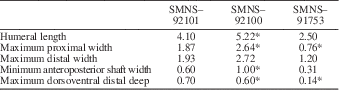
The material referred to Owenettidae, aff. Barasaurus, consists of two isolated humeri that represent a single morphotype, with slight differences between them (Figs. 1, 2). These differences could be explained by ontogeny (SMNS 92101 is about 25% smaller —considering the total length—than SMNS 92100; see Table 1), taphonomy (SMNS 92101 is better preserved, being unaffected by compression unlike SMNS 92100), and that they come from different localities but from the same horizon.
Measurements of the described humeri from the Middle Triassic Erfurt Formation (lower Keuper), Germany. Values are in centimeters; *indicates a partial value due to incompleteness or postmortem deformation.

SMNS 92101
The specimen is a left complete humerus (see Table 1). The humerus is stout with well-defined processes and a well-preserved external surface, and considering its small size, its robustness and processes are noteworthy (Fig. 1). Its proximal and distal ends are expanded and twisted relative to one another. The angle between the axis of the proximal articular end relative to the transverse width axis of the distal end is 63°. The maximum proximal width (from the anterior end of the deltopectoral crest to the posterior end of the lesser tuberosity) equals 44% of the maximum length, whereas the maximum preserved width, between the epicondyles, represents 48%.
The proximal articular surface is dorsoventrally elongated and drop shaped. A more rounded surface, which should correspond to the humeral head, is well defined on the most dorsal side of the proximal articular surface, seen in proximal view (Fig. 1). The head is slightly convex and faces posterodorsally; the ventral extent of the head is unclear. Posteroventrally, the proximal articular surface is separated from the lesser tuberosity by a distinctive concave, notched surface. The proximal articular surface, especially the proximodorsal area of the head, has a rough texture, indicating an area of cartilage cover. Along this region, the “greater” tuberosity is not defined.
The deltopectoral crest is extremely reduced and stands apart from the head as an anteriorly projected triangular process, on the same plane as that of the ectepicondyle (Fig. 1). The anterodistal edge of the deltopectoral crest extends distally to contact the anterodorsal edge of the ectepicondyle. The trajectory of this crest is unusual because in most amniote humeri with twisted proximal and distal ends and a short shaft (e.g., some procolophonids, synapsids; Romer, Reference Romer1922; Jenkins, Reference Jenkins1971; deBraga, Reference deBraga2003), the distal border of the deltopectoral crest extends distally to merge with the ventral surface of the entepicondyle (and not the anterodorsal edge of the ectepicondyle). In dorsal view, there is a concave triangular surface and a deep groove on the deltopectoral crest with scars, which would indicate the origin area of M. brachialis and part of M. supracoracoideus (in the deep proximal groove; Romer, Reference Romer1956; Holmes, Reference Holmes1977; Angielczyk et al., Reference Angielczyk, Sidor, Nesbitt, Smith and Tsuji2009; Figs. 1, 4). The insertion of M. deltoideus would be restricted to the anterodorsal edge of the deltopectoral crest. In ventral view, the deltopectoral crest bears a transverse elevation at its middle point, which would correspond to the insertion area of M. pectoralis (Romer, Reference Romer1956; Holmes, Reference Holmes1977). Distal to it, there is also a longitudinal concave area that extends distally, extending parallel to the anterior border of the shaft. We are not confident that this depression corresponds to a muscle attachment area, but perhaps the most proximal portion would have also been part of the insertion area of M. pectoralis (Romer, Reference Romer1956; Angielczyk et al., Reference Angielczyk, Sidor, Nesbitt, Smith and Tsuji2009).
The transverse elevation on the ventral surface of the deltopectoral crest also delimits the laterodistal border of a large semicircular concave area (Fig. 1). This area is widely extended and faces anteroventrally, with randomly distributed vascular foramina and conspicuous scars, which would correspond to the insertion area of M. coracobrachialis.
One of the most conspicuous processes on the proximal half of the humerus is the lesser tuberosity (Fig. 1). It is stout and, contrary to most tetrapods (e.g., Romer, Reference Romer1956), greatly extended posteroventrally as in the procolophonian Barasaurus (unpublished data, Meckert, 1995; hypertrophied in turtles; e.g., Romer, Reference Romer1956). The lesser tuberosity is as wide as the humeral head, and its proximal tip is positioned below the level of the humeral head, almost at the same level as the deltopectoral crest. In addition, its proximal portion forms a rough surface from which a thin crest descends onto the dorsoposterior aspect of the tuberosity. The lesser tuberosity also has a ventral surface with muscle scars. The most proximal portion of the lesser tuberosity would correspond to the insertion of M. subcoracoscapularis and more distally (on the posterodorsal and posteroventral margins) of M. latissumus dorsi. Of note, on the ventral side, at the distal base of the lesser tuberosity, there is a prominent buttress that is not developed in the same way as in other amniotes (e.g., Romer, Reference Romer1922, Reference Romer1956; Jenkins, Reference Jenkins1971). This process would correspond to the insertion area of M. coracobrachialis longus (Angielczyk et al., Reference Angielczyk, Sidor, Nesbitt, Smith and Tsuji2009).
The narrowest portion of the shaft has a subtriangular cross section with a flat surface in the dorsal aspect and a concave apex in the medial aspect, which correspond to the bridge linking the distal base of the lesser tuberosity and the proximal base of the supinator process (Fig. 1).
The distal width of the humerus is slightly more expanded than the proximal width, representing about one-half (0.47) of the proximodistal length. The entepicondyle is proximodistally tall, well developed posteriorly, with a straight lateral edge, forming a right angle with the distal articular end. The posterior surface of the entepicondyle has a longitudinal, gently concave groove with shallow rugosities and pits for the origin of the flexor muscles of the forearm (Holmes, Reference Holmes1977; Angielczyk et al., Reference Angielczyk, Sidor, Nesbitt, Smith and Tsuji2009; Fig. 4). There is no evidence of an entepicondylar foramen on either side, and both the dorsal and ventral sides of the entepicondyle are gently concave (Fig. 1). The ectepicondyle is also well developed, with its anterior edge semicircular in outline. This area of the ectepicondyle, for the attachment of extensor muscles of the forearm (Holmes, Reference Holmes1977; Angielczyk et al., Reference Angielczyk, Sidor, Nesbitt, Smith and Tsuji2009), is not as rough as the opposite area of the entepicondyle. On the ventral surface, there is a stout supinator process. This process delimits the proximal edge of the entepicondylar notch, which is open anterodistally. The entepicondylar notch encloses the groove for nerves and veins extending dorsoproximally-ventrodistally (Fig. 1). The ectepicondylar notch is positioned well distally, similar to the condition in some procolophonians (Barasaurus; unpublished data, Meckert, 1995), some basal synapsids (e.g., Dimetrodon; Romer and Price, Reference Romer and Price1940) and some archosauromorphs (e.g., Trilophosaurus buettneri Case, Reference Case1928 and Otischalkia elderae Hunt and Lucas, Reference Hunt and Lucas1991; Spielmann et al., Reference Spielmann, Lucas, Rinehart and Heckert2008).
The distal articular surface is characterized by a prominent semispherical capitellum (radial condyle) positioned on the lateral half of the distal end, close to the ectepicondyle and ectepicondylar notch. The articular surface of the capitellum is mainly developed on the ventral and distal aspects of the humerus, without a contribution to the dorsal surface. Most of the surfaces of the capitellum have a rough texture indicative of a cartilaginous cover. The trochlea (ulnar condyle) is medial to the capitellum, almost at the middle of the distal end, but it is poorly developed, almost flat. In addition, there is no evidence of an olecranon fossa. Consequently, the dorsal aspect of the distal half of the humerus is gently concave without remarkable features.
SMNS 92100
This specimen is a right humerus with a partially preserved proximal articular surface, capitellum, and most of the distal portion of the distal end, lacking most of the supinator process in the ectepicondylar region (Fig. 2). This element has the same morphological pattern (i.e., shape of the processes and crests, relationships of the areas for muscle origin/insertion, lack of an entepicondylar foramen) as the already described humerus SMNS 92101 (Fig. 1). For such reason, it is described in less detail than is SMNS 92101. The main differences are the development of the scars for the muscles and the twisted angle between the proximal and distal ends. The more robust scars in SMNS 92100 are consistent with the larger size of this specimen (see Table 1). The difference in the angle of the proximal and distal ends, and the shape of the lesser tuberosity (more gently quadrangular than in SMNS 92101), is explained by taphonomic deformation: SMNS 92100 has evidence of strong flattening all over the bone. Due to the flattening, the major axis of the proximal end is on the same plane as the major axis of the distal end, considerably deforming the lesser tuberosity. Consequently, the lesser tuberosity of SMNS 92100 is more posteriorly (in almost the same plane as the entepicondyle) than posteroventrally projected (the condition in SMNS 92101). As in SMNS 92101, the lesser tuberosity is strongly developed with stout scars for muscle attachment, and the deltopectoral crest is reduced, forming a thin triangular projection (Fig. 2). The supinator process is broken near its base, but the notch of the ectepicondyle is clearly observed, as is the lateral groove. The ectepicondylar notch is distally located as in SMNS 92101, and anterodistally opened, according to the anterior end of the ectepicondyle (Fig. 2).
In ventral view, the attachment buttress for M. coracobrachialis longus (Angielczyk et al., Reference Angielczyk, Sidor, Nesbitt, Smith and Tsuji2009), located at the base of the lesser tuberosity, is extremely large, forming a prominent irregular surface (Fig. 2), more developed than in SMNS 92101. The same occurs on the posterodorsal edge of the lesser tuberosity, which has a rougher surface with prominent thin processes. In the distal half, the entepicondyle has a more irregular lateral edge, possibly for attachment of powerful flexor muscles. On the dorsal surface of the entepicondyle, near the posterior edge, there is prominent process with a rough surface not observed in SMNS 92101 (this area is relatively flat in this specimen). This structure seems to be related to muscle attachment and would correspond to the area of origin of M. triceps humeralis medialis or, as an alternative hypothesis, the area for a dorsal component of the antebrachial flexor muscles (Holmes, Reference Holmes1977; Angielczyk et al., Reference Angielczyk, Sidor, Nesbitt, Smith and Tsuji2009). Due to the lack of an entepicondylar foramen in SMNS 92101 and the absence of any evidence of this foramen on the ventral surface of the entepicondyle of SMNS 92100, we are confident that this prominent process has no relation to the absence of this foramen. In ventral view, the capitellum is large but unfortunately mostly eroded. However, judging from its outline, it seems to be as prominent as in SMNS 92101. The trochlea is not preserved. Possibly it was poorly developed as in SMNS 92101. In dorsal view, most of the distal half is almost flat, with some small, randomly distributed foramina.
Comparisons
At first glance, the expanded and twisted proximal and distal ends and the robustness of the humerus are features reminiscent of several groups of synapsids, including most Permian nontherapsid families such as varanopids (Varanops and Watongia; Reisz and Laurin, Reference Reisz and Laurin2004), ophiacodontids (e.g., Ophiacodon; Romer and Price, Reference Romer and Price1940), and sphenacodontids (Romer, Reference Romer1922; Romer and Price, Reference Romer and Price1940), and late Permian and Triassic therapsids, such as many dicynodonts (e.g., Cistecephalus, Dicynodontoides, Ischigualastia; Cox, Reference Cox1965; Cluver, Reference Cluver1978; Angielczyk et al., Reference Angielczyk, Sidor, Nesbitt, Smith and Tsuji2009), some basal therocephalians (Cynariognathus; Cys, Reference Cys1967), and some nonmammaliaform cynodonts (e.g., Thrinaxodon, Exaeretodon, Chiniquodon; Bonaparte, Reference Bonaparte1963; Jenkins, Reference Jenkins1971; Abdala, Reference Abdala1999). This condition is also observed, in different degrees of development, in other tetrapods such as diadectomorphs (e.g., Kennedy, Reference Kennedy2010) and some parareptiles (e.g., Millerosaurus and Procolophon; Watson, Reference Watson1957; deBraga, Reference deBraga2003). Nonetheless, in the aforementioned taxa, the deltoid or deltopectoral crest is usually a bulbous or flaring well-developed process unlike the condition present in SMNS 92101 and SMNS 92100 (Figs. 1, 2).
Usually, an expanded proximal end is the product of the enlargement of the deltopectoral crest for powerful pectoral and deltoid musculature, serving to hold a heavy body with sprawling forearm orientation (e.g., Romer, Reference Romer1922, Reference Romer1956; Cox, Reference Cox1965) or as a result of an ecological adaptation for swimming or digging (e.g., Cluver, Reference Cluver1978; Hildebrand, Reference Hildebrand1988; Walker and Liem, Reference Walker and Liem1994; Martinelli et al., Reference Martinelli, Bonaparte, Shultz and Rubert2005). The expanded proximal halves of SMNS 92101 and SMNS 92100 have an uncommon combination of features. We observe in these specimens a reduced deltopectoral crest and a hypertrophied posteroventrally projecting lesser tuberosity. A comparable organization of the processes and muscle attachment sites of the proximal half of the humerus are observed in the late Permian–Early Triassic owenettid procolophonian Barasaurus (unpublished data, Meckert, 1995). Turtles also possess great development of the lesser tuberosity and less conspicuous deltoid and pectoral processes (Romer, Reference Romer1956; Sterli et al., Reference Sterli, de La Fuente and Rougier2007), but the overall configuration is quite different from what is observed here. In addition, some transversal enlargement of the proximal half of the humerus is observed in some medium- to large-sized archosauromorphs, such as Trilophosaurus (Spielmann et al., Reference Spielmann, Heckert and Lucas2005, Reference Spielmann, Lucas, Rinehart and Heckert2008) and archosaurs Postosuchus and Batrachotomus (Gower and Schoch, Reference Gower and Schoch2009; Weinbaum, Reference Weinbaum2013). However, in the latter taxa the lesser tuberosity is much less developed, and overall the distal end is less expanded; the humeri are slender, elongate, and not twisted.
SMNS 92100 and SMNS 92101 lack an entepicondylar foramen (Figs. 1, 2). The presence of this foramen is a plesiomorphy in some tetrapods (e.g., Romer, Reference Romer1922; Romer and Price, Reference Romer and Price1940; Kennedy, Reference Kennedy2010). This foramen is absent in several amphibians (Romer, Reference Romer1956), some stem turtles and testudines (Romer, Reference Romer1956; Sterli et al., Reference Sterli, de La Fuente and Rougier2007; Schoch and Sues, Reference Schoch and Sues2015), and almost all Mesozoic archosauromorph groups (e.g., Romer, Reference Romer1956; Nesbitt, Reference Nesbitt2011; Ezcurra et al., Reference Ezcurra, Scheyer and Butler2014; the protorosaur Czatkowiella harae Borsuk–Białynicka and Evans, Reference Borsuk–Białynicka and Evans2009 is apparently the only archosauromorph with an entepicondylar foramen according to Borsuk–Białynicka and Evans, Reference Borsuk–Białynicka and Evans2009). Moreover, the lack of an entepicondylar foramen is diagnostic of the procolophonian family Owenettidae (Reisz and Laurin, Reference Reisz and Laurin1991; Reisz and Scott, Reference Reisz and Scott2002).
In SMNS 92101 and SMNS 92100, the ectepicondylar foramen is absent. However, the ectepicondyle has a well-developed ectepicondylar notch and an associated groove for the radial nerve (Romer and Price, Reference Romer and Price1940), bordered proximoventrally by the supinator process. An ectepicondylar notch is recognized in several amniote groups with different degrees of development (Romer, Reference Romer1922, Reference Romer1956; Dilkes, Reference Dilkes1998; Spielmann et al., Reference Spielmann, Lucas, Rinehart and Heckert2008; Ezcurra et al., Reference Ezcurra, Scheyer and Butler2014). In articular, a relatively large, distally positioned notch is seen in some basal tetrapods (e.g., diadectomorph Limnoscelis; Kennedy, Reference Kennedy2010), some basal nontherapsid synapsids (e.g., Casea, Varanops, Dimetrodon, and Ophiacodon; Romer, Reference Romer1922; Romer and Price, Reference Romer and Price1940), some basal archosauromorphs (e.g., Trilophosaurus buettneri and Otischalkia elderae; Hunt and Lucas, Reference Hunt and Lucas1991; Spielmann et al., Reference Spielmann, Lucas, Rinehart and Heckert2008), and owenettid procolophonians (Barasaurus and Owenetta; unpublished data, Meckert, 1995; Reisz and Scott, Reference Reisz and Scott2002).
In conclusion, the combination of features (i.e., stout humerus with expanded and twisted proximal and distal ends, lesser tuberosity larger than deltopectoral crest, deep ectepicondylar notch with prominent supinator process, lack of entepicondylar foramen) noted in SMNS 92101 and SMNS 92100 is only observed in the owenettid Barasaurus from the upper Permian and Lower Triassic of Madagascar (unpublished data, Meckert, 1995; see Fig. 5).
Among the six recognized species of owenettids, only Owenetta kitchingorum Reisz and Scott, Reference Reisz and Scott2002 and Barasaurus besairiei have associated postcranial elements (unpublished data, Meckert, 1995; Reisz and Scott, Reference Reisz and Scott2002). Barasaurus has a stout humerus with expanded and twisted proximal and distal ends (unpublished data, Meckert, 1995; Fig. 5), whereas O. kitchingorum has a longer and more slender humerus (Reisz and Scott, Reference Reisz and Scott2002). These dissimilar humeral morphologies between these owenettid taxa highlight the diversity within the family. Nonetheless, both taxa lack an entepicondylar foramen, a synapomorphy of the family, unlike in other basal parareptiles (e.g., Millerosaurus; Watson, Reference Watson1957; Gow, Reference Gow1972) and procolophonids (e.g., Procolophon; deBraga, Reference deBraga2003). Compared to humeri figured and described by Mecker (1995), the humeri here described from Germany are similar in structure (Fig. 5) to Barasaurus, rather than Owenetta. Cisneros (Reference Cisneros2008, fig. 3D) illustrated, as a comparative figure, a right humerus of Barasaurus besairiei, which has several differences (e.g., presence of an ectepicondylar foramen) when compared to the description and figures of several specimens of B. besairiei studied by Mecker (1995). For that reason, we opted to follow the complete description of Mecker (1995).
Family Procolophonidae Lydekker in Nicholson and Lydekker, Reference Nicholson and Lydekker1889
Gen. indet. sp. indet.
Referred specimens
SMNS 91753, left humerus.
Occurrence
From the Schumann quarry (near the village of Eschenau), Germany. Middle Triassic Erfurt Formation (lower Keuper).
Description
SMNS 91753 is a small complete left humerus (see Table 1), although it is strongly affected by compression resulting in an extremely thin (almost laminar) fossil, with the deltopectoral crest partially broken off (Fig. 3). The proximal half and most of the entepicondylar area have several small fractures that slightly affect the shape of the bone. The proximal half is not as expanded as the distal end (Fig. 3). The humeral head is reduced and anterodorsally projected. On the dorsolateral edge of the head, a faint crest originates (crest ‘A’ in Fig. 3) that extends distally and delimits the lateral border of the shaft. Just ventrally, there is a proximodistal concave area and another thin and flat crest (crest ‘B’ in Fig. 3). This crest would have been less sharp and thin originally. This crest and the depression would correspond to the process for the insertion of M. brachialis (Angielczyk et al., Reference Angielczyk, Sidor, Nesbitt, Smith and Tsuji2009). Seen in ventral view, the crest ‘B’ forms part of the anterior edge of the proximal half of the humerus and is separated from the base of the deltopectoral crest by a longitudinal concavity, which also would be for insertion of M. brachialis (Angielczyk et al., Reference Angielczyk, Sidor, Nesbitt, Smith and Tsuji2009).
The deltopectoral crest is mostly broken off, but judging from its preserved base, it was more developed than the lesser tuberosity (Fig. 3). As preserved, the deltopectoral crest is apparently projected posteroventrally. In ventral view, the bicipital groove for insertion of M. coracobrachialis is well developed proximodorsally between the deltopectoral crest and the lesser tuberosity. The lesser tuberosity forms a thin triangular projection with its most posterior point located below the level of the head. This tuberosity is continuous with the head. The greater tuberosity is indistinguishable, and the bad preservation of this portion of the bone makes its identification difficult. The shaft is narrow and elliptical in cross section but was possibly affected by deformation. On the posteroventral edge of the shaft, there are two tiny foramina.
In ventral view, the distal half is extremely flat and fan shaped (Fig. 3). The widest portion of the distal end represents 48% of the total humeral length. The ectepicondyle is poorly developed, with the main muscular surface facing anterodistally. The ectepicondylar foramen is absent, as are the supinator process and ectepicondylar notch. The entepicondyle is proximodistally high and well expanded posteriorly. The entepicondylar foramen is large and elongated, extending obliquely through the entepicondyle and located well away from the posteroproximal edge. There is a substantial entepicondylar ridge with the foramen through the entepicondyle. The articular condyles are heavily crushed, but on the ventral aspect of the humerus, a rough surface indicates a cartilaginous cover. The larger rough surface is anterior, close to the ectepicondyle, and corresponds to the capitellum (radial condyle; Fig. 3). It is well expanded on the ventral surface of the distal half of the humerus. Continuous with it, there is a reduced rough surface that corresponds to the trochlea (ulnar condyle) posterior to the capitellum. In dorsal view, there is a shallow depression, near the distal edge, which may correspond to an incipient olecranon fossa. The muscle scars are poorly recognized on the humerus.
Comparisons
The humerus SMNS 91753 is more slender than the humeri described in the preceding (SMNS 92100 and SMNS 92101; Figs. 1, 2). The proximal half is affected by compaction but clearly lacks the stout processes of SMNS 92101. The shape of the deltopectoral crest and the posteriorly placed deep fossa are similar to those of some procolophonids, such as those of the procolophonid Anomoiodon liliensterni von Huene, Reference Huene1939, from the Lower Triassic of Germany (Säilä, Reference Säilä2008). For example, in the larger procolophonid Procolophon trigoniceps Owen, Reference Owen1876, this crest and the fossa are better developed (deBraga, Reference deBraga2003).
The presence of the entepicondylar foramen in SMNS 91753 is a plesiomorphy widely shared among amniotes (e.g., Romer, Reference Romer1922, Reference Romer1956; Romer and Price, Reference Romer and Price1940; Kennedy, Reference Kennedy2010; Nesbitt, Reference Nesbitt2011). Its position and shape in SMNS 91753 are also reminiscent of that of Anomoiodon (Säilä, Reference Säilä2008) and other nonowenettid procolophonians (e.g., deBraga, Reference deBraga2003; Modesto and Damiani, Reference Modesto and Damiani2007; Cisneros, Reference Cisneros2008). The well-developed entepicondyle was a feature used to characterize ‘horned procolophonids’ (i.e., procolophonines plus leptopleuronines) by Cisneros (Reference Cisneros2008). The lack of an ectepicondylar foramen or ectepicondylar groove is also a feature of procolophonids (Laurin and Reisz, Reference Laurin and Reisz1995; Cisneros, Reference Cisneros2008).
In this way, the combination of features observed in SMNS 91753 resembles the procolophonid condition, having especially close similarity to that of Anomoiodon (Säilä, Reference Säilä2008), and represents a gracile form, slighter in appearance than unlike Procolophon (deBraga, Reference deBraga2003).
Discussion
The assignment of SMNS 92100 and SMNS 92101 to the owenettid procolophonians sheds new light on the evolution of this parareptile clade after the Permian–Triassic extinction. The six known members of this family range from the late Permian to the Middle Triassic times. Owenetta rubidgei Broom, Reference Broom1939 is based on several specimens from Permian localities of the Karroo Basin of South Africa, from the Cistecephalus and Dicynodon Assemblage Zones (AZs; Broom, Reference Broom1939; Reisz and Scott, Reference Reisz and Scott2002). The other known species, Owenetta kitchingorum, was recorded in the Lower Triassic Lystrosaurus AZ (Reisz and Laurin, Reference Reisz and Laurin1991; Reisz and Scott, Reference Reisz and Scott2002). Barasaurus besairiei was first recognized in the upper Permian of the Lower Sakamena Formation, Ranohira, southern Madagascar (Piveteau, Reference Piveteau1955; unpublished data, Meckert, 1995), and later on, the genus was recorded in the Lower Triassic Middle Sakamena Formation (Madagascar; considered intermediate in age between the Lystrosaurus and Cynognathus AZs; Ketchum and Barret, 2004). Saurodektes rogersorum Modesto et al., Reference Modesto, Damiani, Neveling and Yates2003 was described on the basis of cranial material from the Lystrosaurus AZ (Modesto et al., Reference Modesto, Damiani, Neveling and Yates2003, Reference Modesto, Damiani, Neveling and Yates2004). Ruhuhuaria reiszi Tsuji et al., Reference Tsuji, Sobral and Müller2013 is based on a single skull from the Middle Triassic Lifua Member of the Manda Formation (Ruhuhu Basin) of southwestern Tanzania (Tsuji et al., Reference Tsuji, Sobral and Müller2013), and finally, Candelaria barbouri Price, Reference Price1947 is from the Dinodontosaurus AZ of the Pinheiros–Chiniquá Sequence, Santa Maria Supersequence of southern Brazil (Cisneros et al., Reference Cisneros, Damiani, Schultz, da Rosa, Schwanke, Neto and Aurélio2004; Soares et al., Reference Soares, Schultz and Horn2011; Horn et al., Reference Horn, Melo, Schultz, Philipp, Kloss and Goldberg2014).
The humeri from the Middle Triassic of Germany constitute the first owenettids from Europe and represent one of the youngest records for the group, together with Ruhuhuaria reiszi from Tanzania and Candelaria barbouri from Brazil. They also add support to the survival and diversification of this family of procolophonians during the Triassic, as stated by other authors (Modesto et al., Reference Modesto, Sues and Damiani2001, Reference Modesto, Damiani, Neveling and Yates2003; Reisz and Scott, Reference Reisz and Scott2002; Cisneros et al., Reference Cisneros, Damiani, Schultz, da Rosa, Schwanke, Neto and Aurélio2004), since the oldest representatives are known from the late Permian.
The isolated procolophonid humerus represents the second taxon of procolophonians in the lower Keuper of Germany. It resembles Anomoiodon from the Lower Triassic of Germany (Säilä, Reference Säilä2008); nonetheless, more complete skeletal material is needed to corroborate this hypothesis.
Conclusions
From two isolated humeri, we recognize the presence of an owenettid procolophonian, aff. Barasaurus, in the Middle Triassic of Germany. This family was first recorded from the late Permian to the Early Triassic (Reisz and Laurin, Reference Reisz and Laurin1991; Reisz and Scott, Reference Reisz and Scott2002; Modesto et al., Reference Modesto, Damiani, Neveling and Yates2003; Ketchum and Barrett, Reference Ketchum and Barrett2004); therefore, the specimens from Germany represent the first record in Europe and one of the youngest records of the family, together with Ruhuhuaria reiszi from Tanzania and Candelaria barbouri from Brazil. The other specimen, SMNS 91573, indicates the presence of a small-sized procolophonid. The three described humeri indicate the coexistence of both procolophonian families in the Middle Triassic of Germany. Finally, although based on isolated specimens, these records highlight the taxonomic diversity of the still poorly known tetrapod assemblage of the lower Keuper in southwestern Germany.
Acknowledgments
We thank F. Ullmann and M. Salomon for donating the material and I. Rosin and M. Kamenz for skillfully preparing the specimens. We are grateful to C. Schultz and A.M. Ribeiro for providing helpful suggestions. Funds were provided by the Conselho Nacional de Desenvolvimento Científico e Tecnológico (CNPq nº 304143/2012-0; grants to MBS and AGM). We thank the editor in chief S. Hageman, the associate editor H.-D. Sues, and the reviewer R.R. Reisz for comments that greatly improved the manuscript.