Introduction
In the United States, 9.7% of infants and toddlers have a high weight-for-recumbent length and 16.9% of children and adolescents 2–19 years of age are obese.Reference Ogden, Carroll, Kit and Flegal 1 Obese children are more likely to become obese adults later in life.Reference Daniels 2 The development of obesity has largely been attributed to unhealthy lifestyle choices or uncontrollable genetic predispositions; however, emerging evidence reveals that one’s exposure within the intrauterine environment may play a role in the development of obesity.Reference Barker 3 , Reference Gillman 4 The Developmental Origins of Health and Disease (DOHaD) hypothesis purports that an unfavorable intrauterine environment due to several conditions, including maternal obesity and excessive gestational weight gain (GWG), increases the obesity risk in offspring.Reference Gillman 4
Maternal obesity and excessive GWG are related to giving birth to a large-for-gestational-age (LGA, birth weight ⩾90th percentile) infant.Reference Adamo, Ferraro and Brett 5 , Reference Oken 6 Further, evidence suggests that the association between maternal obesity and/or excessive GWG with offspring obesity can continue into adulthood.Reference Li, Law, Lo and Power 7 – Reference Ferraro, Barrowman and Prud’homme 9 Many women also fail to lose weight after pregnancy.Reference Gunderson 10 Studies showed that overweight and obese women retain more weight compared with women who are of normal pre-pregnancy weight.Reference Harris, Ellison, Holliday and Lucassen 11 Retained weight may be carried to the next pregnancy, and each subsequent pregnancy may result in more weight gain.Reference Gunderson 10 Epidemiological studies have supported the role of physical activity (PA) as a strategy for pregnant women to minimize GWG.Reference Olson and Strawderman 12 – Reference Haakstad, Voldner, Henriksen and Bø 14 Thus, interventions have been designed to help pregnant women increase their PA to improve maternal and fetal health outcomes.Reference Haakstad and Bø 15 – Reference Mottola, Giroux and Gratton 17 Few studies have investigated the impact of prenatal PA interventions on post-partum weight retention, and/or infant growth.
The timing of GWG is also important.Reference Muscati, Gray-Donald and Koski 18 A fetus’ exposure to the maternal intrauterine environment at different periods of gestation could have different impacts on the offspring. In the Dutch Famine study, children of mothers who were exposed to famine during the first and second trimester had a higher risk of obesity compared to those who were exposed to famine during the last trimester.Reference Ravelli, Stein and Susser 19 Thus far, studies have shown that weight gain at different trimesters was associated with birth weightReference Margerison-Zilko, Shrimali and Eskenazi 20 , Reference Davenport, Ruchat, Giroux, Sopper and Mottola 21 and childhood body mass index (BMI) at ages fiveReference Margerison-Zilko, Shrimali and Eskenazi 20 and seven;Reference Andersen, Gamborg, Sørensen and Nohr 22 however, no study has reported trimester-specific GWG with weight during infancy (ages 1–12 months). In terms of infant body composition, studies reported a positive relationship between GWG in early pregnancy and offspring adiposity at birthReference Davenport, Ruchat, Giroux, Sopper and Mottola 21 and at age 9;Reference Fraser, Tilling and Macdonald-Wallis 23 but, again previous work has not examined trimester-specific GWG with offspring’s adiposity during infancy.
The objectives of this study were (1) to compare post-partum weight retention and offspring outcomes of overweight and obese women who enrolled in an unsupervised walking intervention during pregnancy with control group; (2) to examine the association between trimester-specific GWG rates with infant anthropometric outcomes at 1 and 6 months of age. Our hypotheses were (1) overweight and obese women who participated in the walking intervention during pregnancy would have less maternal weight retention and their infants would be smaller (weight-for-length z-score), and have less total fat mass at 1 and 6 months of age; (2) infant’s weight-for-length z-score and total fat mass would be significantly associated with GWG during first and second trimesters.
Methods
Study design
The main objective of the unsupervised walking intervention was to promote moderately intense PA (MPA) among previously non-exercising, overweight and obese pregnant women. Women in the intervention group were verbally advised to meet the 2008 US Physical Activity Guidelines for pregnant population (accumulate a minimum of 150 min per week of moderate PA, preferably spread throughout the week). 24 Participants were allowed to walk in shorter bouts of at least 10 min in length, which is also consistent with the Guidelines. The walking program began by week 15 of gestation, and lasted until at least week 35. Treadmills were provided to individuals in the intervention group for the duration of the study, and were returned at the program’s end. Women in the control group were not provided PA recommendations, and treadmills; but, they were not restricted from participating in PA. The PA levels of women from both groups were objectively assessed during the intervention period using a StepWatch™ Activity Monitor at 10–14 (V1), 17–19 (V2), 27–29 (V3) and 34–36 (V4) weeks of gestation. Studies have reported the accuracy and precision of StepWatch™ monitor for measuring walking.Reference Feito, Bassett and Thompson 25 , Reference Foster, Lanningham-Foster and Manohar 26 The detailed information (i.e. recruitment, walking program instructions, subject compliance) of this pilot, unsupervised walking intervention has been published elsewhere.Reference Kong, Campbell, Foster, Peterson and Lanningham-Foster 27 Women in the study were not given instructions or counseling on their diet; therefore, any intervention effect on the maternal and child health outcomes during the post-partum period maybe attributed to some extent to the walking program during pregnancy. Post-partum data regarding the anthropometric information of mothers and infants were collected at 1 and 6 months.
Participants
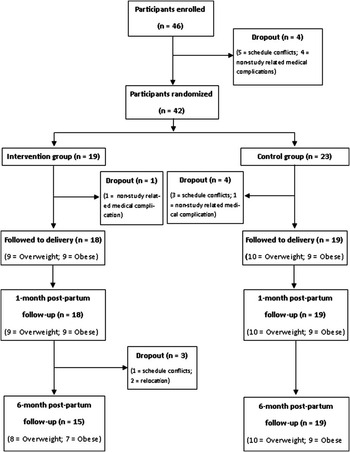
The study was approved by the Institutional Review Board of Iowa State University (ISU). Pregnant women were recruited through mass email service provided by ISU to the students, staff, and faculty on campus, online advertisement (i.e. Craigslist), and flyers posted throughout the community (i.e. restaurants, public libraries, grocery stores) as well as our partnership with local hospitals and obstetric clinics. Participants were randomly assigned to the intervention or control group using a computer-based random number generator (Microsoft Excel 2010, WA) after the initial enrollment. Before baseline data collection, all participants and research personnel were blinded to the group allocation. A study coordinator revealed the study groups to women at the baseline data collection visit. A total of 46 overweight and obese women enrolled in the program. Nine women dropped out from the walking program due to schedule conflicts and medical complication (non-related to the study) such as miscarriages. The final number of women who completed the 1 month post-partum data collection was 37 (n=18 intervention; n=19 control), and six months post-partum collection was 33 (n=15 intervention; n=19 control). Details on dropouts are presented in Figure 1. Participants who were enrolled met the following inclusion criteria: maternal age between 18–45 years old, singleton pregnancy, non-smoker, self-reported overweight (BMI⩾25.0 kg/m2) or obese (BMI⩾30.0 kg/m2) before pregnancy, no prior history of gestational diabetes or other chronic diseases. Additionally, women were only recruited into the study if they engaged in leisure-time physical activity (LTPA) for ⩽30 min fewer than three times per week during the 6 months before enrollment.
Participant flow chart. Overweight and obese pregnant women who participated in an unsupervised walking intervention were followed after 1- and 6-month delivery.

Data collection
Maternal anthropometric and demographic data
Weight was measured in light clothing at each time point: weeks 10–14 (V1), 17–19 (V2), 27–29 (V3) and 34–36 (V4) of gestation to the nearest 0.1 kg (Detecto Model 6855 Cardinal Scale, Manufacturing Co., Webb City, MO). Pre-pregnancy BMIs were determined by using enrollment height along with self-reported weight prior to conception. Weight retention was calculated by subtracting post-partum weight from self-reported pre-pregnancy weight.Reference Phelan, Phipps and Abrams 28 At 6 months post-partum, women’s weight retention was further defined as substantial (weight retention defined ⩾5 kg above pre-pregnancy weight) or not substantial.Reference Gunderson 10 , Reference Gunderson, Rifas-Shiman and Oken 29 Weight retention was then converted to percentage of weight retention (% weight retention) based on self-reported pre-pregnancy weight. Individual weight change from 1 month to 6 months post-partum was calculated and analyzed. GWG rate in this study was divided into three periods: weight gain per week from conception (0 week) up to V1 (Tri1 GWG rate), weight gain per week between V1 and V3 (Tri2 GWG rate), and weight gain per week between V3 and V4 (Tri3 GWG rate). Participants reported their age, education level, employment, race, marital status, income level and parity.
Infant anthropometric data
Infant lengths at 1 and 6 months were measured to the nearest 0.1 cm using a measuring board (Seca 416, Medical Scales and Measuring Systems Seca corp., Chino, CA). Body weights and body compositions were measured to the nearest 0.001 kg (PEA POD® or BOD POD Pediatric Option™, COSMED USA, Concord, CA). PEA POD® and BOD POD Pediatric Option™ are systems for body composition measurement based on air displacement plethysmography. Instruments were calibrated daily. The weight limit of the PEA POD® is 12 kg; therefore two 6-month-old babies were measured using the BOD POD Pediatric Option™. Before the measurement of weights and body composition, infants were undressed and baby oil was used to smooth the infants’ hair down to eliminate air trapped in hair. Body weights and body compositions were performed on babies with clothing removed in the PEA POD®. Light-weight and form-fitting shorts were provided for babies measured using the BOD POD Pediatric Option™. Infants were weighed first and then body volume was assessed while infants were awake.
To account for sex differences, enable comparison of effect sizes, and maintain consistency, all infant anthropometric outcomes were converted to z-scores. Infant weights z-score, lengths z-score, and weight-for-lengths z-score at 1 and 6 months were calculated to sex- and age-specific z-scores using the 2000 Centers for Disease Control/National Center for Health Statistics growth charts.Reference Kuczmarski, Ogden and Grummer-strawn 30 Ponderal index (PI) was assessed in this study using the measured length and weight at 1 and 6 months old.Reference Catalano, Tyzbir, Allen, McBean and McAuliffe 31 However, the analyses using PI were not significant; therefore, results were not included.
Statistical analysis
A multivariate analysis of variance (ANOVA) was conducted to examine differences in demographic variables (age, height, pre-pregnancy weight, pre-pregnancy BMI, education, employment, race, marital status, total household income, parity) between the groups. Two-way ANOVA was used to determine the differences in weight retention (kg and percent), and infant anthropometric outcomes (weight, length, weight z-score, length z-score, weight-for-length z-score, fat mass and fat-free mass) by treatment group and mother’s pre-pregnancy BMI category (overweight or obese). Pairwise comparison tests (all pairs Tukey–Kramer P=0.05) were then performed to further determine the differences among overweight women in the intervention group (Int-OW), overweight women in the control group (Con-OW), obese women in the intervention group (Int-OB), and obese women in the control group (Con-OB) on variables mentioned above. Fisher’s exact tests were used to analyze differences in substantial weight retention (⩾5 kg) and weight changes (gain or loss) from 1 to 6 months post-partum among Int-OW, Con-OW, Int-OB and Con-OB women. A Pearson correlation was performed to examine the association between pre-pregnancy BMI and rate of GWG at different trimesters with infant anthropometric outcomes. Stepwise linear regression modeling was used to further explore the predictor(s) of infant anthropometric outcomes after adjusting for birth weight, treatment group and pre-pregnancy BMI. Independent variables included in this analysis were Tri1 GWG rate, Tri2 GWG rate and Tri3 GWG rate. Significance was defined as P<0.05. Data analyses were conducted using JMP, Version 7 (SAS Institute Inc., Cary, NC).
Results
The prenatal PA intervention was successful in changing the walking behavior of the overweight and obese women. Women in the intervention group walked at a higher intensity and for longer amounts of time and were able to sustain these walking habits until late pregnancy. Briefly, women in the treatment group had significantly higher minutes of meaningful walks (walking cadence ⩾80 for at least 8 min bout) at V2 (Int=52.8 min; Con=20.2 min), V3 (Int=44.9 min; Con group=7.8 min, and V4 (Int=42.1 min; Con=6.7 min). There were also significant difference between pre-pregnancy BMI categories at V3 (OW=45.8 min; OB=6.9 min) and V4 (OW=41.7 min; OB=7.1 min). Overall, there were no significant differences in pregnancy complications (i.e. preterm delivery, cesarean delivery, pre-eclampsia, maternal hypertension, gestational diabetes) and infant outcomes (i.e. birth weight, APGAR score) among groups. The detailed results of this prenatal PA intervention have been reported elsewhere.Reference Kong, Campbell, Foster, Peterson and Lanningham-Foster 27
Participant characteristics
Overall, there were no significant differences between groups for age, height, gestational length at V1, education, employment, race, marital status and total household income. There was also no significant difference between groups in parity. Pre-pregnancy weight and pre-pregnancy BMI were significantly higher for obese compared to overweight participants. Majority of participants were Caucasian, married, and educated. Participant characteristics in each group by treatment and BMI category has been published in another journal paper.Reference Kong, Campbell, Foster, Peterson and Lanningham-Foster 27
Maternal post-partum weight
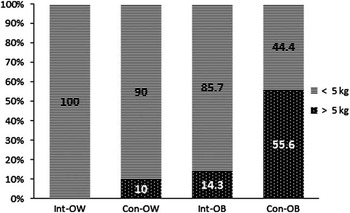
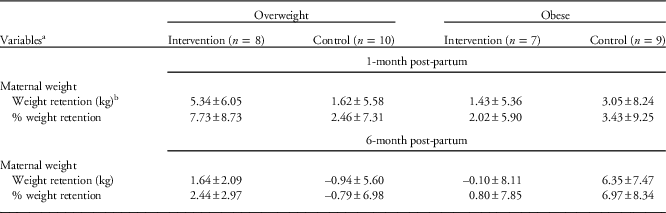
At 1 month post-partum, there was no significant difference between the treatment groups, pre-pregnancy BMI categories and interaction effect between treatment groups and pre-pregnancy BMI categories for weight retention % weight retention. At 6 months post-partum, there was no significant difference between the treatment groups and pre-pregnancy BMI categories, but the interaction effect was significant (P=0.044) for weight retention; while, for % weight retention, there was no significant difference between the treatment groups and pre-pregnancy BMI categories, but a trend of significance in the interaction effect (P=0.059). When pairwise comparison tests were further performed, weight retention and % weight retention were both lower among obese women in the intervention group compared with control group at 6 months post-partum; however, it was not statistically significant (Table 1). When substantial weight retention was examined, a significantly higher percentage of obese women in the control group (55.6%) retained more than 5 kg at 6 months post-partum compared to women in other groups (Int-OW 0%, Con-OW 10%, Int-OB 14.3%) (P=0.024) (Fig. 2). It is worth noting that even though there were no significant differences in weight retention among groups, it appeared that women in the Int-OW group had rather high weight retention at 1 month post-partum. However, this higher weight retention did not persist through 6-month post-partum. In fact, there was 0% of women in Int-OW retained more than 5 kg at 6-month post-partum (Fig. 2).
Percentages of women who had substantial weight retention at 6-month post-partum. When substantial weight retention was examined, women were divided to those who retained less than or those who retained more than 5 kg at 6-month post-partum. Int-OW, overweight women in the intervention group; Con-OW, overweight women in the control group; Int-OB, obese women in the intervention group; Con-OB, obese women in the control group.

Post-partum maternal weight by treatment and pre-pregnancy BMI

BMI, body mass index.
a Values shown are mean±s.d.
b % weight retention was calculated using self-reported pre-pregnancy weight.
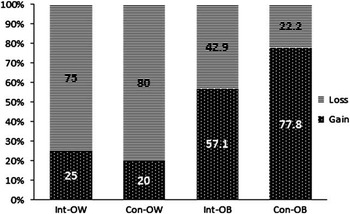
Weight changes from 1 month to 6 months post-partum were then further analyzed and classified as gain or loss (Fig. 3). There were a significantly higher percentage of obese women in the control group (77.8%) who gained weight from 1 to 6 months compared with other groups (Int-OW 25%, Con-OW 20%, Int-OB57.1%) (P=0.046). For those who gained weight from 1 to 6 months, the average weight gain for each group is as follows: Int-OW=1.3 kg, Con-OW=2.2 kg, Int-OB=1.3 kg, Con-OB=5.1 kg; while, for those who lost weight from 1 to 6 months, the average weight loss for each group is as follows: Int-OW=−5.3 kg, Con-OW=−3.8 kg, Int-OB=−5.4 kg, Con-OB=−3.2 kg.
Percentages of women who gained or lost weight from 1 month to 6 months post-partum. Maternal weight was collected at 1 month and 6 months post-partum. Individual weight change was classified as gain or loss from 1 month post-partum to 6 months post-partum. Int-OW, overweight women in the intervention group; Con-OW, overweight women in the control group; Int-OB, obese women in the intervention group; Con-OB, obese women in the control group.

Infant anthropometric outcomes
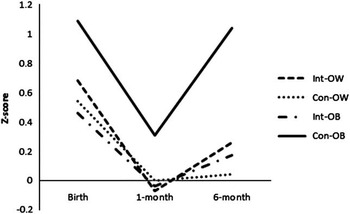
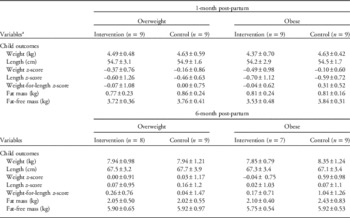
Overall, there were no significant differences in weight, length, weight z-score, length z-score, weight-for-length z-score, fat mass, and fat free mass between the treatment groups, pre-pregnancy BMI categories, or interaction effect at each post-partum visit. Lower weight-for-length z-scores at 1 month (Int-OB=−0.037; Con-OB=0.311; P=0.7904) and 6 months (Int-OB=0.167; Con-OB=1.04; P=0.430) were observed among infants who were born to obese women in the intervention group compared with infants born to obese women in the control group; however, pairwise comparison tests showed no significant difference (Table 2). Even though statistical comparisons did not show group differences between offspring’s anthropometric values, strikingly offspring of obese women in the walking program remained smaller in weight-for length z-score than offspring of obese women in the control group tracking from birth (data reported elsewhereReference Kong, Campbell, Foster, Peterson and Lanningham-Foster 27 ) to 6 months old (Fig. 4).
Infants’ anthropometric outcomes tracking from birth until 6 months old. From birth to 6 months, the offspring growth trend of obese women in the control group was consistently higher than the offspring of obese women in the intervention group. Birth weight z-score was used for birth and weight-for-length z-scores were used for 1-month and 6 months outcomes. Int-OW, overweight women in the intervention group; Con-OW, overweight women in the control group; Int-OB, obese women in the intervention group; Con-OB, obese women in the control group.

Child outcomes by treatment group and pre-pregnancy BMI category

BMI, body mass index.
a Values shown are mean±s.d.
Association between trimester-specific GWG with infant anthropometric outcomes
Table 3 shows the correlation analysis between pre-pregnancy BMI and Tri1, Tri2 and Tri3 GWG rate with infant anthropometric outcomes at months 1 and 6. Tri3 GWG rate significantly correlated with 6-m weight-for-length z-score. Stepwise linear regression was further performed to identify which trimester weight gain rate predicted child weight-for-length z-score, fat mass and fat free mass at 1 and 6 months. The analysis showed that Tri3 GWG rate was a significant predictor of 6-m weight-for-length z-score after controlling for birth weight, treatment group and pre-pregnancy BMI (r 2=0.31, β=1.75, P=0.03). No variables significantly predicted any of the 1-m anthropometric outcomes and 6-m fat mass and fat-free mass.
Correlations between pre-pregnancy BMI and weekly trimester-specific GWG rates with child outcomes

BMI, body mass index; Pre-BMI, pre-pregnancy BMI; Tri1 GWG rate, first trimester gestational weight gain rate; Tri2 GWG rate, second trimester gestational weight gain rate; Tri3 GWG rate, third trimester gestational weight gain rate.
**P<0.01.
Discussion
One of the objectives of the current follow-up study was to examine the impact of an unsupervised walking intervention during pregnancy on post-partum weight retention. It was observed that significantly fewer obese women in the intervention group retained substantial weight (substantial weight retention defined as ⩾5 kg above pre-pregnancy weight) compared with obese women in the control group at 6 months post-partum. On average, obese women in the intervention group returned to their pre-pregnancy weight compared with obese women in the control group who retained more than 7% of their maternal weight at 6 months post-partum. Interestingly, when weight retention was further analyzed, it was found that a significantly higher percentage of the obese women in the control group gained weight between months 1–6 post-partum compared with obese women in the intervention group. Obese women in the intervention group experienced a 1.22% weight loss; while, obese women in the control group experienced a 3.54% weight gain between months 1–6 post-delivery. In other words, a higher percentage of the obese women who participated in the walking intervention continued to lose the weight gained during pregnancy.
Prenatal PA may help pregnant women minimize excessive GWG;Reference Olson and Strawderman 12 – Reference Haakstad, Voldner, Henriksen and Bø 14 however, less is known about the effect of prenatal PA on gestational weight retention after pregnancy. The reduced substantial weight retention observed in this follow-up study among the obese women in the walking intervention group may be partly explained by lifestyle modifications. Obese women in the intervention group may have continued their higher intensity walking, which they had adapted during pregnancy,Reference Kong, Campbell, Foster, Peterson and Lanningham-Foster 27 even after intervention termination during the post-partum period. Thus far, no known study has evaluated the impact of lifestyle intervention, using modified PA behavior during pregnancy, on post-partum weight retention. Presently, two studies have examined the effects of PA together with dietary modification during pregnancy on post-partum weight retention.Reference Phelan, Phipps and Abrams 28 , Reference Huang, Yeh and Tsai 32 Both studies showed that a significantly higher percentage of women in the PA/diet intervention group returned to their pre-conception weight when compared with the control group at 6 months post-partum. High pre-pregnancy BMI and excessive GWG are two independent risk factors associated with substantial weight retention.Reference Gunderson 10 The walking intervention demonstrated the possibility of helping overweight and obese pregnant women to develop and possibly maintain a more active lifestyle after delivery.
Another objective of the current follow-up study was to examine the impact of an unsupervised walking intervention during pregnancy on offspring’s anthropometric outcomes. There were no significant differences between groups in regards to the infant anthropometric outcomes. However, it is worth noting that there was a trend for the offspring of obese women in the intervention group to have lower z-scores from birth to 6 months old compared with offspring of obese women in the control group. In other words, tracking from birth to 6 months, the growth trend observed among offspring of obese women in the control group was consistently higher than the offspring of obese women in the intervention group. Maternal PA participation helps reduce the risk of giving birth to LGA infants.Reference Juhl, Olsen, Andersen, Nøhr and Andersen 33 – Reference Bayol, Simbi, Bertrand and Stickland 36 There is limited research that examines long-term longitudinal post-natal growth in the offspring of women who engaged in PA during pregnancy. There are currently three such studies in the literature, yet these findings are based on observational studies rather than intervention follow-up studies.Reference Clapp, Simonian, Lopez, Appleby-Wineberg and Harcar-Sevcik 37 – Reference Mattran, Mudd, Rudey and Kelly 39 Studies by Clapp et al. focused on recreational athletes and found conflicting results when weight and body composition of children at 1 and 5 years old were measured. In a more recent women/toddler pairs study, Mattran and colleagues found that PA at third trimester was marginally associated with lower toddler weight and weight-for-height z-score between 18 and 24 months of age.Reference Mattran, Mudd, Rudey and Kelly 39
The last objective of this study was to examine the association between trimester-specific GWG rates with offspring anthropometric outcomes at 1 and 6 months of age. It appeared that third trimester GWG played a significant role in influencing the offspring’s weight at 6 months old. Third trimester GWG predicted the weight of 6 month old babies after adjusting for birth weight, treatment effect and pre-pregnancy BMI. The findings of this current study were contrary to other published studies, which had examined the association of trimester-specific GWG with birth weightReference Margerison-Zilko, Shrimali and Eskenazi 20 , Reference Davenport, Ruchat, Giroux, Sopper and Mottola 21 and childhood BMI at ages 5Reference Margerison-Zilko, Shrimali and Eskenazi 20 and 7.Reference Andersen, Gamborg, Sørensen and Nohr 22 Davenport et al. recently conducted a study and showed that at birth the offspring of women who gained excessive GWG at the first half of pregnancy had significantly higher birth weight and body fat compared with those who were born to women who gained excessive weight in the second half of pregnancy.Reference Davenport, Ruchat, Giroux, Sopper and Mottola 21 Margerison-Zilko et al. Reference Margerison-Zilko, Shrimali and Eskenazi 20 and Andersen et al. Reference Andersen, Gamborg, Sørensen and Nohr 22 also showed that GWG at first and second trimester, but not third trimester was positively associated with child BMI at age 5 and age 7, respectively.
Evidence of the impact of maternal PA participation on post-partum weight retention and child obesity among overweight and obese women is limited. There are many strengths of the present study, which provided unique contributions to research in this area. The PA assessment tool used during the pregnancy portion of the study was an objective measurement. As a result, the study did not rely on women to self-report their PA participation during pregnancy, eliminating any potential bias or under/over reporting of actual PA participation.Reference Prince, Adamo and Hamel 40 Even though the present study had a small sample size, it longitudinally studied women across pregnancy. Among the 37 participants, all women were followed until one month post-partum, and 33 women were followed until 6 months post-partum. Lastly, this study reported the impact of a maternal PA intervention on growth in offspring of overweight and obese pregnant women. Findings of the present study could serve as a starting point for a larger randomized controlled trial.
It is acknowledged that the present study has limitations, including the small sample size and high variability. The small sample size could have reduced the ability to detect statistically significant effects of the intervention on post-partum maternal and infant outcomes. Second, self-reported pre-pregnancy BMI was used in the study, which could lead to an inaccurate percentage of weight retention calculation because evidence has shown that overweight women are more likely to underreport their weight.Reference Rowland 41 Third, it is acknowledged that the body composition measurement on 6-month-old baby using BOD POD Pediatric Option™ has not been previously validated; however, since body composition of the babies in this follow-up study is not the key outcomes and discussion point, so we had decided to include the measurement results in this paper. Lastly, the present study did not collect any PA or diet data during the post-partum period. Therefore, the post-partum effects observed in this follow-up study can only be assumed.
It is important to point out that there was reduced substantial weight retention among the obese women in a pilot, unsupervised walking intervention. There was a trend that the offspring of these women had lower z-score. It was surprising and unexpected that there was not a similar magnitude in effect between changes in pregnancy PA behavior and post-partum weight retention and infant anthropometric outcomes among the overweight participants. It is speculated that the beneficial effect on PA change among the overweight participants is too trivial to be detected in study of small sample size like ours. Potentially, overweight women might require higher intensity, duration and amount of change in PA participation during pregnancy in order to gain the same benefit as the obese population.
In conclusion, the lifestyle modification during pregnancy may have benefited the obese women themselves and their offspring. It is stated in the 2008 Physical Activity Guidelines for Americans that some activity is better than none; 42 therefore, small changes for previously non-exercising, obese pregnant women appeared to provide some benefit. Maternal obesity and excessive GWG can cause a perpetuating cycle of obesity for children.Reference Oken 43 These women are also more likely to retain gestational weight, which then leads to higher weight status for future pregnancies.Reference Gunderson 10 Therefore, targeting PA interventions for women during pregnancy could be a promising starting point for obesity prevention.
Acknowledgments
The authors sincerely thank all of the intervention participants, and all of the individuals who helped to collect the data in LF and CC’s laboratories.
Financial Support
The study was funded by the Department of Food Science and Human Nutrition and the Nutritional and Wellness Research Center of Iowa State University.
Conflicts of Interest
None.
Ethical Standards
The authors assert that all procedures contributing to this work comply with the ethical standards of the relevant national guidelines on human experimentation (The Belmont Report: Ethical Principles and Guidelines for the Protection of Human Subjects of Research in accordance with the US Federal Policy for the Protection of Human Subjects) and with the Helsinki Declaration of 1975, as revised in 2008, and has been approved by the institutional committees of Iowa State University (Institutional Review Board).