Introduction
The concepts of interrogative suggestibility and compliance are of major importance in relation to how suspects cope with police interrogation and in terms of determining the reliability of their admissions for judicial purposes (Kassin & Gudjonsson, Reference Kassin and Gudjonsson2004; Gudjonsson, Reference Gudjonsson2006). High compliance has also been linked to the susceptibility to being led, manipulated or pressured into offending (Gudjonsson & Sigurdsson, Reference Gudjonsson and Sigurdsson2004, Reference Gudjonsson and Sigurdsson2007). In the present study we investigated in a group of prison inmates the relationship between attention deficit hyperactivity disorder (ADHD) symptoms and suggestibility, compliance, and a history of having made a false confession to the police.
ADHD is a developmental disorder of childhood that consists of three primary symptoms: inattention, hyperactivity (restless overactivity) and impulsivity (APA, 1994). The symptoms often persist into adulthood (Young, Reference Young2004) and can increase the risk of poor adjustment in adult life irrespective of the presence of full symptoms in adulthood (Young & Gudjonsson, Reference Gudjonsson, Young and Bramham2007). Faraone et al. (Reference Faraone, Biederman and Mick2006), in a meta-analysis study, found that 15% of children with ADHD remain fully symptomatic in young adulthood and about two-thirds continue to have residual symptoms that are associated with significant clinical impairment. ADHD is particularly common among prisoners, where approximately 50% of inmates have been screened and found to have had childhood ADHD and, of those, about half retain full or partial symptoms in adulthood (e.g. Rasmussen et al. Reference Rasmussen, Almvik and Levander2001).
Gudjonsson et al. (Reference Gudjonsson, Young and Bramham2007b) investigated interrogative suggestibility among 36 clinically referred people who met full diagnostic criteria for ADHD and compared the suggestibility scores from the Gudjonsson Suggestibility Scale (GSS; Gudjonsson, Reference Gudjonsson1997) with those of 36 normal controls. The ADHD participants were found to be no more suggestible than normal controls, but they more often gave ‘don't know’ replies to leading questions. The authors concluded that people with ADHD cope during interrogation by giving a disproportionate number of ‘don't know’ replies rather than merely yielding to suggestions and interrogative pressure.
The present study extends the Gudjonsson et al. (Reference Gudjonsson, Young and Bramham2007b) study in three ways. First, it aimed to replicate the previous findings that ADHD symptoms are not related to interrogative suggestibility. One of the criticisms of the Gudjonsson et al. study is that the ADHD group was composed of clinical referrals to the Maudsley Adult ADHD Service, which might have biased the findings. In the present study we investigated ADHD symptoms among prison inmates and this had the advantage that the symptom free controls were obtained from the same population. The second aim of the study was to include compliance as a measure of psychological vulnerability. Gudjonsson et al. (Reference Gudjonsson, Young and Bramham2007b) did not measure compliance in their research; the focus was only on interrogative suggestibility. Compliance is distinct from suggestibility and has been linked to Milgram's concept of obedience (Milgram, Reference Milgram1974). It has been found to be relevant to the making of false confessions (Gudjonsson, Reference Gudjonsson2003) and being led, manipulated or pressured into offending (Gudjonsson & Sigurdsson, Reference Gudjonsson and Sigurdsson2004, Reference Gudjonsson and Sigurdsson2007). The third aim was to investigate the relationship between ADHD symptoms and false confessions.
In a recent study among patients diagnosed with Asperger's syndrome, which, like ADHD, is a developmental disorder, compliance but not interrogative suggestibility differentiated the patients from normal controls (North et al., Reference North, Russel and Gudjonssonin press). The authors explained the high compliance among the patients as being due to their social deficits making them eager to please others and tending to avoid conflict and confrontation in social settings.
In the present study, we hypothesized that ADHD symptoms would correlate significantly with compliance. It is known that people with ADHD, even if not fully symptomatic, have a number of clinical and psychosocial problems that impair their functioning in interactions with others (Young & Gudjonsson, Reference Gudjonsson and Young2006, Reference Gudjonsson, Young and Bramham2007; Young & Bramham, Reference Young and Bramham2007). Anxiety and low self-esteem are common problems, and these types of problems have been found to be significantly correlated with compliance as measured by the Gudjonsson Compliance Scale (GCS; Gudjonsson et al. Reference Gudjonsson, Sigurdsson, Brynjolfsdottir and Hreinsdottir2002, Reference Gudjonsson, Sigurdsson and Einarsson2004b; Gudjonsson & Sigurdsson, Reference Gudjonsson and Sigurdsson2003).
We also investigated the relationship between the reporting of a false confession and ADHD symptomology, following the methodology we used in our previous research into false confessions among prisoners (e.g. Sigurdsson & Gudjonsson, Reference Sigurdsson and Gudjonsson1996). We hypothesized that active ADHD symptoms in adulthood make people more susceptible to making false confessions to the police because of their maladaptive coping strategies (Young, Reference Young2005).
Method
Participants
The participants were 90 Icelandic prisoners who were serving sentences for a variety of offences, but mainly for property, drug and driving offences. They were all male and had a mean age of 30 years (s.d.=9.8, range 19–56 years).
Measures
The Gudjonsson Suggestibility Scale (GSS; Gudjonsson, Reference Gudjonsson1984, Reference Gudjonsson1997)
The GSS is a research and clinical tool measuring individuals' suggestibility in response to leading questions (‘Yield’) and negative feedback (‘Shift’). There are two forms, GSS 1 and GSS 2 (Gudjonsson, Reference Gudjonsson1997). In the present study we used GSS 1. Both forms consist of a short narrative that is read out to the participants, who are told to try to remember as much of the story as possible. They are then asked to report everything they remember about the story. This gives an ‘Immediate Recall’ score. After about 50 minutes the participants are asked again what they recall about the story; this is referred to as ‘Delayed Recall’ (in some studies, only ‘Immediate Recall’ is obtained; see Gudjonsson, Reference Gudjonsson1997). This is followed by the participants being asked 20 specific questions about the content of the story. Fifteen of the questions are misleading and the number of times the participant gives in to a leading question is rated as ‘Yield 1’. After the questions are completed the participants are told that they have made a number of errors and the extent to which they change their answers to the 20 questions is rated as ‘Shift’. ‘Yield 2’ represents the number of questions to which the participants yielded after the negative feedback was administered.
Yield 1 and Shift combined give the ‘Total Suggestibility Score’, with the range of scores being from 0 to 35. Higher scores indicate greater suggestibility.
The Gudjonsson Compliance Scale (GCS; Gudjonsson, Reference Gudjonsson1989, Reference Gudjonsson1997)
The GCS is a 20-item self-report scale that measures the extent to which an individual is prone to comply with the requests of others. The GCS is composed of true/false statements. Scores range from 0 to 20, with a higher score indicating greater compliance. The GCS was developed for two different purposes. First, to identify persons who are susceptible to making a false confession under interrogative pressure. Second, to identify those who are susceptible to being pressured into crime by peers and others. The reliability and validity of the GCS are well documented (Gudjonsson, Reference Gudjonsson2003).
The Wender Utah Rating Scale (WURS; Ward et al. Reference Ward, Wender and Reimherr1993)
The WURS is a 25-item retrospective, self-report questionnaire that consists of statements relating to childhood symptoms of ADHD. Each item is scored on a five-point rating scale of frequency of symptoms (ranging from 0=‘not at all’ to 4=‘very much’). The possible total score on the WURS ranges between 0 and 100. A score of ⩾46 has been shown to correctly classify 86% of participants with ADHD and 99% of ‘normal’ participants (Ward et al. Reference Ward, Wender and Reimherr1993).
DSM-IV Checklist of Symptoms (APA, 1994)
The DSM-IV Checklist of Symptoms is an 18-item self-report questionnaire consisting of statements relating to symptoms of ADHD. It corresponds with the DSM-IV criteria. Nine items relate to problems with inattention and nine items relate to problems with hyperactivity/impulsiveness. Participants were asked to complete the questionnaire in relation to symptoms they had experienced during the past 6 months.
In addition to categorizing the frequency of symptoms, each item was scored on a three-point rating scale (0=never, 1=sometimes, 2=often). The possible total score on the DSM-IV Checklist ranges between 0 and 36. For the purpose of the present study, ADHD adult criteria were classified as six or more inattentive items (rated as ‘often’) and six or more hyperactive/impulsive items (rated as ‘often’), which means that they met the screening criteria for ADHD.
If there was no classification in childhood then there could be no classification in adulthood (the WURS was used to measure childhood symptoms). For those classified in childhood but who did not fulfill criteria for full symptomology in adulthood, a classification for AHDH in partial remission was determined by a classification of childhood symptoms (on the WURS) plus a total score of ⩾17 for symptoms in the past 6 months on the DSM-IV ADHD Checklist. A score of 17 represents one standard deviation above the mean score obtained by a normal population (Young, Reference Young1999). The reason for using the ‘in partial remission’ criteria as well as the criteria for full symptomology is that even those not meeting the full criteria often have significant functional impairments (Young & Gudjonsson, Reference Gudjonsson, Young and Bramham2007).
Interview
Prior to testing the participants were asked a number of questions about their age, social, educational and offending background, and whether or not they had ever made a false confession during a police interrogation. The question about false confession was worded in the same way as the one used in the prison studies by Gudjonsson & Sigurdsson (Reference Gudjonsson and Sigurdsson1994) and Sigurdsson & Gudjonsson (Reference Sigurdsson and Gudjonsson1996). The question asked was: ‘Have you ever made a confession to the police about a crime you did not commit?’ The answer was reported as ‘yes’ or ‘no’. Those who reported having made a false confession were asked about the offence they had falsely confessed to and the reason for having made the false confession.
Procedure
The prisoners were all tested within 10 days of admission to the prison. They were all tested individually by a psychologist after giving written consent for their participation in the study. They were told that the results were anonymous and confidential. With regard to the GSS 1, only ‘Immediate Recall’ was obtained, which is consistent with the procedure used in our previous research into suggestibility and compliance among Icelandic prisoners (Sigurdsson & Gudjonsson, Reference Sigurdsson and Gudjonsson1996).
The study was approved by the National Bioethics Committee, the Icelandic Data Protection Authority, and the Prison and Probation Administration.
Results
ADHD history and symptomology
Childhood ADHD was screened by a score of ⩾46 on the WURS. Out of the 90 participants, 45 (50%) met the criteria for childhood ADHD. Out of those 45 participants, according to screening of symptoms in adulthood, 18 (40%) were in full remission, 14 (31%) were fully symptomatic, and a further 13 (29%) were in partial remission. This means that a total of 27 participants (60% of those meeting childhood criteria) were symptomatic for ADHD. The mean scores for the total sample on the WURS and DSM-IV Checklist were 48.1 (s.d.=22.0, range 4–99) and 14.1 (s.d.=8.4, range 0–33) respectively.
Memory, suggestibility and compliance
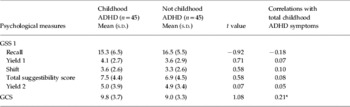
Table 1 gives the mean scores and standard deviations for the GSS 1 and GCS for the ADHD childhood and non-ADHD childhood groups using the WURS criteria. The last column gives the correlations between the Total WURS score and the scores on the GSS 1 and GCS. No significant difference was found between the two groups on any of the GSS 1 scales or the GCS. There was a significant, but ‘small’ (r=0.21), correlation between the Total WURS score and the GCS.
Differences in the scores on the GSS 1 and GCS between those meeting WURS screening criteria for childhood ADHD and those who did not meet the criteria

GSS, Gudjonsson Suggestibility Scale; GCS, Gudjonsson Compliance Scale; WURS, Wender Utah Rating Scale; ADHD, attention deficit hyperactivity disorder; s.d., standard deviation.
* p<0.05.
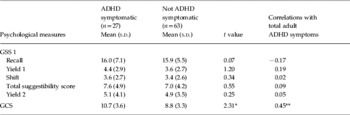
The same analyses were conducted with regard to ADHD adult symptoms as measured by the DSM-IV Checklist. The results are shown in Table 2. The findings are similar to those found for childhood ADHD, except that there was a significant difference on the GCS between the symptomatic and non-symptomatic groups. The effect size using Cohen's d was 0.55, which represents a ‘moderate’ effect (Cohen, Reference Cohen1988). The correlation between current ADHD symptoms and compliance was 0.45 (i.e. having a shared variance of 20%).
Differences in the scores on the GSS 1 and GCS between those participants who were ADHD symptomatic in adulthood and those who were not according to the DSM-IV Checklist criteria

GSS, Gudjonsson Suggestibility Scale; GCS, Gudjonsson Compliance Scale; WURS, Wender Utah Rating Scale; ADHD, attention deficit hyperactivity disorder; s.d., standard deviation.
* p<0.05, ** p<0.001.
Claimed false confession
Out of the total sample, 22 (24%) reported having at some time in their lives made a false confession to the police. Among the ADHD symptomatic group, 11 (41%) reported having made a false confession, in contrast to 11 (18%) of the non-symptomatic group. This difference is significant [χ2=5.55, df=1, p<0.05; odds ratio (OR) 3.25, 95% confidence interval (CI) 1.19–8.89].
Out of the 22 inmates who reported having made a false confession to the police, 21 (95%) listed the offence they had falsely confessed to. Thirteen (62%) were property offences, six (29%) drug-related offences, and two (9%) criminal damage.
Twenty-one (95%) gave the reasons for making a false confession to the police. These were overlapping as more than one reason was sometimes given in each case. The reasons given were as follows: nine (43%) wanted to leave the police station or to avoid custody, six (29%) were protecting someone else, six (29%) were under the influence of alcohol or drugs at the time of the interrogation, four (19%) said they were pressured by police, three (14%) said they were not bothered, two (10%) were paid for it, and two (10%) reported some other reason but did not specify it.
A separate analysis was carried out on the reporting of a false confession to police between those meeting the WURS criteria for childhood ADHD and those who did not. Eleven (24%) in each of the two equal-sized groups reported having made a false confession to the police.
t Tests were conducted on the suggestibility and compliance scores between the ‘false confessors’ and ‘non-false confessors’. None of the tests reached significance.
Discussion
As far as self-reported screening of ADHD childhood and adult symptoms is concerned, there are four main findings in this study. First, the current findings corroborate the findings of Gudjonsson et al. (Reference Gudjonsson, Young and Bramham2007b) that there is no significant relationship between ADHD symptoms and interrogative suggestibility. Second, there was a significant relationship between ADHD symptoms and compliance as hypothesized. Third, the relationship between ADHD symptoms and compliance was stronger for current symptoms than childhood symptoms. Fourth, participants reporting ADHD symptoms in adulthood were significantly more likely than the other participants to claim that they had made a false confession to police at some time in their lives.
The present study suggests that there is no significant relationship between ADHD symptoms, whether childhood or current adult symptoms, and suggestibility. This corroborates the previous finding that people with ADHD are no more susceptible to suggestions than their non-ADHD peers. However, this does not mean that they may not be psychologically vulnerable during police questioning. Interrogative suggestibility is only one type of psychological vulnerability and false confessions are multi-faceted in nature relating to psychological, criminological and background factors (Gudjonsson et al. Reference Gudjonsson, Sigurdsson, Asgeirsdottir and Sigfusdottir2006, Reference Gudjonsson, Sigurdsson, Asgeirsdottir and Sigfusdottir2007a).
The present study has the advantage that compliance was measured as well as suggestibility. Compliance was found to be significantly related to ADHD symptoms for both childhood and current symptoms, as measured by the WURS and DSM-IV respectively. We hypothesized that this was due to people with ADHD symptoms, even if not fully symptomatic, suffering from residual problems, such as anxiety and low self-esteem (Young & Bramham, Reference Young and Bramham2007), which are known to increase susceptibility to compliance (Gudjonsson et al. Reference Gudjonsson, Sigurdsson, Brynjolfsdottir and Hreinsdottir2002, Reference Gudjonsson, Sigurdsson and Einarsson2004b; Gudjonsson & Sigurdsson, Reference Gudjonsson and Sigurdsson2003).
The present findings in relation to suggestibility and compliance are similar to those found among people with Asperger's syndrome in that compliance was significantly elevated among this group whereas suggestibility was not (North et al., Reference North, Russel and Gudjonssonin press). Asperger's syndrome is characterized by impairments in reciprocal social interaction and communication, and a restricted, stereotyped or repetitive pattern of interests and behaviours persisting from the early developmental period (North et al., Reference North, Russel and Gudjonssonin press). Individuals with Asperger's syndrome, like those with ADHD, tend to have an IQ score within the normal range. Both are developmental disorders that are associated with co-morbid psychiatric problems (Kessler et al. Reference Kessler, Adler, Barkey, Biederman, Conners, Demler, Faraone, Greenhill, Howes, Secnik, Spencer, Ustun, Walters and Zaslarsky2006; North et al., Reference North, Russel and Gudjonssonin press). In future research it would be interesting to compare further the psychological vulnerabilities of these two groups. In a recent study among university students, it was found that among males with residual ADHD symptoms, difficulties with positively engaging and socializing with others was the single best predictor of global dissatisfaction with life (Gudjonsson et al., unpublished observations). Difficulties with social interactions, possibly involving distress and avoidance, may represent an important link between compliance and Asperger's syndrome and ADHD. This should be investigated in future research into compliance among people with these two developmental disorders.
The rate of childhood ADHD, as well as the rate of full and partial symptoms in adulthood, is very similar in the present study to rates reported in the literature among prisoners in the USA (Eyestone & Howell, Reference Eyestone and Howell1994), Canada (Vitelli, Reference Vitelli1995), Sweden (Dalteg et al. Reference Dalteg, Lingren and Levander1999), and Norway (e.g. Rasmussen et al. Reference Rasmussen, Almvik and Levander2001). The present findings corroborate the previous findings that a childhood history of ADHD among prison inmates is very common and that it is found in about half of all inmates. Over half of those with childhood ADHD in the present study were either fully symptomatic or in partial remission of their symptoms at the time of the study. This suggests that many of these prisoners are likely to continue to experience significant adjustment problems (Young & Gudjonsson, Reference Gudjonsson, Young and Bramham2007), which increases the likelihood of them continuing their offending (Young & Gudjonsson, Reference Gudjonsson and Young2006) and experiencing problems when having to appear in court (Gudjonsson & Young, Reference Gudjonsson and Young2006). The present finding of a relationship between ADHD symptoms and compliance raises important questions about the potential vulnerabilities of people with ADHD symptoms in terms of them being led, manipulated or pressured into criminal activities by peers (Gudjonsson & Sigurdsson, Reference Gudjonsson and Sigurdsson2007), and merits further research.
The rate of false confession (24%) in the present study is much higher than that reported in the early 1990s by Icelandic prisoners (Gudjonsson & Sigurdsson, Reference Gudjonsson and Sigurdsson1994; Sigurdsson & Gudjonsson, Reference Sigurdsson and Gudjonsson1996), but it is similar to the rate reported in a recent study among suspects interrogated at Icelandic police stations (Sigurdsson et al. Reference Sigurdsson, Gudjonsson, Einarsson and Gudjonsson2006). One possible explanation is that the rate of false confessions to police in Iceland is increasing. Another possible explanation is that prisoners are now more aware of the phenomenon of false confession and therefore more likely to report it.
The main reasons given for the false confessions in the present study were: the prisoner wanted to leave the police station, was protecting someone else, was under the influence of drugs at the time of the interrogation, and police pressure. These are similar reasons to those found in our previous research among prisoners (Sigurdsson & Gudjonsson, Reference Sigurdsson and Gudjonsson1996) and youngsters in the general population (Gudjonsson et al. Reference Gudjonsson, Sigurdsson, Bragason, Einarsson and Valdimarsdottir2004a). The frequency with which the participants reported having made a false confession in order to leave the police station suggests that people with ADHD are particularly vulnerable during police questioning and detention because of their general restlessness, poor concentration, and impulsiveness (Gudjonsson & Young, Reference Gudjonsson and Young2006).
The proportion of the false confessors claiming to being under the influence of drugs during interrogation raises serious questions about the relationship between false confessions and substance abuse (Sigurdsson & Gudjonsson, Reference Sigurdsson and Gudjonsson2001) and their fitness to be interviewed (Gudjonsson, Reference Gudjonsson, Payne-James, Byard, Corey and Henderson2005). Pearse et al. (Reference Pearse, Gudjonsson, Clare and Rutter1998) found that having taken an illicit drug within 24 hours of arrest was the single best predictor of a subsequent confession in interview, but we do not know how many, or if any, of those confessions were false.
The suggestibility and compliance scores did not distinguish between the ‘false confessors’ and ‘non-false confessors’, which is not surprising in view of the low numbers of false confessors and low power in the present study. In the Sigurdsson & Gudjonsson (Reference Sigurdsson and Gudjonsson1996) study, there were 62 ‘false confessors’ and significant differences emerged with regard to both suggestibility and compliance. A much larger study would be needed to investigate specific psychological vulnerabilities, such as suggestibility and compliance, and false confessions.
The finding that the participants reporting ADHD symptoms in adulthood were significantly more likely than the other participants to claim that they had made a false confession to police is probably the single most important finding. It suggests that people with current ADHD symptoms, regardless of their childhood symptoms, are vulnerable to making a false confession during interrogation. The findings emphasize the importance of the persistence of symptoms into adulthood, even if these do not meet the full criteria for ADHD (Faraone et al. Reference Faraone, Biederman and Mick2006). Their adult symptoms, even if only partial, have been shown to be associated with the use of maladaptive coping strategies (Young, Reference Young2005). This may impair their ability to cope with custodial interrogation and confinement, and pressure from peers to ‘take on a case’ for them.
The present paper has a number of limitations, including the fact that the ADHD childhood and adult symptoms were measured by self-reported screens, the grounds for diagnosis of ADHD in adulthood are not well established, the compliance measured is based on self-report, the reported false confessions given by the participants were not corroborated, and other relevant symptoms, such as anxiety and self-esteem, were not reported. The advantage is the screening criteria adopted required the endorsement of childhood symptoms (WURS) in addition to adult symptoms, which reduces the possibility of misdiagnosing people with anxiety disorders (Young, Reference Young, Fitzgerald, Bellgrove and Gill2007). In addition, each participant was interviewed with regard to the reporting of the false confession and asked about the circumstances, nature and the motivation behind it.
In future, it is important to investigate the precise vulnerabilities of people with ADHD symptoms with regard to false confessions, and the role of co-morbid problems, such as antisocial personality disorder, which is commonly found among adults with ADHD (Young, Reference Young, Fitzgerald, Bellgrove and Gill2007).
Acknowledgements
We thank Maria Hronn Nikulasdottir for computing the data and the Nordic Council of Criminology for funding the study.
Declaration of Interest
None.