Whether international trade hurts or helps human rights has been extensively debated.Footnote 1 Most studies find that overall levels of trade dependence of exporting countries tend to be positively associated with higher levels of respect for human rights. Scholars note, however, that such results are often sensitive to the particular way in which measures of overall trade are operationalized.Footnote 2 We offer a new way to study the relationship between trade and human rights by focusing on the role of bilateral trade as a vehicle for the diffusion of human rights practices. Because much of the human rights literature focuses on the influence of overall trade on human rights, scholars overlook the possibility that trade with different partners might have different effects on an exporting country's human rights practices. We suggest that a more appropriate approach is to focus on bilateral trading relationships to understand how the varying human rights standards of the importing destinations might influence the human rights practices of the exporting countries. Our approach is analogous to what Vogel has termed the ‘California Effect’.Footnote 3 Its core idea is that international diffusion of policies and practices depends not on how much a country trades but with whom it trades.
One difficulty that states face in trying to restrict imports from countries with poor human rights practices is that the World Trade Organization constrains the ability of importing countries to regulate imports using process-based rules. Therefore, many observers expect that international trade will abet regulatory races to the bottom. In challenging this logic, Vogel has shown that under some conditions, increasing exposure to international trade will instead lead to a ratcheting up of environmental laws and regulatory standards. In the current study we extend this argument to the diffusion of human rights standards. Unlike the environmental regulations that were the focus of Vogel's study, a country's human rights standards involve a set of norms and practices that tends to be less formal and less strongly legalized. As a result of our analysis, we are able to develop further scope conditions concerning the ability of bilateral trade pressures from importing countries to bring about policy changes in exporting countries.
Drawing on prior research which shows non-linear effects of democracy on human rights,Footnote 4 we hypothesize that the relationship between bilateral trade and human rights might also be non-linear. Unlike a number of studies of bilateral trade-induced changes such as regulatory standards regarding vehicle emissions,Footnote 5 firms’ adoption of the ISO 14001 environmental standards,Footnote 6 and labour rights,Footnote 7 we begin with the assumption that given the wider political and social changes that are required to be made in order to improve a country's respect for human rights, the relationship between bilateral trade and physical integrity rights will not follow the traditional linear path. To model the non-linearities in the hypothesized relationship, we draw on the notion of a ‘tipping point’. Our argument is that the effects that the human rights practices of a country's export destinations will have on the exporting country's own human rights practices will be apparent only above a certain threshold level of pressure. This is because human rights practices are deeply embedded in social customs and political institutions. Some actors have an interest in perpetuating the status quo. Without some minimum level of ‘push’ from importing destinations via the instrumentalities of bilateral trade, the resistance from such actors cannot be overcome.Footnote 8
In addition to testing the notion of threshold effects empirically, our study provides a systematic treatment of the issue of endogeneity. While trade can influence the human rights practices of exporting countries, one might argue that human rights practices can also influence the exporters’ decisions regarding trading destinations. In other words, while actors in importing countries might seek to influence human rights in exporting countries, it is possible that some exporting firms may choose to trade only with countries that are more concerned about the human rights practices of their trading partners. To address this potential selection problem, we employ a propensity score matching technique that allows us to draw more confident causal inferences from observational data. This technique requires the analyst to identify two subsets of the original dataset in a way that most closely resembles the ‘treatment’ and ‘control’ arms of a randomized experiment. In practical terms, this involves finding two sets of country-year cases: one whose value of the key independent variable (in our case, the trade-weighted average human rights performance of each country's trade partners) is high, and one whose value is low, while the distribution of all other variables between the groups are roughly the same. Once these matched sets have been found, the effect of the key independent variable can be estimated in a standard regression model.Footnote 9 The use of the matching technique provides additional confidence that the effect of the bilateral trade context on the exporting countries’ human rights practices can be observed only after a certain threshold is reached.
In the rest of the article, we first introduce the notion of a California Effect in human rights and explain the logic of the threshold model. We then discuss the key variables. The following section provides a discussion of matching analysis and uses this technique to test the relationship between bilateral trade and human rights. In the final section, we discuss various theoretical and policy implications of our study and comment on directions for future research.
Bilateral Trade, the California Effect and Human Rights
In challenging the logic of the race-to-the-bottom hypothesis, Vogel coined the term ‘California Effect’ to describe the mechanism by which (importing) jurisdictions with higher standards are able to transmit their regulatory standards to (exporting) jurisdictions with lower standards.Footnote 10 Vogel used the term to describe the way in which high air quality standards in the state of California (or Germany in the context of Europe) have led to the ratcheting-up of formal laws and environmental standards throughout the United States. The state of California, which represents a major market for the sale of cars produced elsewhere in the United States, has been a pioneer in the adoption of strict air quality standards. Vogel observes how, against the background of these strict standards, Californian regulators have been able to use the large relative market size of their state to induce car manufacturers located elsewhere in the United States to adopt standards that comply with Californian law. In this way, the combination of significant purchasing power and tough regulatory standards in one state has led the other states to engage in a ‘race to the top’ with respect to their own regulatory standards.Footnote 11
This article employs the notion of the California Effect in a slightly different way. Instead of looking at the legal and regulatory standards stipulated by public authorities, we examine the actual practices of states. That is, we do not examine how bilateral trade influences the passing of human rights legislation; rather, we are interested in examining how it influences human rights behaviour across countries. This is an important distinction to make, because a large gap exists between the formal laws protecting human rights and the actual practices of many countries. This was less of an issue for Vogel's study because compliance with product standards in the United States (and Europe) tends to be very high, and each state's formal laws on air quality can, therefore, serve as a reasonably reliable indicator of the actual emissions levels found within that state. Unfortunately, the same cannot be said of international human rights treaties; in many cases the ratification of international human rights treaties actually appears to be associated with worse, rather than better, human rights performance.Footnote 12
Vogel made the original ‘California Effect’ argument in the context of environmental standards embodied in products (for example, the emissions standards of the cars), thereby raising the question of whether this argument can be extended to process standards (such as the various environmental issues that arise during the manufacture of the cars) given that the World Trade Organization (WTO) does not allow importing countries to subject their imports to process standards stipulated in public regulations.Footnote 13 Activist groups commonly complain about this aspect of the WTO, and argue that by preventing importing countries from engaging in this type of discrimination, countries around the world will be forced to enter into a ‘race to bottom’ with respect to their environmental and human rights standards.Footnote 14 However, there is obviously nothing to stop non-governmental actors from attempting to do so. Concerned customers and activist groups are still able effectively to limit imports via boycotts and name-and-shame campaigns. As a result, exporting countries might have incentives to improve certain process standards in response to demands from consumers, stakeholders and activists located in importing countries in spite of the WTO's restrictions on such action being taken at the inter-governmental level. Indeed, two recent studies of the diffusion of regulatory standards have suggested that the California Effect holds in the context of process standards – specifically, the ISO 14001 environmental management standardFootnote 15 and collective labour rights.Footnote 16
Once a trading relationship has been established between a pair of countries, firms located in the importing country can exert pressure on firms in the exporting country to adopt certain types of practices. In the case of environmental standards, this might take the form of firms in the importing country putting pressure on their foreign suppliers to improve their environmental performance in order to allow the importing firm to provide their stakeholders with evidence of an environmentally ‘clean’ supply chain leading all the way back to the fabrication or assembly site. In the case of human rights practices, a similar logic can be thought to operate: firms located in countries with strong levels of commitment to human rights are likely to want to demonstrate to their stakeholders that they are sourcing their supplies from countries with acceptable human rights standards. When the importing countries have a sufficiently high level of concern for human rights standards, we can expect the exporting countries to come under significant pressure to improve their own human rights practices. These pressures will be felt by both the exporting firms and their governments, given that both sets of actors have a shared interest in maximizing exports.
There is some qualitative evidence to support the claim that this sort of bilateral trade-based mechanism can be effective in influencing the human rights performance of exporting countries. Within importing countries, one frequently sees networks of issue-specific NGOs, trade unions and consumer groups mobilizing in an attempt to use trade as a means of coercing foreign governments to change their human rights practices. For example, the annual exercise which was conducted by the United States Congress to renew China's Most Favoured Nation trading status (prior to China's accession to the World Trade Organization in 2001) reflected the leverage that trading relations provide to groups based in the United States that sought to influence China's human rights practices.Footnote 17 Furthermore, activist groups in importing countries routinely make recourse to ‘private politics’ to influence the human rights practices of the countries in which goods are produced.Footnote 18
Recent attempts by consumers in specific importing countries to boycott apparel manufacturers that were found to use prison labour or child labour or to employ other abusive practices in their overseas production facilities have achieved some important successes.Footnote 19 A campaign targeted at the carpet industry within importing countries has resulted in a significant decline in the use of child labour among their suppliers.Footnote 20 Attempts by consumers in specific importing countries to boycott apparel manufacturers that were found to use prison labour or child labour or to employ other abusive practices in their overseas production facilities have achieved some important successes. To illustrate, campaigns in importing markets to dissuade carpet exporters from employing child labour have resulted in a significant decline in the use of child labour. Concerns about the use of child labour in the carpet industry in the Indian subcontinent began receiving media attention in the 1980s. Several policy measures were proposed but these initiatives were not able to make a significant dent in the problem. Key actors, therefore, decided to make recourse to trade pressures by employing ‘social labels’ which allowed importers in developed countries to convey their preferences about human rights to manufacturers in the subcontinent. Two social labels, ‘Rugmark’ and ‘Care & Fair’, deserve particular mention.
Rugmark was an initiative of non-governmental organizations, while Care & Fair was initially an initiative of German carpet importers and retailers.Footnote 21 While their programme designs vary, the key idea is that concerned buyers can use the information conveyed by the labels to create an economic incentive for carpet manufacturers to respect human rights, especially the rights of children. Actors in two key markets, Germany and the United States, mounted an effective campaign to ensure that carpets imported from the Indian subcontinent carry these labels. Indeed, recognizing the economic downside of ignoring this sensitive issue, some state or provincial governments in India became active on this issue themselves and launched initiatives such as establishing schools for children who had hitherto been working on carpet looms. While it is difficult to assess the exact contribution that these social labelling instruments have made to the decline in the use of child labour in the carpet weaving industry, anecdotal evidence suggests that the these labels played an important role in transmitting preferences of the dominant import markets, Germany and the United States, and thereby shaping the policies and preferences of governments in the exporting countries, particularly India, Pakistan and Nepal.
More generally, American labour and human rights groups routinely oppose imports from countries that practise exploitative labour practices or violate human rights and thereby put pressure on exporting countries (such as Mexico or China) to improve their human rights performance. If these cases are reflective of a more general trend in which importing countries can exert upward pressure on the human rights standards of the exporting countries, we should expect to find evidence of a positive correlation between the human rights practices of a country and those of its export destinations, all else being equal.
However, our causal story differs from Vogel's in important ways. In the context of the environmental legislation that Vogel studied, economies of scale motivated companies to push for California's emissions standards to be adopted across the United States, and Germany's standards across Europe. In contrast, the human rights case that we examine does not involve the diffusion of specific pieces of legislation from the importing countries to the exporting countries. Rather, it pertains to the transmission of a more informal and less legalized set of norms concerning human rights. Because improvements in human rights practices require the exporting state to make changes that go beyond simply passing a new piece of legislation, we argue that the level of pressure required to bring about positive change is much higher (hence the threshold effect).
Moreover, in the case of a country-level standard such as the country's human rights practices, this economies of scale argument is less relevant because an exporting country cannot pretend to have different human rights practices for each of its export markets. If a country frequently engages in acts of torture or extrajudicial killings, it cannot claim that the goods it produces for sale to, for example, the European market are not tainted by the same human rights violations as the goods that it produces for sale to other (less discriminating) markets. This is because human rights violations are associated with the country of origin, rather than the specific process through which the goods are produced. To put it differently, if consumers were concerned with specific process standards alone (such as the non-use of child labour in the South Asian carpet industry), then we could imagine a country like Pakistan being able to produce Rugmark-certified carpets for some markets while also producing non-certified carpets for other markets. However, when the consumers are concerned with human rights in the country as a whole, it is not possible for an exporting country to apply different sets of standards to the goods it produces for different markets.Footnote 22
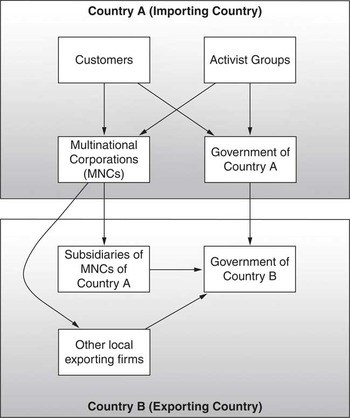
In Figure 1, we provide a summary of the various possible causal mechanisms connecting the human rights practices of exporting countries to those of their export destinations. We identify the following potential causal pathways: first, consumers and activist groups in the importing country can lobby their own government to put pressure on the government of the exporting country to improve its human rights practices. Second, consumers and activist groups in the importing country can target multinational corporations (MNCs) located in their country that have business interests in the exporting country. Once these MNCs are sufficiently concerned about their ability to sell products in the importing country, they can bring pressure to bear on the government of the exporting country, either directly or via the threat of reducing business with local firms. Finally, local exporting firms in the exporting country that are concerned about losing access to foreign markets will also have strong incentives to lobby their own government to improve its human rights practices.
California Effect in human right: Causal chains Note: This casual diagram illustrates some of the potential causes chains connecting actors in importing countries to actors in exporting countries. Pressure for better human rights practices often begins with consumers and activist groups in the importing countries (represented by Country A in this diagram). One way for these actors to put pressure on the exporting countries (represented by Country B in this diagram) to improve their human rights standards is for the consumers and activist groups in Country A to lobby and pressure their own government directly, which, in turn, pressures the governments of the exporting countries. Alternatively, the consumers and activist groups in Country A can target multinational corporations (MNCs) located in their country that have business interests in Country B. Once they are sufficiently concerned about their ability to sell products in Country A, the MNCs can then bring pressure to bear on the government of Country B – either directly or via the threat of reducing business with local firms in Country B.

We take the theoretical argument of the California Effect forward by hypothesizing that while a California Effect might be observed in the context of broader society-wide standards such as human rights, the trade-based diffusion of such standards is unlikely to operate in a linear fashion. When the California Effect concerns regulatory standards that are not so closely connected with domestic politics and broader social practices and, therefore, can be easily implemented by the exporting firm themselves – as is the case for vehicle emission standards or firms’ adoption of the ISO 14001 environmental management standard – we can expect the exporting firms’ levels of adoption of the standards to be fairly responsive to the standards required of their export destinations. In cases such as these the key actor is the firm and its decision to adopt superior practices does not necessarily have significant ramifications for the wider society. Arguably, other societal actors lack the interest and opportunities to veto or influence such firm-level environmental policy level changes. As a result, the prevailing environmental standards/practices among the firms in the importing countries can be expected to be reflected in the standards of firms located in the exporting countries.
However, for changes in standards with wider social ramifications – such as human rights – that require behavioural changes on the part of the exporting country's government or the entire society (and not just its exporting firms), we can expect to find more significant resistance to change. Presumably, much greater pressure from the importing countries is needed to bring about changes in the existing patterns of behaviour that may be much more deeply embedded in the society's customs and political institutions. We would, therefore, expect to find a positive effect of trade-induced change in human rights behaviour only after a sufficiently high level of pressure has been exerted – in other words, after a particular threshold has been reached.
Our argument about a threshold effect is consistent with the notion of ‘tipping points’ that constructivist scholars have developed in the study of diffusion of norms.Footnote 23 Constructivist scholars have sought to explain change in international politics by emphasizing the role that ‘norm entrepreneurs’ play in promoting new ideas about appropriate forms of behaviour. These new ideas, however, tend to be met with significant resistance in the early phase and only gain traction in the international system once a critical mass of states has begun to adopt the norm. Once this tipping point is reached, near-universal transmission of the norm becomes much more likely. While Finnemore and Sikkink use the concept of the tipping point to refer to the critical proportion of states that needs to have adopted a norm before the so-called ‘norm cascade’ is triggered, we operationalize the concept of the tipping point slightly differently. For us, a tipping point is reached when the average level of respect for human rights in the importing countries is sufficiently strong to send an unambiguous signal to the exporting country about the importance that its importers attach to human rights standards.Footnote 24 Once this point is reached, exporting countries are far more likely to change their behaviour to bring their own human rights standards in line with those found among their export markets. Where this point lies is an empirical question that we address in the following sections of the article.
Data
To investigate how bilateral trade influences exporting countries’ human rights practices, we examine a panel of 136 countries for the period 1982–2004. Our unit of analysis is the country-year. Our dependent variable is the Physical Integrity Rights Index developed by Cingranelli and Richards.Footnote 25 Our key explanatory variable is the average physical integrity rights index of a country's export partners, weighted by the salience of each trading relationship in the country's export basket. We call this variable the Bilateral Trade Context. If a California Effect exists in the realm of human rights, we should expect to find that, after controlling for the various factors that determine a country's choice of trading partners, sufficiently high values of Bilateral Trade Context are associated with higher levels of respect for human rights at home, all else being equal.
The Physical Integrity Rights Index (hereinafter PIR Score) provides a composite measure of the extent to which a country respects four basic types of human right that are most closely associated with protecting the personal safety of its inhabitants.Footnote 26 The level of respect for these rights is measured by the extent to which a country engages in the following four categories of rights violations:
-
– Torture;
-
– Imprisonment on the basis of ethnic identity, racial identity, religious practices, or involvement in non-violent political activities;
-
– Extra-judicial killings carried out either by the government or by private groups supported by the government; and
-
– Disappearances: undocumented acts of imprisonment or extra-judicial killing.
Drawing on the annual human rights reports published by both Amnesty International and the US State Department, Cingranelli and Richards have assigned a score of 0, 1 or 2 to each country for every year depending on whether violations of each of these four rights occurred more than fifty times in the year (resulting in a score of 0), between one and fifty times (resulting in a score of 1), or not at all (resulting in a score of 2). By adding together the score in each of the four categories, Cingranelli and Richards arrive at a composite score (ranging from 0 to 8) that measures each country's general level of respect for physical integrity rights in a given year.Footnote 27
The independent variable we use to test whether the California Effect operates in the context of human rights, Bilateral Trade Context, is constructed by calculating a weighted average of the PIR Score of each country's export destinations, where the PIR scores are weighted by the share of exports sent to each destination. This gives a measure of the trade weighted average levels of respect for physical integrity rights found among each country's trading partners. The value of this variable for country i at time t can be expressed as:
 $${\rm{Bilateral}} \ {\rm{Trade}} \ {\rm{Contex}}{{{\rm{t}}}_{it}}\,{\rm{ = }}\,\Sigma_{j}{\rm{ PI}}{{{\rm{R}}}_{jt}}\,\times \,{\rm{Exports}}{{{}}_{ijt}}{\rm{/Exports}}{{{}}_{it}}{\rm{,}}$$
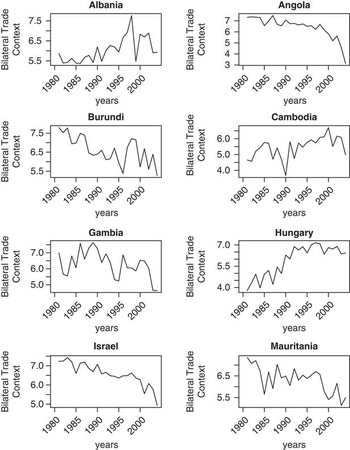
where PIR jt is the PIR score of country j at time t, Exports ijt is the level of exports from country i to country j at time t, and Exports it is country i's total exports at time t. Figure 2 displays the temporal variation in Bilateral Trade Context for eight countries from 1981 to 2004.Footnote 28
Temporal variation in Bilateral Trade Context for a randomly selected sample of eight countries

Our model controls for a number of variables that could plausibly influence a country's human rights record. One of the most widely studied factors is a country's overall dependence on foreign markets.Footnote 29 This is operationalized as the country's total exports plus imports expressed as a percentage of its gross domestic product or GDP (Total Trade).Footnote 30 Analogous to trade, one might suspect that a country's human rights performance can be influenced by levels of foreign direct investment (FDI).Footnote 31 As in the case of trade, conflicting arguments can be put forward regarding the effect of FDI on human rights practices. Globalization pessimists suggest that because foreign direct investors seek to lower their labour costs, they tend to gravitate towards jurisdictions that show scant respect for human rights and countenance exploitation of labour. According to this perspective, countries that seek to attract foreign investment are likely to engage in a ‘race to the bottom’ with respect to human rights standards.Footnote 32 These countries are likely to use their security apparatus to subdue labour and citizens’ groups who might protest against their exploitative practices. Globalization optimists, by contrast, suggest that by facilitating economic development, foreign direct investment can help to raise countries’ human rights standards. This more optimistic view of the effect of FDI on human rights standards finds some support in recent quantitative studies of human rights abuse. For example, Apodaca finds that during the period 1990–96, FDI (as well as trade) leads to a statistically significant decrease in levels of abuse of physical integrity rights as measured by an alternative indicator of physical integrity rights, the ‘Political Terror Scale’.Footnote 33 Other results for FDI are mixed; Richards et al. report a positive association between FDI and their measure of ‘political rights and civil liberties’, but fail to find a statistically significant association between FDI and physical integrity rights.Footnote 34 Therefore, our model includes a measure of each country's exposure to FDI (Inward FDI) that is made up of inward flows of FDI expressed as a percentage of that country's GDP.
Our model also controls for the wealth of a country expressed in terms of GDP per capita. Previous studies have consistently reported wealth to be positively associated with improved human rights performance presumably because economic development empowers citizens to demand that their governments respect their basic human rights. At the same time, development provides resources to the government to supply institutions that can respond to such demands.Footnote 35 Data for Total FDI as well as GDP per capita (expressed in constant 2000 US dollars) were obtained from the World Bank's World Development Indicators Online database.
Domestic political institutions are also likely to have an important influence on a country's human rights practices. While activist groups have often led the way in demanding that governments improve their human rights practices, such groups need a certain amount of political space to be able to work effectively. If they are not allowed to voice their opinions freely, to organize and to protest, their ability to put pressure on the government will be severely diminished.Footnote 36 To operationalize political openness (Democracy), we employ the ‘Polity 2’ measure of democracy provided by the Polity IV database.Footnote 37 While scholars have tended to employ a variety of indicators to assess levels of political openness, Polity 2 is best suited to capture the institutional dimensions of political openness and, therefore, serve as a proxy for the political space available for the domestic implantation of human rights practices transmitted from abroad.Footnote 38 Furthermore, because Polity 2 is coded on a 21-point scale that ranges from −10 to +10 (reflecting the most autocratic and most democratic regimes respectively), it is sufficiently textured to pick up variations in domestic political institutions across countries.Footnote 39
We also control for the effect that civil conflicts have on a country's human rights performance. Governments often use threats to the security of the state as an excuse for engaging in widespread human rights violations. Strong evidence of this relationship has been reported in previous quantitative studies of human rights abuse.Footnote 40 Therefore, we include a dummy variable (Civil War) that indicates whether a civil war is occurring in each of the country-years in the sample. These data were obtained from Hafner-Burton and Tsutsui.Footnote 41
Arguably, regime stability also has a separate effect on a country's human rights practices. Simply put, more stable regimes – irrespective of their democratic credentials – tend to engage in fewer violations of physical integrity rights; our model includes a variable called Regime Durability that is taken directly from the Polity IV database. This measures the number of years that have elapsed since the last time the country underwent a ‘transition period’, which is defined as a change of three points or more in the country's Polity 2 score that takes place within a period of three years or less.
Demographic factors can also be expected to bear upon human rights performance. Scholars have found a negative relationship between population density and levels of respect for human rights that is thought to reflect the fact that resource scarcities facilitate human rights violations.Footnote 42 That is why our model includes a variable, Population Density, which provides a measure of the average number of persons per square kilometer in each country-year.Footnote 43 These data were obtained from the World Development Indicators Online.
The international institutional context in which a country is situated is also likely to influence its human rights practices.Footnote 44 There is an established debate in the field of international relations about the effectiveness of international inter-governmental regimes in changing the policies and practices of the signatory countries.Footnote 45 Hafner-Burton's examination of the ability of human rights treaties and Preferential Trade Agreements (PTAs) to influence actual human rights practices has found that while the ratification of international human rights treaties seems to make little difference to actual human rights behaviour, participation in certain types of PTA has a positive effect. In order to examine whether a California Effect holds in the realm of human rights practices, we need to control for changes in human rights behaviour that stem from pressures exerted via a country's participation in certain types of PTA. Consistent with Hafner-Burton,Footnote 46 our model includes two dummy variables that measure the seriousness of the human rights conditions imposed by the PTAs to which a country belongs. Hard PTA Membership is coded as 1 for each country-year in which the country belongs to at least one PTA with enforceable human rights conditions, while Soft PTA Membership is coded as 1 for each country-year in which the country belongs to one or more PTAs in which human rights are mentioned, but only in a declaratory or promotional sense.Footnote 47 Information on PTA memberships was obtained from the World Trade Organization.Footnote 48
In addition to domestic drivers of human rights behaviour and a country's membership in preferential trading agreements, our model includes two variables that are designed to capture non-trade related influences on a country's human rights standards. The first of these, Neighbourhood Effect, is a spatially-lagged variable that reflects the average human rights standards found among a country's geographic neighbours. A large literature on geographic diffusion has shown that countries’ domestic politics tend to be closely correlated with those of their geographic neighbours.Footnote 49 This may result from the fact that ideas and norms travel more easily between geographically proximate countries as a result of the greater flows of people (as well as media products) that take place between them, and/or the fact that geographically proximate countries tend to have a shared cultural history.Footnote 50
Along with the geographical neighbourhood, one could also think of states as operating within cultural ‘neighbourhoods’ that produce isomorphic pressures and serve to diffuse human rights practices across countries. We use the presence of a shared language as an indicator of cultural similarities that could make countries more receptive to the influences of others. We hypothesize that both citizens and elites are likely to have greater exposure to, and a higher probability of being influenced by, the norms and practices of culturally-similar states. For example, we might expect the human rights practices of French-speaking countries to have a marginally greater influence on the human rights practices of a country like Niger than they would have on its primarily Arabic-speaking neighbours in North Africa. As with the geographical neighbourhood variable, our model controls for the linguistic neighbourhood effect by calculating the average PIR Score for groups of countries that share a common language (Common Language). Data on each country's official language(s) were obtained from the CIA World Factbook.Footnote 51
Matching Analysis
The California Effect describes one type of mechanism that would produce a positive coefficient for the Bilateral Trade Context variable. However, self-selection among countries can also produce a positive relationship. Importing (or exporting) countries might choose their trading partners selectively; for example, one of the criteria for establishing a trading relationship might be the previous human rights records of the exporting country. So it is possible that a statistical association between one country's human rights record and the Bilateral Trade Context variable is due to a selection effect rather than a California Effect. In order to distinguish between these two processes, we need to go beyond simple statistical association and consider a causal model. One way to define causality or causal effects follows the logic of counterfactuals. In our context, the causal effect of the Bilateral Trade Context variable can be considered as the difference between the human rights record of a country i when its value of Bilateral Trade Context is high and the human rights record of the same country when its value of Bilateral Trade Context is low. In causal modelling terminology, let us choose T as the treatment variable where T = 1 denotes a high level of Bilateral Trade Context (i.e., good human rights practices among a country's export destinations), and T = 0 denotes a low value of the Bilateral Trade Context (i.e., poor human rights practices among a country's export destinations). As before, the response variable is still country i's level of respect for human rights, as measured by its PIR Score. We shall use the term YT = 1 to refer to country i's human rights level if this country receives the treatment (i.e., a high level of Bilateral Trade Context) and YT = 0 otherwise (i.e., a low level of Bilateral Trade Context). The causal effect of the Bilateral Trade Context variable can therefore be inferred by comparing YT = 1 and YT = 0, which often involves simply taking the difference between the two: YT = 1 − YT = 0.Footnote 52
Of course, in reality one can only observe either YT = 1 or YT = 0; a country, at one point in time, can only have one value of Bilateral Trade Context. One way to infer the causal effect is to calculate the average treatment effect, that is, E(Y∣T = 1) − E(Y∣T = 0). This quantity can be easily estimated from the results of randomized experiments where units (i.e., countries in this study) are randomly assigned to treatment and control groups, thereby ensuring that the pre-treatment characteristics/covariates of the treatment group units and the control group units, X, are similar enough (in distribution) that the only difference between the two groups is the treatment itself. However, in the context of our study such randomization is impossible; we cannot randomly assign countries to two groups with different levels of Bilateral Trade Context. Nonetheless, what we can do is to select a subset of the observational data wherein the treatment units and control units are said to be ‘matched’ in that they have similar levels of all pre-treatment covariates, X, and differ only in their average level of the treatment variable, T. In this way, the link between pre-treatment covariates X and treatment assignment T can be broken (approximately) in a way that brings us much closer to the ideal situation where the treatment and control units had been assigned randomly from a single population. Imai and van Dyk have developed the broad notion of using propensity scores as a means of managing sample matching in parametric studies.Footnote 53 Once the matched subsamples are produced, one can simply calculate the average treatment effect (E(Y∣T = 1) − E(Y∣T = 0)); one can also proceed with normal parametric model fitting as we will do in the following analysis.Footnote 54
We use propensity score matching from the MatchIt library for the R programming language developed by Ho et al. to find subsamples of the data where the assignment of the treatment – a high average value of Bilateral Trade Context – is not correlated with the pre-treatment covariates X.Footnote 55 We look for subsamples of data based on matching on the propensity score (that is, the probability of receiving the ‘treatment’) which is a function of a number of variables that might possibly affect the countries’ level of Bilateral Trade Context. For example, among many other things, countries might select their trade partners based on the partner countries’ previous human rights records and political factors such as levels of democracy.Footnote 56 Specifically, the pre-treatment covariates, X, that we include are the countries’ previous year's human rights records, their levels of democracy and regime durability, their levels of economic development (as measured by GDP per capita) and economic openness (measured by total trade as a percentage of GDP and inward FDI as a percentage of GDP), as well as other relevant factors such as civil war, population density, ‘hard’ and ‘soft’ PTA membership, and their neighbouring countries’ as well as same-language countries’ average human rights records. In other words, after matching, countries in the treatment group and countries in the control group are similar enough in distribution in all of the dimensions of the pre-treatment covariates, and, assuming we have accounted for most of the factors that might affect a country's choice of trading partners, the only difference that remains is whether they receive the treatment, that is whether they are subject to a high or low value of Bilateral Trade Context.
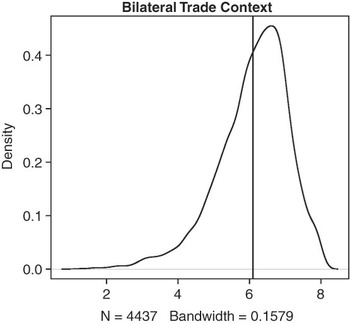
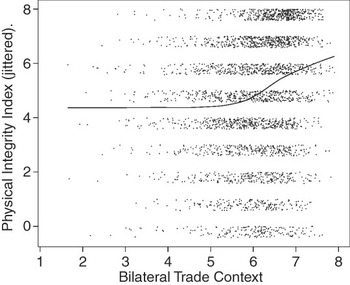
Given that our treatment variable, Bilateral Trade Context, is not a binary variable, we have to dichotomize it in order to create separate treatment and control groups. However, there is no theoretical prior to tell us at what point along the range of possible values of Bilateral Trade Context the variable can be expected to have a significant effect. Figure 3 plots its density distribution. The mean is around 6.1 and the mode is around 6.5.Footnote 57 Figure 4 plots the human rights variable (jittered to avoid overlapping) against the bilateral trade context variable and includes a non-parametric Lowess line to show the relationship between Bilateral Trade Context and PIR Score.Footnote 58 Note that this scatter plot and Lowess line are based on the data before matching. However, they still give us some hints on where the thresholds might be; the effect of the Bilateral Trade Context variable only starts to show after it reaches the level around 6: the Lowess line starts to go up, revealing a positive association.
Distribution of the Bilateral Trade Context variable in the full dataset Note: The vertical line represents the mean value.

Non-parametric lowess line showing the relationship between Bilateral Trade Context and Physical Integrity Right for all country-year observations in our sample Note: The vertical positions of the points have been jittered to minimize the degree of overlap.

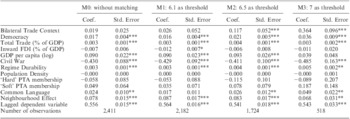
We start by trying Bilateral Trade Context values of around 6 as thresholds to dichotomize the treatment variable, find sub-samples in the data based on matching on the propensity score for receiving the treatment (that is, the possibility of having a high Bilateral Trade Context), and finally run a regression based on the matched sub-samples.Footnote 59 We start by using a threshold of 6.1 (the mean of the Bilateral Trade Context variable). The results are reported in Table 1: Model 1 where we find no significant effect of Bilateral Trade Context. When we increase the threshold to 6.5 (the modal value of Bilateral Trade Context), we begin to observe the causal effect of bilateral trade context becoming statisticaly significant (see Table 1: Model 2). We also try higher thresholds such as 7. As reported in Table 1: Model 3, at this point we find a significant causal effect of Bilateral Trade Context.
Explaining Levels of Physical Integrity Rights (PIR) across Space and Time

Notes: The table shows ordered probit regression estimates based on full sample without matching (M0) and on subsamples after matching (M1–M3). For M1 to M3, each column represents the results obtained when a different choice of threshold is used to dichotomize the Bilateral Trade Context variable. ***, **, * show significance levels 99%, 95%, and 90% respectively.
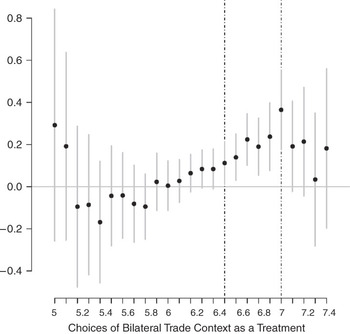
In Figure 5, we plot the 95 per cent confidence intervals of the treatment effects of Bilateral Trade Context across a wide range of different thresholds. We find that when Bilateral Trade Context takes on values between 6.5 and 7 the treatment effects are consistently statistically significant in the regression analysis on the matched data.Footnote 60 We also provide the estimates of Bilateral Trade Context and the other control variables from the same ordered probit regression but based on the full sample without matching (see Model 0 in Table 1). The purpose of presenting these estimates without matching is to demonstrate that estimated effects of other control variables are not a function of the restricted sample of data that results from the matching exercise. Indeed, the effects of most of our control variables included in the regression model are broadly compatible with the effects reported in earlier quantitative studies of human rights (with the exception of ‘hard’ and ‘soft’ PTAs). As expected, we find that civil wars are strongly associated with decreased levels of respect for human rights. We find that Total Trade and Regime Durability show a positive relationship to PIR Scores. The finding that Total Trade is positively related to PIR Scores is also consistent with many of these studies.Footnote 61 This provides further evidence to support the arguments made by globalization optimists that exposure to global markets in the more general sense – that is, irrespective of the human rights performance of one's trading partners – tends to be associated with subsequent improvements in human rights performance. However, we do not find a consistent and significant effect of our measure of Inward FDI. The general intuition that richer countries show greater respect for physical integrity rights than poor countries holds in most of the model specifications we tried, except in Model 3 in which a Bilateral Trade Context of 7 is used to define the treatment and control groups.
Explaining levels of Physical Integrity Rights (PIR) across space and time Notes: Estimated effect size of the Bilateral Trade Context variable in the regression analysis (after matching) when different thresholds are used to distinguish between ‘low’ and ‘high’ values of Bilateral Trade Context. The 95% confidence intervals around the coefficient estimates are indicated by the grey vertical lines around each point estimate.

Our analysis also suggests that the California Effect holds even when we control for a country's membership in PTAs. Importantly, contrary to Hafner-Burton, we find that neither a country's membership in a ‘hard’ PTA nor its membership in ‘soft’ PTAs is positively associated with physical integrity rights.Footnote 62 The inclusion of the two control variables makes very little difference to the size and significance of the Bilateral Trade Context variable.Footnote 63 In other words, the California Effect that we report in the context of human rights practices is not simply reflecting the fact that some of the better-performing countries belong to PTAs with strict human rights conditions.
Regarding the spatial variables, we find that the influence of a country's geographical neighbourhood (Neighbourhood Effect) is positive and highly statistically significant in all three models. This means that the human rights performance of a country's geographical neighbours appears to be closely related to the country's own human rights performance even after controlling for other domestic and international-level influences on that country's performance. However, our control for a common culture, Common Language, does not show a significant relationship with physical integrity rights in all the model specifications. Therefore, it appears that the effect of physical proximity is far stronger than the effect of cultural ties when it comes to considering other external influences on a country's human rights performance.
Conclusions
This study provides evidence that trading relationships can, under certain conditions, serve as ‘transmission belts’ for the diffusion of human rights standards from importing to exporting countries. In doing so, it contributes to a growing literature that is extending David Vogel's original concept of the California Effect to a number of different issue areas in international politics. Human rights practices provide an especially hard test of the California Effect because the causal chain that connects consumer behaviour in importing countries to the human rights practices of exporting states is less direct given that the actors that come under pressure to improve human rights standards (the exporting firms) are not the same as the actors responsible for changing the human rights practices of the target states (the governments of the exporting countries). Also, because human rights practices tend to be embedded in the wider political institutions and social practices of the country, attempts to change them are likely to generate strong resistance among other societal actors.
Given these obstacles to norm transmission, we find evidence for the existence of a California effect only when the average human rights practices of the export destinations exceeds a certain threshold. This finding has important theoretical and practical implications. From a theoretical point of view, it lends support to the view that trade-based pressures can reach deeper into the domestic politics of an exporting state than previously thought. Trade not only connects the practices of importing jurisdictions to those of the exporting firms, but can also connect the practices of importing jurisdictions to those of the governments of exporting states. It also emphasizes the need for IR scholars to pay greater attention to the non-linear nature of the relationship between various international stimuli and domestic political outcomes. This is an idea that has been around for some time in the theoretical literature on norm diffusion, but has not, as far as we are aware, been subject to detailed testing in large-n studies.Footnote 64
This article suggests that in assessing the effect of trade on human rights practices, we ought to move beyond a simple one-dimensional measure of trade-induced globalization. Instead, we should also consider ways in which the practices of specific trading partners might shape the practices of exporting countries. From a practical point of view, our findings suggest that non-governmental organizations located in importing countries should reassess their opposition to international trade. Instead of viewing trade as a vehicle for instigating ‘races to the bottom’ in a variety of policy domains including human rights, they could perhaps think of leveraging trade to create ‘races to the top’. This is something that can be achieved through ‘private politics’, even though a country's human rights performance represents a process-based standard without a clear label. This form of leverage is facilitated by the structure of world trade: the bulk of exports from developing countries is absorbed by developed countries that tend to have superior environmental, labour and social practices. Furthermore, non-governmental organizations tend to be more established and have greater political clout in developed countries. Hence, the inequitable structure of international trade whereby developing countries are dependent on developed countries for market access provides northern non-governmental organizations with an opportunity to manipulate trading relations to serve as conduits of their preferred practices and norms. Instead of developed countries being transformed in the image of practices of developing countries – as the race to the bottom literature suggests – non-governmental organizations could strategically leverage the structural inequity in trade to shape the practices and norms of developing countries.
This article should encourage systematic thinking about the emergence of new economic poles in the global economy. Particularly, how might China's emerging trading relationships with certain African countries affect the human rights practices of these countries? Our model suggests that given China's very low score on the Physical Integrity Rights Index (the Cingranelli-Richards dataset assigns China a score of 1 for 2004), bilateral trade with China is very unlikely to induce improvements in the human rights performance of China's trading partners. Arguably, as long as OECD countries with fairly high levels of human rights practices dominated world trade, bilateral trade served to improve human rights standards in the developing world countries whose exports were dependent on these markets. As the structure of the world economy changes and new countries with less than stellar human rights performance emerge as important destinations for exports from developing countries, the positive effect of bilateral trade on human rights would most likely be compromised.
Finally, we believe that future research could benefit from considering some other possible ways in which this model of trade-related norm diffusion could be refined. While we provide evidence on how high levels of bilateral trade facilitate norm diffusion from importing to exporting countries, one could argue that such diffusion might also be predicated on other factors such as the gap between the exporting country's human rights score and the average score of its export destinations.Footnote 65 Moreover, future research might benefit from looking at the California Effect across different sectors of trade by disaggregating total bilateral trade flows. Another interesting question relates to the time dynamics of the California Effect diffusion mechanism. For example, one could ask whether the time taken for the trade-related diffusion of human rights practices is a function of various domestic variables. It is possible that even under the same level of bilateral trade pressure, some countries resist the pressure for longer than others prior to improving their human rights. Answering this question requires careful theorizing about the relevant domestic variables and mechanisms that moderate (or facilitate) the effect of bilateral trade pressure.Footnote 66 In short, we believe that there are many exciting theoretical and empirical opportunities for the creative examination of the role of bilateral trade in global diffusion processes.