


INTRODUCTION
During 2006, a large mumps outbreak occurred in the United States mainly affecting the Midwestern states [1–3]. The highest incidence was observed among 18- to 24-year-olds, many of whom were college students [2, 3]. The state of Kansas had the second highest number of mumps cases during this epidemic, with many of the cases reported by a university in eastern Kansas. About 27 000 students were enrolled at this university in autumn 2005, and close to 70% of the students were registered as in-state residents. Although a two-dose measles, mumps and rubella (MMR) vaccination requirement for enrolment had been in place at this university since 1993 and estimated two-dose MMR coverage for undergraduates was ⩾95% [Reference Cortese4], a mumps outbreak occurred in 2006.
Both vaccination and isolation are used during mumps outbreaks to reduce transmission and limit the number of cases. Because two-dose MMR coverage was very high at this university, broadly improving coverage was not an option; isolation of cases was therefore implemented to help limit transmission. In the Midwest states involved in the outbreak, isolation recommendations varied from 4 to 9 days. In Kansas, a 9-day isolation period was initially recommended by the state health department on 30 March 2006. On 7 April 2006, the health department changed the recommendation to 4 days because the infectious period of mumps was considered to be up to 4 days after onset of active disease [Reference Atkinson5]. On 25 April 2006, the recommendation was changed back to 9 days after definitive guidelines from the Centers for Disease Control and Prevention (CDC) were published [6] and to comply with Kansas regulations. The use of 9-day and 4-day isolation recommendations at different times during the outbreak provided an opportunity to measure students' compliance based on the isolation period recommended to them. This study describes the isolation measures instituted during this outbreak and compliance with these measures among students suspected of having mumps.
METHODS
Identification of mumps cases
Most students at the university with suspected mumps were evaluated and received care at the university's student health service (SHS), which then reported cases to the county health department (CHD). Students with suspected mumps who sought health care outside SHS were first reported to the CHD. SHS was subsequently notified, and SHS staff then contacted the case-students to discuss isolation recommendations. Masks were recommended and provided to all students suspected of having mumps who were seen at SHS. Masks were to be worn when contact with others could not be avoided. For this study, attempts were made to interview all university students suspected of having mumps that were reported to the CHD with onset of symptoms from 1 February 2006 to 17 May 2006.
Assessment of isolation and isolation compliance
A standard questionnaire was used to gather demographic information and to assess self-reported isolation compliance among the students suspected of having mumps. Questions on isolation included: (i) number of days the case-student was told to stay in isolation; (ii) whether isolation was on campus (i.e. in a dormitory, sorority or fraternity house, scholarship hall, or university-owned apartment) or off campus; (iii) whether a mask was provided and, if provided, how frequently the mask was worn; (iv) case-student's perception of the importance of avoiding contact with others during the isolation period, and (v) number of days the case-student stayed in isolation. Questionnaires were administered over the phone or in person by the outbreak investigation team or trained interviewers. Most interviews were conducted between 26 April 2006 and 5 May 2006; the last interview was conducted on 20 July 2006.
Data analysis
Data were entered into an Access database and analyses were performed using SAS 9.1.3 software (SAS Institute, Cary, NC, USA). Compliance was measured by comparing the number of days case-students were told to stay in isolation with the days they reported as actually staying in isolation. Case-students were considered compliant if they stayed in isolation the full number of days that was recommended to them and non-compliant if they stayed in isolation fewer than the full number of days. The number of days recommended for the case-student to stay isolated depended on the official policy at that time and the duration of the case-student's illness at the time of medical evaluation (e.g. if the policy at that time was for students with mumps to be isolated for 9 days following symptom onset and a student with mumps sought medical care on day 3 of illness, the case-student was recommended to stay isolated for a further 6 days. If the policy at the time was for students with mumps to be isolated for 4 days following symptom onset and a student with mumps sought medical care on day 3 of illness, the case-student was recommended to stay isolated for one more day). Isolation compliance among case-students given an isolation recommendation of 1–4 days was compared to those who were recommended 5–9 days of isolation. For univariate analysis, characteristics of compliant vs. non-compliant case-students were compared using χ2 tests and odds ratios (OR) with 95% confidence intervals (CI). In addition, multivariate logistic regression using both forward and backward stepwise selection algorithms was used to identify significant independent predictors of isolation compliance. Test statistics with P values <0·05 were considered statistically significant.
RESULTS
Isolation measures
General description of isolation measures
The SHS health-care providers implemented isolation measures as soon as students with suspected mumps entered the clinic. Students were given a mask to wear and stayed in a designated area of the waiting room until medical evaluation. A special exit booth at SHS was instituted where isolation procedures were reviewed with every case-student. Symptomatic students were advised to avoid contact with others by not attending classes, work, or social events. In addition, case-students were encouraged to isolate themselves from other people by leaving campus (e.g. to their parents' or other relative's home). Case-students who lived in dormitories and who could not leave campus were advised only to leave their rooms to use the bathroom; food and other necessities were delivered to their rooms. Masks were to be worn when contact with others could not be avoided. Letters and emails were sent by the university to teachers of case-students exempting them from class during their isolation period.
Isolation measures among interviewed case-students
Of the 183 students reported to CHD with suspected mumps, 146 (80%) were interviewed and provided information regarding isolation recommendations. Nearly two-thirds of the interviewed case-students were female, whereas about half were female in the general student body. Case-students tended to be younger and were more likely to be freshmen compared to the general student body (Table 1). About 93% of the case-students described themselves as being non-Hispanic white whereas 79% were non-Hispanic white in the general student body. Slightly less than half (45%) of the suspected mumps cases lived on campus.
Demographics of general student body and interviewed students suspected of having mumps
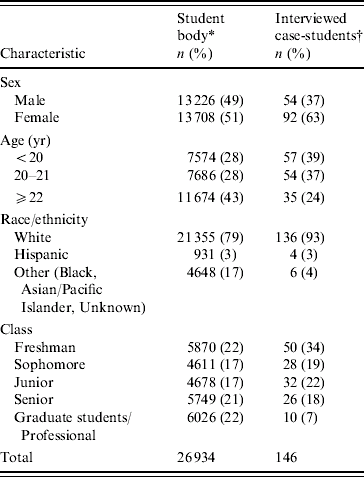
* Characteristics based on students enrolled for autumn term, 2005.
† Students included had symptom onset from 1 February 2006 to 17 May 2006.
Among the 146 case-students, 136 (93%) reported that isolation was recommended at the time of their medical evaluation. Of the 136 instructed to stay isolated, three case-students were interviewed on the day of their diagnosis and assessment of their compliance was not possible, and one case-student reported being told to stay isolated but received no specific isolation instructions. These four subjects were excluded from the analysis.
Of the 132 case-students included in the analysis, 117 (89%) reported being informed about the need for isolation by a clinician at SHS at the time of their evaluation for mumps; the remainder were contacted by SHS after being evaluated elsewhere. Of the 60 (45%) case-students who reported their usual residence was on campus, 58 (97%) provided information on their place of isolation. Of these, 14 (24%) remained isolated on campus. The remaining 44, except for one for whom no information was available, reported they isolated themselves in a different city or went to the home of a parent, relative, or friend. Among the 129 case-students who responded to questions on receipt of isolation information, 89 (69%) received written material, 49 (38%) were sent emails, and 55 (43%) reported reading information posted in their place of residence. Among the 131 case-students who responded to questions on importance of isolation, 88 (67%) stated that avoiding contact with others during isolation was very important, 33 (25%) stated it was somewhat important, and 10 (8%) stated it was not that important or not important at all.
A total of 121 (92%) case-students reported they were given masks by their health-care provider. Masks were provided by SHS for 114 case-students and by health-care providers outside SHS for seven case-students. Among those receiving masks, 40 (33%) reported that they never left isolation, 80 (66%) reported leaving their residence during the isolation period, and information was missing for one subject. Of those that left their residence during isolation (79 with response available), 43 (54%) reported that they wore the mask all the time, 16 (20%) reported wearing the mask some of the time, and 20 (25%) reported never wearing the mask. The frequency of mask use among those that left isolation did not differ by gender, age, or the period of time told to stay isolated. Among the 16 case-students who reported they wore the mask some of the time, six reported they were not around others when not wearing the mask, four reported they were not around others for a long period of time (e.g. for more than an hour) and felt wearing the mask was unnecessary, two reported they felt they were no longer infectious, one did not wear the mask because it was uncomfortable and two because it was stigmatizing or embarrassing, and one did not provide a reason. Among the 20 case-students who reported never wearing the mask, detailed information was only available for five. One reported only leaving isolation once, one immediately discarded the mask after leaving SHS, one found the mask uncomfortable, and two stated the mask was embarrassing to wear.
Isolation compliance
Of the 132 case-students told to stay isolated, 99 (75%) reported that they stayed isolated for the recommended number of days (i.e. they were compliant). Of the 59 case-students told to stay isolated for 1–4 days, 51 (86%) were compliant, while 48 (66%) of the 73 case-students told to stay isolated for 5–9 days were compliant (Table 2). Among the 48 case-students advised to stay isolated for 9 days, 31 (65%) fully complied with the 9-day recommendation but nearly all (47, 98%) stayed isolated for at least 4 days.
Isolation complianceFootnote * among mumps case-students by recommended number of days to stay isolated
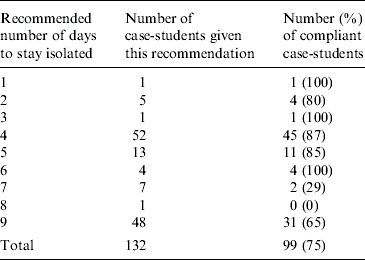
* Case-students were considered compliant if they stayed in isolation for the full number of isolation days recommended to them.
By univariate analysis, case-students told to stay isolated for 1–4 days were more likely to be compliant than those told to stay isolated for 5–9 days (Table 3). Isolation compliance did not significantly differ by gender, age, full- or part-time student status, location of residence, employment status, or presence of room-mates. In addition, compliance did not differ by symptom type, with the exception of orchitis among males. All 13 male case-students with orchitis were compliant compared to 21 (64%) of the 33 male case-students who did not report testicular involvement. Compliance also did not significantly differ by the number of different symptoms reported by case-students or by total number of days ill (data not shown). Compliance was higher (83%, 73/88) among those who considered avoiding contact with others during isolation very important than among those who considered avoiding contact with others somewhat important, not that important or not important at all (60%, 26/43) (Table 3).
Univariate analysis of factors associated with isolation complianceFootnote *
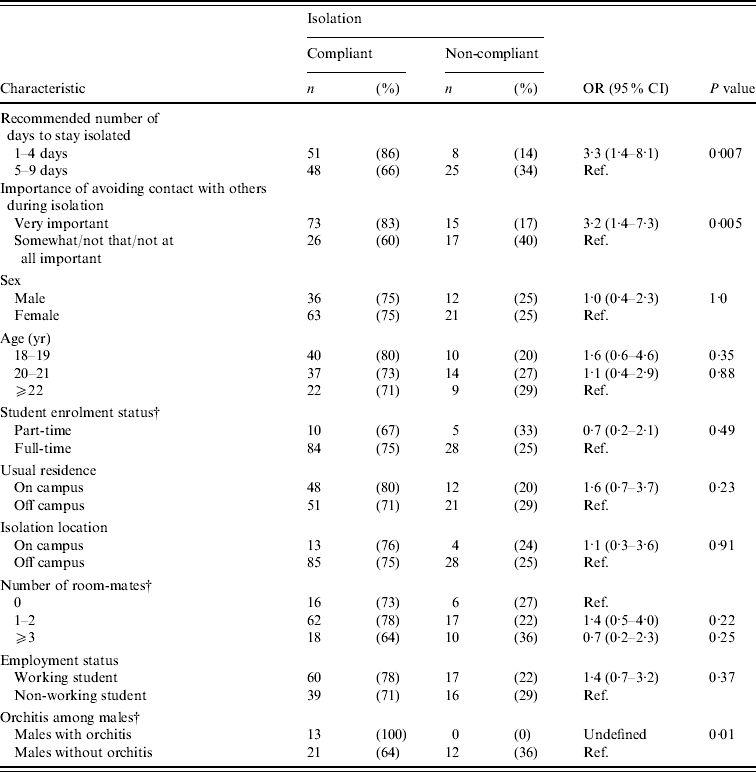
OR, Odds ratio; CI, confidence interval; Ref., referent category.
* Odds of being isolation compliant. Case-students were considered compliant if they stayed in isolation for the full number of isolation days recommended to them.
† One or more students had a missing response for these characteristics.
In multivariate analysis, excluding orchitis from the model, the only significant predictors of isolation were the number of days told to stay isolated [1–4 days vs. 5–9 days; adjusted odds ratio (aOR) 3·6, 95% CI 1·4–9·0] and the case-students' rating of the importance of avoiding others during isolation (very important vs. less than very important; aOR 3·6, 95% CI 1·5-8·4). The effect of number of days told to stay isolated and the ranking of the importance of avoiding others on compliance was not modified by any other characteristic. When analysis was restricted to males and a variable for orchitis was included, the models became unstable because 100% of males with orchitis were compliant.
DISCUSSION
In spring 2006, a large mumps outbreak occurred at a university in Kansas where coverage with two doses of MMR was very high among undergraduate students [Reference Cortese4]. During the outbreak, isolation of students suspected of having mumps was recommended and implemented to reduce spread of the disease. Overall compliance with isolation recommendations was 75%. We found that case-students told to stay isolated for 1–4 days were more likely to be compliant compared to those told to stay isolated for 5–9 days. Various methods of communication (e.g. literature provided at the time of medical evaluation, information sent by email, and posters on campus) were used to increase the student body's awareness about the outbreak and the importance of isolation to reduce mumps exposure at the university.
As public health agencies prepare for a possible influenza epidemic or pandemic, the use of isolation is being considered as an important non-pharmaceutical control measure. Therefore, understanding compliance with isolation measures for other diseases, such as mumps, is valuable. Disease severity and infectiousness need to be considered when isolation recommendations are developed. Although mumps is usually a mild disease in most individuals, complications do occur and can be severe. In unvaccinated persons, meningitis can occur in up to 10% of cases [Reference Galazka, Robertson and Kraigher7], epididymo-orchitis in up to 37% of cases in post-pubertal males [Reference Philip, Reinhard and Lackman8, Reference McGuiness and Gall9] and mumps has been implicated as one of the leading causes of deafness in childhood [Reference Okamoto10–Reference Westmore, Pickard and Stern12]. In addition, other severe complications such as encephalitis and pancreatitis may occur [13].
Mumps is less infectious than some other vaccine-preventable diseases, which may suggest that isolation is less important for mumps. In a household contact study conducted by Hope-Simpson in 1952, secondary attack rates among household contacts aged ⩽15 years with no history of prior disease were 76% for measles, 61% for varicella, and 31% for mumps [Reference Hope-Simpson14]. In the pre-vaccine era, Brunell et al. [Reference Brunell15] argued that the isolation of mumps cases is ineffective among children because the virus can be transmitted before the main symptom of parotitis emerges and because of the presence of minimally symptomatic persons that can be infectious [Reference Henle16, Reference Utz17].
In spite of the controversy over the usefulness of isolation for reducing mumps transmission, isolation is one of the control measures available and it may be particularly used in settings with high two-dose MMR coverage where coverage cannot be further increased. The period of isolation should be based on the duration of viral shedding; however, feasibility of implementation should also be taken into account. Although mumps virus has been isolated in urine up to 25 days after the onset of symptoms [Reference Johnson and Goodpasture18], most studies documented that viral shedding in the oropharynx predominantly occurs during the first 4 days after onset of symptoms [Reference Leymaster and Ward19–Reference Knowles and Cohen21]. In our highly vaccinated population, seven of the eight buccal swab specimens from which mumps virus RNA was detected by RT–PCR were collected during case-students' first 3 days of parotitis, suggesting that viral shedding is minimal after the first 3 days of symptoms [Reference Bitsko22]. At the time of the outbreak, CDC recommended isolation for 9 days after symptom onset [6]. Our data showing that isolation compliance is lower when the required isolation period is as long as 9 days should be considered by policy-makers when mumps isolation recommendations are reassessed.
Some researchers have investigated the psychological consequences of hospital isolation/quarantine practices [Reference Cava23–Reference Hawryluck25], but little is known about the experiences of isolation outside the hospital environment. In our study, most case-students thought that isolation was very important in order to avoid infecting others and compliance was highest among those that believed this. These findings suggest that high compliance may be achieved when health-care workers emphasize the importance of isolation at the time of mumps diagnosis.
Masks were provided to mumps case-students during the outbreak as an additional control measure, with the recommendation that masks be worn if the case-students were around others during their isolation period. Ideally, all persons with mumps should stay in isolation making mask use unnecessary. In this study, only about half of the case-students that left their residence during isolation reported wearing the mask all the time. Reasons for not wearing the mask included belief that they were not exposing others, that the mask was uncomfortable to wear, and that it was stigmatizing or embarrassing to wear among their peers. High compliance with mask use to help reduce mumps spread may be difficult to achieve in a college setting because some students experience physical or social discomfort wearing masks or underestimate potential contact with others that may result in mumps transmission.
One of the limitations of this study was that some case-students were interviewed several weeks after they received the isolation recommendation and therefore recall may have been inaccurate for some persons. In addition, compliance was self-reported and it was not possible to validate case-students' responses. Finally, not all case-students sought medical evaluation the first day after symptom onset, therefore the variation in the number of isolation days recommended was due to changes in isolation policy as well as differences in time from illness onset to medical evaluation. For simplicity, our analysis combined both these factors into one end-point: days of isolation recommended by a health-care provider.
Maintenance of high MMR coverage remains the most important strategy to prevent mumps outbreaks. Colleges and universities should continue to follow the current recommendations of the Advisory Committee on Immunization Practices and the American College Health Association [26–28]. These recommendations state that all undergraduate and graduate students on colleges, universities, and other institutions for post-high-school education should have received two doses of MMR or have other acceptable evidence of mumps immunity before enrolment. Isolation is an additional control measure available to help limit transmission during mumps outbreaks. To optimize compliance with isolation recommendations, providers should clearly communicate the importance of avoiding contact with others. In a college setting, it may be difficult to achieve high compliance with guidelines recommending persons stay isolated for much longer than 4 days.
ACKNOWLEDGEMENTS
We thank Drs Charles LeBaron, Mona Marin, and Deborah Gust from the Centers for Disease Control and Prevention. We also thank Dr Gail Hansen and staff from the Kansas Department of Health and Environment, the Lawrence-Douglas County Health Department, and Watkins Memorial Health Center, University of Kansas, for their assistance with this study. The findings and conclusions of this paper are those of the authors and do not necessarily represent the views of the funding agency (Centers for Disease Control and Prevention).
DECLARATION OF INTEREST
None.



