

Introduction
Attention-deficit/hyperactivity disorder (ADHD) is defined as ‘a persistent pattern of inattention and/or hyperactivity-impulsivity that interferes with functioning or development’ (American Psychiatric Association, 2013, p. 61). The term ADHD refers to a set of diagnostic criteria that are applied to people who exhibit inattention, impulsivity, and hyperactivity (Barkley, Reference Barkley2005; Conners, Reference Conners2000).
The draft Australian Guidelines on ADHD (The Royal Australasian College of Physicians, 2009) also advises that symptoms often become problematic and more apparent when the child starts school and that they may remain troublesome across the lifespan. ADHD often causes secondary impairments in working memory, motivation and internalisation of speech. Children with ADHD experience a myriad of behavioural and social problems that are a direct result of the inattention, hyperactivity and impulsivity experienced by these children (Evans, Sibley, & Serpell, Reference Evans, Sibley and Serpell2009). The behavioural characteristics of ADHD can have significant educational implications for both student and teacher (Barkley, Reference Barkley2005; Daley & Birchwood, Reference Daley and Birchwood2010; Gillberg et al., Reference Gillberg, Gillberg, Rasmussen, Kadesjö, Söderström, Råstam and Niklasson2004; Loe & Feldman, Reference Loe and Feldman2007; Selikowitz, Reference Selikowitz1995).
All of the behavioural manifestations of ADHD have significant educational implications, including academic, social and emotional implications. Hyperactive, impulsive and inattentive behaviours can have significant adverse social ramifications, including problems with the initiation and maintenance of friendships due to a lack of impulse control and hyperactivity that often makes playing games with rules difficult. These behaviours may be correlated with poor academic achievement and significantly lower test scores in reading and mathematics than other children (Carroll, Maughan, Goodman, & Meltzer, Reference Carroll, Maughan, Goodman and Meltzer2005; Currie & Stabile, Reference Currie and Stabile2006; Daley & Birchwood, Reference Daley and Birchwood2010; Rapport, Scanlan, & Denney, Reference Rapport, Scanlan and Denney1999). ADHD-type behaviours can also often mask comorbid learning disabilities, which left undetected can cause significant problems throughout life. Approximately 31–45% of children with ADHD have a comorbid learning disability, and are 3 times more likely to have a learning disability than their peers who do not have ADHD (DuPaul, Gormley, & Laracy, Reference DuPaul, Gormley and Laracy2013). Children with ADHD are also twice as likely to have a comorbid writing disability than one in reading/spelling or mathematics (Mayes, Calhoun, & Crowell, Reference Mayes, Calhoun and Crowell2000). Approximately 8–39% of children with ADHD also have a learning disability in reading, 12–30% in mathematics, and 12–27% in spelling (Barkley, Reference Barkley2005).
Globally, there is a high prevalence of ADHD among school-aged children, with a 4–10% incidence estimated (Skounti, Philalithis, & Galanakis, Reference Skounti, Philalithis and Galanakis2007). This translates into the probability of at least one student in every classroom having a diagnosis of ADHD, and possibly also other students in the classroom exhibiting ADHD-type behaviours.
A diagnosis of ADHD takes time and requires input from parents, teachers and medical practitioners. Often the diagnostic process begins with a referral from teachers for an assessment (Norvilitis & Fang, Reference Norvilitis and Fang2005). Parents, teachers and other professionals are required to complete questionnaires, including written assessments of the student's behaviour and rating scales of the severity of particular behaviours. The responses are used in conjunction with psychological assessment to determine if the exhibited behaviour is maladaptive and inconsistent with the developmental level of the person being assessed. Teachers are often the front-line identifiers, so their level of knowledge and perceptions about ADHD are of the utmost importance.
Importance of the Present Study
Teacher-reported perceptions of students who exhibit ADHD-like behaviours are significantly affected by their knowledge of ADHD and its behaviour manifestations (Ohan, Cormier, Hepp, Visser, & Strain, Reference Ohan, Cormier, Hepp, Visser and Strain2008). Low levels of knowledge about ADHD can potentially lead to a failure to notice the warning signs of students requiring assistance. Of the limited studies that exist, many examined teacher (both preservice and inservice) knowledge of ADHD, including cause, interventions and behavioural manifestations. However, few focused on the actual feelings, attitudes and perceptions that teachers hold towards ADHD-type behaviour and the students who exhibit behaviour associated with ADHD regardless of a diagnosis. Much of the literature centres on teachers’ perceptions of ADHD itself, and their knowledge surrounding the disorder.
The core goal of this paper was to establish a general idea of the attitudes held by teachers towards students who display ADHD-type behaviour. There are few studies that examine the level of knowledge or attitudes teachers have with regard to ADHD in Australia. The majority of the studies around the world that do, purport to examine teacher attitudes, yet they do little more than examine the false factual information teachers believe to be true (Kos, Richdale, & Hay, Reference Kos, Richdale and Hay2006). It is well documented that there is a link between attitudes and behaviour (Kos et al., Reference Kos, Richdale and Hay2006) and, in particular, that a teacher's knowledge of, and attitude towards, ADHD-type behaviours influence their resultant behaviour (Glass & Wegar, Reference Glass and Wegar2000). This is probable given the vast array of research highlighting that behaviour of teachers reflect their attitudes on a variety of issues and topics (Kos et al., Reference Kos, Richdale and Hay2006, and the references therein). There is therefore a strong need for investigation into teacher attitudes towards ADHD-type behaviour, as they have not been clearly assessed in the past (Kos et al., Reference Kos, Richdale and Hay2006). The present study aimed to address this gap in the literature. It was therefore appropriate for the authors to develop a new research instrument to thoroughly investigate attitudes.
Exploratory factor analysis was predominantly used to examine the underlying dimensionality of the item set, and to determine if there were groups of highly correlated survey items, thus identifying underlying themes in the teacher attitudes. Multiple regression analysis was used to determine if sociodemographic data could be used to predict these themes in the teacher attitudes.
Teacher perceptions may be influenced by many factors: age, experience, education and culture. This study is grounded in the sociocultural perspective of disability. Munyi (Reference Munyi2012) discussed the historical perception of disability and how perception of disability is affected by culture. Kang (Reference Kang2009) specifically examined the perception of disability in schools through a case study that examines the way a special education teacher is informed by the sociocultural perspective. She argued that discourses, which are influenced by an individual's culture, construct knowledge and power, and that changing discourses in schools is required to construct a more positive perception of disability in schools. This study examined many demographic factors to discover the impact they have on perceptions of students who display ADHD-like behaviours.
It is important to investigate the demographic predictors of teachers’ personal attitudes and feelings towards teaching students who display ADHD-type behaviours, as students with various disorders and disabilities are more frequently part of the mainstream classroom. With data pertaining to the predictors of teacher attitudes and feelings, it will be possible to tailor professional development and learning to specific demographics of teachers.
Teacher Characteristics: Teaching Experience
Although Jerome, Washington, Laine, and Segal (Reference Jerome, Washington, Laine and Segal1999) studied the difference in knowledge of ADHD preservice and practising teachers, and reported very little difference in the knowledge of ADHD and myth conception between graduating education students and practising teachers, later studies contradicted these findings (Anderson, Watt, Noble, & Shanley, Reference Anderson, Watt, Noble and Shanley2012; Bekle, Reference Bekle2004; Kos, Richdale, & Jackson, Reference Kos, Richdale and Jackson2004).
Kos et al. (Reference Kos, Richdale and Jackson2004) found more experienced teachers were more likely than less experienced teachers to have engaged in professional development regarding ADHD, and that on average the inservice teachers had better knowledge and understanding of ADHD than their preservice counterparts, scoring 60.7% and 52.6%, respectively. The study found that inservice teachers were better informed about the causes of the disorder; however, both sample groups had low knowledge concerning diet and ADHD. Bekle (Reference Bekle2004) revealed the existence of knowledge gaps for both teachers and undergraduate students, with inservice teachers appearing to have a better knowledge of ADHD than the students, whereas Anderson et al. (Reference Anderson, Watt, Noble and Shanley2012) found results comparable to the previous two studies. Anderson et al. found that preservice teachers both with and without teaching experience had approximately the same knowledge of ADHD, scoring 52.2% and 52.9%, respectively, which was significantly lower than inservice teachers, who averaged 60.2%.
Teacher Characteristics: Nationality
Some studies have compared differences in teacher knowledge and views of ADHD between teachers of different nationalities. Jerome, Gordon, and Hustler (Reference Jerome, Gordon and Hustler1994) compared American and Canadian teachers’ knowledge and views of ADHD. The study showed that although teachers from both America and Canada had little professional development regarding ADHD, most considered ADHD a valid diagnosis that had significant educational implications. Most teachers answered the majority of knowledge-based questions concerning the aetiology and educational implications of the condition correctly, but many teachers perceived diet as being a more effective treatment than medical or behavioural interventions. Many teachers involved in the study regarded ADHD as a disorder that can be outgrown during adolescence, and only a small percentage of the teachers had been involved in the diagnostic process for ADHD. Although American and Canadian teachers shared similar levels and types of knowledge of ADHD, the results indicated that there was still a strong need for further professional development in both education systems.
Norvilitis and Fang (Reference Norvilitis and Fang2005) examined the difference in perceived importance of the symptoms of ADHD and attitudes towards ADHD for both American and Chinese inservice teachers and preservice teachers. Both Chinese groups highlighted that, in their opinion, hyperactive behaviours were the most important symptoms of ADHD, whereas both American groups felt inattentive behaviours were the most important symptoms. There were significant differences between the Chinese and American groups for many of the 21 items, which assessed attitudes towards ADHD. It became apparent through this study that teachers perceived ADHD in different ways depending on cultural context; however, all four groups of respondents agreed that symptoms included as diagnostic criteria in the Diagnostic and Statistical Manual of Mental Disorders (4th ed., text rev.; DSM-IV-TR; American Psychiatric Association, 2000) are the most critical to recognise when diagnosing ADHD. This suggests that the DSM criteria reflect both the American and Chinese conceptualisation of ADHD and its symptoms.
Havey (Reference Havey2007) examined the knowledge and perceptions of ADHD of Dutch and American teachers of children aged 6–12 years. Teachers were questioned about their views of the incidence and causes of, along with treatments for, ADHD. The study found that American teachers were less likely to view ADHD as a result of biochemical causes than Dutch teachers. The study also found that American teachers were more likely than Dutch teachers to report that children with ADHD were in their classrooms. Although the study found teachers from both America and the Netherlands had slightly differing views about aetiology and prevalence of ADHD, they had similar views with respect to the treatment of ADHD. The majority of teachers both in America and the Netherlands reported that a combination of stimulant use and behaviour modification would be the most effective treatment for children with ADHD.
Teacher Perceptions and Misconceptions
Although the studies previously mentioned examined the influence of experience between preservice and inservice teachers and nationality on their knowledge and attitudes towards ADHD, there have been several studies that examine more closely the perceptions and knowledge of teachers in general, regardless of their characteristics.
Teachers perceived a much higher incidence of ADHD than the actual rate of incidence (Glass & Wegar, Reference Glass and Wegar2000), and although teachers are fairly knowledgeable about the ‘hallmark’ characteristics of ADHD, they are less so about other distinguishing characteristics (Sciutto, Terjesen, & Bender Frank, Reference Sciutto, Terjesen and Bender Frank2000). Many teachers also indicated that they did not believe the aetiology of ADHD lay in biological or neurological origins (Glass & Wegar, Reference Glass and Wegar2000) and continued to hold misperceptions regarding the effects of sugar and preservatives in the diet and the aetiology of ADHD (Sciutto et al., Reference Sciutto, Terjesen and Bender Frank2000). However, despite believing the cause of ADHD was not biological or neurological, most respondents identified that a combination of stimulant medication and behaviour management was their preferred method of treatment for ADHD (Glass & Wegar, Reference Glass and Wegar2000).
As teachers feel pressure to maintain order and facilitate the learning of students with ADHD without adequate training (Atkinson, Robinson, & Shute, Reference Atkinson, Robinson and Shute1997; Mahar & Chalmers, Reference Mahar and Chalmers2007; Ohan et al., Reference Ohan, Cormier, Hepp, Visser and Strain2008), further professional development would benefit teachers in the classroom and allow for better help for those children who require it (Sciutto et al., Reference Sciutto, Terjesen and Bender Frank2000). It is known that teachers who had participated in professional development surrounding ADHD had greater knowledge of ADHD than those teachers without the specific training, and felt more at ease teaching students with ADHD (Vereb & DiPerna, Reference Vereb and DiPerna2004). Generally, teachers reported a need for strategies to better manage ADHD-type behaviours in their classroom and a more concrete knowledge about ADHD and its behaviour manifestations (Gargaro, Reference Gargaro2009).
A thorough review of the literature revealed a lack of studies focused on the predictors of teacher knowledge and attitudes; however, the studies that examined demographic features tended to focus on teaching experience or teacher nationality. In the current study, we examined the attitudes that teachers hold surrounding teaching students who exhibit ADHD behaviours regardless of diagnosis, the knowledge the teachers hold of ADHD, and demographic features that could predict their attitudes.
Methodology
Participants
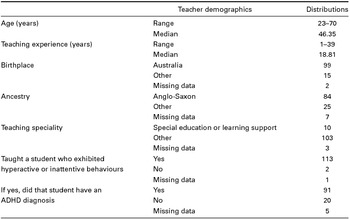
The participants for this study were 111 public school teachers from selected schools within the Sydney Metropolitan Area, selected for convenience and to obtain an even geographical distribution of schools throughout the Sydney Metropolitan Area. In addition, five teachers were recruited via social media, making a total of 116 participants. A description of participant demographic distributions is presented in Table 1. Selected schools were asked to participate in the current study and those that agreed were forwarded a link to the online survey to all staff members. Teachers voluntarily completed the online survey.
Participant Demographic Distributions

Schools that were accessible to the authors were contacted due to convenience, and others were contacted after their geographical location had been determined, in order to have the same number of schools from Northern, Southern, Eastern, Western and Central Metropolitan Sydney. It is difficult to pinpoint the exact number of schools that participated in this study due to the confidential nature of the online survey. Forty public schools, both primary and high, single sex and coeducational, were contacted via email. All schools were subsequently contacted via a follow-up phone call; some schools agreed to participate during the follow-up phone call while others did not. Some schools were unable to be contacted via phone, and may have passed the survey onto their teaching staff without notifying the authors of this action. The percentage of teachers who participated in the study is quite low if compared to the total number of teachers for all schools initially contacted, with high schools having as many as 100 teaching staff and primary schools as many as 80. Due to the confidential nature of the survey and the undefined number of participating schools, the percentage of respondents compared to the total number of teachers in all schools that participated in the study is unknown. The pool of teachers from social media is also unknown due to the ability for anybody to pass the information on to colleagues or friends who fit the criteria for participation.
Ethical Approval
Ethical approval was sought and received for this study through UNSW Australia's Minimal Ethical Impact Human Research Ethics Advisory Panel, as the study had no significant risk of harm, did not include vulnerable subject groups, or involve sensitive topics. Ethical approval was also sought and received from the NSW Department of Education and Communities to survey teachers from their public schools. In addition to ethical approval from these two authorities, prospective participants were provided with a participant information statement that outlined the research being undertaken, explained that their consent would be confirmed by the completion and return of the survey under the National Statement on Ethical Conduct in Research Guidelines, Section 2.2.5 (Australian Government National Health and Medical Research Council, 2012), and detailed how to contact the researchers or make a complaint should they wish to do so. The survey instrument included only basic demographic questions, to avoid the identification of individual participants, and all survey responses were kept in a secure location.
Research Instrument
The research instrument (which can be obtained from the corresponding author on request) was designed with the intention of determining a group of underlying themes with respect to teacher knowledge and attitudes towards ADHD and its associated behaviours. The survey was also designed to assess demographic features that are predictive of teacher attitudes. The survey consisted of items adapted from existing surveys (Akram, Thomson, Boyter, & McLarty, Reference Akram, Thomson, Boyter and McLarty2009; Arcia, Frank, Sánchez-LaCay, & Fernández, Reference Arcia, Frank, Sánchez-LaCay and Fernández2000; Bekle, Reference Bekle2004; Bishop & Boag, Reference Bishop and Boag2006; Canu & Mancil, Reference Canu and Mancil2012; Norvilitis & Fang, Reference Norvilitis and Fang2005; Ohan et al., Reference Ohan, Cormier, Hepp, Visser and Strain2008; Rush & Harrison, Reference Rush and Harrison2008; Watson & Bond, Reference Watson and Bond2007), which were developed to assess teacher knowledge and attitudes of students with ADHD and with other disabilities. The questions centred on the extent of teacher knowledge with respect to ADHD-type behaviours, possible causes and the effects of these behaviours in the classroom. Questions were chosen by the frequency with which they appeared in the surveys listed previously, and scored as correct or incorrect based on established facts, also listed as the correct answers in these surveys. The survey predominantly focused on the attitudes teachers have towards ADHD as a diagnosis, behaviours associated with ADHD and students who exhibit these behaviours. The survey consisted of four sections (parts A, B, C, D). Part A included eight demographic questions, followed by 20 questions in Part B that assessed teachers’ knowledge of ADHD using a 3-point Likert scale. The 30 items in Part C measured teacher attitudes of ADHD and towards ADHD-type behaviours using a 6-point Likert scale, and Part D comprised three open-ended questions, to gather additional information with respect to teacher's personal attitudes towards and feelings about ADHD and its behaviour manifestations.
Analysis
Correct response analysis (CRA) and frequency analysis (FA) were performed on responses to Part B of the research instrument (teacher knowledge) that determined the level of knowledge teachers held about ADHD. An exploratory factor analysis was conducted on the results of Part C (teacher attitudes) to examine the underlying dimensionality of the item set and to analyse the data through the extraction of factors. Analysis of the data collected using exploratory factor analysis determined the existence of clusters of variables with large correlations, suggesting that they were measuring the same underlying dimension.
Multiple regression analysis was employed with data from Part C as a second analytical technique to identify the relationship between the demographic characteristics of teachers, including level of knowledge, in an attempt to explain or predict their attitudes.
Results
Correct Response Analysis and Frequency Analysis
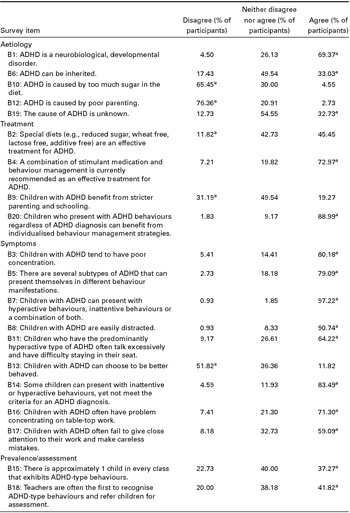
Section B of the research instrument, the knowledge questions, was analysed using CRA to determine the level of knowledge of ADHD that this sample of teachers possessed. Teachers generally had an adequate knowledge of ADHD, scoring an average of 61.6% in the knowledge questions. Having an excellent (> 85% correct) knowledge were 8.2% of participants, 76.4% of participants had an adequate (50–85% correct) knowledge and 15.5% of participants had a poor (< 50% correct) knowledge of ADHD and its associated behaviours.
The questions in the knowledge section of the research instrument related to four areas of knowledge around ADHD. Teachers scored an average of 55.5% on questions related to aetiology, 51.1% on questions related to treatment, 71.3% on questions related to symptoms and 39.5% on questions related to prevalence and assessment (Table 2).
Correct Response Analysis Frequencies

aDenotes the correct response to the survey item.
The questions that teachers answered most accurately were focused around symptoms and management, with the least accurate answers focused around diet, prevalence and aetiology, a result commensurate with those results found by Glass and Wegar (Reference Glass and Wegar2000) and Sciutto et al. (Reference Sciutto, Terjesen and Bender Frank2000). Teachers indicated that they neither agreed nor disagreed with an average of 5.5 questions. They were most uncertain about questions relating to aetiology and prevalence.
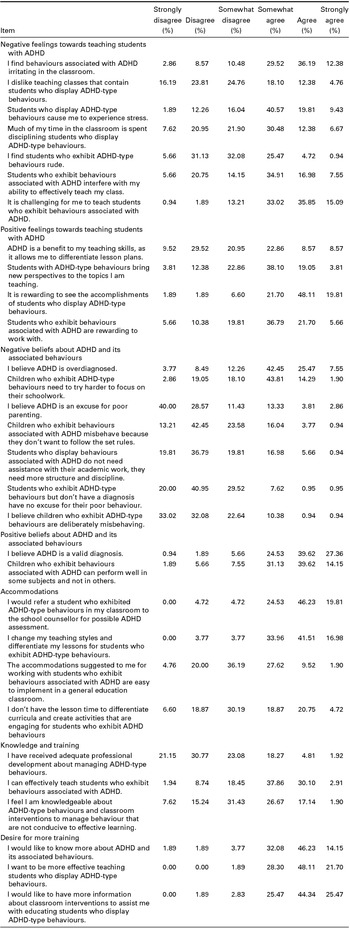
Section C of the research instrument, the attitude questions, was analysed using FA to determine the attitudes that teachers possessed towards ADHD, its associated behaviours and students who exhibit these behaviours (see Table 3). Generally, teachers agreed to some extent with statements about negative feelings towards teaching students with ADHD, with 78.1% of teachers finding behaviours associated with ADHD irritating in the classroom and 69.8% of teachers stating that students who display ADHD-type behaviours cause them to experience stress. The majority of teachers also agreed to some extent with the statements about positive feelings towards teaching students with ADHD, with 64.2% of teachers reporting that they believe students who exhibit behaviours associated with ADHD are rewarding to work with. However, only 40% of respondents believed that teaching students with a diagnosis of ADHD benefits their teaching skills, as it allows them to differentiate lesson plans. The majority of teachers disagreed with the negative beliefs about ADHD, with an overwhelming majority (91.5%) believing ADHD is a valid diagnosis. Further understanding of ADHD and its treatment was evidenced by the fact that 60% of teachers believed that children who exhibit ADHD-type behaviours need to try harder to focus on their schoolwork. This may indicate that teachers possess the understanding that students with ADHD need to try harder than most to focus, due to the characteristic of inattention, and that having the condition does not preclude the child's responsibility to make an effort. It may also suggest teacher knowledge of the necessity to support students in eventually taking responsibility for their behaviour. To eliminate supposition and determine what the connection between these two results is more accurately, future studies should employ teacher interviews and/or focus groups.
Frequencies of Responses to Attitude Survey Items

Seventy five percent (75%) of teachers disagreed that they had received adequate professional development about managing ADHD-type behaviours and an overwhelming majority (>92% for all questions related to the desire for more training) desired more training and information regarding ADHD, its associated behaviours, and classroom interventions. Although there was a strong desire for more information and classroom interventions, 70.8% of teachers indicated that they agreed to some extent that they can effectively teach students who exhibit behaviours associated with ADHD.
Exploratory Factor Analysis
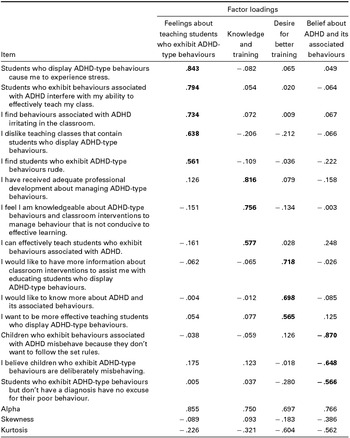
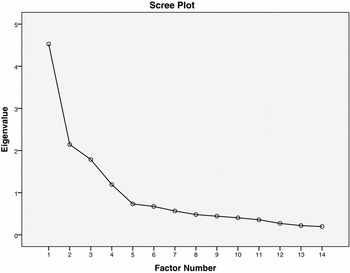
Following free exploratory factor analysis, a four-factor solution was identified for the dataset associated with teacher attitudes. The adequacy of extraction and the number of retained factors was evaluated by an examination of the eigenvalues of the factors and the scree plot. All four factors had eigenvalues of greater than one (i.e., 4.527 for Feelings about teaching students who exhibit ADHD-type behaviours, 2.143 for Knowledge and training regarding ADHD, 1.789 for Desire for better training regarding ADHD, and 1.194 for Beliefs about ADHD and its associated behaviours). A four-factor solution was also supported by the scree plot (see Figure 1). It is noted that items with communality values of less than .30 (Roberts, Donoghue, & Laughlin, Reference Roberts, Donoghue and Laughlin2000; Thomas, Allen, & Phillips, Reference Thomas, Allen and Phillips2009) were progressively removed prior to the conduct of factor analysis, as items with low communalities contribute minimally to factor analysis (De Vaus, Reference De Vaus2002). The four factors collectively accounted for 68.95% of the total variance of the dataset, which is above the 60% threshold noted by, Hair, Black, Babin, and Anderson (Reference Hair, Black, Babin and Anderson2010) for a satisfactory factor solution. Finally, all of the items that constituted each factor were assessed and confirmed to make a logical, meaningful and useful contribution to each factor (Pedhazur & Schmelkin, Reference Pedhazur and Schmelkin1991). The Bartlett's test of sphericity (564.41, p < .001) and the Kaiser–Meyer–Olkin measure of sampling adequacy indicated that factor analysis was an appropriate form of analysis for the dataset. The items constituting each factor, the factor loadings, Cronbach's alpha values, skewness and kurtosis of each of the four extracted factors are shown in Table 4.
Table of Factor Compositions

Note. Values shown in boldface illustrate the significant loadings onto each factor.
Scree Plot of Factor Extraction.

Multiple Regression Analysis
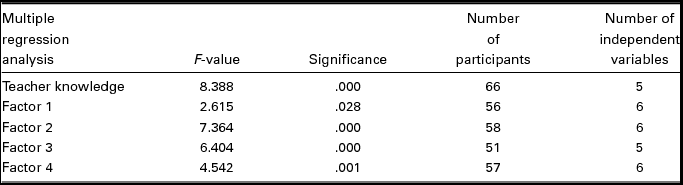
Multiple regression analysis, which is a multivariate statistical technique that is used specifically to examine relationships between a dependent variable and a set of independent variables (Hair et al., Reference Hair, Black, Babin and Anderson2010), was employed to assess the relationships between each of the factors extracted during the exploratory factor analysis (dependent variable) and the sociodemographic data collected in the study (the independent variables). The sample sizes in the study (see Table 6) were adequate to meet the minimum ratio requirements for multiple regression analysis of 5:1 (number of observations to number of independent variables) purported by Hair et al. (Reference Hair, Black, Babin and Anderson2010), with actual ratios ranging from 9.3:1 to 13.2:1.
As the presented study was designed as a pilot study, a forced entry method of linear regression was used, as other techniques may be influenced by random variation and thus seldom give replica results if the model is retested with the same sample (Studenmund & Cassidy, Reference Studenmund and Cassidy1987). Five separate multiple regressions were conducted to determine predictors of each of the previously listed dependent variables (see Table 5).
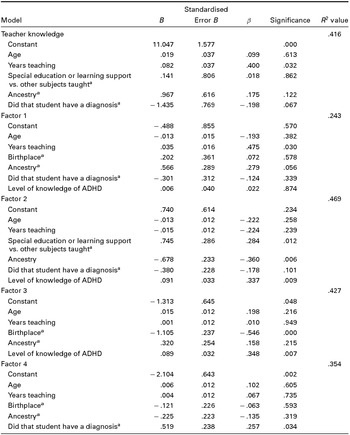
Multiple Regression Model of Teacher Knowledge and Each of the Four Factors

aCoded dichotomously: ‘.00’ Special Education or Learning Support, ‘1.00’ Other; Ancestry: ‘1.00’ Anglo-Saxon, ‘.00’ Non-Anglo-Saxon; Diagnosis: ‘1.00’ Yes, ‘2.00’ No; Birthplace: ‘1.00’ Australia, ‘.00’ Other.
Multiple Regression of Teacher Knowledge
In this multiple regression, teacher knowledge was the dependent variable with the predictor variables being ‘age’, ‘years teaching’, ‘special education vs. other subjects taught’, ‘ancestry’, and ‘did the student who displayed ADHD-type behaviours have an ADHD diagnosis’. In the regression model, only ‘years teaching’ was significant at the .05 level.
Multiple Regression of Factor 1: Feelings About Teaching Students Who Exhibit ADHD-Type Behaviours
The factor Feelings about teaching students who exhibit ADHD-type behaviours was the dependent variable with the predictor variables being ‘age’, ‘years teaching’, ‘birthplace’, ‘ancestry’, ‘did the student who displayed ADHD-type behaviours have an ADHD diagnosis’ and ‘level of knowledge about ADHD’. In the regression model, only years teaching was significant at the .05 level.
Multiple Regression of Factor 2: Knowledge and Training Regarding ADHD
The factor Knowledge and training regarding ADHD was the dependent variable with the predictor variables being ‘age’, ‘years teaching’, ‘special education vs. other subjects taught’, ‘ancestry’, ‘did the student who displayed ADHD-type behaviours have an ADHD diagnosis’, and ‘level of knowledge about ADHD’. In the regression model, the independent variables ‘special education vs. other subjects taught’, ‘ancestry’, and ‘level of knowledge about ADHD’ were all significant at the .05 level.
Multiple Regression of Factor 3: Desire for Better Training Regarding ADHD
The dependent variable was the factor Desire for better training regarding ADHD with the predictor variables being ‘age’, ‘years teaching’, ‘birthplace’, ‘ancestry’, and ‘level of knowledge about ADHD’. In the regression model for Factor 3, ‘birthplace’ and ‘level of knowledge about ADHD’ were both significant at the .05 level.
Multiple Regression of Factor 4: Beliefs About ADHD and its Associated Behaviours
The fourth multiple regression analysis used the factor Beliefs about ADHD and its associated behaviours as the dependent variable and the independent (predictor) variables ‘age’, ‘years teaching’, ‘birthplace’, ‘ancestry’, ‘did the student who displayed ADHD-type behaviours have an ADHD diagnosis’ and ‘level of knowledge about ADHD’. The variables ‘did the student who displayed ADHD-type behaviours have an ADHD diagnosis’ and ‘level of knowledge about ADHD’ were significant at the .05 level in the regression model.
A test of the assumptions for multiple regression analysis showed that the results might be generalised to other samples; however, due to the small sample size and the sampling procedures, it is difficult to make this generalisation. A linear relationship is modelled in each regression between the predictor and dependent variables, and all independent variables are either an interval scale or a dichotomous nominal scale. The independent variables birthplace, ancestry, subject taught, and the diagnosis status of the child with ADHD-type behaviours were coded dichotomously, whereas the other independent variables were interval scale variables.
The analysis of variance (ANOVA) for all of the regression models showed significance at < .05 level, thus it can be concluded that at least one of the predictor variables in the regression model had an effect on the dependent variable.
For all regression models, the standardised residuals are uniformly distributed, suggesting that there is no nonlinear behaviour in the regression model as determined by analysis of both the scatterplot and histogram. This, coupled with the Durbin–Watson value and the variance inflation factor (VIF) value, demonstrates that the model residuals are independent, normally distributed and that there is no evidence of multicollinearity, respectively, thus allowing for confidence in all regression models.
Discussion
The present study aimed to shed light on the following questions:
What level of knowledge of ADHD do teachers have?
Teachers were shown to have an adequate knowledge of ADHD, scoring an average of 61.6% on the knowledge section of the research instrument. Teachers appeared to know most about the symptoms of ADHD and least about assessment and prevalence. Multiple linear regression analysis was performed on teacher knowledge to determine if there were any significant predictors of the level of knowledge teachers possessed. Based on this analysis, it was shown that experience (measured by years teaching) was a significant predictor of teacher knowledge. In particular, it was observed that as teacher experience increased, so did teacher knowledge of ADHD. This result supports results from other recent studies (Anderson, Watt, Noble, & Shanley, Reference Anderson, Watt, Noble and Shanley2012; Bekle, Reference Bekle2004; Kos, Richdale, & Jackson, Reference Kos, Richdale and Jackson2004). The results of the present study may be attributed to engagement in professional learning, more time spent with students who exhibit ADHD-type behaviours, or wider reading on the subject by practising teachers; however, further research is needed.
What are teachers’ attitudes towards ADHD?
Part C of the research instrument was used to determine the attitudes teachers held towards ADHD itself and students who exhibit ADHD-type behaviours. Generally, teachers held negative feelings towards teaching students with ADHD, found behaviours associated with ADHD irritating in the classroom, and felt that these behaviours caused them to experience stress. Overwhelmingly, teachers agreed that ADHD is a valid diagnosis and expressed a desire for better training and professional development specifically regarding ADHD, a result that is congruent with that of Gargaro (Reference Gargaro2009). Exploratory factor analysis was conducted, which extracted four separate groups of highly correlated questions (factors). These factors contain questions with the themes Feelings about teaching students who exhibit ADHD-type behaviours, Knowledge and training regarding ADHD, Desire for better training regarding ADHD, and Beliefs about ADHD and its associated behaviours.
Are there any demographical characteristics that may impact teacher attitudes?
The multiple linear regression of demographic variables with the dependant variable Feelings about teaching students who exhibit ADHD-type behaviours, showed that the number of years a teacher has been teaching has a significant effect on the dependent variable. As a teacher's experience increases, she or he is more likely to agree with the statements in the factor. As the statements in the factor are of a negative nature, it is possible that as a teacher becomes more experienced he or she also becomes less tolerant of disruptive behaviours and less sympathetic to students who exhibit ADHD-type behaviours. It is also possible that more experienced teachers’ attitudes have been influenced by the controversial nature of ADHD. The significance of .03 illustrates that the relationship should be further investigated.
Multiple regression analysis using Knowledge and training regarding ADHD as the dependent variable showed evidence for a relationship between it and the independent variables ‘special education or learning support vs. others subjects taught’, ‘ancestry’, and ‘level of knowledge’, with ancestry and level of knowledge about ADHD having a greater significance than subject taught. In the regression model, teachers from a special education or learning support background and teachers with Anglo-Saxon ancestry are less likely to agree with statements related to knowledge and training than those from other subject areas or non-Anglo-Saxon backgrounds, respectively. As the level of knowledge teachers possess about ADHD increases, teachers are more likely to agree with the statements in the factor Knowledge and training regarding ADHD. Teachers from a special education or learning support background indicated that they did not feel that they had received adequate professional development, were knowledgeable about ADHD or could effectively teach students with ADHD. This may be because teachers from these backgrounds are more aware of educational issues surrounding students with learning disabilities and may see more students with ADHD than other teachers, particularly those students with ADHD and comorbid conditions.
Place of birth and level of knowledge about ADHD were characteristics that influenced a teacher's desire for better training regarding ADHD. Teachers born in Australia are more likely to disagree with statements expressing a desire for better training regarding ADHD, whereas teachers with greater level of knowledge are more likely to desire more information and to be more effective when teaching students with ADHD. It is possible that having a small amount of information with regard to ADHD available to them allows teachers to see the deficits in their knowledge and to also understand that specific interventions may be needed in order for students with ADHD to access the curriculum and obtain expected educational outcomes.
The status of a student's ADHD diagnosis and the level of knowledge about ADHD that teachers possessed appeared to predict their beliefs about ADHD and its associated behaviours. In the regression model for the factor about teacher beliefs about ADHD and its associated behaviours, both variables had a positive relationship with the dependant variable. Those teachers who had taught a student with an ADHD diagnosis and those with a higher level of knowledge were more likely to agree with the statements in this factor. This is particularly interesting, as one would expect that teachers who had taught students with an ADHD diagnosis and those with a higher level of knowledge would be more tolerant of students with ADHD. It would be expected that these teachers would disagree with statements regarding students with ADHD deliberately acting out rather than having a valid reason for their behaviour. This result may be due to the controversy surrounding ADHD; however, this would need to be investigated further.
Although an increase in the level of knowledge a teacher possesses regarding ADHD increases the likelihood that teachers will agree with the statement, ‘I can effectively teach students who exhibit behaviours associated with ADHD’, it also increases the likelihood that they will also agree with the statement, ‘I want to be more effective teaching students who display ADHD-type behaviours’. This suggests that although teachers’ self-efficacy in the area increases with their level of knowledge, they would still like to improve their skills in supporting students with ADHD. As level of knowledge appears to be a predictor for three of the four factors, there is evidence that the level of knowledge about ADHD could be a predictor of teacher attitudes towards students who exhibit ADHD-type behaviours. This provides evidence for further investigation into the predictors of attitudes towards ADHD-type behaviours and those students who exhibit those behaviours.
The results of demographical impact are in line with the sociocultural perspective of disability, as this study suggests teachers’ attitudes and perceptions regarding students who exhibit ADHD-type behaviour are coloured by their experience. Teachers’ attitudes towards training in the area were influenced by where they were born and their level of perceived knowledge about ADHD. These preliminary findings suggest that further studies on these factors are necessary, as they are important when using the sociocultural perspective as a lens, especially when planning teacher training.
The data from the multiple regression analysis highlighted demographical predictors of teacher attitudes regarding beliefs about ADHD and its associated behaviours, amount of and desire for ADHD-specific knowledge and training, and teachers’ feelings about teaching students who exhibit ADHD-type behaviours. This is important when designing ADHD-specific professional development and learning and allows the learning to be tailored to specific teaching groups. Teaching experience was a significant predictor of ADHD-specific knowledge, and this lends itself to the possible development of a mentoring program in which less experienced teachers who have students who exhibit ADHD-type behaviours in their classroom are paired with more experienced teachers who have also taught students with these behaviours.
From the data it also appears that as teachers become more experienced they become less tolerant of ADHD-type behaviours in their classroom and that teachers with a higher level of knowledge regarding ADHD and those who have taught students with an ADHD diagnosis have negative beliefs about students who exhibit ADHD-type behaviours. This demonstrates that experienced teachers and those who are knowledgeable about ADHD may benefit from further ADHD-specific training, possibly focusing on practical classroom interventions rather than knowledge facts.
The regression model for the factor regarding knowledge and training posits that teachers who have a learning support or special education background feel that they have not had adequate ADHD-specific training, whereas teachers from Australia are less likely to report that they have a desire for better training regarding ADHD. This is particularly important to acknowledge when developing professional learning modules, ADHD-specific training days and/or peer-mentoring programs. These predictors allow professional learning developers to use the NSW Department of Education and Communities’ Quality Teaching Elements (NSW Department of Education and Training Professional Support and Curriculum Directorate, 2012) to target specific groups of teachers while not singling out/discriminating against any one demographic of teacher. The Quality Teaching framework focuses on three main areas of classroom teaching that are linked to improved student learning. These three areas — intellectual quality, quality learning environment, and significance — should be used in conjunction with the demographic predictors of teacher attitudes to formulate a professional learning program that enhances the learning of all teachers involved in the program. In particular, data pertaining to demographical predictors can allow the developers of professional learning programs to focus on the significance area of the quality teaching framework, which outlines that best teaching practice links new learning to previous learning, and is inclusive of perspectives from differing cultures and stages of life.
Conclusion
A study investigating teacher knowledge of, and attitudes towards, ADHD itself, ADHD-type behaviours, and students who exhibit those behaviours has been presented. This study begins to fill a gap in research with respect to demographic predictors of teacher attitudes of knowledge towards students who exhibit ADHD-type behaviours. It was found that teachers in Sydney public schools have adequate knowledge of ADHD. Through exploratory factor analysis of the data four groups of highly correlated survey items were found. Multiple regression analysis determined demographic data that has the potential to predict teacher attitudes and knowledge of ADHD and ADHD-like behaviours.
There were several limitations to this study that make it difficult to draw any strong conclusions or generalisations from the data, and thus form the impetus for further investigation. One limitation of this study is its small sample size. As this study was intended to be a pilot study, only a small number of schools were selected for possible participation. The small sample size was reduced even further due to the removal of participants with missing data, outliers or influential cases. A second limitation of this present study was the method of selection of potential participants; the schools selected as potential participants were selected by convenience sampling. This method introduces the possibility of sampling bias; however, this is generally acceptable for a pilot study. Although the predictive strengths of models in the pilot study are not high enough to draw conclusive trends (as evidenced by the relatively low R 2 values; see Table 5), they are strong enough to warrant further investigation.
Further investigation should include independent variables such as socioeconomic status of the schools in which teachers work, teacher gender, and the gender of the students who have exhibited ADHD-type behaviours. Due to the removal of participants with missing data and those who were deemed to be outliers or influential cases, the present study was also unable to determine if the type of school was a contributing factor, particularly if teaching in a primary school or high school had an impact on teacher attitudes towards students who exhibit ADHD-type behaviours. Further study would be needed to determine if primary or high school, selective or comprehensive or special education schools, or single sex or coeducational schools could be used to predict teacher attitudes. Due to the small sample sizes for the multiple regression analysis (see Table 6), the present study suggests a relationship between some predictors and the dependent variables; however, the evidence is not conclusive, and further investigation into this area is warranted.
Values from Multiple Regression Analysis
A lack of knowledge regarding the aetiology, symptoms, and treatment of ADHD significantly impacts teacher-reported perceptions of students who exhibit ADHD and can often lead to less assistance for those students who may require it. The majority of the current studies centre on teachers’ perceptions of ADHD itself, and their knowledge surrounding the disorder. Little research both in Australia and internationally has focused on the feelings and attitudes teachers hold towards the behaviour manifestations of ADHD and those students who exhibit this behaviour.