Translational developmental science necessarily entails reciprocity between researchers and practitioners (Cicchetti & Hinshaw, Reference Cicchetti and Hinshaw2002; Cicchetti & Toth, Reference Cicchetti and Toth2006). No one appreciated this more than Ed Zigler. A champion for effecting enduring and positive change in the lives of children and families facing social vulnerabilities, Ed viewed his research participants as “partners,” emphasizing scientists’ “special responsibility to use this knowledge – not to fill up journals, but to make the lives of these children better” (Perkins-Gough, Reference Perkins-Gough2007, p. 8).
As noted by Zigler, “it's easy to write wonderful schemes in a book” (Finholm, Reference Finholm1992), but far more challenging (and impactful) to work directly with at-risk communities to actualize these ideas in the service of addressing pressing issues confronting children and families in practice. Latinx families face numerous structural and systemic challenges that threaten positive youth development and foment youth aggression and violence (Farrington, Gaffney, & Ttofi, Reference Farrington, Gaffney and Ttofi2017; O'Brien, Daffern, Chu, & Thomas, Reference O'Brien, Daffern, Chu and Thomas2013). Exceptionally high rates of adverse childhood experiences (e.g., violence exposure, household crowding, experiences of discrimination, and parent–child role-confusion due to language- and/or immigration-based barriers) amid a paucity of social and material resources fuel ongoing disparities in child outcomes (Allem, Soto, Baezconde-Garbanati, & Unger, Reference Allem, Soto, Baezconde-Garbanati and Unger2015; Hill & Torres, Reference Hill and Torres2010).
Situated in a markedly underserved, southern California community, Latino Health Access (LHA; Latino Health Access, 2018) operates on the front line to help Latinx families navigate these challenges via promotoras, who are trained community workers drawn from, and respected by, the local residents. Through prior partnerships with Drs. Nancy Guerra and Kirk Williams, LHA promotoras administered a targeted parent training program aimed at preventing immigrant Latinx children's aggression by addressing culturally specific factors, such as parent–child role confusion associated with culture brokering, that were overlooked in extant intervention programs. The resultant Madres a Madres program evidenced positive and replicable impacts on elementary school children's aggression and mental health (Williamson, Knox, Guerra, & Williams, Reference Williamson, Knox, Guerra and Williams2014). However, despite these gains, rates of serious, assaultive youth violence continued to be disproportionately higher among urban, Latinx youth, including those served by LHA. Homicide is the second leading cause of death among Latinx youth ages 10–24, whereas it is the fourth leading cause of death among non-Latinx white youth (CDC, 2014), and rates of dating and other interpersonal violence experiences are similarly elevated (Cuevas, Bell, & Sabina, Reference Cuevas, Bell and Sabina2014). Given the unique difficulties of implementing manualized programs, which typically feature minimal flexibility, high costs, and highly professionalized staff, in low-income, minority communities (Backer & Guerra, Reference Backer and Guerra2011), LHA recognized the ongoing need for culturally informed, cost-effective, flexible interventions to help Latinx families navigate the challenges before them.
This paper documents the development, implementation, and evaluation of a transactional partnership with this community-based health organization to actualize the spirit of Ed's legacy in the service of mitigating risk and promoting resilience among Latinx families. We begin by summarizing core developmental principles that informed the development of this culturally and developmentally sensitive intervention to mitigate violence and promote compassion and cohesion in this Latinx community and beyond. Next, we describe the eight-session curriculum we developed to promote attachment security, self-efficacy, empathy, and reflective functioning (RF) among Latinx mothers and their children (ages 8–17) as powerful mechanisms of therapeutic change. Finally, we provide initial evidence that supports the effectiveness of this intervention for promoting parent–youth relationship quality and reducing psychopathology, including a case analysis to illustrate how the curriculum shaped the lived experiences of the women and youth served by LHA. In closing, we discuss directions for ongoing research and practice, as well as opportunities to extend Ed's legacy into the future.
Guiding principles
Over the course of his career, Ed championed (and embodied) several core principles that inspired and shaped the growth of translational developmental science, as well as that of the first author. As a young doctoral student, the first author served for four years as a Bush Fellow for Child Development and Social Policy, a program Ed led at Yale. In this program, she attended weekly presentations on applied developmental science, and completed annual trips to Washington, DC to meet with Congressmen and policymakers and learn how research evidence can support children's issues most effectively. In this way, Ed's scholarship and mentoring shaped the development of the current intervention.
Collaborative partnerships
A core feature of open and dynamic systems in development is that the whole is greater than the sum of its parts (Gottlieb & Halpern, Reference Gottlieb and Halpern2002). This is also true of collaborative partnerships wherein researchers, practitioners, and community-based organizations have the capacity to develop interventions that far surpass any single perspective or approach in impact (Bogart & Uyeda, Reference Bogart and Uyeda2009). A vociferous proponent of the whole-child perspective, Ed long advocated for a multi-system, integrative approach to supporting children through Head Start (Zigler & Styfco, Reference Zigler, Styfco, Paris and Wellman1998), Schools of the 21st Century (Zigler & Finn-Stevenson, Reference Zigler and Finn-Stevenson2007), and other multitiered interventions. Likewise, when answering LHA's call for an intervention to support Latinx families at high risk for violence perpetration and victimization, we forged a deliberative community partnership, one in which the goals and perspectives of the community and of science were equally represented and valued (Kliewer & Priest, Reference Kliewer and Priest2019).
From our earliest conversations, we learned that LHA sought to engage more adolescent and middle school-aged youth in their programming. Focus groups with Madres a Madres participants revealed mothers’ consensus that they faced considerable parenting challenges, particularly as they struggled to monitor and guide their older children amid few opportunities for positive community engagement and the lure of substance use and antisocial behavior. Drawing from the wisdom conferred by their own lived experiences, these community partners naturally identified needs (and treatment foci) that have been well supported by empirical research on peer and community risk factors for youth violence (Bernat, Oakes, Pettingell, & Resnick, Reference Bernat, Oakes, Pettingell and Resnick2012). Moreover, at the same time these parents and providers called for explicit guidance and skills, they also emphasized the need to honor culturally specific protective processes and values, including strong bonds of intrafamilial trust and support (i.e., familismo; Ayon, Marsiglia, & Bermudez-Parsai, Reference Ayon, Marsiglia and Bermudez-Parsai2010).
We developed this intervention with an explicit appreciation that learning from and with LHA staff and community members would support the identification of culturally congruent values, norms, and resources to create an intervention that would be more readily accepted, utilized, and integrated into the community structure (Cicchetti, Rappaport, Sandler, & Weissberg, Reference Cicchetti, Rappaport, Sandler and Weissberg2000). Thus, we designed the intervention to advance beyond traditional skill building to address multiple layers of risk, such as neighborhood factors, family strengths, and cultural values, which often are overlooked in standard cognitive-behavioral youth violence prevention programs (e.g., Fast Track; Conduct Problems Prevention Research Group, 2002). The resultant intervention sought to prevent multiple forms of violent behavior, including perpetration and victimization, having broad appeal to the community, and addressing the manifold developmental paths toward youth violence (i.e., equifinality; Cicchetti & Rogosch, Reference Cicchetti and Rogosch1996).
Opportunities for success
Children, families, and communities developing in the face of structural barriers to success often are denied access to a long-recognized driver of positive development – the gratification of, and resultant desire for, mastery (White, Reference White1959). Thus, when designing Head Start, Ed sought to give vulnerable children a taste of success, appreciating that such experiences ignite the human motivation to persist and overcome challenges (Malakoff, Underhill, & Zigler, Reference Malakoff, Underhill and Zigler1998). Likewise, we integrated opportunities for mothers and children to demonstrate their strengths and experience success as central elements of the intervention, both in the process of its collaborative development and in its community implementation.
In designing the intervention, we emphasized community-origin metaphors of strength and resilience, and consciously spotlighted instances of parenting and youth success across the sessions. In this way, the resultant intervention embodied contemporary strength-based (Kalke, Glanton, & Cristalli, Reference Kalke, Glanton and Cristalli2007) and empowerment-oriented (Wiley & Rappaport, Reference Wiley, Rappaport and Weissberg2000) approaches to practice, which are particularly salient when working with ethnic minority populations (Case & Robinson, Reference Case, Robinson, Bernal, Trimble, Burlew and Leong2003). As the intervention emerged from side-by-side collaborations among parents, youth, promotoras, and academics, both promotoras and community members articulated a sense of ownership and dedication to the intervention program, while celebrating their success at having built this program from the ground up.
Development is cumulative
Development reflects the recurrent process of something evolving from what was there before; it is cumulative such that the origins of current phenomena (e.g., youth's aggressive behavior) begin long before the behavior emerges (Sroufe, Reference Sroufe, Cicchetti and Beeghly1990). Ed himself observed “that the development of a child does not begin the day he is born – or at age three – but much earlier, during the formative years of his parents” (Zigler, Reference Zigler1976, Foreword). As such, we joined the community in recognizing the significance of supporting both parents and children in their efforts to negotiate challenges, while appreciating the need to re-visit our assumptions and expectations amidst inevitable shifts in both challenges and available resources over time.
To that end, we developed complementary intervention curricula for both mothers and children by integrating the educationally oriented Madres a Madres Manual with Borelli's Relational Savoring Manual, which was designed to help parents and children access and deeply process memories of felt security (Borelli et al., Reference Borelli, Smiley, Kerr, Hong, Hecht, Blackard and Bond2020), and has demonstrated particularly strong effects among Latinx parents (Goldstein et al., Reference Goldstein, Kerr, Li, Campos, Sbarra, Smiley, Borelli and Goldstein2019), likely due to its cultural congruence with familismo (Neblett, Rivas-Drake, & Umana-Taylor, Reference Neblett, Rivas-Drake and Umana-Taylor2012). For nearly a year, our team of scientists, clinicians, promotoras, and LHA staff met on a weekly basis to critically examine each aspect of the mother and youth protocols, talk through strategies for how to present the material, and practice administering the techniques with families. The team considered the cultural values and tools of both mothers (e.g., metaphors entailing paths or trees) and youth (e.g., videography, community interviews) to develop accessible and relatable intervention strategies. Revised intervention protocols emerged from prior incantations as mothers, youth, and promotoras provided feedback during the six months of pilot testing. For example, although we began this process with mother and youth groups that were parallel in structure, focus, and timing, we surrendered that plan in response to youth feedback that some intervention elements (e.g., the tree metaphor) did not resonate with their experiences. Through this iterative, recursive process, the treatment manuals became what they were intended to become – living documents that were born of local knowledge and scientific wisdom, with the capability to grow and change as a result of input from promotoras and participants, or amidst shifting challenges and resources in the community itself.
Program implementation
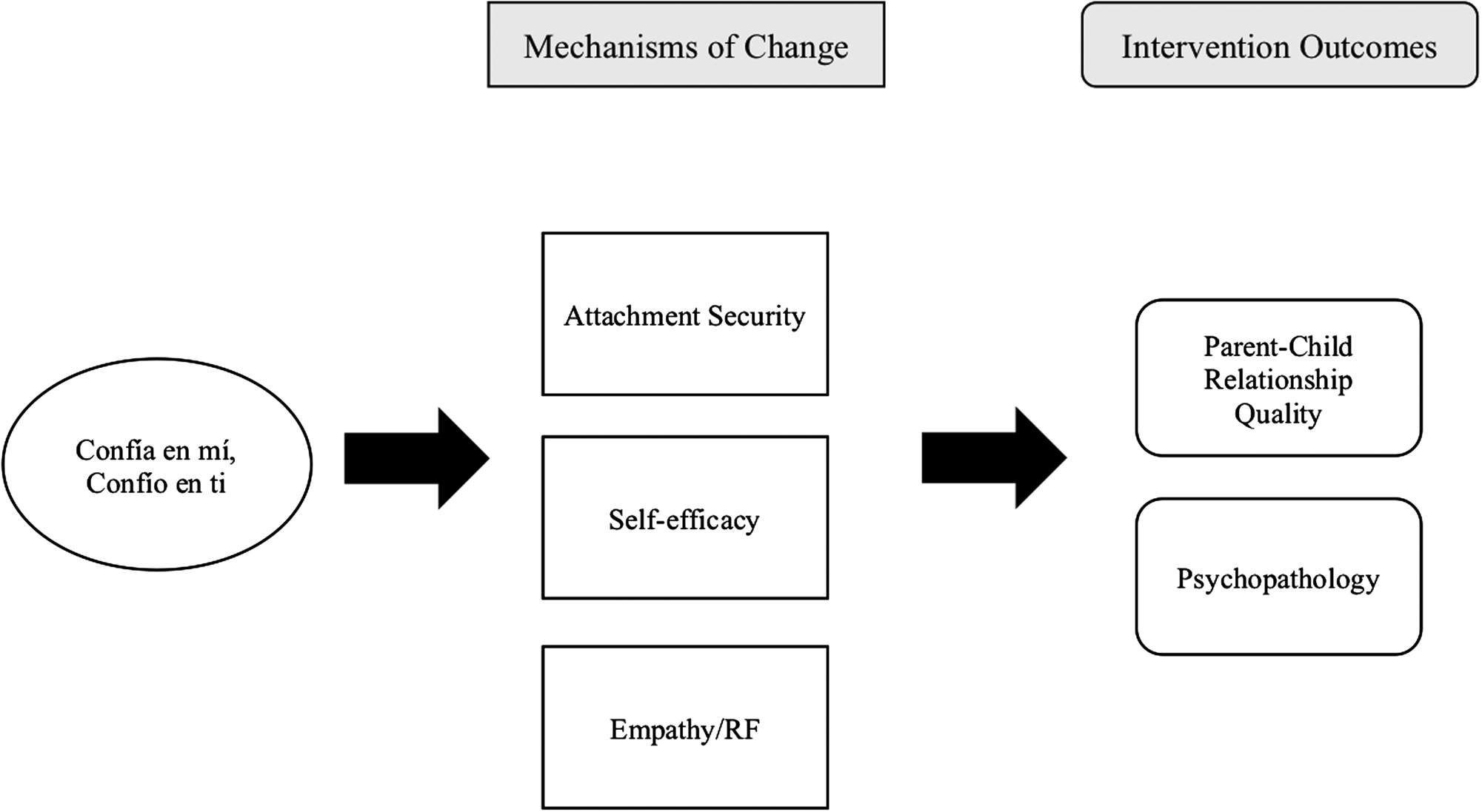
This collaborative effort culminated in an eight-week curriculum, which was designed to provide a flexible intervention for Latinx youth and their families who were at elevated risk for violence victimization and/or perpetration. Roughly translated to mean Trust in Me, for I Trust in You, the Confía en mí, Confío en Ti intervention supported Latina mothers and their children (ages 8–17) during a series of eight, two-hour long, weekly sessions. Promotoras facilitated concurrent treatment groups with an average of 12 mothers (SD = 4.36) and their children per group. Each group protocol targeted theoretically specified mechanisms of change (i.e., attachment security, self-efficacy, empathy, and RF) using culturally and developmentally appropriate, cost-effective strategies (e.g., Spanish-speaking promotoras, group-based dissemination) to improve proximal indicators of violence risk (i.e., parent–child relationship quality, psychopathology). Figure 1 depicts these mechanisms of change and intervention outcomes. We anticipated that this collaborative and emic process of intervention development and implementation would promote the uptake, success, and sustainability of the program to support children and families’ navigation of the manifold risks in their community.
Proposed mechanisms of change and intervention outcomes for program. Note: RF = reflective functioning.

Mechanisms of therapeutic change
The parent and youth curricula targeted three central mechanisms of change in the service of actualizing positive therapeutic outcomes (improved parent–child relationship quality and reduced psychopathology) that would mitigate violence victimization and perpetration.
First, we sought to increase mothers’ and youth's attachment security by directing participants to increase their attention and emphasis on moments of parent–child connection (i.e., relational savoring), such as a time when a mother gave her child an encouraging nod before he went off to take an exam at school (see Borelli et al., Reference Borelli, Smiley, Kerr, Hong, Hecht, Blackard and Bond2020, for further description). Attachment security comprises a sense of confidence that one's attachment figure will be there for support during times when the youth challenges themselves (i.e., secure base) or protection (i.e., safe haven) in times of need (Ainsworth, Reference Ainsworth1989). When people feel safe and secure in important relationships, they behave in ways that are adaptive, making decisions that support the psychological and physical health of themselves and others (Ranson & Urichuk, Reference Ranson and Urichuk2008; Sroufe, Reference Sroufe, Cicchetti and Beeghly1990). Attachment security is important for children (e.g., Ducharme, Doyle, & Markiewicz, Reference Ducharme, Doyle and Markiewicz2002) and their parents (e.g., Atkinson et al., Reference Atkinson, Paglia, Coolbear, Niccols, Parker and Guger2000), because it is associated with positive interpersonal behavior and health for both. Unsurprisingly, it is a well-documented protective factor against environmental risks, such as community violence (e.g., Lynch & Cicchetti, Reference Lynch and Cicchetti2004), poverty (e.g., Johnson, Mliner, Depasquale, Troy, & Gunnar, Reference Johnson, Mliner, Depasquale, Troy and Gunnar2018), racial discrimination (e.g., Anderson et al., Reference Anderson, Hussain, Wilson, Shaw, Dishion and Williams2015), and threats of deportation or other immigration-related stressors (e.g., Venta et al., Reference Venta, Galicia, Bailey, Abate, Marshall and Long2019).
Second, through team building exercises and story vignettes, promotoras sought to increase participants’ confidence in themselves and in their self-efficacy to effect positive changes in their community. Promoting self-efficacy is especially important for communities that may feel powerless to change their circumstances by virtue of discrimination and marginalization, including among urban Latinx youth (Vick & Packard, Reference Vick and Packard2008). In the mothers’ group, we integrated a tree metaphor to help mothers conceptualize their strengths, goals, support systems, and resources as the trunk, branches, leaves, and roots of the tree.
Relational savoring exercises targeted mothers’ sense of self-efficacy when parenting by helping them focus on and enhance memories of parenting success when they provided a secure base and safe haven for their child. For youth, self-efficacy was targeted through exercises in which they described their resources and skills, team building activities to conquer challenges (e.g., tower building competition), and tasks in which they brainstormed prosocial ways to overcome social challenges (e.g., story vignettes). Both the mother and the youth groups discussed the social determinants of health, providing an opportunity for encouraging participants to discuss how these determinants shaped their own experiences. By shifting the narrative from one of victimization to one of community empowerment, we encouraged parents and youth to take appropriate action to protect and advocate for themselves, as well as to work together and with their communities to overcome these challenges.
Third, by facilitating narrative sharing among group members, we sought to increase participants’ ability and motivation to “feel with” others (i.e., empathy; Stueber, Reference Stueber2006) and to reflect upon their own experiences and those of others (i.e., reflective functioning, RF; Fonagy, Gergely, Jurist, & Target, Reference Fonagy, Gergely, Jurist and Target2002). Empathy and RF promote a sense of communal connection (McMillan & Chavis, Reference McMillan and Chavis1986), and inspire prosocial actions for the benefit of others (Jolliffe & Farrington, Reference Jolliffe and Farrington2006) thereby mitigating aggressive or violent behavioral tendencies (McPhedran, Reference McPhedran2009; Taubner & Curth, Reference Taubner and Curth2013). By targeting empathy and RF, we sought to inspire group members to experience and express compassionate emotions toward themselves, one another, and in their community. Group members were encouraged to share their reactions to hearing other participants describe poignant or painful experiences. In turn, these moments of empathizing with and reflecting upon others’ experience often lead group members to become more vulnerable and open with one another, thereby enhancing the group's cohesion. At the close of both mother and youth group sessions, each participant was invited to share what they learned that day and how they were feeling, which often included gratitude for the group, expressions of empathy for its members, and additional opportunities for sharing.
Importantly, most sessions targeted multiple change processes. By tapping multiple processes within sessions, we capitalized on reciprocally promotive relations across these change processes. For example, a sense of security was necessary for participants to feel sufficiently safe to experience tender emotions and trust the group in order to activate empathy and RF. Likewise, prior evidence supports reciprocal relations between attachment security and self-efficacy; for example, low-income Latinx youth who perceive their teacher to be encouraging report higher academic self-efficacy (Riconscente, Reference Riconscente2013), which, in turn, predicts better performance (Manzano-Sanchez, Outley, Gonzalez, & Matarrita-Cascante, Reference Manzano-Sanchez, Outley, Gonzalez and Matarrita-Cascante2018).
Program curricula
Madres curriculum
Each mothers’ group commenced with a brief participant check-in followed by promotoras reviewing key take-away messages from the preceding session and introducing central goals for the current group session. As detailed in Table 1, the madres curriculum was framed, particularly the first few sessions, using a community-origin tree metaphor (see Figure 2). Through conversation and an immersive art project to construct a three-dimensional tree, mothers learned to recognize and appreciate their vital role in rooting their children in the community and their unique capacity to make their children feel safe, with Sessions 1–2 focused on increasing mothers’ confidence in themselves and in their ability to support themselves, their child, and their community. Sessions 3–4 focused on the social determinants of health, increasing empathy and prosocial behavior. Sessions 5–7 concentrated on discussing the key concepts underlying attachment security (i.e., secure base and safe haven; Ainsworth, Reference Ainsworth1989), as well as increasing mothers’ own feelings of security by practicing Relational Savoring. Finally, Session 8 re-visited empathy and RF processes, as mothers shared their final reflections on their experience of the group. At the close of each session, promotoras provided a brief overview of the core themes and then asked each mother to provide a word or phrase to summarize what she would take away from the day's session.
Illustration of the community-origin tree metaphor used in the program.

Intervention structure, session by session

Youth curriculum
Notably, for the youth curriculum, we replaced the tree metaphor and construction project used in the madres curriculum with video clips and interactive activities (e.g., role-plays, crafts, ice breakers) because the tree metaphor was not well received by the youth during the pilot sessions. Each youth group began with promotoras reviewing the take-away message from the prior session. Following this overview, youth engaged in a short team building exercise to foster cohesion, and then promotoras introduced the main goals for the session. Each session included three components: educational content, group discussion, and an interactive activity. Sessions 1–2 focused on team building and identification of areas of competence to build self-efficacy (see Table 1). In Sessions 3–5, youth learned about secure base and safe haven functions of the attachment relationship and practiced Relational Savoring to heighten youth's awareness of their mothers’ psychological availability to them, and thereby, increase the likelihood that they would turn to their mothers in times of need. Session 6 widened the lens to help youth consider opportunities to experience security and safety in their community, and also focused on promoting prosocial behavior in youth. Finally, in Sessions 7–8, youth reviewed the main intervention themes, with an emphasis on normalizing youth's need for (and right to) security and safety.
Program evaluation
The Confía en mí, Confío en Ti intervention evaluation is ongoing using a randomized controlled trial across eleven intervention groups and a waitlist control group. In this paper, we present preliminary data from 112 mother–youth dyads who have completed the eight-week intervention thus far to test our hypothesized mechanisms of change, as well as initial indicators of successful treatment outcomes. We also present a case study to illustrate the therapeutic change process in action and the broader, high-risk Latinx community from which they were drawn.
To test our hypotheses, we evaluated pre–post changes in mechanisms of change, namely youth's attachment security, mothers’ RF, and adolescents’ (ages 11–17) RF (RF was not evaluated among children ages 8–10), and intervention outcomes, namely parent–child relationship quality and mother and youth psychopathology. In tandem, these analyses evaluated our overarching hypothesis that promoting attachment security, self-efficacy, and RF in mothers and children would move the dial toward improved parent–child relationship quality and reduced psychopathology as two powerful buffers against aggression and violence (Taubner, White, Zimmermann, Fonagy, & Nolte, Reference Taubner, White, Zimmermann, Fonagy and Nolte2013).
Method
Participants
Latina mothers (N = 112; M age = 40.89, SD = 6.00, Range: 27.02–56.39) and their children (54% male, M age = 12.50, SD = 2.05, Range: 8.03–17.67) participated in this study. Most mothers (94%) were born in Mexico, and most (98%) spoke Spanish as their preferred language. On average, mothers reported an annual household income of $29,095 (SD = $14,210; Range: $10,500–$93,600). More than half (58.3%) the mothers were married, with an additional 25% cohabiting with partners. Approximately half the mothers (54.8%) were working part- or full-time and 30% reported food insecurity in the past year. Median education level of the mothers was 9th grade, ranging from second grade to 12th or higher. To minimize anxiety, we did not inquire about immigration status or length of time in the United States; however, 63% of the mothers reported living in the LHA service area for 11–20 years, with 20% reporting <11 years and 17% reporting more than 20 years.
Procedure
We recruited families from three neighborhoods identified as having high levels of inequalities, according to the 10-year Building Healthy Communities Initiative funded by the California Endowment (2010–2020). Promotoras recruited families via door-to-door outreach, flyers, word of mouth, and calling families from local school lists. Families were screened by promotoras over the phone for eligibility, which included living in one of the high crime neighborhoods, having a child between the ages of 8 and 17, speaking fluent Spanish (mothers only) and English (children only), and the absence of a developmental disability or severe mental illness diagnosis (e.g., psychotic disorder) in the mother or child. Mothers with more than one child in the target age range selected the child they wanted to participate.
Eligible families were invited to the community center, with transportation provided when needed, to receive more information about the study. Interested families provided their informed consent and informed assent, which were administered by trained bilingual research assistants. Mothers and children then completed an intake assessment and dyads were randomized to intervention or waitlist control groups. Intervention families began treatment as soon as a new eight-week intervention cycle began, while waitlist control group families returned to the community and were contacted regularly by promotoras until they returned to complete a second baseline assessment and enroll in the intervention three months later.
Measures
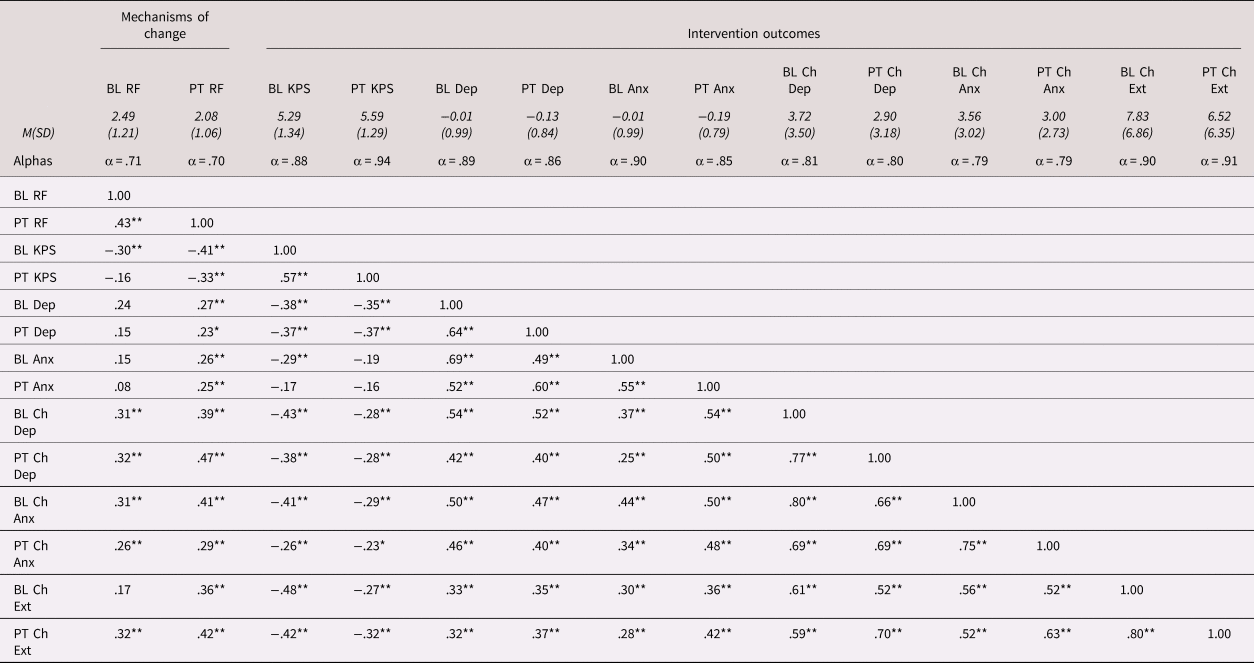
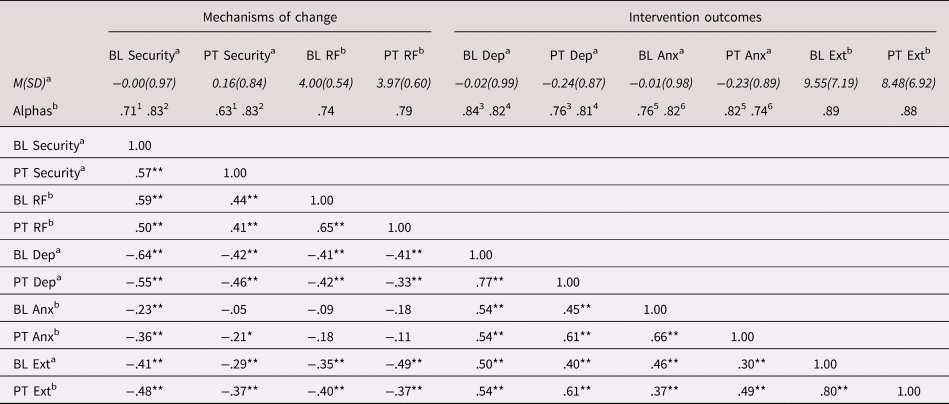
Sample means, standard deviations, and Cronbach's alphas are provided in Table 2 (mother-reported measures) and Table 3 (youth-reported measures).
Bivariate correlations among baseline and post-treatment mother-reported variables

Note: *p < .05, **p < .01; M(SD) = mean and standard deviation; Alphas = Cronbach's alpha; BL = baseline data; PT = post-treatment data; RF = reflective functioning (prementalizing) on PRFQ-A, high scores signify low RF; KPS = parenting satisfaction; Dep = depressive symptoms on BSI; Anx = anxiety symptoms on BSI; Ch Dep = mother-reported youth depressive symptoms on Child Behavior Checklist (CBCL); Ch Anx = mother-reported child anxiety symptoms on CBCL; Ch Ext = mother-reported child externalizing symptoms on CBCL.
Bivariate correlations among baseline and post-treatment youth-reported variables

Note: *p < .05, **p < .01; M(SD) = mean and standard deviation; Alphas = Cronbach's alpha; BL = baseline data; PT = post-treatment data; Security = attachment security scores for the sample (for children, these are their scores on the Security Scale1, and for adolescents, this is their score on the Experiences in Close Relationships – Relationships Structures Scale [ECR-RS]2), higher scores signify high security; RF = reflective functioning (other-focused RF) on Reflective Functioning Questionnaire for Youth (RFQ-Y), high scores signify high RF; Dep = standardized depression scores for the sample (for children, these are their scores on the Child Depression Inventory3, and for adolescents, this is their depressive problems subscale score on the Youth Self Report [YSR]4); Anx = standardized anxiety scores for the sample (for children, this is their score on the Multidimensional Anxiety Scale for Children (MASC)5, and for adolescents, this is their anxiety problems score on the YSR6); Ext = adolescent self-reported externalizing symptoms on YSR.
a n = 107 youth (all ages).
b n = 84 adolescents (11–17-year-olds).
Mechanisms of change
Attachment security
Adolescents (n = 89; ages 11–17) completed the Experiences in Close Relationships –Relationships Structures Scale (ECR-RS; Fraley, Heffernan, Vicary, & Brumbaugh, Reference Fraley, Heffernan, Vicary and Brumbaugh2011), in which they indicated the extent to which a series of statements described their attachment relationship with their mother (e.g., I'm afraid this person may abandon me or I don't feel comfortable opening up to this person) on a 7-point Likert scale (1 = strongly disagree to 7 = strongly agree). The measure provides scores of attachment anxiety (three items) and avoidance (six items), with low scores on both scales signifying high security. This measure has previously been validated in adolescent samples (Donbaek & Elklit, Reference Donbaek and Elklit2014).
Children (n = 23, ages 8–10) completed the Security Scale (Kerns, Klepac, & Cole, Reference Kerns, Klepac and Cole1996) with respect to their mother. The scale assesses children's perceptions of their attachment figures’ responsivity and availability (e.g., Some kids find it easy to count on their mom for help, BUT other kids think it's hard to count on their mom) on a 4-point scale using Harter's (Reference Harter1982) format where the child first selects the statement that is most true for them and then indicates whether the statement is really true or sort of true; higher scores connote greater security. This measure shows strong psychometric properties (Brumariu, Madigan, Giuseppone, Abtahi, & Kerns, Reference Brumariu, Madigan, Giuseppone, Abtahi and Kerns2018).
All youth completed the Child Attachment Interview (CAI; Shmueli-Goetz, Target, Fonagy, & Datta, Reference Shmueli-Goetz, Target, Fonagy and Datta2008), a semi-structured interview consisting of 19 questions concerning the child's current and past experiences with primary caregivers and prompts for the child to evaluate the qualities of these relationships. In the current study, the CAI was reduced to seven questions, omitting the self adjectives and only asking children about their mothers. Interviews were video-recorded and transcribed verbatim. Coding is underway for these interviews, but we present qualitative data from one CAI in this study.
Reflective functioning
Mothers completed the six-item prementalizing subscale of the Parental Reflective Functioning Questionnaire-Adolescent version (PRFQ-A; Luyten, Mayes, Nijssens, & Fonagy, Reference Luyten, Mayes, Nijssens and Fonagy2017), rating the extent to which they agree or disagree with each statement (e.g., My child sometimes gets sick to keep me from doing what I want to do) on a 7-point scale (1 = strongly disagree to 7 = strongly agree). Higher prementalizing scores indicate a lower capacity to reflect on the mental states of one's child. The PRFQ-A has demonstrated good reliability and validity in prior samples of parents with children ages 12–18 (Luyten et al., Reference Luyten, Mayes, Nijssens and Fonagy2017).
Mothers completed the Parent Development Interview – Revised (PDI-R; Slade, Aber, Bresgi, Berger, & Kaplan, Reference Slade, Aber, Bresgi, Berger and Kaplan2004), a semi-structured, 17 question, hour-long interview. The PDI-R emphasizes emotional experiences of parenting, both the parent's own emotions (e.g., What gives you the most pain or difficulty as a parent?) and the parent's experiences of responding to their child's emotions (e.g., Can you tell me about a time when your child felt rejected?). Parental RF on the PDI is associated with school-aged children's attachment security on the CAI (Borelli, St. John, Cho, & Suchman, Reference Borelli, St. John, Cho and Suchman2016). In this study, PDI-R interviews were conducted in Spanish, audio-recorded, and transcribed verbatim. Coding is underway; here we present qualitative data from one PDI-R in this study.
Adolescents (ages 11–17) completed the other-focused subscale of the Reflective Functioning Questionnaire for Youth (RFQ-Y; Ha, Sharp, Ensink, Fonagy, & Cirino, Reference Ha, Sharp, Ensink, Fonagy and Cirino2013) to assess their capacity to consider others’ mental states. Youth indicated agreement with items (e.g., “I always know what I feel”) on a Likert scale from 1 (strongly disagree) to 6 (strongly agree); higher scores indicate greater mentalization ability. The RFQ-Y has been validated in adolescent clinical populations (Duval, Ensink, Normandin, Sharp, & Fonagy, Reference Duval, Ensink, Normandin, Sharp and Fonagy2018). Children (ages 8–10) did not report on RF because there is no measure suitable for this age range.
Intervention outcomes
Parenting satisfaction
The Kansas Parental Satisfaction scale (KPS; James et al., Reference James, Schumm, Kennedy, Grigsby, Shectman and Nichols1985) assessed mothers’ satisfaction with their child's behavior, themselves as a parent, and their relationship with their child. Mothers completed the three-item questionnaire using Likert scale from 1 (extremely dissatisfied) to 7 (extremely satisfied) with higher scores signifying more satisfaction. In prior studies, the KPS has evidenced strong reliability (James et al., Reference James, Schumm, Kennedy, Grigsby, Shectman and Nichols1985).
Psychopathology
Mothers completed the 18-item Brief Symptom Inventory (BSI-18; Derogatis, Reference Derogatis2001) for their own depression and anxiety symptoms. Items (e.g., During the past week including today, how much were you distressed by nervousness or shakiness inside?) are rated on a 5-point Likert scale from 0 (not at all) to 4 (extremely). Past studies have demonstrated good reliability and validity for low-income Latina mothers (Prelow, Weaver, Swenson, & Bowman, Reference Prelow, Weaver, Swenson and Bowman2005).
Mothers also reported on their children's depressive, anxiety, and externalizing symptoms using the Mexican version of the Child Behavior Checklist for ages 6–18 (CBCL/6–18; Achenbach & Rescorla, Reference Achenbach and Rescorla2001), in which they indicated whether their child displayed any of a wide range of behaviors in the last 6 months on a 3-point scale from 0 (not true) to 2 (very true or often true). We used the depressive problems scale (13 items; e.g., feels worthless or inferior), anxiety problems scale (nine items; e.g., too fearful or anxious), and externalizing problems broadband scale (e.g., 35 items; argues a lot). The Mexican version of the CBCL has been found to be both reliable and valid for Mexican parents (Albores-Gallo et al., Reference Albores-Gallo, Lara-Muñoz, Esperón-Vargas, Zetina, Soriano and Colin2007).
Adolescents (ages 11–17) reported on their own depressive, anxiety, and externalizing symptoms during the past 6 months using the Youth Self Report (YSR; Achenbach, Reference Achenbach1991), which assesses broadband psychopathology among youth ages 11 to 18. This investigation used the depressive problems scale (13 items; e.g., I feel that no one loves me), anxiety problems scale (nine items; e.g., I'm afraid of going to school), and externalizing problems broadband scale (e.g., 32 items; I disobey my parents). Youth rated each item on a 3-point scale from 0 (not true) to 2 (very true or often true). The YSR has previously been validated in Spanish and Brazilian adolescent populations (Geibel et al., Reference Geibel, Habtamu, Mekonnen, Jani, Kay, Shibru and Kalibala2016; Zubeidat, Dallasheh, Fernandez-Parra, Sierra, & Salinas, Reference Zubeidat, Dallasheh, Fernandez-Parra, Sierra and Salinas2018).
As the YSR is not suitable for children under the age of 11, children (n = 23, ages 8–10) reported on their depressive symptoms using the Child Depression Inventory (CDI; Kovacs, Reference Kovacs1992), and on their anxiety symptoms using the Multidimensional Anxiety Scale for Children (MASC; March, Parker, Sullivan, Stallings, & Conners, Reference March, Parker, Sullivan, Stallings and Conners1997). Children (ages 8–10) did not report on their externalizing symptoms. The CDI is a 27-item measure assessing behavioral, cognitive, emotional, and psychological features of depression. Participants choose one of three statements that best describes their symptoms over the past two weeks (e.g., I am sad once in a while, I am sad many times, or I am sad all the time); higher scores indicate more severe depressive symptoms. The psychometric properties of the CDI are excellent (Kovacs, Reference Kovacs1992; Saylor, Finch, Spirito, & Bennett, Reference Saylor, Finch, Spirito and Bennett1984). The MASC is a 39-item questionnaire that prompts participants to decide how often statements (e.g., The idea of going away to camp scares me) are true for them on a 4-point scale from 0 (never) to 3 (often). The MASC assesses physical symptoms, social anxiety, harm avoidance, and separation anxiety and has demonstrated high reliability and validity in past studies with clinical and nonclinical populations (March et al., Reference March, Parker, Sullivan, Stallings and Conners1997).
Measure validation for Spanish-speaking Latinx mothers
From the larger set of questionnaires used in this study, the ECR-RS, PRFQ-A, and the KPS had not previously been translated and validated in Spanish. To address this issue, prior to administering these measures to the mothers, we conducted an online validation study of these measures using an independent sample of N = 215 Spanish-speaking Latina mothers residing in the United States. We translated all measures into Spanish using the forward-back translation method to ensure accuracy. Participants were recruited through email and social networks (n = 205) as well as Mechanical Turk (n = 10). We selected a set of convergent measures that had been used to establish validity with other native Spanish-speaking samples, including (a) the Experiences in Close Relationships – Spanish (ECR-S; Alonso-Arbiol, Balluerka, & Shaver, Reference Alonso-Arbiol, Balluerka and Shaver2007), a 36-item measure designed to assess attachment patterns in romantic relationships, (b) the Acceptance and Action Questionnaire-II (AAQ-II; Ruiz, Langer Herrera, Luciano, Cangas, & Beltran, Reference Ruiz, Langer Herrera, Luciano, Cangas and Beltran2013), a seven-item self-report Spanish instrument designed to measure experiential avoidance and psychological inflexibility, and (c) the Parental Stress Scale (PSS; Oronoz, Alonso-Arbiol, & Balluerka, Reference Oronoz, Alonso-Arbiol and Balluerka2007), an 18-item self-report instrument designed to assess the parent–child relationship. Supplementary Tables 1 and 2 in the Appendix report alphas for each scale and display the significant findings that validate our Spanish versions of the ECR-RS, PRFQ-A, and KPS.
Data analytic plan
Data preparation
Data were examined for non-normality to render parametric statistics valid (Afifi, Kotlerman, Ettner, & Cowan, Reference Afifi, Kotlerman, Ettner and Cowan2007). Missing data were generally rare with 6 (5%) mothers missing data on household income, 2 (2%) mothers missing data on education, and 3 (3%) missing data on food insecurity; however, 22 (20%) mothers were missing data on the number of children in the home. Missing data were handled across 40 rounds of multiple imputation and aggregated data from the imputations were used in all analyses.
To accommodate our use of age-appropriate measures (e.g., child anxiety was measured with the MASC at ages 8–10 and the YSR for at ages 11–17), youth's scores were standardized within each measure at baseline, and post-treatment scores were standardized based on the sample baseline values for each measure. For example, if the baseline sample mean for the MASC was 90.81 (SD = 15.70), we computed each participant's post-treatment standardized MASC score as (X – 90.81/15.70). Thus, while the mean z score for baseline MASC scores was 0.00 (SD = 1.00), the mean z-score for children's post-treatment MASC score was −0.09 (SD = 0.84), reflecting a sample-wide decrease in MASC scores. This procedure allowed us to maintain within-measure standardization, combine different measures (e.g., YSR-Anxiety and MASC), and examine change over time, and was used for each of the constructs assessed with different scales for specific age ranges (i.e., YSR-depression and CDI, YSR-anxiety and MASC, ECR-RS and Security Scale).
Data analyses
Bivariate correlations revealed associative patterns among the study variables (sociodemographics, mechanisms of change, and treatment outcomes). Repeated measures multivariate analyses of covariance (MANCOVAs) evaluated baseline to post-treatment changes in treatment mechanisms (i.e., attachment security and RF), and outcomes (i.e., parent–child relationship satisfaction and psychopathology). We used a multivariate approach in order to reduce the total number of tests needed to evaluate change within participants. However, we tested baseline to post-treatment change in two variables (one mechanism of change variable: adolescent RF, and one treatment outcome variable: adolescent-reported externalizing symptoms) using univariate repeated measures ANCOVAs because we only had data on the adolescents in the sample, as there are no self-report measures available for youth under age 11.
All analyses controlled for youth age/gender and mother age. Although we evaluated additional covariates (i.e., maternal education, maternal age, household income, marital status, food insecurity, number of children in the family, and time living in the local region), none evidenced consistent relations with the dependent variables.
Results
Bivariate correlations among baseline and post-treatment variables are depicted in Table 2 (mother-reported measures) and Table 3 (youth-reported measures). None of the key study variables were associated with the following sociodemographic factors: mother education, household income, number of years in the local area, number of children in the home, child age, mother age, and child gender.
Hypothesis testing
Did mechanisms of change improve from baseline to post-treatment?
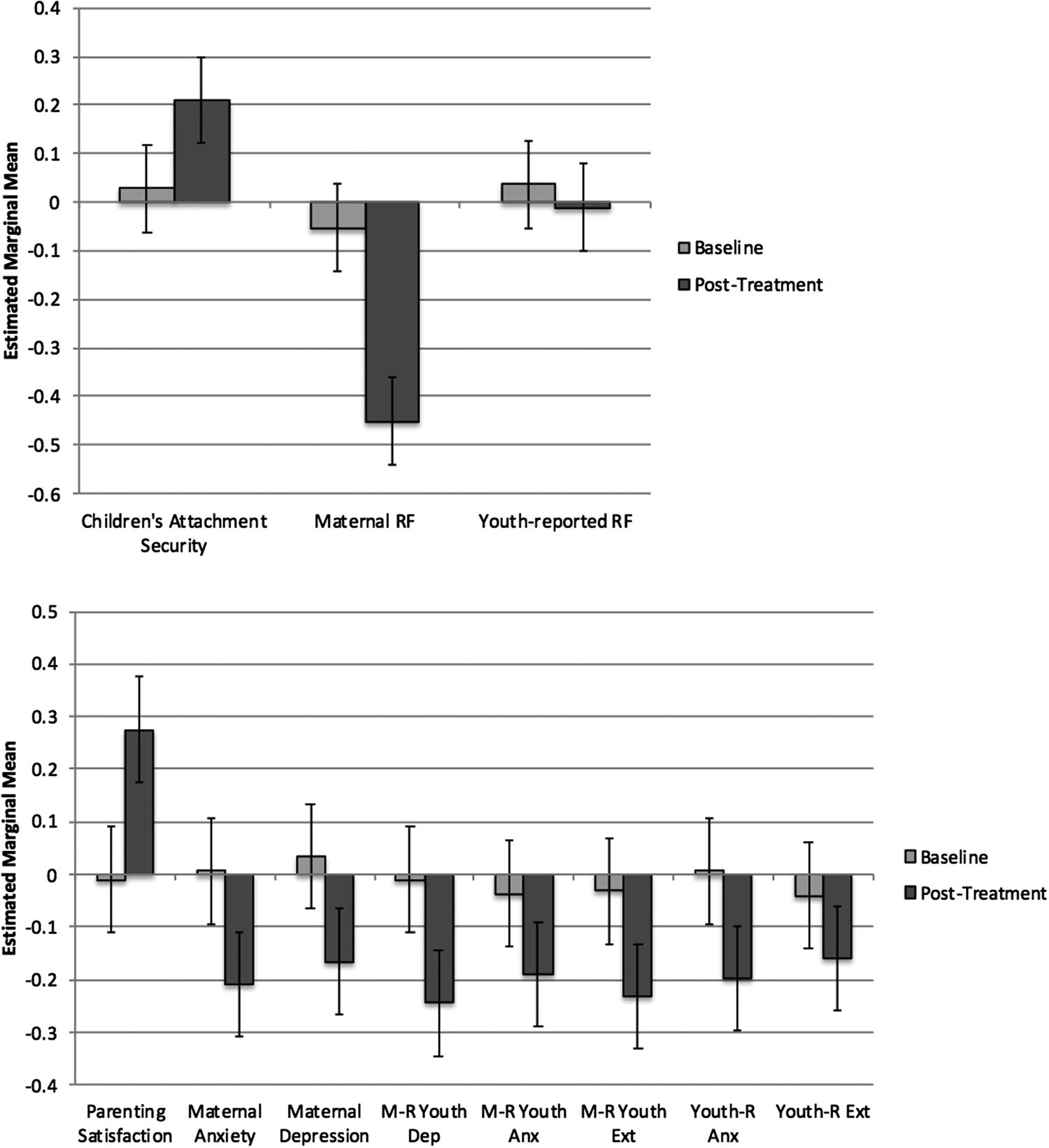
A repeated-measures MANCOVA tested whether measures assessing mechanisms of change (i.e., youth attachment security, mothers’ RF) changed from baseline to post-treatment, while holding child gender, child age group (i.e., 8–11, 11–14, 14–17), and mother age constant (see Figure 3). The main effect of treatment on mechanisms of change was significant; Λ = 0.86, F (3,105) = 8.85, p < .001, $\eta _p^2$ = .14. Further, there was an interaction between treatment and child age, Λ = 0.90, F (3,212) = 2.95, p = .02, $\eta _p^2$
 = .05. Follow-up univariate ANCOVAs indicated baseline and post-treatment increases in youth's attachment security (F = 4.18, p = .04, $\eta _p^2$
 = .04) and mothers’ RF (F = 13.48, p < .001, $\eta _p^2$
 = .11).
Pre–post-treatment differences in mechanisms of change (attachment security, reflective functioning [RF]) and intervention outcomes (parenting satisfaction, maternal and youth psychopathology). Note: Scores represent standardized z scores represented as estimated marginal means adjusted for the following covariates (child age, child gender, mother age). Error bars represent standard errors. Youth-reported externalizing data available for adolescents in the sample only (n = 89 youth, ages 11–17), whereas all other data available for all youth (N = 112 youth, ages 8–17).

Follow-up univariate analyses revealed that increases in youth's attachment security significantly varied as a function of age, F = 5.40, p = .006, $\eta _p^2$ = .09; only youth under 14 increased in attachment security from baseline to post-treatment.
Adolescents’ (ages 11–17) RF was examined separately using a univariate repeated measures ANCOVA because only 89 adolescents completed this questionnaire. Although there was not a significant change in adolescent RF from baseline to post-treatment, Λ = 0.99, F (1, 81) = 0.49, p = .48, $\eta _p^2$ = .01, there was an interaction between adolescent age and time, Λ = 0.93, F (1, 81) = 5.97, p = .02, $\eta _p^2$
 = .07; older adolescents (ages 14–17) showed increases in RF from baseline to post-treatment, whereas younger adolescents (ages 11–13) showed decreases.
Did intervention outcomes improve from baseline to post-treatment?
A repeated-measures MANCOVA tested whether measures assessing intervention outcomes (i.e., mothers’ parenting satisfaction, mothers’ reports of their own anxiety and depression, mothers’ reports of their child's anxiety, depression, and externalizing symptoms, youth's reports of their own anxiety and depression symptoms, and adolescents’ reports of their own externalizing symptoms) changed from baseline to post-treatment, while controlling child gender and age, and mothers’ age (see Figure 3).
The main effect of treatment was significant: Λ = 0.74, F (8,99) = 4.45, p < .001, $\eta _p^2$ = .26. The results of the univariate follow-up tests revealed that all eight of the intervention outcomes changed significantly in the expected direction from baseline to post-treatment: mothers’ parenting satisfaction, F = 8.33, p = .005, $\eta _p^2$
 = .07; mothers’ anxiety symptoms, F = 8.61, p = .004, $\eta _p^2$
 = .08; mothers’ depressive symptoms, F = 5.67, p = .02, $\eta _p^2$
 = .05; mother-reported youth depressive symptoms, F = 10.96, p < .001, $\eta _p^2$
 = .09; mother-reported youth anxiety symptoms, F = 4.16, p = .04, $\eta _p^2$
 = .04; mother-reported youth externalizing symptoms, F = 8.56, p = .004, $\eta _p^2$
 = .08; youth-reported youth anxiety symptoms, F = 7.53, p = .007, $\eta _p^2$
 = .07; and youth-reported youth depressive symptoms, F = 11.22, p = .001, $\eta _p^2$
 = .10. No covariates were significantly associated with treatment outcome. A univariate repeated-measures ANCOVA using the smaller sample of adolescents (ages 11–17) revealed no significant change in youth-reported externalizing symptoms; Λ = 0.97, F (1, 80) = 2.66, p = .10, $\eta _p^2$
 = .03.
Case illustration
We provide a case study to illustrate changes from baseline to post-treatment with regard to the mother and child's PDI and CAI, respectively. At baseline, this 38-year-old mother emphasized that her 12-year-old daughter was quiet – “es reservada, es reservada” – but did not provide depth or specificity in her depiction of her daughter's personality. When asked to describe a time when she and her daughter were getting along, the mother focused on her daughter's behaviors with a response that lacked depth:
Hubo un momento que nos gusta mucho a las dos y es alimentar ardillas así que nos fuimos al parque, nos sentamos y alimentamos a las ardillas. Mientras alimentábamos las ardillas estábamos platicando, relajadas, y a ella le gusta mucho que la ardillita venga hasta su mano y darle el cacahuate.
Translated: There was a moment that we both like a lot and it is feeding the squirrels, so we went to the park, we sat and we fed the squirrels. While we were feeding the squirrels, we were talking, relaxed, and she likes it a lot when the little squirrel comes up to her hand and she gives it a peanut.
In her post-treatment PDI, the mother described having strong communication with her daughter, feeling connected to her, and valuing even small moments with her (a principle taught in relational savoring):
Los jueves son cuando lo hacemos, cuando lo solemos hacer y tenemos esa paz para sentarnos y ella se abre más a contarme sus cosas uh, bueno, su, lo que pasa en su escuela o cosas. Y, y yo también me relajo para poderla escuchar y estar más ampliamente ahí y a lo mejor son cosas no muy profundas pero suele pasar uno o dos horas ahí. Eh entonces de escuchar cuando nos sentimos eh más integradas, más contentas.
Translated: Thursdays are when we do it, when we usually do it and have the peace to sit down and she opens up more to tell me her things uh, well, her, what happens in her school or other things. And, and I also relax to be able to listen to her and be there more deeply and maybe they are not very profound things, but we usually spend an hour or two there. Um so listening is when we feel um more connected, happier.
The mother shows pride her daughter can confide in her, referencing the safe haven concept:
Es importante el, el como jovencita que mi hija tenga confianza y que hable conmigo. Entonces es muy gratificante como madre saber que tu hija confía en ti.
Translated: It is important that, that as a young person, that my daughter has trust and that she talks with me. So it is very gratifying as a mother knowing that your daughter trusts you.
This mother demonstrated growth in her ability to empathize and make inferences regarding her daughter's mental states (RF), whereas at baseline, she alluded to challenges at home (e.g., overcrowding), but expressed limited awareness of how they affected her daughter.
For example, in reference to how her daughter was feeling when they were feeding squirrels:
Se siente feliz porque en mi casa, estamos viviendo muchos y mis nietos son niños que hacen ruido, brincan y saltan.
Translated: She feels happy because at home, there are many of us living there and my grandchildren are children who make noise, skip, and jump.
At post-treatment, this mother was able to openly express how the home environment is stressful for her daughter and explicitly connect her child's behaviors with stress:
El estar viviendo en la forma que estamos viviendo que somos para mí bastantes en la casa, para eso, para ella es muy estresante incluso a veces tiene que hacer uh adaptar sus, sus actividades para poder hacerlas porque durante el día pues no puede hacer tarea. Porque los niños brincan, corren, así. Y Entonces a veces lo que hace es que duerme un rato en el día, y se para en la noche hacer sus actividades de tareas porque es cuando está tranquilo… Entonces es muy difícil para ella no tener un espacio, donde tener su privacidad.
Translated: Living in the way we are living which for me is many in the house, for that, for her is very stressful, including sometimes she has to adapt her, her activities to be able to do them because during the day, she can't do homework. Because the children jump, run, like that. And so sometimes what she does is sleep a little during the day, and gets up at night to do her homework activities because that is when it's quiet… So it is very difficult for her to not have a space, where she can have privacy.
Shifting focus to the daughter's development across the intervention period, she described her relationship with her mother as “frustrating, kind, and unfair” in her baseline CAI. When asked to provide a memory to describe her choice of the word frustrating, the daughter provided a response that seemed to reveal feeling misunderstood by her mother:
Most of the fact that my mom doesn't like most of my friends. She only likes the people who she already knows from elementary or something. Like yesterday, my friends were passing by and I said ‘hi’ to them, and she's like, “Remember, those are not your best friends.” I'm like, “I already know that” and she's like--like she's like, “I don't like your friends.” I'm like, I just stayed quiet. I'm like, “I never s- I never said that, that they were my best friends, I just like them as friends, you know.” And like when that happened, I told my mom, “Could you let me go to [FRIEND]'s?” and she's like, “No because it's a lot of things can happen.” I'm like, “Yeah I get that but like you should also like trust me” and she's like, “I don't know, I will think about it.”
At post-treatment, the daughter's adjectives to describe her relationship with her mother were “overprotective, motivation, and love.” When asked to describe a specific time that “love” described the relationship with her mother, the daughter said:
I would feel love because she is always there for me when I need her. She—she says she doesn't work for a reason. She lets my dad do the work because she always wants to be involved in school, she wants to be involved in us, she wants to pay attention to us. Since we're younger, she—she wants more time with us and she said maybe when we're older, she can start to work again to help my dad. But she doesn't at the moment because she shows her love to us, she spends time with us, she's always in the house with us, and she always takes us to places with her so that's like.. love.
post-treatment, the daughter provides a more coherent CAI narrative with relevant details and responses to the question, and without sporadic topic changes or incoherent speech. She increased in security in her relationship with her parents, as illustrated by her response when asked, “Do you ever feel that your parents don't really love you?”:
Baseline: Um.. when they took my phone away. So I'm like, “Oh why did you take my phone away?” And she's like, “Because you're not- you're not-- um you're not doing what you're supposed to do” because I was on YouTube and I was supposed to do my multiplication tables on my home. And she was like, “Why were you on YouTube?” I'm like, “Oh it's because n- and I told her what I was watching.” She's like- I also felt like that because I'm like, “Can't you give me another opportunity?” And she's like, “No.” So then she's like, “When are you going to give my phone back?” She's like, “Um.. Ima think about it.” So then the days went by and I started talking back to her. And I thought that was going to be better for what I'm I was going to do but it turns out it went worse. So I'm like, “Oh dang.” So then I'm like, “Oh you know what? I'm going to stop talking back to my mom and stuff.” So I felt like unloved. I was like, “Why are you doing this to me?” She's like, “I'm doing this for your own good.” I'm like- that's when I felt mad.. I felt sad about that.
post-treatment: Sometimes. But most of the time, I do feel like they love me because they always do things for my good benefit so. Umm. When.. when they don't understand me or they say is – like for example, I say something and they're all like, “Oh”. Umm.. when they're like- when they don't understand me, it's kinda hard because then sometimes – because I don't feel loved because sometimes they're all like, when I say, “Oh, don't embarrass me” and they're like, “Oh, I'm going to keep doin’ it” and it doesn't feel – I don't feel comfortable like, you know?
Discussion
This paper describes the process of co-developing an intervention program through a community participatory research process, a project that embodies the spirit of Ed Zigler's work. We grounded this intervention in principles that Ed supported in his science and policy work, including the “whole-child” and strength-based approaches to working with underserved communities. The basic premise of the intervention is that strengthening a caregiver's capacity and sense of confidence to be sensitive to her child's attachment bids, and increasing youth's comfort and confidence when relying on their mother for emotional support, will enhance the quality of the parent–child relationship, reduce mothers’ and youth's psychopathology, and, ultimately, prevent youth aggression and violence.
Younger children showed the greatest improvements in attachment security because, as compared to adolescents, they typically spend more time with their mothers such that their relational worlds center more prominently on their parents. Apparent gains in younger children's attachment security may have followed, not only from children's own acquisitions in the context of the intervention, but also from their relatively greater sensitivity to improvements in their mother's parenting practices across the course of the intervention. As predicted, mothers evidenced improvements in RF from baseline to post-treatment and younger youth (i.e., those under 14) showed gains in attachment security, while older adolescents (those 14 and older) showed gains in their other-focused RF. Anecdotally, promotoras commented that older youth were less willing to openly discuss and reflect upon their relationships, particularly with their mothers, during the intervention sessions compared to younger youth. This pattern is consistent with normative developmental patterns whereby adolescents tend to downplay the importance of familial connections (Ammaniti, Van IJzendoorn, Speranza, & Tambelli, Reference Ammaniti, Van IJzendoorn, Speranza and Tambelli2000).
With regard to the intervention outcomes, mothers reported increased relationship satisfaction with their child from baseline to post-treatment, and both mothers and youth evidenced significant declines in their psychological symptoms. Specifically, mothers’ anxiety and depressive symptoms decreased from baseline to post-treatment, as did youths’ mother-reported and self-reported anxiety and depressive symptoms. Although adolescents’ externalizing symptoms decreased according to mother-report, they did not change significantly according to self-report. This is unsurprising, as adolescents are notoriously poor reporters of their own externalizing symptoms (Zeman, Klimes-Dougan, Cassano, & Adrian, Reference Zeman, Klimes-Dougan, Cassano and Adrian2007).
These preliminary analyses suggest that Confía en mí, Confío en ti shows promise as a potentially effective intervention to promote relational and psychological well-being. When reflecting about the intervention experience, both mothers and youth expressed feeling connected and understood by the other group members and the promotoras, suggesting the intervention strengthened not only the mother–child relationship, but also participants’ sense of community support outside the family.
Strengths and limitations
Strengths of the study included working directly with a community agency to build an intervention program from the ground up using a community participatory research process, working with an underserved population, and designing a flexible intervention intended to be delivered by respected members of the local community.
Conversely, limitations of the study include the absence of coded observational assessments (e.g., interaction tasks, interviews), which (when available) will enrich our understanding of the phenomena under investigation. Likewise, although we collected fidelity data on each intervention session, these data await further analysis to determine potential moderating. Although our inclusion of a wide age range of youth (ages 8–17 years) enhanced the generalizability of our findings and enabled broad participation among families, the developmental breadth of the participating youth introduced heterogeneity into the groups and complexity into the interpretation of our findings.
Finally, the most significant limitation of this study rests in our inability to include waitlist control group data in this report. The difficulties we encountered when collecting data from a waitlist control group are worth discussing as they taught us important lessons. When we began the study, we decided not to conduct a randomized controlled trial with a true control group because we felt it was unethical for some participants to receive a placebo intervention and wanted all participants to receive our actual intervention. However, across the first year of data collection, we experienced high rates of attrition in our waitlist control group, despite calling waitlisted participants monthly to check in and inviting them to attend community events at LHA. Waitlist participants who completed the baseline assessment would not return for the second assessment, which was scheduled at the same time as the intervention group's post-treatment assessment, and was intended to serve as a second baseline assessment for the waitlist control. Promotoras speculated that a combination of the length of the assessment, the relative lack of contact with the agency, and the current political climate contributed to their lack of desire to continue to be involved in the organization.
In response to these insights, we adjusted our approach in multiple ways, such as inviting waitlisted families to gatherings of just the waitlist group immediately following the baseline assessment, sending newsletter updates, and increasing the compensation. Ultimately, the adjustment that made a significant impact was conducting our second baseline assessment via home visits or phone calls, and increasing the flexibility of when they occurred and whether or not participants could opt out of completing the lengthier interview measures. In time, we will complete the study with a sizable waitlist control group. However, we learned a valuable lesson from this investigation: the connections to promotoras and the service agency are absolutely essential for families to have sufficient investment in the research process.
Lessons learned and future directions
Our collaboration with LHA has provided valuable opportunities to engage in research that bridges the research-community gap and serves the community using a culturally sensitive approach. Through this partnership, we have learned several lessons. First, from the research perspective, we became more flexible in responding to the stated needs and goals of the community and the agency. For instance, over the course of the project, we made several changes to our plans for recruitment, participant compensation, and curricula, among other things. Second, faced with difficulties in recruitment and group retention, particularly for the waitlist control families, we strategized about how to improve on these aspects of the intervention and research design. Third, through observing the intervention groups in action and working with promotoras directly, we were privileged to benefit from the wisdom of the promotora model of community work. Presently, we continue this deliberative and collaborative community approach as we develop plans for our ongoing research partnership with LHA, negotiate issues related to ethics, discuss data ownership, and identify strategies for program sustainability moving forward, and particularly in light of the current COVID-19 pandemic. By partnering with LHA and empowering promotoras to facilitate and implement all components of the intervention, we aimed to establish a culturally congruent, low-cost, flexible, and sustainable community intervention. Importantly, our decision to involve promotoras as research partners has enhanced their desire and capacity to engage in research, which, in turn, translated to improvements in the community's ability to problem solve. For example, through this collaboration, promotoras learned how to design, administer and organize participant assessments using HIPPA-compliant Google Suite calendars and software, which significantly streamlined scheduling and data collection, and strengthened their capacity to conduct future evaluative work for external funding agencies.
Innovative problem-solving from the scientists, LHA staff, promotoras, and community members is of inestimable value as we negotiate the COVID-19 pandemic. Through promotoras’ personal knowledge of and experience in their community, we have been granted insight into identifying the needs of this community during a time of heightened anxiety and vulnerability due to unemployment, lack of health insurance, crowded living situations, and the added stress of distance learning. Given these circumstances, our project operations with LHA have necessarily shifted, but our investment in serving this community has only deepened. LHA has halted all in-person programs, including Confía en mí, Confío en ti, and shifted to meet the educational, material, and emotional needs of the community via telehealth, psychoeducation, food drives, and relief funding. Likewise, our research has transitioned to phone interviews and paper questionnaires with no-contact delivery to assess the remaining post-treatment and waitlist control participants. Promotoras continue to offer resources (access to food banks and social services, health information) to families involved in our program, but formal group sessions have been stopped. As we move forward during these unprecedented times, we are working with LHA to integrate Confía en mí, Confío en ti into their broader "Emotional Wellness” programming. To that end, we plan to transfer ownership of the program to the community, a process that has been identified as “essential” for achieving sustained change (Rappaport & Seidman, Reference Rappaport and Seidman2000). We hope to continue our collaboration with LHA in ways that enrich the valuable work they do and to serve as an ally in our shared commitment to support the well-being of the whole community. As part of our scientific mission, we will work to disseminate this model of intervention development and implementation to other entities, contingent on our finding evidence of its effectiveness. By providing communities access to the intervention at no cost and publicly disseminating our findings, we hope the Confía en mí, Confío en ti intervention will be adopted and adapted to best fit various community needs.
Ed Zigler recognized the need for interventions to remain open and flexible, capable of pivoting in response to the shifting needs and resources of a family or community. This has never been truer than at the present moment, when our world is living in the grip of the COVID-19 pandemic, and vulnerable communities everywhere face difficult circumstances that are changing by the moment. We fully expect this intervention to evolve, to be re-envisioned; as the community changes, as promotoras change, so, too, must Confía en mí, Confío en ti. Ed always emphasized that research and social change go hand-in-hand, and both take time, persistence, and patience. Reflecting on his most valuable lessons taught, Ed noted, “I tell my students, whatever your favorite cause, if you do not intend to pursue that for 25 years, do yourself a favor - don't start. You have to be prepared to hang in there for the long run” (Perkins-Gough, Reference Perkins-Gough2007, p. 13). We are in this, together, for the long run, committed to supporting vulnerable children and families in the LHA service community and beyond until all of us experience the security and safety we need to thrive.
Supplementary Material
The supplementary material for this article can be found at https://doi.org/10.1017/S0954579420001364.
Acknowledgments
We would like to acknowledge the contributions of the promotoras at Latino Health Access: Araceli Robles and Noraima Chirinos, who were the promotoras leading the madres groups for the study; Moises Vazquez, Christina Marquez, and Gina Torres, who were the promotoras leading the youth groups for the study; Verenice Escobar, who served as the Emotional Wellness Program Assistant; Catalina Garcia and Victoria Garcia who helped with participant recruitment for the program; and the countless research assistants from the UCI THRIVE Laboratory who assisted with every step of this project. Gina Torres also served as a coordinator for the project. We would like to thank Cassidy Weiss, who worked on the project and then generously loaned us her creative talents to design Figure 2 based on the community-origin metaphor used in the intervention program. As described in the paper, the intervention was co-developed by the promotoras, and would never have been as successful as it was without their input.
Financial Statement
We would also like to acknowledge our funding agency (the Centers for Disease Control and Prevention: 1R01CE002907: PIs Guerra and Borelli), whose generosity was essential in supporting this program.
Conflicts of Interest
None.