1 Introduction
The system of pronominal reference used in linguistic discourse in Modern English is extremely ambiguous when compared to other Germanic languages. The availability of independent demonstrative pronouns in addition to personal pronouns allows for a greater degree of pragmatic disambiguation in Dutch and German.Footnote 1 In the following examples taken from Bosch & Umbach (Reference Bosch and Umbach2007), he in (1) could refer to either Peter or Paul. The German and Dutch personal pronouns er and hij, in (2) and (3) respectively, could also co-refer with either Peter or Paul, but the demonstratives der and die can only refer to Paul. Modern English has no such pronominal topic-switching device and can only achieve the same degree of disambiguation by repeating the lexical item Paul.
-
(1) Peteri wanted to play tennis with Paulj. But he i,j was sick.
-
(2) Peteri wollte mit Paulj tennis spielen. Doch er i,j/der j war krank.
-
(3) Peteri wilde met Paulj gaan tennissen. Maar hij i,j/die j was ziek.
Pragmatic disambiguation can, however, be achieved in English through the use of he himself. Bickerton (Reference Bickerton1987) argues that he himself functions not only as an emphatic pronoun in English, but also as an anaphoric pronoun that differs in distribution from both he and himself. Thus in (4), he himself would most naturally be interpreted as referring to Peter rather than Paul.
-
(4) Peteri wanted to play with Paulj. But hei/j/he himselfi was tired.
The referential options of pronouns in English are also subject to the parameter of stress. Kameyama (Reference Kameyama, Bosch and Sandt1999) uses examples like (5) to illustrate his contention that stressed personal pronouns pick up the unstressed counterpart, the least expected antecedent. The function of the stressed personal pronoun in English does not, however, correlate with that of the demonstrative in Dutch and German. As (6) taken from Bosch et al. (Reference Bosch, Rozario and Zhao2003: 63) indicates, accentuating he does not serve to disambiguate between competing referents. The function of English stressed personal pronouns can be explained in terms of contrast (Kameyama Reference Kameyama, Bosch and Sandt1999; Bosch et al. Reference Bosch, Rozario and Zhao2003: 63), but such an explanation does not account for the distinction between German and Dutch personal pronouns (Bosch et al. Reference Bosch, Rozario and Zhao2003: 63).
-
(5) Paul called Jim a Republican. Then HE (=Jim) insulted HIM (=Paul).
-
(6) Paul wanted to go running with Peter. But HE (?) had a cold.
Psycholinguistic research on anaphoric strategies in Modern German (Bosch et al. Reference Bosch, Rozario and Zhao2003, Reference Bosch, Katz, Umbach, Schwarz-Friesel, Consten and Knees2007) has highlighted the grammatical role of antecedent expressions in explaining the complementary distribution of personal and demonstrative pronouns; personal pronouns favour subject antecedents while demonstratives prefer non-subject antecedents. This analysis is consistent with the accessibility hierarchies for pronominal material proposed in the literature (Ariel Reference Ariel1990, Reference Ariel, Sanders, Schilperoord and Spooren2001; Gundel et al. Reference Gundel, Hedberg and Zacharski1993). Saliency factors – including recency, topic-hood and stereotypeness of the antecedent – determine the accessibility of the antecedent; less salient and thus less accessible antecedents like objects require demonstrative anaphoric expressions because these are ranked high on the hierarchy scale. Subject antecedents are more salient, making them more accessible, and therefore require an anaphoric expression lower down the hierarchy scale, such as personal pronouns.
In a refinement of their earlier stance that understood pronominal reference in terms of the grammatical status of antecedent expressions, Bosch & Umbach (Reference Bosch and Umbach2007: 39) argue that the opposition between anaphoric pronouns should be viewed in terms of the ‘information-structural properties of referents rather than in terms of the grammatical role of antecedent expressions’. The earlier generalisation was broadly correct in that demonstratives were found to exhibit a non-subject antecedent bias and subjects generally constitute discourse topics, but it failed to account for exceptions whereby demonstratives cannot be used to refer to non-subject antecedents, even when competing referents are available, as in (7), or accept a subject antecedent, as illustrated in (8). As Bosch & Umbach (Reference Bosch and Umbach2007: 47) note, ‘the expectability of referents is a matter of the information-structural properties of the referent at a specific point in discourse – which may indeed be reflected in the properties of antecedent expressions, provided there are any’. The crucial explanatory parameter involves information structure: demonstratives do not pick up referents that are discourse topics where ‘discourse topic’ is understood to refer to a referent previously mentioned in the discourse, not as a new referent in the immediately preceding sentence (Bosch & Umbach Reference Bosch and Umbach2007: 50).
-
(7) Woher Maria i das weiß? Peter hat es ihr i gesagt. Sie i war gerade hier.
‘How does Maria i know? Peter told her i. She PProi has just been here.’
-
(8) Woher ich das weiß? Peteri hat es mir gesagt. Der i/Er i war gerade hier.
‘How do I know? Peter i told me. He DProi/PProi has just been here.’
(taken from Bosch & Umbach Reference Bosch and Umbach2007: 49)
Therefore in (7), even though the personal pronoun ihr ‘her’ constitutes a non-subject antecedent, it involves topic maintenance of Maria in the previous sentence, making it ‘discourse old’, and thus an unsuitable referent for a demonstrative. The referent of Peter in (8) does not have the status of discourse topic in the sentence in which it occurs so a demonstrative can be used. Personal pronouns therefore favour (but are not restricted to) discourse-old referents and demonstratives highlight ‘discourse-new referents that were not previously mentioned and not referred to by antecedent expressions in discourse’ (Bosch & Umbach Reference Bosch and Umbach2007: 50). This explanation of the personal/demonstrative pronoun opposition as rooted in information structure is similar in essence to Zifonun et al. (Reference Zifonun, Hoffmann and Strecker1997), whose formulation of topicality is described in terms of Theme and Rheme. From this perspective, the demonstrative is used if the antecedent is part of the Rheme, or contrasts with other topics, whereas the personal pronoun refers back to an established topic. The generative literature interprets the properties of the antecedent in terms of focus and prominence (van Kampen & Pinto Reference Kampen, Pinto, Gavarro and Freitas2008); demonstratives that mark topic switch require their antecedents in the preceding clause to have a focus kind of prominence.
Style and text type also appear to be important parameters in explaining the relative frequency of each pronoun type. Bosch et al.’s (Reference Bosch, Katz, Umbach, Schwarz-Friesel, Consten and Knees2007) corpus investigation found a striking written/spoken contrast; fewer than 7 per cent of masculine pronouns were demonstratives in their newspaper corpus, whereas this figure shot up to 80 per cent in their spoken language corpus. This suggests that in contexts where either a demonstrative or personal pronoun is possible spoken language favours the use of the demonstrative. Text type might also play a role given that newspaper articles typically show topic continuity (Bosch et al. Reference Bosch, Rozario and Zhao2003: 65).
The Old English system of pronominal reference approximated Dutch and German more closely than Present-day English in that anaphoric strategies in Old English made use of both personal and demonstrative pronouns. The distribution of Old English pronoun forms has also been explained in terms of information structure; personal pronouns express the discourse topic, while demonstratives mark topic switch (Traugott Reference Traugott and Hogg1992: 171; Kiparsky Reference Kiparsky, Kaufmann and Stiebels2002; van Gelderen Reference Gelderen and Lohndal2013). Only van Kemenade & Los (Reference Kemenade and Los2017) approach the matter quantitatively. Their analysis of the late ninth-century Old English translation of Bede's Eccesiastical History of the English People suggests that clause-initial demonstrative pronouns in Old English function as topic switch markers with non-nominative antecedents. Nevertheless, there is a degree of indeterminacy involved in explaining the exact nature of pronoun distribution in Old English. An analysis of anaphoric strategies in Old English as rooted in the grammatical role of antecedents does not explain those instances in which demonstratives co-refer with subject antecedents or personal pronouns pick up non-subject antecedents. Previous research has tended only to consider contexts involving a choice between two referents, but not whether demonstratives pick up new discourse topics that constitute the only possible referent (see van Kemenade & Los Reference Kemenade and Los2017). Furthermore, no study to date has addressed the behaviour of personal pronouns quantitatively or the extent to which personal pronouns also marked topic switch in Old English. Nor has the anaphoric function of self-forms in Old English been considered.
The aim of this article is to assess what parameters best explain the anaphoric strategies of Old English by carrying out a quantitative and qualitative study of personal and demonstrative pronoun usage across a selection of late (post c. AD 900) Old English prose text types. My main concern is to establish whether the findings in the cognitive/psycholinguistic literature on the distribution of pronouns in other Germanic languages apply to Old English, and more specifically to what extent the information structural properties of referents rather than the grammatical role of the pronoun's antecedent most accurately explain the personal/demonstrative pronoun contrast in Old English. In considering the Old English system of pronominal reference, the anaphoric function of self-forms in Old English will also be explored. The present analysis differs from previous studies in that it also considers the possible influence of text type, style and text tradition on a writer's choice of anaphoric strategy. The historical data discussed in the present study provide important additional support for modern cognitive and psycholinguistic theory, but the findings also highlight how issues pertaining to style, such as the author–writer relationship, text type, subject matter and the conventionalism propagated by text tradition, influence anaphoric strategies in Old English.
2 Background: pronominal usage in Old English
Personal pronouns in Old English were used (a) anaphorically, as in Uton nu behealden þa wundorlican swyftnysse þære sawle: heo hæfð swa mycele swyftnysse (ÆLS (Christmas), 0057.124) ‘Let us now consider the wonderful swiftness of the soul: it has such great swiftness’, (b) reflexively with or without self, as in Judas se arleasa . . . aheng hine sylfne (ÆAdmon 1,0135.9.25) ‘Judas the disgraceful . . . hanged himself’, but also þa wearð heo mid yfele eall afylled, and gebræd hi seoce (ÆLS (Eugenia), 0045.148) ‘then was she with evil completely filled and feigned herself sick’. Nominative personal pronouns also occurred with self as an adnominal intensifier, as in & hi sceoldon geoffrian heora lac þam godum, oððe hi sylfe sceoldon him beon geoffrode (ÆLS (Eugenia), 0114.369) ‘and they had to offer their sacrifice to the gods or they themselves had to be offered to them’.
Old English used the forms of the se-demonstrative paradigm dependently as determiners, as in on þæm dagum (Or 4,0203.7.97.1) ‘in those days’. Independently, they were used as (a) relative pronouns on ðam timan rixode sum reðe cyning se wæs Totilla gehaten (ÆCHom II,11,0077.99.234) ‘at that time reigned a cruel king who was called Totila’; (b) antecedents to restrictive relative clauses se bið godes wiðersaca þe godes lage & lare forlæt (WHom Ib,0004.9) ‘he is God's adversary who abandons God's laws and teachings’; (c) se-forms also combined with the indeclinable relative þe to form a relative marker, as in þæt heo ne woldon heora Gode hyran, þone þe heo gelyfden (Bede 3,0480.15.222.22) ‘that they did not want to hear their God, (in) whom they believed’; and (d) the forms of the se-paradigm were employed pronominally and anaphorically, as in ða god geseas (MkGl (Li) 5.8) ‘they will see God’.
Distinguishing the anaphoric pronominal and relatival functions of se/seo/þa in Old English is problematic (for discussion see Mitchell Reference Mitchell1985: §321, 327, §§2109–21); se-forms had sentential scope like relatives and overlapped to a degree in form and function. A neat distinction is further hampered in Old English by the language's tendency towards parataxis. As the alternative translations illustrate, se in (9) and (10) could be analysed as either an anaphoric pronoun or as a relative. The use of the Old English se-forms as relatives is believed to have a paratactic origin whereby the se subject of an independent clause in paratactic relation with a preceding independent clause was reanalysed as a relative (Fischer et al. Reference Fischer, Kemenade, Koopman and der Wurff2000: 55–6). It is questionable nonetheless to what extent initial se was necessarily a relative rather than an emphatic anaphoric pronoun. Mitchell (Reference Mitchell1985: §2019) highlights the ambiguity inherent in distinguishing between the se-form's pronominal or relative function, ‘lacking as we do a knowledge of the intonation patterns’, and insightfully notes that the tendency of modern scholarship to interpret se as relatival is influenced by the biased view that hypotaxis is superior to parataxis (Mitchell Reference Mitchell1985: §2115). Interpreting se-forms as anaphoric pronouns is generally possible because even when se-‘relatives’ have non-nominative antecedents, they are often marked for nominative case proper to a main clause, and only agree with their antecedent in gender and number, as in (10). Furthermore, a large number of se-‘relatives’ retain certain features of a paratactic independent clause, such as verb-second word order (Fischer et al. Reference Fischer, Kemenade, Koopman and der Wurff2000: 56). Contrastively, the unambiguous relative pronoun ðe triggers verb-final word order, as (11) illustrates, in much the same way that the verb-final word order of subordinate clauses in Dutch and German distinguishes between the relatival and demonstrative function of die/der etc. In the present data sample, only one clause-initial se-form triggered verb-final word order; on all other occasions, verb-second word order is retained.
-
(9) On ðam timan rixode sum reðe cyning se wæs Totilla gehaten. se ferde sume
dæge wið þæs halgan weres mynster. (ÆCHom II,11,0077.99.234)
‘At that time reigned a cruel king who/he was called Totila. He went one day towards the holy man's minister.’
-
(10) Gregorius ða asende ænne pistol to ðam casere Mauricium. se wæs his
gefædera. (ÆCHom II,9,0045.75.96)
‘Gregory then sent an epistle to the emperor Mauricius who/he was his godfather.’
-
(11) Abraham hatte se heahfæder. ðe ærest æfter ðam micclum flode to gode cyððe hæfde; He wæs godes gespreca. (ÆCHom II,12.1,0006.110.17–18)
‘The patriarch was called Abraham who first after the great flood had knowledge of God. He spoke to God.’
That paratactic syntax in these contexts might have been intended, and was certainly deemed acceptable, is borne out by alternative manuscript readings involving personal pronouns; (12) and (13) illustrate how the se-forms found in MS. Julius E. vii. are replaced by personal pronouns in MS. B (Bodley 343, lf. 45), a later copy.
-
(12) Ioppe hatte sum burh, gehende þære Liddan, on þære wæs an wydewe wel gelyfed, Thabitas geciged, and swyþe ælmesgeorn, and mid godum weorcum geglencged forþearle. seo [B. heo] wearð geuntrumad on þam ylcan timan (ÆLS (Peter's Chair), 0022.53–7)
‘(There was) a city called Joppa near Lydda in which was a widow, a true believer called Tabitha, very diligent in alms-giving and with good works adorned greatly. She became sick at that same time.’
-
(13) Þa læg þær sum creopere lama fram cildhade, se [B. he] wæs dæghwamlice geboren to þam beorhtan gete, þæt he ælmessan underfencge æt þam infarendum (ÆLS (Peter's Chair), 0011.25)
‘Then lay there a cripple lame from childhood, he was daily carried to the beautiful gate that he might receive alms from those entering.’
Given that the use of se-forms as anaphoric pronouns or relatives is ambiguous and that no conclusive case can be made for viewing se/seo/þa as necessarily relatival, all instances of clause-initial se/seo/þa with verb-second word order were included in the present analysis.
Se-forms that combined with the relatival marker þe, as in Animað animað hraðe þa reðan wiccan, seo þe ðus awent þurh wiccecræft manna mod (ÆLS (Agnes), 0079.207) ‘Away away quickly with the cruel witch, she who/who thus perverts through her witchcraft men's minds’, were excluded from the data set because, as the alternative translations indicate, they pose interpretive problems. It is impossible to know with any certainty whether the se-form acts as the antecedent to þe or is part of the relative (Mitchell Reference Mitchell1985: §2204, §2208).
Indefinite relative clauses involving se-forms of the type Ac se bið gesælig þe eal swylc oferhogað (WHom 12,0029.89) ‘But he will be blessed who also so scorns’ were also problematic in that se in these contexts has indefinite or generic reference and no textually available antecedent. Such instances were excluded from the data sample because they did not fit the coding criteria of the present study that tested for the influence of both the information-structural properties of referents on anaphoric choice, as well as the grammatical role of their antecedent expression.Footnote 2 Such usage is interesting, however, in that it substantiates Bosch & Umbach's (Reference Bosch and Umbach2007: 48) contention that the classification of the pronoun's antecedent in determining anaphoric strategy is, at most, only indirectly relevant because ‘demonstratives as well as personal pronouns can function perfectly well without antecedent expressions’ and pronominal interpretation is ‘more a matter of referent search than a search for co-referential antecedent expressions’.
3 Data, methods, statistical overview and analysis
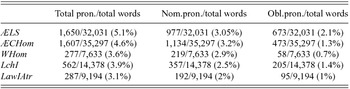
The material of this study comprises samplings taken from a selected corpus of post-c. AD 900 West Saxon prose texts that were chosen to reflect a cross-section of genres and text types. The texts under scrutiny included homilies and sermons (ÆCHom, WHom), saints’ lives (ÆLS), legal texts (LawIAtr) and medical recipes (LchI).Footnote 3 In order to gain a general picture of a text's reliance on pronominal anaphora, all occurrences of nominative and oblique third-person plural and singular personal pronouns, and se-pronouns used independently and anaphorically, regardless of their position in the clause, were extracted from the corpus.Footnote 4 Table 1 provides the overall rates of personal pronouns and se-pronouns per text.
Overall totals for nominative and oblique third-person personal pronouns and se-pronouns

What immediately stands out is the difference in relative frequency across text types. There is a statistically significant difference in the overall rate of pronominal anaphora between ÆCHom and WHom (χ² 12.765, p < 0.001) and also between ÆLS and ÆCHom (χ² 13.065, p < 0.001), but no statistically significant difference is noted in WHom and LchI (χ² 1.064, p = 0.30). Hagiographical and homiletic writing employs more nominative pronouns than scientific and legal writing. There is no statistically significant difference in the frequency of nominative pronouns in ÆLS and ÆCHom (χ² 1.461, p = 0.22), ÆLS and WHom (χ² 0.691, p = 0.40), or ÆCHom and WHom (χ² 2.428, p = 0.11), but a statistically significant difference does occur in ÆLS and LawIAtr (χ² 23.987, p < 0.001) and ÆLS and LchI (χ² 11.436, p < 0.001). With regard to the rate of oblique pronouns, ÆLS stands out as favouring a high rate of oblique pronouns, while Wulfstan's homiletic prose, in particular, shows a notably low incidence. A statistically significant difference in oblique pronoun usage is noted in ÆLS and ÆCHom (χ² 58.126, p < 0.001), ÆCHom and WHom (χ² 17.294, p < 0.001), and ÆLS and LchI (χ² 24.382, p < 0.000), but not in WHom and LchI (χ² 3.461, p = 0.06).
3.1 Nominative pronoun forms
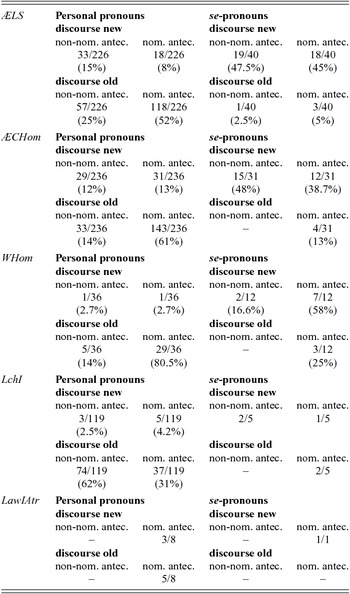
There is a general consensus across the cognitive, psycholinguistic and generative literature that clause-initial position is the crucial environment for topic switch. Van Kampen & Pinto (Reference Kampen, Pinto, Gavarro and Freitas2008) analyse topic-shifting demonstratives as A-bar anaphors that are restricted to the clause-initial scope position in Spec, C (see also van Kemenade & Los, Reference Kemenade and Los2017). Such an analysis is consistent with Bosch & Umbach's (Reference Bosch and Umbach2007) survey of German newspaper texts in which 93 per cent of demonstrative subject and object pronouns occur in sentence-initial position. In view of the importance attributed in the literature to clause-initial position as the crucial environment for topic switch, for the second analysis, nominative clause-initial personal pronouns (including pronoun + self forms) and se-pronouns with more than one possible referent were extracted from the larger data set. In order to test whether the distribution found in Modern German, and illustrated by (8), held for Old English, contexts where there were no competing referents were included for both pronoun types if the referent constituted a discourse-new referent. Tokens were coded according to (a) the grammatical role of their antecedent expression and (b) the information-structural properties of their referents, in other words, whether they co-referred with referents that were discourse old or discourse new. In line with Bosch & Umbach (Reference Bosch and Umbach2007), a discourse-old topic was understood to refer to a referent previously mentioned in the discourse, not as a new referent in the immediately preceding sentence. The purpose behind the coding criteria was to disentangle the discourse properties of the pronouns’ referents from the grammatical role of their antecedent expression and thereby test for the possible effect of both parameters. The results are given in table 2. Owing to the fact that clause-initial pronouns are rare in LawIAtr and little can be gleaned from the data, the text does not form part of the discussion that follows.
Clause-initial third-person personal pronouns and se-pronouns according to the information-structural properties of their referents and the grammatical role of their antecedent

The findings indicate a notable difference in relative frequency between the different subject pronoun types: personal pronouns are far more common than se-pronouns. These results are in line with Bosch et al.’s (Reference Bosch, Rozario and Zhao2003) findings for German, which indicated that demonstratives were considerably rarer in their corpus of written language than personal pronouns.
The findings in table 2 suggest that personal pronouns are far freer in their choice of referent than se-pronouns. They can pick up discourse-new referents, as in (14), but they generally prefer discourse-old topics (15); the overall rate of nominative personal pronouns that are co-referential with discourse-old referents across texts is as follows: ÆLS 77% (N = 175/226); ÆCHom 75% (N = 176/236); WHom 94% (N = 34/36) and LchI 93% (N = 111/119).
-
(14) Betwux ðisum gewende Augustinus ofer sæ. to ðam ercebiscope Etherium. and he [=Etherius] hine [=Augustinus] gehadode angelcynne to ercebiscope. (ÆCHom II,9,0089.79.226)
‘In the meantime Augustine went over the sea to the archbishop Etherius, and he [=Etherius] ordained him [=Augustine] archbishop of the English nation.’
-
(15) Ða gebæd Eugenia hi to ðam ælmihtigan Gode . . . Þa het se casere ahon anne weorcstan on hyre halgan swuran, and hi [= Eugenia] bescufan on ða ea. Eac se stan tobærst and heo [= Eugenia] sæt up on þam wætere (ÆLS (Eugenia), 0120.386–0121.391)
‘Then prayed Eugenia to the almighty God . . . Then the emperor ordered to hang a hewn stone on her holy neck and throw her [= Eugenia] in the river. But the stone cracked and she [= Eugenia] sat on the water.’
Se-pronouns demonstrate a clear preference for discourse-new referents regardless of whether these referents constitute nominative antecedents, as in (16) and (17), or non-nominative antecedents like (18). The grammatical role of the antecedent is not the crucial parameter. In all three excerpts, the se-pronoun picks up discourse-new referents.
-
(16) Israhela folc ða þeowde þam cyninge nabochodonosor and his æftergengum hundseofontig geara. oð þæt Cyrus feng to rice. se asende þæt folc ongean mid wurðmynte to heora earde. (ÆCHom II,4,0097.36.222)
‘The people of Israel then served the king Nebuchadnezzar and his successors seventy years until Cyrus obtained the kingdom. He sent the people back with honour to their country.’
-
(17) Eft þæs on mærgen rad Maurus to þam lande. þe se cyning him geaf, and hisGEN.OBJ cepte sum beddryda, se læg seofon gear toslopenum limum (ÆLS (Maur), 0062.253)
‘After this in the morning rode Maurus to the estate which the king had given him and a bed-ridden man awaited him. He lay seven years with relaxed limbs.’
-
(18) Crist gesette ða ealdan.æ. and seo stod ða hwile ðe he wolde. (ÆCHom II,12.2,0029.123.458)
‘Christ established the old law and it stood as long as he wished.’
In contexts involving no competing referents, se-pronouns generally only pick up discourse-new referents that constitute nominative antecedents with predicative nominals functioning as subject complements, as in (19). There are counterexamples, however, in which se-pronouns co-refer with nominative discourse-new referents even when competing referents are available, as in (20), where se refers to Quintianus rather than þam casere ‘the emperor’.
-
(19) Basilius wes gehaten sum halig biscop se wæs fram cyldhade swiðe
gehealdsum (ÆLS (Basil), 0001.1)
‘Basil a certain holy bishop was called he was from childhood very observing.’
-
(20) on ðam timan þe Quintianus, se cwealmbære ehtere, þære scyre geweold
wælhreowlice under þam casere. Se wæs grædig gitsere, and his galnysse underþeod
(ÆLS (Agatha), 0002.1–0003.5)
‘in the time when Quintianus, the murderous persecutor, the province cruelly governed under the Emperor. He was a greedy miser and subject to his lusts.’
Further counterexamples to the general parameters conditioning the occurrence of se-pronouns are also found. For instance, seo in (21), se in (22), and the second occurrence of pronominal þa in (23) comprise instances of se-pronouns that are co-referential with discourse-old referents.
-
(21) Ðeos wyrt þe man betonican nemneð, heo biþ cenned on mædum & on clænum dunlandum & on gefriþedum stowum. Seo deah gehwæþer ge þæs mannes sawle ge his lichoman. (LchI (Herb), 0001–0002.1.1)
‘This wort which they call betony, it is produced in meadows and on clear downlands and in shady places. It is good whether for the man's soul or for his body.’
-
(22) ac se soða scyppend næfð nan angin, forðan þe he is him sylf angin na gesceapen ne geworht. Se geworhte ealle þing. . . (ÆLS (Christmas), 0027.63–0028.66)
‘but the true creator has no beginning because he himself is the beginning, neither
created nor made. He made all things. . .’
-
(23) Þa wæron þær ðry cnihtas swiðe gelyfede on þone soðan god. þa wæron gehatene Annanias. Azarias. Misahel. þa gecwædon þæt hi noldon bugan to nanum deofolgilde fram heora scyppende; (ÆCHom II,1,0113.9.230)
‘Then were three young men there greatly believed in the true god. They were called Annanias. Azarias. Misahel. They said that they did not want to bow to any idol from their creator.’
3.2 Oblique pronoun forms
Similarly to Dutch and German (Bosch & Umbach Reference Bosch and Umbach2007; van Kampen & Pinto Reference Kampen, Pinto, Gavarro and Freitas2008), the parameter of information structure also appears to explain the distribution of oblique pronouns in Old English. In the ÆCHom data, there were 29 se-pronoun objects in clause-initial position, all of which picked up new discourse referents: 6 had nominative antecedents, as in (24), and 23 had non-nominative antecedents of the type illustrated in (25).Footnote 5
-
(24)

-
(25)


The behaviour of oblique personal pronouns parallels that of nominative personal pronouns; oblique personal pronouns alternate more freely than oblique se-pronouns in their choice of referent, at times continuing the discourse topic, as in (26), or topic switching, as in (27).
-
(26) þonne geleanað he hit us swa us leofast bið. Him sy lof 7 wuldor aa butan ende, amen. (WHom 2,0018.71)
‘Then he will reward us as is most pleasing to us. To him be praise and glory always without end, amen.’
-
(27) Hwæt ða Iosue. siððan ferde. mid israhela ðeode. to eallum leodum. þæs æðelan eardes. and hi ealle ofsloh. (ÆCHom II,12.2,0008.121.398)
‘Whereupon Joshua afterwards went with the people of Israel to all the peoples of that noble country and killed them all.’
3.3 self-forms
Having analysed the distribution of personal pronouns and se-pronouns in the Old English system of pronominal referencing, a further anaphoric strategy in Old English that requires consideration is the use of personal pronouns accompanied by self. Intensifiers involving self in Modern English, as in She herself said she would come, coincide in form with reflexive pronouns but differ in distribution and semantic contribution to a sentence.Footnote 6 The simplex intensifier self in Old English is assumed to be the precursor of reflexive self and is already widely attested as both an intensifier and reflexive in Old English (see van Gelderen Reference Gelderen2000 for detailed discussion).
The formal classification of self in Old English is a matter of debate. At times self functions unambiguously as an adjective, in which case it has either definite or indefinite adjectival inflection according to the usual declension rules of Old English adjectives, e.g. ða fem.dat.sg sylfan fem.dat.sg.def rode fem.dat.sg (WHom 2,0016.65) ‘the same cross’. The simplex intensifier self-form is a free morpheme that co-occurs with an NP or pronominal focus. In this function self usually has indefinite marking which suggests a pronominal function (Mitchell Reference Mitchell1985: §188), e.g. se m.sg.nom deofol sylf m.sg.nom (ÆHom 22,0157.584) ‘the devil himself’ (cf. se sylfa deofol ‘the same devil’ in which sylfa is adjectival and is marked as definite). Campbell (Reference Campbell1959: 291) classifies OE self as a demonstrative, although van Gelderen (Reference Gelderen2000: 29, fn. 29) rightly suggests that this designation is invalidated to an extent by virtue of the fact that self declines adjectivally. Van Gelderen's (Reference Gelderen2000) survey of the OE self-form indicates that self in Beowulf has indefinite inflection when it co-occurs with first- and second-person pronouns, but definite inflection with third-person pronouns. However, in the late West Saxon data sample under scrutiny in the present study, self exhibits indefinite marking when it modifies third-person pronouns. The occurrence of reduced indefinite forms like heo sylf in the present dataset, instead of the expected heo sylfu, and the more ubiquitous use of indefinite marking regardless of person, indicate that the grammaticalisation of self was already under way in Old English.
Several studies (Baker Reference Baker1995; König & Siemund Reference König, Siemund, Frajzyngier and Walker2000) analyse the function of intensifiers in Modern English in terms of prominence and centrality of meaning versus peripheral meaning. König & Siemund (Reference König, Siemund, Frajzyngier and Walker2000: 45) interpret adnominal intensifiers as focus markers that mark a referent as more discourse prominent; the NP or pronoun to which the intensifier is adjoined is the focus of the relevant sentence. In an example like The minister himself will give the opening speech, the intensifier himself:
evokes alternatives to the referent of its focus (i.e. the NP to which it is adjoined) and this aspect of meaning is lost when the intensifier is omitted. The intensifier, having evoked these alternatives characterises them as periphery of the referent and restricts the reference to the minister. The self-form acts as an instruction that the expression that it combines with should be interpreted as the centre rather than the periphery.Footnote 7
While König & Siemund's stance elucidates the function of the adnominal intensifier in contexts in which the potential co-referent of he himself is a unique discourse topic, it is less adequate as an explanation for the function of self in contexts involving competing referents. Examples (28) and (29) suggest that where a choice of referents exists, he himself and she herself function as anaphoric pronouns and distinguish competing referents (see Bickerton Reference Bickerton1987). The pronoun associated with the adnominal intensifier self tends not to pick up discourse-new referents. The referent of the nominal constituent with which these intensifiers co-occurs has the status of discourse topic. Therefore in (28), the reference of she is ambiguous, but she herself can only refer to the discourse topic her. Similarly in (29), himself would most naturally be interpreted as referring to the discourse topic he.Footnote 8
-
(28) Shei wanted to have her motherj live with heri but only so that shei/j/she herselfi/*j could be looked after.
-
(29) Hei advised me not to do so as hei said his fatherj was a difficult man, and hei/j/he himselfi/*j was indifferent.
Although the literature does not note it, self-forms in Old English appear under similar conditions to those outlined above for Modern English; they function as (a) intensifying expressions and (b) anaphoric expressions that co-refer with discourse-old referents.
There are forty instances of self modifying both clause and non-clause initial nominative pronouns in ÆLS and ÆCHom. In contexts involving a unique discourse topic, the function of self is in line with König & Siemund's (Reference König, Siemund, Frajzyngier and Walker2000) analysis; self evokes alternatives to the referent of its focus, characterises these alternatives as periphery, and restricts the reference to the focus, as (30) illustrates.
-
(30) and he swa leofode. swa swa he sylf lærde (ÆCHom II,10,0094.88.259)
‘and he so lived as he himself taught’
In contexts involving two possible referents, self-forms are generally co-referential with discourse topics and distinguish between competing referents. For instance, in (31) hi sylfe maintains the discourse topic Protus and Iacinctus and distinguishes it from þam godum ‘the gods’. Similarly in (32), he sylf disambiguates between the discourse topic he [= devil] and Christ. This usage is found in thirteen of the fifteen contexts that arise in the sampling taken from ÆCHom. In ÆLS the anaphoric use of self is even more widespread and occurs categorically (N = 10/10).
-
(31) Æfter þysum wordum þa twægen godes halgan, Protus and Iacinctus, wurdon sona gelæhte, and hi [= Protus and Iacinctus] sceoldon geoffrian heora lac þam godum, oððe hi sylfe [= Protus and Iacinctus] sceoldon him [= the gods] beon geoffrode. (ÆLS (Eugenia), 0114.369)
‘After these words the two saints of God Protus and Iacinctus were soon caught and they [= Protus and Iacinctus] had to offer their sacrifices to the gods or they themselves [= Protus and Iacinctus] had to be offered to them [= the gods].’
-
(32) þa he wile þreatian . . . He aginð leogan deoflice swyðe & ætsæcð cristes <&> cweð þæt he sylf sy godes agen bearn, & gebringð on gedwylde ealles to manege. (WHom 5,0028.72–0029.75)
‘Then he will threaten . . . He will begin to lie very devilishly and deny Christ and say that he himself is God's own son and lead everyone astray into heresy.’
The results in tables 1 and 2 also indicate that the relative frequency of different pronoun types varies textually, as does their distribution, which suggests that information-structural concerns alone do not explain pronominal referencing in Old English. In the following section, we will consider to what extent the concepts of ‘genre’ ‘text type’ and ‘style’ are useful in accounting for the different anaphoric strategies of Old English.
4 Discourse, genre, text type and style
Discourse analysis in modern language writing has shown that the concepts of ‘genre’ ‘text type’ and ‘style’ are important parameters in shaping the writing process (Werlich Reference Werlich1983; Swales Reference Swales1990; Bhatia Reference Bhatia1993; Eggins & Martine Reference Eggins, Martine and Dijk1997), and are equally applicable to historical discourse analysis (Ogawa Reference Ogawa1989; Wright Reference Wright1989, Reference Wright and Kastovsky1991; Taavitsainen & Pahta Reference Taavitsainen and Pahta2000; Taavitsainen Reference Taavitsainen2001). A further consideration in explaining the characteristics of medieval writing is ‘text tradition’. The writing process in the Middle Ages deviated significantly from modern practices with regard to text production and transmission. Original composition was rare and common methods of text production included the translation, compilation and adaptation of classical and learned sources. The copying process complicated the transmission of texts by subjecting the original contents to modification, sometimes to the extent that their original status changed. Taavitsainen (Reference Taavitsainen2001: 90) notes, for example, that much of the medieval almanac material originates from learned astrological treatises. Text tradition clearly needs to be borne in mind when explaining the characteristics of medieval writing, but genre is nevertheless still a valid notion for this period and distinct genre types, such as recipes, sermons and saints’ lives, can easily be identified. The concept of ‘genre’ is generally distinguished from that of ‘text type’ (Taavitsainen Reference Taavitsainen2001: 88–90). Genres are classified according to external features and text function, e.g. medical recipes constitute a readily identifiable genre type that has maintained the same function as a handbook for consultation throughout the history of English (Taavitsainen Reference Taavitsainen2001: 89). Text type groupings are defined according to the internal linguistic features of texts, and do not necessarily coincide with the categories of genre. Werlich (Reference Werlich1983) identifies five different text types based on text strategy: descriptive, narrative, expository, argumentative and instructive. Each text type is characterised by certain linguistic features. For instance, narrative texts involve high rates of third-person pronouns and comprise action-recording sentences in past-tense forms. Instructive texts are realised by action-demanding sentences in imperative forms.
The need to integrate both a classificatory idea of genre and text type (i.e. poetry vs prose; narrative vs descriptive etc.), and a consideration of the relationship between communicative intent and the use of a syntactic construction, has greatly influenced the redefinition and refinement that the term ‘style’ has been subject to in the literature (Traugott & Romaine Reference Traugott and Romaine1985; Wright Reference Wright and Kastovsky1991: 469–70). Wright (Reference Wright and Kastovsky1991: 470) interprets ‘style’ as a strategy that is adopted in order to achieve a particular communicative intention on the speaker's part; certain syntactic constructions or rhetorical features may be employed to shape the ‘style’ of a particular text (articulate the communicative aim) until such usage becomes a defining property of the genre. Other important (and inevitably overlapping) parameters in addition to text strategy include the text's intended audience, its subject matter, its level of formality, and so too, the relationship of the text to spoken language and the extent to which the text might be considered conceptually oral.
Numerous studies have highlighted the relevance of style in explaining the propagation of linguistic change. Ogawa's (Reference Ogawa1989) survey of Old English modal verbs shows that the replacement of inflectional subjunctives by modal auxiliaries cannot be explained as a simple chronological development whereby the rate of modals simply increases as the Old English period progresses. Textual variation is found to cut across chronology; modal auxiliaries occur at a higher rate in poetry than in prose, and variation is also found in different prose texts. The stylistic implementation of syntactic change has also been identified for participle and gerund constructions (Kohnen Reference Kohnen2004) and periphrastic-do (Wright Reference Wright1989, Reference Wright and Kastovsky1991; Tieken-Boon van Ostade Reference Tieken-Boon van Ostade1987). The impact of genre and text type in shaping linguistic choices in historical data is in line with the findings of discourse analysis in modern language writing; for example, Vihla's (Reference Vihla1999: 136–8) survey of modern medical writing demonstrates that manuals intended for quick consultation differ in their expression of modality from articles that present new scientific knowledge. As Wright notes (Reference Wright and Kastovsky1991: 470), ‘style provides a basis for examining a syntactic construction which appears to behave in different ways in different (con)texts’. In what follows, I explore to what extent factors such as genre and text type, style and communicative intent, as well as intended audience, impact upon an author's choice of pronominal anaphoric strategy.
4.1 The effect of text type, genre and style on pronominal referencing
4.1.1 Topic switching
The texts under scrutiny exhibit a varying propensity towards topic switching, and the type of pronoun used to topic switch. Topic switching makes for a more complex patterning of anaphoric relations. Se-pronouns unambiguously mark topic switch when they pick up non-nominative discourse-new referents, and usually only co-refer with nominative discourse-new referents in contexts involving no competing referents. Contrastively, personal pronouns can pick up both nominative and non-nominative discourse-new referents even when competing referents are available, which makes for potentially ambiguous reference tracking, particularly in contexts involving two competing referents that coincide in number and/or gender, as in (33), where hi could potentially refer to Iudeiscan ‘Jews’ or boca ‘books’, and in (34) where both Gallicanus the man of God and the discourse topic Julian are possible referents.
-
(33) We hedað þæra crumena ðæs hlafes. and ða Iudeiscan gnagað þa rinde. for ðan ðe we understandað þæt gastlice andgit þæra boca. and hi rædað þa stæflican gereccednysse buton andgite; (ÆCHom II,8,0060.70.108)
‘We heed the crumbs of the bread and the Jews gnaw the crust because we understand the spiritual meaning of those books and they read the literal explanation without meaning.’
-
(34) Adræfde þa Gallicanum þone godes man aweg. And he ferde to Alexandrian þære ægiptiscan byrig. (ÆLS (Agnes), 0144.398–0145.399)
‘Then (Julian) drove away Gallicanus the man of God. And he went to Alexandria the Egyptian city.’
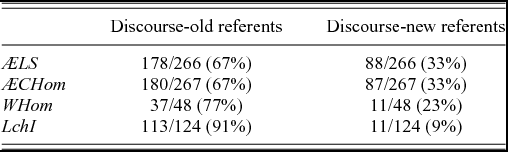
Based on the data sample discussed in section 3.1 (table 2), table 3 summarises the relative frequency of clause-initial pronominal anaphora across texts according to the information-structural properties of their referents. The findings indicate that certain texts exhibit greater topic continuity; for example, 91 per cent of clause-initial pronouns continue a discourse-old topic in the scientific writing of LchI, and only 9 per cent topic switch. WHom also involves greater topic maintenance than ÆLS and ÆCHom.
Frequency of clause-initial pronominal anaphora depending on the information-structural properties of their referents

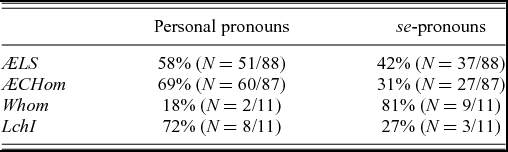
A breakdown of the figures in table 3 reveals that texts differ with regard to the type of pronoun employed to pick up discourse-new material. Table 4 summarises the rate at which personal pronouns and se-pronouns are used to highlight discourse new referents across texts.
Frequency of personal pronouns and se-pronouns used to highlight discourse-new referents (including nominative and non-nominative antecedents)

At 58 per cent (N = 51/88) and 69 per cent (N = 60/87), respectively, ÆLS and ÆCHom rely heavily on personal pronouns to pick up discourse-new referents regardless of whether these referents constitute nominative or non-nominative antecedents. The use of topic-switching personal pronouns is relatively common, and quantitatively remarkably similar in both ÆLS and ÆCHom. In ÆLS there are 52 contexts in which a pronoun picks up a non-nominative discourse-new referent; personal pronouns are employed at a rate of 63 per cent (N = 33/52) and se-pronouns occur 36.5 per cent of the times (N = 19/52). In ÆCHom personal pronouns occur at 66 per cent (N = 29/44) and se-pronouns at 34 per cent (N = 15/44). ÆLS and ÆCHom also show a propensity towards using personal pronouns to mark topic switch even in contexts involving competing referents that coincide in gender and number; 30 per cent (N = 10/33) of the personal pronouns in ÆLS that pick up non-nominative discourse-new referents fall into this category, and 48 per cent (N = 14/29) in ÆCHom. LchI employs personal pronouns to highlight discourse-new referents on eleven occasions (N = 8/11: 72%), but none of these instances involves competing referents, or two co-referents that coincide in gender and number, and topic switching is in any case rare in LchI.
One notable feature of Wulfstan's homiletic writing is his tendency in WHom to mark discourse-new referents unambiguously using se-pronouns; at 81 per cent (N = 9/11), se-pronouns are the preferred anaphoric type for highlighting discourse-new referents. WHom also uses se-pronouns more so than any other text to pick up discourse-old referents (N = 3/12: 25%), as table 2 indicates. In fact, WHom employs the highest overall rate of se-pronouns out of all the texts. Based on the figures in table 2, the relative frequency of se-pronouns across texts (as opposed to personal pronoun usage) is as follows: WHom 25% (N = 12/48) > ÆLS 15% (N = 40/226) > ÆCHom 11% (N = 31/267) > LchI 4% (N = 5/119). Se-pronouns are thus notably rare in scientific writing, but relatively abundant in Wulfstan's homiletic writing, with Ælfric's homiletic writing and the saints’ lives falling somewhere between.
4.1.2 The texts
Medical recipes of the kind found in LchI are a well-defined genre with a clear purpose as a handbook intended for consultation. Their communicative context differs from the other genres treated here in that recipe collections were probably intended for individual consultation (Taavitsainen Reference Taavitsainen2001: 107). The recipes provide instructions on how to prepare medicine and follow a highly regular structure. The entries in LchI are organised according to plant type. A description of the plant is followed by indications of preparation, application and efficacy, generally using the formula he bið gehæleð ‘he will be healed’. The recipes possess many of the text-type features that Taavitsainen (Reference Taavitsainen2001: 98–106) has identified for Late Middle and Early Modern English recipes. These features explicate the text's very clear instructive communicative strategy. They include the chronological sequencing of ingredients and actions in order to reflect the steps in preparing the prescription, the redaction of instructions in short paratactic sentences, and the use of the imperative in accordance with the instructive text style (Werlich Reference Werlich1983). Taavitsainen (Reference Taavitsainen2001: 100) does not find strong evidence in her Middle English material of the type of object pronoun deletion that has been identified for later medical writing (see Görlach Reference Görlach, Rissanen, Ihalainen, Nevalainen and Taavitsainen1992; Carroll Reference Carroll1999). At 1.4 per cent, the overall rate of oblique pronoun forms in LchI is in line with other texts in the present study, and the use of oblique pronouns is often plentiful, as in (35), but object pronoun deletion of the type illustrated in (36) is not uncommon.
-
(35) Wið eagena sare genim þas wyrte þe man argimoniam & oðrum naman garclife nemneð, cnuca hy swa grene þurh hy selfe. Gyf ðu hy þonne grene næbbe genim hy drige & dype on wearmum wætere swa þu eaþelicost hy brytan mæge. (LchI (Herb), 0385.32.1)
‘For sore of eyes take this wort which is called agrimony and by another name garclive, pound it so green by itself. If then you have it not green take it dry and dip (it) in warm water so you most easily can use it.’
-
(36) Gif man gewundud sy genim wegbrædan sæd, gnid to duste & scead on þa wunde. (LchI (Herb), 0075.2.6)
‘If a man be wounded take seed of waybread rub (it) to dust and shed (it) on the wound.’
With regard to the reference-tracking system of the recipes, as previously mentioned, 91 per cent of clause-initial anaphors pick up discourse-old referents, which indicates that topic continuity is characteristic of the linguistic discourse of medical recipes. The excerpt in (37) exemplifies the type of unambiguous reference tracking that characterises LchI.
-
(37) Wið næddran slite genim ðas sylfan uiperinam, cnuca hy, mengc mid wine, syle drincan. Heo hælð wundorlice þone slyte & þæt attor todrifð. (LchI (Herb), 0181–0182.6.1)
‘For adder bite take the same viperina, pound it, mix with wine, give to drink. It heals wonderfully the perforation and drives away the poison.’
In medical writing, narration is not the core text function; in other words, the central aim of ‘telling a story’ does not shape the composition of such text types. The main textual concern in scientific writing is to convey facts succinctly and unambiguously, a textual concern that is explicated by a system of pronominal referencing that minimises ambiguity.
The same textual concern of maximal transparency applies to the law texts. The redaction of Old English law codes conforms to the underlying logical structure that has been identified for modern-day legal documents: ‘Reduced to a minimal formula the great majority of legal sentences have an underlying logical structure which says something like “if X, then Z shall be Y” or alternatively “if X, then Z shall do Y”. . ..’ (Crystal & Davy Reference Crystal and Davy1969: 203). In the excerpt taken from Æthelred's laws (LawIAtr) in (38), disambiguation between the various participant lines, comprising freoman ‘freeman’, borh ‘guarantor’ and hlaford ‘lord’, is achieved by the repetition of the lexical items borh and hlaford. The text's reliance on lexical items rather than an excessive use of pronominal anaphora no doubt correlates with the relatively low rate of nominative pronoun use in LawIAtr (N = 192/9,194: 2%), and reflects a concern for exactness of reference expected from legal writing.
-
(38) Þæt is, þæt ælc freoman getreowne borh hæbbe, þæt se borh hine to ælcon rihte gehealde, gif he betyhtlad wurðe. Gyf he ðonne tyhtbysig sy, gange to þam þryfealdan ordale. Gif se hlaford sæcge, þæt him naðer ne burste ne að ne ordal, syððan þæt gemot wæs æt Bromdune, nime se hlaford him twegen getreowe þegenas innan þam hundrede . . . (LawIAtr 0003.1–0005.1.2)
‘That is that every freeman have a true guarantor that the guarantor might present him to every justice if he should be accused. If he then be of bad repute let (him) go to the threefold ordeal. If his lord should say that he had failed neither in oath nor ordeal since the assembly was at Bromdus, let the lord take with him two true thanes within the hundred . . .’
We might compare the concern for exactness of reference witnessed in LawIAtr with Ælfric's apparent occasional disregard for precise reference. Often in sections involving two female or male participants, Ælfric's heavy reliance on pronominal anaphora, rather than lexical items, makes the grammatical ties supplied by the anaphors ambiguous, as in (39), where it is not immediately obvious that heo refers to Melantia and not Eugenia. Similarly, in (40), the use of pronominal anaphors instead of lexical items seriously complicates tracking the three different participant lines Chromatius, Tranquillinus and preoste ‘priest’.
-
(39) Eugenia þa hi [= Melantia] gesmyrode mid gehalgodum ele and eac gemearcode mid rodetacne. And heo [= Melantia] þæt reðe attor eall ut aspaw, þe hyre [= Melantia] dærede, and wearþ gehæled þurh þæt halige mæden. (ÆLS (Eugenia), 0041.136–0042.138)
‘Eugenia smeared her [= Melantia] with hallowed oil and also marked (her) with the sign of the cross. And she [= Melantia] that evil poison all vomited out that harmed her and was healed through the holy maiden.’
-
(40) Chromatius þa bæd þæt he [= Tranquillinus] him [= Chromatius] gebrohte ðone mann þe hine [= Tranquillinus] gefullode and fram þære coðe gehælde. Tranquillinus ða eode to ðam arwurðan preoste, sæde hu hi spræcon, and hine [= priest] sona gelædde to þam heahgerefan. And he [= Chromatius] cwæð him [= priest] to . . . (ÆLS (Sebastian), 0055.190–0056.192)
‘Chromatius then asked that he [= Tranquillinus] brought him [= Chromatius] the man who had baptised him [= Tranquillinus] and healed from the illness. Tranquillinus then went to the venerable priest, said how they had spoken and brought him [= priest] immediately to the prefect and he [= Chromatius] said to him [= priest] . . .’
With regard to the saints’ lives and the homilies, a strict correlation between anaphoric strategy and genre is not immediately apparent. Despite the statistically significant difference in the overall rate of pronominal anaphora between ÆLS and ÆCHom, noted in table 1, the reference-tracking systems of Ælfric's saints’ lives and homilies are as strikingly similar, in terms of the distribution of anaphoric types, as those of ÆCHom and WHom are dissimilar. Differences in usage across different text types could be idiosyncratic to particular authors or the product of a text's subject matter. If the parameter of author remains the same across text types, this helps to control for differences in pronoun usage being idiosyncratic to a particular author rather than the result of content, but in this case, it is the similarities in usage across seemingly different texts (ÆCHom and ÆLS), and divergences in usage in apparently similar types of writing (ÆCHom and WHom), that require explanation.
The parallels in linguistic usage across Ælfric's homilies and saints’ lives could reflect an idiosyncrasy of Ælfric's writing style, but overlaps in subject matter are more likely to explain the similarities. ÆCHom and ÆLS both draw from similar content involving the accounts of saints’ lives and scriptural narratives. The parallels in subject matter explain the strong narrative elements found in both texts, such as the predominance of preterite forms (Ogawa Reference Ogawa1989: 104) and the high overall rate of third-person pronouns. ÆCHom and ÆLS belong to different genres but to the same narrative text type. The discourse of narrative text types has a strong ‘story telling’ element, which often involves an intricate set of referents that appear and reappear in changing configurations as the story develops. Hagiographical narratives are particularly complex in that the communicative situation in saints’ lives functions at two levels; in mediating the narrative, the narrator communicates with the reader/audience while at the same time the characters communicate with each other (von Contzen Reference Contzen, Fludernik and Jacob2014: 188).
Text tradition is also an important consideration. The saints’ lives under scrutiny here derive from Christian Latin sources, and the Anglo-Saxon hagiographical material was part of that tradition in its details and arrangement. This raises the question of whether linguistic choices in the Latin original may have influenced Ælfric's system of pronominal reference. The Latin text would have exerted no influence on Ælfric's employment of personal pronouns as the unmarked praxis in Latin is not to use pronominal subjects, thus providing no model for the referential pronouns that had to be added to the English text. While Ælfric's stylistic devices do not owe a heavy debt to Latin rhetorical tradition (see Randall Lipp Reference Randall Lipp1969 for discussion), his indebtedness to the content of his Latin source texts is often substantial. A line-by-line comparison of Ælfric's system of pronominal reference with that of his Latin sources is beyond the scope of the present study, but a brief comparison suggests that the highly conventionalised narration associated with saints’ lives is drawn from Latin hagiographical tradition, and may have influenced Ælfric's choice of pronominal anaphora. A case in point is the formulaic introduction of the saint that begins with an appropriate epithet, e.g. ‘noble maiden’, followed by the saint's name and biographical details that reiterate the saint's devout Christian nature. A comparison of Ælfric's initial description of St Agnes in (41) with that of his Latin source in (42) indicates that he followed his source closely in this case. The formulaic introduction of the saint is clearly modelled on the Latin and could explain the use of the OE se-form to render Latin quæ.
-
(41) On þære tide wæs sum æðelboren mæden Agnes gehaten, on ðone Hælend gelyfed, binnan Rome byrig, bilewit and snotor, cildlic on gearum and ealdlic on mode. Seo wan þurh geleafan wið þa feondlican ealdras, and on ðam þritteoðan geara þone deað forleas and þæt ece lif gemette, forðan þe heo lufode Crist. Heo wæs wlitig on ansyne, and wlitigre on geleafan. (ÆLS (Agnes), 0004.6–0006.13)
‘At that time (there) was a certain noble maiden called Agnes, (she) believed in the Saviour, in the city of Rome, gentle and wise, a child in years and old in mind. She contended through faith against the fiendish rulers and in her thirteenth year lost mortality and found eternal life because she loved Christ. She was fair in countenance and fairer in faith.’
-
(42) Tempore illo erat quædam virgo Romæ nobilibus orta natalibus, nomine Agnes, quæ certans contra principes et potestates tenebrarum, tertiodecimo ætatis suæ anno mortem perdidit, et vitam invenit . . . Infantia quidem computabatur in annis, sed erat senectus mentis in moribus: corpore quidem juvencula, sed animo cana. Pulchra facie, sed pulchrior fide, et elegantior castitate. (Ambrose, ed. Migne Reference Migne1845: col. 735, §1)
‘At that time there was a girl in Rome, born from noble parents, called Agnes, who, fighting against rulers and powers of the dark, lost death in her thirteenth year and found life . . . Though her childhood was computed in years, there was old age/maturity of mind in her behaviour: though of juvenile body, she was grey/old in mind. She had a pretty face, but was prettier in her faith, and more elegant in her chastity.’
Bethurum's (Reference Bethurum1932) comparative study of Ælfric's Old English renderings of the Latin originals reveals that Ælfric varied his method of translating and not all the lives are rendered with the same degree of literalness. The lives of St Lucy, St Martin and particularly St Agnes present ‘a fairly literal rendering of the Latin text, adding little of his own and omitting little of the Latin’ (Bethurum Reference Bethurum1932: 519). In other lives, such as those of St Sebastian and St Eugenia, summary rather than translation was his ‘usual practice’ (Bethurum Reference Bethurum1932: 519), which might explain some of the divergences in approach to reference tracking between the Latin and Old English versions. For instance, in (43) taken from the Life of St Eugenia, the Latin original relies heavily on lexical items, unlike Ælfric's reference tracking, which, as we have seen, refrains from employing lexical items, regardless of the resulting ambiguity.
-
(43) Hec et his similia prosequente Eugenia, Melantia surda aure transiebat. Interea dum Eugenia conaretur Melantiam de laqueo mortis eripere, et ageret Melantia quatenus Eugeniam inretiret. (Fábrega Grau Reference Fábrega Grau1955: 89, §18)
‘While Eugenia continued this and similar such things, Melantia kept going on with a deaf ear. Meanwhile, while Eugenia tried to pull Melantia out of the snare of death, [and] Melantia was acting so as to ensnarl Eugenia.’
With regard to the differences between Ælfric's and Wulfstan's homiletic writing, the authors’ divergent pronominal systems add to the list of linguistic differences between the homilists that have been noted in the literature, such as Wulfstan's more widespread use of present-tense finite verbs and modal auxiliaries (Ogawa Reference Ogawa1989: 101, 103).Footnote 9 Once again the differences between the two homilists in matters of linguistic choice can partly be explained on the basis of differing subject matter and text type. ÆHom and WHom represent different types of homilies (Ogawa Reference Ogawa1989: 142). Bethurum (Reference Bethurum1957: 96) suggests that ‘if we accept the distinction that a homily is an elaboration of a text, a sermon, with or without a text, an elaboration of some subject, then Wulfstan wrote more sermons than homilies’. Often ‘homilies’ and ‘sermons’ are treated synonymously in the literature because they share the central activity of preaching (see Kohnen Reference Kohnen, Fitzmaurice and Taavitsainen2007), but important differences between the genres have been identified with respect to their source material and the context of the speech act. Whereas a homilia was ‘an exegetical commentary on scripture for a specific liturgical celebration’, a sermo was ‘an edifying discourse meant to bring the faithful closer to Christian truth with no prescriptive theme – scriptural or otherwise – and no obligatory connection to the liturgical event’ (Heffernan Reference Heffernan1984: 179, cited in Kohnen Reference Kohnen, Fitzmaurice and Taavitsainen2007: 142). Wulfstan's homilies are mainly sermo-type homilies that treat dogmatic, moral or hortatory themes, whereas ÆHom largely comprise exegetical homilies, or vita-type homilies that draw from accounts of saints’ lives and scriptural narratives (Ogawa Reference Ogawa1989: 103). All of Ælfric's homilies included in the present data set are of the homilia or vita type and all of Wulfstan's represent the sermo type, except the eschatological homily ‘Matthew on the Last Days’ (Bethurum's II), which mostly relies on adapted Gospel passages. The religious instruction provided by Wulfstan is more directive in nature, a textual concern that is reinforced by the frequent use of imperatives in direct instruction in action-demanding sentences, as exemplified in (44). Ælfric's homilies, on the other hand, offer instruction that involves exposition, exegesis and narration.
-
(44) & scyldað eow wið galscypas & swyðe georne wið æwbrecas, & wið oferfylle beorgað eow georne. (WHom 8c,0057.163)
‘And protect yourselves against luxury and very eagerly against lawbreakers and against excess protect yourselves eagerly.’
Divergent subject matters and text types alone do not account for the differences between the two homilists in matters of linguistic usage. Each writer adopts a style that is best suited to his intended audience. Wulfstan's homilies were composed for public delivery to a largely ad populum audience, whereas Ælfric's intended audience comprised a clerical congregation. Ogawa (Reference Ogawa1989: 120, 144) interprets Wulfstan's preference for present-tense finite verbs and modal auxiliaries as indicative of the fact that he seems to be writing in a form of Old English prose that is closer to colloquial language, and thus better suited to his lay audience. There are frequent traces of orality in Wulfstan's homilies which belie their conceptually oral nature and the fact that they were composed with public delivery in mind: for instance, there are moments of direct address to his lay congregation, as in swa hit þincan mæg ‘as it can seem’, and hortatory phrases, like understande se þe wille ‘may he understand who wants to’ and gecnawe se þe cunne ‘may he understand who knows how to’ (Ogawa Reference Ogawa1989: 120).
Wulfstan's style in WHom also demonstrates a very clear communicative aim or text strategy. He is noted for mastering an impassioned, heightened style that was intended to move his audiences and warn them in no uncertain terms that impending judgment loomed nigh. To the same purpose, however, he also masterfully employed a plain style suitable for exposition and teaching that adhered to the Augustinian tenet of ‘sacrificing everything to clarity’ (Bethurum Reference Bethurum1957: 89). Ælfric presupposes that his audience shares the same learned Christian background and worldview; Wulfstan does not. Indeed, Ælfric's apparent lack of concern for maintaining entirely unambiguous participant lines may reflect the fact that his saints’ lives and homilies were written for a clerical audience already familiar with the narratives. The need for clarity when addressing large audiences ‘whose capacity for abstruse thought he [Wulfstan] did not overestimate’ necessitated a clear preaching style (Bethurum Reference Bethurum1957: 92). Wulfstan adds explanatory rephrasings, introduced by þæt is, to potentially confusing comments (Bethurum Reference Bethurum1957: 89–90).Footnote 10 His use of pleonastic pronouns and pronominal adverbs serves the same elucidatory purpose, as does his rejection of potentially confusing poetic imagery, such as metaphor and simile (Bethurum Reference Bethurum1957: 90, 91).
Similarly, Wulfstan's system of pronominal referencing, which involves (a) an overall low rate of anaphoric material, (b) a tendency towards topic maintenance and c) a high overall use of se-pronouns rather than personal pronouns to highlight not only discourse-new referents but also discourse-old referents, minimises the chances of ambiguous reference tracking and is part of a communicative strategy that is motivated by textual concerns including the instructive, and above all, a need for clarity. In minimising opacity, the system of reference tracking employed is perfectly suited to discourse that was intended for a large lay congregation. The colloquial, conceptually oral nature of Wulfstan's homilies and the orator's desire for force, which motivated a general proclivity in Wulfstan for intensifying words (Bethurum Reference Bethurum1957: 90), might also explain his comparatively heavy reliance on se-pronouns. Commonalities can also be drawn here with the interaction between style and information structure that has been identified for anaphoric strategies in Modern German whereby spoken language exhibits a striking preference for demonstrative usage (Bosch et al. Reference Bosch, Katz, Umbach, Schwarz-Friesel, Consten and Knees2007).
More in-depth analysis in future research is naturally still required, but the present analysis would suggest that text type, text strategy and communicative intent, together with intended audience, play important roles in conditioning a text's pronominal referencing system. Such factors affect both the relative frequency of the different anaphoric pronoun types and their distribution.
5 Conclusion
In line with the cognitive/psycholinguistic literature on the distribution of pronouns in Modern Dutch and German, the information-structural properties of referents rather than the grammatical role of the pronoun's antecedent most accurately explain the personal/se-pronoun contrast in the West Saxon dialect of Old English. The grammatical role of the antecedent is not the crucial parameter; se-pronouns generally avoid discourse topics regardless of whether their referents constitute subject or non-subject antecedents. Personal pronouns offer a less clear pattern both in their selection of referents and in the discourse function they perform, but tend to favour discourse-old referents. It has also been demonstrated that personal pronouns accompanied by the adnominal intensifier self were already well specialised in maintaining reference in West Saxon.
I emphasise the diatopic limitations of the present findings because this article has not considered dialect variation. The results reflect pronominal referencing in late West Saxon, the southern dialect of Old English, and diatopic homogeneity should not be assumed. In Old Northumbrian personal pronouns and se-pronouns overlapped considerably in function and were used interchangeably regardless of information-structural parameters (Cole Reference Cole2017). The ensuing cross-paradigmatic merger in function between personal pronouns and se-pronouns in Old Northumbrian was crucial in shaping the divergent development of the northern Middle English personal pronoun paradigm and suggests that the replacement of the OE third-person plural personal pronouns by northern ME forms in þ- can be explained from a native perspective (Cole Reference Cole2017). Furthermore, the present study is a synchronic study that offers a snapshot of pronominal referencing in a particular dialect at a particular moment in the development of Old English, rather than a diachronic perspective.
The findings of the present study support the claim that information structure is important in explaining pronominal referencing in the West Saxon dialect of Old English, but also highlight how concepts such as ‘genre’ and ‘text type’, ‘style’ and communicative intent all need to be borne in mind when accounting for anaphoric strategy, as does intended audience. The relative frequency and distribution of different anaphoric pronouns varies according to text type. Narrative text types exhibit dense reference tracking and frequent topic switch, whereas instructive text types favour topic continuity and unambiguous reference tracking. The author–audience relationship was also central in conditioning how a text's reference-tracking system was shaped to suit particular audiences and situational contexts.