Introduction
Hypertension is a disease of complex aetiology, affecting 972 million people worldwide. It is estimated that the worldwide prevalence of hypertension could increase from 26.4% in 2000 to 29.2% in 2025 (Kearney et al., Reference Kearney, Whelton, Reynolds, Muntner, Whelton and He2005). Hypertension is an important risk factor for cardiovascular disease (CVD) and has become a major global burden on public health (Lawes et al., Reference Lawes, Vander Hoorn, Law, Elliott, MacMahon and Rodgers2006). The rate of hypertension among the Aggarwal Baniya of India is also a cause for concern. The prevalence of systolic pre-hypertension has been found to be 49.4% and 46.0% among Aggarwal Baniya males and females, respectively, whereas the percentages of systolic hypertensive males and females were 21.8% and 7.4%, respectively (Gupta & Kapoor, Reference Gupta and Kapoor2010).
Epidemiological evidence demonstrates a multifactorial cause of this condition (Williams et al., Reference Williams, Hunt, Hasstedt, Hopkins, Wu and Berry1991; Cooper & Rotimi, Reference Cooper and Rotimi1994; Harrap, Reference Harrap1994), with major modifiable risk factors including obesity, diet, stress and physical inactivity (Stamler et al., Reference Stamler, Berkson, Dyer, Lepper, Lindberg, Oglesby and Paul1975; Cooper et al., Reference Cooper, Rotimi, Ataman, McGee, Osotimehin, Kadiri and Muna1997). However, hypertension has a complex genetic basis too. Genetic factors that confer susceptibility to hypertension are now being identified in several populations (Jeunemaitre et al., Reference Jeunemaitre, Soubrier, Kotelevtsev, Lifton, Williams and Charru1992; Hata et al., Reference Hata, Namikawa, Sasaki, Sato, Nalamura, Tamura and Lalouel1994; Lifton, Reference Lifton1996; Cusi et al., Reference Cusi, Barlassina, Azzani, Casari, Citterio and Devoto1997). Even many of these modifiable risk factors (obesity, blood pressure, total cholesterol) have a genetic basis or, at a minimum, tend to aggregate in families. These factors also change in prevalence over time and have a potential effect on phenotype (an age-specific penetrance). By examining age-stratified heritability associated with common risk factors, a better understanding of the genetic contribution to their phenotypic variance can be made.
Most studies undertaken to define genetic influences have been conducted in Westernized societies where high levels of exposure to environmental risk factors prevail, especially obesity and excess sodium. The present study reports on the familial patterns of blood pressure in a population sample of Aggarwal Baniya families residing in New Delhi, India. An important focus of this work is to understand better how genes interact with the environment. The analysis presented in this paper represents an evaluation of the familial patterns of blood pressure among Aggarwal Baniya families.
Methods
Population under study
The present study was conducted on Aggarwal Baniyas of Delhi. Baniya is generic term used for some communities that basically means a trading community. They are divided into a number of sub-castes, such as Aggarwals, Barnwal, Kesharwani, Mahawar, Maheshwari, Mahur, Mahuri, Mathuria Vaishya, Khandelwals, Oswals, Omar, Rastogis, Sunga, Ghate Banias, Parwars and Porwals. The Aggarwals are generally considered to be the largest and most influential of the Baniya communities from northern India. Aggarwals are largely a trading community with a sedentary lifestyle and a diet rich in oily foodstuffs, making them prone to cardiovascular health risk. They practise caste endogamy and gotra exogamy.
Recruitment of subjects
Data were collected using a multistage, stratified sampling method from 309 Aggarwal Baniya families located in New Delhi, having at least one child in the age group 14–19 years and their respective parents. In total, data were collected on 1214 subjects, including 271 males, 307 females and 636 children of both sexes. The majority of children resided with their parents in family households. Exclusion criteria included obesity secondary to hypothyroidism, severe debilitating diseases or cancer. In addition, women who were pregnant or lactating were excluded, as were inter-caste offspring. Participants from a wide range of socioeconomic groups were enrolled. The study was approved by the Ethical Committee of the Department of Anthropology, University of Delhi, and informed consent was obtained from each subject. For minor children consent was obtained from one of their parents.
Anthropometric measurements
Blood pressure was measured on the left arm of each participant using a manual (mercury) sphygmomanometer and stethoscope with the patient seated in a chair. Three readings were taken for both systolic and diastolic measures; the average of the three blood pressure measurements was used as the estimate of SBP and DBP.
Statistical analysis
Data were analysed using the computer software Statistical Package for the Social Sciences (SPSS) version 15.0 for Windows (SPSS Inc., Chicago, USA). Analyses of blood pressure variables included descriptive statistics and genetic analyses. Descriptive data were expressed as mean values with standard deviations for continuous variables.
Genetic analysis was based on quantitative genetic theory, which defines a phenotype as the sum of the effects of both genotype and environmental factors (Falconer, Reference Falconer1989). The goal was to decompose the phenotypic variance into its genetic and environmental components by comparing the similarity within the siblings (measured by intraclass correlation) and rearing groups. Correlation between sibs and variance analysis of sibships are not the ideal methods to determine the extent of genetic involvement. However, the fact that environmental factors make more important contributions to the correlation between sibs than to the parent–child correlation, at least for measurements easily influenced by the environment, means that the comparison of intrafamilial correlations allows the evaluation of genetic, environmental and dominance effects (Susanne, Reference Susanne1975). Partial correlation coefficients were calculated for SBP and DBP measures stratified by generation and sex (i.e. father, mother, son and daughter) with control for age. Two-tailed probability levels for statistical significance are reported.
The coefficient of heritability, which estimates the proportion of phenotypic variance due to genetic variance, is equal to the regression of the offspring on parent (Falconer, Reference Falconer1981), and is also estimated for blood pressure. It is given by:

, where VA is the additive genetic variance, VP is the phenotype variance and b is the regression coefficient. Linear regression analysis was performed, where the total genetic variance was regressed by phenotypic variance to obtain the β-coefficient as a heritability coefficient.
Results
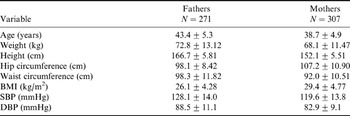
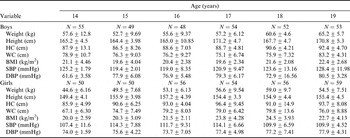
The means and standard deviations of various measurements and indices for parents and their children are presented in Tables 1 and 2. A high prevalence of obesity in this community is evident in the sex- and generation-specific mean BMI values (fathers, 26.1 kg/m2; mothers, 29.4 kg/m2; sons, 19.6–22.4 kg/m2; and daughters, 20.0–22.7 kg/m2). Although mothers were 3 BMI units heavier than the fathers, the SBP and DBP values were significantly higher among fathers. However, among children BMI was not significantly different but SBP and DBP were higher in boys as compared with girls. As expected, females had significantly larger hip circumferences compared with males in both generations, whereas waist circumference was higher in males in both generations.
Basic characteristics of fathers and mothers (means±SD)

Basic characteristics of children (means±SD)

HC, hip circumference; WC, waist circumference; BMI, body mass index; SBP, systolic blood pressure; DBP, diastolic blood pressure.
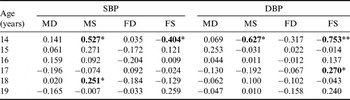
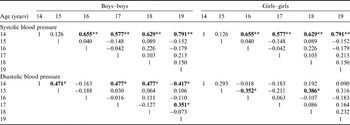
The results of the intraclass correlation coefficients are presented in Tables 3 and 4. Among the Baniya population, for systolic and diastolic blood pressures, sons showed a significantly higher correlation with their parents than did daughters. Most sibling–sibling correlations were larger than the parent–offspring correlations, and all parent–offspring and sibling–sibling correlations were larger than the corresponding spouse correlations (SBP=0.026; DBP=0.029). Overall, genetically related individuals showed significant positive correlations for all the cardiovascular risk factors after adjustment for sex and age.
Parent–child correlation for blood pressure

MD, mother–daughter; MS, mother–son; FD, father–daughter; FS, father–son.
*p<0.05; **p<0.01.
Sib–sib correlation matrix for blood pressure (boys–boys and girls–girls)

*p<0.05; **p<0.01.
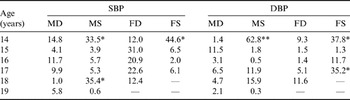
Table 5 summarizes the heritability estimates for both SBP and DBP. The maximum heritability was estimated as 44.6% for SBP and 62.8% for DBP. However, no particular trend was observed in different age groups of sons and daughters.
Heritability of blood pressure

MD, mother–daughter; MS, mother–son; FD, father–daughter; FS, father–son.
*p<0.05; **p<0.01.
Discussion
Hypertension is one of the indicators of metabolic syndrome. Genetic as well as environmental influences have been implicated in obesity and several cardiovascular risk factors (Austin et al., Reference Austin, King, Bawol, Hulley and Friedman1987; Mayer et al., Reference Mayer, Newman and Austin1996), and it has recently been suggested that the metabolic syndrome may originate in utero (Ozanne & Hales, Reference Ozanne and Hales2002). Tracking of cardiovascular disease from childhood to adulthood suggests that early detection of individuals at risk, along with family-based intervention programmes, may have long-term benefits for the prevention of cardiovascular risks (Wadden et al., Reference Wadden, Stunkard and Rich1990; Flodmark et al., Reference Flodmark, Ohlsson, Ryden and Sveger1993).
Among the various approaches to understand the genetic basis of hypertension, one is to study the genetic basis of the underlying quantitative trait. The present study used genetic epidemiology methods to estimate the proportion of blood pressure variability that is determined by transmissible factors (i.e. shared environmental and shared genetic factors) in a population sample of Aggarwal Baniya families. All the anthropometric measurements reflected the high obesity level of this population (Gupta & Kapoor, Reference Gupta and Kapoor2010). Heritability was estimated to be 44.8% for SBP and 62.8% for DBP. To the best of the authors' knowledge, this study represents the first attempt to use standard statistical genetic methods to estimate the degree of familial clustering of blood pressure among Aggarwal Baniya families. The Aggarwal Baniya is a traditional and conservative community preferring their own traditional diet, which is generally rich in oil and fat making this community prone to obesity and other cardiovascular risk factors. Most of the children live with their parents, sharing a common culture and nutritional environment indicating the role of the shared environment in heritability. However, higher sibling correlations than for parent–child indicate the role of non-shared environmental factors. Among the Baniya population, for systolic and diastolic blood pressure, sons showed a significantly higher correlation with their parents than did daughters. Although the exact reason for higher parent–son association is not know, one plausible explanation could be this society's preference for males. Because of this boys are likely to enjoy more of the family's resources and are more pampered than girls, resulting in poor eating habits making them more prone to cardiovascular problems similar to their parents. Moreover, high heritability of blood pressure for sons also indicates that they are genetically predisposed to hypertension, similar to their fathers (Gupta & Kapoor, Reference Gupta and Kapoor2010).
Most sibling–sibling correlations were larger than parent–offspring correlations, and all parent–offspring and sibling–sibling correlations were larger than the corresponding spouse correlations, suggesting that individuals who share genes tend to be more alike in cardiovascular risk factor levels. These findings are in agreement with those of other studies (Knuiman et al., Reference Knuiman, Divitini, Welborn and Bartholomew1996; Park et al., Reference Park, Park and Cho2006; Chiu et al., Reference Chiu, Lin, Wang, Chen, Wang, Warwick and Chen2007).
The findings of the present study suggest that there is a greater sharing of environmental determinants between siblings than between parents and offspring, or that dominant as well as additive genetic effects are involved. The lack of significant trends in the spouse correlations suggests that the observed correlation between spouses for cardiovascular risk factors is primarily due to assortative mating rather than cohabitational effects. This result agrees with several studies (Annest et al., Reference Annest, Sing, Biron and Mongeau1979; Havlik et al., Reference Havlik, Garrison, Feinleib, Kannel, Castelli and McNamara1979; Tambs et al., Reference Tambs, Mourn and Eaves1991, Reference Tambs, Mourn and Holmen1992; Lin et al., Reference Lin, Boden-Albala, Juo, Park, Rundek and Sacco2005), but not with one study (Longini et al., Reference Longini, Higgins, Hinton, Moll and Keller1984) where the author found an increasing correlation with age for blood pressure. The findings of the present study indicate that correlations between first-degree relatives for hypertension are largely independent of age.
A study by Poulsen et al. (Reference Poulsen, Vaag, Kyvik and Beck-Nielsen2001) has reported 76% and 66% heritability for systolic and diastolic blood pressure. Lin et al., (Reference Lin, Boden-Albala, Juo, Park, Rundek and Sacco2005) demonstrated heritability of 20% for blood pressure. It has also been reported that genes account for 18% and 28% of the total phenotypic variation in systolic and diastolic blood pressures, respectively; both of these results were lower than the heritability estimates of the present Baniya population (Mitchell et al., Reference Mitchell, Kammerer and Blangero1996).
Although some studies have reported significant spouse correlations, especially for SBP (Ward et al., Reference Ward, Chin, Prior, Sing and Skolnick1979; Morton et al., Reference Morton, Guldbrandsen, Rao, Rhoads and Kagan1980), none was observed in the present study, an indication that most couples from this Aggarwal Baniya community were discordant in relevant environmental determinants of blood pressure. There is a growing body of literature suggesting that environmental factors that operate during fetal and early life may have profound effects on disease susceptibility in later life (Marmot, Reference Marmot1979). It has been suggested that maternal undernutrition during pregnancy leads to retarded intrauterine growth and increased risk of hypertension and cardiovascular disease (Barker et al., Reference Barker, Osmond, Golding, Kuh and Wadsworth1989, Reference Barker, Gluckman, Godfrey, Harding, Owens and Robinson1993; Martyn et al., Reference Martyn, Barker, Jespersen, Greenwald, Osmond and Berry1995). Another theory hypothesizes that nephron numbers are programmable in utero such that deficiencies in nephron endowment at birth result in hypertension in later life (Mackenzie et al., Reference Mackenzie and Brenner1995, Reference Mackenzie, Lawler and Brenner1996). An alternative to the direct effect of the intrauterine influence on blood pressure is that the accelerated growth sometimes observed in low birth weight babies during early infancy may be linked to an accelerated rate of increase in blood pressure levels that persist over time (Ounsted et al., Reference Ounsted, Cockburn, Moar and Redman1985).
Circumstances operating in utero, and in early life, may affect the total inter-individual variation in blood pressure. Widespread expectation now exists that genetic markers could enhance the precision with which individual risk of hypertension is predicted. Of the potential candidate loci, the strongest case for susceptibility of human hypertension now exists for genes encoding components of the renin–angiotensin system (Hata et al., Reference Hata, Namikawa, Sasaki, Sato, Nalamura, Tamura and Lalouel1994; Cusi et al., Reference Cusi, Barlassina, Azzani, Casari, Citterio and Devoto1997). Evidence of strong heritability of blood pressure in family sets, as reported here, suggests that molecular determinants should be identified given the ongoing improvement in laboratory methods.
In summary, this study provides evidence of familial resemblance of blood pressure in a population with a high prevalence of hypertension. Although parameter estimates vary from one study to another, these data reinforce the general consensus that a large proportion of the phenotypic variation in blood pressure is genetically determined. Family studies of hypertension and associated risk factors in populations of the Aggarwal Baniyas may contribute to a better understanding of the complex interaction between genetic and environmental factors leading to hypertension.
Acknowledgments
The financial assistance to SG from the Indian Council of Medical Research (ICMR) is gratefully acknowledged. The authors extend their gratitude to all the study participants for their co-operation. They also acknowledge the support of the Department of Anthropology, University of Delhi, India, for providing the infrastructure for conducting this study.