Any discussion of human health is incomplete without including social health, the ability to form meaningful and rewarding relationships with others, and to interact positively with family, friends, colleagues, and the community at large. The importance of social health for good quality of life and general well-being is widely recognized (Courtin and Knapp, Reference Courtin and Knapp2017). Assessing social health, however, presents several challenges owing to the complexity of social ties. Most approaches consider the structure and content of social ties, and the subjective response to the social contact, in the assessment. In relation to structure, there is reference to the number, diversity and frequency of social contacts (House et al., Reference House, Landis and Umberson1988), and the social networks such contacts generate (Amieva et al., Reference Amieva, Stoykova, Matharan, Helmer, Antonucci and Dartigues2010). The converse of a large and integrated social network is social isolation. The content may be positive or negative, making social contacts emotionally sustaining or challenging and leading to social support or social stress and feelings of connectedness or loneliness.
Good social engagement is regarded, along with physical exercise and complex cognitive activity, as one of the pillars of brain health (Livingston et al., Reference Livingston2020). Social isolation has been linked to depression and dementia (Livingston et al., Reference Livingston2020), as well as physical disorders such as hypertension and coronary heart disease (Hemingway and Marmot, Reference Hemingway and Marmot1999). The Lancet Commission Report on dementia prevention estimated that social isolation increased the risk of dementia 1.5-fold (95% CI 1.33-1.79), with its relative contribution at the population level being similar to that of hypertension and physical inactivity (Livingston et al., Reference Livingston2020). A recent meta-analysis of 31 cohort and 2 case–control studies estimated an increased dementia risk in relation to having a poor social network (RR = 1.59, 95% CI 1.31–1.96) or poor social support (RR = 1.28, 95% CI 1.01–1.62). Good social engagement, on the other hand, was protective against dementia (RR = 0.88, 95% CI 0.80–0.96) (Penninkilampi et al., Reference Penninkilampi, Casey, Singh and Brodaty2018). The paper by Goldberg et al. (Reference Goldberg, Choi, Lee, Gurland and Devanand2021) in this issue of the Journal supports this trend in the literature, with social isolation (HR=1.78, 95%CI 1.17-2.70) being associated with episodic memory and incident dementia.
There are several caveats to the association of social isolation with dementia risk. The meta-analysis mentioned above showed considerable heterogeneity in the findings, with the potential for publication bias toward positive results (Penninkilampi et al., Reference Penninkilampi, Casey, Singh and Brodaty2018). Moreover, not all measures of social health show this association. In the same meta-analysis, the association of loneliness with dementia, while in the same direction, was nonsignificant (RR = 1.38; 95%CI 0.98-1.94). In the Goldberg et al. (Reference Goldberg, Choi, Lee, Gurland and Devanand2021) study, loneliness was not associated with incident dementia or episodic memory. Another limitation is in the measures themselves, as they often rely on self-report alone, without objective measurements of contact frequency and duration, something possible with modern wearable and other new technologies (Liddle et al., Reference Liddle2021). Finally, the relationship between social isolation and dementia may be bidirectional, with dementia, even in its early stages, leading to isolation, which in turn may promote further cognitive decline (Penninkilampi et al., Reference Penninkilampi, Casey, Singh and Brodaty2018).
A related risk factor that Goldberg et al. present is “restriction of physical and instrumental activities of daily living,” which showed a greater association with incident dementia (HR=2.22, 95% CI 1.42-3.47) than isolation. Restriction and isolation were related to each other, and when examined in the same model, only restriction was significant (HR=1.97, 95% CI 1.24-3.14). Considering the striking importance of restriction in this study, it is important to understand this risk factor.
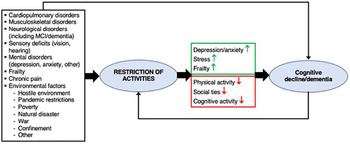
The concept of restriction is based on self-report of whether physical, emotional, or cognitive problems prevent an individual from doing what they would like to do. The scale used in this study does not actually measure the activity levels of the individuals, i.e. it is not based on measurement of behavior. There is a long tradition of measuring activity restrictions in the fields of disability and rehabilitation (World Health Organization, 2002), but this has rarely been used in the context of dementia. Restrictions may occur due to physical conditions, chronic pain, mental disorder, and cognitive impairment, as summarized in the Figure 1. Whether the cause of the restrictions, the rate of their development, and the nature of restrictions (e.g. physical, mental, or cognitive) are important for their impact remains uncertain. In the analysis by Goldberg and colleagues, restrictions that reflected physical activities or mental/neuropsychiatric symptoms were both independently associated with episodic memory.
Figure 1.A model for the relationship of restriction of activities with cognitive decline and dementia.
There are several possible mechanisms by which restriction may be associated with cognitive decline and dementia. The conditions associated with restriction, such as cardiopulmonary disease, frailty, and depression, have, in fact, a direct relationship with dementia, not necessarily mediated through restriction. However, restriction is likely to exacerbate some of these conditions. Reduced physical activity could increase frailty and worsen cardiopulmonary fitness. Restriction is stressful for the individual and is likely to lead to or worsen anxiety and depression. Reduced social ties and cognitive activity, if associated with the restriction, are independent risk factors for dementia. As the Goldberg et al. study shows, memory impairment leads to restrictions which in turn worsen cognition, although they showed that the latter effect was greater than the former (Goldberg et al., Reference Goldberg, Choi, Lee, Gurland and Devanand2021). While episodic memory was examined in this study, it is quite likely that other cognitive domains, in particular executive function, have a similar reciprocal relationship with restriction.
While the exploration of restrictions in relation to dementia in this manner is new, there has been much recent interest in the restrictions related to the Coronavirus Disease 2019 (COVID-19) pandemic. The COVID-19-related restrictions have included social distancing, reduced ability to visit family and friends, disruption of routines, inability to access many services, increased social isolation, and a fear of possible infection with hospitalization and potential death (Tuijt et al., Reference Tuijt, Frost, Wilcock, Robinson, Manthorpe, Rait and Walters2021). Since dementia patients are judged to be at high-risk of COVID-19-related complications (Mok et al., Reference Mok2020), and many live in institutional setting with greater risk of rapid spread of infection, the restrictions faced by dementia patients have been more severe. There is evidence that this has resulted in an increase in depression, anxiety, apathy and irritability (García-Esquinas et al., Reference García-Esquinas2021; Mok et al., Reference Mok2020), as well as alcohol use (García-Esquinas et al., Reference García-Esquinas2021), and there is concern of more rapid decline in people with mild cognitive impairment and dementia, even in the absence of direct infection (Tsapanou et al., Reference Tsapanou2021).
While COVID-19 is a special case of restrictions due to an external threat, there are many situations in which restrictions occur, and their relationships to cognition and cognitive decline deserve further systematic study. We need to understand the relative significance of physical, emotional, and cognitive restrictions; restrictions that arise from poor health and those imposed by an external agency or circumstance; and restrictions that develop gradually versus those that develop suddenly. The mechanisms by which restrictions interact with cognition also need further study. This has practical consequences. Not only are restrictions sometimes reversible but there may also be strategies to mitigate their adverse effects through appropriate interventions. Restriction of activities should therefore be added to the long list of potentially modifiable risk factors of cognitive impairment and dementia, ripe for further investigation and mitigation.





 You have
Access
Any discussion of human health is incomplete without including social health, the ability to form meaningful and rewarding relationships with others, and to interact positively with family, friends, colleagues, and the community at large. The importance of social health for good quality of life and general well-being is widely recognized (Courtin and Knapp, Reference Courtin and Knapp2017). Assessing social health, however, presents several challenges owing to the complexity of social ties. Most approaches consider the structure and content of social ties, and the subjective response to the social contact, in the assessment. In relation to structure, there is reference to the number, diversity and frequency of social contacts (House et al., Reference House, Landis and Umberson1988), and the social networks such contacts generate (Amieva et al., Reference Amieva, Stoykova, Matharan, Helmer, Antonucci and Dartigues2010). The converse of a large and integrated social network is social isolation. The content may be positive or negative, making social contacts emotionally sustaining or challenging and leading to social support or social stress and feelings of connectedness or loneliness.
Good social engagement is regarded, along with physical exercise and complex cognitive activity, as one of the pillars of brain health (Livingston et al., Reference Livingston2020). Social isolation has been linked to depression and dementia (Livingston et al., Reference Livingston2020), as well as physical disorders such as hypertension and coronary heart disease (Hemingway and Marmot, Reference Hemingway and Marmot1999). The Lancet Commission Report on dementia prevention estimated that social isolation increased the risk of dementia 1.5-fold (95% CI 1.33-1.79), with its relative contribution at the population level being similar to that of hypertension and physical inactivity (Livingston et al., Reference Livingston2020). A recent meta-analysis of 31 cohort and 2 case–control studies estimated an increased dementia risk in relation to having a poor social network (RR = 1.59, 95% CI 1.31–1.96) or poor social support (RR = 1.28, 95% CI 1.01–1.62). Good social engagement, on the other hand, was protective against dementia (RR = 0.88, 95% CI 0.80–0.96) (Penninkilampi et al., Reference Penninkilampi, Casey, Singh and Brodaty2018). The paper by Goldberg et al. (Reference Goldberg, Choi, Lee, Gurland and Devanand2021) in this issue of the Journal supports this trend in the literature, with social isolation (HR=1.78, 95%CI 1.17-2.70) being associated with episodic memory and incident dementia.
There are several caveats to the association of social isolation with dementia risk. The meta-analysis mentioned above showed considerable heterogeneity in the findings, with the potential for publication bias toward positive results (Penninkilampi et al., Reference Penninkilampi, Casey, Singh and Brodaty2018). Moreover, not all measures of social health show this association. In the same meta-analysis, the association of loneliness with dementia, while in the same direction, was nonsignificant (RR = 1.38; 95%CI 0.98-1.94). In the Goldberg et al. (Reference Goldberg, Choi, Lee, Gurland and Devanand2021) study, loneliness was not associated with incident dementia or episodic memory. Another limitation is in the measures themselves, as they often rely on self-report alone, without objective measurements of contact frequency and duration, something possible with modern wearable and other new technologies (Liddle et al., Reference Liddle2021). Finally, the relationship between social isolation and dementia may be bidirectional, with dementia, even in its early stages, leading to isolation, which in turn may promote further cognitive decline (Penninkilampi et al., Reference Penninkilampi, Casey, Singh and Brodaty2018).
A related risk factor that Goldberg et al. present is “restriction of physical and instrumental activities of daily living,” which showed a greater association with incident dementia (HR=2.22, 95% CI 1.42-3.47) than isolation. Restriction and isolation were related to each other, and when examined in the same model, only restriction was significant (HR=1.97, 95% CI 1.24-3.14). Considering the striking importance of restriction in this study, it is important to understand this risk factor.
The concept of restriction is based on self-report of whether physical, emotional, or cognitive problems prevent an individual from doing what they would like to do. The scale used in this study does not actually measure the activity levels of the individuals, i.e. it is not based on measurement of behavior. There is a long tradition of measuring activity restrictions in the fields of disability and rehabilitation (World Health Organization, 2002), but this has rarely been used in the context of dementia. Restrictions may occur due to physical conditions, chronic pain, mental disorder, and cognitive impairment, as summarized in the Figure 1. Whether the cause of the restrictions, the rate of their development, and the nature of restrictions (e.g. physical, mental, or cognitive) are important for their impact remains uncertain. In the analysis by Goldberg and colleagues, restrictions that reflected physical activities or mental/neuropsychiatric symptoms were both independently associated with episodic memory.
A model for the relationship of restriction of activities with cognitive decline and dementia.
There are several possible mechanisms by which restriction may be associated with cognitive decline and dementia. The conditions associated with restriction, such as cardiopulmonary disease, frailty, and depression, have, in fact, a direct relationship with dementia, not necessarily mediated through restriction. However, restriction is likely to exacerbate some of these conditions. Reduced physical activity could increase frailty and worsen cardiopulmonary fitness. Restriction is stressful for the individual and is likely to lead to or worsen anxiety and depression. Reduced social ties and cognitive activity, if associated with the restriction, are independent risk factors for dementia. As the Goldberg et al. study shows, memory impairment leads to restrictions which in turn worsen cognition, although they showed that the latter effect was greater than the former (Goldberg et al., Reference Goldberg, Choi, Lee, Gurland and Devanand2021). While episodic memory was examined in this study, it is quite likely that other cognitive domains, in particular executive function, have a similar reciprocal relationship with restriction.
While the exploration of restrictions in relation to dementia in this manner is new, there has been much recent interest in the restrictions related to the Coronavirus Disease 2019 (COVID-19) pandemic. The COVID-19-related restrictions have included social distancing, reduced ability to visit family and friends, disruption of routines, inability to access many services, increased social isolation, and a fear of possible infection with hospitalization and potential death (Tuijt et al., Reference Tuijt, Frost, Wilcock, Robinson, Manthorpe, Rait and Walters2021). Since dementia patients are judged to be at high-risk of COVID-19-related complications (Mok et al., Reference Mok2020), and many live in institutional setting with greater risk of rapid spread of infection, the restrictions faced by dementia patients have been more severe. There is evidence that this has resulted in an increase in depression, anxiety, apathy and irritability (García-Esquinas et al., Reference García-Esquinas2021; Mok et al., Reference Mok2020), as well as alcohol use (García-Esquinas et al., Reference García-Esquinas2021), and there is concern of more rapid decline in people with mild cognitive impairment and dementia, even in the absence of direct infection (Tsapanou et al., Reference Tsapanou2021).
While COVID-19 is a special case of restrictions due to an external threat, there are many situations in which restrictions occur, and their relationships to cognition and cognitive decline deserve further systematic study. We need to understand the relative significance of physical, emotional, and cognitive restrictions; restrictions that arise from poor health and those imposed by an external agency or circumstance; and restrictions that develop gradually versus those that develop suddenly. The mechanisms by which restrictions interact with cognition also need further study. This has practical consequences. Not only are restrictions sometimes reversible but there may also be strategies to mitigate their adverse effects through appropriate interventions. Restriction of activities should therefore be added to the long list of potentially modifiable risk factors of cognitive impairment and dementia, ripe for further investigation and mitigation.
Conflict of interest declaration
None.