The world is full of competing sources of information and, in some cases, these conflict. For example, information about where to direct attention can be gleaned from the direction of eye gaze, but also from facial emotional cues. Sometimes the two provide contradictory information (e.g. de Jong, van Engeland & Kemner, Reference de Jong, van Engeland and Kemner2008). Similarly, in the domain of language, there are no perfectly reliable indicators of word boundaries in continuous speech (Cole & Jakimik, Reference Cole, Jakimik and Cole1980), and sometimes cues, such as prosody and statistical properties, offer conflicting signals to the placement of word boundaries (e.g. Johnson & Seidl, Reference Johnson and Seidl2009). Historically, the scientific approach has led researchers to study a single variable in isolation while controlling others in their efforts to understand the cues to which learners attend (see Jusczyk, Cutler & Redanz, Reference Jusczyk, Cutler and Redanz1993), and yet inquiry into situations in which there are multiple possible sources of information are highly informative. These situations mimic much more closely children's experience of learning and, as such, they provide us with more ecologically valid insight into the sources of information that might be prioritized.
One clear area in which there are competing sources of information lies in the representation of words on the page. English is often described as an irregular or deep orthography because spellings in English do not accord with straightforward correspondences based on the sounds (or phonology) of words (e.g. Seymour, Aro & Erskine, Reference Seymour, Aro and Erskine2003). The term ‘irregular’ is somewhat of a misnomer; it does not appropriately capture the many regularities that underlie spellings in English that are based on letter- and meaning-patterns (or orthographic and morphological, respectively). It is an intriguing question as to whether young learners of the English writing system detect the existence of these multiple regularities. This is an important question given that these features are experienced in conjunction with one another and, as we will see, they sometimes offer conflicting information.
It takes only one example, that of the number of medial consonant letters, to see how the regularities underpinning spelling do not always converge. There is an orthographic regularity in English that consonants are more likely to occur on their own than in a doublet pair. This is considered to be a formal regularity because it is based simply on patterns within the written language (as highlighted by Lehtonen & Bryant, Reference Lehtonen and Bryant2005). Regularities about how such orthographic patterns connect to phonology or morphology are considered to be functional (see Ferreiro & Teberosky, Reference Ferreiro and Teberosky1982; Lehtonen & Bryant, Reference Lehtonen and Bryant2005); for example, the number of consonants is affected by the vowel quality within the word, thereby linking orthography with phonology. In bisyllabic words with a long vowel, this consonant is spelled with a single letter (referred to as a singlet; e.g. skater). In bisyllabic words with a short vowel, this is spelled with two consonants (referred to as a doublet; e.g. knitter). This functional principle sometimes supports and sometimes conflicts with another functional principle, that of root consistency (see e.g., Bourassa & Treiman, Reference Bourassa and Treiman2008; Deacon & Bryant, Reference Deacon and Bryant2006). Here again, the orthographic pattern connects with another dimension, morphology, in that the spelling of the root is typically retained in related forms. The principle of root consistency might lead a child to consider using a singlet in spelling the consonant words that are related to roots containing a singlet for the consonant (such as skate and knit). This would be correct for words with long vowels like skater, but it would be incorrect for words with short vowels, such as knitter (spelled *kniter). In these short-vowel words, the morphologically based principle of root consistency conflicts with an orthographically based principle. To our knowledge, there are no investigations of how children resolve conflicts between orthographic and morphological regularities in their spelling. The investigation of words with long and short vowels of varying morphological structure offers an ideal opportunity to do so, in part because we can contrast two functionally based principles.
This study builds on prior research demonstrating that children are sensitive to morphological constraints on word spellings in English (e.g. Deacon, Reference Deacon2008; Treiman, Cassar & Zukowski, Reference Treiman, Cassar and Zukowski1994). Children are more accurate in representing letter–sound sequences when these have a morphological basis than when these do not (e.g. Deacon & Bryant, Reference Deacon and Bryant2006; Kemp, Reference Kemp2006; Treiman & Cassar, Reference Treiman and Cassar1996). As an example, children are better able to spell turn in turning than in turnip, even at six years of age (e.g. Deacon & Bryant, Reference Deacon and Bryant2006). The common explanation offered for this finding is that the initial letter–sound sequence in the first is based on root consistency, but there is no such regularity governing the representation of the second. Children, then, appear to be sensitive to the impact of root consistency in determining the spelling of related forms.
Similarly, there is a growing body of work demonstrating children's sensitivity to orthographic dimensions of the words that they encounter (e.g. Hayes, Treiman & Kessler, Reference Hayes, Treiman and Kessler2006; Pacton, Perruchet, Fayol & Cleeremans, Reference Pacton, Perruchet, Fayol and Cleeremans2001). Cassar & Treiman (Reference Cassar and Treiman1997) conducted the most precise empirical examination to date of children's appreciation of the multiple orthographic regularities underlying consonant doublets in words (see Treiman (Reference Treiman1993) for naturalistic work). In one part of the experiment, the researchers simply showed five- to eleven-year-old children pairs of letter-sequences and asked them to choose the one that looked more like a real word. The target words were all two-syllable words that differed only in whether there were one or two word medial consonants (e.g. tebif–tebbif). Across all participants, there was a general preference for singlets over doublets in word-medial position (e.g. tebif over tebbif), reflecting the formal regularity that consonant singlets are more common than consonant doublets in English. Cassar and Treiman also examined children's appreciation of a functional regularity: the relationship between the vowel quality and the number of medial consonants, with long vowels typically followed by singlets and short vowels typically with doublets. In this part of the experiment, the children were asked to choose between spellings (e.g. tebif–tebbif) for words that were presented orally so that children heard whether a long or short vowel preceded the middle consonant. In this case, the general preference for singlets over doublets was moderated by vowel quality in the data for the oldest participants. These participants were more likely to choose singlets for long vowels and doublets for short vowels. It seems that children are sensitive to orthographic constraints on spelling, with sensitivity to formal dimensions preceding sensitivity to more functional ones (see Lehtonen & Bryant (Reference Lehtonen and Bryant2005) for a similar pattern in Finnish).
The research described above has focused on investigating a single variable at a time, either morphological or orthographic. Recent, albeit limited, work has attempted to investigate the influence of multiple dimensions on children's spelling within the same experiment. Pacton, Fayol & Perruchet (Reference Pacton, Fayol and Perruchet2005) examined French children's spelling of a sound for which there are morphological and orthographic regularities. The sound /εt/ is always written -ette when it is a diminutive suffix and this particular spelling is more frequent following the consonant r than f. Pacton and his colleagues found that seven- to eleven-year-old children were more likely to spell pseudo-words such as /vitarεt/ and /vitafεt/ with -ette when the pseudo-words were in sentence contexts indicating their morphological structure (e.g. une petite /vitar/ est une /vitarεt/ ‘a little /vitar/ is a /vitarεt/’) than when there was no such information. The participants were also more likely to use -ette when this was preceded by a letter that commonly preceded this spelling (e.g. with pseudo-words such as /vitarεt/ than with pseudo-words such as /vitafεt/). Such evidence supports the idea that children might be sensitive to multiple regularities, in this case specifically morphological and orthographic, in their spelling.
There is some evidence then that children are sensitive to multiple regularities in print when these can lead them to correct spelling, but it is not yet clear what might happen when these regularities provide conflicting information. Sensitivity to the principle of root consistency, whereby the spelling of the root is retained in related forms, could lead children to make mistakes with some orthographically based regularities. As we noted earlier, the presence of a single consonant in roots such as skate and knit might lead a child to consider using a singlet in spelling their related forms. This would be correct for words with long vowels (like skater) and incorrect for words with short vowels, such as knitter (spelled *kniter). In these short-vowel words, the morphologically based principle of root consistency conflicts with the orthographically based principle. The present study is designed to investigate how children resolve the conflict between these two functional regularities within the same study by manipulating morphological and orthographic structure of the words that we ask them to spell.
We asked children to spell two-syllable words that varied on two dimensions. The first was morphological structure; we asked children to spell two-morpheme words (such as skater and dimmer) and one-morpheme words (such as crater and patter). Within these two categories, one half of the words had a long vowel in the first syllable (e.g. skater and crater) and the other half had a short vowel in this place (e.g. knitter and patter). As such, the middle consonant sound should be spelled with a single consonant in the long-vowel words and with two consonants in the short-vowel words. We expected overall orthographic effects based on the findings of prior research, and yet it is also possible that we will see the impacts of morphological constraints leading to both correct and incorrect spellings.
Turning first to the orthographic effects, we expect that children will demonstrate sensitivity to the formal principle that consonant singlets are more common than doublets. Specifically, overall, they should be more likely to use singlets than doublets. This would lead them to be more likely to be correct with the long- than the short-vowel words, given that consonant singlets are correct for the former and not for the latter. We expect a preference for singlets to emerge early, given prior suggestions that sensitivity to formal properties emerges earlier than sensitivity to functional ones (Cassar & Treiman, Reference Cassar and Treiman1997; Lehtonen & Bryant, Reference Lehtonen and Bryant2005).
We expect a later-emerging sensitivity to the functional orthographic principle that the quality of the vowel preceding the consonant affects the number of consonants used in the spelling. This prediction is based on late emergence in prior studies with slightly different paradigms (Cassar & Treiman, Reference Cassar and Treiman1997) and in other writing systems (Lehtonen & Bryant, Reference Lehtonen and Bryant2005). If children are sensitive to the functional orthographic regularity determining the spelling of bisyllabic words, then they should be more likely to use a singlet for the long- than for the short-vowel words. If they rely solely on this regularity, their performance should be similar regardless of the morphological structure of the word that they are spelling.
Perhaps most interestingly, these sensitivities to orthographic dimensions might interact with morphological considerations; sensitivity to morphological structure might increase accuracy in spelling words with long vowels, but decrease accuracy for words with short vowels. Reference to the root form could serve as an additional indication (beyond the quality of the vowel) to the number of consonants in the long-vowel two-morpheme words (e.g. skate has one t and so skater should also have one t). Accordingly, we would expect greater accuracy in spelling the middle consonant in the two- than in the one-morpheme words for the long-vowel words. In contrast, for the short-vowel words, sensitivity to morphological dimensions might lead children to use a singlet (which is incorrect) by reference to the root form (e.g. retaining the single t from knit to result in the spelling *kniter). If so, children would be less accurate in spelling the middle consonant for short words when these are made up of two in comparison to one morpheme. The presence of the root, with its single consonant, could lead the children to represent correctly the word-medial consonant in the two-morpheme form with a long vowel and to do so incorrectly in two-morpheme forms with a short vowel.
To recap our questions, we are interested in whether children would demonstrate sensitivity to functional morphological regularities that might occur even when accurate spelling is supported by a clear functional orthographic regularity. We expect to see orthographic regularities emerge in two ways. First, we expect a preference for singlets over doublets for consonants in the word-medial position across all children, reflecting sensitivity to a formal regularity. Second, we may see greater use of singlets with long- than with short-vowel words, reflecting a functional regularity, though this is likely to emerge only for the older children. Finally, we are interested in examining a potential interaction between two functional regularities: one based on orthography and another based on morphology. We conduct this investigation in one context where the two functional regularities reinforce the same spelling (as with the long-vowel words) and in another situation where the two regularities offer diverging information (as with the short-vowel words). In our first study, we examine these ideas in a study with children in grades two to four.
EXPERIMENT 1
METHOD
Participants
A total of 198 children participated in this study. The 64 children in each of grades two and three had a mean age of 7 ; 09 (SD=4 months) and 8 ; 09 (SD=5 months), respectively. The 70 children in grade four had a mean age of 9 ; 10 (SD=4 months).
Materials
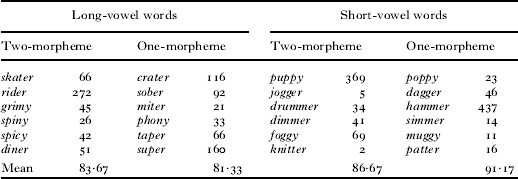
Great care and attention was given to the appropriate selection of target words because interpretable results depend crucially on the choice of stimuli. The application of the selection criteria outlined below severely limited the available words, particularly in ensuring that these had frequencies at the grade two level. We were able to select 12 bisyllabic words with long vowels and 12 with short vowels, requiring singlets and doublets, respectively, that met all of our criteria and for which we could balance critical dimensions. Six of each of the sets of 12 items were two-morpheme words made up of a root and the suffix -er or -y and the other 6 were one-morpheme words, which had no such root. All 24 items are listed in the Appendix.
We ensured that the average frequency of the items was similar across conditions. We obtained the word frequencies at grade two from a children's frequency database (Zeno, Reference Zeno1995). Frequencies for each target word and mean frequencies for the conditions are listed in the Appendix. We conducted a two-way analysis of variance (ANOVA) with Vowel Quality (Long and Short) and Number of Morphemes (One- or Two-morpheme) as independent variables with the frequency data. This analysis showed that the average frequencies did not differ across the four sets of words (ps>0·89). Similarly, the frequency of the smaller word contained within the target words did not vary across conditions (ps>0·69).
It was also important to balance the frequency with which the medial consonants in the two- and one-morpheme words appear as singlets or as doublets. This is important as we do not want differences in the frequency of a consonant occurring as a singlet or doublet to obscure differences between our conditions of interest. We accomplished this for the word-medial doublets by choosing two- and one-morpheme words with precisely the same word-medial consonants (e.g. knitter and patter; see Appendix). Given the other important constraints on word selection, it was not possible to do so for the singlet items. Instead, we ensured that the word-medial singlets had similar frequencies of occurrence in that position (e.g. in fourth position in a six-letter word for t in crater). Analyses of the frequencies obtained from Solso (Reference Solso1979) and Solso & King (Reference Solso and King1976) indicated that the word-medial letters in the two conditions occurred at similar rates of frequency (p=0·43). We also examined frequencies from Dewey (Reference Dewey1970) of the spelling of the singlet for that specific sound in English in word-medial position across all words (e.g. /t/ represented with a single t in the middle of a word). These were similar across the two conditions (p=0·66). To summarize, the frequency of the consonant as a doublet in word-medial position was controlled across the one- and two-morpheme items by choosing words with precisely the same word-medial consonant for the two conditions and the frequency of the consonant as a singlet was controlled by ensuring that ratings of the frequency with which that specific consonant occurs in word-medial position as a singlet were similar across the two- and one-morpheme conditions.
Procedure
Test administration occurred in the children's classrooms. Children for whom we had consent completed the spelling task, while the remainder did silent reading. The number of participants completing the spelling task varied between 15 and 20 children at a time, depending on the number returning consent forms. We placed two-foot tall dividers on the desk of each child so that they could not see one another's work. One experimenter directed the tasks while two other assistants roamed the classroom. Their primary task was to ensure that the children remained focused and that they were on the correct item.
The words were presented orally by the experimenter, who said the word, read it in a sentence, and then repeated the word again. For example, the experimenter said, ‘Simmer. The soup was left to simmer. Simmer.’ The child's task was to write the whole word on the line provided. The children were given two practice items prior to beginning the experimental task. The experimenter moved on to the next word only once all of the children in the group were finished writing. Before proceeding to the next item, the experimenter assured that everyone was ready by saying, ‘Now, put your finger on … ’ and then stating the number of the next item. The children were given small breaks every 8 items. The 24 items were presented in two randomized orders (Word Order A and B). These were presented so that half of the children had Word Order A and the other half had Word Order B.
RESULTS
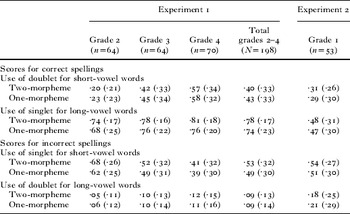
Children's representation of the word-medial consonant was coded as use of a singlet or doublet. In either case, we counted the number of consonants used only when the correct letter was chosen (e.g. tt or t for the items knitter and patter). These data are presented in Table 1. Reliability, calculated through inter-item correlations, of the task was good (alpha=0·84). We examined the data for outliers and for normality within performance on our experimental task. There was significant positive skew for the two- and one-morpheme doublet conditions at grade two and there was significant negative skew for the two- and one-morpheme singlet conditions at each grade. Inspection of the data identified outliers. We applied Winsorizing techniques to the identified outliers to ensure that all data were included in the analysis without giving outliers undue influence (Howell, Reference Howell1992). We report solely on analyses by participants given concerns that analyses by items are inappropriate in studies in which items are purposefully chosen to match for specific conditions, thereby violating the principle of random assignment (Raaijmakers, Schrijnemakers & Gremmen, Reference Raaijmakers, Schrijnemakers and Gremmen1999).
Proportion of correct and incorrect spellings (out of 6) of the one- and two-morpheme items for both the long- and short-vowel words (standard deviations are in parentheses)

To examine the impact of the context in which children spelled, an ANOVA was constructed with the two within-subjects factors of Vowel Quality (Long or Short) and Number of Morphemes (One- or Two-morpheme), and one between-subjects factor of Grade (2, 3 or 4). The outcome measure was accuracy, specifically use of a doublet for the short-vowel words and a singlet for the long-vowel words. Here, and in other analyses, we report measures of effect size with partial η2 for the results of the ANOVAs. For comparisons between two means we also report Cohen's d as it includes guidelines as to the relative size of an effect (e.g. small, medium or large; Cohen, Reference Cohen1988).
There was a main effect of Vowel Quality (F(1, 195)=221·765, p<0·001, partial η2=0·53), reflecting that accuracy was higher for the singlet than doublet words (d=1·26). This reflects the tendency to use singlets over doublets, given that singlets were correct for the long-vowel items and doublets were correct for the short-vowel words. This effect interacted with Grade (F(1, 195)=12·329, p<0·001, partial η2=0·11). There was greater accuracy for the long- than for the short-vowel words at grades 2 (t(63)=12·131, p<0·001), 3 (t(63)=7·439, p<0·001) and 4 (t(69)=13·064, p=0·002), with decreasing effect sizes by grade (d=2·04, 1·28 and 0·85, respectively).
There was no overall effect of Number of Morphemes (F(1, 195)=0·526, p=0·469, partial η2<0·01); however, there was a significant interaction between Vowel Quality and Number of Morphemes (F(1, 195)=13·173, p<0·001, partial η2=0·06). Post-hoc paired-sample t-tests of this interaction with Bonferroni corrections indicated that accuracy was higher for the two- than for the one-morpheme items for the long-vowel words (t(197)=2·799, p=0·006, d=0·21), and the opposite pattern occurred with the short vowel words (t(197)=2·543, p=0·012, d=0·08).
The finding above of lower accuracy for two- than for one-morpheme short-vowel items is likely due to greater use of a singlet (incorrectly) for the two- than for the one-morpheme items. To examine this possibility more directly, we conducted an analysis with the use of singlets as the dependent variable. Including both long- and short-vowel words will allow us to examine the possibility that children are using singlets more for long-vowel words than for short-vowel words, potentially reflecting the sensitivity to the impact of vowel quality on the number of consonants used.
We analyzed use of singlets with the within-subjects variables of Number of Morphemes (One- or Two-morpheme) and Vowel Quality (Long or Short) and the between-subjects factor of Grade (2, 3 or 4). This analysis revealed a significant effect of Number of Morphemes (F(1, 195)=15·315, p<0·001, partial η2=0·07) that did not interact with Grade (F(2, 195)=0·994, p=0·372, partial η2=0·01). The Number of Morphemes effect reflected greater use of singlets with two- than with one-morpheme items (d=0·16), and the absence of an interaction with Vowel Quality (F(1, 195)=0·020, p=0·888, partial η2<0·01) suggested that children did so regardless of the number of consonants required by the vowel context.
This analysis also revealed a main effect of Vowel Quality (F(1, 195)=122·597, p<0·001, partial η2=0·39, d=0·98) that interacted with Grade (F(2, 195)=19·713, p<0·001, partial η2=0·17). There was no significant difference between use of a singlet for the long- and short-vowel items at grade 2 (t(63)=1·398, n.s.). At grades 3 and 4, children were more likely to use a singlet for the long-vowel items than for those with short vowels (t(63)=6·161, p<0·001, d=1·07 and t(69)=9·882, p<0·001, d=1·65, respectively). This pattern suggests that only the oldest children are sensitive to the impact of vowel quality on the number of consonants chosen.
Discussion
This study was designed to examine whether grade two to four children's sensitivity to the impact of morphological structure on spelling might lead them to make mistakes, even when they can refer to a clear orthographic regularity. We did, indeed, find evidence of this effect; children were more likely to use a consonant singlet (just like in the root form) to spell two-morpheme words than they were for one-morpheme words, even in cases when this leads them to use an incorrect spelling (as was the case for the short-vowel words). To give an example, the children were more likely to use a single t in the two-morpheme word skater over its one-morpheme counterpart crater and in the two-morpheme word knitter over the one-morpheme counterpart patter. This is an interesting pattern in part because it means that the children were less accurate in spelling the medial consonant of words such as knitter.
Across all grades, there was sensitivity to a formal orthographic regularity; overall, children in grades two to four had a preference for singlets over doublets. By grade three, there was evidence of sensitivity to the functional orthographic regularity; children in grades three and four were more likely to use a singlet for bisyllabic words with long than with short vowels. To give an example, children in grades three and four were more likely to use a single t for words such as skater and crater than for words such as knitter and patter.
The pattern from this study is one in which we see sensitivity to a formal orthographic regularity and a functional morphological one across the grades tested (two to four). Sensitivity to the functional orthographic regularity does not appear to occur until grade three.
EXPERIMENT 2
We conducted a second study with younger writers, children in grade one, to examine the relative influence of morphological and orthographic sensitivities on children's early spellings. We used the same methodology as in Experiment 1, with the exception that we lowered task demands by reducing the amount that children were asked to spell. The findings of a recent study suggest that this methodological change is likely to lower task demands without unduly affecting results; Deacon (Reference Deacon2008) showed that the size of the morphemic effect (difference between spelling accuracy of two- and one-morpheme items) was similar regardless of whether children spelled the whole word or just the critical part. It is important to determine if younger children are sensitive to morphological information in a case where there are strong orthographic regularities, as was the case in our first experiment. This is especially essential given the relatively large effects of orthographic structure on grade two to four children's spellings uncovered in Experiment 1. It is also important given the current theoretical debates about the influences on young children's spelling (e.g. Nunes, Bryant & Bindman, Reference Nunes, Bryant and Bindman1997; Pacton & Deacon, Reference Pacton, Perruchet, Fayol and Cleeremans2008).
METHOD
Participants
A total of 53 children in grade one participated in this study with a mean age of 6 ; 10 (SD=4 months). The children completed the tasks in the spring of their first year of school, following approximately seven months of formal education.
Materials
We used the same words as in Experiment 1.
Procedure
In this experiment, we asked children to complete the letters for the missing word-medial consonant in the target words. The children were given the beginning and ending of the word, and asked to fill in the blank space (e.g. ska__er for skater). We provided two examples to ensure that children understood they could write one or two letters in the space provided. One example item had a word-medial singlet (baby) and the second example item had a word-medial doublet (apple). After the completion of each example, children's spellings were examined by an experimenter to ensure that the children understood the task. All other procedural details were as in Experiment 1.
RESULTS
The data were coded as in Experiment 1. Reliability of items for the doublet and the singlet conditions was reasonable (alpha=0·69). We examined the data for outliers and for normality. There were two outliers in one of the experimental conditions; we applied Winsorizing techniques to ensure that all data were included in the analysis without giving outliers undue influence (Howell, Reference Howell1992).
The scores for the correct use of singlets and doublets are presented in the upper part of the right-hand column of Table 1. The scores for incorrect spellings (specifically, doublets for singlets and singlets for doublets) are presented in the lower part of the right-hand column of the table.
The data were first analyzed with an ANOVA with the two within-subjects factors of Vowel Quality (Long or Short) and Number of Morphemes (One- or Two-morpheme) for which the outcome measure was accuracy, specifically use of a doublet when this was correct or a singlet when this was correct. In this analysis, there was a main effect of Vowel Quality (F(1, 52)=8·243, p=0·006, partial η2=0·14), reflecting that accuracy was higher for the long- than short-vowel words (d=0·62). As in Experiment 1, children appeared to be more likely to use singlets than doublets, reflected in higher accuracy scores for the long- than for the short-vowel words. There was no main effect of Number of Morphemes (F(1, 52)=0·283, p=0·597, partial η2<0·01) and no interaction between Vowel Quality and Number of Morphemes (F(1, 52)=0·526, p=0·815, partial η2<0·01).
As in Experiment 1, we conducted a second analysis of variance to examine the possibility that children used singlets more for long-vowel words than for short-vowel words. This analysis was conducted with use of singlets as the dependent measure and was constructed with the same within-subjects variables as the first analysis. There was no main effect of Number of Morphemes (F(1, 52)=0·682, p=0·413, partial η2=0·01) and no interaction between Vowel Quality and Number of Morphemes (F(1, 52)=0·340, p=0·562, partial η2<0·01). There was a trend towards an effect of Vowel Quality in which singlets were more likely to be used for short-vowel words than for long-vowel words. This effect did not achieve significance (F(1, 52)=3·319, p=0·074, partial η2=0·06).
DISCUSSION
This experiment was designed to examine the relative impacts of orthographic and morphological information on younger children's spelling. To summarize our findings, we saw orthographic effects on grade one children's spelling in that they were more likely to be accurate in spelling words with long vowels (requiring a singlet, such as skater or crater) than with short vowels (requiring a doublet, such as knitter or patter). This difference reflected young children's sensitivity to the formal properties of English in which singlets are more common than doublets, following on the findings of Cassar & Treiman (Reference Cassar and Treiman1997). In contrast to our results with older children in Experiment 1, there was no significant effect of vowel quality, nor did this variable interact with that of morphological structure. The absence of significant effects of these two functional variables suggests that grade one children do not demonstrate a robust sensitivity to the influence of long and short vowels on the number of consonants used to represent word-medial consonants. Similarly, the children did not appear to be sensitive to the morphological structure of the words that they spelled, at least not in a way that caused them to make mistakes in spelling words for which there were strong orthographic regularities. The results suggest that grade one children are sensitive to formal, but not functional, properties of print, at least for the specific orthographic and morphological features investigated here.
GENERAL DISCUSSION
We conducted two studies to examine children's spelling in situations when there are supporting and conflicting cues to the correct spelling. We contrasted sensitivity to orthographic patterns (specifically, both formal and functional regularities of double letters) and morphological regularities (specifically, the functional regularity that roots retain their spellings in related words). The two functional cues reinforce the same spelling (use of a singlet) in bisyllabic words with long vowels (such as skater). The two functional cues collide in bisyllabic words with short vowels (such as knitter). For these words, morphological regularities support the use of a single consonant (as in the root form) and orthographic regularities (specifically of the impact of vowel quality on the number of consonants) support the use of a consonant doublet. We were interested in whether children's sensitivity to orthographic regularities followed a pattern from formal to functional and whether children might demonstrate sensitivity to morphological regularities even when there are clear (and conflicting) orthographic considerations.
Beginning with the results from our youngest participants (grade one in Experiment 2), we found evidence of sensitivity to the formal regularity of the greater frequency of singlets over doublets in word-medial position. Accordingly, and in line with the findings of Cassar & Treiman (Reference Cassar and Treiman1997), children across grades one to four were more likely to be correct for the words requiring singlets than those requiring doublets. There was no evidence of sensitivity to either of the functional regularities examined in the grade one sample, either of the functional morphological or orthographic regularities around consonant doublets.
Turning to the next effect to emerge in our cross-grade comparison, we found evidence of children's sensitivity to the impact of morphological features on spelling by grade two. These emerged in a manner that increased children's accuracy in one case and decreased it in another. Across grades two to four, children were more likely to use a consonant singlet in the two- than in the one-morpheme words. The roots of all of the two-morpheme words (both those with long and short vowels) contained a single consonant (e.g. skate and knit), and so it seems that children's sensitivity to the similarity in spelling of roots and related forms led them to use a singlet. They did so both when this was correct (in the words with long vowels such as skater) and when this was incorrect (in words with short vowels such as knitter). The effect size for the difference between the two- and one-morpheme items was small, which is consistent with prior work (e.g. Deacon & Bryant, Reference Deacon and Bryant2006; Treiman & Cassar, Reference Treiman and Cassar1996). Our findings emerged in a paradigm in which there was close balancing between the one- and two-morpheme items in each of the conditions. As an example, the overall frequency of the one- and two-morpheme items in the short-vowel condition was balanced and the two word types contained precisely the same medial consonant and word-final sound (e.g. simmer and dimmer). Children, then, appear to be sensitive to functional regularities on the morphological level, even in cases when this conflicts with orthographic regularities.
By grade three, children demonstrated sensitivity to the role of vowel quality in determining the number of word-medial consonants. Children in grades three and four were more likely to use a singlet for bisyllabic words with long than with short vowels. This was a large effect, with a Cohen's d of greater than 1 in each grade. The late emergence of this orthographic regularity fits with its functional nature. It involves mapping a letter pattern (in this case a single or double consonant) with a sound (either a long or short vowel). It seems that children might demonstrate awareness of functional orthographic regularities somewhat later than formal orthographic regularities.
These findings extend prior research in several ways. There are certainly prior studies showing that children are sensitive to morphological regularities in spelling at a young age (e.g. Deacon & Bryant, Reference Deacon and Bryant2006; Treiman et al., Reference Treiman, Cassar and Zukowski1994). Our work follows on this by extending it to the examination of children's sensitivity to multiple dimensions in print (e.g. Pacton et al., Reference Pacton, Fayol and Perruchet2005). Our study is the first, to our knowledge, to elucidate what happens when these multiple regularities provide conflicting information. Our findings demonstrate that sensitivity to morphological dimensions can actually lead to incorrect spelling in a case in which sensitivity to orthographic dimensions would support correct spelling. As we noted earlier, studies manipulating a single variable at a time have been dominant to date, and we think that the results speak to the importance of examining sensitivities to several factors at once. This might be particularly useful in cases when these factors conflict, as in our study. Even though morphological sensitivity led children in grades two to four to make mistakes on words governed by orthographic regularities, the orthographic effects were consistently large (based on Cohen, Reference Cohen1988) across the grades tested in our study (as in Waters, Bruck & Malus-Abramovitz, Reference Waters, Bruck and Malus-Abramovitz1988). It seems that it takes some time for morphological sensitivity to emerge in a case where there are strong formal orthographic regularities.
Our finding of sensitivity to the role of vowel quality in determining the number of consonants at grade three is somewhat earlier than uncovered by Cassar & Treiman (Reference Cassar and Treiman1997). This is likely because of the use of real words in our study, in contrast to their use of non-words. Following on Cassar and Treiman, our findings suggest that there is development in children's sensitivities to orthographic structure across grades one to four. The movement from sensitivity to the frequency of consonant singlets and doublets in word-medial position to sensitivity to the relationship between vowel quality and number of consonants follows on the distinction between form and function drawn by Lehtonen & Bryant (Reference Lehtonen and Bryant2005). In that study, Finnish children demonstrated an appreciation of the legal position of doublets, prior to that of the function of the number of consonants in signalling vowel duration. Across orthographies then, it seems that there is cascading emergence of children's appreciation of orthographic regularities moving from formal to functional regularities.
Our results have several implications for models of spelling development. Traditional models of spelling have posited relatively late (age ~eight years) emergence of morphological and orthographic sensitivities as part of phase- or stage-like development (Ehri, Reference Ehri2005; Frith, Reference Frith, Patterson, Coltheart and Marshall1985; Nunes et al., Reference Nunes, Bryant and Bindman1997). Taken together, our data from two studies suggest that children are sensitive to formal orthographic regularities from an early age (six years) and that sensitivity to functional morphological and orthographic regularities emerge relatively soon thereafter (approximately ages seven and eight years, respectively). Such findings concur with more statistically driven models positing that even young children are sensitive to the regularities present in the input to which they are exposed (Deacon, Conrad & Pacton, Reference Deacon, Conrad and Pacton2008; Pacton & Deacon, Reference Pacton, Perruchet, Fayol and Cleeremans2008; Pollo, Treiman & Kessler, Reference Pollo, Treiman, Kessler, Grigorenko and Naples2008).
To move beyond the approach outlined above, our results suggest that not all regularities are created equally. Children demonstrate sensitivity to some aspects of orthographic regularities (specifically, the frequency of singlets over doublets) earlier than others (specifically, the function of doublets in signalling vowel quality). This difference in emergence is likely explicable by the complexity of the regularity; the first is based solely on the orthographic features of words, while the second is based on the connection between orthographic and phonological patterns (see, e.g., Henderson, Reference Henderson1985). Similarly, children's sensitivity to morphological regularities is not present at an early age in all cases (see also Deacon & Bryant, Reference Deacon and Bryant2005; Nunes et al., Reference Nunes, Bryant and Bindman1997). The emergence of the impact of morphological consistency on children's spelling likely requires children's sensitivity to the phonological, orthographic and semantic similarities between words (such as between the sounds, letters and meanings present in the words skate and skater). Sensitivity to morphological consistency might not emerge in children's earliest spellings in cases when this regularity conflicts with a simpler and perhaps more frequent regularity (such as the orthographic features examined here). Only after some time does the regularity based on three dimensions emerge in children's spelling of words for which spellings can also be generated based on fewer dimensions. Experimental research could benefit from the quantification of the occurrence of different formal and functional regularities (whether these are orthographic or morphological). It would be useful to know, for example, how often medial consonants in bisyllabic words with long and short vowels double. We might also want to know whether these frequencies differ for one- and two-morpheme words. This information would help us to contrast the effects of frequency with those of the number of bases of regularities. Such future research would help to determine the mechanisms that underlie children's growing sensitivities to the many regularities that connect oral to written language.
There are several ways in which we hope that future research can build on our findings here. As is common in spelling research (e.g. Read, Reference Read1986; Treiman & Cassar, Reference Treiman and Cassar1996), we used real words in this study as the simplest and perhaps most effective way of manipulating morphological structure. Earlier research concentrating specifically on the acquisition of orthographic regularities has used non-words (e.g. Cassar & Treiman, Reference Cassar and Treiman1997). Innovative future studies might be able to manipulate the putative morphological structure of non-words (as in Kemp, Reference Kemp2006). That said, the items selected for the present work reflect tight balancing on the frequency of the target word itself, of the smaller word within the target word and of the consonant doubling. Accordingly, they permit us to draw our conclusions with some degree of confidence. On another front, we might consider why there were more indeterminate responses, coded as neither singlet or doublet, for the long vowel than for the short vowel condition.Footnote 1 On revisiting our items, we noticed that there were more words with consonants that might be considered to be challenging in the long-vowel than in the short-vowel condition. Specifically, we considered two potentially challenging consonants: word-medial t which would be pronounced as a flap in bisyllabic words and the sound /s/ for which the most common spelling would be s not c, as in the word spicy. The greater presence of these difficult consonants likely led to the greater number of indeterminate responses in the long-vowel condition; some support for this came from the fact that many students used the letter d rather than t to spell the flap (following on Treiman et al., Reference Treiman, Cassar and Zukowski1994). Nevertheless, we do not think that it is likely that this affected our pattern of results. Such ‘difficult’ consonants occurred equally across the two- and one-morpheme conditions, which was the critical contrast. And accuracy was in fact higher for the long- than for the short-vowel items, despite the inclusion of potentially more difficult consonants in the long-vowel condition. Nevertheless, we think that such consonant-specific effects are worthy of further investigation, as is the extension to additional methodologies and suffixes.
All such studies need to be conducted with a wide age range of children, given the suggestions of developmental changes uncovered here. Such studies might attempt to use the same methodology across younger and older children. In our study, we lowered task demands for the younger children by asking them to spell just the critical segment of each word, and so we should be cautious in drawing comparative conclusions across the ages studied. That said, we have good reason to suspect that differences in task demands are unlikely to account for the age-based differences; prior studies have shown consistent morphological effects across studies that vary task demands (e.g. Deacon, Reference Deacon2008; Treiman & Cassar, Reference Treiman and Cassar1996).
In conclusion, this study demonstrates that children extract multiple regularities from the complex print system of English to which they are exposed. The regularities to which they are sensitive change across the first few years of learning to spell. Across grades one to four, we see robust evidence of sensitivity to orthographic regularities in print, beginning with formal regularities at grade one and turning to functional ones by grade three (roughly six and eight years of age, respectively). Perhaps most intriguingly, by grade two (around seven years), children's sensitivity to morphological dimensions of words emerges in a manner that both supports and interferes with accurate spelling. Taken together, these experiments suggest that children are sensitive to the multiple cues that guide the spelling of words in English, even in cases when these collide.
APPENDIX
Two- and One-morpheme words with long and short vowels with grade two frequencies (Zeno, Reference Zeno1995)