As a critical technique for firms to explore new competence and simultaneously exploit existing competence (Gibson & Birkinshaw, Reference Gibson and Birkinshaw2004; Raisch, Birkinshaw, Probst, & Tushman, Reference Raisch, Birkinshaw, Probst and Tushman2009), organizational ambidexterity has drawn an increasing amount of attention from both practitioners and researchers. Solid empirical evidence of its salutary effects on organizational performance and long-term survival has been found (He & Wong, Reference He and Wong2004; Raisch & Birkinshaw, Reference Raisch and Birkinshaw2008; Cao, Gedajlovic, & Zhang, Reference Cameron and Quinn2009). Most of those empirical studies have analyzed the benefits of an ambidextrous organization (AO) from the perspectives of managerial economics (He & Wong, Reference He and Wong2004), organization theory (Adler, Goldoftas, & Levine, Reference Adler, Goldoftas and Levine1999; Benner & Tushman, Reference Benner and Tushman2003), and strategic management (Smith & Tushman, Reference Smircich2005; Jansen, Tempelaar, van den Bosch, & Volberda, Reference Jansen, Tempelaar, van den Bosch and Volberda2009). However , there has been scant research that examined the cultural perspective of AO, although scholars have suggested that ambidextrous organizational culture (AOC) is the core of AOs (Adler, Goldoftas, & Levine, Reference Adler, Goldoftas and Levine1999; Gibson & Birkinshaw, Reference Gibson and Birkinshaw2004; Wang & Rafiq, Reference Wang and Rafiq2014).
An AOC is an organizational culture that possesses the characteristics of organizational ambidexterity in that it is suitable for both exploitative activities and exploratory activities (Gibson & Birkinshaw, Reference Gibson and Birkinshaw2004). The set of underlying values, beliefs, and principles that serve as the foundation for an organization’s systems and management practices (Denison, Reference Denison1990: 2), organizational culture permeates every aspect of an organization and reflects the organization’s essence, or DNA, in the present and the future (Barrett, Reference Baron and Kenny2008: 6). An organization’s culture also significantly influences the values, standards, and behaviors of its employees (Hartnell, Ou, & Kinicki, Reference Hartnell, Ou and Kinicki2011). Although some studies (e.g., Simsek, Heavey, Veiga, & Souder, Reference Smith and Tushman2009) have emphasized the importance of organizational culture in an AO, only a handful of studies (Gibson & Birkinshaw, Reference Gibson and Birkinshaw2004; Wang & Rafiq, Reference Wang and Rafiq2014) have empirically examined the effects of AOC.
To fill that gap, this study intends to investigate the cross-level effects of an AOC on individual employees’ job performance. Building on previous studies (Junni, Sarala, Taras, & Tarba, Reference Junni, Sarala, Taras and Tarba2013) that have shown the effects of AOC on organizational performance, we focus on the role of AOC in affecting individuals’ attitudes and behaviors. In other words, previous studies analyzed the effect of AOC on the organization, but we analyze the effect of AOC on individuals. Individuals are those who create that organizational-level performance, and by looking at the cross-level impact of AOC on individuals we can identify multilevel process of ambidexterity extending the research on AO. Also in the previous organizational culture research, culture itself was measured as individual-level perception of organizational culture as it is difficult to collect organization-level data. In the current research, we have the organization-level culture data across different organizations, which enabled us to rigorously test the cross-level effects of AOC on individuals. Toward this end, we empirically explore how an AOC with two distinctive characteristics affects individual employees’ job performance.
Second, in this study we explore the relationship between AOC and individual positive psychological capital (PsyCap). Over the last few decades, PsyCap has gained remarkable attention in the field of organizational behavior, because it can be altered and developed by experience, education, and environment (Luthans, Reference Luthans2002; Luthans, Avolio, Avey, & Norman, Reference Luthans, Avolio, Avey and Norman2007; Luthans & Youssef, Reference Luthans and Youssef2007). This study intends to identify AOC as one of important contextual factors that enhance organizational members’ PsyCap.
In addition, we examine the mediating role of PsyCap in the relationship between AOC and employees’ job performance. Although previous research on AO has shown the direct effects of AO on the organization’s performance, we know very little about the mechanism by which AO positively affects the organization. By incorporating PsyCap as a cross-level mediating mechanism between an AOC and employees’ job performance, we aim to extend the existing knowledge of AO.
THEORETICAL BACKGROUND AND HYPOTHESES
AOC can be defined as a set of shared, taken-for-granted implicit assumptions, held by an organization, related to its ability to succeed in both exploitation activities and exploration activities. In research on organizational ambidexterity, exploitation is associated with efficiency and productivity by the use of existing solutions or solutions similar to existing ones (Hughes, Hughesw, & Morganz, Reference Hughes, Hughesw and Morganz2007). Exploitation facilitates learning through refinement of knowledge and generates moderate but certain and immediate returns (Hughes, Hughesw, & Morganz, Reference Hughes, Hughesw and Morganz2007). Thus, exploitation is related to the alignment mechanism (McGrath, Reference McGrath2001), such that the members of an organization that has a high degree of alignment efficiently coordinate and collaborate with one another to achieve an objective.
Conversely, exploration promotes learning through the creation of knowledge and generates potentially high but uncertain returns (Hughes, Hughesw, & Morganz, Reference Hughes, Hughesw and Morganz2007). Exploration includes concepts such as search, variation, risk taking, experimentation, play, flexibility, discovery, and innovation (March, Reference March1991). With regard to exploratory activities, it is important for the members of the organization to use adaptability mechanisms to proactively cope with and adjust to the demands within the organization (Gibson & Birkinshaw, Reference Gibson and Birkinshaw2004).
AOC includes values and assumptions for both exploitation and exploration, as a culture possessing the characteristics of an AO. These values can be further explained by the Competing Values Framework (CVF) developed by Cameron and Quinn (Reference Cao, Gedajlovic and Zhang2011). The CVF is recognized as a useful tool because it is relatively simple and more comprehensive than other models that describe organizational cultures (Hartnell, Ou, & Kinicki, Reference Hartnell, Ou and Kinicki2011). It incorporates two axes (flexibility-control and internal-external) such that each of the four quadrants represents a type of organizational culture: an adhocracy culture that highlights flexibility and externality, a clan culture that emphasizes flexibility and internality, a market culture that stresses control and externality, and a hierarchy culture that focuses on control and internality (Quinn & Rohrbaugh, Reference Quinn and Rohrbaugh1983; Hooijberg & Petrock, Reference Hooijberg and Petrock1993; Goodman, Zammuto, & Gifford, Reference Goodman, Zammuto and Gifford2001; Cameron & Quinn, Reference Cao, Gedajlovic and Zhang2011; Hartnell, Ou, & Kinicki, Reference Hartnell, Ou and Kinicki2011; Leung & Chaturvedi, Reference Leung and Chaturvedi2011).
Using the dimensions from the CVF, AOC’s exploitative and exploratory nature can be examined further (Cho & Huh, Reference Cho and Huh2013; Chang, Reference Chang2014). An exploitation-oriented organizational culture maintains, repairs, and fortifies the organization’s current business activities, mainly by focusing on hierarchy and discipline as means to achieve effectively achieve goals. This approach is consistent with the characteristics of market culture and hierarchy culture, both of which emphasize high levels of control for achieving organizational goals (Quinn & Rohrbaugh, Reference Quinn and Rohrbaugh1983; Cameron & Quinn, Reference Cao, Gedajlovic and Zhang2011).
In contrast, an exploration-oriented organization emphasizes new ventures, innovation, aggressive external interactions, autonomy, horizontal relationships among employees, and flexibility (Chang, Reference Chang2014).These characteristics are associated with Cameron and Quinn’s (Reference Cao, Gedajlovic and Zhang2011) adhocracy culture and clan culture, both of which emphasize flexibility (Chang, Reference Chang2014). An adhocracy culture is characterized by flexible creation of new things that are suitable for the external environment; thus, it facilitates the development of new products and services and prepares the organization for the uncertainties of the future (Cameron & Quinn, Reference Cao, Gedajlovic and Zhang2011). A clan culture also emphasizes flexibility, but it focuses more on the organization’s internal environment (Quinn & Rohrbaugh, Reference Quinn and Rohrbaugh1983; Cameron & Quinn, Reference Cao, Gedajlovic and Zhang2011). Because a clan culture is consistent with adaptively coping with internal problems rather than addressing problems of the external environment (Quinn & Rohrbaugh, Reference Quinn and Rohrbaugh1983; Cameron & Quinn, Reference Cao, Gedajlovic and Zhang2011), it emphasizes participation, cooperation, and teamwork (Quinn & Rohrbaugh, Reference Quinn and Rohrbaugh1983; Cameron and Quinn, Reference Cao, Gedajlovic and Zhang2011), which are the main characteristics of an exploratory culture.
Because AOC is an organizational culture in which two distinctive cultures (exploitative and exploratory) are integrated in one organization, its measurement depends on whether the focus of attention is the balance between the two cultures or the synergistic effect of both cultures operating optimally. The former considers an AOC to have a difference score, which measures a culture’s difference between being exploitative and being exploratory, of approximately zero (He & Wong, Reference He and Wong2004); the latter either adds (Jansen et al., Reference Jansen, Tempelaar, van den Bosch and Volberda2009) or multiplies (Gibson & Birkinshaw, Reference Gibson and Birkinshaw2004) the difference score for the exploitative culture and the difference score for the exploratory culture to measure the AOC, so that a strong AOC must have both a strong exploitative culture and a strong exploratory culture. In this study, we follow the latter measurement approach and use the measures from the CVF to identify the degree of AOC present in an organization.
The effects of AOC on employees’ job performance
Previous studies of AO have consistently shown that it positively affects an organization’s performance and innovation (Junni et al., Reference Junni, Sarala, Taras and Tarba2013). According to Junni et al.’s (Reference Junni, Sarala, Taras and Tarba2013) meta-analysis, ~130 studies have found that an organization’s ambidexterity has favorable effects on its sales growth (He & Wong, Reference He and Wong2004), business unit performance (Gibson & Birkinshaw, Reference Gibson and Birkinshaw2004), and firm growth (Beckman, Reference Beckman2006). Most of these analyzed these measures at an organizational level, using the entire organization, its business departments, or its partnerships with other organizations as the unit. Therefore, the positive effects of ambidexterity on the organization per se has been found to be robust, but relatively little attention has been given to the meso-level or microlevel and the question of how an AOC affects the members of the organization.
Therefore, in this study, we consider how an AOC affects the performance of the organization’s members. Organization culture is widely believed to be linked to employee and organizational performance (Deal & Kennedy, Reference Deal and Kennedy1982; Edgar, Gray, Browning, & Dwyer, Reference Edgar, Gray, Browning and Dwyer2014). In particular, culture is likely to be an important driver of performance in recent organizations offering professional and business services (Edgar et al., Reference Edgar, Gray, Browning and Dwyer2014). An AOC possesses ambivalent – simultaneous and contradictory – characteristics. Because an organizational culture is the system of perception, symbolism, and meaning, held by the members of the organization (Smircich, Reference Simsek, Heavey, Veiga and Souder1983), that leads to shared technology, beliefs, assumptions, methods, and systems (Avey, Reichard, Luthans, & Mhatre, Reference Avey, Reichard, Luthans and Mhatre2011), we can infer that the members of an organization that has an AOC carry beliefs, values, principles, and codes of conduct related to both exploitative culture and exploratory culture.
The effects of an AOC having characteristics of both exploratory and exploitative culture can be explained by the information and decision-making theory (Williams & O’Reilly, Reference Williams and O’Reilly1998). This theory elucidates the positive aspects of diversity, suggesting that diverse values, backgrounds, technologies, and professionalism expand the scopes of knowledge, insights, and ideas and constitute the key ingredients in developing a new strategy or solution (Williams & O’Reilly, Reference Williams and O’Reilly1998). In the context of AOC, the diverse beliefs, values, principles, and codes of conduct of two conflicting cultures can exist concurrently. This coexistence equips the AO’s members with the capacity to make breakthroughs when faced with grave difficulties, by adapting their behavior to the specific situation. These breakthroughs can lead to successful outcomes. Recently, based on a large sample of empirical data, Wang and Rafiq (Reference Wang and Rafiq2014) found that AOC, which is characterized by organizational diversity, has a statistically significant positive effect on the outcome of new product innovation.
Therefore, based on theoretical and empirical evidence, we predict that individuals who work in a strong AOC, which has characteristics of both a strong exploratory culture and a strong exploitative culture, will perform better, by use of full range of exploitative and exploratory traits, than will employees who work in other types of organization cultures.
Hypothesis 1: AOC has a positive effect on the job performance of the organization’s individual employees.
The effects of AOC on positive PsyCap
The researchers who developed the concepts of organizational ambidexterity contended that ambidexterity was not limited to managerial activity but rather extended to capability (Turner, Swart, & Maylor, Reference Turner, Swart and Maylor2013). In other words, ambidexterity is not about performing two different tasks by using diverse behavioral methods; rather, it is the capacity to integrate and apply various characteristics in order to fulfill two contrasting goals. Because AOC has future-oriented and positive characteristics, such as challenge, creativity, and innovation, as well as supportive features, such as cooperation, support, and sharing, individuals who work in an AOC are likely to appreciate those characteristics. Organizational cultures are naturally formed through the continuous interaction members (Jung, Nam, Lee, & Kim, Reference Jung, Nam, Lee and Kim2016), which in turn influence members in organization.
PsyCap is composed of four positive psychological attributes: self-efficacy, optimism, hope, and resiliency (Newman, Ucbasara, Zhu, & Hirst, Reference Newman, Ucbasaran, Zhu and Hirst2014). As an individual’s psychological state of development, PsyCap has attracted great attention from both practitioners and researchers (e.g., Combs, Milosevic, Jeung, & Griffith, Reference Combs, Milosevic, Jeung and Griffith2011; Avey et al., Reference Avey, Reichard, Luthans and Mhatre2011). However, some scholars have argued that there is less research on the drivers of PsyCap than on the results of PsyCap. For example, Avey (Reference Avey2014) suggested that more studies are needed to identify factors that lead to or inhibit the formation of PsyCap, because PsyCap can contribute to the development and reinforcement of individuals’ positive traits. Toward this end, by focusing this study on the positive cross-level effects of AOC on individual employees’ PsyCap, we aim to identify AOC as a contextual antecedent of PsyCap at the organizational level.
AOC can help to create ideas for employee behavior that forms the distinctive foundation of an AO. Moreover, it can propagate positive viewpoints by promoting confidence in individuals’ capabilities and enhancing resiliency through learning. Previous research found that personality traits, such as proactivity (Avey, Reference Avey2014), authentic leadership ability (Clapp-Smith, Vogelgesang, & Avey, Reference Clapp-Smith, Vogelgesang and Avey2009), and transformation leadership ability (Gooty, Gavin, Johnson, Frazier, & Snow, Reference Gooty, Gavin, Johnson, Frazier and Snow2009), as well as supportive organizational climate (Luthans, Norman, Avolio, & Avey, Reference Luthans, Norman, Avolio and Avey2008) can contribute to the development and enhancement of individuals’ PsyCap. These antecedents share common positive aspects and can support an individual’s development by stimulating his or her psychological state. Based on prior findings, this study starts with the assumption that the AOC can help to facilitate PsyCap with efficacy, resiliency, optimism, and hope. With these underpinnings, we hypothesize the following relationship between AOC and PsyCap:
Hypothesis 2: An AOC positively affects the PsyCap of the organization’s employees.
The effects of positive PsyCap on employees’ job performance
Since the introduction of the constructs and measurement methods in terms of PsyCap by Luthans et al. in the early 2000s (e.g., Luthans, Reference Luthans2002; Luthans, Avey, Avolio, Norman, & Combs, Reference Luthans, Avey, Avolio, Norman and Combs2006), many studies have investigated the relationship between PsyCap and individual employees’ attitudes, behavior, and performance (Avey, Luthans, & Youssef, Reference Avey, Luthans and Youssef2010; Avey et al., Reference Avey, Reichard, Luthans and Mhatre2011). Most notably, there is growing evidence that PsyCap influences individual employees’ job performance (Avey et al., Reference Avey, Reichard, Luthans and Mhatre2011) across different national cultures (Lee & Choi, Reference Lee and Choi2010; Sun, Zhao, Yang, & Fan, Reference Sun, Zhao, Yang and Fan2012).
PsyCap has been found to be positively related to multiple types of job performance (e.g., Avey, Nimnicht, & Pigeon, Reference Avey, Nimnicht and Pigeon2010). Avey, Luthans, and Youssef (Reference Avey, Luthans and Youssef2010) found a positive relationship between PsyCap and both the financial performance and the manager-rated performance of employees in the financial services industry. Peterson, Luthans, Avolio, Walumbwa, and Zhang (Reference Peterson, Luthans, Avolio, Walumbwa and Zhang2011) reported that employee PsyCap is positively associated with both supervisor-rated performance and financial performance as measured by sales. Accordingly, PsyCap’s four attributes (self-efficacy, hope, optimism, and resiliency) can facilitate the motivation for intentional behavior so that employees complete tasks and accomplish goals. Based on the above-mentioned theoretical and empirical evidence, we propose the following hypothesis:
Hypothesis 3: PsyCap has a positive effect on self-perceived job performance of the organization’s employees.
The mediating effects of positive PsyCap
We also propose that there PsyCap serves as a mediating mechanism in the relationship between AOC and job performance. According to Schein (Reference Schein1990), organizational culture is expressed through various forms including symbols, institutions, norms, and leadership, which in turn affect its members. We bring Social Information Processing Theory here to link these expressions of organizational culture and individuals’ PsyCap. The social information processing and social cognitive perspectives argue that ‘individuals, as adaptive organisms, adapt attitudes, behavior, and beliefs to their social context’ (Salancik & Pfeffer Reference Salancik and Pfeffer1978: 226). As a result, organizational members process information from their social environment, and through that process, their cognitive attitude and behaviors are formed (Salancik & Pfeffer, Reference Salancik and Pfeffer1978). Therefore, various elements of organizational culture are perceived and processed as important social information by organizational members, followed by their attitudes and behaviors.
In this process, the current study focus on the positive effect of the AOC on self-efficacy, optimism, hope, and resiliency, represented as individual PsyCap that leads to better performance. Based on the information and decision-making theory (Williams & O’Reilly, Reference Williams and O’Reilly1998), suggesting that diverse values, backgrounds, technologies, and professionalism expand the scopes of knowledge, insights, and ideas and constitute the key ingredients in developing a new strategy or solution, we hypothesized the positive effects of AOC on employees’ PsyCap and job performance, PsyCap is an important mechanism linking AOC and job performance. As previously mentioned, an AOC is defined as the set of values and behaviors that enable the organization to tackle and solve various new problems, crises, and difficulties by the use of diverse methods (Gibson & Birkinshaw, Reference Gibson and Birkinshaw2004; He & Wong, Reference He and Wong2004; Junni et al., Reference Junni, Sarala, Taras and Tarba2013). Employees’ job performance is the result of the AOC, reflecting employees’ belief in their own abilities. When employees perceive that their organization is equipped with such capacity of the AOC, their PsyCap improves, and which in turn motivates and facilitates their job performance.
PsyCap has been shown to be an important mediator in the relationships between an organization’s contextual factors and its members’ attitudes and behaviors (e.g., Luthans et al., Reference Luthans, Norman, Avolio and Avey2008; Gooty et al., Reference Gooty, Gavin, Johnson, Frazier and Snow2009; Rego, Sousa, Marques, & Cunha, Reference Rego, Sousa, Marques and Cunha2012). For example, PsyCap mediates the relationships between a supportive organizational climate and the organization’s employees’ outcomes such as performance and satisfaction (Luthans et al., Reference Luthans, Norman, Avolio and Avey2008), between transformational leadership and behaviors (Gooty et al., Reference Gooty, Gavin, Johnson, Frazier and Snow2009) and between authentic leadership ability and creativity (Rego et al., Reference Rego, Sousa, Marques and Cunha2012).
Hackman (Reference Hackman1992) referred to high-order contextual factors as ambient stimuli that affect the individual, because they are not targeted to a specific subject but rather are part of the environment to which all the employees of an organization are equally exposed. Organizational context is the most representative ambient stimulus, because it can alter employees’ attitudes and behaviors widely and in various ways from their mind-sets and values. According to a recent empirical study by Luthans et al. (Reference Luthans, Norman, Avolio and Avey2008), PsyCap plays a mediating role in the relationship between a supportive organizational climate and employees’ job performance, indicating that PsyCap is the mechanism by which contextual factors affect employees’ attitudes. With these underpinnings, we propose the following hypothesis:
Hypothesis 4: PsyCap mediates the relationship between AOC and employees’ job performance.
METHODS
Sample and procedure
The sample for this study comes from about 50 companies in South Korea. The current data were collected as a part of larger survey research focusing on the job satisfaction according to the organizational size. Therefore, the sample organizations were selected based on their size (large >1,000 employees, medium, small <100 employees), while industry type was randomly selected. We initially distributed 1,000 survey questionnaires, of which 857 were returned (85.7% response rate). After eliminating incomplete responses, the final sample consisted of 758 employees from 42 organizations (75.8%). In terms of organizational size, 18 organizations were large (individual N=280, 36.8%), while 16 companies were medium-sized (individual N=240, 31.7%) and six companies were categorized as small (individual N=238, 31.4%). The number of respondents from each organization ranged from 8 to 58, with a mean of 19.4 (SD=12.07). In addition, about half of the final sample was male (53.3%). Participants varied in age: 28.8%were in their 20s, 23.5% were in their 30s, 21.4% were in their 40s, 21.4% were in their 50s, and 5.03% were in their 60s. The majority have bachelor’s degrees. Participants come from a wide range of industries, including manufacturing, service, information and technology, construction, and finance.
Measures
We measured all of the variables (except control variables, which are categorical variables) using the 5-point Likert scale.
AOC
In order to measure the degree of AOC, we followed two steps. First, we measured organizational culture based on CVF developed by Kalliath, Bluedorn, and Strube (Reference Kalliath, Bluedorn and Strube1999). The original instrument was developed by Quinn and Spreitzer (Reference Quinn, Spreitzer, Woodman and Pasmore1991) and it contained 16 items, four items per subscale. Kalliath, Bluedorn, and Strube (Reference Kalliath, Bluedorn and Strube1999) modified this by adding additional four items for each subscale, resulting in 32 items in total. Considering the full-length of the survey, we selected five items out of eight for each subscale, resulting in 20 items in total and this short-form of the scale was examined by exploratory that yielded a stable factor structure of the original scale. Furthermore, we conducted confirmatory factor analysis (CFA) to verify the factor structure of organizational cultures. The factor loadings ranged from 0.65 to 0.95, and the model of organizational cultures based on its four components had a high goodness of fit indices (χ2=1,508.864 with df=164, Bentler’s comparative fit index (CFI)=0.89, Tucker-Lewis Index (TLI)=0.82, root mean square error of approximation (RMSEA)=0.09, and standardized root mean square residual (SRMR) =0.04), which supported the higher-order factor structure of organizational cultures. The reliability of organization culture was 0.88 for adhocracy culture, 0.89 for clan culture, 0.81 for hierarchy culture, and 0.81 for market culture.
Second, we categorized hierarchy cultures and market cultures as exploitative cultures and adhocracy cultures and clan cultures as exploratory cultures and then, for each organization we used the sum of hierarchy and market culture scores as the score for the exploitative culture, and the sum of adhocracy and clan culture as the score for the exploratory cultures. In order to construct the AOC measure, we multiplied the score for the exploitative culture by the score for the exploratory culture for each organization. In this way, we could capture the ambidextrous potential of organizational culture more than alternatives such as the simple addition of all four culture scores or categorization of high versus low AOC culture, consistent with the method adopted by Wang and Rafiq (Reference Wang and Rafiq2014).
PsyCap
We assessed 24-items the Psychological Capital Questionnaire developed by Luthans et al. (Reference Luthans, Avolio, Avey and Norman2007) to measure PsyCap. We analyzed our data using exploratory factor analysis with varimax rotation, and items with factor loading higher than 0.60 were selected for the further analysis. As a results, three items for each subdimension except for the optimism that remained four items. We conducted CFA to verify the factor structure of PsyCap and we adopted a 3-item scale to measure each component of PsyCap as it yielded a better fit than the model with optimism with four items. First, we conducted the CFA of single-factor model (χ2=11, df=166, CFI=0.738, TLI=0.680, RMSEA=0.116) and compared CFA of single-factor model to CFA of four-factor model. The model of PsyCap based on its four components had a high goodness of fit indices (χ2=214.03 with df=50, CFI=0.94, TLI=0.93, RMSEA=0.06, and SRMR=0.04), which supported the higher-order factor structure of PsyCap. The reliability of the measures of those components was 0.76 for optimism, 0.70 for resiliency, 0.72 for efficacy, and 0.82 for hope. The reliability of the measure of total PsyCap was 0.86. The factor loadings ranged from 0.65 to 0.95, indicating that they have statistically significant relationships with PsyCap.
Job performance
We used a 5-item scale, based on those developed by Williams and Anderson (Reference Williams and Anderson1991) and Yang, Mossholder, and Peng (Reference Yang, Mossholder and Peng2009), to measure job performance. Examples of the items are ‘I perform my task well’ and ‘I fulfill my performance standard well.’ Cronbach’s α for the measure of job performance was 0.87.
Control variables
We controlled for demographic characteristics such as gender, age, education, and tenure, which are thought to influence employees’ job performance. In addition, we controlled for the size of the organization, by categorizing each organization as small, mid-size, or large, because the effect of an AOC on job performance and PsyCap may vary based on the size of the organization.
Analytic processes
We used SPSS 19 and Mplus 7 to conduct factor analysis and reliability tests and then examined our hypotheses by conducting a multilevel analysis. We took steps to mitigate threats of method effects following the suggestions by Conway and Lance (2010). Before conducting the multilevel analysis, we tested whether there is a common method variance problem in our data by conducting the Harman’s single-factor test, Bartlett test and Keiser-Meyer-Olkin (KMO) estimates for the individual-level data (Harman, Reference Harman1967; Podsakoff & Organ, Reference Podsakoff and Organ1986). The result of single-factor test using exploratory factor analysis yielded variance explained by the first factor is 24.5%, not so problematic to imply the existence of the common method variance. The result of Bartlett test was significant at the level of p<.001, and KMO test yielded 0.889 which is higher than 0.5, showing that our data is a good fit for further analysis.
In addition, we examined whether it was appropriate to aggregate individual-level measurements to the organizational level. Because organizational culture is the only organizational-level construct in this study, we examined the intraclass correlation coefficients (ICCs) and r wg (j) index of agreement of our measure of organizational culture. For an AOC, the ICC(1) was 0.21,the ICC(2) was 0.77, and the mean r wg was 0.94, all of which meet the threshold criteria. Hence, it is safe to say that individual measures of organizational culture can be aggregated to the organizational level. After reaching this conclusion, we performed the multilevel regression analysis (Raudenbush & Bryk, Reference Raudenbush and Bryk2000).
RESULTS
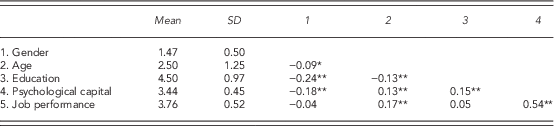
Tables 1 and 2 report the means, standard deviations of the variables, and correlations among them both at the individual employee level and the organizational level, respectively. As shown in Table 1, PsyCap is positively related to age (r=0.13, p<.001) and education (r=0.15, p<.001) and job performance is positively related to age (r=0.17, p<.001) and PsyCap (r=0.54, p<.001). As shown in Table 2, an AOC is negatively related to organization size (r=−0.22, p<.001) but positively related to average employee tenure (r=0.57, p<.001).
Means, standard deviations, and correlations (individual employee level)

Note. N=758.
*p<.01, **p<.001.
Means, standard deviations, and correlations (organizational level)

Note. N=42; organization size: 1=large company, 2=medium company, 3=small company.
AOC=ambidextrous organization culture.
*p<.01, **p<.001.
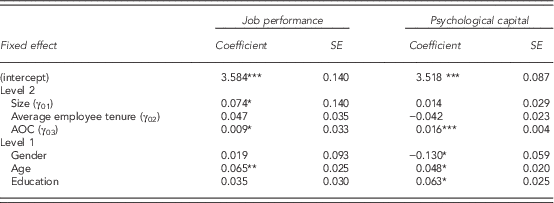
Hypothesis 1 states that AOC is positively related to employees’ job performance. As shown in Table 3, the effect of AOC on job performance is positive and statistically significant (r=0.009, p<.05). Thus, Hypothesis 1 is supported. Hypothesis 2 states that AOC is positively related to PsyCap. As shown in Table 3, the effect of AOC on PsyCap is positive and statistically significant (r=0.016, p<.001). Thus, Hypothesis 2 is supported.
Effects of an ambidextrous organizational culture (AOC) on employees’ job performance and psychological capital

Note. All variables were grand mean centered before the analyses.
Level 1=individual employee level; Level 2=organizational level.
N=758 participants from 42 organizations.
*p<.05, **p<.01, ***p<.01.
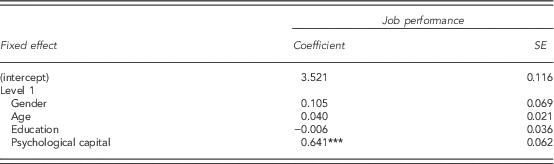
Hypothesis 3 states that PsyCap is positively related to employees’ job performance. As shown in Table 4, PsyCap has a positive effect on job performance (r=0.641, p<.001). Thus, Hypothesis 3 is supported.
Effects of psychological capital on employees’ job performance

Note. All variables were grand mean centered before the analyses.
*p<.05, **p<.01, ***p<.01.
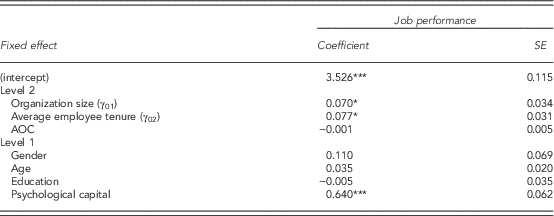
Hypothesis 4 states that PsyCap mediates the relationship between AOC and job performance. Following process from Baron and Kenny (Reference Barrett1986), as shown in Table 5, the effect of PsyCap on job performance is statistically significant when the effect of AOC on job performance is not statistically significant, which indicates that PsyCap completely mediates the effects of AOC on job performance. We also conducted the Sobel Test (Preacher & Hayes, Reference Preacher and Hayes2004) to further verify the mediating effects of PsyCap; the result (t=3.73, p<.001) supports Hypothesis 4.
Mediating effects of psychological capital on employees’ job performance

Note. AOC=ambidextrous organization culture.
*p<.05, **p<.01, ***p<.01.
CONCLUSION
The needs to adapt and change are two frequently recurring topics in the organizational survival (Vera & Crossan, Reference Vera and Crossan2004). In this study, we have suggested that these needs can be met by introducing an AOC, which embraces both adaptation and change. Using multilevel data about 758 employees who work at 42 firms in Korea, we have examined the relationship between an AOC and employees’ job performance and whether positive PsyCap mediates this relationship. The major findings and their implications are as follows.
First, AOC at the organizational level has a statistically significant, positive effect on an employee’s self-perceived job performance. That is, employees perceive their job performance more highly when their organizations simultaneously retain exploitative and exploratory cultures. These results are in line with those of previous research regarding the positive effects of AO (e.g., Gibson & Birkinshaw, Reference Gibson and Birkinshaw2004; He & Wong, Reference He and Wong2004) on organizational performance, but they extend the research by showing AOC’s effects on individual employees’ performance. Research on AO has suggested that organizational ambidexterity is not merely an activity but rather that it represents the organization’s capability and capacity (O’Reilly & Tushman, Reference O’Reilly and Tushman2008).Therefore, the findings of this study show that AOC can generate new solutions for organizations to use in coping with the challenges of a rapidly changing society.
Second, AOC has a statistically significant, positive effect on an employee’s PsyCap. Until recently, research on AO has focused mainly on organizational performance (Raisch et al., Reference Raisch, Birkinshaw, Probst and Tushman2009). Our finding suggests that contextual factors such as AOC can positively affect the psychological state of individual employees, which in turn can boost organizational performance. Positive PsyCap has gained increased attention from researchers and practitioners (e.g., Avey et al., Reference Avey, Reichard, Luthans and Mhatre2011) as a measurable and changeable psychological state. Therefore, managers can improve individual employees’ PsyCap by fostering an AOC. Future study can analyze the ability of AOC to affect additional individual and organizational outcomes, such as organizational citizenship behaviors (Organ, Reference Organ1988), creativity (Williams & Yang, Reference Williams and Yang1999), and innovation (Damanpour, Reference Damanpour1991).
Third, we have found that PsyCap fully mediates the relationship between AOC and job performance. Especially, the current research used multilevel approach to examine the cross-level effect of organizational culture on individual-level variables, showing the positive effect of AOC on individual-level PsyCap and performance, expanding previous research of organizational-level ambidexterity and organizational-level performance. This finding also has significant theoretical and practical implications. The cross-level mediation of PsyCap means that AOC’s positive effect on individual employees’ job performance can be achieved by increased PsyCap. In other words, an AOC instills confidence, optimism, hope, and resiliency in individual employees, which in turn positively affects the employees’ job performance.
This answers the question of how organizational ambidexterity produces positive outcomes for the organization. Especially from the perspective of organizational culture, managers should be aware how to manage their own organizational culture in the changing market situation. In a fast-changing globalized market, emphasizing one aspect of organizational culture might not be the best way to sustain competitive advantage whether it is about hierarchy or market-oriented culture. In order to facilitate sustainable growth, managers should focus on how to establish and maintain AOC.
Theoretically, this study contributes to expand the field of AO theory by focusing on organizational culture. In order to discover the effects of AO in more detail, specific effects of various components of AO we must explored, as we have done with AOC. We have examined the role of AOC as a contextual high-order ambient stimulus of the psychological state and job performance of individual employees and have expanded the field of AO research by focusing on the specific components of AO and the mechanisms through which AO affects individual outcomes and organizational outcomes. In addition, given that studies of AOC have been conducted at only the conceptual and theoretical levels (Chang & Moon, Reference Chang and Moon2011; Cho &Huh, Reference Cho and Huh2013; Chang, Reference Chang2014), this study contributes empirical analysis to the field.
Limitations and directions for future research
Despite these significant implications, this study has several limitations, because empirical studies of AOC are still in the early stages. First, the reliability and validity of various AOC measurements must be improved further. Although we utilized CVF framework, AOC can be measured by alternative scales (e.g., O’Reilly, Chatman, & Caldwell, Reference O’Reilly, Chatman and Caldwell1991) and they could be possibly developed, because the construction of the measuring devices is perhaps the most important segment of any study (Hinkin, Reference Hinkin1998). In addition, we used AOC measures by multiplying exploration culture and exploitation culture. However, AOC can be calculated by various methods such as differences between two culture and summation of exploration and exploitation culture. Future studies should improve the reliability of research findings by applying various scales and aggregation methods.
Second, in this study we aimed to promote methodological logic by using a multilevel model to examine the effects of AOC on individual employees’ PsyCap and job performance. However, due to the study’s cross-sectional approach, there is a still a possibility of common method bias. Future studies should employ more rigorous methodologies, such as a longitudinal approach or incorporating organizational-level control variables in addition to organization size and average employee tenure, to reduce error.
Third, although we argue organizational culture at the organizational level is positively related to individual-level PsyCap through Social Information Processing Framework, we could not identify exactly which interpersonal mechanism affects individuals’ PsyCap. Klein, Wallis, and Cooke (Reference Klein, Wallis and Cooke2013) showed that leadership style is related to organizational culture, using 2,662 employees from 311 organizations. Future research should further empirically test the role of leadership, human resource management, or perception on the group/organizational norms in the relationship between organizational culture and individual attitudes and behaviors. In addition, future research should examine the nature of mediation mechanisms relating AOC to individual-level outcomes. For example, one can examine whether each subdimension of AOC, exploitation, or exploration culture is related to separate mediation mechanisms (e.g., alignment and adaptability mechanism) at individual level. In the current research, PsyCap, which is also consisted of four factors, it is possible to assume that some of PsyCap factors are mediating the effects from exploitative nature of AOC, while others are mediating that of more explorative nature of AOC. Future study should also examine additional individual- and meso-level mechanisms by which AOC drives positive organizational outcomes, by focusing on potential mediation variables such as goal orientation (VandeWalle, Reference VandeWalle1997) at the individual level and organizational learning (March, Reference March1991) at the organizational level.
Fourth, although the current study expands the previous research on organizational ambidexterity by showing the positive effect of AOC on members’ performance, there is a limitation as we used a self-rated performance measure due to the nature of our data that is based on the wide-range diagnostic survey intended to measure employee morale based on organizational culture. Thus, future studies should diversity the sources of data so that leader-rated performance measure or objective task performance measure could be used as outcome variable. In addition, future studies need to examine the effects of AOC on organizational members’ positive attitudes related to adaptation and exploration, such as learning orientation (Elliot & Church, Reference Elliot and Church1997), creativity (Amabile, Reference Amabile1983), and commitment to organization change (Herscovitch & Meyer, Reference Herscovitch and Meyer2002).
Fifth, future studies should investigate AOC by considering various drivers of AOC, and outcomes of AOC. For example, AO researchers theoretically suggested that AO could be a key antecedent of AOC, especially contextual ambidexterity reflecting organizational that can change according to the situational context. (Adler, Goldoftas, & Levine, Reference Adler, Goldoftas and Levine1999; O’Reilly & Tushman, Reference O’Reilly and Tushman2008). Thus, future studies should expand the AOC research by examining both internal and external organizational factors that may enable the AOC.
Lastly, future studies could compare the effect of dominant organizational culture with that of the AOC, to examine the effectiveness of the AOC in more robust way. To differentiate and compare the unique effect of specific cultural dimension and the effect of having multiple cultural dimensions, for example, one can compare the effects of four different cultural dimensions and that of AOC, or the effect of each subdimension of AOC and that of AOC as a whole. Related to this aspect, we additionally analyzed the effect of the unique four types of culture on individual performance. Adhocracy culture showed significant but negative effect (r=−0.27, p<.01), while clan culture showed positive effects (r=0.26, p<.001) on individual performance. These results show that employees who perceive their own organization having clan culture also show the positive effect on performance, not only when they perceive it as ambidextrous. Therefore, based on the results, future study should examine the differences between the effect of dominant culture and that of ambidextrous culture by examining more diverse industries and larger sample, thus find potential boundary conditions such as industry or the size of organization which makes the effects of AOC stronger.
Acknowledgements
This manuscript is an original work that has not been submitted to nor published anywhere else. All authors have read and approved the paper and have met the criteria for authorship listed above.