INTRODUCTION
The Volutidae is a caenogastropod family with more than 200 extant species inhabiting sea bottoms all around the world, especially in the southern hemisphere (Gallardo & Penchaszadeh, Reference Gallardo and Penchaszadeh2001). Volutid females lay big egg-capsules in which only few embryos develop (Darragh & Ponder, Reference Darragh, Ponder, Beesley, Ross and Wells1998) and from which juveniles emerge, sometimes after several months of intra-capsular development (Penchaszadeh et al., Reference Penchaszadeh, Miloslavich, Lasta and Costa1999). This developmental mode has been recorded for all the South American volutids hitherto studied (Adelomelon brasiliana, Zidona dufresnei, Adelomelon ancilla, Adelomelon beckii and Odontocymbiola magellanica) (Penchaszadeh & De Mahieu, Reference Penchaszadeh and De Mahieu1976; Penchaszadeh et al., Reference Penchaszadeh, Miloslavich, Lasta and Costa1999).
Only four species of Volutidae support commercial fisheries in Argentine coastal waters: Z. dufresnei, O. magellanica, A. beckii and A. brasiliana (Lasta et al., Reference Lasta, Ciocco, Bremec, Roux and Boschi1998). Zidona dufresnei is a big-sized species (up to 210 mm) with a long lifespan (up to 18 years) (Giménez et al., Reference Giménez, Brey, Mackensen and Penchaszadeh2004), endemic to the south-western Atlantic (from Río de Janeiro, Brasil –22ºS, to San Matías Gulf, Argentina –42°S) and dwelling in sandy bottoms between five and 115 m depth (Kaiser, Reference Kaiser1977; Scarabino, Reference Scarabino1977; Carranza et al., Reference Carranza, Scarabino and Ortega2008).
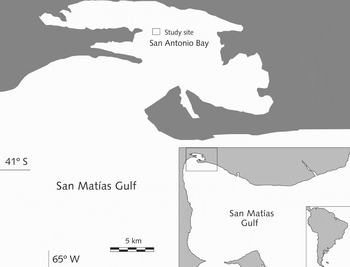
San Antonio Bay is the southern distributional limit of this species and during the summer the Z. dufresnei population sustains a subsistence fishery by local people. Unlike everywhere else, at San Antonio Bay this snail inhabits the intertidal zone, with a maximum depth of 4 m during low tide. Although San Antonio Bay is a Natural Protected Area, different human activities (navigation by overseas and domestic ships, fishing, tourism, etc.) occur in it, especially at the ports of San Antonio Oeste and San Antonio Este (Figure 1). Dredging projects in order to attain deeper navigable paths are under study and hence negative impacts on reproduction and recruitment are foreseeable (Catterall et al., Reference Catterall, Poiner and Kerr1992). Our aims were to describe the characteristics of this unique population and to analyse the possible impacts of human activities on them.
Location of the study site in the San Antonio Bay, San Matías Gulf (Argentine Patagonia).

MATERIALS AND METHODS
San Antonio Bay is a shallow bay located in northern Patagonia (40º45′S 64º 56′W; Figure 1) with wide mudflats and tidal channels. The tidal regime is semidiurnal and has an amplitude ranging between six and nine metres. The dominant bottom type is sand, with variable content of interspersed pebble and cobble. The dominant macroinvertebrates are crabs (Libinia spinosa and Neohelice (=Chasmagnathus granulata), octopuses (Octopus tehuelchus), snails (Zidonaa dufresnei, Tegula patagonica, Buccinanops globulosum and Buccinanops cochlidium) and bivalves (Brachydontes rodriguezii and Ostrea puelcheana). The macroalgae cover is diverse and variable with Ulva lactuca dominating in an area affected by sewage discharges from San Antonio Oeste town (Piriz et al., Reference Piriz, Ponce and Casas2004), 4 km away from the study site.
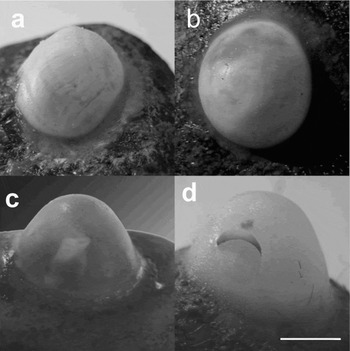
According to non-systematic observations gathered during several years along the course of different research projects on benthic biota in this area (Storero et al., Reference Storero, Narvarte and González2007; Narvarte et al., Reference Narvarte, Willers, Avaca and Echave2008; Storero & González, Reference Storero and González2008), the oviposition season of Zidona dufresnei runs from November to March. Therefore, monthly samplings were performed during receding tides on the inner navigation channel of San Antonio Bay from October 2005 to April 2006. Adults and egg capsules of Z. dufresnei were searched for during four hours and were collected by a skilled fisherman. Most snails were found buried in the sand and egg capsules on the top of hard substrates (mostly cobble). The fisherman followed a transect of at least 500 m length and 3 m width (assuming a maximum visual detection distance of 1.5 m on each side of the path). The position of each snail and capsule was recorded with a submetric precision GPS; all the snails were gathered for further examination in the laboratory. Egg capsules were categorized in situ (according to previous observations; Figure 2) as: E0 (newly laid: whitish, viscous and dense fluid, capsule wall still soft and the female still laying there; Figure 2a); E1 (recently laid, externally not different from the previous stage but a female was not observed on it; Figure 2a); E2 (capsule wall tough, capsular fluid with big clear areas; Figure 2b); E3 (embryos clearly visible, fluid transparent with scarce whitish threads; Figure 2c) and E4 (capsule with a hole or slit-like hatching opening, with or without embryos; Figure 2d). Broken egg capsules were also recorded (only part of the capsule wall or the base adhered to the substrate). Five to ten capsules were collected during each sampling and brought to the laboratory with their substrate.
Different developmental stages in the egg capsules of Zidona dufresnei: E0/E1 (newly laid/recently laid, capsular fluid intact); E2 (capsular fluid partially consumed); E3 (capsular fluid consumed with shelled embryos) and E4 (hatched capsule, with or without embryos) (scale bar = 10 mm).

The collected snails were weighed with a digital balance (± 0.01 g) to obtain total fresh weight (TFW) and dissected to obtain shell weight (SW) and to determine the sex by observation of the penis. Shells were measured with a digital calliper (±0.01 mm) to obtain: total length (TL, from the apex to the extreme of the siphonal channel) and total width (TW, maximum diameter perpendicular to TL). Egg capsule dimensions (maximum and minimum diameter and maximum height) were measured when still attached to the substrate; embryos were carefully extracted and measured with a calliper or under stereoscopic microscope depending on stages.
Snails and eggs capsule positions were mapped with GPS Pathfinder Office® software to estimate density. The path followed by the fisherman in each sampling date was randomly split into several non-overlapping sections (seven to nine). It was also considered that the fisherman collected all the snails present in the track, but this is likely to be true only for adult snails, because the smaller sizes were probably underestimated. The area of each section was calculated and the density of snails and capsules was estimated.
To analyse whether there is a selection of oviposition substratum by size, five 0.25 m2 quadrats were randomly deployed in an area with high density of egg capsules. All the material up to a depth of 3 cm was collected and sieved through a 1 cm mesh and the selected material taken to the laboratory. The maximum projection of each cobble was plotted on paper of known weight by unit area, cut and weighed to obtain its area. The egg capsules were detached from the substratum and the area of the base estimated in the same way.
Covariance analyses were performed on TFW, SW and TW using TL as covariate after log–log transformation, in order to obtain the simple allometric equation (Y = aX b) and to compare the equations between sexes. The frequency distribution of cobble areas used as substratum and that of available cobble were compared through a Kolmogorov–Smirnov test.
RESULTS
The total number of individuals sampled was 439 (females = 211; males = 228); although the sex-ratio varied somewhat among sampling dates the overall sex-ratio for the entire study (0.519) was not significantly different from 0.50 (χ2 = 0.66; P > 0.25). The shell length–frequency distribution for the whole year was not different between sexes (Kolmogorov–Smirnov test, D = 0.0553; P > 0.05).
The rates of increase of total weight, shell weight and shell width relative to shell length showed no significant differences between sexes (Table 2). Female shells were 7.8% heavier and 1.5% wider than those of males of the same shell length; the total weight of females was 3.4% higher than that of males (Table 1).
Morpho-gravimetric variables of the Zidona dufresnei San Antonio Bay population.

min, minimum; max, maximum.
Covariance analyses of the effect of sex on total fresh weight (TFW), shell dry weight (SW) and total width (TW) in Zidona dufresnei with total length (TL) as covariable after log–log transformation (number of males: 228; number of females: 211).

Egg capsules showed a smooth surface, an almost hemispherical profile with a mean of 11.7 mm high (SD = 1.7 mm high, N = 21) and a somewhat elliptical base with a mean of 21.0 mm long and a mean of 17.4 mm wide (SD = 3.0 and 1.7, respectively, N = 21). The most frequent number of embryos per egg capsule was two and ranged between one and four. The shells of newly hatched snails were 8.2 mm long and 4.6 mm wide (SD = 1.3 and 0.5, respectively, N = 21).
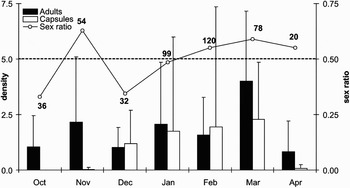
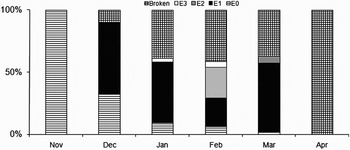
Considering the values per track section, the maximum egg capsule density was found in February (21.12/100 m2) whereas the adult density peaked in March (9.64/100 m2). Mean values during the whole sampling period were 1.34 ± 3.52 egg capsules and 1.91 ± 2.42 snails per 100 m2, respectively (Figure 3). Egg capsule deposition peaked in December, when the highest number of capsules with nearby females (E0) was observed, but extended from November to March (Figure 4). Recently laid egg capsules (E1) were frequent between November and March but advanced stages where observed only during January and March. Broken egg capsules were found during almost all the sampling dates (December to April); by April only scarce, broken capsules, were found.
Monthly sex-ratios and mean densities/100 m2 of adult snails and egg capsules (±SD); sample sizes for sex-ratios are indicated with numbers on the graph.

Percentage of different capsule stages of Zidona dufresnei in San Antonio Bay during the summer 2005–2006. Details on stages are provided in text.

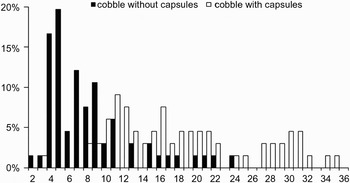
The area–frequency distributions of available cobble (mean area = 7.74 ± 4.81 cm2; N = 70) and of cobble used as substrate for egg capsules (mean area = 17.88 ± 7.73 cm2; N = 66) were significantly different (Figure 5; Kolmogorov–Smirnov test: D = 0.667; P < 0.005). Almost all the egg capsules were found on cobble with areas larger than 7 cm2; the average basal area of the egg capsules was 3.02 ± 0.60 cm2 (N = 66) and showed no significant correlation with cobble area (r = 0.182; P > 0.10; N = 66).
Area–frequency distributions for cobble with and without egg capsules.

DISCUSSION
The Z. dufresnei population studied here showed many contrasting points with those described previously. This population, the southernmost one reported up to date, inhabits a quite small channel in the shallow San Antonio Bay and the low intertidal zones, while bathymetric ranges of 5 to 115 m have been mentioned for northern populations of this species (Carranza et al., Reference Carranza, Scarabino and Ortega2008). Lahille (Reference Lahille1895), in his work on Argentinean volutids, named this small-sized form as Voluta angulata affinis, now a junior synonym of Z. dufresnei, and mentioned that the maximum shell length was 100 mm. For the subtidal zone of San Matías Gulf, Scarabino (Reference Scarabino1977) reported the larger form of this species. Maximum and mean shell length in the present study was 120.5 mm and 94.34 mm respectively, whereas around Mar del Plata (38º20′S 57º3′7W) corresponding values of 210 mm and 160 mm were reported (Giménez et al., Reference Giménez, Brey, Mackensen and Penchaszadeh2004, Reference Giménez, Lasta, Bigatti and Penchaszadeh2005). Half of the individuals in the Mar del Plata population were already mature when a shell length of 150–160 mm was reached, at 8–9 years of age (Giménez & Penchaszadeh, Reference Giménez and Penchaszadeh2003; Giménez et al., Reference Giménez, Brey, Mackensen and Penchaszadeh2004). In our study no female reached the minimum size at first gonadal maturity reported there (128 mm) and notwithstanding most analysed specimens were reproductively mature. Interpopulation variation in size at first maturity is widespread in snail species (Cledón, Reference Cledón2004; Shelmerdine et al., Reference Shelmerdine, Adamson, Laurenson and Leslie2007) though in the present case the extent is noticeable since there is no overlap between the size-ranges of mature snails from the two sites. The origin of these differences, whether genetic or ecophenotypic, is uncertain: the lack of a pelagic larval phase and the sedentary nature of adults supports the idea of a limited gene flow between coastal and deep water populations but the influence of the quite anomalous habitat on an alleged phenotypic plasticity cannot be ruled out. The absence of individuals of ‘normal’ size dwelling in the San Antonio Bay indicates that immigration from deep water populations is null.
Sex-ratio was balanced in the San Antonio Bay population of Z. dufresnei as reported previously for a Mar del Plata population (Giménez & Penchaszadeh, Reference Giménez and Penchaszadeh2002). A 100% prevalence of imposex (development of a penis in females) has been reported for females of another volutid inhabiting near the study area just outside San Antonio Bay (Bigatti & Penchaszadeh, Reference Bigatti and Penchaszadeh2005). Although this could have led to the misidentification of some females as males in our study it is clear that imposex, if present at all, has not seriously affected the population of Z. dufresnei.
Males and females showed a quite similar size–frequency distribution regarding shell length but females were wider and also heavier on average than males of the same shell length. No sex dimorphism in shape has been hitherto reported for Z. dufresnei though slight differences in size at maturity have been found by Giménez & Penchaszadeh (Reference Giménez and Penchaszadeh2003) off Mar del Plata. The wider female shell found in this study is probably related to the necessity to accommodate a bulkier reproductive system than in the case of males and also to store the big egg capsules up to the moment of egg laying. Giménez et al. (Reference Giménez, Brey, Mackensen and Penchaszadeh2004) suggested that size limitations to produce the big capsules are partially responsible for a late maturity in Z. dufresnei. The higher female shell weight is probably just the result of their squatter shape and probably this and the storing of reserves for capsule deposition account for their higher total fresh weight.
Reproductive parameters of the San Antonio Bay population seem to be strongly affected by the small female size. Although egg capsules were morphologically similar to those described by Penchaszadeh & de Mahieu (Reference Penchaszadeh and De Mahieu1976) for a Z. dufresnei population 70 km northwards of Mar del Plata, they were clearly smaller (21.1 mm of mean maximum diameter versus 30 mm of mean diameter); embryo size (up to 8 mm) was also smaller than that previously reported (up to 18 mm in length). On the other hand, most egg capsules contained two to six embryos in northern populations (Penchaszadeh & de Mahieu, Reference Penchaszadeh and De Mahieu1976; Riestra & Fabiano, Reference Riestra and Fabiano2000) while one to four has been found in the present study.
On the basis of histological gonad analyses, Giménez & Penchaszadeh (Reference Giménez and Penchaszadeh2002) determined that the reproductive cycle of Z. dufresnei in Mar del Plata lasts from October to March, being highly synchronous within the population: spermatogenesis occurs all year round but females ripen and copulation occurs only when water temperature increases in spring. During the present study ovipositing females were observed between November and March, with the density of recently laid egg capsules peaking in December. The absence of newly laid capsules in our first and last sampling dates indicates that our seven months-long sampling (October to April) covered well all the oviposition season; moreover, only a few newly laid capsules were recorded in November, only one was detected in March, and by April only a few capsule remains were observed. The reproductive season seems to be quite similar in spite of the higher latitude of San Antonio Bay (located 300 km southwards), probably due to the fact that water temperatures are higher than in Mar del Plata at 50 m of depth, because of the shallowness of the bay.
The scarceness of egg capsules in advanced stages and the great number of broken egg capsules are noteworthy; moreover, no egg capsules with a hatching hole were found in the field. A short duration could result in a low probability of detection but this seems not to be the case since according to preliminary laboratory observations on embryo development the duration of later stages is quite long (42 and 25 days for E3 and E4, respectively) as compared to early ones (6 and 1 days for E1 and E2, respectively). A high predation rate or a higher fragility of later stages cannot be discarded; in the field the dome of the capsule probably disintegrates soon after the exit of the juveniles, perhaps due to the effect of the same enzymes that usually help to open the hole (Pechenik, Reference Pechenik1986). The abundance of broken capsules between January and March is probably due to the accumulation of already hatched or predated egg capsules whose attachment basis and surrounding walls are more resistant than the dome (personal observation).
The distribution of Z. dufresnei is quite limited inside San Antonio Bay, occupying mostly the beaches located near the internal channels (Montenegro personal communication). Particle size is apparently one of the female selection criteria for capsule laying substrates in San Antonio Bay but besides the report that egg capsules are generally attached to dead bivalve shells (Penchaszadeh & de Mahieu, Reference Penchaszadeh and De Mahieu1976), little is known about the populations from deeper waters. Selection of adequate substrata is especially important for snails with prolonged intra-capsular development (Borzone & Vargas, Reference Borzone and Vargas1999; fides Almeida Rocha-Barreira, Reference Almeida Rocha-Barreira2003). Adult burrowing and egg laying on intertidal substrata seems to be a distinctive characteristic of this population, whose persistence probably depends on an adequate proportion of sand and cobble of suitable size.
Dredging of the main channel to increase navigability in San Antonio Bay would impact negatively on recruitment rates, especially taking into account the long egg deposition and development period and the very low position of the egg capsules on the beach. Caterall et al. (1992) reported that density of a volutid snail with similar egg capsules decreased drastically during the year in which dredging was taking place and remained low two years thereafter, although the nature of the effects was not clear. The unregulated fishery could also impact negatively on mature ovipositing females as they are more easily detected than buried snails but the activity of fishermen has no direct effect on egg capsules (personal observation). Populations of species lacking a pelagic larval phase are vulnerable to local extinction due to natural or anthropogenic disturbances, especially if adults are slow moving or sedentary (Caterall et al., 1992), as it seems to be the case here. Probably the unusual Z. dufresnei population in San Antonio Bay would require quite different conservation measures than its deep water counterparts.
ACKNOWLEDGEMENTS
We wish to thank the staff of the Instituto de Biología Marina y Pesquera Almirante Storni (Río Negro Province) where this study was completed, and especially to Lorena Storero, Gregorio Bigatti, Juliana Giménez, Patricia Miloslavich and Maximiliano Cledón, for their help in many ways. This study was supported in part by a grant from the Agencia Nacional de Promoción Científica y Tecnológica (Project PID # 371).