The singing of Greek chants in the medieval Latin West was quite widespread, and scholarly research concerning these chants goes back at least to the nineteenth century. An important milestone was, however, reached in 1947 with the publication of Egon Wellesz's Eastern Elements in Western Chant.Footnote 1 Soon afterwards Jacques Handschin and Michel Huglo dealt with the so-called Missa graeca,Footnote 2 although mainly from a Western point of view. More recently Charles M. Atkinson has written extensively on the subject.Footnote 3 Questions of why and how these chants found their way into Western manuscripts remain unanswered. Neither do we know what the origins of these compositions were. Were the Byzantine melodies imported into the West through the agency of monks, singers, diplomats and their like? Or are they instead clever imitations by Western monks and Grecophile scholars? These questions will not in all likelihood be answered soon inasmuch as we are still dealing with too many unknowns and they will not be addressed here. Instead, because the Cherubikon is seldom considered in the context of such bilingual chants, it has been chosen as a suitable object of research in hopes of reassessing the historical, theological, liturgical and melodic aspects in question.
Definition and text of the Cherubikon
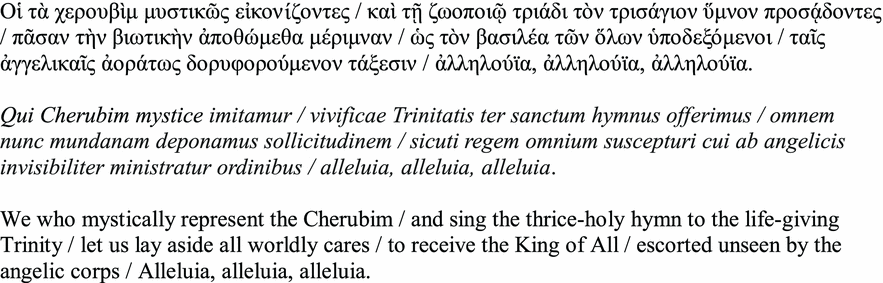
The Cherubikon, also called the Cherubic or mystic hymn, is a troparion – a short composition used as a refrain for psalm verses – normally sung at the Great Entrance in the Byzantine Divine Liturgy.Footnote 4 Figure 1 compares the Byzantine and Latin texts and provides an English translation.Footnote 5
Byzantine and Latin texts of the Cherubikon, with English translation.

As to its liturgical place and early historical development in the East, the Cherubikon was inserted into the Divine Liturgy as an offertory chant probably in the sixth century.Footnote 6 According to the historian Georgios Kedrenos (fl. 11th cent.),Footnote 7 Emperor Iustinus II (565–78) allegedly ordered it and the Τοῦ δείπνου σου (Cenae tuae) to be sung during the Divine Liturgy for Maundy Thursday, although Kedrenos neither indicates the composer's name nor the exact liturgical placement of the Cherubikon. Eutychios, a sixth-century patriarch of Constantinople, lends support to the dating, informing us of a precursor to the Cherubikon (as we know it from later centuries) in a homily condemning the worship of the non-consecrated gifts in which he talks about the ‘King of Glory’ (‘Ο βασιλεὺς τῆς δόξης’).Footnote 8 This points not to the Cherubikon (which speaks of the ‘King of All’) but a psalm that must have been sung during the Eucharistic offering or anaphora,Footnote 9 likely psalm 24, in which the expression ‘King of Glory’ is used five times in verses 7–10.Footnote 10 It is reasonable to infer that, prior to the insertion of the Cherubikon into the liturgy, the cantors would have sung this psalm, probably with Alleluia as the responsorial refrain by the congregation. The Cherubikon may at first have been added as a refrain to the psalm, as was the usage of troparia.Footnote 11 Over the centuries the Cherubikon first replaced the Alleluia, then the complete psalm, probably because its text was deemed more appropriate to the Great Entrance.
The Cherubikon was at first sung without interruption, but apparently in the fourteenth century the ceremony for bringing the gifts to the altar was extended, necessitating not just the interruption of the Cherubikon, but also a change to its text. Instead of τῶν ὅλων ὑποδεξάμενοι (the aorist participle) the passage reads τῶν ὅλων ὑποδεξόμενοι (the future participle), the latter form being found in nearly all musical manuscripts from the fifteenth century on.Footnote 12 Originally there was only one Alleluia at the end of the Cherubikon (Alleluia being a common ending to Byzantine troparia) but three Alleluias became customary in the fifteenth or sixteenth centuries.Footnote 13 At first, the triple Alleluia was intended solely for Easter, but Kenneth Levy posits that it may have been the result of a misunderstanding of a direction to sing the Cherubikon three times, which came to be applied to the Alleluia alone.Footnote 14 Perhaps because the Alleluia was sung at a very special moment, namely the placing of the gifts on the altar at very end of the Great Entrance, the Byzantines might have regarded the Alleluia as the equivalent of heavenly chanting, such as John describes in Revelation 19:1–6.Footnote 15
The history of the Great Entrance and its theological meaning have been widely discussed, thus only a brief summary will be offered here.Footnote 16 From earliest times the Byzantine Divine Liturgy seems to have known some kind of Great Entrance even if the ceremonial was less elaborate than we find in later descriptions. The procession developed chiefly on account of practical necessity, namely the carrying of the gifts to the altar, which happened at first without much ceremony and apparently without symbolism. This simple act took on increasing significance due mainly to developing theological interpretations, but also the expanding symbolism of the Divine Liturgy, particularly at this point in the service. The development of the ritual happened gradually over time, although as early as the fourth century a homily by Theodore of Mopsuestia (d. 426) describes a procession that has the dimensions of a Great Entrance.Footnote 17
Since there is no evidence that the faithful took part in the procession, it is assumed that the Great Entrance developed from an earlier ceremony in which the deacons carried the gifts to the priest who then placed them on the altar.Footnote 18 In fact, most extant accounts of the Great Entrance describe just this.Footnote 19 Thus we know who participated but not the exact procession route: sources tell us only that it started from a so-called skeuophylakion, where the chalices and books for the Divine Liturgy were kept.Footnote 20 The gifts were prepared there before Mass and brought back there afterwards. The psalmists, whose usual place was the ambo, sang the Cherubikon from the solea, the portion of the bema (raised floor or platform) that extended beyond the sanctuary from the iconostasis into the nave. As the procession passed the solea the psalmists may have changed their location, although Neil K. Moran suggests that it might have been an expression of humility that the soloists chanted the Cherubikon from the solea rather than the ambo.Footnote 21
Liturgically as well as theologically the Cherubikon serves as a kind of preparation for the faithful for the next part of the Mass, especially the eucharistic sacrifice. As Dimitri Conomos explains, the ‘hymn symbolises the heavenly procession of Christ majestically escorted by hosts of angels “bearing” spears and crying “allelouia”. The heavenly King proceeds to the bloodless sacrifice to offer Himself to all those faithful who lay aside the things of the world and who join the Cheroubim in their unending praise.’Footnote 22 The faithful represent the Cherubim and their service, whereby the earthly liturgy imitates and reflects the celestial.Footnote 23 Yet the Cherubikon is also seen in a paschal context, in which the faithful ‘see’ again the suffering of Christ, an interpretation already found in eighth-century Byzantine sources including the writings of Patriarch Germanos. According to this interpretation, it would be insufficient to understand the Cherubikon only as a chant for the procession of the Holy Gifts. Its meaning is much more significant because during their entrance the Holy Gifts become a symbol for Christ himself and are worshipped by the faithful in regard to their consecration and communion.Footnote 24
The Cherubikon in the West
Little is known about the early history of the Cherubikon in Western Europe, in part because it was never a proper part of the Roman Mass.Footnote 25 It is assumed that the Cherubikon was introduced in the early ninth century, when it served as the Offertory of the so-called Missa graeca,Footnote 26 although James McKinnon dates its appearance some three hundred years earlier.Footnote 27 The Cherubikon migrated to a temporary position among the verses of the Offertory for Trinity Sunday, ‘Benedictus sit’, in northern Europe. An independent Latin translation appears among the antiphons in a southern Italian processionalFootnote 28 and, according to The New Harvard Dictionary of Music, a Latin translation of the Cherubikon (Qui cherubim mystice) is also found without notation as a processional antiphon for the Dedication.Footnote 29 Michel Huglo discovered that it was customary at St Denis until the seventeenth century to sing it in Greek at such special feasts as Christmas, Easter, Pentecost and the feast of the patron saint.Footnote 30
In any event, it remains unclear why the Cherubikon was used in the West at all. Ewald Jammers was of the opinion that it was not a Latin invention but rather was based on a Greek source, questioning how a Western monk could have composed a new text that was incomprehensible to him and that was not of immediate use in the liturgy.Footnote 31 Gerlach concurs in suspecting that the Cherubikon was an ‘import’ transcribed from Greek into Latin.Footnote 32
Eastern and Western manuscripts containing Cherubika
Cherubika can be found in a great many Byzantine sources. Among the earliest neumed diastematic manuscripts are two from the Library in Grottaferrata and two from the Greek National Library in Athens.
-
1. Grottaferrata, Cod. crypt. graec. 156 (Γ.γ. I), fols. 34–5 (dated 1225),Footnote 33 is an Asmatikon manuscript from Messina that employs Middle Byzantine neumes.Footnote 34
-
2. Grottaferrata, Cod. crypt. graec. 62 (Γ.γ. VII), fol. 149 (13th cent.),Footnote 35 in which the Cherubikon is a later addition in late Byzantine neumes c.1400. Interestingly, this version is syllabic in outline while the older Cherubikon is highly melismatic. Neil K. Moran, who transcribed it, writes that it ‘manifests two musical styles. The first section Οἱ τὰ χερουβὶμ μυστικῶς εἰκονζοντες . . . τριάδι is in the style of the Sticherarion; the following section represents the purely kalophonic style . . . Neither the first nor the second part of the composition exist in parallel versions.’Footnote 36
-
3. Athens, EBE 2458, fols. 161v–167r, 173v–176r (dated 1336), in Middle Byzantine notation from the Monastery of the Forerunner in Serres.Footnote 37 According to Levy, the ‘Cherubikon asmatikon’ on fol. 161v is the earliest copy of this type, ‘an extended, composite work, with mixed choral and solo sections, again in the deuteros plagal; its initial section is related in basic material . . . to the corresponding section of the ordinary Cherubikon in the Asmatikon.’Footnote 38
-
4. Athens, EBE 2622, 369r–377r (dated 1341–c.1360) was also copied at the Monastery of the Forerunner in Serres and employs Middle Byzantine notation. It is a Papadike manuscript with mixed repertory similar to the anthology-type collection EBE 2458.Footnote 39
Three later manuscripts in the Vienna Austrian National Library will also be considered here:
-
5. Phil. gr. 194, fols. 29v–136r, 155r–161v (15th cent., first half), an anthology manuscript which contains chants for the Orthros and Hesperinos, among others.Footnote 40
-
6. Theol. gr. 185, fol. 255v–264r (c.1400), a music-liturgical anthology that seems to have come from Thessalonica and includes chants for the Orthros, Hesperinos and other liturgies.Footnote 41
-
7. Suppl. gr. 190, fol. 43r–81r (late 18th cent.), a music-liturgical anthology of unknown origin with late Byzantine notation.Footnote 42
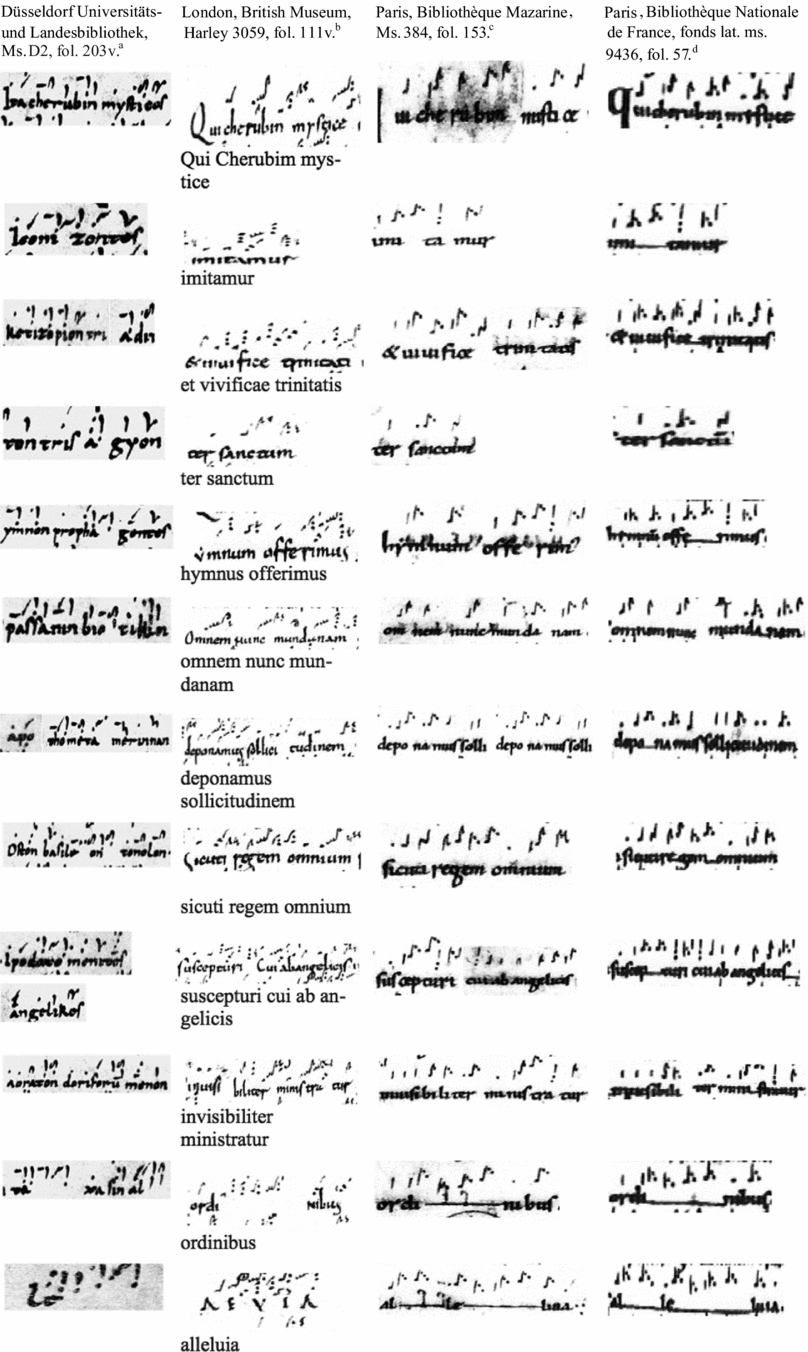
Finally, the remainder of this article will examine four relatively early Western manuscripts that contain the Cherubikon.Footnote 43
-
1. Düsseldorf, Universitäts- und Landesbibliothek, Ms. D2, fol. 203v (10th cent.), is a sacramentary from Corvey, the only source of the Missa graeca to include the Cherubikon.Footnote 44 According to Handschin it is also the earliest adiastematic source and contains a more richly ornamented version of the melody than the other codices surveyed here. The Cherubikon is designated as the offertory for PentecostFootnote 45 and has a Greek text copied in the Latin alphabet.Footnote 46
-
2. London, British Library, Harley 3095, fol. 111v (10th cent., 2nd or 3rd quarter), a manuscript mainly devoted to the works of Boethius, contains as an early eleventh-century addition a richly ornamented Cherubikon with Latin text copied in German neumes.Footnote 47 The liturgical place for the Cherubikon here is after the feast of the Resurrection and before Pentecost.Footnote 48
-
3. Paris, Bibliothèque Mazarine, Ms. 384, fol. 153 (11th cent.), a gradual from St Denis, contains a Latin-texted Cherubikon designated as an offertory for Trinity Sunday (rather than Pentecost, as in Düsseldorf D2).
-
4. Paris, Bibliothèque nationale, fonds lat. ms. 9436, fol. 57 (11th cent.), is a missal from St Denis with a Latin-texted Cherubikon.Footnote 49
The melodic style of the Eastern Cherubika
As previously noted, in the earliest sources apparently only the Cherubikon melody for the choir, preserved in the so-called Asmatikon, comes down to us, not the soloistʼs version, which would have been written down in the Psaltikon, the book for soloists.Footnote 50 Because only the first line and final Alleluia of Οἱ τὰ χερουβίμ is given in the Asmatikon, Oliver Strunk proposed that ‘Either this setting was regarded in its day as too well known to require copying or the intervening lines were sung by a soloist whose melody the Psaltikon has not preserved.’Footnote 51 We now know from Anthony of Novgorodʼs description of the Divine Liturgy at Hagia Sophia (c.1200) that eunuchs sang the Cherubikon and a monk was assigned some solo parts.Footnote 52
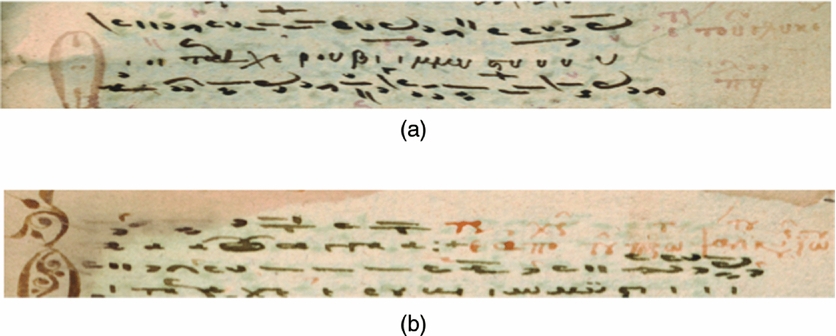
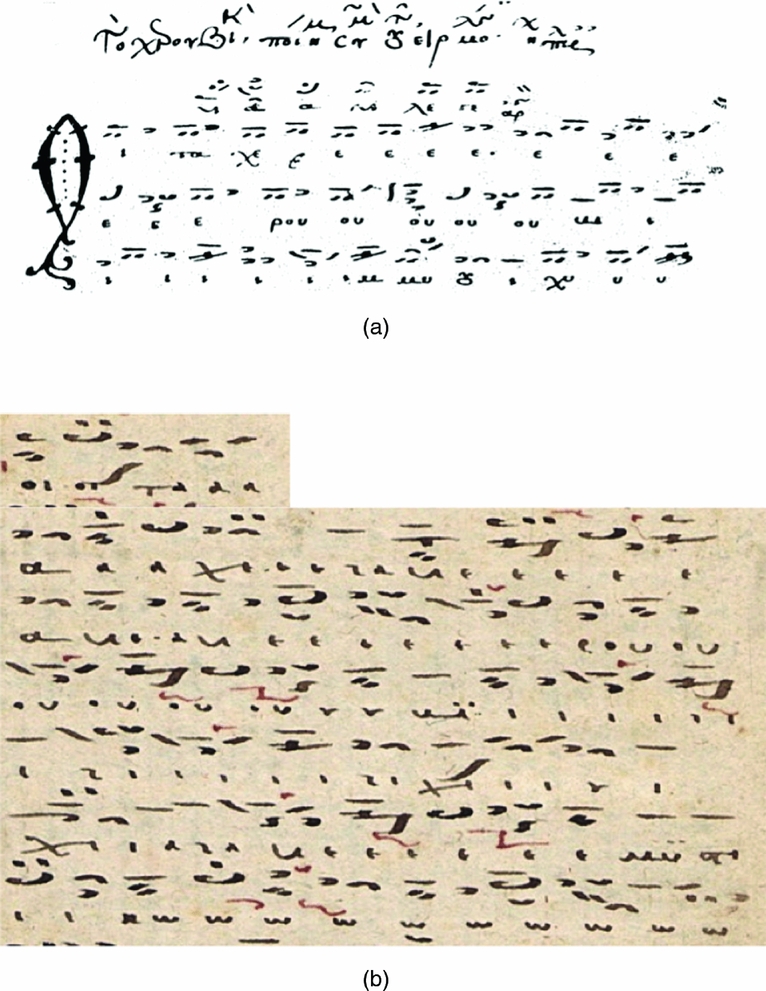
An almost countless number of Eastern manuscripts containing Cherubika preserve a great many different melodic settings that varied considerably over the course of time.Footnote 53 Even the earliest sources transmit rather elaborate versions.Footnote 54 The earliest preserved Asmatika containing the Cherubic Hymn, namely Mount Athos, Codex Laura Γ 3 and Vatican Library, Vat. gr. 1606, both from the thirteenth century, yield but a single version of the chant melody;Footnote 55 manuscripts of the fourteenth and fifteenth centuries transmit seventeen, seven by known hymnographers of the fourteenth century, eight by hymnographers of the fifteenth along with two older melodies. The Cherubika in these sources are arranged chronologicallyFootnote 56 and the hymnographers’ names are almost always given at the beginning (see Fig. 2a and 2b).Footnote 57 Moreover, fourteenth- and fifteenth-century manuscripts, including Vienna Phil. gr. 194 and Theol. gr. 185 (Fig. 2a and 2b), contain references to the origin of the hymnographers or the execution of the hymn.Footnote 58
Comparison of Vienna, Austrian National Library, Mss. Phil gr. 194 (132r) and Theol. gr. 185 (259r) with indications of hymnographers’ names at the beginnings of Cherubika. © Vienna, Österreichische Nationalbibliothek.

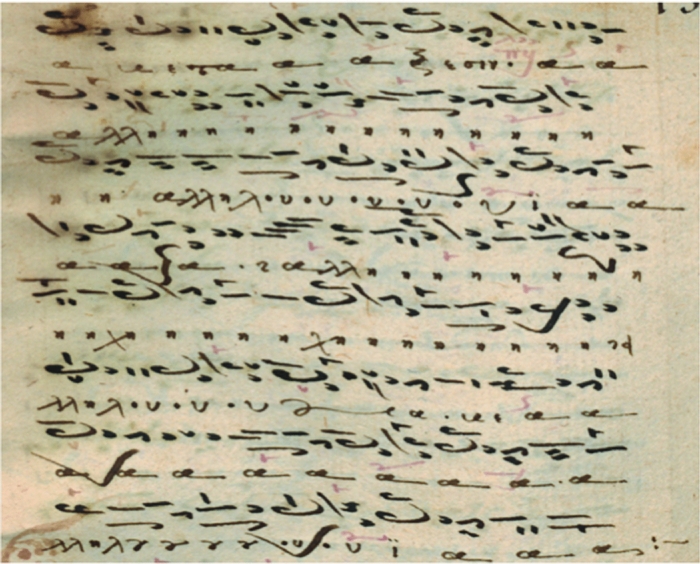
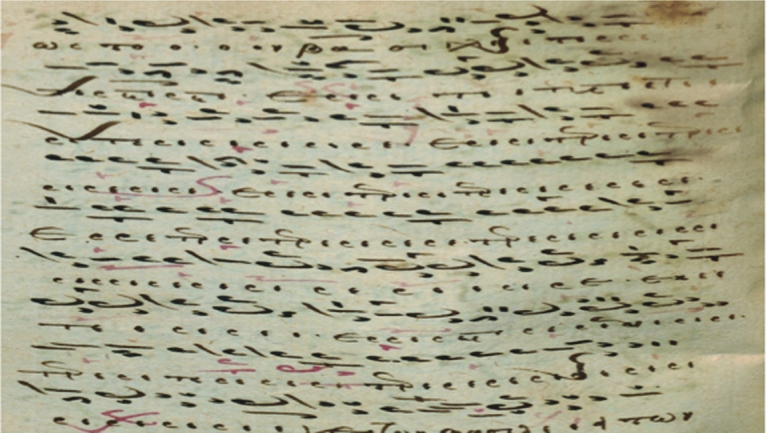
Until the mid-fifteenth century only the second and fourth modes authentic and plagal were used for the Cherubikon with the sole exception of the version by Xenos Korones (14th cent.), written in the first plagal mode.Footnote 59 (In later manuscripts, and mainly in post-Byzantine times, Cherubika are found in all eight modes.) Nonetheless Cherubika of the fourteenth century differ distinctly from those of the fifteenth in their melodic outlines. The earlier consist of seemingly random sequences of melodic elements, of which some are identical, but others are repeated in varied forms. The fifteenth-century Cherubika show a somewhat looser compositional structure. Some later hymnographers worked mainly with units between two medial signatures, whose melodic line is formed freely and independently throughout.Footnote 60 The Alleluia is of particular musical interest in this regard because it was still part of the main body of the Cherubikon in the fourteenth century. In the fifteenth century, the Alleluia gains more independence and displays a free melodic outline, having almost no formulas or melodic elements in common with the other parts of the Cherubikon. Alleluia melodies became ever longer over the centuries due to the prolongation of the Divine Liturgy at the point at which the clergy entered the sanctuary and the priest and the deacon exchanged a final dialogue.Footnote 61 In post-Byzantine times, the Alleluia became extremely elaborate and artistic in outline and does not show any formulas at all (Fig. 3).Footnote 62
Alleluia section of a Cherubikon by Ioannes Glykys, Ms. Phil. gr. 194 (133r).

The middle section of the Cherubikon (beginning πᾶσαν τὴν βιωτικὴν bis ἀλληλούϊα), sung by the soloistsFootnote 63 constitutes the culmination of the hymn (see Fig. 4). At the words ὡς τὸν βασιλέα τῶν ὅλων ὑποδεξόμενοι (‘that we may receive the King of All’) ‘the music stops and a procession of clergy takes place’Footnote 64 and the so-called commemorations are said. After this the clergy returns to the sanctuary and the Cherubikon concludes. As Conomos has demonstrated, the melody at its midpoint is practically the same in all the fourteenth-century Cherubika, comprising the repetition of one single note (mainly a') and a short embellishment. Fifteenth-century Cherubika sometimes transpose this up a fifth,Footnote 65 the climbing motif perhaps suggesting that a high point in the Divine Liturgy had been reached.
Middle section (ὡς τὸν βασιλέα τῶν ὅλων ὑποδεξόμενοι / that we may receive the King of All) of a Cherubikon by Ioannes Glykys, Ms. Phil. gr. 194 (132v).

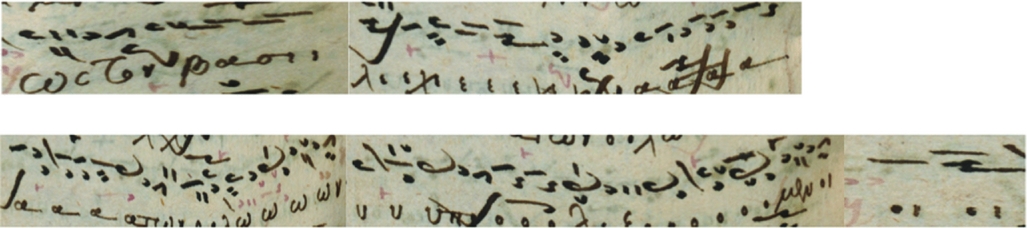
Often the ὡς τὸν βασιλέα section is flanked by so-called teretismata. As the Cherubika are very melismatic chants, the words of this section were stretched to make room for the various melismata or vocalises into which were inserted meaningless syllables, often on -te-te- or -te-re-, -to-to-, -ri-ri-ri- or such like. These teretismata can already be found in compositions of the fourteenth century, and were meant to represent the ceaseless chanting of the angels (see Fig. 5).Footnote 66
Teretismata (vocalises) from a Cherubikon by Agallianos, Ms. Phil. gr. 194 (131v).

An important characteristic of the Eastern Cherubika is their versatility. In this respect they are unlike other Byzantine compositions, which did not usually undergo significant changes in melodic outline over time, adherence to the old forms and formulas having been considered much too important. Many such chants were only slightly reworked by younger generations of hymnographers and thus remained stable until the eighteenth century. The Cherubikon, however, inspired many melodes to create new compositions, probably on account of its frequent liturgical use as well as to its text, which is highly suitable for choral music.
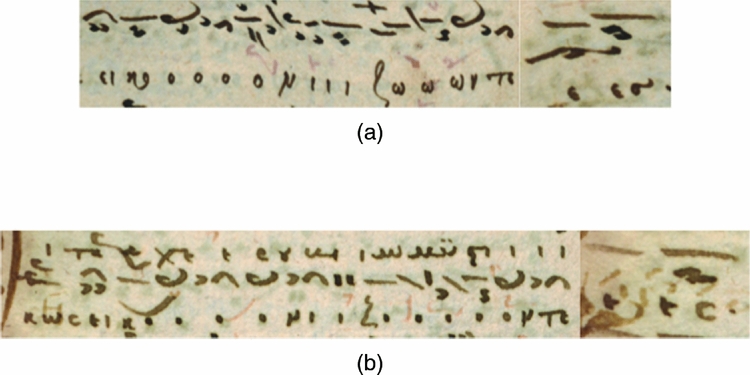
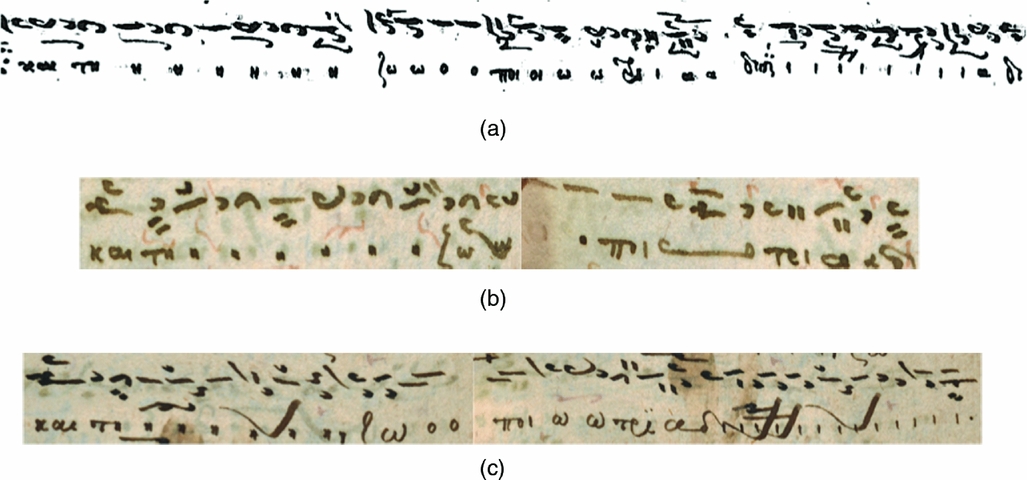
Changes to the melodies of the Cherubika are already evident in fourteenth and fifteenth-century sources. Taking a Cherubikon by Ioannes Glykys as an example,Footnote 67 one may discern that it appears in different versions in later manuscripts, including Theol. gr. 185 (fol. 259r) and Phil. gr. 194 (fol. 132r). There are many places where the melodies do not overlap and where Phil. gr. 194, the younger source, contains melismata not found in Theol. gr. 185 (compare Fig. 6a and 6b).
Comparison of melismata in Mss. Phil gr. 194 (132r) and Theol. gr. 185 (259r).

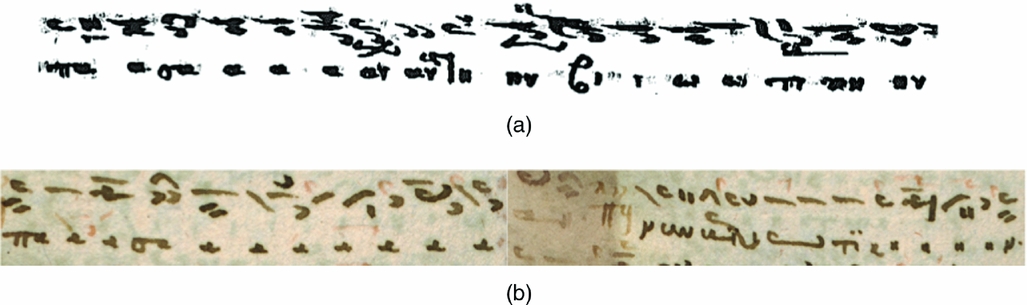
Quite often just the beginning of a new colon has the same sequence of neumes, but then the younger manuscript follows its own course (Fig. 7a and 7b).
Comparison of colon beginnings in Mss. Phil gr. 194 (132r) and Theol. gr. 185 (259r).

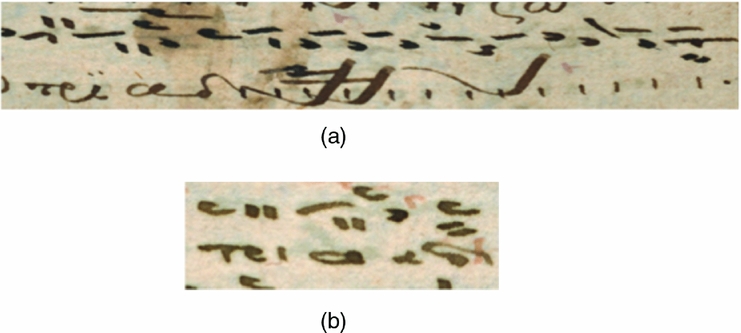
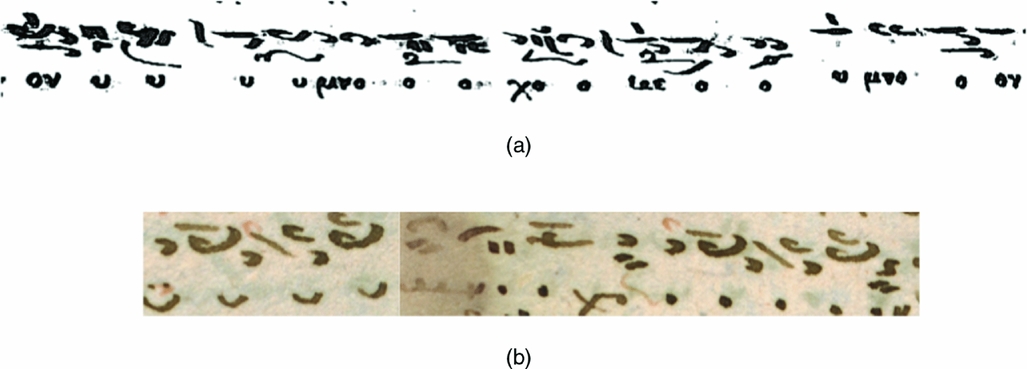
There are also a few cases in which Theol. gr. 185 contains a small melisma which Phil. gr. 194 does not include in its version (Fig. 8a and 8b).
Comparison of short melismata in Theol. gr. 185 (259r) and Mss. Phil gr. 194 (132v).

Comparing the Cherubikon from Theol. gr. 185 with the one in Athens EBE 2458 (fol. 164v), it is apparent that they are the same melody except for some short passages mostly in the Alleluia section. EBE 2458 differs at the same points from Phil. gr. 194, as does Theol. gr. 185, so it is safe to conclude that the Cherubikon in the younger codex has already been reworked (Fig. 9).

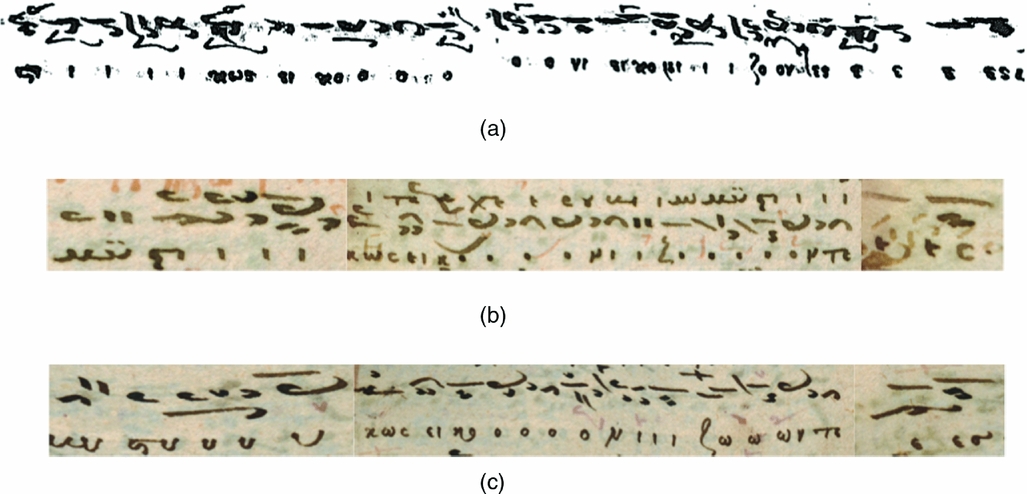
The Cherubika of post-Byzantine times differ even more from the oldest examples than did those of the fourteenth and fifteenth centuries. Referring again to the Cherubikon by Glykys, but comparing it to one found in a late eighteenth-century manuscript, Vienna, Austrian National Library, Suppl. gr. 190, fol. 74r, it is evident that it bears hardly any resemblance to older Cherubika (see Fig. 10a–c).
Comparison of μυστικῶς εἰκονίζοντες / mystically represent, Vienna, National Library, Mss. Suppl. gr. 190 (74r), Theo. gr. 185 (259r) and Phil. gr. 194 (132r). © Vienna, Österreichische Nationalbibliothek.

In only a few places does the old melody from Theol. gr. 185 seem to have been preserved as a kind of framework; for example, on the word εἰκονίζοντες, whose beginning is similar to Theol. gr. 185, but which is then developed in a much more extended way, or at the phrase καὶ τῇ ζωοποιῷ, which also takes up the beginning from the old Cherubikon, but goes on to use the repertory of eighteenth-century formulas (Fig. 11a–c). At τριάδι the beginning (until the first medial signature) is the same in Suppl. gr. 190 and Theol. gr. 185, but the former takes up a melisma on the last syllable of τριάδι, which cannot be found in Theol. gr. 185, but is already present in Phil. g. 194.
Comparison of καὶ τῇ ζωοποιῷ τριάδι / to the life-giving Trinity, Mss. Suppl. gr. 190 (74r), Theo. gr. 185 (259r) and Phil. gr. 194 (132r).

On the contrary, the phrase τὸν τρισάγιον (Fig. 12a and 12b) features only certain intervals (the ascending third or the fourth) that are reminiscent of the old basic melody. Otherwise the melodic lines here are completely different.
Comparison of τὸν τρισάγιον / the thrice-holy, Mss. Suppl. gr. 190 (74r) and Theo. gr. 185 (259r).

The same can be said about ὕμνον, where Suppl. gr. 190 has a much longer melody, one that does not even take up the melisma from Phil. gr. 194 (Fig. 13a and 13b). Πᾶσαν τὴν βιωτικήν shares a common beginning with Theol. gr. 185, but is much longer and developed differently compared with the earlier manuscripts (Fig. 14a and 14b).
Comparison of ὕμνον / hymn, Mss. Suppl. gr. 190 (74r) and Theol. gr. 185 (259r).

Comparison of Πᾶσαν τὴν βιωτικήν / all worldly, Mss. Suppl. gr. 190 (74r) and Theol. gr. 185 (259r).

Neither ἀποθώμεθα μέριμναν nor ὡς τὸν βασιλέα shows any resemblances to the old Cherubikon; only at the beginnings of ὑποδεξόμενοι and δορυφορούμενον τάξεσιν, as well as at the Alleluia sequence, can some similarities be found.
The Cherubikon in Suppl. gr. 190 may thus be called a free adaptation of Glykys's original melody. As there are already many differences between Theol. gr. 185 and Phil. gr. 194, so even a hundred years after Glykys the tradition cannot have been stable any more. These changes might be due to the frequent usage of Glykys's Cherubikon, which was embellished with numerous different added melismata or melodic ornaments. By the eighteenth century, the Cherubikon had been altered so much that it hardly bears any resemblance to the old version. There is only one feature that Suppl. gr. 190 takes over from the version found in EBE 2458. Glykys's Cherubikon is divided into five textual sections, where the same melody is always used for a different text: οἱ τὰ χερουβίμ, ζωοποιῷ, τὴν βιωτικήν, ὡς τὸν βασιλέα, τῶν ὅλων and ταῖς ἀγγελικαῖς agree with each other; a second group uses the same melody for εἰκονίζοντες, πᾶσαν, ἀοράτως etc.Footnote 68 In Suppl. gr. 190 this structure is partially taken up in such a way that the phrases οἱ τὰ χερουβίμ, ζωοποιῷ and τὴν βιωτικήν also have identical melodies. Suppl. gr. 190, however, does not make use of this structure as consequently as EBE 2458 and therefore does not employ the same melody for the remaining words or phrases.Footnote 69
The Western melodies
Even though all Western sources under consideration employ adiastematic neumes, it can still be seen in Example 1 that Harley 3059, Paris Bibliothèque Mazarine 384 and Paris BnF 9436 have the same melody.Footnote 70 The Mazarine 384 and BnF 9436 melodies are especially close in structure and employ the same neume shapes. Harley 3059, notated in German neumes, preserves a more ornamented version, with melismata on a number of vowels. The manuscript itself is older than the French ones, making it possible that a melody like that in Harley could have served as basis of the melodies copied in Mazarine 384 and BnF 9436.
Comparison of Latin Cherubika in four medieval Western sources.
a The manuscript ‘MS-D-2 Liturgische Sammelhandschrift (Sacramentarium Gregorio-Hadrianum)’ is a loan from the city of Düsseldorf to the ‘Universitäts- und Landesbibliothek Düsseldorf’. The excerpts of the manuscript are printed by permission of the library.
b © British Library Board, B. M. Harley 3095.
c © Bibliothèque Mazarine.
d © Bibliothèque Nationale de France

The oldest of the four Western versions, Düsseldorf D2, would seem the furthest removed from the others. In Handschin's opinionFootnote 71 it is the most richly ornamented, although it could be argued that Harley 3059 is more melismatic still. Comparing the two more closely reveals traces of similarity, such as the melodic outline of ‘et vivificae Trinitatis’ and ‘καὶ τῇ ζωοποιῷ τριάδι, ‘sanctum’ and ‘(τρισ)άγιον, ‘omnem nunc mundanam’ and ‘πᾶσαν τὴν βιωτικὴν’. Indeed, the closer one looks, the stronger the impression that these are very similar melodies. This is all the more surprising inasmuch as Düsseldorf D2 employs the transliterated Greek text, which not only has a different number of syllables from the Latin, but also has vowels in different places.
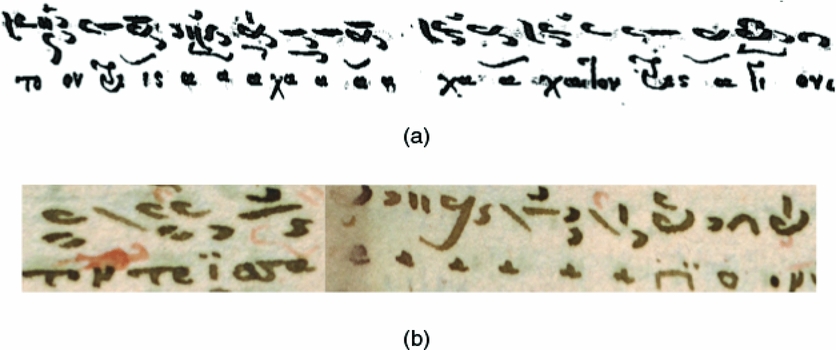
We might posit that the Western manuscripts reflect one and the same melodic tradition despite the differences in melismatic vs syllabic density, but we still lack its Byzantine source, let alone one that could bear scrutiny as suitably ‘old’ let alone ‘original’. According to Moran, ‘not a single asmatikon in Palaeo-Byzantine notation [has] come down to us’, meaning that no manuscript of a comparably early date survives.Footnote 72 Turning to the Cherubikon in one of the earliest extant Asmatika,Footnote 73 namely Grottaferrata, Codex crypt. graec. 156 (Γ.γ. I), copied in 1225, we find under the heading ποίημα Συμεὼν τοῦ ΕἱρμολόγουFootnote 74 a highly melismatic chant, indeed one more melismatic than some later versions, including Ioannes Glykysʼs Cherubikon discussed above.Footnote 75 Moran has written that this Cherubikon melody ‘forms part of an extended composition for choir and soloists in Late Byzantine manuscripts . . . [I]n this arrangement the ancient melody is retained for the initial section of the text and the Alleluja; the main part of the composition consists of new melodies composed by Late Byzantine hymnographers.’Footnote 76 Comparing its beginning in Codex crypt. graec. 156 and EBE 2458, one can detect traces of the Grottaferrata melody in the Athens source (Fig. 15a and 15b).Footnote 77
Comparison Grottaferrata, Codex crypt. graec. 156 (Γ.γ. I) (34v) and EBE 2458 (161v).

If there were a syllabic original of the Byzantine Cherubic hymn, if such ever existed, it has not survived. Handschin, in 1954 referring explicitly to the Cherubikon in Grottaferrata, Codex crypt. graec. 156, concluded that no resemblances exist between this melody and ones in the Western manuscripts.Footnote 78 Three decades later Conomos hypothesised that the music of the Cherubikon was likely to have been rather elaborate from earliest times, rendering dubious the prospects for comparing ‘the Byzantine Cherubikon’ with any of the four surviving early Western versions.
Such comparison remains risky for five reasons: (1) the likelihood that rather than a single original there were several different versions of the Cherubikon from the beginning; (2) the fact that the Western sources were copied centuries before the extant Byzantine ones; (3) the earliest surviving Byzantine Cherubika are more highly melismatic than their Western counterparts; (4) the inherent uncertainty of correctly reconstructing the Western Cherubikon from adiastematic neumes; and (5) one Western source, Düsseldorf D2, transmits Greek text, but the fact that it is in a transliterated form means that the syllable count and the vowels on which melismata might be placed would differ from the ‘original’ Greek.
Thus the prospects for a serious and thorough comparison of the Greek and Western Cherubika are not good. Even if this is an unsatisfactory outcome, one must conclude that such a comparison would be based too much on hypothesis and guesswork. At the moment and until proven otherwise we can only state that the Byzantine and Western sources seem not to have much in common and that it seems doubtful that the Byzantine Cherubikon could really have been taken over in the West. As long as we do not know any more details as to how and who might have transmitted and imported this chant, it is safest to conclude that the text of the Cherubikon was taken over in the West, but probably set to a newly composed melody.