Historically, researchers and clinicians alike have sought to identify and understand the multiple factors that might be implicated in the development of psychopathology and later adaptational difficulties following stressful life experiences. For many years, the emphasis in such research was on the study of risk, vulnerability, and illness, rather than on protective factors, adaptive strengths, recovery, and health. Yet, as the pioneering work of Norman Garmezy has so clearly illustrated, many people are remarkably resilient when confronting significant crises or chronic adversities (Cicchetti & Garmezy, Reference Cicchetti and Garmezy1993; Garmezy, Masten, & Tellegen, Reference Garmezy, Masten and Tellegen1984; Garmezy & Rutter, Reference Garmezy and Rutter1983). This paper focuses on survivors of childhood sexual abuse (CSA), a group that exemplifies the challenges inherent in recovering from a “toxic relational environment” that poses significant risks for adaptational difficulty across many domains of functioning (Cicchetti & Toth, Reference Cicchetti and Toth2005, p. 409). The goal of the paper is twofold: (a) to provide a succinct review of the literature on vulnerability and resilience in adult survivors of CSA, specifically focusing on later competence in their parental role; and (b) to present the findings of a grounded theory study in which we explored the processes through which women with CSA histories navigate mothering as a survivor.
In the past 30 years there has been an increased awareness of the prevalence of childhood sexual abuse and considerable attention paid to the complex mental health and developmental sequelae that can follow such an experience (Briere & Jordan, Reference Briere and Jordan2009; Courtois, Reference Courtois2010; Trickett, Noll, & Putnam, Reference Trickett, Noll and Putnam2011; Walsh, Fortier, & DiLillo, Reference Walsh, Fortier and DiLillo2010). CSA is unfortunately quite common; estimates from community samples suggest that approximately 12% to 35% of all women and 3% to 16% of all men experience some form of sexual abuse or sexual assault prior to the age of 18 (Finkelhor, Reference Finkelhor1994, Reference Finkelhor2008; Gorey & Leslie, Reference Gorey and Leslie1997; Johnson, Reference Johnson2004; Putnam, Reference Putnam2003). Past research has often focused on later psychopathology associated with being a survivor of CSA. It has been well documented that CSA survivors carry an increased risk for most psychiatric disorders, including depression, anxiety, posttraumatic stress, substance dependence, somatization, eating problems, and a variety of personality disorders (Beitchman et al., Reference Beitchman, Zucker, Hood, DaCosta, Akman and Cassavia1992; Briere & Eliott, Reference Briere and Elliott2003; Briere & Runtz, Reference Briere and Runtz1988; Fergusson, Boden, & Horwood, Reference Fergusson, Boden and Horwood2008; Fergusson, Horwood, & Lynskey, Reference Fergusson, Horwood and Lynskey1996; Polusny & Follette, Reference Polusny and Follette1995; Putnam, Reference Putnam2003; Roberts, O'Connor, Dunn, Golding, & The ALSPAC Study Team, Reference Roberts, O'Conner, Dunn and Golding2004). Other long-term effects include a variety of abuse-related negative cognitions such as self-blame, shame, low self-efficacy, low self-esteem, and perceptions of oneself as helpless and of life and other people as dangerous (Barnett, Miller-Perrin, Perrin, Reference Barnett, Miller-Perrin, Perrin, Barnett, Miller-Perrin and Perrin2005; Briere, Reference Briere1992; Browne & Finkelhor, Reference Browne and Finkelhor1986; Courtois, Reference Courtois2010). Problematic emotion regulation strategies (such as self-harm, suicide attempts, bingeing and purging, sexual acting out, and substance abuse), have also been noted (Briere, Reference Briere1992; Courtois, Reference Courtois2010; Kendall-Tackett, Reference Kendall-Tackett2004; Trickett & Putnam, Reference Trickett, Putnam, Trickett and Schellenbach1998). Finally, a heightened risk for sexual revictimization is now well documented (Arata, Reference Arata2002; Messman-Moore & Long, Reference Messman-Moore and Long2003; Trickett et al., Reference Trickett, Noll and Putnam2011).
However, considerably less attention has been devoted to later relationship difficulties for CSA survivors, particularly experiences in marriage, as a parent, and with respect to the potential for the intergenerational transmission of abuse (Banyard, Reference Banyard1997; DiLillo, Reference DiLillo2001; DiLillo & Damashek, Reference DiLillo and Damashek2003; Trickett et al., Reference Trickett, Noll and Putnam2011; Zuravin & Fontanella, Reference Zuravin and Fontanella1999). This neglect is surprising given the commonly held assumption among developmental psychopathologists that internal working models of self, others, and self in relationship to others are strongly influenced by childhood experiences in one's family of origin and these models are often influential in the formation of later representational models of caregiving (Bowlby, Reference Bowlby1988; George, Reference George1996; Riggs, Reference Riggs2010; Rogosch, Cicchetti, Shields, & Toth, Reference Rogosch, Cicchetti, Shields, Toth and Bornstein1995; Roisman, Madsen, Hennighausen, Sroufe, & Collins, Reference Roisman, Madsen, Hennighausen, Sroufe and Collins2001; Wright, Reference Wright2007).
High levels of family dysfunction also often characterize homes in which CSA occurs. Later parenting competence might be impacted because survivors of CSA may not have had adequate opportunities to observe and learn from healthy, effective parenting models (DiLillo & Damashek, Reference DiLillo and Damashek2003). Other childhood risk factors that heighten the risk for poor parenting, and that often co-occur with CSA, include childhood physical and/or emotional abuse and neglect, witnessing domestic violence, high family conflict, or parental alcoholism and substance abuse (Dong et al., Reference Dong, Anda, Felitti, Dube, Williamson and Thompson2004; Harter & Taylor, Reference Harter and Taylor2000; Higgins & McCabe, 2001; McGee, Wolfe, & Wilson, Reference McGee, Wolfe and Wilson1997). Given the frequent co-occurrence of multiple risk factors within the family, it is often difficult to disentangle the specific effects of CSA from more general family dysfunction and abuse. Thus, it is important to view CSA as one of many risk factors that is often embedded with other family dysfunction and adversity, and together these cumulative risk factors increase the likelihood of later adaptational difficulties (Banyard, Williams, & Siegel, Reference Banyard, Williams and Siegel2003; DiLillo & Damashek, Reference DiLillo and Damashek2003; Roberts et al., Reference Roberts, O'Conner, Dunn and Golding2004; Trickett et al., Reference Trickett, Noll and Putnam2011). A recent review by Pratchett and Yehuda (Reference Pratchett and Yehuda2011) revealed the importance of considering lifetime trauma exposure, particularly experiences of adult interpersonal revictimization, in accounting for subsequent psychopathology and interpersonal difficulties among CSA survivors. Overall, these findings highlight the importance of cumulative trauma exposure and a life span perspective (Masten & Wright, Reference Masten, Wright, Reich, Zautra and Hall2010).
However, it is important to note that although many deleterious long-term effects have been documented, not all survivors display adjustment problems. Early reviews of research on the long-term adjustment of CSA survivors reported that approximately 20% to 40% of adult survivors reported no psychological dysfunction related to the abuse (Browne & Finkelhor, Reference Browne and Finkelhor1986; Finkelhor, Reference Finkelhor1990; Russell, Reference Russell1986) and many adult CSA survivors report leading healthy, happy lives and identify themselves as functioning well (Banyard, Reference Banyard1999; DiPalma, Reference DiPalma1994; Himelein & McElrath, Reference Himelein and McElrath1996; Liem, James, O'Toole, & Boudewyn, Reference Liem, James, O'Toole and Boudewyn1997; Perrott, Morris, Martin, & Romans, Reference Perrott, Morris, Martin and Romans1998; Wright, Fopma-Loy, & Fischer, Reference Wright, Fopma-Loy and Fischer2005). A recent meta-analysis of 59 studies focusing on college student samples also indicated that although there were adjustment differences between students with a history of CSA and controls, all effect sizes were of a small magnitude, suggesting considerable variability in outcome (Rind, Tromovitch, & Bauserman, Reference Rind, Tromovitch and Bauserman1998). Wright et al. (Reference Wright, Fopma-Loy and Fischer2005) found that when CSA survivors' functioning was assessed across multiple domains (e.g. mental health, physical health, parenting competence, and marital satisfaction), 20% of the women in their study displayed positive adjustment in each domain, whereas a majority (82%) demonstrated positive functioning in at least one of these domains. Of concern, however, was the finding of continued vulnerability for many mothers; 18% of the mothers had difficulty in every domain assessed, and over 50% of the mothers experienced difficulty in at least two or more domains. Unfortunately, there has been remarkably little research that has examined the process of recovery and the specific intervening processes that might attenuate risk for problematic parenting outcome and foster resilience. Extending knowledge of the factors associated with continued vulnerability as a parent as well as positive adaptation to parenting should provide greater understanding of the mechanisms by which posttraumatic recovery is facilitated.
Later Vulnerability in Parenting Among CSA Survivors
One aspect of functioning that survivors of childhood sexual abuse have identified as an important realm affected by their CSA experience is their parental role (Courtois, Reference Courtois2010; Cross, Reference Cross2001; Westerlund, Reference Westerlund1992). Although research is still in the early stages of development in this area, findings suggest that CSA (a) is associated with higher levels of stress related to parenting, (b) may adversely impact feelings of confidence and competence in parenting and negatively impact parent–child attachment, (c) may result in a higher reliance on negative parenting behaviors and punitive discipline, and (d) may contribute to an elevated risk for intergenerational transmission of abuse or neglect. Evidence in each of these areas is briefly reviewed.
Schuetze and Das Eiden (Reference Schuetze and Das Eiden2005) reported that mothers with a CSA history demonstrated lower levels of confidence in their parenting ability and higher levels of stress related to their parental role. Their findings echoed previous research regarding parenting attitudes and beliefs among CSA survivors. CSA mothers have reported a greater wish to avoid motherhood than mothers without such a history (Herman, Reference Herman1981), more negative views of themselves as mothers (Banyard, Reference Banyard1997), less confidence in their parenting competence and decreased positivity in the mother–child relationship (Roberts et al., Reference Roberts, O'Conner, Dunn and Golding2004), and less emotional control when interacting with their children (Cole, Woolger, Power, & Smith, Reference Cole, Woolger, Power and Smith1992). Overall, the evidence does suggest that the experience of CSA is often associated with the parent's perception of reduced competence. This self-perception may critically impact the mother's satisfaction as a parent, her ability to bond with her child, and her ability to consistently provide a home environment that promotes optimal emotional development (Schuetze & Das Eiden, Reference Schuetze and Das Eiden2005).
CSA survivors have also had difficulty establishing appropriate hierarchical boundaries and limits with their children, which has resulted in some negative parenting behaviors. Past studies have documented that some CSA survivors promote premature autonomy (Cole & Woolger, Reference Cole and Woolger1989), and others engage in role reversal with their children (Alexander, Teti, & Anderson, Reference Alexander, Teti and Anderson2000), potentially negatively impacting the attachment relationship (Rumstein-McKean & Hunsley, Reference Rumstein-McKean and Hunsley2001). Research also suggests that these mothers face challenges in limit setting with their children. Some mothers have been reported to be overly permissive, whereas others are overly protective and excessively restricting (Kreklewetz & Piotrowski, Reference Kreklewetz and Piotrowski1998; Ruscio, Reference Ruscio2001). Conversely, the opposite parenting style has also been observed, with some CSA survivors resorting to excessive physical punishment in disciplining their children (Banyard, Reference Banyard1997; Schuetze & Das Eiden, Reference Schuetze and Das Eiden2005; Zuravin & Fontanella, Reference Zuravin and Fontanella1999). Although mothers may struggle initially to set limits, when they do, they may respond with anger and resort to harsh or overly punitive methods. An increased potential for physical abuse or neglect of their children has been documented (Cohen, Reference Cohen1995; DiLillo, Tremblay, & Peterson, Reference DiLillo, Tremblay and Peterson2000; Mapp, Reference Mapp2006; Trickett et al., Reference Trickett, Noll and Putnam2011) and this increase in risk for physical abuse has been partially accounted for by elevated maternal anger (DiLillo et al., Reference DiLillo, Tremblay and Peterson2000). Finally, CSA mothers are more likely to have children who are victims of abuse by other perpetrators, including the mothers' own abuser(s) (McCloskey & Bailey, Reference McCloskey and Bailey2000; Zuravin, McMillan, DePanfilis, & Risley-Curtis, Reference Zuravin, McMillen, DePanfilis and Risley-Curtiss1996), suggesting difficulty adequately monitoring and protecting the child from sexual predators.
There are only a few observational studies of CSA mothers and their children. Some studies have revealed that CSA mothers demonstrate a greater focus on themselves and a tendency toward role reversal (Burkett, Reference Burkett1991), as well as lowered sensitivity and warmth in interactions with their infants (Lyons-Ruth & Block, Reference Lyons-Ruth and Block1996). More recently, Fitzgerald, Shipman, Jackson, McMahon, and Hanley (Reference Fitzgerald, Shipman, Jackson, McMahon and Hanley2005) reported that although mothers in their study did demonstrate lower levels of perceived self-efficacy (similar to that found by Banyard [1997] and Cole et al. [1992]), these mothers actually demonstrated similar levels of actual support, assistance, and confidence when compared to nonabused mothers during an interaction task with their children. This finding highlighted the diversity in parenting outcome that can be observed and the resilience of some mothers. The study also suggested that it is important to differentiate between parental perceptions of competence and actual parenting behavior. This critical area has received very limited attention, and is an important area in need of further study.
Finally, very few studies have examined the effect of the mother's experience of CSA on the adjustment of her children (Noll, Trickett, Harris, & Putnam, Reference Noll, Trickett, Harris and Putnam2009; Roberts et al., Reference Roberts, O'Conner, Dunn and Golding2004). Roberts and colleagues (2004) found that the mother's history of CSA was associated with adjustment problems for her children, which was mediated, in part, by the mother's level of anxiety. In Noll and colleagues' (2009) 18-year longitudinal study, children born to mothers who had a history of CSA were more likely to be born prematurely, have a mother who was a teenager, and be involved in child protective services. Their study highlighted the importance of intervention and prevention programs for victims of childhood sexual abuse to prevent the intergenerational transmission of adversity and abuse.
In an attempt to further understand the effects of CSA on parental functioning, several recent studies have examined the role of possible mediators and moderators of the relationship between childhood sexual abuse and parenting outcome. Maternal depression and current experiences of intimate partner violence have been the primary mediators studied, whereas partner or other forms of social support have been moderators that have received attention. Banyard et al. (Reference Banyard, Williams and Siegel2003) reported that high rates of trauma exposure over one's lifetime (including child and adult traumatic experiences) were related to decreased parenting satisfaction, reports of child neglect, use of physical punishment, and a history of protective service reports. The link between overall trauma exposure and parenting satisfaction was partially mediated by maternal depression. However, the specific experience of CSA was not related to the parenting outcomes. Banyard and colleagues (2003) speculated that for their sample, cumulative abuse experiences, and other types of trauma, were more strongly predictive of parenting problems. For participants who had experienced both childhood and adult traumas, receiving social support and taking care of one's own needs emerged as protective factors. Schuetze and Das Eiden (Reference Schuetze and Das Eiden2005) did find that CSA experiences were associated with both maternal depression and partner violence, and these latter factors mediated parenting confidence and disciplinary strategies. Similarly, in a study of incest survivors, Seltmann and Wright (Reference Seltmann and Wright2012) found that higher levels of depressive symptoms mediated the parents' ability to promote age appropriate autonomy and communicate effectively with their child. Partner support strengthened the survivor's bond with her child and was associated with appropriate limit setting. Overall, severity of CSA demonstrated an indirect effect on parenting through depressive symptoms, and this effect was found to be conditional on level of partner support but only at high levels of partner support. Taken together, these studies provide strong evidence for the important mediating role of depression and moderating influence of support in abuse survivors.
Rationale for the Present Study
Past research in this area has revealed considerable variability in parenting outcomes, a variety of parenting concerns and struggles, and contradictory findings regarding parenting competence. However, the majority of research in this area is based on quantitative findings, conducted from the perspective of the researcher. The value of the participants' perspective is well recognized, but rarely studied. As Sullivan (Reference Sullivan1998) noted in his review, qualitative methods are particularly well suited to capturing the complexity of social context and the social construction of meaning. Quantitative and qualitative research paradigms differ in their emphasis on deductive versus inductive reasoning respectively, with quantitative research focusing more specifically on a context of validation and qualitative research focusing on a context of discovery (Sullivan, Reference Sullivan1998). In quantitative research based on survey data, there is a tendency to generalize from group aggregate data to individual cases, converting numbers into narratives to explain how individual processes of development occur (Sullivan, Reference Sullivan1998). However, qualitative methods, working directly from narrative data, are able to preserve the specific meanings that individuals attribute to their experiences and actions. This idiographic approach allows a more direct examination of the impact of personal agency and situational contingencies on development (Sullivan, Reference Sullivan1998). Thus, qualitative approaches have the potential to contribute a great deal to our understanding of developmental psychopathology by discovering context specific processes leading to maladaptation. Sullivan (Reference Sullivan1998, p. 385) summarizes the importance of such work:
In a society with deep and widening chasms of inequality and elaborate systems for classifying and controlling the poor and powerless, a great deal of skepticism about how these systems work and how their categories correspond to the lived experience of those they classify is surely justified. The recovery and representation of the social contexts and constructions of meaning by and about those who are classified as psychopathological are activities of considerable importance, in the name of objective social science.
The purpose of this qualitative study was to address this notable gap in prior research—the absence of the mother's own voice regarding her parenting experiences—in order to understand the parent–child relationship and parenting challenges from the mother's perspective. How does the survivor experience herself as a mother on a day-to-day basis? What are her perceptions of stressors and challenges in parenting, and how do these differ with the age and gender of her child and the stage of her recovery from her abuse experiences? Although often acknowledged as important, very little direct research attention has explored how the survivors' own viewpoint of what impacts recovery contributes to our understanding of later psychopathology versus resilience following CSA. Further, there has been limited theoretical discussion and empirical research regarding the specific processes underlying the parenting challenges experienced by survivors and little research addressing changing demands experienced by mothers as their children enter the age of the mothers' victimization and/or face new developmental tasks (Cross, Reference Cross2001; Fitzgerald et al., Reference Fitzgerald, Shipman, Jackson, McMahon and Hanley2005; Kreklewetz & Piotrowski, Reference Kreklewetz and Piotrowski1998). Such an understanding could provide a stronger conceptual foundation for clinical intervention with CSA mothers who remain vulnerable and continue to struggle. Consequently, the purpose of the present study was to develop an overarching model of mothering as a survivor of childhood sexual abuse, informed by the survivors' own descriptions of the challenges, stressors, and rewards that they encountered. We selected a qualitative research strategy because we believed that this approach was particularly well suited for discovering and understanding the subjective perspectives of these women regarding the interface between their childhood experiences of sexual abuse and their current parenting experiences (Banyard & Williams, Reference Banyard and Williams2007; Marecek, Fine, & Kidder, Reference Marecek, Fine, Kidder, Tolman and Brydon-Miller2001; Morrow & Smith, Reference Morrow and Smith1995; Phillips & Daniluk, Reference Phillips and Daniluk2004; Sullivan, Reference Sullivan1998).
Method
Procedure
This study relied upon grounded theory methodology in order to enhance understanding of the women's experiences of mothering as they recovered from their childhood history of CSA (Strauss & Corbin, Reference Strauss and Corbin1998). A major strength of grounded theory methodology is that it provides a systematic set of procedures for collecting and analyzing data and for developing new theoretical understandings (Glaser, Reference Glaser1992; Glaser & Strauss, Reference Glaser and Strauss1967). Grounded theory is based on the inductive method and assumes that theory is discovered by examining concepts grounded in the data (Charmaz, Reference Charmaz2006; McLeod, Reference McLeod2001).
Narrative data were collected through the mother's written responses to open-ended questionnaire items (N = 79). For example, participants were asked to describe their own parenting, and to discuss a parenting problem they believed was related to their history of CSA and how they coped with this, and to identify additional parenting stressors that they believed were related to their history of CSA. All responses to the questionnaire items were copied verbatim. A subset of 15 mothers (12 from the original questionnaire group who volunteered to be interviewed and 3 from the surrounding community) participated in a semistructured interview that was audiotaped and/or videotaped. The interviews ranged from 30 to 120 min, with the majority of interviews being approximately 90 min in length. The initial prompt on the interview guide was “As I've learned in talking to other mothers, survivors have many different views. Some survivors feel there are connections between their history of CSA and who they are as a mother, some don't, and some have never thought about this. I wonder where you are? Would you talk to me about how you see the relationship between your experience of being sexually abused as a child and you being a parent?” Participants were also asked to discuss a situation that best described what it is like to be a survivor and a mother. Another question on the initial interview guide was “How have you changed as a parent as you have moved through the recovery process?” Consistent with grounded theory methodology, this interview guide evolved and additional questions were incorporated as theory emerged from the data. Audiotapes and videotapes were transcribed verbatim. Data was analyzed concurrently with data collection, using the guidelines formulated by Strauss and Corbin (Reference Strauss and Corbin1998). All three authors read each questionnaire narrative and interview transcript several times to develop a sense of the overall context of the data. Next, through open coding done both individually, and as a group, common themes of mothering were identified and examined in relation to the context, meanings, and circumstances of mothering as a survivor. As concepts and categories emerged, these were tested deductively through subsequent data collection, resulting in refinement of coding schemes. Ongoing open, axial, and selective coding led to the emergence of a core variable or category. In keeping with the grounded theory criteria of theoretical saturation, sampling was continued until the categories upon which the theory was built were saturated or well developed.
Credibility in grounded research is demonstrated when “informants, and also readers who have had the human experience . . . recognize the researcher's described experiences as their own” (Beck, Reference Beck1993, p. 264). A variety of methods for enhancing credibility (Chiovitti & Piran, Reference Chiovitti and Piran2003) were utilized: (a) allowing participants to guide the research process, (b) checking the generated theoretical construction against participants' meaning, (c) using participants' actual words in the theory, and (d) articulating the researchers' views about the explored phenomenon. Concepts introduced by the participants were incorporated into the interview guide used with subsequent mothers. Member checking was incorporated in several ways. Participants were questioned regarding developed codes for their relevance to their experience of mothering as a survivor and, thus, were invited to “refine, develop, and revise the emerging theoretical structure” (Chiovitti & Piran, Reference Chiovitti and Piran2003, p. 431). At completion of data analysis, the theory was presented twice to CSA survivor mothers, their significant others, and therapists in a focus group format at a national meeting of survivors of childhood sexual abuse (Victims of Incest Emerge Survivors conference); participants verified that the model reflected their experiences as well. The language used by study respondents was incorporated at all levels of coding. Researchers' views were articulated through memo writing (Strauss & Corbin, Reference Strauss and Corbin1998). Audibility, or the consistency of the research study, was enhanced through the use of the audit trail, which was comprised of study procedures, original transcripts, memos, notes, and audiotapes of meetings during which the researchers analyzed data. Approval for the study was obtained from the institutional review boards of the two Midwestern universities supporting the authors' work.
Participants
Participants were initially recruited for the study using multimedia publicity asking adult mothers who had experienced childhood sexual abuse to volunteer to complete an anonymous mail-in questionnaire. Flyers were placed in a variety of community settings across several states, including pediatricians' offices, grocery stores, laundromats, bookstores, and libraries. Announcements also appeared in local newspapers, a national survivors' newsletter, and on several Internet listservs for survivors. In response to the recruitment effort, 104 eligible women requested the questionnaire and 79 returned them, representing a 76% return rate. The characteristics of the participants who responded to the questionnaire were as follows: mothers' mean age was 38.2 years (SD = 8.03), their mean educational attainment was partial college (the range was from partial high school to a doctoral degree) and their mean socioeconomic status was 62.4 (SD = 21.15) on a scale that ranged from 15 (unemployed) to 97 (physician; Duncan, Reference Duncan, Reiss, Duncan, Hatt and North1961; Nakao & Treas, Reference Nakao and Treas1992). This mean score corresponded to a job in a technical or managerial capacity. The sample was predominantly Caucasian (95%), 73% were married, 3% were living with a domestic partner, 21% were divorced, and 3% were single. They had an average of 2.2 children (mean age of children = 10.6 years). Respondents were also recruited for interviews from those women who indicated their willingness to be contacted for a subsequent in-depth interview by returning a postcard with contact information in a separate mailing from the questionnaire. Those mothers who returned a postcard were contacted by phone to provide further information about the study and to ascertain their continued interest. Twelve mothers were recruited in this manner; these interviews were audiotaped because this sample lived across the United States and Canada. Three additional respondents were recruited following their response to a volunteer announcement in a local newspaper. These three interviews were audiotaped and videotaped at the Psychology Clinic on the university campus. These three respondents received $50.00 compensation for time spent in the interview, travel time and costs, and childcare arrangements. The demographic characteristics of the 15 mothers who participated in the interviews were very similar to that of the larger questionnaire sample: their mean age was 39 years (range = 25–53 years), number of children ranged from one to four, education ranged from high school to partial graduate work, 10 were married, 2 partnered, and 3 divorced, all but one were Caucasian. Informed consent and demographic information was obtained from each mother returning the questionnaires and prior to the start of all interviews.
Characteristics of the sexual abuse
The 79 questionnaire participants experienced predominantly intrafamilial abuse. A total of 87.3% of the participants indicated that at least one perpetrator was an immediate or extended family member (father 41.8%, stepfather 15.2%, brother 20.3%, uncle 13.9%, grandfather or stepgrandfather 15.2%, brother in law 3.8%, mother 16.5%, and cousin 11.4%). Exclusively extrafamilial abuse occurred for 12.7% of the participants and the perpetrators included neighbor (22.8%), stranger (13.9%), family friend (22.8%), teacher (1.3%), and minister (1.3%). A total of 41.8% of the sample reported one perpetrator, whereas 58.2% reported two or more perpetrators. The mean onset of the sexual abuse was when the participant was 5.47 years of age (SD = 3.32 years) and the abuse ended at a mean age of 13.40 years (SD = 5.23 years). Some participants were not able to recall the exact onset (nine missing data) and ending (seven missing data) of the abuse and left this item blank or gave an approximate age. The types of unwanted sexual abuse experiences included touching 91.1%, kissing 43.0%, oral sex 53.2%, digital penetration 70.9%, vaginal or anal intercourse 51.9%, and use of force 58.2%. Only three of the interview mothers were not also part of the questionnaire sample: these mothers also experienced intrafamilial abuse and did not differ from the larger group in the characteristics of their CSA experiences.
Results
Construction of a theoretical model for mothering as a survivor
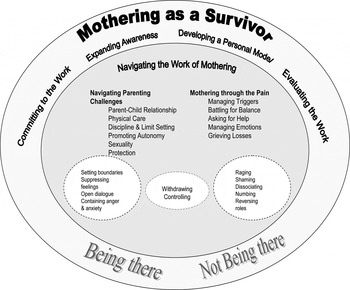
Processes emerged that described the ways in which participants approached and managed the work of mothering in light of memory of their childhood history and attempts to heal from this earlier trauma. The theoretical model identified through analysis of the data was titled “The Hard Work of Mothering as a Survivor.” The core category, developing a mothering self, described the developmental process by which participants developed an ability to love and nurture the self as well as effectively mother their children. In this process of change and growth mothers became increasingly able to differentiate mothering needs of their child and the child within, as well as to find the middle ground in relation to caring for their child and caring for the self, and in relation to specific tasks of parenting. There was a cycling or spiraling back and forth nature to this process. The process began with committing to the work. Committing to the work was ongoing as were the processes of expanding awareness, developing a personal model, and evaluating the work of mothering (refer to Figure 1). In navigating the work of mothering, mothers must navigate parenting challenges encountered in day-to-day interactions with their children. In the process of navigating parenting challenges, wounds were continually reopened and childhood experiences were relived. Consequently, mothers found themselves mothering through the pain. Mothers struggle to be there for their children as they navigate the work of mothering. These processes are elaborated below.
The theoretical model entitled “The Hard Work of Mothering as a Survivor.”

Committing to the work
Committing to the work involved committing to becoming a better mother, which necessitates committing to the hard work of recovery. This entailed promise or undertaking, as well as performance of action. Mothers expressed a calling to mother their children differently than they were mothered. One participant stated, “I had to be right for them, honestly. I have to be right for them.” Another mother voiced that having her daughter was a “call to action.”
Expanding awareness
In order to commit to the work, mothers had to become aware of the abuse as well as accept the way abuse had affected their life and them as a mother. Participants differentiated between the time during which they gained initial awareness of their abuse history and the ongoing process of expanding awareness. Some mothers talked about gaining new awareness of the effects of abuse on them as mothers when they exhibited behavior that was “foreign” or when confusing feelings “came at me.”
The stress of being a parent is enough for the quote–unquote normal person, but if you've got shit in here it comes out . . . because of parenting her, because of the issues around that that brought out all the demons, you know? Yeah, and so even though I'd done psychological work before, I knew something was wrong, but I could not put my finger on it. You know, I just, I was dog paddling.
Developing a personal model
Mothers expressed that they did not have a model for parenting, and were unable to determine what was normal in terms of child development and behaviors, parenting behaviors and, finally, what were normal feelings and behavior for a mother with a history of childhood sexual abuse. Mothers revealed several strategies for developing a personal model for mothering; reflecting on the way in which they were parented, seeking out information on parenting through books and parenting classes, checking out perceptions with therapists, selecting a “model” mother to emulate, and attending survivor support groups. Some mothers who had not had contact with survivor mothers expressed distress regarding their difficulty in judging what was “normal” for a survivor mother. Personal models also included goals for mothering. For most mothers the foremost goals were that their child would not experience abuse or other pain and that the child would enjoy the experience of having a childhood. Mothers expressed the importance of valuing and showing respect to their child. They also articulated goals of being open, real, and present for their children. The process of developing a personal model for mothering was ongoing, as mothers realized that as their children reached new developmental stages they needed to continue to revise and expand their models of mothering. For example, mothers of late adolescent and adult children indicated that they did not have a healthy model for this phase of the relationship. One mother with a child in college expressed her belief that survivors do not have a chance to separate in a healthy way and that allowing her son to separate was very difficult.
Evaluating the work
Mothers also engaged in a process of evaluating their work as mothers. It was very important to participants that they be able to meet the mothering goals identified above: that they be good, or even perfect mothers. As was stated by one mother it is “very important to do it right, set out to try to figure out how to do it and to judge/evaluate how well you're meeting your standards.” A second participant expressed her struggles with negative evaluations of her mothering, stating “I have a big button about bad mommy.” Participants' evaluations included judgments about their competency/normalcy as a mother and as a survivor/mother, and about their child's normalcy. Mothers also imagined others' evaluations of their mothering. As mothers shared their self-evaluations, they revealed hoped for mothering selves, actual mothering selves, and feared mothering selves.
Navigating the work of mothering: Parenting challenges
Navigating the work of mothering refers to the process of attempting to mother in ways consistent with one's developing personal model while simultaneously mothering through the pain of recovery. As participants engaged in the daily work of mothering, they found certain mothering tasks and responsibilities to be especially important but also challenging and problematic. These included demonstrating empathy and affection, disciplining and setting limits, promoting autonomy, promoting healthy sexuality, and protecting the child. Participants recognized that mothers without a history of CSA also struggle with these parenting issues. Participants perceived, however, that their difficulties were more extreme due to their lack of reference for normal developmental experiences and behaviors, and because these mother–child situations triggered reliving of abuse experiences and associated emotions. Mothers also struggled to find a healthy middle ground in relation to these issues, tending to parent in extremes.
Protecting from danger, pain, and unhappiness
As protecting from danger, specifically abuse, was a major parenting goal of the mothers, there was much attention and energy focused on this parenting task. In infancy and early childhood mothers used guarding/surveillance behaviors to ensure safety. As children grew older, guarding/surveillance was extended and mothers also began to use additional strategies: warning children of the danger, monitoring access to potential perpetrators, teaching children to protect themselves, and being open with children. Mothers indicated that being open with children about their emotions and experiences and encouraging children to do the same was essential so that the child would know that he/she could come to the mother if hurt or abused. Openness about risk behaviors was a strategy used to protect the child from his/her own potentially dangerous choices. Mothers perceived that their awareness of dangers and openness were parenting strengths, and ways that they differed from mothers who were not survivors of CSA.
Mothers' responses also revealed difficulties in finding a healthy balance between underprotection and overprotection of children. Some mothers revealed that due to a lack of processing of their abuse and/or internalized self-blame for the abuse they had not recognized the potential for abuse of their own children, and had not consistently engaged in protecting strategies in the past; consequently, at times exposing their children to dangerous situations. Several mothers revealed that, in fact, one of their children had been sexually abused. Other mothers veered toward hypervigilance and overprotection. For a few mothers who had come to see all males as being unsafe, a male child reaching puberty or a spouse were also viewed as potential perpetrators dangerous to others. These mothers conveyed that they had to protect their daughters from these male family members.
Building the mother–child relationship
Determining healthy emotional intimacy and experiencing emotional closeness and connection was a difficult task for some mothers. Although mothers discussed the importance of being emotionally present for their children, they also recounted times when they withdrew, experienced emotional numbing, or resented their children. One mother described the way in which she distanced herself from her son as a way to protect herself from fears that she would become abusive or that others would perceive her to be an abusive mother. Another respondent described how she “pulled back too far” because of her fear that she would invade her son's boundaries. Other mothers also related this difficulty to the lack of a model for healthy affection in the mother–child relationship.
When my daughter first went to preschool, her very first day I took her into preschool and I just left her. I didn't know you did this, that you kiss them and say have a good day—I didn't know you did that stuff. Or, if they get hurt somewhere, I'll go outside to see how she is but I think it's just, it's like an act for me . . . It feels like I'm standing back and watching them. And it's kind of like, it's like an act to me.
Other mothers expressed difficulty in responding with empathic understanding as they compared their own childhood and that of their child.
I have trouble relating to my daughter's ‘problems’ because I think she's had such a stable, healthy family life. I think of the troubled childhood I had, and can understand why I had problems with self-image, relationships, and communicating, but feel she doesn't have reason to be troubled.
Although mothers articulated the goal of giving their children a childhood, at times the child's expressions of pain, fear, or anxiety, and subsequent needs for comforting were experienced negatively by some mothers. Mothers described difficulties identifying and empathizing with the child's fear and vulnerability, instead responding to the situations with feelings of lack of control (child not doing what he/she was asked to do) or anxiety as these situations triggered emotions related to their own childhood experiences. Further, mothers often used their child's behavior as a measure of their effectiveness and value as a mother and a person; when the child did not behave according to rigid/perfectionistic standards this elicited mothers' feelings of guilt and “not being good enough.” One mother described asking her 3-year-old daughter to recite the alphabet.
And she started, and she messed up. And I'm like ‘You are so stupid! Oh my God!’ . . . I think I wanted her to be better than everybody. You can be better than I was! We can do this! I've always blamed myself for anything she was doing, or not doing.
Providing physical caregiving
Mothers were sometimes wary of conditions in which physical touch and intimacy between them or their child or between their spouses/partners and their child was present. For some mothers, diapering or bathing young children provoked fears that they would become abusive or that others would consider them abusive. Some mothers described having fleeting thoughts of wanting to touch their child inappropriately, but not acting on those feelings.
...it would cross my mind sometimes with diapering them, just what they looked like—I never touched them or anything like that but just, it would cross my mind as far as that and especially with little boys getting erections.
Some mothers described avoiding their child's nude body as much as possible in an effort to protect themselves from these thoughts. Others engaged in the caregiving, but harbored fears regarding potential consequences.
Discipline and limit setting
Mothers expressed struggling with knowing how and/or being able to appropriately discipline their children. Taking on this role at times conflicted with the mother's goal of protecting the child from unhappiness. Data also indicated that situations in which children expressed anger in response to discipline/limit setting were especially problematic. In these situations, mothers often experienced a sense of disrespect and loss of control. This loss of control often elicited thoughts and emotions similar to those the mother experienced during childhood abuse, such as fear, anxiety, rage, confusion, or shame. Last, mothers also had difficulty imposing structure and consistency because as one mother revealed the “inner child needs play and affection.” Mothers identified several strategies used in this area: trusting the process, avoiding corporal punishment, and using strategies that minimized the child's negative affect.
Promoting autonomy
Promotion of age-appropriate autonomy and separation/individuation was likewise troublesome for mothers. Some of the participants again expressed the difficulties inherent in having no model for what were developmentally appropriate expectations, responsibilities, and privileges. In vivo codes for this category included letting go and giving the space, yet for some mothers, letting go and a child's assertions of independence caused feelings of anxiety related to no longer being the “protector.” Children's expressions of separation/individuation also, at times, caused mothers to feel invisible, unappreciated, or unacceptable, feelings experienced during their own childhoods. In describing circumstances and outcomes related to this task of mothering, one respondent stated, “It triggers not being good enough. If I'm good enough then I can prove that I'm not this dirty thing that happened and that it's not my fault.” Difficulties in promoting age appropriate autonomy also resulted, in some cases, from a mother's overwhelming depression and fears of being alone; at times, this resulted in role reversal. One mother revealed, “I kept her home from school a lot, when she was little, so I wouldn't have to be alone. You know she was my best friend in the world really.”
Promoting healthy sexuality
Promotion of the sexual health of their child was extremely troublesome for mothers, as this was the area identified by many as least resolved in their own lives. Mothers conveyed concerns about children's sexual curiosity and sexual behavior. This became more pronounced as children neared puberty and mothers feared that they would be viewed as sexual by others. It also was difficult for some mothers to promote healthy views of sexuality and self as a sexual being because of their focus on protecting the child. Respondents attempted to meet this challenge by modeling comfort with nudity in the home and exposing children to literature related to sexual development. Mothers also expressed talking to children about the right to say no to unwanted touch and sexual advances by dating partners.
Navigating the work of mothering: Mothering through the pain
Mothers experienced significant challenges in meeting their goals for mothering as they mothered through the pain of having been sexually abused as children and confronting this pain in recovery work. Children and mothering tasks often contributed to memories of abuse and reliving of the abuse experiences and the related emotions of fear, anxiety, rage, confusion, powerlessness, and shame. One respondent voiced “. . . you're having to in effect sort of nurse, you know, these children when you need a nurse.”
Managing triggers
Mothers described the importance of learning how to anticipate and manage triggers in order to attain their parenting goals. Triggers sometimes involved specific circumstances, such as time of day, locations, or anniversary events. At other times the process of mothering and/or characteristics of a particular child, including age, gender, and behavioral responses were sometimes triggers. Often, mothers recounted that when a child reached the age of their abuse this milestone served as a trigger for initial recovery of memories or for rememories. At times, this made any interaction with that child extremely painful. One mother spoke of her son when he was 8 years old, also the age when her abuse began, “I couldn't stand him. There were times I didn't even want to be around him, and that was real hard . . . to have love and that kind of repulsive thing going on.” The frequency and intensity of triggering varied, with mothers describing this as being most intense during their most active recovery work. Mothers also found that new developmental stages sometimes brought new triggers for which they were unprepared.
Battling for balance
Mothers realized that confronting and working on abuse-related issues was paramount to becoming healthier women and mothers; one aspect of recovery work was acknowledging the hurt of the child within and healing that inner child. Consequently, participants described a painful battling for balance between the demands of mothering their child or children and the demands of recovery work and mothering the child within. One mother expressed this struggle:
I couldn't identify my own emotions, much less help him identify his . . . he's a high demand, very intelligent, but high demand child. And I had my own high demand child inside. It was definitely needing to help myself grow up in a sense and learn about myself while trying to do that for my child . . .
Managing emotions
Mothering through the pain involved managing emotions precipitated by or exacerbated by recovery work and those precipitated by the interaction of recovery work and mothering. One respondent talked about the ongoing emergence of new memories and stated, “I think that being a survivor you learn to control your feelings so that a lot of times I just keep things hidden, sheltered until I know that I can have the time that I need to deal with it without scaring them or whatever.”
Grieving losses
Respondents expressed that mothering through the pain also involved the pain of grieving for their own lost childhoods. One mother stated, “I look at her and I think . . . sometimes I get sad, like I think ”God, that's what I could have been, you know . . . and sometimes I wish that I was a kid with her, you know?” A second mother revealed “And she just runs around and plays and has no fears, you know, but I'm there to protect her and when I see that and experience that I miss that part of my childhood. And I'm so glad that she has that, but it makes me sad too.” Further, mothers expressed grief over the ways in which CSA and recovery had negatively impacted their ability to enjoy their children and the mothering experience.
Asking for help
Mothers recognized the necessity of asking for help as they were mothering through the pain of recovery. Asking for help involved help with specific tasks such as bathing, accessing of helping resources, and spiritual help or support. Husbands and partners, friends, other survivors, therapists, clergy, and God or a higher power were important sources of help. Family members were sources of help in some instances, but family of origin issues and family cutoffs related to abuse were barriers to help seeking and resources in other cases. Asking for help and the availability of resources was affected by the mother's willingness to disclose her history and her needs for help.
Struggling to be there
Mothers' success in navigating the work of mothering resulted in varying behavioral outcomes—degrees of “being there” for their child. Being there involved physical presence and emotional attunement or availability. As mothers developed increasing awareness of their history and secondary responses to abuse they developed methods of attempting to simultaneously manage their reactions and meet their goals and standards for mothering. In these situations they had to identify whose needs must be met (self/child), they had to control their own intense/overwhelming emotions, and they had to avoid responding from the pain of their own inner child. Mothers described working to stay connected, both within themselves and with their child in order to meet their goal of being there for their child.
I find it very confusing because often I'm being triggered and in the situation of needing to cope with, there's a button being pushed . . . something is going on in the background, which is kicking in the fight or flight. But in the foreground there's the adult, she's saying, but here's this 2 year old or 9 year old child or whatever who had a need I had to meet. And I have the interplay of trying to bargain with myself to meet my own need which is ‘O.K. I can deal with this trigger later and meet the need of the child standing in front of me at that time.’ So, I find it often very confusing. And the other word that comes to mind is exhausting. Because it's a constant battle of attempting to make sure that I'm not knee jerk responding—that I choose my responses because I don't, in most cases I don't necessarily want to go with the first response.
This example illustrates the mother's ability to “be there,” by setting boundaries around the recovery work, suppressing her feelings, and containing her anger and anxiety.
Sometimes, mothers were unable to successfully suppress or contain memories or emotions precipitated by the simultaneous influences of mother–child interactions and recovery work. Yet, they were able to stay sufficiently connected within themselves and the present interaction to behave in ways seemingly less destructive to their children and themselves than “not being there” responses. As one mother voiced, “I would just come unglued over him . . . I went out of the room because I knew I couldn't deal with the situation any longer.”
Mothers recounted instances in which they were unable to effectively navigate the work of mothering, became overwhelmed by abuse-related emotions and were unable to stay connected to the present, to “be there” for their child. In these instances, mothers demonstrated raging or shaming behaviors toward their child, experienced numbing or dissociating, or engaged in role reversal. Raging is an important outcome that respondents perceived as frightening and the degree of rage experienced is one way in which respondents see themselves as being different from other mothers. Respondents indicated that “not being there” behaviors were most frequent and severe prior to active recovery work and during the most intense periods of active recovery work. As respondents gained greater awareness and understanding of their abuse history, secondary responses, and relationships between mother–child interactions and triggering of memories and abuse-related emotions, these “not being there” responses tended to decrease.
Developing a Mothering Self
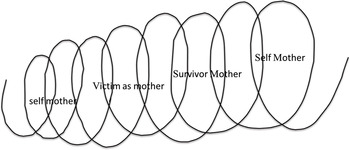
Mothers described a process of change and movement over time in their efforts to develop a “mothering self” (refer to Figure 2). A mothering self is able to love, nurture, and protect herself as well as able to mother her children in ways that promote their health. Data revealed the cycling nature of developing a mothering self as respondents described this as “ongoing,” “back at first base,” “over and over again,” and “pushed forward.” Some mothers described their mothering prior to recovery of memories in ways that reflected later phases of this process, and a cycling back following their first awareness of their abuse history. Some mothers who recounted healthier families of origin and active recovery work prior to motherhood never experienced the first phase of the process. Mothers' descriptions also suggest that as a child reaches new developmental stages, they may experience new triggers and cycle back in the spiral. Thus, the degree to which the mother changes over time is dependent on a number of factors.
Developing a mothering self.

Self mother
The use of the lower case illustrates that mothers in this phase demonstrate minimal awareness, understanding, and/or processing of parenting or of the abuse experiences and how these have affected the self and self as mother. Respondents' descriptions of their mothering in this phase indicated a limited ability to differentiate between the needs of their child and their own unmet needs, and a minimal healthy valuing of self or of self as mother. Not being there responses are common in this phase. One respondent described herself as a parent before recovery work:
We were very close—we grew up together. I don't think I thought so much about how I was shaping her. I took her almost everywhere with me and that was the point in my life when I was partying a lot and I would take her to parties, and she would see me, you know, and I would drink with her.
Victim as mother
During this phase mothers are developing a beginning awareness and acknowledgement of abuse and/or abuse effects, and are often immersed in recovery work, denoted by the use of the upper case for victim. The predominant focus is on the pain associated with the abuse and its effects, with mothers describing themselves as “raw,” having an “open wound,” and a “gaping hole.”
I'm kind of like a person, but not a real person . . . I'm on a spiral, I'm kind of like, I'm not at the very beginning, but I don't think I'm even in the middle after all these years. I think because I still blame me and I still hate me and that's where I'm at and actually I never see me getting past that . . . I feel like I'm wearing a plastic bag or something and that's all they see is that layer, they don't see how bad, really things are for me.
Survivor mother
Mothers described a phase in which the personal identification of the self as a survivor is highly salient, but there is a greater acceptance and ability to differentiate needs of the child and their own unmet needs. Mothers in this phase are experiencing fewer of the secondary effects of the abuse and do not become so overwhelmed by abuse-related emotions when interacting with their child; consequently, they more often exhibit “being there” for the child.
I'm a lot more settled. I just feel more whole or balanced or something . . . I don't think about it as much as I used to . . . I still deal with shame, the areas where I get triggered are getting smaller and smaller . . . So much less anger, so much less projecting of my stuff, a quicker recognition of what's going on and being able to own it.
Self mother
Mothers in this phase demonstrate an understanding and acceptance of personal limitations and a healthy self-worth. This woman values and is able to nurture and protect herself as well as able to nurture and protect her child.
There's an internal peace that I can actually achieve at times now which is really really lovely. And as I achieve that and become more centered and balanced as a person I think I have a tendency to react differently to my children . . . I have a tendency to more often see the joy and see the humor in the situation, I need to control things less . . . I think I'm also willing to accept a deeper sense of satisfaction in being a parent. And it's not so fear based now.
Discussion
This study centered on the perspectives of women who had experienced significant CSA, and were willing to reflect on how this traumatic experience had impacted them in their role as mothers. The study utilized a qualitative methodology as an avenue to discover and develop a more comprehensive model of mothering following the experience of CSA. As described by Maracek et al. (2001), the essence of a qualitative stance involves “listening to and theorizing about what emerges when people use their own words to make sense of their lived experience” (p. 33). We felt that this approach provided an in-depth subjective description of the experience of parenting as a CSA survivor. Our proposed model “the hard work of mothering as a survivor” captured the complex, challenging, and changing issues that survivors of child sexual abuse face as they attempted to navigate both their recovery from the abuse experience and the task of parenting. Early on in the recovery process, issues pertaining to their victimization experience often predominated, leaving less attention and emotional capacity available for parenting. Later in the recovery process, identification with their abuse experience and its myriad effects appeared to diminish and the mother seemed more able to attend to her own needs as well as the needs of her child and family. By working with the mothers' own words, we were struck by the complexity of the issues facing them in their role as parents. We heard stories involving parental struggles, triumphs, joys, confusion, and despair. The overall model attempted to capture the dynamic nature of the task of parenting as the survivor continued to heal from the legacy of her abuse.
Our findings supported, yet expanded upon and enriched, past quantitative research conducted on mothering in adult survivors of CSA. Consistent with prior research, the mothers participating in this study reported a variety of parenting challenges and characteristics that have been reported by other investigators: questioning of their parenting competency, concerns over inconsistency, being overly permissive or overly protective, problems in fostering of age-appropriate autonomy, difficulties with emotional and physical intimacy, excessive maternal anger, less emotional control in parenting, and concern that their child might become a victim of sexual abuse. Our findings illustrated the complexity of the contexts in which these stresses and mothering behaviors occurred. Mothers' descriptions of their experiences, as they confronted these situations in their interactions with their children, suggested a complex, dynamic interplay among four important and interconnected domains: (a) the mothers' processing of their childhood abuse history, (b) the development of a healthy model for mothering, (c) the pain of recovery and the mother's position on the abuse recovery trajectory, and (d) the mothers' navigation of specific parenting challenges as they and their child grow and develop. The key struggle for many mothers was how to balance these competing tasks. Their ability to achieve an appropriate balance was essential in both their personal recovery and feelings of confidence in themselves as a parent. Understanding the dynamic relationships among each of these processes was critical in safeguarding recovery and successful navigation of parenting challenges. For some mothers, early in parenting they were largely unaware of how their abuse experiences were negatively impacting their parenting, and it was only in retrospect that they gained more awareness and understanding. For other mothers, issues pertaining to their sexual abuse experience reemerged at various times throughout their parenting and the child's development. Often this was unexpected, and mothers reported being surprised at the intensity of emotion that arose regarding issues that they had thought had been addressed and resolved. The child reaching the age that they were when they had been abused was particularly activating, as were concerns regarding the possibility that their child might be sexually victimized. The interplay between awareness and management of CSA recovery issues and parenting challenges has not received much attention in past literature and warrants further research.
Although participants in our study varied in their present evaluations of their parenting competence, they consistently described times during which they perceived themselves to be inadequate as mothers. They expressed the high value they placed on being good mothers, and guilt and grief about those times in which they had been unable to meet their expectations of themselves. This finding parallels that of past research that has documented a fear among CSA survivor mothers of being “a bad parent” (Banyard, Reference Banyard1997; Herman, Reference Herman1981). Mothers found that as they developed a greater understanding of the impact of their history on their intrapersonal and interpersonal functioning, they were more realistic in their expectations for themselves and their children, achieved greater balance in their responses, and evaluated themselves as being healthier women and mothers. This is consistent with findings of prior research (Phelps, Belsky, & Crnic, Reference Phelps, Belsky and Crnic1998; Stiles, Reference Stiles2001; Wright, Crawford, & Sebastian, Reference Wright, Crawford and Sebastian2007), suggesting that adults who have worked through the pain of their abusive childhoods and have formed a coherent perspective on these experiences exhibit greater resilience later in life. The findings also highlighted the importance of understanding and learning to tolerate and modulate affective responses during mother–child interactions. Mothers reported being particularly troubled by lack of emotional control, resulting in uncontrollable feelings of rage, anger, or a need to detach or dissociate. Consequently, a focus on affect regulation is likely to be an important part of the process of recovery (Cloitre, Koenen, Cohen, & Han, Reference Cloitre, Koenen, Cohen and Han2002; Gross, Reference Gross1998).
The findings also highlighted the dynamic, multifaceted nature of recovery and resilience, as a process that evolves over time (Luthar, Cicchetti, & Becker, Reference Luthar, Cicchetti and Becker2000). When resilience is viewed as multidimensional and contextual, variation in functioning across multiple domains is anticipated. Resilience is influenced not only by the mother's personal ability to cope, but also by the severity and chronicity of the specific challenges she faces and the adequacy of her current resources and support (Harvey, Reference Harvey2007; Masten & Wright, Reference Masten, Wright, Reich, Zautra and Hall2010; Sullivan, Reference Sullivan1998; Wright et al., Reference Wright, Fopma-Loy and Fischer2005; Wright & Masten, Reference Wright, Masten, Goldstein and Brooks2005). Thus, the process of “developing a mothering self' is fluid, dynamic, and responsive to multiple factors and influences.
The dynamic process that was captured in our model was consistent with Sgroi's model (1989) on the stages of recovery for adult survivors of sexual abuse. Our findings suggested that mothers experienced the greatest difficulty in parenting in the “self mother” and “victim as mother” phases, which corresponded to the phases of “acknowledging the reality of the abuse” and “overcoming secondary responses to the abuse” described by Sgroi (Reference Sgroi1989). The spiraling nature of developing a mothering self was consistent with Sgroi's (1989) recovery spiral that accounted for setbacks, relapses in recovery efforts, as well as forward movement. We felt that a spiral model appeared to better capture the journey for these mothers than a stage model. Stage models convey forward progress, but they suggest a linear process, which did not appear to accurately reflect these mothers' experiences. They described an ongoing dialectic, a nonlinear process including positive changes and personal growth as well as setbacks and discouragement. This spiral model has also been utilized in conceptualizing recovery from serious mental health problems, where a nonlinear, dynamic, forward and backward process has also been noted (Ochocka, Nelson, & Janzen, Reference Ochocka, Nelson and Janzen2005).
It is also important to recognize that mothers may be in varying phases of developing a mothering self for different aspects of mothering tasks and roles. There needs to be attention to variability across the different domains of interest and concern. The challenges experienced also differed in respect to specific children; unique characteristics of a particular child (e.g., age, gender, temperament) and/or unique characteristics coinciding with intense recovery work contributed to more problematic mothering of that child. Mothers may cycle back to earlier phases of developing a mothering self when children reach new developmental stages. The mothers own words revealed the cycling nature of this process—it's an “ongoing process,” at times the mother might feel like she is “back at first base,” struggling with issues “over and over again,” and at other times she feels “pushed forward.” The importance of this spiraling back and forth dynamic was particularly salient in this community sample, and may be even more evident in a clinical sample. When this model was presented for feedback to a group of sexual abuse survivors, this aspect particularly resonated and made sense to them. They felt that it could open up important dialogue with therapists about the difficulty of simultaneously working on recovery issues and parenting challenges. A concern widely shared among the survivor group was that at times, to maintain effective parenting, it was necessary to put aside work on CSA recovery, as it tended to be destabilizing.
Clinical implications
Participants consistently expressed appreciation for the opportunity to discuss their mothering experiences, stressing that this was an extremely important aspect of their lives and recovery which was not addressed sufficiently in psychotherapy or through other resources, such as reading literature on recovery from CSA. Some mothers expressed that although they consulted resources on parenting, these did not meet their needs because these resources did not provide information on what was “normal” for a survivor mother, and many mothers requested feedback as to whether their experiences had been articulated by other mothers who were survivors. This lack of attention to the area exacerbated mothers' difficulty in performing the hard work of mothering as a survivor. Thus, this research points to the need for an increased focus on parenting in clinical work with survivors. Study findings suggested that mothers would benefit from guidance about healthy parenting and normal childhood development to assist them in developing a personal model for mothering. Further, mothers may also benefit from anticipatory guidance about common experiences and concerns of mothers who are survivors of CSA. Challenges encountered in mother–child interactions may not be spontaneously discussed by mothers due to their concerns about the meaning of these thoughts, feelings, and behaviors, and subsequent negative evaluations of their mothering.
Mothers also need resources for coping as they move through different phases of developing a mothering self. For example, a woman in the “victim as mother” phase is often overwhelmed by negative emotions and may be triggered frequently and intensely by her child and response to that child. This parent may need assistance in learning how to manage and appropriately express her emotions. Some mothers in our study reported vacillating between silencing their emotions and becoming numb, or raging and losing control. Such a parent may need a break from constant child care responsibilities and need permission/resources for child care and respite, as well as assistance in identifying ways to tolerate and cope with these overwhelming emotions without losing control or contact. Helping her chart a more modulated approach, and develop better self-awareness and self-regulation can be essential to recovery (Cloitre et al., Reference Cloitre, Koenen, Cohen and Han2002; Gross, Reference Gross1998). Direct work with a mother who feels overwhelmed by anger and loss of control utilizing parent–child interaction therapy might also be extremely valuable in reducing the risk for physical abuse (Chaffin et al., Reference Chaffin, Silovsky, Funderburk, Valle, Brestan and Balachova2004; Timmer, Urquiza, Zebell, & McGrath, Reference Timmer, Urquiza, Zebell and McGrath2005). A woman in the “survivor mother” phase has often learned to manage triggers and emotions more effectively, but might benefit from cognitive approaches and problem solving related to specific problematic mother–child interactions. Therapies that focus on narrative process, how past family of origin experiences have negatively impacted internalized schemas of the self and influenced expectations of significant others, and learning alternative ways of relating and responding to others might be useful complements to experiential work on emotion regulation (Allen, Fonagy, & Bateman, Reference Allen, Fonagy and Bateman2008; Young, Klosko, & Weishaar, Reference Young, Klosko and Weishaar2003). It is also important for clinicians to recognize that moving too quickly with recovery may interfere with a mother's ability to meet her goals for mothering. Again, providing permission for the mother to put boundaries around the extent/pace of recovery work and collaborating in the development of ways to do this is important. The spiral nature of the developmental process of developing a mothering self also has important clinical implications. Our findings revealed that issues often surfaced anew as children reached different developmental stages, and mothers were unprepared for the reemergence of triggers and abuse-related memories and emotions. Anticipatory guidance regarding this is also important.
Building supportive networks, learning to counteract negative self-evaluations, and finding time to engage in pleasurable and restorative activities can significantly impact overall well-being and improve capacity to cope with challenging parenting demands. At the appropriate time, survivor mothers might also benefit from broadening their life focus and redirecting attention away from processing CSA memories and into new priorities and pursuits (Morrow & Smith, Reference Morrow and Smith1995; Phillips & Daniluk, Reference Phillips and Daniluk2004). The overarching model of mothering as a survivor might also serve as a useful psychoeducational tool in therapy. It might facilitate dialogue about sensitive parenting and recovery issues, and help the survivor navigate work related to abuse related trauma and how it has impacted parenting.
Limitations of the study
It is important to note the limitations of the study. The participants reflect only a subset of the population of mothers who are survivors of CSA, and they had predominantly experienced more severe and prolonged forms of intrafamilial abuse. The participants were also women who were motivated to respond to a research solicitation and able to share their thoughts with a research team. The participants were very homogenous with regard to race/ethnicity. Some mothers in the study recounted additional family of origin issues such as alcohol abuse and experienced multiple forms of child abuse. Consequently, their experiences of mothering as a survivor may have also been influenced by these stressful childhood experiences or by stressful experiences in their adult life. The model of mothering developed is thus unique to this particular sample, the interpretative process of these three investigators, and the specific context of the study. The transferability of this model of mothering needs to be examined in other contexts, with more diverse participants and through other investigative lenses.
Some of the data collected was based on women's retrospective accounts of parenting challenges that had occurred earlier in the child's development and may have been affected by selective memories. Respondents were also comfortable disclosing their perceptions of mothering as a survivor; therefore, results may not reflect the perceptions and experiences of those women who would be less comfortable with this process. Study questions did focus heavily on the mothers' immediate family experience, and did not fully explore her outside support system and other important contextual influences. Future research needs to incorporate an ecological analysis, focusing not only on the mother, but on her relationships with others and the social structures and systems that impact her over time (Sullivan, Reference Sullivan1998). When research focuses primarily on the individual, there is a danger of overemphasizing the attributes of the individual that contribute to her current difficulty. This can result in blaming the victim for her problems (Ochocka et al., Reference Ochocka, Nelson and Janzen2005). Finally, it would also have enriched and extended the study to have interviewed spouses and children regarding their experiences and thoughts and to have had independent observer assessments of the mothers' parenting competence and family environment. Given the richness and sensitivity of qualitative methodologies, and their ability to sensitively explore social context, future studies might benefit from use of participant observation, open-ended interviewing, focus groups, and life history case studies from a broader array of individuals important in the life of survivor mothers (Sullivan, Reference Sullivan1998).
Directions for future research
The findings illustrate the importance of investigating concerns about parenting and mother–child interactions across varying stages of the mother's recovery and stages of the children's development. Short-term prospective and longitudinal studies will enhance our understanding of the factors that influence the complex and dynamic experience of parenting among child sexual abuse survivors. Further studies are needed to establish a comprehensive framework that is inclusive of the experiences of women of differing sociodemographic characteristics and to establish the transferability of this model of mothering as a survivor to other mothers who have experienced CSA. It is also critical to incorporate the voices of fathers, a much neglected group also struggling with the aftermath of CSA and parenting. Whether fathers' issues are similar to mothers, and/or how their concerns and struggles might differ is an important area for new research. Extending this model of mothering to encompass multiple ecological systems (e.g., partner, children, extended family, friends, therapists, religious figures, etc.) as they influence and are influenced by the survivor mother is also needed (Cicchetti & Valentino, Reference Cicchetti, Valentino and Masten2007; Luthar & Brown, Reference Luthar and Brown2007; Masten, Reference Masten2007; Masten & Wright, Reference Masten, Wright, Reich, Zautra and Hall2010; Sullivan, Reference Sullivan1998). Triangulation of research methodologies, incorporating qualitative and quantitative approaches, as well as self-report, significant other report (partners and children), and observational study, will enhance understanding of parenting in survivors of child maltreatment and inform clinical intervention. Given the multiple areas of potential vulnerability for CSA survivors in their role as parents, there is also a critical need for research that explores and validates specific parenting interventions to enhance the overall well-being of the mother and family. A closer partnership between quantitative and qualitative methodologies has the potential to advance intervention efforts for survivor parents and their children by identifying important precursors of difficulty, specific developmental challenges, patterns of dysfunction, and relevant variations across social contexts (Sullivan, Reference Sullivan1998). Finally, it is our fervent hope that research efforts will continue to be informed by Garmezy's legacy of listening to the stories of others' struggles with trauma and adversity, by his compassion and willingness to assist in their efforts toward recovery, and by his remarkable ability to direct attention to the factors that promote their competence and resilience in the face of tremendous stress.