In the Middle East over the past half-century, three religious processes have grown together. One, the growth of fundamentalism, has received worldwide attention both by academics and journalists. The others, the bureaucratization of religion and the state co-optation of religion, of equal duration but no less importance, have received much less attention. The bureaucratization of religion focuses on the hierarchicalization of religious specialists and state co-optation of religion focuses on their neutralization as political opponents. Few commentators link the three processes. In Jordan, fundamentalism, the bureaucratization of religion (BOR), and state co-optation of religion (SCR) have become entwined sometimes in mutually supportive and sometimes in antagonistic relations. The following case study will describe and analyze the implications of this mutual entanglement for the relations of state and civil society and for the human beings simultaneously bureaucratized and “fundamentalized.”1
I coined this term to indicate individuals who have to some extent embraced the world view and ethos of fundamentalism and many of its prominent attributes described later.
It should be emphasized that the aim of this social anthropological case study is to trace a process through the lives of people in particular places to cut away misconceptions and lead to novel insights. The case study also provides in-depth understanding by focusing on a detailed investigation over a narrow field of social relations over a period of time. The processes being investigated here are the growth of religious fundamentalism, the bureaucratization of religion, and the co-optation of religion by the state. The subjects of the case study are the people of al-Kura district, Jordan, more particularly the people of the village community of Kufr al-Ma, and still more particularly, certain individuals: one village preacher, Shaykh Luqman, one fundamentalist running for office, Abd al-Majid Nusayr, and one local waqf bureaucrat. The social anthropological case study involves great contextualization over a narrow range of social relations, but its aim is not historical contextualization. Thus, for instance, I do not seek to locate either the preacher or the electioneering fundamentalist within a range of Islamic movements or trace the development of such movements (e.g., Muslim Brotherhood), over time. Rather, I describe their activity/views with the goal of illuminating the processes referred to above.
This essay reinforces a point previously made about relations between state and civil society in Jordan, and I would argue in the Middle East generally: these are not separate formations, but rather, part of a web of social relations that cut across different institutional and legal settings.2
See Antoun, “Civil Society, Tribal Process, and Change in Jordan: An Anthropological View,” International Journal of Middle East Studies 32 (2000): 441–63, for an elaboration of the argument in the social context of tribalism rather than religion.
The approach to fundamentalism taken here is against the grain of much writing on the subject: it is cross-cultural and comparative and cross-cuts world religions such as Christianity, Islam, and Judaism. Such an approach is well established in disciplines such as the history of religion and comparative religion, although not in many social sciences and humanities.3
For examples of this comparative approach, see Bruce Lawrence, Defenders of God: The Fundamentalist Revolt Against the Modern Age (San Francisco, Calif.: Harper & Row, 1989) and Karen Armstrong, The Battle for God (New York: Alfred A. Knopf, 2000).
For a more detailed account of these and related concepts, see Richard Antoun, Understanding Fundamentalism: Christian, Islamic, and Jewish Movements (New York: AltaMira Press, 2001) and Bruce Lawrence, Defenders of God.
Fundamentalism, then, is not against change. Fundamentalists embrace social organizational and technological change on a selective basis, provided the changes are consonant with their own values and help them combat their internal and external enemies. Fundamentalists accept many aspects of the modern world on a selective basis, for example, Christian fundamentalists are highly successful televangelists who have mastered bureaucratic modes of social organization and business techniques to raise money in the process of building a mass following; Muslim fundamentalists run huge Islamic banks and are highly skilled in using modern communications (audiotape, videotape, Internet, cell phone). Fundamentalist movements are inherently oppositional and minoritarian, and their adherents are usually members of protest movements; it is the protest of those not in power seeking to gain power, that is, to change.
Fundamentalist movements coalesce around and are defined by certain consuming themes: the quest for purity in an impure and corrupt world; the search for authority in an increasingly pluralized world; the necessity for certainty (in a divine scripture) in a constantly changing world; activism and totalism in a world where the local has lost its coherence; selective modernization and controlled acculturation in a world in which secularization advances from all directions; and making relevant a mythic past to the present situation (“traditioning”) in a world where traditions are perceived to be unravelling.5
This capsule summary necessarily simplifies the complexity of the concepts presented and their analysis. See Antoun, Understanding Fundamentalism, for the argument, the analysis, and the evidence.
Although the world view and ethos of fundamentalism are the same cross-culturally, the cultural content of fundamentalism and the historical circumstances of its emergence differ. Whereas Christian fundamentalists have raged against alcoholism, immigration, the decline of the family, and the doctrine of evolution, Muslim fundamentalists have raged against Western cultural and economic (not simply political) penetration through Western colonialism; and Jewish fundamentalists have raged against anti-Semitism, the Holocaust, and the rise of Zionism.
We will now proceed to our case study and its focus on the processes of bureaucratization of religion, state co-optation of religious specialists, and the spread of fundamentalism in northwestern Jordan. We start with a brief discussion of anthropological approaches to the study of bureaucratization.
THE BUREAUCRATIZATION OF RELIGION
In contrast to other social scientists, anthropologists who recently have studied bureaucracy stress the intertwined character of the relationship between state, society, and local community (and not the dichotomy of state and civil society). They stress the internal complexity of bureaucracies and societies that are segmented, forcing bureaucrats to continually mediate between different societal levels and the bureaucracy's cultural demand for unity at the highest (national) level. They stress the powerful and pervasive, often conflicting, cultural factors such as metaphors of kinship and family, patron and client, purity and pollution, and reciprocity and fate. These historical cultural mortgages, popularly rooted, undercut and render ineffective bureaucracy's official rhetoric and commitment to rational decisionmaking, individual accountability, and universalistic standards.
One anthropologist, Michael Herzfeld, has argued that “the new [bureaucracy] never fully escapes the trammels of the old [society]” and that “the roots of official [bureaucratic] intolerance and indifference lie in popular attitudes upon which official discourse builds to make its own case.”6
See Michael Herzfeld, The Social Production of Indifference: Exploring the Symbolic Roots of Western Bureaucracy (Oxford: Berg Publishers, 1992), 49, 51.
Ibid., chap. 2.
Ibid., 62.
Another anthropologist, Starrett, dealing with the educational bureaucracy, has described the role of state schools in Egypt in establishing Islam as part of modern education and a general climate of opinion, legitimizing Islamic expressions of all kinds, including militant Islam.9
See Gregory Starrett, Putting Islam to Work: Education, Politics, and Religious Transformation in Egypt (Berkeley, Calif.: University of California Press, 1998), 229.
Ibid., 124.
Ibid., 242.
In discussing the establishment of Moroccan bureaucracies under French colonialism, Hammoudi emphasizes the impossibility of treating local/tribal power centers in a dichotomous manner. “All are clearly colonial and not traditional or simply modern—there is no modern bureaucracy that we can oppose dichotomously to a ‘traditional’ Moroccan social organization.”12
See Abdellah Hammoudi, Master and Disciple: The Cultural Foundations of Moroccan Authoritarianism (Chicago: University of Chicago Press, 1997).
in spite of its spectacular development in the last hundred years, the bureaucratic apparatus sees its rules constantly subverted by concrete codes of interaction geared toward building closeness through gift exchange—that is, through the same procedures we found at work in the master–disciple relationship. These procedures can be observed in lobbies and offices as well as in relations with the supreme leader.
Hammoudi argues that “the formal structures of mass organizations are in fact superposed on network and clientilist practices governed by criteria of allegiance and faithfulness akin to those operating in brotherhoods”13
Ibid., 136.
THE JORDANIAN CASE STUDY
Since the middle of the past century, the BOR and the SCR specialists have proceeded steadily in Kufr al-Ma in a somewhat remote district in northwest Jordan, al-Kura. In 1959, only one bus a day went to the nearest market town, Irbid, in the morning and returned in the late afternoon. No taxis or automobiles were readily available—the road to the village was not paved and no villager owned an automobile. In 1952, BOR began with the establishment of an Islamic court in the adjoining subdistrict center of Deir Abu Said.
It must be clear that, as used here, “bureaucratization” does not emphasize some of the attributes associated with the term by many social scientists: application of universalistic standards; rationality in decisionmaking; impersonality in social relations; routinization of tasks through rules, roles, and files; and the dominant attitude of affective neutrality toward clients.14
See Max Weber, The Theory of Social and Economic Organization, (Glencoe, Ill.: The Free Press, 1947) and Peter Blau and W. R. Scott, “Professional and Bureaucratic Organization,” in The Political Influence of the Military: A Comparative Reader, ed. Amos Perlmutter and Valerie Place (New Haven, Conn.: Yale University Press, 1980) for a discussion of these attributes by prominent social scientists.
The first index of BOR in Jordan is increase of numbers. In 1959, when I began my field work in al-Kura, there were only four preachers in the district. The remaining twenty-one villages were without a preacher. Many villages had mosques, but they were insubstantial dwellings, often a rented house. By 1965, every village in the district had a preacher. Today, seven villages have two preachers, every village has a permanent mosque, and several villages have three or four mosques. In 1986, there were thirty-two functioning mosques in al-Kura with two under construction. Although several mosques had no preacher, all had a muezzin and a custodian. Because all mosques, preachers, and religious functionaries in Jordan are under the authority of the Ministry of Religious Endowments and Holy Places, the increase in numbers, itself, indicates bureaucratization.
A second index of BOR is the differentiation of the government's religious structure. The overall national structure of the Ministry of Religious Endowments has separate branches for finance, pilgrimage, mosque administration, documents, administration, religious guidance, structures and maintenance, and secretariat, each of which has subdivisions.
In 1959, the preachers of the district were under the authority of the Islamic court system. A Muslim court had been established in the district in 1952, and the preachers often gathered in the court on an informal basis during the hearing of court cases and acted as friends of the court. In this capacity, they vouched for witnesses when they came from their own villages and proffered information on the family circumstances of the parties to the dispute. In 1976, a separate branch of the directorate (mudīriyya) of religious endowments and holy places was established in Deir Abu Said, the district center. The new director (mudīr) oversaw the activities of all preachers, exhorters, and mosque employees in the district.
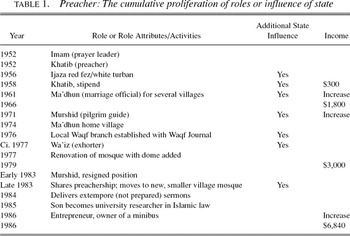
In the 1960s and 1970s, the BOR and SCR also took the form of the dissemination of waqf ministry publications, including at first, a simple newsletter, and later, a glossy monthly magazine. These developments can be traced for their impact on preachers in the life of Shaykh Luqman whose career trajectory is summarized in Table 1.

As Luqman expanded his roles in a cumulative way—from imam to preacher to marriage officer to pilgrim guide—he became increasingly co-opted into the state bureaucracy, because all these activities were overseen and, more important, recompensed by the state; his income rose accordingly. The implication of this BOR is greater control by the state of its employees. Here, bureaucratization and state co-optation of religious specialists are mutually suggested. Before 1958, Luqman had been entirely recompensed for his services by the village. The new waqf publications suggested topics for Friday sermons on stipulated occasions. Indeed, by the 1980s, every issue included a (suggested) model sermon. This is not to conclude that Luqman automatically followed such injunctions. I noted no difference in the range of his sermon topics between 1959 and 1960 (when he received no publications) and 1965 and 1967 (when he did).
In 1970, the government established a two-year preacher's institute in Amman to influence the content of religious learning for new preachers.15
The institute was first termed Maעhad Sharעi (Islamic Religious Institute) and later renamed Maעhad al-עUlum al-Sharעiyya (Institute of Islamic Religious Sciences).
See the section appearing later on the growth of fundamentalism in Jordan for a discussion of the proclamation's significance.
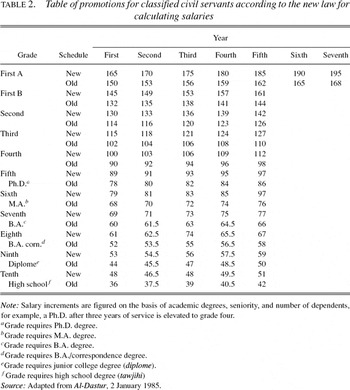
In addition to an increase in the number of religious personnel and edifices, an increasing differentiation and localization of religious organization, and an increasing centralization of religious instruction and control, BOR has occurred through an increasing differentiation and hierarchicalization of roles at the local level within the directorate of religious endowments on the basis of type and amount of education, type of work, hiring category, and salary. Records are kept at the national level on certain attributes of the bureaucrats working at all local levels. These records list ministry employees according to function, academic qualification, bureaucratic rank, classified status, type of work pursued, university degrees, training inside/outside the bureaucracy, and nationality of contract workers. Salary increments are figured on the basis of academic degrees earned, seniority, and number of dependents (see Table 2).

For instance, a Ph.D. with three years of experience is elevated to the fourth grade in the bureaucracy. A college graduate gets a 30 percent increment added to his basic salary. Personal status increments up to a total of 20 Jordanian dinars monthly are given accordingly: 2 dinars for each child up to four and 7 dinars for a wife.
The Jordanian bureaucracy has ten grades, with the lower six all requiring the attainment of different academic degrees for hiring and promotion. The critical bureaucratic attributes are hierarchy; educational status marked by attainment of a formal degree; seniority; and uniform and centralized regulation by the state. Finer bureaucratic distinctions relate to type of education (religious vs. nonreligious), type of institution in which education is gained (institute vs. noninstitute), employee's bureaucratic ministry of origin (religious endowments, army, or education), and type of work.
Bureaucratic regulation and control is implemented at the local level by the district director of the waqf ministry. His office devises a monthly schedule for exhortation and guidance for the corps of exhorters (wuעāẓ) in the district. A regular schedule of rotation between villages is devised by the supervisor–scheduler each month. Exhorters go at least three times a week to other villages in the district to lead sunset prayer, after which they give a lesson in the mosque.17
For a discussion and analysis of the Islamic “lesson” (dars) as it was given in Kufr al-Ma, Jordan, in the 1960s, see Antoun, “Themes and Symbols in the Religious Lesson: A Jordanian Case Study,” International Journal of Middle East Studies 25 (1993): 607–24.
BUREAUCRACY AT THE LOCAL LEVEL: THE DIRECTOR AND THE PREACHERS
Our goal in this section is to demonstrate the conflict/accommodation between bureaucratic standards and tribal norms, to illustrate in a case study the co-optation of religion by the state within a bureaucratic framework; and to view the pressures/tensions generated from the novel perspective of the individual bureaucrat/fundamentalist within the system. In doing so, we demonstrate the intertwined character of state, society, and local community rather than the dichotomy of state and civil society as has become fashionable in the social sciences.18
Of course, the dichotomy of state and civil society has a long tradition in the views of the philosophers John Locke, Georg Hegel, and Jurgen Habermas. For the evidence against applying this view in tribal societies in Jordan, see Antoun, “Civil Society, Tribal Process.”
Once a week, the eleven exhorters meet in the director's office. The director oversees all Friday preachers, daily exhorters, prayer leaders, overseers of marriage contracts, muezzins, and mosque custodians. As noted above, exhorters are rotated on a monthly schedule between mosques in the district on a schedule drawn up by the supervisor/scheduler. The exhorters are selected from the pool of twenty-three preachers in the district. I was told that they all had to be graduates of universities or preacher's institutes.
The session always begins with one exhorter reciting a few verses from the Qurءan. The religious and bureaucratic content of the four-hour session varies widely. Discussions were free flowing and involved such topics/questions as divine rewards for collective prayer, the proper procedure for collection of zakat and sadaqa (voluntary alms), the meaning of the profession of faith, the distinction between “lordly” and “Godly” tawḥīd, banks and usury, and the ethics of taking birth control pills and practicing coitus interruptus.
The prevailing ethos of these sessions is one of informality, openness, and consensus-seeking.19
The ethos indicates the emotional tone and quality of a people's life, their moral and esthetic style and mood.
A discussion that occurred in the director's office on 5 July 1986 highlights certain bureaucratic issues and the underlying and contested values on which they are based. This session occurred in the absence of Shaykh Luqman, who was arranging for the marriage of his son. A few weeks before, the director had appointed Luqman as head of a committee of guidance for outlying regions (Lajnat Tawjih Jihat). His responsibility was to review credentials of prospective muezzins and marriage officers for the al-Kura district as well as the appointment of the local supervisor/scheduler.
Five young exhorters, all recently graduated from the two-year Amman preacher's institute, protested that Shaykh Luqman's appointment was inappropriate as well as the appointment of Shaykh Mustafa as supervisor/scheduler.20
All village proper names used are pseudonyms.
We respect Shaykh Luqman, but he doesn't have the qualifications, the certificate, [shahada, i.e., an academic degree], that we have. I myself will never accept one like him coming to inspect the mosques of my village. As for Shaykh Mustafa, we know he has an [inside] contact [in the bureaucracy].
The director went on to outline the regular positions in the local waqf hierarchy, and to say that the committee to which Luqman was appointed did not fit any of these positions; it was extraorganizational. Luqman had told him (after his appointment) that he had heard that the other preachers were angry with his appointment and that he was willing to resign. The director said that he regarded Shaykh Luqman as like the old-time free preachers and Qurءan reciters (qurrāء); in Islamic law (fiqh), he had exposure to the four schools of thought in Muslim law, and he considered his learning as the equivalent of a Master's degree. He ended the defense of his appointment by saying, “All who have degrees don't necessarily glitter.”
The young preachers replied that there were two other exhorters who had higher qualifications than Luqman (including the preacher who had the lone university degree). One preacher continued in a somewhat strident manner, “We are against intermediation/intermediaries [wasṭas] and coming around from behind, that is, circumvention (al-laff min warāء).” (The wasṭas is a well-embedded technique/role for getting things done in tribal Jordan, including urban as well as rural areas.)
The director replied, “You can proceed with your official objection through administrative channels, but I advise you to search for your salvation [al-ākhira] and not a government position [mansib].” He continued, “As you know [referring to Mustafa's appointment], three dossiers were put forward and Mustafa was selected; whether and what happened [to influence the decision] only God knows.”
Later that day, Shaykh Luqman told me that, after Mustafa was appointed (supervisor-scheduler), Shaykh Ali raised a claim protesting to the waqf ministry that the previous director had appended comments to Mustafa's dossier elevating him above himself (when the respective qualifications suggested otherwise). Among the preachers, Shaykh Ali was the only university graduate. Luqman said his own appointment to the committee was all done over the telephone. Tradition favored the appointment of the senior shaykh to be head of the committee, and Ali was added as a member.
The appointments of Shaykh Luqman and Mustafa triggered a discussion between the young preachers, all graduates of the two-year preacher's institute in Amman except Shaykh Ali, who was a university graduate and the district director of the religious endowments ministry. The discussion had certain pragmatic and overtly political dimensions: Mustafa had scheduled Ali to serve in a remote village, much to his dissatisfaction. The director had appointed Luqman rather than Ali as head of the new oversight committee.
However, the underlying conflict was one of standards and underlying values. The director had favored the old-time, intimate, multiplex, dyadic learning over classroom learning. He had favored age and experience over formal school certificates of learning. He had favored learning (Luqman had been exposed to the four schools of law) over bureaucratic status. He favored general religious learning over expertise.
They could not argue a lack of expertise or classroom learning in Mustafa's appointment, because he too was an institute graduate. His appointment, they argued, reflected favoritism, circumventing the rules, and by implication, the politics of hospitality (a dominant tribal process). That is, it was/is common in this part of tribal Jordan to entertain officials in the bureaucracy by inviting them for sumptuous meals, cultivating their friendship, and winning their support in precisely such matters as local-level bureaucratic appointments. Indeed, intermediaries (wasṭas) were/are at the very heart of how things got/get done in Transjordan, and the young preachers, no doubt, relied on them to arrange marriages, secure positions, and settle disputes.21
See Antoun, “Institutionalized Deconfrontation: A Case Study of Conflict Resolution Among Tribal Peasants in Jordan,” in Conflict Resolution in the Arab World, ed. Paul Salem (Syracuse, N.Y.: Syracuse University Press, 1997) for examples of the use of intermediaries.
However, there was another standard to which they paid more than lip service. That was the standard of bureaucratic rank: there were ten bureaucratic grades, there were different academic degrees associates with these grades, and there was formal training (classrooms, professors, exams) that was the requisite of expertise. Luqman clearly stood outside the circle of qualification by his lack of such training. Mustafa had such training, and he was the equal of the other exhorters (although not of Ali). However, they charged he had obtained his position through nepotism, intermediaries, and friendship (all praiseworthy in the tribal culture of Jordan); it was known that the director's brother had served previously as a schoolteacher in Kufr al-Ma for several years.
The director was caught in the middle in this conflict. On the one hand, he was the district head of the bureaucracy and, no doubt supported standards of expertise, bureaucratic rank, and formal educational advancement. According to that basis, Luqman did not technically qualify to be an exhorter because he was neither an institute nor a university graduate. On the other hand, as a Transjordanian, the director also respected seniority and experience as well as the more multiplex, dyadic learning of the previous generation.22
Multiplex ties are those that cut across many interests. In the 1960s when two villagers interacted with one another, they interacted according to several roles simultaneously. They were coworshipers in the same mosque, neighbors in the settlement area or on the cultivated land; they often met in the same guest house in the evening and might cooperate in farming or harvesting; and they might be tied by the marriage of their children or other kinsmen. These many lines of interest—economic, religious, recreational, consanguineal, or spatial—tinged their relationships with moral and ethical meaning. The mentor–student tie was one of these multiplex relationships.
The conflict, insofar as it exists, however, is not simply between bureaucratic standards on the one hand and communities (both rural and urban) informed with tribal culture on the other. The growth of the fundamentalist movement in Jordan is a significant third factor fused into community and bureaucracy. It is to fundamentalism that we now turn.
THE GROWTH OF FUNDAMENTALISM IN JORDAN
State co-optation of religion and the bureaucratization of religion and the growth of fundamentalism are complex, entwined processes in Jordan. As mentioned, fundamentalism is not so much a literal belief in an inerrant religious scripture as much as a distinctive world view and ethos, and an ideology of protest against the rapid change associated with the modern and postmodern worlds.23
World view is the widest intellectual construction an individual places on his/her world and the events taking place within it; ethos is the emotional tone or attitude with which the individual faces his/her world and the people in it. I have written at length on a cross-cultural basis about fundamentalism in Understanding Fundamentalism. I cannot define all terms used in the analysis here. I shall only give a very brief summary of the lineaments of this religious ideology and assume that readers will refer to the full study for details.
When I returned to Kufr al-Ma, Jordan, in 1986 after an absence of seven years, I immediately noticed a change in the emotional tone of discourse when something happened that had never happened before over twenty years of conducting research in the area. Young men politely invited me to their homes and offered me tea and proceeded to tell me that if I did not convert to Islam I would end up in The Fire (Hell). They did not do this as an act of hostility, but rather as a concern over my eternal destiny. I was in a precarious position, theologically, because as a man of Christian origin, I had read the Qurءan (with Shaykh Luqman on the occasion of my first field work in 1959–60) and, therefore, was fully enlightened about the message of Islam. Although I am sure many of the villagers hoped that I would convert to Islam and I had given them some reason to entertain that hope (I had fasted the month of Ramadan and attended the preacher's Friday sermons), no one had ever made conversion an issue.
Later that year (1986), I attended the Friday congregational worship service in the mosque, where a visiting imam, serving as a chaplain in the Jordanian army, gave a guest sermon (at the invitation of Luqman). After the sermon, both the imam and I were invited for dinner by a local village notable. I was late in arriving at the notable's house. I entered unobtrusively and was able to hear several young men gathered around the imam asking in a somewhat agitated tone, “What do you think of this American [Christian] entering our mosque without performing his ablutions? Isn't he defiling the mosque?” I was stunned. No one, including Luqman with whom I had much contact over the years, had ever suggested I perform ablutions, although, of course, ritual purification is an absolute requirement for Muslims before performing prayer. The imam replied, “But the Messenger of God [Muhammad] received a delegation of Christians from Najran [a Christian town in highland Arabia] and put them up, overnight, in the mosque [in Medina]. How can you keep this man out of your mosque?” The issue of religious purity had clearly grown in importance.24
In the 1960s, I had noted that many peasants in the village entered the mosque barefoot for Friday prayers and proceeded to pray without washing their feet.
Over the years on almost every visit to Kufr al-Ma (particularly in 1959–60 and 1965–67), I attended sessions of the Islamic court in the adjoining district center. Although I witnessed bickering between plaintiffs and defendants, I never witnessed disrespect or defiance of the judge. Over these years, there were no lawyers in court. I had been welcomed by the religious judges and encouraged to attend. In 1986, I also requested the local judge to allow me to attend sessions of the court. He told me that I had to get permission from the central authorities in Amman. I did so and attended a session of the court. I was startled to find lawyers in the court. Indeed, the proceedings were dominated by their bickering and one-upmanship. The judge, a young, rather strident Transjordanian and recent graduate of the religious law faculty at the University of Jordan, seemed to me to be more inexperienced, more intolerant of foreigners, and more strict in applying the modesty code than previous judges. Most of the cases (marriage, divorce, עidda payments,25
The עidda is the prescribed period of waiting during which widows and divorced women cannot contract a new marriage after the dissolution of a previous one. The woman is entitled to a payment during this period.
See Antoun, “On the Modesty of Women in Arab Muslim Villages: A Study in the Accommodation of Traditions,” American Anthropologist 70 (1968) for an essay describing the importance of the modesty code in rural Jordan and in the Qurءan.
Another incident occurred in 1986 that alerted me to the growth of a new and alternative world view and ethos. I was invited by a man from a nearby village to attend a religious exhortation (waעẓ) in his mosque in the market town of Irbid after the sunset prayers. This man previously had refused my request to photograph him in the street in his picturesque Saudi Arabian-like garb—skullcap and long white gown, quoting to me a tradition of the Prophet, “The picture-maker [muṣawwir] will receive the sternest punishment [in Hell]. On the Day of Judgement, the Lord will come and ask the picture-maker, ‘Can you put life back into the picture you have made?’” (i.e., the picture-maker was aping God).27
The prohibition on taking pictures of human beings is an aspect of the world view of many fundamentalists.
See Understanding Fundamentalism, chap. 7, for a full description and analysis of this incident and its significance for fundamentalism.
Jamāעa here does not designate so much a formal group but, rather, a collectivity mobilized for action.
I later discovered that the religious activity at the mosque was related to the Muslim movement of spiritual renewal, Tablighi Jamaעat, founded approximately 90 years before in British India.
The importance of the struggle of good and evil and making the right decision in choosing between them was dramatized for me by two other incidents occurring in Kufr al-Ma in 1986. A young man, who was attending a two-year institute (equivalent to junior college) in Irbid and majoring in Islamic studies, invited me for tea one evening. As we were walking toward his house, he told me that he had prohibited his family from watching (American) wrestling (probably the most popular TV program in the village) on television on Saturday nights. He proceeded to tell me that the faith of Muslims rested on five beliefs: in God, his angels, his books, his prophets, and the divine decree (al-qadr) of God for good or evil. He suggested that I read a book by an author who defined the differences between humans and angels, recited the five pillars of Islam, and ended by quoting an excerpt from a book entitled, Torture in the Grave and in the Fire.
The excerpt described three angels in prostration to God, when the angel of death, עIzraءil, called them: there was Israfil, the trumpeter of death, and Mikhaءil who brought rain from heaven, and Jabraءil, the link with the prophets. God finally told עIzraءil to gather in his own soul. Israfil blew three blasts on his trumpet: the first was the blast of fear, the second was the blast of death, and the third was the blast of judgment day—the day when the sun will be as close as a hand-span and men will swim in their own sweat.
His intention was clearly to frighten me and instigate a conversion decision. A few weeks later, I was accompanying the exhorters on a bus as they went to attend a preliminary wedding celebration of one of their number in another village. I overheard the bus driver whisper to a few of the preachers sitting up front, “It's up to you to explain to him [me] that if he doesn't become a Muslim, he'll end up in the Fire [Hell].” The focus on good and evil and its eschatological consequences in the mosque, the truck, the bus, and the house of the student marked a clear-cut fundamentalist theme. An important element of the fundamentalist world view is the struggle in the world between the forces of good and evil, with the necessity of the religious person having to choose between them. However, the on-going struggle is not only in this world but rather cosmic and, for individuals, determines their eternal destiny.
Attendance of the discussions at the waqf director's office offered other insights into prevailing attitudes and knowledge. On the occasion of the discussion of Islam's emphasis on equality, the issue of racial discrimination in the United States was raised. The entire discussion assumed that racial segregation in buses, schools, and restaurants continued to prevail in the United States, twenty years after the civil rights movement! Perhaps I should not have been shocked to discover that the young man who had invited me to tea and was majoring in Islamic studies had never heard of Gandhi, and was ignorant of the distinction between Protestantism and Catholicism in Christianity, but I was. Ecumenicalism within one's faith or outside it is not a part of the fundamentalist world view. On the contrary, it is specifically derided as a value by Christian, Jewish, and Muslim fundamentalists and is interpreted as supporting the forces of evil.
The district director of waqf extended this lack of ecumenical spirit to the political arena in what most would construe to be a condemnation of secular democracy and its rhetoric. Before the regular weekly meeting of exhorters began, he told them:
I read a speech today by Hafez al-Asad [President of Syria] in which there is blasphemy [kufr]. He said, “From your (the people's) beneficence (min faḍlikum) we have achieved thus and so.” If I had been there, I swear I would have killed him. He credited to the people what is only given by God's bounty.
The rhetoric of secular democracy denies a religious perspective by attributing to human beings worldly achievements when such achievements are only through God's favor. The director's histrionic statement established Islam rather than secular democracy as the dominant discourse.
During this period (1986), an intense election campaign was taking place in the district to elect a district representative to the national assembly. In 1984, a candidate with many fundamentalist attributes had won the parliamentary election for the Irbid (the third largest city in Jordan) district by an overwhelming margin.
Candidates frequently distributed and put up election posters. The posters usually carried a photograph of the candidate and sometimes their platform. In 1986, there were several “tribal” candidates, that is, who appealed for votes mainly to their own tribes and, therefore, did not have any elaborate political platform (other than kinship). They usually wore the (tribal) shawl and headband. There was one candidate in 1986 who was clearly a religious/fundamentalist candidate. His fundamentalist religiosity was also clearly dramatized by his photograph: he was bare headed, with a neatly clipped mustache and a beard also neatly clipped that ran from cheek to jowl and from ear to ear. He did have a rather detailed political platform (for a small poster) that is described here.
Election Poster
In the name of God, the Compassionate and the Merciful Praise be to God, Lord of the Worlds and Salutations to God's Messengers
THIS IS A PROCLAMATION TO THE PEOPLE
My Brother Elector My Sister Elector
Someone must take up the responsibility of serving in Parliament Voting is a Testimony (shahada) and Electing is a Trust
The qualifications of the single representative are limited, but the least he can do is as follows:
- Transmitting the voice of the people in matters of concern with courage and honesty.
- Attention to citizens' concerns relating to the authorities and pursuit of these concerns.
- Warding off the disapproved and attracting the good by introducing adjustments in legislation and its design.
I have been nominated in the governate of Irbid, trusting in God, the powerful and majestic, hoping that I will be the nominee of all of you and of all segments and divisions. My basic point of departure, by word and action, is Islam. It is the religion of truth (al-ḥaqq). It is the distinguishing identity and the splendid humanitarian civilization for all. From this foundation I shall endeavor, with God's permission, to put at the forefront the following in particular:
- Palestine is the cause of the larger Islamic community (umma). Its liberation from the (Mediterranean) sea to the (Jordan) river by clean hands and pious hearts, sincere to God, most high. Jihad is a religious obligation, and preparation for it is a necessity.
- Education is the most powerful instrument of construction when accompanied by a proper program, a sincere, responsible leadership, and clean procedures. Comprehensive, rooted reflection on educational matters is absolutely necessary (whether pertaining to) students, teachers, or courses at the level of school and university.
- (There must be) mosques and complementary measures of learning for building an effective, integrated education which must be independent of bureaucracies. (This education must be) sincere, enlightened, and committed to belief in the Islamic community (umma).
- The citizen (muwāṭin), except in rare cases, is weak, helpless, and living on the edge of poverty. His dignity (karamatihi) must be preserved and his strength secured and his family's future guaranteed. Therefore, we call for
Social Security for All who Do Not Have a Pension, and Protection from Unemployment and Hunger
- The toiler and the minor bureaucrat deserve protection from poverty and disgrace and fear of an oppressive future.
- The woman is half of society and the upbringer of future generations. Her problems will not be solved by counterfeit expressions and cheap words.
- Taxes are blind. They do not distinguish between the rich and the poor. Most of them must be discontinued. Only legal taxes should be imposed including the obligation of the alms tax (zakat), and encouraging people to give voluntarily. The exercise of restraint in spending public monies is a guarantee for filling the coffers of the treasury.
- Last, but not least it is necessary to transform the slogan, “The human being is the most precious thing we possess,” into a reality: the citizen, respected for his mind, thought, and freedom.
His honor should be safeguarded to insure his survival in an atmosphere of freedom and responsibility. I call on you to fulfill your duty to elect the most righteous (aṣlaḥ), devoted exclusively to the truth. I implore God, the powerful and majestic, for me and for you, success and the right way in word and deed.
DOCTOR ABD AL-MAJID NUSAYR
Thumbnail sketch of the nominee
Born in al-Husn in 1941, he has held the Ph.D. degree in Applied Mathematics since 1969. He is a member of the Jordanian Arabic Language Academy and the Iraqi Academy of Sciences, and is a founder of the Society of Islamic Studies and Research. He is the head and a member of several philanthropic, cooperative, and cultural societies. He worked as a teacher in secondary school, and as a professor of mathematics in American, Saudi, and Emirate universities. He was one of the founders of Yarmouk University and its first director of student affairs. He is the founder of a computer center, a preacher (khatīb) in mosques, an author, and a poet. He has several scientific, literary, and historical works, published and in manuscript, exceeding twenty-five in number.
This poster with its election platform skillfully appeals to several interest groups including lower echelon bureaucrats, workers, professionals who value education, people with tribal values (by emphasis on safeguarding honor), and people with religious values. Its program is extremely varied, but its pledges are very general: calls for social security, pensions, improvement of education, and tax relief; it mentions no specific legislative or administrative proposals. For a candidate who represents a fundamentalist orientation, the platform is couched very much in secular terms with an impressive statement of professional accomplishments and a counterintuitive humanistic ending: “the human being is the most precious thing we possess.” One of the most interesting aspects of key figures in fundamentalist movements is that the overwhelming majority are not religious specialists, but rather, lay leaders in religious activities. The candidate is a mathematician and a teacher.
The list of accomplishments at the end is an excellent example of the fundamentalist attribute of selective modernization and controlled acculturation. The list emphasizes the candidate's modernity in his professional status (doctor), his scientific status (mathematician), and his technological expertise (computer center founder). However, these modern traits are contained within an Islamic framework that infuses in them a religious ethos: he is a member of the Society of Islamic Studies and Research; a preacher in the mosques; and a member of the Jordanian Arab Language Academy, expertise in Arabic being required for an understanding of the Qurءan and other religious texts. His scientific expertise is put in the service of Islam.
Key symbolic terms in the platform such as shahada, al-ḥaqq, umma, zakat, jihad, and khatīb set the terms of reference, transmitting particular religious meanings and a particular ethos. The platform is encompassed by the symbolic religious bookends, “God, the powerful and majestic [עazza wa-jalla].” In a long list of generalities, there were only three that referred to specifics: the requirement of giving zakat, the requirement to participate in armed struggle to emancipate Palestine, and the necessity for mosques and related religious educational processes to be “independent of bureaucracies.” It is this last concern that will be the focus of our final discussion of the relationship between the religion of the people (dīn al-milla) and the religion of the government (dīn al-dawla).
TENSION AND ACCOMMODATION BETWEEN STATE'S RELIGION AND PEOPLE'S RELIGION
Dale Eickelman and James Piscatori have argued that, despite the rhetoric put out by many states, Islamic institutions are pluralistic. There is no single form of state-dominated Islam nor any single form of popular Islam.31
Dale Eickelman and James Piscatori, Muslim Politics (Princeton, N.J.: Princeton University Press, 1996).
Ibid., particularly chaps. 3 and 5 for details.
In Jordan, the state is closely associated with the religion of Islam and, being so, Islam in many of its manifestations is associated with the state. We have already mentioned the two-year preacher's institute run by the government in the capital, Amman. Islamic courts are run by the Ministry of Justice. Preachers and exhorters are supervised by the Ministry of Religious Endowments (waqf).33
According to the Ottoman millet system, still recognized in Jordan, Christian courts of various recognized denominations handled the civil affairs of their communities. These courts are still today part of the government structure. The implementation of the Christian courts' decisions are carried out by state authorities and have the force of law. So the integration of “state” and “church” extends beyond the religion of Islam. I am thankful to a personal communication from Nicolas Gavrielides for this information.
The giving of the alms tax (zakat) has always been a formal obligation of Islam. For the villagers of Jordan, it has customarily been given by individual Muslims directly to the eligible recipients or to the village preacher for transmission to higher ranking religious specialists. In 1986, I heard an Amman radio interview with a representative of the waqf ministry who was reprimanding many poor women and children for gathering outside the mosque after Friday prayers to beg for help. He said this was not religiously normative (sharעī) behavior. They should go to the zakat chest (sanduq al-zakat) run by the state or to private philanthropic societies (jamעīyyāt khayriyya) to receive help. They should not make the round of people's houses asking for help. He directed people in mosque congregations to bring blankets and other needed items to the mosque where they would be handed over to the zakat chest for distribution. I also heard the district waqf director caution villagers against giving alms to the local preacher for transmission to the local waqf office. (They should go directly there.) However, Shaykh Luqman told me that, in Kufr al-Ma, they still give alms directly (to the recipient) or to the preacher (for transmission). This is a nice example of the tension between the religion of the people and the religion of the state.
The most dramatic example of the Jordanian state's supervision and control over religion did not involve legal and technical matters over worship. Rather, it involved the king's proclamation of the “Law on Religious Exhortation, Guidance, Preaching and Instruction in the Mosques of Jordan” in January 1986. The law was signed by twenty-three ministers, that is, by the entire government. It aimed at reining in preachers who criticized government policies and officials, and more generally spread “dispute, dissension and confusion,” that is, factionalism. Imprisonment and fines were stipulated for repeated violations. The very general stipulations of the law allowed wide latitude for the government to exercise control.
Outside the capital at the local level, it would have been difficult to enforce the law. Indeed, Luqman was not even aware there was such a law, and when told about it said it was the government's intelligence service that monitored religious activity. He said, furthermore, that the rotation of Friday preachers in Amman, and the publication of their names in the newspapers on Thursdays was to circulate professors (of religion) to prevent the people from being bored, that is, he dismissed the law as insignificant. Outside the capital the rigid control of preachers by the state suggested by this law then is questionable.
Very different from the religion of the state is the religion of the people (dīn al-milla).34
The terms, dīn al-dawla and dīn al-milla, are found in Sayed Qutb's book, Ma alim al-tariq (Milestones), and his usage may have popularized the terms. People's religion takes many forms, for example, mystic orders, fundamentalist movements, proletarian urban protests, bazaar merchant's associations, academic fora. I am only recounting the version I encountered in one district in rural Jordan.
In an article entitled “The Changing Voices of Islam: The Emergence of Professional Preachers in Contemporary Egypt,” The Muslim World 81 (January 1991), Patrick Gaffney has argued that, in Egypt, the distinction between state and private mosques is no longer clear-cut as a result of the government's efforts through the 1960s, 70s, and 80s to bring them under bureaucratic supervision. However, he also points out that the proliferation of mosques during that period (from 16,000 mosques in 1950 to 50,000 in 1985) has prevented the state from actually implementing bureaucratization in more than one quarter of all mosques. In addition, Gaffney points out that the contrast of activist (daעi) and conformist preachers remains important in Egypt. With some difference in terms (populist vs. state) and numbers, the same general conclusion holds for Jordan. That is, despite the growing attempts of governments to control religious activity, there remains a distinct contrast in content and style between religious activity associated with the state and such activity associated with social movements opposed to the state.
During Ramadan, many special events in Muslim religious history are celebrated: the conquest of Mecca, the Night Journey and Ascent of the Prophet, the Battle of Badr, and the Night of the Divine Decree (when the Qurءan was revealed). All of these events allow critical commentary on contemporary political affairs in sermons and lessons. For instance, God promised victory to Muslims at Badr if they kept the faith. The Muslims prevailed at Badr even though they were outnumbered four to one. This commentary is an implied criticism of contemporary Muslim Arab governments who, despite their overwhelming numerical preponderance, could not defeat Israel and a further implied condemnation of their lack of religious faith and commitment. Sufi symbolism is sometimes used to comment critically on current evils in a veiled manner.
Because of the numerous worship events during the month and because of the historical events linked to social and political crises, during Ramadan, mosques provide excellent opportunities for candidates with a religious platform to campaign. In 1986, one candidate preaching during Ramadan quoted the future second caliph, Umar ibn al-Khattab, saying to a man who was to become his leading general, “How is it we live under oppression when our mothers gave birth to us as free men?”
Although mosque sermons are supposed to be and generally are delivered in classical Arabic, village preachers often depart from such usage and speak in colloquial Arabic; and they resort more to traditions of the Prophet and stories of religious exhortation and inspiration for illustration of their message. Such popular usage is more effective than formal religious discourse. The sermons, lectures, and lessons taking place in small local mosques on such special occasions as the fast month of Ramadan and the pilgrimage month are primary sites for fundamentalists to contest the religion of the Jordanian state.
During Ramadan in 1986, Luqman invited one incumbent with fundamentalist credentials and another who was a candidate for office in the parliamentary elections that were about to occur to his home for a meal. The incumbent had been ousted (by university authorities who were also government employees) from his position in Yarmouk University in 1984. Some villagers told me that it was alleged he had divided men and women in his classes, making the men sit up front and the women in the back. Others told me that he had been ousted because he had struck a Christian woman in class, and she had complained. This man won the election in a landslide.
Luqman intended for these fundamentalists to give a lecture after the midafternoon prayer in the main mosque of the adjoining district center—which was in size no more than a large village. The police came to the door of the mosque and prevented them from entering. A large crowd had gathered in anticipation of hearing them. Luqman said this prohibition from speaking (the candidate's opponents said he was using the pulpit to give campaign speeches) made the people angry and assured a large vote for the fundamentalist candidate. Luqman said that day before yesterday the Minister of the Interior had met with the fundamentalist candidate and pressured him to withdraw from the election, saying his activities were hostile to authority. The candidate refused, saying he had the right to be nominated and elected. This incident leads us back to the central thrust of this essay: the mutual entanglement of state and civil society; more specifically, the complex entwined relationship of fundamentalism and the state co-optation of religion.36
Starrett has emphasized the competitive rather than the inextricably entwined aspect of the relationship between dīn al-dawla and dīn al-milla in contemporary Egypt: “In Egypt the authority of the ulema, the ‘traditional’ state-trained and subsidized scholars, is under threat by a new market-driven economy of religious commodities produced by private sector companies, secular intellectuals (psychologists, lawyers, physicians, and academics), and independent movements such as the Muslim Brotherhood and the smaller Islamic groups, which are the political and military vanguard of the Islamic trend. The state under Mubarak has responded to this new informational economy not by restraining it heavily, but by entering the fray with products carrying the imprimatur of al-Azhar, the Ministry of Religious Endowments, the Supreme council on Islamic Affairs, and subsidiary organizations,” Starrett, Putting Islam to Work, 97. Occasionally, the complex and ambivalent character of the relationship assumes prominence, including the fact of the complexity of the bureaucracy itself, which sometimes works at cross-purposes: “The same government that declares Islam the religion of the state produces public sector beer and wine (but then bans the sale in several southern provinces to quiet Islamist opposition),” ibid., 212.
THE MUTUAL ENTANGLEMENT OF STATE AND CIVIL SOCIETY
The simple presentation of the preacher's career trajectory in Table 1 neither brings out the complexity/ambiguity that accompanies the confusion of the religion of the state with the religion of the people nor does it record the transnational dimension. For instance, the Qurءanic school established in Kufr al-Ma in the 1970s for students ten to fifteen years of age is local, but its transnational examiners are from the Council of Islamic Organizations of the World Islamic League in Mecca. The building of the second mosque in Kufr al-Ma involved individual local philanthropy ($15,000), general village contributions ($30,000), as well as a transnational contribution from Abu Dhabi ($9,000).37
For the impact of transnational migration on Jordan, see the author's extended account of transnational migration from Kufr al-Ma to 17 different countries for higher education and work as well as military service; Richard T. Antoun, Documenting Transnational Migration: Jordanian Men Working and Studying in Europe, Asia, and North America (New York: Berghahn Books, 2005). See also Antoun, “Sojourners Abroad: Migration for Higher Education in a Post-Peasant Muslim Society,” in Islam, Globalization and Postmodernity, ed. Akbar Ahmed and Hastings Donnan (London: Routledge, 1994) and “Jordanian Migrants in Texas and Ohio: The Quest for Education and Work in a Global Society,” in Arabs in America: Building a New Future, ed. Michael Suleiman (Philadelphia, Penn.: Temple University Press, 1999).
The boundaries between the old and the new modes of cultural and social reproduction are often blurred. The old mode of religious training (Luqman's) was piecemeal, private, dyadic or in very small groups, in homes, either the student's or the mentor's/teacher's. Luqman was taught by a series of peripatetic scholars and preachers who passed through the village teaching the books they knew. The new mode of reproduction of religious knowledge involved attending classes in religion (along with other subjects) in state (secular) schools and at higher levels by the state-controlled preacher's college, featuring formal classes, curriculum, exams, and degrees. However, the dichotomy, if indeed it exists, is not clear. For instance, as indicated in Table 1, Luqman told me that he began wearing his red fez and white turban after he received his ijāza. It is not clear to me then or now what that statement means. The traditional ijāza was a small scroll containing the names of the teachers under whom he had studied and the books he had read with them. This scroll was used as the equivalent of “educational credentials” today. To my knowledge, Luqman had no such scroll. In any case, the teachers he studied under were not notable scholars. However, Luqman did take an examination in 1962 that did certify him in religious knowledge. Here, we have the new mode of cultural reproduction, a formal certificate stipulating knowledge with a formal document referred to today as an ijāza. This is one more instance illustrating the ramifying web of culture and social organization rather than the dichotomy of state and civil society. The term, ijāza, has old roots and connotations that persist even as it is used in a new way.
In an article devoted to the question of whether violence is inherent/contingent in “Islamist projects,” Langhor has made an important observation. She says that research on state–Islamist relations assumes “that the state and Islamist groups are two well-bounded entities…choos[ing] whether to fight against or cooperate with each other.”38
Vickie Langhor, “Of Islamists and Ballot Boxes: Rethinking the Relationships between Islamism and Electoral Politics,” International Journal of Middle East Studies 33 (2001): 605.
Ibid., 606.
Ibid.
Seen from the perspective of the co-opted and bureaucratized movement member, tension, ambivalence, opposition, and conflict is woven into the entanglement. The district director of the waqf wanted to run for office in the parliamentary election referred to above. He was prevented from doing so. He ranked higher than grade five in the bureaucracy and, being so, his resignation (to run for political office) had to be approved by the prime minister. He was not allowed to resign. He was reputed to be a member of the Muslim Brotherhood. In Jordan, such membership is legal but also suspect from the perspective of top government circles. His dress also reflects this entanglement: he wears a white shirt and dark shoes, but his shirt is open at the collar (without a tie) and a tribal shawl and headband.41
Although I have interpreted the shawl and headband as “tribal,” it is a multivocal symbol and, depending on the situation, can have national or religious meaning, or alternatively, all three meanings simultaneously.
Shaykh Luqman's sermon discourses and behavior dramatically illustrate one version of this complicated entanglement involving both mutual support and antagonism between state and religious institutions and between the religion of the state and the religion of the people. As he assumed the roles of preacher, marriage official, and pilgrim guide, he became more and more implicated in the state bureaucracy (see Table 1). Every week Luqman legitimized King Hussein's rule by mentioning his name in the Friday sermon.42
The following excerpts from Luqman's sermon discourses are drawn from my analysis of “Religion and Politics” in Muslim Preacher in the Modern World: A Jordanian Case Study in Comparative Perspective (Princeton, N.J.: Princeton University Press, 1989), chap. 7.
The Sultan is the shadow of God on earth; there seeks refuge with him every oppressed worshiper. If he renders justice he receives reward [in the after life] and the thanks of his subjects. If he goes astray and oppresses, then on him is sin and incumbent on his subjects is patience. If the governors go astray the heavens dry up and… the flocks perish.43
Sermon on Justice, Kufr al-Ma, Jordan, July 1966.
The ruler is not only a dispenser of justice but also a keystone of society and a critical actor in the cosmos as is appropriate to his role in an organic society. The consequence of the sultan's injustice (“the heavens dry up and… the flocks perish”) testifies to this fact. He is also a model for household management and control:
The head of the family is the ruler of the household. He is obliged to render equally between its members. He must not prefer a boy to a girl or an elder over a younger or one wife over another.44
Ibid.
However, there is another side to Luqman's teaching. Luqman had collected the tapes of the well-known antiestablishment Egyptian preacher Shaykh Kishk. In addition in his sermons, he made it perfectly clear that it was not kingship that conveyed authority but rather divinity and that, by implication, kings, when they departed from divine ordinances and rendered injustice, were subject to divine retribution. There was a historical example of such retribution in the birth of Muhammad and his prophecy:
How majestic respect [becomes] and how great [recollection] grows before the tomb of the Prophet when the onlookers remember what happened on the night of his noble birth in the land of Mecca, the venerable–of the cleaving of Kisra's palace and the splitting of Caesar's seat, and of what these sovereigns heard [in their dreams on that night] when an invisible man whose voice was heard cried out: “Today an epoch ends and an epoch begins. After today there will be no kings or diviners or chiefs (sayyids). Verily, worship is to God and sovereignty (siyyada) is to the religion of God and leadership (qiyyada) is to the Seal of the Prophets of God and government (hukūma) is to the successors (khulafāء) of the Messenger of God and the world is to all God's worshipers—justice and freedom and brotherhood and equality.45
Sermon on Pilgrimage, 29 April 1960.
Muhammad's religious prophecy undermined two great empires, the Sassanid and the Byzantine, symbolized by the reference to Kisra and Caesar, whose leaders were paying for their sins with a collapse of their political fortunes, as fundamentalist ideology predicts.
This sermon excerpt certainly cannot be regarded as support for “state Islam.” On the contrary, it has revolutionary implications for the relationship between religion and the state. Luqman, moreover, composed his own sermons and did not recite “canned” ones prepared in classical sermon texts or sent out in contemporary journals from the waqf ministry. Only two of his sermons that I heard, read, or had reported to me over several research trips, those on Palestine and Algeria, concerned the fate of the “Arab nation” in any direct way. Most were focused on ethical issues of concern to community, family, clan, spouse, parents, children, neighbors, orphans, and cobelievers. Furthermore, his interpretation of his own role was an egalitarian one. All free adult Muslims not only had the ability and obligation of performing the required pillars of the faith (prayer, fasting, alms giving, pilgrimage), they had the obligation of performing special religious duties such as ablutions and rituals connected with death and burial. Most important, they had the obligation of being their brother's keeper in hand, tongue, and heart. His was a priesthood of all believers.
Luqman's career and sermons weave together various strands of state Islam and people's Islam with various meanings: legitimacy of ruler, co-opted functionary of the state, obedience of the subject, dispenser of justice, divine retribution for injustice, model for the family, perversion of the establishment, brother's keeper, priesthood of all believers, corruption of (political) parties, passer over truth in silence. The communication is complex, but its emergent pattern contains a clear message: political obedience is conditioned on orthopraxy, justice, personal piety, and regard for Muhammad's community (umma).
In this essay, I do not pretend to answer some important basic questions about the general relations of religion and politics in Middle Eastern states that deserve an answer such as, Why do such states always incorporate Islamic content and style in an integral fashion? Why are relations between civil society and state permeated by a cross-cutting web of social relations? Rather I have attempted to answer the questions, How do such societies work? What is the quality of the relationship between representatives of civil society (in Jordan a socioreligious movement, Islamic fundamentalism) and representatives of the state (here, the bureaucracy) when in many instances they are the same persons. How do individuals espousing a world view and ethos hostile to many government policies and even to the assertion of absolute state sovereignty (which challenges the state itself) behave and talk when they are members of that same bureaucracy? How is this inherently conflictful and ambivalent relationship handled from the top (government authorities), from the bottom (peasants, postpeasants, professionals), and from the middle (preachers, teachers, and bureaucratized fundamentalists)?
The method and the bulk of the evidence for the answers to such questions are provided by the case study: the in-depth analysis of particular people, Shaykh Luqman, Abd al-Majid Nusayr, and the district director of waqf; a particular village, Kufr al-Ma; and a particular district, al-Kura. From this bottom-up perspective, one must remember the constraints on those in the middle. Jordan is a non-oil state without an industrial base or great agricultural potential. For a person with education (Jordan is one of the most highly educated countries in the world) positions in the bureaucracy (including schools, institutes, and universities) provide not only economic survival/security, but also respect and sociopolitical legitimacy.
What we have discovered is that the roles of bureaucrat, preacher, exhorter, and (fundamentalist) movement member are seldom performed in a discrete manner. Each role exists in the shadow of the other and influences its exercise. Furthermore, contradictory discourses of fundamentalism, state power, and bureaucratization are juxtaposed and reinterpreted in odd and unpredictable ways with resulting tension, ambivalence, and conflict, but also with the possibility of achieving some sort of situational accommodation. Members of social movements can sometimes impress their principles and discourse on bureaucratic policy (as when the local waqf director denounced Hafez al-Asad as a blasphemer). At other times, bureaucratic regulation confines and negates social movement principles and activities (as when it prevented the same director from running for office). Alternatively, those in the middle may choose, temporarily, to leave the bureaucracy and operate, for instance, in electoral politics, from a precarious social movement base. In any case, values such as respect for seniority, the politics of hospitality, and the necessity of intermediaries (wasṭas) to resolve important problems are rooted in both local community and state bureaucracy.
In this essay, I have applied the insights generated by anthropologists such as Hammoudi, Herzfeld, and Starrett regarding bureaucracy and society to the novel Jordanian case where I am dealing with relationships between state, society, and local community in the context of the spread of one kind of religious movement, fundamentalism. I have concluded not only that such bureaucracies are complex and segmented as are the societies with whom they interact and intertwine but also that the powerful metaphors of family, clan, tribe, patron, and client sometimes dominate (at most) and render ambiguous (at least) universalistic bureaucratic norms. The application of an anthropological case study approach here highlights the problematic character of bureaucratization and the state's co-optation of religion as well as the multivocal character of the metaphors themselves.
Theoretically, it may be difficult to understand a society in which family, tribe, community, and bureaucracy are cross-cut by a web of social relations, while at the same time a fundamentalist social movement, operating from within and without, opposes the state in a relentless manner, but this is the situation in Jordan and I suspect in many other societies. When the enemy is within the gate but dependent on the ruler of the city, a kind of politics/discourse emerges that is usually muffled but sometimes in competitive contexts abrasive and overtly hostile. Even there, as our fundamentalist campaign poster indicated, diverse and sometimes contradictory values are not only entertained but also trumpeted before the general public.
Author's note: I thank Andrew Shryock and the anonymous reviewers of IJMES for their comments on earlier versions of this article.