INTRODUCTION
The literature on democracy has considered many potential factors influencing the advent and quality of democracy; so it is surprising to find that the separation of religion and the state (hereafter referred to as religion-state separation) has been largely overlooked in such analyses.Footnote 1 We seek to remedy this deficiency by providing theoretical and empirical evidence that religion-state separation affects citizens' equality and thus impacts levels of democracy.Footnote 2
In this article, we examine three questions. First, what is the nature of the religion-state separation concept? We argue that it should be viewed as a multi-dimensional concept with both structural and social dimensions.Footnote 3 Second, why has religion-state separation been overlooked as a component of democracy? We argue that this has occurred in part because it has been conceptualized in an associational manner that misses the qualitative impact religion-state separation has on democracy. Third, what is the relationship between religion-state separation and level of democracy? We find evidence linking increased religion-state separation to higher levels of democracy.
The article proceeds in the following manner. We begin by setting our project in the context of the literature before then explaining our theory in more detail. We then lay out our research design, and proceed to conduct our analysis. The article concludes by summarizing our findings and suggesting possible avenues for future research.
LITERATURE REVIEW
In reviewing the literature, we begin by explaining our conception of democracy. We then consider three literatures to which we believe this article contributes. First, the mainstream democracy literature lumps religion-state separation into a broad associational category, thereby failing to distinguish its unique role in a democratic society. This article shows why that understanding of religion's role is inadequate. Second, contra the secularization thesis of modernization theory, we demonstrate that religion remains a significant factor in political life and that a lack of religion-state separation has implications for democracy. Third, we examine the two shortcomings of the existing literature on the relationship between religion-state separation and democracy: namely, that it has largely considered whether democracies can have formal ties between religion and the state instead of what impact those ties have on democracy, and that previous studies focused on a specific religion, country or region, in contrast to this article's global perspective.
Robert Dahl (Reference Dahl1971, 1–2) has argued that, “a key characteristic of a democracy is the continuing responsiveness of the government to the preferences of its citizens, considered as political equals.” Dahl's analysis subsequently descended from the heights of his probably unattainable ideal democracy to the real world of political democracy (or polyarchy) by focusing more on the political institutions needed to maintain a minimal level of democracy in the polity (Dahl Reference Dahl1971, 2–47; see also Coppedge Reference Coppedge1994, 18–19). We concur with Dahl's approach to levels of democracy, arguing that it is useful to contrast countries based on how democratic they are rather than considering democracy as a dichotomous variable (Przeworski et al. Reference Przeworski, Alvarez, Cheibub and Limongi2000).
Dahl's theoretical framework has the two-fold appeal of acknowledging the democratic ideal of “continuing responsiveness,” while at the same time offering two practical dimensions — contestation and inclusiveness — by which to measure real world levels of democracy (Dahl Reference Dahl1971, 1–10). While these dimensions offer a parsimonious way to analyze democracy (Coppedge and Reinecke Reference Coppedge and Reinicke1990; Coppedge, Alvarez, and Maldonado Reference Coppedge, Alvarez and Maldonado2008), they largely overlook the role of religion-state separation, merely including it under the broader rubric of freedom of association, a necessary component of true contestation. In Przeworski et al.'s (2000, 33–36, 124–126) statistical analysis of democracy worldwide, the authors only included select individual religions as variables that do not capture the impact religion-state separation has on democracy.Footnote 4 A further example of this problem is with Freedom House, which groups freedom of religion under its civil liberties category as an equal with issues such as free media, the right to form labor unions, and academic freedom (Freedom House 2008, “Methodology”).Footnote 5
A very different reason for overlooking the impact of religion-state separation stems from the secularization thesis, which argues that modernization will lead to “religious institutions, actions, and consciousness, [losing] their social significance” (Wilson Reference Wilson1982, 149).Footnote 6 In short, the argument is that modernization leads to secularization and democratization, which suggests that religion is less than relevant in studying democracies (Inglehart and Welzel Reference Inglehart and Welzel2005, 15–18). The secularization thesis has been well rebutted (Stark and Finke Reference Starke and Finke2000; Stark Reference Starke2003; Fox Reference Fox2008, 12–28); so overlooking religion-state separation as a component of democracy for this reason is clearly problematic.
The existing literature on the relationship between religion and democracy tends to be country-, region-, or religion-specific. For example, Mazie (Reference Mazie2006) examines the Israeli case, arguing that “A Jewish and democratic state is possible” (xviii),Footnote 7 while Fox and Rynhold (Reference Fox and Rynhold2008) go a step further and argue that government involvement in religion in Israel does not hurt democracy. Fox and Sandler (Reference Fox and Sandler2005) reached a similar conclusion to Mazie about the co-existence of state involvement in religion with democratic government in Western Europe. In contrast, there are mixed conclusions for the Islamic world, as Stepan and Robertson (Reference Stepan and Robertson2003; Reference Stepan and Robertson2004) argue that the problem is with Arab, not Islamic, states. Price (Reference Price1999) concurs, while Fisch (Reference Fisch2002) and Midlarsky (Reference Midlarsky1998) do not. While useful, none of these studies consider in a broadly theoretical and empirical manner whether religion-state separation has an impact on a country's level of democracy.
The work of Jonathan Fox on the extent to which religion and state are separated provides an excellent foundation for our analysis in this article. Fox argues that only the United States has full religion-state separation and that, even if low levels of government involvement in religion are counted as separation, more than three out of four states do not have such separation (Fox Reference Fox2006; Reference Fox2008). In a cross-national study of 152 states, Fox analyzed whether democracies have religion-state separation, finding that, on the whole, they do not (Fox Reference Fox2007, 12–20). In short, Fox's work provides a careful analysis of the involvement of religion in the state and whether such involvement can co-exist with democracy, thereby providing valuable insights into the nuances of our project, despite overlooking the critical question which this article addresses.
To summarize, as valuable as all these studies are, they do not address what we believe to be the fundamental question of how state involvement in religious life impacts the level of democracy by impacting citizen equality. We concur with Fox that the literature has moved past Horowitz and Lijphart's debate over whether or not democracy is possible in religious societies (Horowitz Reference Horowitz1985; Lijphart Reference Lijphart1977; cf. Fox Reference Fox2007; Reference Fox2008). Studies such as those described earlier (cf. Price Reference Price1999; Fox and Sandler Reference Fox and Sandler2005; Mazie Reference Mazie2006; Fox Reference Fox2007) show that democracy and religiosity can co-exist, even when democratic governments are involved in religious life. Studies indicating otherwise (cf. Midlarsky Reference Midlarsky1998; Fisch Reference Fisch2002) arguably say more about the specific religious culture of Islam (or of the Arab region, cf. Stepan and Robertson Reference Stepan and Robertson2003; Reference Stepan and Robertson2004) than about the compatibility of religion and democracy per se. Despite these points of concurrence, the question of whether levels of democracy are impacted by religion-state separation remains unanswered.Footnote 8
In short, we argue that religion-state separation should be considered an important component of democracy since it impacts citizen equality and thus levels of democracy. To demonstrate this point, we conduct a broad empirical study of a relationship that has previously been overlooked or analyzed somewhat idiosyncratically.
THEORY
We argue that a lack of religion-state separation negatively impacts democracy in two ways. First, we theorize that there is a structural dimension to religion-state separation. A structural lack of religion-state separation is theoretically problematic since it harnesses the state to a specific religion, which creates a perception of superior and inferior citizenship based on religious affiliation. We also expect structurally preferential treatment of religion to include passing legislation in favor of the supported religion(s) and against the interests of other religions, thereby harming citizen equality practically as well as theoretically. In short, this structural dimension of religion-state separation captures the impact of sectarian bias on the institutions of the state.
Second, we theorize that there is a social dimension to religion-state separation that operates at the micro level and captures the non-institutional aspects of the interplay of religion and state. While the structural dimension involves the formal institutions of the state and has a top-down impact, we expect the social dimension to have a bottom-up impact since it captures social interactions reflecting religious biases.Footnote 9 In short, it is possible for formal state institutions to be seemingly unbiased in religious matters, while still having a lack of real religion-state separation due to sectarian social biases (cf. Grim and Finke Reference Grim and Finke2007, 637). These structural and social dimensions that we have identified capture the macro and micro-level impact of religion-state separation on democratic equality and lead to our first hypothesis:
(H1): The concept of religion-state separation is multi-dimensional.
We argue that a lack of religion-state separation has a negative impact on democracy because, while the major religions of the world have many doctrinal differences, each holds that its position is true and those that contradict the “truth” are false.Footnote 10 Logically, this is problematic for a democratic state's relationship with its citizenry, as majority opinion is neither important nor relevant when the absolute truth is known. Thus, the danger is that the foundational principle of democratic rule would be undermined if a lack of religion-state separation led to religious logic being applied to the state.Footnote 11 This leads to our second hypothesis:
(H2): Religion-state separation should be considered a component of democracy.
The practical problem with a state backing the claims of one religion over others is that it inherently creates citizen inequality, which may lead to favoritism of some and discrimination against others (Trigg Reference Trigg2007, 12–13, 22–24). Religion-state separation is important even when a country's populace is not particularly religious (Norris and Inglehart Reference Norris and Inglehart2004) because the government is implicitly endorsing these ontological claims (cf. Ward Reference Ward, Cohn-Sherbok and McLellan1992).Footnote 12 More practically, less religious regulation by the state has been empirically linked to democratic longevity (Grim and Finke Reference Grim and Finke2007). Put simply, democratic governments should see their citizens as fundamentally equal, so that they understand that separating citizens into those with the “truth” and those without it undermines democracy.Footnote 13 Based on this insight, and on our understanding of religion-state separation as multi-dimensional, our third hypothesis is that:
(H3): As religion-state separation increases on either the structural or the social dimension, then the level of democracy will also increase.
A classic illustration of the consequences of our argument is seen in the trial of Socrates (Plato Reference Plato, West and West1984a, 73–82), which demonstrated a flaw in Athenian democracy as the charges “assert[ed] that Socrates does injustice by corrupting the young, and by not believing in the gods in whom the city believes, but in other daimonia that are novel” (Plato Reference Plato, West and West1984a, 73). That a large majority of the jury voted to execute Socrates because his religious views were not in line with those of the city shows that Athenian democracy was lacking in true equality even for full citizens like Socrates (Stone Reference Stone1988; Plato Reference Plato, West and West1984a, 83–91; Plato Reference Plato, West and West1984b, 108–114).Footnote 14
To summarize, government involvement in religion undermines citizen equality by favoring certain religious views over others.Footnote 15 This manifests itself through sectarian biases both in the institutional framework and legislative outputs of government (structural dimension) and in the social context (social dimension). In short, we believe religion-state separation is a critical component of democracy, since a lack of religion-state separation erodes equality within the polity, which damages the foundation of democracy and in turn decreases levels of democracy.
RESEARCH DESIGN: DATA AND MEASUREMENT
Hypotheses
As described earlier, we are testing the following three hypotheses in this article: (1) H1: The concept of religion-state separation is multi-dimensional. (2) H2: Religion-state separation should be considered a component of democracy. (3) H3: As religion-state separation increases on either the structural or the social dimension, then the level of democracy will also increase.
Data
We test our three hypotheses regarding the inclusion of the concept of religion-state separation and its relationship to democracy using a cross-sectional data set. The data set codes 125 countries for the year 2002 that have populations greater than 250,000. This data set is based upon The Religion and State Project, created to provide a more detailed and accurate description of the religious policies of states and of government policies toward religious institutions within countries. It also provides a means to see how religious factors can impact the social and political context within a state (Religion and State Project 2004; Fox Reference Fox2008). We modified the original data set to include regime type and other control variables to facilitate our empirical testing. Summary statistics for the data set can be found in Appendix A. In this section, we describe our dependent, explanatory, and control variables. We also describe the empirical tests and results for our three hypotheses and discuss the data limitations that were encountered.
Dependent Variable
Our argument contains a three-part empirical testing process since we claim that religion-state separation is a multi-dimensional component (H1), that it should be considered as a component of democracy (H2), and that greater religion-state separation should lead to higher levels of democracy (H3). To examine our hypothesis (H1) that religion-state separation is multi-dimensional, we have identified 10 indicators for religion-state separation:
1. Whether the state had a declared official religion or not (Official Religion).
2. The amount of institutional preference that the state shows one religion over others (Official Preferences).
3. The level of official support for religion by the state (Official Support).
4. The level of official restrictions placed on minority religions (Minority Restrictions).
5. The level of official restrictions placed on all religions (All Restrictions).
6. Legislation that is influenced by religion (Religious Legislation).
7. Secular nature of the law (Secular).
8. The level of enforcement of religious laws (Enforcement).Footnote 16
9. The number of religious minorities that are over 5% (5% minorities).
10. The percentage of the population that belongs to the majority religion (Majority Religion %).
If religion-state separation is a multi-dimensional concept, we should expect these indicators to measure different aspects of it. These indicators were selected because they capture the dynamics of how the institutional framework of the state can be impacted by religious bias. Gauging the level of official support, preferences, or whether a state has an official religion provides leverage on conceptualizing the structural aspect of religion-state separation. Some of these indicators also can account for what we consider the social context of religion-state separation. The specific religious demographic make-up of the state and levels of secularization in the state can provide illustrations of the everyday realities of how religion-state separation manifests within a country. The coding of the above indicators is discussed further in the section dealing with explanatory variables.
To empirically test H2 we use established components of democracy provided by the Polity IV dataset (Marshall and Jaggers Reference Marshall and Jaggers2007). The components of democracy we use are Executive Recruitment and Political Competition. These indicators are constructed by combining component variables within the Polity IV dataset. The indicators concerning the regulation of the chief executive recruitment process, extents of competition for the chief executive position, and the extent to which attainment of the chief executive position is open to the general public, are combined to form the composite indicator of Executive Recruitment. The composite indicator of Political Competition was constructed by combining indicators determining the extent of regulation in the participation in the political process and how competitive that process is. We also use the Civil Liberties indicators from Freedom House to account for differing definitions of democracies. Some have argued that there are measurement issues associated with Freedom House scores, but we are only interested in the correlation with established components of democracy, and the Civil Liberties index is known to correlate highly with measures of democracy that are less controversial (Pemstein, Meserve, and Melton Reference Pemstein, Meserve and Melton2008). We expect that our indicators for religion-state separation will not correlate highly with these established components of democracy because they are capturing a different dimension of democracy focused upon the interplay of religion and governance.
The dependent variable of interest for H3 is the regime type of states within our sample. We use the combined polity score from the Polity IV data set as our indicator for democracy (Polity).Footnote 17 This indicator provides a continuous definition of democracy and is constructed by subtracting the score on an autocracy indicator from one for democracy, which provides a scoring ranging from -10 (most autocratic) to 10 (most democratic). We believe that an indicator that captures a more continuous conceptualization of democracy is more suitable for our purposes since we argue that religion-state separation should be considered a component of democracy, but do not make causal claims of its weighting in relation to more established components of democracies like inclusiveness or contestation (cf. Dahl Reference Dahl1971, Coppedge, Alvarez, and Maldonado Reference Coppedge, Alvarez and Maldonado2008). Since we do not claim that religion-state separation causes democracy, but rather that states will become more democratic as separation between their religious and governing institutions increases, a continuous indicator more efficiently captures how differing levels of religion-state separation affect regime dynamics than would an indicator limited to the democracy/autocracy dichotomy.
Since definitions and conceptualizations of democracy can be contentious, we also use a different indicator of democracy to control for our results being biased from a specific definition of democracy. We use Freedom House scores for Political Rights (Free PR), which range from 1 (being most democratic or free) to 7 (being least democratic or free). We have reversed the Political Rights indicator to have it go from 1 (least democratic) and 7 (most democratic) to facilitate data analysis and interpretation (Freedom House). We hypothesize that the level of democracy and extent of religion-state separation will exhibit a linear relationship. As separation of religion and state increases, we would expect the level of democracy to increase and vice-versa. It should be noted that the use of Freedom House scores is not without controversy. Some have argued that the Freedom House Political Rights index suffers from issues associated with aggregation, replication, and conceptualization, making causal inferences drawn from them misleading (Munck Reference Munck2009, 10, 17, 33, 50–51). We only use the Freedom House rankings as a robustness check to ensure that our results are not being driven by the type of democracy measure included in our analysis; so these methodological issues associated with the indices should be minimized. Use of a more sensitive indicator for democracy such as the United Democracy Scores (UDS) data set or components such as contestation or inclusiveness from the polyarchy scale would help with our analysis. However, since this is a cross-sectional study of 125 countries for the year 2002, these measures were unavailable for the temporal period under investigation.
Explanatory Variables
The data set assembled by The Religion and State Project is utilized to create the explanatory variables of interest. We identified 10 indicators from the data set that we grouped into two dimensions: structural and social. The variables capture both the structural and the social aspect of religion-state separation. The indicators capturing the structural aspect are focused upon bias in the institutional framework of the state because of sectarian considerations, while the indicators capturing the social aspect focus on how the social context of the state leads to a prevalence of social inequality based on religious grounds.
The coding of most of our indicators of religion-state separation is ordinal. A complete list of coding criteria is available in Appendix D. The coding of whether or not there is an established state religion (Official Religion) ranges from 0 to 2, with 0 indicating no official state religion and 2 indicating an official religion. We expect that states that do not have an officially recognized religion will be more democratic than those that do. Institutional preference for a religion (Official Preference) is coded 0 to 4 with 0 representing no institutional preference and 4 the highest institutional preference. We anticipate a negative relationship between institutional preference and democracy, so that as institutional preference increases, democracy should decrease. The level of official support for religion (Official Support) is coded 0 to 5 with 0 indicating no support and 5 indicating the exclusive support of one religion. We also predict a negative relationship, indicating that, as the level of official support for religion grows larger, the level of democracy should decrease. The restrictions on dealing with minority religions (Minority Restriction) variable is coded from 0 to 48 and is a composite measure of 16 indicators scored 0 to 3 (0 being no significant restrictions and 3 signifying prohibitive or sharp restrictions). The expectation is that, the more restrictions governments place on minority religions, the less democratic they will be. The variable dealing with restrictions on all religions (All Restriction) is coded 0 to 3, with 0 indicating no restrictions or government involvement, and 3 indicating that religious activity is illegal or that there is high government involvement in religious life. We expect the relationship here to be negative because as the government becomes hostile to all forms of religion, levels of democracy should decrease. At first glance, this measure seems similar to the previous variable (Minority Restriction) that measures restrictions dealing with minority religions. However, we argue that they are conceptually different and mutually exclusive since the latter (All Restriction) captures discrimination against all religions and may indicate a proclivity for the secularization of the state.
In addition to these variables that are directly related to the institutional structure of the state, we also identified variables that reflect the sectarian influenced policy out-puts and religious demography of the state. Religious-inspired legislation (Religious Legislation) is coded 0 to 32 since it is a composite indicator constructed from 34 different types of religious laws. Zero signifies that none of these laws are present while 32 indicate that all of the identified religious laws are present. The prediction is that the more religious laws that are passed, the less democratic the state will be. The secular nature of legislation (Secular) is coded 1 to 4 with 1 signifying that no religious statutes are legislated as law, and 4 indicating that religious law is state law. A better indicator for this would be the percentage of legislation passed that is religious in nature, but the data for this are not available (Fox Reference Fox2004, 11). We anticipate that the relationship between the secularization of law and democracy will be negative, so that, as legislation becomes more religious, democracy should decrease. The level of enforcement for religious laws (Enforcement) is coded 0 to 3 with 0 signifying that no laws or substantial restrictions exist and 3 indicating that all religious restrictions or laws are enforced strictly. We expect that less enforcement of religious laws will increase levels of democracy. The variable for minority religions comprising more than 5% of the population of a state (5% minorities) is a count variable, so that the value equals the number of minority religions in the state that meet the five percent criteria. We suspect that the relationship with democracy will be positive. Another religious demographic variable is the percentage of the population that belongs to the majority religion (Majority Religion %). We expect that the more people join the majority religion, the less democratic the state will be since the majority will exert its religious preferences at the expense of citizens unaffiliated with the majority religion. These religious demographic indicators are reasonable proxies to capture the social dimension of religion-state separation, but they are limited by not being able to account for individual levels of religious adherence that would contribute to the social aspects of religion-state separation. In short, the use of these indicators gives us an aggregate snapshot of the social dimension of religion-state separation, but does not capture all of the socio-cultural inputs that make up the social dimension of religion-state separation.
We also use three composite variables that were constructed from the 10 variables discussed above. Using principal component factor analysis, we constructed a Structural composite variable and a Social composite variable. In addition to the Structural and Social composite variables, we utilize a composite variable that combines these dimensions as a whole. This variable (SRAS) is a combination of the variables listed above and is coded 0 to 100. Originally, a 0 would indicate high religion-state separation while 100 would signify low separation.Footnote 18 For ease of data analysis and interpretation, we reversed the direction of the coding. We predict a positive relationship, so that, as religion-state separation increases, the level of democracy will increase as well.
Control Variables and Estimator
We control for variables that are also known to have a causal relationship with democracy. To account for relative economic wealth, we control for gross domestic product per capita (GDP) with figures for the year 2002 from the Penn World tables (Heston, Summers, and Aten Reference Heston, Summers and Aten2006). We also control for the size of a country's population (Population) using a population variable from the Religion and State Project dataset that was collected from the CIA World Fact Book. In addition, we control for conflict (Conflict) using the Uppsala Conflict Data Program/International Peace Research Institute, Oslo Armed Conflict data set v.4-2007, 1946–2006 for the conflicts occurring in the year 2002 (Lotta and Wallensteen Reference Lotta and Wallensteen2007). We also control for major religious traditions (Christian and Islam) to ensure that majority religious affiliation in a state is not driving the relationship.Footnote 19
To test our first hypothesis concerning religion-state separation being multi-dimensional, we use principal component factor analysis to determine whether our explanatory variables are capturing different aspects of religion-state separation. We then use a correlation matrix to determine how the composite indicators from the factor analysis relate to established components of democracy. We also use an ordinary least squares (OLS) estimator in our multivariate regression to empirically test our argument that religion-state separation impacts the level of democracy in a state, since we hypothesize a positive linear relationship between our dependent variable (level of democracy) and explanatory variables (separation of religion and state). An OLS estimator is appropriate given the non-dichotomous nature of our dependent variable. We run the OLS estimator using robust standard errors to control for hetero-skedasticity and contemporaneous correlation between observations.
FINDINGS
The empirical testing in this section is separated into three parts. First, we perform principal component analysis to show that religion-state separation is multi-dimensional with both a structural and a social dimension. Second, we then compare our indicators of these dimensions of religion-state separation to established components of democracy using a correlation matrix. Finally, we run a multivariate regression to empirically test our argument that religion-state separation impacts levels of democracy.
To examine our hypothesis (H1) that religion-state separation is multi-dimensional, we utilize factor analysis to assess the relationship between the indicators for the two dimensions: structural and social. This method of component analysis is appropriate since it is theoretically unclear whether religion-state separation is a multi-dimensional concept, and since we argue that a causal relationship exists between the indicators and the latent concept of structural and social religion-state separation (Goertz Reference Goertz2006, 14–15).
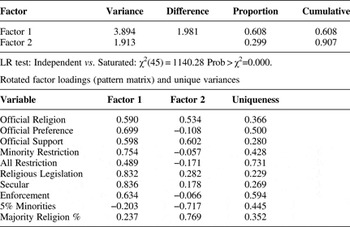
Using principal component factor analysis with an oblique rotation we have identified two factorsFootnote 20 that we argue capture the structural and social dimensions of religion-state separation. The rotational matrix and correlation involving all indicators can be found in Appendix B. In Table 1, the factor item values and indicator loadings are listed. In examining the factor loading table, we can see that almost all the indicators except restrictions on all religions, number of minority religions with at least five percent of the population, and percentage of population belonging to the dominant religion loaded significantly on Factor 1. We argue that this factor is capturing the structural aspects of religion-state separation given the loadings of the different indicators. In our later empirical tests Factor 1 becomes our structural composite variable (Structural).
Factor analysis/correlation (Number of obs = 175). Method: principal factors (Retained factors = 2). Rotation: orthogonal oblimin (Kaiser off). Number of params = 19

Factor 2 had the heaviest loading from the religious demographic indicators (5% minorities and Majority Religion %) and to a lesser extent Official Religion and Official Support. The interpretation of this does not lend itself to unequivocally declaring that we have identified what we consider the social dimension of religion-state separation. However, given the heavy loading from the religious demographic indicators it seems that this factor is capturing latent aspects of how the social context of a state is molded by its religious demography. Given this assumption, in our later empirical tests, we identify Factor 2 as our social composite variable (Social). We should note that we do not consider our principal component analysis as definitive proof of religion-state separation being multi-dimensional, but rather it should be viewed as plausible support for our working hypothesis that religion-state separation should be approached as a multi-dimensional concept.
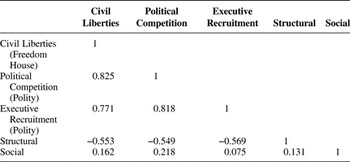
Having provided evidence suggesting that religion-state separation has both structural and social dimensions, our next empirical test is to determine the extent of association that our variables have with more established components of democracy. In Table 2, we compare our structural and social dimension indicators with indicators for Civil Liberties from Freedom House and Executive Recruitment and Political Competition from the Polity IV data set.
Correlation Matrix Between Dimensions of Religion-State Separation and Indicators of Democracy

In the correlation matrix, it seems that our claim that religion-state separation should be considered a component of democracy has some support. Our structural indicator exhibits a moderate negative correlation averaging at −0.557. The negative relationship results from the structural indicators being coded with high values representing less religion-state separation while the democracy components are coded with high values representing more democracy. This could indicate that our structural variable is related to democracy but is capturing some different aspect. However, this simple correlation probably does not justify such a broad assumption. It is possible that the uncorrelated part is measuring something entirely different from democracy. We argue that, since the components of democracy and our composite variable of religion-state separation's structural dimension are both configured to measure institutional aspects of the state, they both have some conceptual association. Whether this is due to the fact that these indicators measure either democracy or its institutional configuration needs further empirical testing. Using more varied indicators for democracy would provide more leverage to determine the exact association between our composite structural variable and established components of democracy.
The association between our composite variable for the social dimension of religion-state separation and established components of democracy provides less support for our argument. The average correlation was low at 0.152. This could possibly be because of the heavy loading of the religious demography indicators (5% Minorities and Majority Religion %), which are not conceptually similar to our democracy components that are more structurally based. It is also possible, given the low correlation, that our composite variable for the social dimension has no association at all with components of democracy. However, it is also plausible that our social variable measures a conceptually different component of democracy from what these indicators capture. Again, given the nature of our empirical test none of these possible conclusions should be ruled out and further empirical testing is needed to determine the true relationship of our social composite variable and components of democracy. Given these results, our claim that religion-state separation should be considered a component of democracy cannot be considered definitive, but the results from the correlation matrix provide sufficient support to explore what impact religion-state separation has upon levels of democracy.
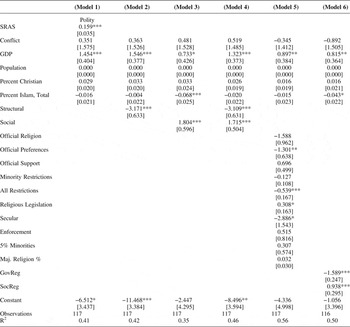
We claim that religion-state separation exhibits a linear relationship to levels of democracy. To test this claim we run a multivariate regression with five models. Table 3 shows the results from that regression with the dependent variable being the polity index score from the Polity IV dataset (Polity), and differing explanatory variables being utilized in the models.
OLS Regression with Polity IV Democracy-Autocracy Score

*10%; **5%; ***1% Significance Levels, Robust SE in brackets.
In model 1, our composite variable for religion-state separation (SRAS) is positively associated with democracy, indicating that, as religion-state separation increases, a state's level of democracy also increases. This conforms to our argument that states with more religion-state separation tend to be more democratic. The Log of GDP is positive and significant in all the models as expected, and no other control variable shows any statistical significance.
In model 2, we drop the composite variable for religion-state separation and test the structural dimension composite variable (Structural). The composite variable indicates a negative and statistically significant relationship with the polity index democracy scores. The negative association is from the indicators used to construct this variable being coded with higher values indicating lesser religion-state separation. This lends support to our argument that as structural religion-state separation increases, the level of democracy increases as well. In short, as the institutions of the state are less influenced by religion, we expect that the state will be more democratic.
In model 3, we drop our structural composite variable and add the composite variable measuring the social dimension of religion-state separation (Social). This variable shows a positive and statistically significant relationship, which would lend weight to our argument that the social dimension of religion-state separation impacts the level of democracy in a state. In model 3, the control for the percentage of the population that is Muslim is statistically significant, which would indicate that the higher the percentage of the population that is Muslim the less democratic that state will be. However, another possible interpretation is that since model 3 is not run with the composite variables Structural or SRAS, the percentage of Muslims in the population is picking up the effect that we would expect low religion-state separation in a country to have. Simply put, many Muslim countries are known to have low religion-state separation (Esposito and Voll Reference Esposito and Voll1996; Esposito Reference Esposito1998), and, since we argue that low religion-state separation leads to less democracy, we would expect that predominantly Muslim countries will have low levels of democracy. The fact that the control Islam is only significant in model 3 (where the structural indicators for religion-state separation are missing) lends weight to this interpretation. We should be clear that we do not see this relationship being driven by the specific adherence to Islam, but rather by low levels of separation between the institutions of state and religion.
Model 4 is run with both composite variables Structural and Social, and both are statistically significant in the expected direction. This would indicate that the more separate the institutions of the state and the social context are from religious influence, the more democratic a state will be. In model 5, the composite variables for structural and social dimensions of religion-state separation are dropped and the individual indicators that were used to construct them are added to the regression. The results show that the variables Official Preferences and All Restrictions are statistically significant and in the expected direction (negative because of the coding of higher values indicating less religion-state separation) at the five percent and one percent levels, respectively. Religious Legislation and Secular are statistically significant at the 10 percent level. These results would seem to confirm the claim that the structural dimension of religion-state separation may be the most important since the indicators that loaded more heavily on the social dimension (5% Minorities and Majority Religion %) show no statistical significance. However, this could also indicate that our claim that religion-state separation should be approached as a multi-dimensional concept is wrong, or at the very least, our conceptualization of the non-structural aspect of religion-state separation is flawed.
The results from model 5 indicate that, when a state has an institutional preference for religion, or when the government places restrictions on all religions, it is likely to be less democratic. To a lesser extent, when the nature of the law is highly sectarian rather than secular and when religious legislation increases, we would also expect the state to be less democratic.
In model 6, we control for the possibility that these results are driven by our indicators for religion-state separation by using the Grim and Finke government regulation and social regulation indices of religion (Grim and Finke Reference Grim and Finke2006). These indices measure the degree the government regulates religious activity, and how the social context can restrain religious freedom, and are conceptually similar to our indicators for religion and state separation.Footnote 21 Using the Grim and Finke indexes (GovReg and SocReg) to replace our religion-state separation variables is a good robustness check to ensure that our results are not being driven by the indicators we constructed. The results from model 6 show results similar to those from model 4. Using the Grim and Finke indices, model 6 indicates that, as government and social regulation of religion increases, democracy decreases. This result adds further support to our argument that the degree of separation between religion and state can impact democracy levels in a state.
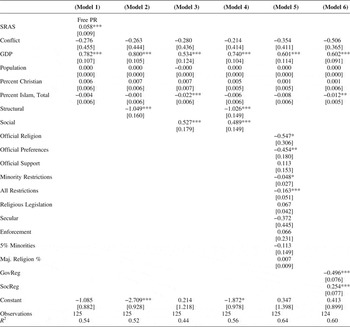
The next question is whether these empirical findings hold if we were to utilize a different indicator for democracy. In the next section, we replace the polity index value from the Polity IV data set and replace it with the Freedom House indicator for political rights (Free PR). We do this as a robustness check in order to see if the coefficients from Table 3 are being biased because of a differing definition of democracy. The same estimator is used: OLS with robust standard errors to control for hetero-skedasticity and contemporaneous correlation between observations. Also, the same variables from models 1–5 in Table 1 are used. This model has a few more observations because of missing data associated with the Polity IV index for democracy. The results are listed in Table 4.
OLS Regression with Freedom House Political Rights Score

*10%; **5%; ***1% Significance Levels, Robust SE in brackets.
Using a different indicator for democracy shows virtually no changes from the results found in Table 1. The composite variables of SRAS, Structural, and Social all show statistical significance in the expected direction. The biggest change from Table 3 is in model 5. Both All Restrictions and Official Preferences remain unchanged from Table 3, but the variables Secular and Religious Legislation are no longer significant. Another change in model 5 is the variables Official Religion and Minority Restrictions, they are now significant at the 10 percent level. The implications of this model show that, when institutional preference for religion is high, or when the government places restrictions on all religions, the state is likely to be less democratic. To a lesser extent, the establishment of a state religion and higher levels of restrictions on religious minorities tend to lower the level of democracy within a state. It should be noted that, despite the differences between the tables in model 5, the individual indicators that show statistical significance are the ones that loaded the most heavily on our structural composite indicator (Structural). This could be evidence that the structural dimension of religion-state separation might have a larger impact than the social dimension. Another possible interpretation is that, instead of seeing religion-state separation as a distinctive multi-dimensional concept, one should view it as a uni-dimensional concept that exhibits specific temporal dynamics. In short, the overall concept of religion-state separation is constructed through a process that involves a causal chain where structural religion-state separation influences how social religion-state separation is created.
One possible explanation for the difference between Tables 3 and 4 in model 5 is that the method of coding these indices accounts for the change. Given that others have identified problems with the inclusion of certain aspects of civil liberties in the Freedom House index, it is possible that the method of construction of this index is partly responsible for this result. What also could be accounting for the change in model 5 in Table 4 is that the Freedom House measure is capturing some non-institutional aspects of democracy that the Polity measure did not include in its conceptualization and that these elements capture a different dynamic of the interaction of religion with the state. Further empirical testing is needed to confirm or reject this possibility, but given our earlier discussion of problems associated with use of Freedom House indicators, caution is needed in interpreting these results. Using different indicators such as United Democracy Scores (UDS) and Polyarchy's inclusiveness and contestation components could help provide some explanatory leverage on these results.
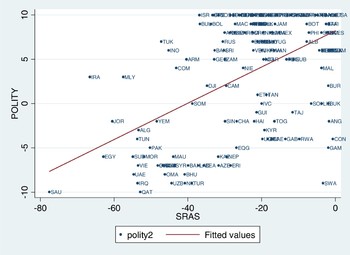
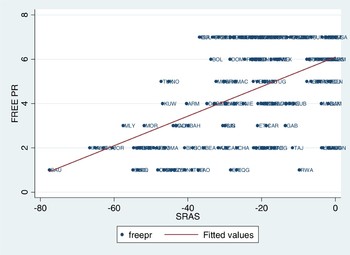
However, despite this variation in Tables 3 and 4, the results indicating that religion-state separation had an impact on democracy consistent with our hypotheses were confirmed. In Figures 1 and 2, we use the composite religion-state separation variable (SRAS) to give a visual representation of the linear relationship we predicted with the level of democracy. We also provide graphs representing the relationship between democracy indicators and our component variables for the structural and social dimensions of religion-state separation in Appendix C.
(Color online) Relationship between Polity IV and SRAS.

(Color online) Relationship between Freedom House PR and SRAS.

CONCLUSION AND FUTURE RESEARCH AVENUES
To summarize, the empirical tests we have conducted give strength to our theoretical claims regarding religion-state separation. The principal component factor analysis lends weight to our claim that the conceptualization of religion-state separation should be approached in a multi-dimensional manner. The moderate correlation with established components of democracy by our structural and social indicators makes it plausible that religion-state separation is associated with democratic components, but may capture a conceptually different aspect of democracy. Finally, the two multivariate regressions empirically tested our claim that more separation of religion and state leads to higher levels of democracy.
One implication of our findings is that those interested in measuring democratization need to move beyond an associational conceptualization of religion since such measures do not really capture the impact it has on democracy. An additional finding of this study is that, even with modernization, understanding religion's role in political life remains important. We also provide evidence that those who study the relationship of specific religious traditions to democracy need to move beyond studies limited to individual religions or countries and account for how religion-state separation can impact democracy from a broader perspective.
It should be noted that we consider these results preliminary. Further research is needed to assess the validity of our arguments, more systematically test our interpretation of the data, and overcome limitations in our analysis. One of these limitations and a future avenue of research is the need to construct a time-series cross-sectional data set to more rigorously and systematically test the claims we make. It could be argued, since religious aspects of institutions and society do not vary much over time, that a cross-sectional test is sufficient to determine the effects of religion-state separation on democracy. We believe that some aspects of religion-state separation probably do not vary much over shorter temporal periods, but it is likely that over longer periods of time both the indicators and the dynamics of religion-state separation probably change considerably. Also, since our argument is that religion-state separation affects the institutional framework of governance, it is reasonable to assume that, when those institutions change over time, this may have some endogenous effect on that impact.
Another possible area for future research regards our claim that the relationship between religion-state separation and levels of democracy is linear. It is possible that the impact that religion-state separation has upon the institutional framework of the state diminishes once a certain threshold is reached, or that extremely high levels of religion-state separation produce inequality because the state will be biased toward citizens who are agnostic or atheist at the expense of those adhering to established religions. These possibilities would indicate that the relationship between religion-state separation and democracy is logarithmic or curvilinear, respectively. It is also possible that, since there is a clustering pattern inherent in the scatter plot, a positive quadratic relationship may exist. More research needs to be conducted in this area to determine the exact impact that religion-state separation is having upon democracy. Another future avenue of research regards the dimensionality of religion-state separation. We argue that we have identified two dimensions: structural and social. However, it is possible that religion-state separation could be conceptually disaggregated further to capture more possible dimensions that may exist. It could also be that, since the institutional aspects of religion-state separation load so heavily, if different dimensions of religion-state separation exist, they may be sufficient but not necessary components of this concept.
What is clear given these findings and the future research avenues available is that our conceptualization of religion-state separation deserves further attention from those interested in the interplay between religion, the state, and democracy. While the claims we make and the empirical results we have found are preliminary, they offer evidence that the continued debate over conceptualizations of democracy needs to consider another component that captures the impact of religion-state separation.
Appendices
APPENDIX A: SUMMARY STATISTICS


APPENDIX B: FACTOR ANALYSIS AND CORRELATION MATRIXES
Factor analysis/correlation (Number of obs = 175). Method: principal factors (Retained factors = 2). Rotation: orthogonal oblimin (Kaiser off). Number of params = 19.

LR test: Independent vs. Saturated: χ2(45) = 1140.28 Prob > χ2=0.000
Rotated factor loadings (pattern matrix) and unique variances

Factor rotation matrix

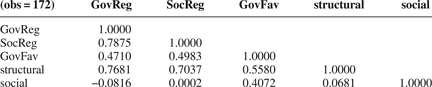
Correlation Matrix w/ Grim and Finke Indexes
APPENDIX C: DEMOCRACY INDICATORS AND DIMENSIONS OF SRAS

APPENDIX D: CODING OF VARIABLES
The coding for the following variables can be found in Fox, Jonathan. 2004. Religion and State Data Codebook. http://www.religionandstate.org (Accessed on September 10, 2009).
• Official Religion — coded from sch2002.
• Secular — coded from l1g2002.
• Enforcement — coded from l2e2002.
The coding for the following variables can be found in Fox, Jonathan. 2008. A World Survey of Religion and the State. New York, NY: Cambridge University Press, 48–54.
• Official Preference — coded from general restrictions.
• Official Support — coded from official support.
• Minority Restrictions — coded from religious discrimination.
• All Restrictions — coded from religious regulation.
• Religious Legislation — coded from religious legislation.
The variable (5% Minorities) is a count variable simply calculating the number of minority religions that have adherents composing 5% or more of the population. This information was retrieved from the CIA World Fact Book.
The variable (Majority Religion %) is a count variable and is coded for the percentage of the population that belongs to the majority religion in the country. This information was taken from the CIA World Fact Book.
COMPOSITE VARIABLE
The variable (Structural) was constructed from principal component analysis (see Appendix B). We used Factor 1 as our Structural dimension indicator because of the variable loadings for that factor.
The variable (Social) was also constructed from principal component analysis (see Appendix B). We used Factor 2 as our Social dimension indicator because of the variable loadings for that factor.
Our composite variable (SRAS) combines the variables (Official Religion, Official Preference, Official Support, Minority Restriction, All Restriction, Religious Legislation, and Secular, Enforcement) into a composite ranging from 0 to 100 with higher values indicating less separation of religion and state. For our analysis this variable is inverted so that higher levels of religion-state separation (SRAS) indicate more separation of religion and state.