Introduction
Deafness is the most common hereditary otolaryngological disease. It is estimated that 60 per cent of prelingual nonsyndromic hearing loss cases are of genetic origin.Reference Yan and Liu1 To date, more than 120 loci for nonsyndromic hearing loss have been mapped in the human genome, and approximately 47 genes have been identified as causative.2
Enlarged vestibular aqueduct is the most commonly identified inner ear bony malformation and is associated with characteristic clinical findings, including disequilibrium and fluctuating or progressive sensorineural hearing loss.Reference Valvassori3 It can also be associated with thyroid goitre in the case of Pendred syndrome.Reference Everett, Glaser, Beck, Idol, Buchs and Heyman4 The incidence of enlarged vestibular aqueduct ranges from 1 to 1.3 per cent; some estimates are as high as 7 per cent, depending on the examined population.Reference Pinto, Mello, Marqui, Perfeito, Ferreira and Silva5
Routine investigation of nonsyndromic sensorineural hearing loss involves imaging of the temporal bone, including computed tomography (CT) and/or magnetic resonance imaging (MRI), as well as possible genetic evaluation. During the course of radiological investigation, the vestibular aqueduct is deemed enlarged if it measures greater than 1.5 mm at its midpoint or wider than the posterior semicircular canal. Genetic examinations target causative genes such as SLC26A4 (Solute carrier family 26, member four) and FOXI1 (Forkhead box i1). Genetic investigation has provided a ‘short cut’ to the early diagnosis of nonsyndromic hearing loss with enlarged vestibular aqueduct and Pendred syndrome, including possible prenatal diagnosis.Reference Pinto, Mello, Marqui, Perfeito, Ferreira and Silva5
Unfortunately, there is no effective treatment for nonsyndromic hearing loss with enlarged vestibular aqueduct, nor for Pendred syndrome. For cases with residual hearing, amplification is the preferred treatment modality, together with associated language rehabilitation training, as soon as possible. For those with severe to profound hearing impairment, amplification is of limited to no benefit, and cochlear implantation becomes an effective intervention.Reference Vivero, Fan, Angeli, Balkany and Liu6
To further expand our understanding of nonsyndromic hearing loss with enlarged vestibular aqueduct, and of its treatment, we reviewed the genotypes and cochlear implantation results of 21 patients with enlarged vestibular aqueduct treated at our hospital between 2005 and 2010.
Materials and methods
Subject recruitment and clinical evaluation
We recruited into the study 21 children from unrelated families from the central southern region of China, who were diagnosed with enlarged vestibular aqueduct at the Second Xiangya Hospital of Central South University between 2005 and 2010.
Informed consent was obtained from all participants, or their parents, prior to commencement of the study, in accordance with the institutional review board and ethical committee of the Second Xiangya Hospital of Central South University.
High-resolution CT and MRI scanning of the temporal bone confirmed the diagnosis of enlarged vestibular aqueduct. The diameter of the bony vestibular aqueduct was measured on the axial CT scans at its midpoint between the common crus and the external aperture. As described by Valvassori, a measurement greater than 1.5 mm was considered enlarged; this is a generally accepted definition.Reference Valvassori3
A complete history and physical examination was obtained from all patients and their families. The thyroid glands of affected patients were screened using ultrasound. Audiometry was used to assess air and bone conduction pure tone thresholds. Auditory brainstem response thresholds were also measured. The severity of hearing loss was assessed using the average hearing thresholds at 500, 1000 and 2000 Hz. Auditory speech perception performance was conducted using open-set Mandarin speech recognition tests (without visual clues), as reported in previous studies.Reference Luo, Fu, Wei and Cao7 Chinese tone, vowel, consonant, word and sentence recognition were measured using speech stimuli derived from the Chinese Standard Database and the Mandarin Hearing in Noise Test.Reference Luo, Fu, Wu and Hsu8, Reference Wong, Liu and Han9
Genetic examination
After obtaining formal consent, genomic DNA was extracted from peripheral blood samples taken from the patients and their first-degree relatives. Genomic DNA from 100 healthy individuals was used as a control group.
DNA microarray
A combination of hereditary hearing loss allele specific polymerase chain reaction and universal array (CapitalBio, Beijing, China) was used to simultaneously screen for nine mutations causing hereditary hearing loss (GJB2: 35 delG, 176 del16, 235 delC, 299 delAT; GJB3: 538 C>T; mtDNA12StRNA: 1555A>G, 1494C>T; SLC26A4: IVS7-2A>G, 2168A>G) (where G = guanine, C = cytosine, A = adenine and T = thymine).Reference Li, Pan, Guo, Li, Gao and Zhang10 It has been reported that IVS7-2A>G and 2168 A>G (H723R) are common mutations of the SLC26A4 gene in East Asians.Reference Dai, Yu, Kang, Zhang, Liu and Mi11 Multiplex allele-specific polymerase chain reaction was performed as described previously.Reference Li, Pan, Guo, Li, Gao and Zhang10 The microarrays were scanned in a LuxScan TMHT 24 Microarray Scanner (CapitalBio) and the data were analysed. The DNA microarray detected homozygotes and heterozygotes for the IVS7-2A>G and H723R mutations of the SLC26A4 gene.
DNA sequencing
Patients in whom DNA microarray identified only one or none of the two mutant alleles of SLC26A4 underwent further DNA sequencing.
The SLC26A4 gene consists of 21 exons and contains a 2343 base pair open reading frame. Exon 1 of SLC26A4 is not in the open reading frame, and no mutation in exon 1 has been found, despite investigation.
Consequently, exons 2–21 of the SLC26A4 gene and exons 1–2 of the FOXI1 gene were amplified from genomic DNA samples by polymerase chain reaction. The primers flanking each exon have been reported previously.Reference Dai, Yu, Kang, Zhang, Liu and Mi11, Reference Hu, Wu, Feng, Pan, Long and Li12 The DNA fragments were amplified, purified with the Qiagen gel extraction kit (Qiagen, Valencia, CA) and then sequenced using an ABI 377 sequencer. Serial sequencing was performed from the frequently mutated exons until two mutant alleles were identified.
Samples from parents and siblings of the probands were also analysed to determine the genotype of each mutation.
All polymerase chain reaction products were sequenced on both strands and analysed using the DNAstar software program (DNASTAR, Inc., Madison, Wisconsin, US) to confirm their similarity to the Genebank sequence. Data were compared with the wild-type sequence of each gene in RefSeq (accession numbers: SLC26A4, NG_008489.1 gDNA and AF030880 cDNA; FOXI1, NG_012068 gDNA and AY707089 cDNA). Each variant allele was analysed in pedigrees and cross-checked with a panel of 100 normal controls as well as with international databases (i.e. the Pendred/BOR homepage; see www.healthcare.uiowa.edu/labs/pendredandbor), in order to clarify whether it was a true mutation.
Cochlear implantation
Nine patients with nonsyndromic hearing loss and enlarged vestibular aqueduct were treated with amplification.
The remaining 12 patients received multi-channel cochlear implants at the Second Xiangya Hospital of Central South University. Recipients were implanted with C40+ devices (Med-EL, Innsbruck, Austria) via posterior tympanotomy, using a standard cochleostomy in the right ear. Implants were activated with the Tempo+ speech processor (Med-EL) one month after surgery.
Implant patients also received post-operative oral education at the Rehabilitation Center for Deaf Children in Hunan province, for three years after implantation.
The outcome of cochlear implantation was assessed by taking the average of five speech recognition scores (assessing Chinese tone, vowel, consonant, word and sentence), 24 months post-implantation.
In order to explore the safety and efficacy of cochlear implantation in patients with an enlarged vestibular aqueduct, 50 cochlear implant recipients with normal cochlear structure were randomly chosen as a control group.
Statistical analysis
Data underwent statistical analysis using the SPSS version 13.0 software package (SPSS Inc, Chicago, Illinois, USA). The efficiency of the two methods of genetic diagnosis was statistically compared using the Fisher exact test. The independent t-test and Fisher exact test were used to compare the sex, age at implantation, pre-operative mean hearing threshold and cochlear implant outcome of patients with enlarged vestibular aqueduct versus control group patients. A p value of less than 0.05 was taken to indicate statistical significance.
Results and analysis
Clinical data
All patients were diagnosed with enlarged vestibular aqueduct. They comprised 16 boys and five girls, with ages ranging from six months to seven years (mean, 4.9 years).
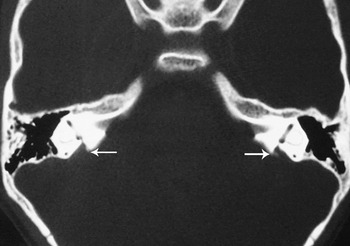
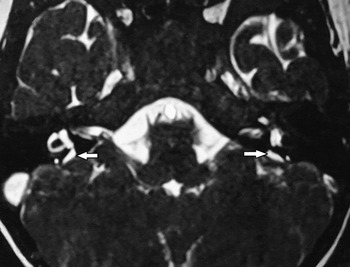
In all patients, computed tomography scanning showed a dilated distal segment of the vestibular aqueduct in the region of the endolymphatic sac (Figure 1). Magnetic resonance imaging showed an enlarged extraosseous endolymphatic sac in 16 cases (Figure 2). Ultrasonography failed to identify a goitre in any of our patients.
Axial, temporal computed tomography scan showing bilateral enlarged vestibular aqueducts (arrows).

Axial, temporal, T1-weighted magnetic resonance imaging scan showing bilateral, markedly dilated endolymphatic sacs (arrows) in a patient with enlarged vestibular aqueduct.

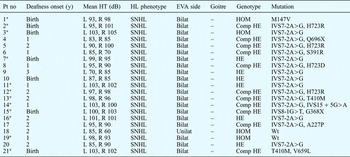
Hearing loss varied from moderate to severe, with either a fluctuating or progressive pattern, and with onset typically occurring not long after birth (Table I). Rarely, hearing loss was noted to be acutely associated with head trauma. The majority of patients with enlarged vestibular aqueduct eventually developed profound sensorineural hearing loss.
Nonsyndromic HL + EVA patients: phenotype and genotype

*Cases receiving cochlear implants. HL = hearing loss; EVA = enlarged vestibular aqueduct; Pt no = patient number; y = years; HT = hearing threshold; L = left; R = right; SNHL = sensorineural hearing loss; Bilat = bilateral; Unilat = unilateral; – = absent; HOM = homozygous; Comp HE = compound heterozygous; Wt = wild-type
Genetic diagnosis
Twelve different mutations of the SLC26A4 gene were identified in 19 cases from 21 families with nonsyndromic hearing loss with enlarged vestibular aqueduct (90.5 per cent). The prevalence of biallelic mutation was 61.9 per cent (13/21) and that of monoallelic mutation 28.6 per cent (six of 21). Using a DNA microarray which targeted the IVS7-2A>G and H723R mutations, we detected SLC26A4 gene mutations in 76.2 per cent (16/21) of our cases. Using a DNA microarray combined with direct sequencing, SLC26A4 gene mutations were detected in 90.5 per cent (19/21) of our cases. The difference in the detection rates of these two methods was not statistically significant (Fisher exact test, p = 0.41). However, DNA microarray alone detected only 59.4 per cent (19/32) of the mutant alleles in our cohort. All the novel mutations we identified were detected only by direct sequencing.
Therefore, while DNA microarray is useful for genetic screening for common SLC26A4 gene mutations, it appears that direct sequencing analysis is still necessary in order to detect novel or rare mutations.
Table I summarises data on the 12 mutations detected among the families of our patients, which included seven mis-sense mutations, two stop mutations and three splice site mutations. Nine of the detected mutations had been reported previously, while three mutations were novel. These three mutations were G368X, Q696X and IVS8-1G>T. None of the novel mutations was found in the controls, and nucleotide sequence analysis in other family members confirmed cosegregation of the mutations for deafness.
No FOXI1 gene mutations were found in our patients.
Mis-sense mutations
Seven mis-sense mutations were detected in our study, all of which were confirmed as mutations. These comprised M147V (439A>G in exon 5), H723R (2168A>G in exon 19), T410M (1229C>T in exon 10), V659L (1975G>C in exon 17),Reference Hu, Wu, Feng, Pan, Long and Li12 S391R (1173G>C in exon 10),Reference Albert, Blons, Jonard, Feldmann, Chauvin and Loundon13 H723D (2167C>G in exon 19)Reference Reyes, Wang, Ouyang, Han, Du and Yuan14 and A227P (679G>C in exon 6).Reference Jiang, Feng, Chen, He and Mei15
Stop mutations
Two stop mutations were detected in our study. In one case, a 1102 G>T substitution in exon 9 caused G368X. In the other case, a 2086C>T substitution in exon 18 caused Q696X. Both of these mutations are considered to be deleterious, as the premature stop codon would result in a truncated protein.
Splice site mutations
Two confirmed pathogenic mutations, IVS7-2A>G (an exon 8 acceptor splice site) and IVS15 + 5G>A (an exon 15 donor splice site), were detected. One of the novel mutations we discovered, IVS8-1G>T (an exon 9 acceptor splice site), is considered pathogenic because it affects the canonical splice acceptor nucleotide position, which may lead to aberrant splicing. In our study, it coexisted with G368X in the proband, and was not detected among control chromosomes.
Mutations in unaffected controls
Two IVS7-2A>G heterozygous mutant alleles were detected from amongst 200 control group alleles analysed. No other mutant alleles were found in the controls.
SLC26A4 mutation spectrum
In this study, IVS7-2A>G was the most common mutation detected, accounting for 44.7 per cent (17/38) of mutant alleles. We found a carrier frequency for this mutation of 1 per cent (two of 200) among our normal Chinese control group.
The H723R mutation is also common in Chinese patients with nonsyndromic hearing loss and enlarged vestibular aqueduct. In our study, it accounted for 8.3 per cent of mutant alleles (three of 38 alleles). It was not found in the control group.
Cochlear implantation
In this study, the success rate of implantation surgery in patients with enlarged vestibular aqueduct was the same as that in individuals with normal cochlear structure (i.e. our control group subjects); the rate in both groups was 100 per cent. Full electrode insertion was achieved in the 12 patients undergoing cochlear implantation. Perilymphatic leakage occurred in nine cases during implantation, controlled by full electrode insertion and packing of the cochleostomy with temporalis muscle fascia. None of the cochlear implant recipients developed nystagmus, meningitis, cerebrospinal fluid leakage or facial paralysis after implantation.
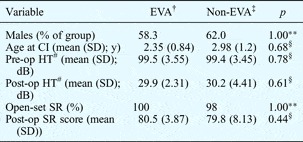
Table II summarises the outcome of cochlear implantation in patients with enlarged vestibular aqueduct. After implantation, 12 recipients with enlarged vestibular aqueduct developed good audiometric and speech recognition performance; 10 of these patients subsequently enrolled in a normal school. The mean hearing threshold of the enlarged vestibular aqueduct recipients was 29.9 dB, compared with 30.2 dB in the 50 control subjects; this difference was not statistically significant (independent t-test, p > 0.05). The mean speech recognition score of the enlarged vestibular aqueduct group was 80.5, compared with 79.8 in the control group; this difference was not statistically significant either (independent t-test, p > 0.05). Therefore, we concluded that cochlear implantation in recipients with enlarged vestibular aqueduct was as effective and safe as that in patients with normal cochlear structure.
Demographic & hearing data for CI recipients: EVA vs NON-EVA*

*Determined by imaging. †n=12; ‡n = 50. **Fisher exact test; §Independent t-test. #Right ear. CI = cochlear implantation; EVA = patients with enlarged vestibular aqueduct; Non-EVA = patients without enlarged vestibular aqueduct; SD = standard deviation; y = years; Pre-op = pre-operative; HT = hearing threshold; Post-op = post-operative; SR = speech recognition
Discussion
The SLC26A4 gene encodes pendrin, a polytopic transmembrane protein that can exchange a variety of anions across the plasma membrane, including HCO3−, Cl−, I− and formate.Reference Scott, Wang, Kreman, Andrews, McDonald and Bishop16 It is expressed in the endolymphatic sac or duct, in discrete areas adjacent to the maculae of the utricle and saccule, and in the spiral prominence of the scala media. It has proven to be important for endolymphatic fluid resorption in the inner ear.Reference Taylor, Metcalfe, Watson, Weetman and Trembath17 The FOXI1 gene is a transcriptional activator of SLC26A4.Reference Yang, Vidarsson, Rodrigo-Blomqvist, Rosengren, Enerback and Smith18
The incidence of SLC26A4 mutations is high in patients with nonsyndromic hearing loss with enlarged vestibular aqueduct, and patients with this mutation may represent up to 4 per cent of nonsyndromic hearing impairment cases. More than 174 recessive mutations of the SLC26A4 gene have been described in patients with nonsyndromic hearing loss with enlarged vestibular aqueduct and Pendred syndrome.19 The frequencies and nature of the mutations are known to be influenced by ethnic grouping and geographical location, with multiple mutational ‘hotspots’ identified. The most common mutation in Caucasians is L236P, but this is rare in Asians.Reference Ouyang, Yan, Yuan, Pu, Du and Han20 In Korean and Japanese populations, H723R and IVS7-2A>G are the prevalent alleles of SLC26A4 mutations.Reference Ouyang, Yan, Yuan, Pu, Du and Han20–Reference Park, Shaukat, Liu, Hahn, Naz and Ghosh22 In 2007, Wang et al. identified 40 SLC26A4 mutations among 107 Chinese patients with enlarged vestibular aqueduct.Reference Wang, Zhao, Rao, Guo, Yuan and Zong23 The most common mutation in Chinese populations is IVS7-2A>G, suggesting a founder effect.Reference Wang, Zhao, Rao, Guo, Yuan and Zong23 Overall, the prevalence and distribution of SLC26A4 mutations identified in our investigation were similar to those reported previously in East Asian subjects. We too found that IVS7-2A>G and H723R were prevalent mutations in Chinese patients with enlarged vestibular aqueduct. In our cohort, the most common genotype of nonsyndromic hearing loss with enlarged vestibular aqueduct was the compound heterozygote of IVS7-2A>G and another mutant allele.
The FOXI1 gene seems to be a rare causative gene for enlarged vestibular aqueduct, as no pathogenic mutation was detected in our study.
Three novel SLC26A4 mutations, G368X, Q696X and IVS8-1G>T, were found in our research. We consider these to be pathological mutations rather than rare polymorphic changes, for several reasons. First, none of the novel mutations represented was found in the controls. Second, these mutations were highly associated with cases in which mutations were found to be homozygous or compound heterozygous, indicating that they may cause deafness. Furthermore, the two stop mutations are considered to be deleterious because the premature stop codon will result in a truncated protein. The IVS8-1G>T mutation affects the canonical splice acceptor nucleotide positions and may lead to aberrant splicing, but this effect remains to be verified experimentally.
The high prevalence of IVS7-2A>G and H723R mutations in the Chinese population make it convenient to use DNA microarray for genetic screening in patients with enlarged vestibular aqueduct. The DNA microarray technique is a simple, fast, cheap method for routine genetic diagnosis. It can be used to easily detect specific mutations in known genes. Combining DNA microarray with direct sequencing analysis enables large scale genetic examination with accurate outcomes. However, the methods used in the current study were not able to detect biallelic pathogenic mutation in all our patients with enlarged vestibular aqueduct. This could have been due to our strategy of sequencing polymerase chain reaction products amplified only in exons and their adjacent intronic region, and therefore missing some deleterious mutations. Another possible reason is that an enlarged vestibular aqueduct could be caused by other factors, or could be associated with other inner ear abnormalities. Genetic examination has become a very important method of diagnosing enlarged vestibular aqueduct and other ear malformations.
Genotypic-phenotypic correlations of the SLC26A4 genotype remain controversial. Mutations in different regions of the SLC26A4 gene can cause different phenotypes. However, nonsyndromic hearing loss with enlarged vestibular aqueduct and Pendred syndrome may be caused by the same combination of mutations. Until now, IVS5-1G > A has only been found in the Pendred syndrome family, whereas M147V and IVS7-2A>G have been detected in the families of patients with nonsyndromic hearing loss and enlarged vestibular aqueduct. The H723R mutation has been found both in nonsyndromic hearing loss with enlarged vestibular aqueduct and in Pendred syndrome families.Reference Tsukamoto, Suzuki, Harada, Namba, Abe and Usami21 In our research, homozygous or compound heterozygous M147V, H723R, H723D, V659L, S391R, T410M, A227P, IVS7-2A>G and IVS15+ 5G>A mutations, and the novel mutations G368X, Q696X and IVS8-1G>T, were detected in families with nonsyndromic hearing loss with enlarged vestibular aqueduct. Some studies indicate that the phenotype of patients with enlarged vestibular aqueduct correlates with the number of SLC26A4 variant alleles. Choi et al. observed a strong correlation between Pendred syndrome and biallelic SLC26A4 mutations, whereas nonsyndromic hearing loss with enlarged vestibular aqueduct was associated with one or no SLC26A4 mutations.Reference Choi, Stewart, Madeo, Pryor, Lenhard and Kittles24 Our results suggest that discordant segregation of phenotypes and genotypes could occur in some cases. Biallelic SLC26A4 mutations were also found in cases with nonsyndromic hearing loss with enlarged vestibular aqueduct, which indicates that other genetic or environmental factors underlie the phenotypes.
• Chinese patients with nonsyndromic hearing loss and enlarged vestibular aqueduct were assessed using DNA microarray plus direct sequencing
• Twelve mutations, including three novel mutations, were detected
• The SLC26A4 mutation spectrum in these Chinese patients was similar to that in other East Asian populations
• Cochlear implantation was effective in these patients, with no significant surgical complications
Early treatment is necessary for patients with enlarged vestibular aqueduct. They may have moderate to severe hearing impairment during the early stages of childhood. For children with residual hearing, hearing aids may enable development of oral language and integration into mainstream schooling. Unfortunately, most patients with enlarged vestibular aqueduct gradually develop profound hearing loss over time.Reference Vivero, Fan, Angeli, Balkany and Liu6 Our experience suggests that cochlear implantation surgery is safe and complete electrode insertion is feasible. Leakage of perilymph during cochleostomy can be controlled by sealing the opening with temporalis muscle fascia. Most importantly, patients perform well following implantation. In our patients, speech discrimination and spoken language improved significantly following routine oral rehabilitation.
Conclusion
This study assessed 21 patients with nonsyndromic hearing loss and enlarged vestibular aqueduct, from distinct familial lineages, and discovered three novel mutations in the SLC26A4 gene. The spectrum of SLC26A4 mutations detected was similar to that previously reported in East Asian subjects. For those patients with profound hearing loss, cochlear implantation was noted to be a safe and effective therapeutic option.
Further work is necessary to study the genetic aetiology of enlarged vestibular aqueduct, and to investigate additional diagnostic and therapeutic modalities.
Acknowledgements
This study was supported by grants from the Eleventh Five-Year Plan for Deaf Children Cochlear Implantation Program of Hunan Province, the National Natural Science Foundation of China (grants number 30000094 and 30070807) and the Postdoctoral Science Foundation of Central South University, China. We thank the patients who participated in this study, and Yong Chen and Zhengmao Hu for their technical support.