There is no longer any doubt that Information and Communications Technology (ICT) is part of everyday life for young adults; they use it to communicate, and as a tool to learn and explore. Subrahmanyam and Šmahel (Reference Subrahmanyam and Šmahel2011) proposed a theoretical model to analyze young people’s online behavior from a psychodevelopmental perspective. According to those authors, ICT (understood as using mobile devices and social networking) has become a real space for young people’s development and learning, a context in which they can express themselves and grapple with the main challenges of their age, which revolve around assuming responsibility in different spheres of social and personal life, including romantic life (Brown & Bobkowski, Reference Brown and Bobkowski2011; Shulman & Connolly, Reference Shulman and Connolly2013). From that point of view, one would expect online and offline behavior to be related, not only reflecting young people’s interests and concerns, but providing two-way feedback.
Studies of online behavior in young adults seem to confirm Subrahmanyan and Šmahel’s postulates (2011) that young adults use the Internet in fundamental ways to communicate with their romantic partner and develop the relationship (Fox & Warber, Reference Fox and Warber2013), and publicly share emotional states, photos, and other content from their romantic relationships (Carpenter & Spottwood, Reference Carpenter and Spottswood2013). By the same token, it has been suggested that online couple behavior influences perceptions of the romantic relationship overall. For example, Caughlin and Sharabi (Reference Caughlin and Sharabi2013) analyzed online and offline behavior in the form of private and public messages via Internet, text messages, chat, video chat, and phone calls between American young adults and their romantic partners. They concluded that people who adopted both modes of communication, in a balanced way, had more favorable results in terms of intimacy and relationship satisfaction than those who used only one (online or offline), and those who had trouble switching online to offline or vice versa. Similarly, Morey and her collaborators (Morey, Gentzler, Creasy, Oberhauser, & Westerman, Reference Morey, Gentzler, Creasy, Oberhauser and Westerman2013) found that communicating via phone and text message was associated with greater relationship satisfaction and intimacy in American young adults.
More numerous studies have analyzed the relation between negative online relationship dynamics and different indicators of romantic relationship quality in young adults. For instance, online jealousy – understood as an emotional reaction prompted by visualizing online relationship content – and concerns and suspicions about a partner’s interest in someone else (Utz & Beukeboom, Reference Utz and Beukeboom2011) have been associated with low levels of relationship satisfaction (Elphinston & Noller, Reference Elphinston and Noller2011), and predict involvement in psychological (Strawhun, Adams, & Huss, Reference Strawhun, Adams and Huss2013) and physical abuse (Sánchez, Muñoz, Nocentini, Ortega-Ruiz, & Menesini, Reference Sánchez, Muñoz, Nocentini, Ortega-Ruiz and Menesini2014). On the other hand, research on online intrusive behavior, which is understood as repeated, obsessive attempts to initiate contact and communicate with a partner after a break-up or fight, has revealed that people who exhibit these behaviors in online mode do so offline too (Spitzberg & Hoobler, Reference Spitzberg and Hoobler2002; Strawhun et al., Reference Strawhun, Adams and Huss2013), and has linked it to low relationship quality (Lavy, Mikulincer, Shaver, & Gillath, Reference Lavy, Mikulincer, Shaver and Gillath2009) as well as intimate partner abuse (Sánchez et al., Reference Sánchez, Muñoz, Nocentini, Ortega-Ruiz and Menesini2014; Strawhun et al., Reference Strawhun, Adams and Huss2013). Regarding online monitoring or control, that is, surveillance and tracking of the partner’s online activity (Tokunaga, Reference Tokunaga2011), results have been inconclusive. Some studies have found negative associations between control and relationship satisfaction (Elphinston & Noller, Reference Elphinston and Noller2011), while other studies have not (Stewart, Dainton, & Goodboy, Reference Stewart, Dainton and Goodboy2014). Finally, the research on online infidelity, understood as using ICT to flirt or contact others, have produced similarly disparate results: some studies related it to lower relationship satisfaction (Cravens, Leckie, & Whiting, Reference Cravens, Leckie and Whiting2013), while others found it was more closely tied to sensation-seeking behaviors than low relationship satisfaction (Hertlein & Stevenson, Reference Hertlein and Stevenson2010). What these studies do clearly suggest is that while positive online practices – like using ICT to communicate with one’s partner, and spending time together online – are related to positive relationship outcomes, associations with negative online relationship dynamics have been inconclusive.
In addition to those findings, differences in online practices and relationship satisfaction have been observed as a function of sex, age, and relationship length. The research suggests that women are involved in longer, more serious relationships with higher satisfaction (Dhariwal, Connolly, Paciello, & Caprara, Reference Dhariwal, Connolly, Paciello and Caprara2009; Rauer, Pettit, Lansford, Bates, & Dodge, Reference Rauer, Pettit, Lansford, Bates and Dodge2013), but tend to exhibit more online jealousy (Muise, Christofides, & Desmarais, Reference Muise, Christofides and Desmarais2014). Men, meanwhile, tend to engage in more cyberbullying and cyberdating (Duran-Segura & Martínez-Pecino, Reference Durán-Segura and Martínez-Pecino2015; Sánchez, Muñoz-Fernández, & Ortega-Ruiz, Reference Sánchez, Muñoz-Fernández and Ortega-Ruíz2015). To date, we do not know of previous studies that relate age to higher relationship satisfaction, but it does seem to be negatively associated with Internet usage (Correa, Hinsley, & De Zuniga, Reference Correa, Hinsley and Zuniga2010) and certain online practices, such as partner monitoring (Tokunaga, Reference Tokunaga2011). Studies exploring the effect of relationship length appear to be more conclusive, indicating that more enduring couples feel more satisfied with their relationships (Ahmetoglu, Swami, & Chamorro-Premuzic, Reference Ahmetoglu, Swami and Chamorro-Premuzic2010; Hurley & Reese-Weber, Reference Hurley and Reese-Weber2012) and utilize the Internet less (Lenhart & Duggan, Reference Lenhart and Duggan2014). Recently, Rahaman (Reference Rahaman2015) concluded that long-term couples presented less online conflicts, and therefore greater commitment to the relationship.
In light of the above, the literature suggests that the kind of relationship dynamics a couple establishes online impacts their satisfaction with the relationship; However, it could be hypothesized that this association can differ as a function of sex, age, and relationship length. The research to date on this association has focused on specific online behaviors – like jealousy, control, communication, and intrusiveness – only sometimes including the effects of variables like sex (Muise et al., Reference Muise, Christofides and Desmarais2014), age (Tokunaga, Reference Tokunaga2011), and relationship length (Rahaman, Reference Rahaman2015). Thus, we do not know with certainty what dimensions of online couple quality are most important to explaining relationship satisfaction, nor what effect those three variables might have on the association.
In Spain, research on this subject remains nascent. Many studies have analyzed cyberbullying in young couples (Durán-Segura & Martínez-Pecino, Reference Durán-Segura and Martínez-Pecino2015) in relation to offline violence (Sánchez et al., Reference Sánchez, Muñoz, Nocentini, Ortega-Ruiz and Menesini2014), but we know of no study that analyzed how online couple quality contributes to relationship satisfaction in a college population. In this study, we understand relationship satisfaction as an indicator of relationship quality, and as characterized by intimacy, communication, and a desire to stay in the relationship (Madsen & Collins, Reference Madsen and Collins2011). With that in mind, this study’s first objective is to analyze online relationship quality in young adult, Spanish couples, taking into account the effects of sex, age, and relationship duration. The second objective is to explore the connection between online relationship quality and relationship satisfaction, specifically analyzing which dimensions of online couple quality (intimacy, jealousy, control, intrusiveness, communication, or cyberdating practices) are most closely related to relationship satisfaction, and to include the possible effects of age, sex, and relationship length in the results.
According to earlier studies’ findings, we expect that women will exhibit more online jealousy (Muise et al., Reference Muise, Christofides and Desmarais2014) and men more cyberdating (Sánchez et al., Reference Sánchez, Muñoz-Fernández and Ortega-Ruíz2015), and that in general, positive and negative online practices will decrease with age (Tokunaga, Reference Tokunaga2011) and length of the relationship (Lenhart & Duggan, Reference Lenhart and Duggan2014). Regarding the relationship between online couple quality and relationship satisfaction, we expect that positive dynamics like online intimacy will be positively associated with relationship satisfaction (Caughlin & Sharabi, Reference Caughlin and Sharabi2013; Morey et al., Reference Morey, Gentzler, Creasy, Oberhauser and Westerman2013). Since findings in Spain about negative online couple quality have been scant and inconclusive, we have formulated no clear hypothesis about it. It is for that reason that the second objective aims to further our understanding of this association by generating new data.
Method
Participants
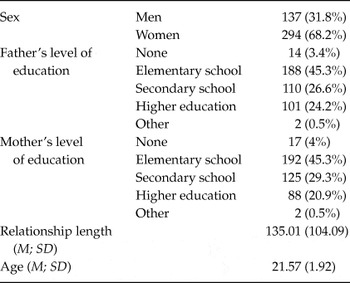
Initially, 793 college students at the University of Córdoba (Spain) participated in this study. From those, 431 were selected because they reported a current dating relationship (68.2% women; age range 18 to 26 years, average age 21.57, SD = 1.92). Participants were selected through convenience sampling from the departments of Literature (10.8%), Education (26%), Law (3.9%), Business Administration and Management (4.2%), Occupational Science (11.4%), Veterinary and Medicine (19.3%), Biology (3.2%), and Engineering (19.3%), heeding Ferrer and collaborators’ (2006) remarks about the impact of curriculum on romantic relationship knowledge (Ferrer, Bosh, Ramis, & Navarro, Reference Ferrer, Bosch, Ramis and Navarro2006). The students’ distribution by department was representative of the university sample at large.
The sample’s characteristics and descriptive results appear in Table 1.
Sample Descriptive Statistics

Note: Father’s level of education (n = 415); Mother’s level of education (n = 424).
Instruments
Ad hoc measures
Participants were asked about descriptive variables including sex, age, family level of education, and hours of Internet use.
Relationship status
Two items from the Dating Questionnaire (Connolly, Craig, Goldberg, & Pepler, Reference Connolly, Craig, Goldberg and Pepler2004) were posed. The first gauges relationship status and was multiple-choice (response categories as follows: a) Yes, I have a girl(boy)friend right now; b) No, I don’t have a girl(boy)friend right now, but I had one in the last two months; c) I don’t have a girl(boy)friend right now, but I did more than two months ago; d) No, I’ve never had a girl(boy)friend). The second item measures relationship length in weeks. The relationship status variable was applied as a filter, such that only participants who reported a romantic relationship at the time they completed the questionnaire were selected for this study.
Relationship satisfaction
This was assessed using six items from the Network of Relationships Inventory (Furman & Buhrmester, Reference Furman and Buhrmester1992), measured on a 5-point Likert scale with anchors 0 (never) and 4 (all the time) (e.g., “I am sure this relationship will continue in the future ” “I tell my boy/girlfriend things I would not want others to know”). A given participant’s relationship satisfaction score was computed from his or her average scores.
Online couple quality
This was measured by the Cyberdating Q_A (Sánchez et al., Reference Sánchez, Muñoz-Fernández and Ortega-Ruíz2015). The questionnaire is comprised of 28 items on a 5-point Likert scale (from never-0 to always-4) that analyze six dimensions of online couple quality: (1) four items about online jealousy, which is a person’s emotional reaction and concerns about content shared by their partner, and the possibility that he or she is interested in someone else (e.g., “I get jealous when my partner posts provocative photos on their social network profile;” “I worry about my partner starting a relationship with someone else via social networks”); (2) four items about online intrusive behavior, that is, trying to resume communication after an argument by means of mass, insistent messages and calls (e.g., “When we’ve had an argument and my partner blocks me, I use a friend’s profile to leave him/her messages, communicate by chat or on their page;” “When we’ve had an argument and my partner blocks me, I use a friend’s profile to leave him/her messages, communicate by chat or on their page”); (3) six items about online control, which is the process of supervising and monitoring the partner’s profile and online activity in his or her social network (e.g., “I have added my partner’s friends as a way of controlling him/her;” “I have opened a fake account so that my partner adds me and I can control him/her”); (4) three items about online intimacy, which refers to shared time on the Internet and a feeling of closeness to one’s partner while online (e.g., “I have a really good time with my partner when we’re online together;” “I spend a lot of free time talking to my partner on chat”); (5) four items about cyberdating practices, that is, contacting and flirting with other parties while in a relationship (e.g., “I have ‘flirted’ with other people via social networks whilst in a relationship;” “When I meet someone I like, I quickly give them my mobile number”); and (6) seven items referring to emotional communication strategies, which are tactics to manipulate or control one’s partner, or display anger or show that there is a problem (e.g., “I use capital letters when I am annoyed with my partner;” “I use ellipses to insinuate something to my partner”). Scores on these online quality scales are calculated using participants’ average scores. According to earlier results reported by the scale’s authors, online intimacy is considered a positive dimension of online couple quality, and the remaining dimensions are negative.
Procedure
These self-report instruments were administered in paper form during school time in a single 40-minute session. Participants completed an informed consent form, and participation was entirely voluntary. Trained researchers executed data collection and we ensured the confidentiality of all information collected.
Data analysis
The first step was to do two Confirmatory Factor Analyses (CFAs) of online couple quality and relationship satisfaction in order to validate the instruments in this study’s sample. Next, means comparisons were done as a function of gender, using Student’s t test on each scale of online couple quality and romantic relationship satisfaction. Subsequently, we analyzed Pearson’s correlations between age, relationship duration, online couple quality, and relationship satisfaction. These analyses were done separately for men and women in order to differentially analyze the association between these variables by gender. To satisfy this study’s second objective, a multiple linear regression was done using a step-wise method; in it, relationship satisfaction was the dependent variable, and sex, age, relationship length, and online couple quality were independent variables. Moderating variables (sex, age, and relationship length) were entered into a first block; a second block included the dimensions of online couple quality; and the third block added the interaction terms of the moderating variables in online couple quality: the interaction between sex and each dimension of online couple quality, the interaction between age and each dimension of online couple quality, and the interaction between relationship duration and each dimension of online couple quality. To diminish collinearity issues, all the independent variables were first standardized; all interactions were computed using standardized variables. The gender variable was coded such that a value of 0 was assigned to men, and 1 to women.
Analyses were conducted using the statistics packages Lisrel 8.72 and SPSS 23. Goodness of fit of the models resulting from CFA was appraised based on Satorra-Bentler’s chi-square, RMSEA, and CFI. We determined that goodness of fit was adequate when the value of RMSEA was under .08, and CFI over .90.
Results
Preliminary analyses
Two CFAs were tested, one for online couple quality and another for romantic relationship satisfaction.
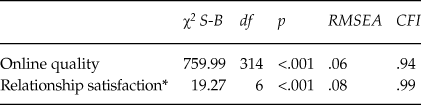
The model of online quality revealed a high correlation between online jealousy and online control (r = .91), so we test a model with five correlated factors where those two scales merged into one factor. The remaining scales were the same as in the original instrument: online intrusiveness, online intimacy, cyberdating practices, and emotional communication strategies. The results of relationship satisfaction CFA, meanwhile, suggested freeing the correlations between error terms in three items (see Table 2). Both models showed goodness of fit.
Goodness of Fit Indices for Online Couple Quality and Relationship Satisfaction

Note: Robust maximum likelihood estimation was employed because the assumption of multivariate normal distribution was not met. *Correlations between the error terms in three items were added; they measure relationship satisfaction. (Reliability: Online intimacy α = .68; cyberdating practices α = .60; online intrusiveness α = .65; emotional communication strategies α = .76; online jealousy-control α = .81; romantic relationship satisfaction α = .87.)
Descriptive analyses
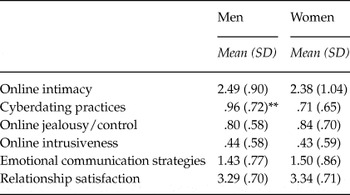
This study’s first objective was to analyze online couple quality in romantic relationships between young adults as a function of sex, age, and relationship length. Table 3 presents means and standard deviations of online quality and relationship satisfaction as a function of sex. Evidently online intimacy, emotional communication strategies, and relationship satisfaction had the highest means, exceeding 3 points in young men and women alike. Online intrusiveness, conversely, had the lowest means. Significant differences were only found on the cyberdating practices dimension (t(422) = 3.552; p < .01, d = .35), on which men scored higher than women on average, though the effect size was small.
Comparison of Online Couple Quality and Relationship Satisfaction by Gender

Note: **p < .01; *p < .05.
Table 4 lists the correlations of age and relationship duration with online couple quality and relationship satisfaction, as a function of sex.
Correlations between Age, Relationship Length, Dimensions of Online Couple Quality, and Relationship Satisfaction in Young Men and Women

Note: **p < .01; *p < .05. Correlations in men appear sans parentheses.
According to the results, age was negatively related to online intimacy, cyberdating practices, online jealousy-control, and emotional communication strategies in men as well as women. Furthermore, it was not related to relationship satisfaction, but was related to relationship length in women. In terms of relationship duration, this was negatively associated with cyberdating practices in both sexes. In women only, we found that relationship length was negatively associated with online intimacy and emotional communication strategies. In men, no relationship was found between relationship duration and the other dimensions of online couple quality. All significant correlations registered a small or medium effect size.
Regression model of the association between online couple quality and relationship satisfaction
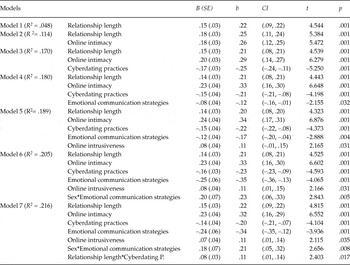
Table 5 presents results from the multiple linear regression model. As in the results in the last step, Model 7, we observed that relationship satisfaction was explained by relationship length, online intimacy, cyberdating practices, emotional communication strategies, online intrusiveness, the interaction between sex and communication strategies, and the interaction between relationship duration and cyberdating practices, with a total explained variance of 21.7% (F(7, 400) = 15.810; p = .011.
Relationship Satisfaction Model Resulting from Hierarchical Multiple Linear Regression

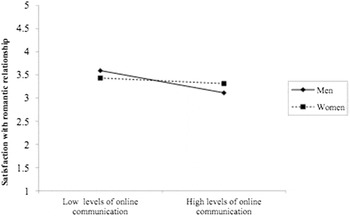
To be specific, relationship length, online intimacy, and online intrusiveness were observed to positively correlate with relationship satisfaction, whereas relationship satisfaction negatively correlated with cyberdating practices and emotional communication strategies. Finally, to make the interaction terms easier to interpret, we carried out a simple analysis of slopes, finding that for the interaction between sex and communication strategies (Figure 1), the slope was significant in men only (t = –3.795, p = .001; for the women it was t = –.435, p = .664) such that the more communication strategies male participants reported, the lower their satisfaction with the relationship.
Interaction effect between sex and emotional online communication on relationship satisfaction.

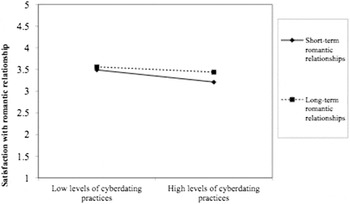
On another note, regarding the interaction between cyberdating practices and relationship duration (Figure 2), the slope was only significant in shorter-term relationships (t = –2.214, p = .027; for longer relationships it was t = –.717, p = .474). Accordingly, greater use of cyberdating practices was associated with lower relationship satisfaction in shorter relationships; that effect was not produced in longer relationships.
Interaction effect between relationship length and cyberdating practices on relationship satisfaction.

Discussion
In recent years, we have seen a rising number of studies interested in how young people incorporate new technologies into their romantic relationships (Fox & Warber, Reference Fox and Warber2013; Morey et al., Reference Morey, Gentzler, Creasy, Oberhauser and Westerman2013; Stewart et al., Reference Stewart, Dainton and Goodboy2014). However the influence of those behaviors on couples’ lives is still up for debate, especially in Spain, where studies on this have been few. Therefore, this study aimed to explore relationship quality online in young adults, and its association with overall relationship satisfaction. In line with earlier studies that found differences on some measures of online couple quality as a function of sex (Muise et al., Reference Muise, Christofides and Desmarais2014), age (Tokunaga, Reference Tokunaga2011), or relationship length (Hurley & Reese-Weber, Reference Hurley and Reese-Weber2012), this study also analyzed those three variables as potential moderators in the relationship between online quality and relationship satisfaction.
Descriptive analyses showed that these young people had moderate levels of online intimacy and communication strategies, and low online jealousy, intrusiveness, and control. These results confirm, first, that a couple’s life also develops in the space of virtual media (Fox & Warber, Reference Fox and Warber2013), and second, that positive relationship dynamics are more common than negative, which is consistent with research examining relationship quality in couples off-line (Sánchez et al., Reference Sánchez, Muñoz, Nocentini, Ortega-Ruiz and Menesini2014). Analysis of a potential gender effect on results revealed differences only in cyberdating practices, with young men more than women reporting that they flirt with various people while in a relationship, and emphasizing physique as the most important feature of people they meet on the Internet. These results are similar to findings in adolescent populations (Sánchez et al., Reference Sánchez, Muñoz-Fernández and Ortega-Ruíz2015), which some authors have interpreted as a greater tendency for adolescent boys and young men to engage in sensation-seeking behaviors and risk-taking (Hertlein & Stevenson, Reference Hertlein and Stevenson2010); that would logically increase in an environment where anonymity and privacy are attained more easily than off-line (Utz & Beukeboom, Reference Utz and Beukeboom2011). Nonetheless, it might also reflect differing male and female interpretations of what they can and cannot do while in a relationship. Along those lines, studies about beliefs and attitudes about love have suggested that females still have more romantic, conservative ideas about love, while males more openly accept flirting and infidelity (Espinoza, Correa, & García, Reference Espinoza, Correa and García2014). The lack of differences on other scales, namely the negative ones, contradicts earlier findings that females exhibit higher levels of jealousy (Elphinston & Noller, Reference Elphinston and Noller2011), which would lead them to deploy more partner-monitoring and -control behaviors (Muise et al., Reference Muise, Christofides and Desmarais2014). These differences could be explained by methodological aspects such as different designs and measurement instruments. For example, Muise et al. (Reference Muise, Christofides and Desmarais2014) used an experimental design to test whether jealousy levels predicted monitoring and surveillance behavior after seeing the partner’s Facebook posts. In contrast, the present study was survey-based. In relation to measurements, in our study, jealousy and control dimensions were considered part of a single dimension; earlier studies examined them separately even though their authors concluded that the two scales are strongly correlated (Elphinston & Noller, Reference Elphinston and Noller2011; Muise et al., Reference Muise, Christofides and Desmarais2014). Future research could confirm whether the lack of differences between males and females on this dimension is due to methodology, or the presence of cultural differences, in love styles for instance (Rohman, Führer, & Bierhoff, Reference Rohman, Führer and Bierhoff2016).
Correlation analyses showed that age and relationship length were negatively associated with online couple quality scales, but that effect size was small. These results are in line with past studies where less partner monitoring was observed in older participants (Tokunaga, Reference Tokunaga2011); and more stable couples presented less flirting behavior and infidelity (Blow & Harnett, Reference Blow and Hartnett2005), as well as less use of new ICTs (Pew Research Centre, 2014). These results reinforce the hypothesis that the online world becomes less important in more stable couples during the transition to adulthood, a tendency that was not found, however, in adolescent populations (Sánchez et al., Reference Sánchez, Muñoz-Fernández and Ortega-Ruíz2015). It is worth noting that the correlations were small, suggesting that while there was in fact a trend, these variables’ association was not very strong. Future studies might extend participants’ age range and test whether the online world’s influence on the couple’s life continues to decrease significantly in older participants.
Finally, multiple linear regression analysis showed that online quality was related to overall relationship satisfaction. In particular, satisfaction was explained positively by online intimacy and intrusiveness, and negatively by cyberdating and emotional communication strategies. These results confirm that the relationship dynamics unfolding in online media impact a young person’s satisfaction with his or her partner, and highlight the connection between life on- and off-line (Subrahmanyan & Šmahel, Reference Subrahmanyam and Šmahel2011). Accordingly, positive relationship dynamics that take place in online media, like spending time together on the Internet and having greater online intimacy, are associated with higher relationship satisfaction (Morey et al., Reference Morey, Gentzler, Creasy, Oberhauser and Westerman2013), while higher levels of cyberdating and emotional communication strategies were associated with lower relationship satisfaction. It is interesting to consider that online jealousy did not enter into our regression equation, in contrast to earlier studies on this subject (Elphinston & Noller, Reference Elphinston and Noller2011), and despite the association between the two variables found in correlation analyses, in females only. These results seem to indicate that even though the two variables are related, their influence on relationship satisfaction is not as important as other measures of online relationship quality. From that point of view, we believe that jointly analyzing the influence of different online quality scales on overall relationship satisfaction, as we did in this study, represents an advance over prior studies because it allowed for deeper analysis of how important each of the variables analyzed was.
Online intrusiveness was associated with higher relationship satisfaction, contradicting the findings of past studies relating it to negative relationship outcomes such as dating aggression (Sánchez et al., Reference Sánchez, Muñoz, Nocentini, Ortega-Ruiz and Menesini2014). Some studies have tried to further explore the association between intrusiveness and relationship satisfaction by analyzing possible mediating variables, such as attachment styles. Lavy, Mikulincer, and Shaver (Reference Lavy, Mikulincer and Shaver2013) found that intrusiveness was associated with higher relationship satisfaction in people with more insecure attachment styles, with intrusive behaviors lowering uncertainty (Stewart et al., Reference Stewart, Dainton and Goodboy2014), which in turn increased perceived relationship satisfaction. Future research could confirm this meditational role of attachment style in the association, and the role of the other dyad member’s reactions to such behaviors. We could hypothesize that one partner’s type of response to an insecure and intrusive boy/girlfriend would reinforce his/her online behavior and thus increase his/her relationship satisfaction.
The negative impact of cyberdating and emotional communication strategies on relationship satisfaction confirms others studies’ findings about flirting and infidelity in virtual contexts (Cravens et al., Reference Cravens, Leckie and Whiting2013) and about the role of online conflict in relationship decline for both sexes (Clayton, Reference Clayton2014; Rahaman, Reference Rahaman2015). These results were also moderated by gender and relationship length. Thus, while relationship length was associated with higher relationship satisfaction, it also moderated the association between cyberdating and satisfaction, such that cyberdating behaviors were associated with low relationship satisfaction in shorter relationships, but not in the context of longer relationships. These results are consistent with what Clayton, Nagurney, and Smith reported (2013); those authors suggested that flirting behavior and communication with ex-partners had a more negative impact on relationships less than three years than in more enduring couples. That would indicate that in less established couples – with less maturity, trust, and commitment – certain online behaviors (like the ones this study analyzed) negatively affect the relationship. In more stable, solid couples, meanwhile, those online behaviors are not important enough to significantly influence the overall value young people place on their dating relationships.
Gender ultimately moderated the negative relation between emotional communication strategies and relationship satisfaction such that men who make greater use of those strategies are less satisfied with their relationships. Given the nature of this scale, which taps communication strategies geared toward manipulating or controlling one’s partner, or displaying anger when problems arise, these results suggest that when young men deploy these strategies, they are ineffective, which would explain their low levels of relationship satisfaction. Future studies could confirm this hypothesis and, using information from both members of the romantic dyad, determine how one partner using these communication strategies affects the couple’s relationship dynamic, and therefore relationship satisfaction.
By way of summary, this study’s results provide evidence that the online context matters to young adults in dating relationships, a connection which is moderated by sex and relationship length. We analyzed positive as well as negative relationship dynamics so we could take a closer look at the online dynamics that impact relationship satisfaction the most, in one of the first studies conducted in this area, especially in Spain.
This study was not, however, without various limitations that warrant consideration. The first is a matter of methodological design. This study’s cross-sectional design makes it less possible to establish causal relations between variables; so future studies should utilize longitudinal designs to ascertain with greater accuracy the direction of the relationship among the study’s variables. Next, the present study’s accidental sampling method and sample size both limit the generalizability of results. Therefore we should broaden the study to include other Spanish universities using stratified random sampling. On another note, the very construct of online couple quality remains a challenge for the scientific community. Measures validated in different countries need to be developed in order to determine whether the differences observed might be due to cultural differences. Most studies have developed ad hoc measures of concrete negative behaviors like jealousy or controlling partner behavior, setting aside measures of positive online couple quality. Future studies should take a closer look at the range of positive behaviors couples can implement online, and how those impact relationship satisfaction. In closing, it is important for future studies to include perspective from both members of the couple, and different moderating variables – like attachment style and beliefs and attitudes about love – to better understand these variables’ role in the association between life online and off.
This research was funded by the Spanish Ministerio de Economía y Competitividad into the national I+D program: (PSI2013-45118-R). Parejas y redes de iguales en la adolescencia. Noelia Muñoz-Fernández has a grant from the Spanish Ministerio de Educación, Cultura y Deporte (FPU2013/00830).