There remains considerable convergence among cognitive models regarding the importance of self-related constructs in contributing to the emergence and maintenance of social anxiety (for reviews, see Alden & Regambal, Reference Alden, Regambal, Hofmann and DiBartolo2010; Gregory, Peters, & Rapee, Reference Gregory, Peters, Rapee, Kyrios, Moulding, Nedeljkovic, Bhar, Doron and Mikulincer2016).Footnote 1 Indeed, there is increasing recognition that at a fundamental level, social anxiety encompasses a distorted and negative view of self (e.g., Moscovitch, Reference Moscovitch2009; Stopa, Reference Stopa2009). This focus on the self has similarly been emphasised in cognitive models of depression (e.g., the negative cognitive triad; Beck, Reference Beck1967) and related empirical research. A body of research now indicates that self-related constructs such as maladaptive self-beliefs, low self-esteem, high self-criticism, self-focused attention, social comparison, and an uncertain self-concept are generally predictive of both social anxiety (e.g., Norton & Abbott, Reference Norton and Abbott2016; Stopa, Brown, Luke, & Hirsch, Reference Stopa, Brown, Luke and Hirsch2010; Wong et al., Reference Wong, Gregory, Gaston, Rapee, Wilson and Abbott2017) and depression (e.g., see Mor & Winquist, Reference Mor and Winquist2002; Sowislo & Orth, Reference Sowislo and Orth2013; Wheeler, Reference Wheeler, Suls and Wheeler2013). However, relatively few studies have investigated whether these self-related constructs contribute unique variance in social anxiety and depression scores or have controlled for the association between the two variables. This is despite high conceptual overlap between self-related variables (e.g., Butzer & Kuiper, Reference Butzer and Kuiper2006) and the common co-occurrence of social anxiety and depression (see Ohayon & Schatzberg, Reference Ohayon and Schatzberg2010).
Many of the theoretical suppositions regarding self-related constructs in cognitive models of social anxiety (e.g., Clark & Wells, Reference Clark, Wells, Heimberg, Liebowitz, Hope and Schneier1995) can be linked back to the seminal cognitive model of depression proposed by Beck (Reference Beck1967). The basic assumption underlying Beck's model suggests that depressive individuals hold implicit representations of their self, which are called schemata, that are composed of rigid and inflexible beliefs about the self (often pertaining to maladaptive themes of contingent self-worth), the future, and the world. These negative beliefs comprise unrealistic, distorted, and illogical ways of thinking that, once activated by negative life experiences, drive biases of memory, attention, and interpretation. Individuals with social anxiety are also posited to hold maladaptive beliefs about the self (Clark & Wells, Reference Clark, Wells, Heimberg, Liebowitz, Hope and Schneier1995; Rapee & Heimberg, Reference Rapee and Heimberg1997), though their cognitive profile is suggested to relate to a future orientation with more focus on threat cognitions of perceived social harm or danger (see the content-specificity hypothesis; Beck & Emery, Reference Beck and Emery1985). Like depression, activation of these beliefs tends to shift attentional processing to detailed self-monitoring. Unlike in depression, however, socially anxious individuals are said to possess ‘unstable self-schemata’, which are characterised by the emergence of negative self-views in perceived socially threatening situations (Clark & Wells, Reference Clark, Wells, Heimberg, Liebowitz, Hope and Schneier1995).
Empirical research has supported many of the propositions made in cognitive models of social anxiety. A consistent finding in the literature is that individuals with social anxiety report having a negative self-view that is comprised of maladaptive thoughts and beliefs about the self and others (e.g., Hope, Burns, Hayes, Herbert, & Warner, Reference Hope, Burns, Hayes, Herbert and Warner2010; Moscovitch, Rowa, Paulitzki, Antony, & McCabe, Reference Moscovitch, Rowa, Paulitzki, Antony and McCabe2015; Rapee & Abbott, Reference Rapee and Abbott2006; Stopa & Clark, Reference Stopa and Clark1993; Wong & Moulds, Reference Wong and Moulds2009; Wong et al., Reference Wong, Gregory, Gaston, Rapee, Wilson and Abbott2017). These dysfunctional self-beliefs can be dependent on social-evaluative context (e.g., ‘If I make a mistake, others will reject me’; Rodebaugh, Reference Rodebaugh2009; Turner, Johnson, Beidel, Heiser, & Lydiard, Reference Turner, Johnson, Beidel, Heiser and Lydiard2003; Wong & Moulds, Reference Wong and Moulds2009) or be independent of this social context (e.g., ‘I am unlikeable’; Wong et al., Reference Wong, Gregory, Gaston, Rapee, Wilson and Abbott2017). These latter beliefs tend to reflect global and absolute self-statements, however, and as a result are more likely to also relate to depression (e.g., Wong et al., Reference Wong, Gregory, Gaston, Rapee, Wilson and Abbott2017; Wong, Moulds, & Rapee, Reference Wong, Moulds and Rapee2014).
Studies have also demonstrated that socially anxious individuals tend to be highly self-critical (Cox et al., Reference Cox, Rector, Bagby, Swinson, Levitt and Joffe2000; Cox, Fleet, & Stein, Reference Cox, Fleet and Stein2004; Kopala-Sibley, Zuroff, Russel, & Moskowitz, Reference Kopala-Sibley, Zuroff, Russell and Moskowitz2014), hold an uncertain or unstable sense of self (i.e., self-concept clarity; Moscovitch, Orr, Rowa, Reimer, & Antony, Reference Moscovitch, Orr, Rowa, Reimer and Antony2009; Stopa et al., Reference Stopa, Brown, Luke and Hirsch2010; Wilson & Rapee, Reference Wilson and Rapee2006), and engage in upward social comparisons (i.e., comparisons of oneself to an appraised higher standard; Antony, Rowa, Liss, Swallow, & Swinson, Reference Antony, Rowa, Liss, Swallow and Swinson2006; Mitchell & Schmidt, Reference Mitchell and Schmidt2014). Considerable evidence also exists linking social anxiety and excessive self-focused attention (i.e., an awareness of self-referent, internally generated information; for a review, see Norton & Abbott, Reference Norton and Abbott2016), although public self-consciousness (the dispositional tendency to examine the self as a public object) has tended to yield higher effect sizes than private self-consciousness (the dispositional tendency to focus on internal experiences and emotions; see Mor & Winquist, Reference Mor and Winquist2002).
Empirical support for the role of self-related constructs in cognitive models of depression has also been provided. While research tends to indicate that low self-esteem (i.e., an individual's subjective evaluation of his or her worth as a person) and depression are related, the specific nature of this relationship has been questioned. Some researchers argue that self-esteem and depression are essentially the same construct, as strong negative correlations between the two variables have been observed (e.g., Watson, Suls, & Haig, Reference Watson, Suls and Haig2002). Other studies, however, demonstrate correlations ranging from -.20 to -.70 (Minor, Champion, & Gotlib, Reference Minor, Champion and Gotlib2005), suggesting that a distinction between the two constructs remains necessary and useful (for a review, see Sowislo & Orth, Reference Sowislo and Orth2013). Generally speaking, there is consensus regarding a strong relationship between self-focused attention and depression (e.g., Ingram, Reference Ingram1990). However, unlike for social anxiety, depression appears to be more strongly associated with private self-consciousness than public self-consciousness (see Mor & Winquist, Reference Mor and Winquist2002). Thus, trait levels of self-focused attention may be differentially related to anxiety and depression. Finally, studies have found that depressed individuals tend to have an unclear or inconsistent sense of self (i.e., low self-concept clarity; Bigler, Neimeyer, & Brown, Reference Bigler, Neimeyer and Brown2001; Butzer & Kuiper, Reference Butzer and Kuiper2006; Campbell, Reference Campbell1990), and are particularly sensitive to social comparison (see Wheeler, Reference Wheeler, Suls and Wheeler2013). Whether depressed individuals have a preference for engaging in upward or downward social comparisons remains somewhat disputed in the literature (see Wheeler, Reference Wheeler, Suls and Wheeler2013).
From the research cited above, it is evident that self-related constructs are consistently linked with both social anxiety and depression. Most of the literature to date, however, has examined self-related constructs independently from one another (however, see Butzer & Kuiper, Reference Butzer and Kuiper2006; Stopa et al., Reference Stopa, Brown, Luke and Hirsch2010). Exceptions to this include a study by Iancu, Bodner, and Ben-Zion (Reference Iancu, Bodner and Ben-Zion2015) that examined the joint role and relationship between low self-esteem, self-efficacy, high dependency, and high self-criticism in predicting social anxiety scores in a clinical sample with social anxiety disorder. While all variables were related to social anxiety when assessed independently, self-criticism was found to be the only unique predictor of social anxiety scores when assessed simultaneously with all other variables in the model. Such a finding underscores the importance of controlling for potential shared variance between self-related constructs when examining unique relationships with outcome variables. This proposition is further corroborated by empirical research documenting moderate to high intercorrelations between variables such as self-esteem, self-focused attention, self-criticism, social comparison, and negative self-judgments (e.g., Butzer & Kuiper, Reference Butzer and Kuiper2006; Campbell et al., Reference Campbell, Trapnell, Heine, Katz, Lavallee and Lehman1996; Turner, Carver, Scheier, & Ickes, Reference Turner, Carver, Scheier and Ickes1978; Woody, Chambless, & Glass, Reference Woody, Chambless and Glass1997).
More research is needed that simultaneously examines the relationship between a broader collection of self-related constructs and social anxiety and depression scores, while also controlling for the association between the two variables. This would help clarify the common (i.e., transdiagnostic) and distinct correlates of social anxiety and depression, and extend current understanding of the role of the self in these conditions. The present study aimed to address this gap using an undergraduate sample, and included the following self-related statistical predictors: maladaptive self-beliefs; self-esteem; self-criticism; self-focused attention; general, upward, and downward social comparison; and self-concept clarity. These variables were considered as relatively important statistical predictors of each syndrome given their central role in cognitive models and the extensive research linking these constructs. It was expected that all self-related constructs would be at least moderately and significantly associated with both social anxiety and depression when examined independently. Self-related constructs were also expected to be moderately and significantly associated with each other. When examined as simultaneous predictors, we expected that there would be a unique positive association between maladaptive beliefs about the self and public self-consciousness and social anxiety, while there would be a unique positive association between private self-consciousness and depression, and a unique negative association between self-esteem and depression.
Method
Participants
Participants were 522 psychology undergraduate students (441 females; mean age = 20.06, SD = 4.76) at Macquarie University who participated for course credit.
Measures
Social Interaction Anxiety Scale (SIAS; Mattick & Clarke, Reference Mattick and Clarke1998)
The SIAS is a 20-item questionnaire designed to measure feared social situations involving general social interactions with others. Items are rated on a 5-point Likert-type scale (0 = not at all characteristic or true of me to 4 = extremely characteristic or true of me). Total scores range from 0 to 80, with higher scores indicating greater symptom severity. Scores on the SIAS have been shown to possess desirable psychometric properties with a high level of internal consistency (α = .88 to .94; Mattick & Clarke, Reference Mattick and Clarke1998; Osman, Gutierrez, Barrios, Kopper, & Chiros, Reference Osman, Gutierrez, Barrios, Kopper and Chiros1998), and adequate discriminant and construct validity (Mattick & Clarke, Reference Mattick and Clarke1998; Peters, Reference Peters2000). For the present study, internal consistency was .89.
Depression Anxiety Stress Scales (DASS; Lovibond & Lovibond, Reference Lovibond and Lovibond1995)
The DASS is a 21-item questionnaire designed to measure symptoms of dysphoric mood, symptoms of physiological arousal and fear, and symptoms of tension and negative appraisals of stressful events. Items are rated on a 4-point Likert-type scale (0 = did not apply to me at all to 3 = applied to me very much, or most of the time). Each of the scales have demonstrated good psychometric properties (Antony, Bieling, Cox, Enns, & Swinson, Reference Antony, Bieling, Cox and Swinson1998). For the present study only the 7-item depression subscale (DASS-D; items 3, 5, 10, 13, 16, 17, and 21) was used. Consistent with the scoring instructions for the DASS, scores were multiplied by 2 and ranged from 0 to 42, with higher scores indicating greater depression symptom severity. The DASS-D has been found to correlate with the Beck Depression Inventory (r = .70; Lovibond & Lovibond, Reference Lovibond and Lovibond1995). In the present study, internal consistency for the DASS-D was .92.
Self-Beliefs Related to Social Anxiety (SBSA; Wong & Moulds, Reference Wong and Moulds2009)
The SBSA is a 15-item questionnaire designed to measure the strength of beliefs about the self in a social context. It includes three subscales that map directly onto the model proposed by Clark and Wells (Reference Clark, Wells, Heimberg, Liebowitz, Hope and Schneier1995): excessively high standard beliefs (n = 4), conditional beliefs concerning social evaluation (n = 7), and unconditional beliefs about the self (n = 4). Participants rate the extent to which they agree with each belief on an 11-point Likert-type scale (0 = do not agree at all to 10 = strongly agree), with higher scores indicating a greater endorsement of maladaptive self-beliefs. The SBSA has demonstrated excellent internal consistency and good validity in both clinical and non-clinical samples (Wong et al., Reference Wong, Moulds and Rapee2014). In the present study, internal consistency for the SBSA total scale was .96.
Self-Concept Clarity (SCC; Campbell et al., Reference Campbell, Trapnell, Heine, Katz, Lavallee and Lehman1996)
The SCC is a 12-item questionnaire designed to measure the extent to which an individual's self-concept is clearly defined and stable, capturing how certain the individual is of their self-concept (e.g., ‘My beliefs about myself seem to change very frequently’). Individuals rate each item on a 5-point Likert-type scale (1 = strongly disagree to 5 = strongly agree) with two reverse-scored items. Total scores range from 12 to 60, with higher scores indicating a greater degree of self-concept clarity. Campbell et al. (Reference Campbell, Trapnell, Heine, Katz, Lavallee and Lehman1996) report excellent internal consistency and construct validity coefficients. In the present study, internal consistency was .86.
Rosenberg's Self-Esteem Scale (RSES; Rosenberg, Reference Rosenberg1965)
The RSES is a 10-item questionnaire designed to measure positive and negative evaluations of self. Items are rated on a 4-point Likert-type scale (1 = strongly disagree to 4 = strongly agree). Total scores range from 10 to 40, with higher scores reflecting more positive self-evaluations or higher self-esteem. The scale demonstrates excellent internal consistency, stability, and construct validity (Rosenberg, Reference Rosenberg1965). In the present study, internal consistency was .91.
Self-Consciousness Scale (SCS; Scheier & Carver, Reference Scheier and Carver1985)
The SCS is a 16-item questionnaire designed to measure private self-consciousness, related to the inward direction of one's thoughts (SCS-PRI; e.g., ‘I'm always trying to figure myself out’), and public self-consciousness, related to the outward direction of one's thoughts (SCS-PUB; e.g., ‘I'm concerned about the way I present myself’). The social anxiety subscale was not included in this study as the purpose of the measure was to assess individual differences in private and public self-consciousness. Items are rated on a 4-point Likert-type scale (0 = strongly disagree to 3 = strongly agree), with higher scores indicating higher public or higher private self-consciousness depending on the scale. Scores on the SCS exhibit good psychometric properties (Scheier & Carver, Reference Scheier and Carver1985). In the present study, internal consistency for the private and public self-consciousness subscales were .75 and .84 respectively.
The Depressive Experiences Questionnaire (DEQ; Blatt, D'Afflitti, & Quinlan, Reference Blatt, D'Afflitti and Quinlan1976)
The DEQ is a 66-item questionnaire designed to assess a broad range of phenomenological experiences associated with negative self-evaluations (e.g., statements reflecting a depreciated evaluation of self and others, dependency, helplessness, distortions in family relations, self-blame, loss of autonomy etc.). These experiences tend to be associated with a depressive state of mind. Individuals rate each item on a 7-point Likert-type scale (1 = strongly disagree to 7 = strongly agree). The questionnaire is indexed according to three factors: dependency, self-criticism, and self-efficacy (goal-oriented strivings); however only six items reflecting self-criticism (DEQ-SC6) were used in the current study, with higher scores indicating greater self-criticism. Adequate internal consistency for the DEQ-SC6 has been demonstrated (Iancu et al., 2014). In the present study, internal consistency was .83.
Iowa-Netherlands Comparison Orientation Measure (INCOM; Gibbons & Buunk, Reference Gibbons and Buunk1999)
The INCOM is an 11-item questionnaire designed to measure individual differences in social comparison orientation. Items are rated on a 5-point Likert-type scale (1 = strongly disagree to 5 = strongly agree) with two reverse-scored items. Total scores range from 0 to 55, with higher scores indicating a greater tendency to engage in general social comparison. Scores on the INCOM possess good psychometric properties (Gibbons & Buunk, Reference Gibbons and Buunk1999). Upward and downward social comparisons were assessed using revised INCOM items obtained from the original authors. Both measures of upward (INCOM-UC) and downward (INCOM-DC) social comparison contained 6 items rated on the same Likert-type scales as the original INCOM. Representative items include ‘When I wonder how good I am at something, I prefer to compare myself with others who are doing better than I’ for upward social comparison, and ‘I often compare myself with others who have accomplished less in life than I have’ for downward social comparison. For the present study, internal consistency for the general, upward, and downward social comparison scales were .67, .78, and .90, respectively. Given the brevity of the general and upward social comparison scales, these internal consistency figures are acceptable.
Procedure
All procedures were approved by the Macquarie University Human Research Ethics Committee. After participants had provided informed consent, they completed the full assessment battery online via the Qualtrics website. The order of questionnaires was randomised to control for ordering bias.
Results
Preliminary Analyses
The total data set included 58,206 data points with 242 (0.42%) containing missing data. Results from Little's MCAR Test (Little & Rubin, Reference Little and Rubin1989) confirmed that missing data points were missing completely at random (χ2 = 7466.38, df = 7524, p = 0.679, ns). Expectation-maximisation was used to replace these missing values (Schafer & Graham, Reference Schafer and Graham2002). Eight multivariate outliers were identified as exceeding the Mahalanobis distance critical χ2 statistic (df = 10; all ps < .001). Five univariate outliers were detected (z scores > 3.29; 1 DASS-D score, 1 RSES score, and 3 INCOM_UC scores). These extreme values were winsorised, with outliers being replaced with values equivalent to 3.29 standard deviations from the mean of their respective variable. Following winsorisation, all multivariate outliers remained significant and were therefore removed. No evidence of careless responding, where participants complete the assessment battery in a very brief period, was found. Examination of P-P plots of the standardised residuals showed that normality for all variables were within normal limits, except DASS-D and SBSA. Square root transformations improved normality for these variables. These transformed variables were retained in analyses as their inclusion resulted in change in patterns of significance. Assumptions of multicollinearity, linearity, and homoscedasticity were met.
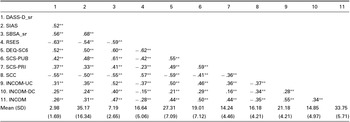
Means, standard deviations, and bivariate correlations for the measures of interest are shown in Table 1. All correlations were significant and in the expected direction. Self-related constructs significantly correlated with social anxiety and depression, and also correlated with each other. These were mostly moderate correlations; however, the strongest relationship was found between maladaptive self-beliefs and social anxiety, and the weakest between self-esteem and downward social comparisons.
Means, Standard Deviations, and Correlations for Social Anxiety, Depression and Self-Related Variables

Note: DASS-D = Depression Anxiety Stress Scales — Depression subscale square root transformed; DEQ-SC6 = The Depressive Experiences Questionnaire – 6-item Self-Criticism subscale; NCOM = Iowa-Netherlands Comparison Orientation Measure; INCOM-DC = Iowa-Netherlands Comparison Orientation Measure —Downward Comparison; INCOM-UC = Iowa-Netherlands Comparison Orientation Measure — Upward Comparison; RSES = Rosenberg's Self-Esteem Scale; SBSA = Self-Beliefs Related to Social Anxiety — square root transformed; SCC = Self-Concept Clarity Scale; SIAS = Social Anxiety Interaction Scale; SCS-PRI = Self-Consciousness Scale — Private subscale; SCS-PUB = Self-Consciousness Scales — Public subscale.
*p < .05 **p < .01
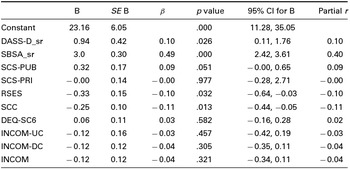
Two multiple regression models using SPSS version 21 were used to examine whether self-related constructs were uniquely associated with social anxiety and depression scores in the undergraduate sample. Predictors in these models included all self-related constructs, and either social anxiety or depression scores depending on the model being tested.Footnote 2 The regression model predicting social anxiety was significant, F(10, 511) = 55.41, p < .001, with around 52% of the variance in social anxiety scores accounted for by the predictors in the model. Specifically, high scores on the SBSA (indicating maladaptive self-beliefs) and depression were uniquely and positively associated with social anxiety scores, while high scores on self-concept clarity and self-esteem were uniquely and negatively associated with social anxiety scores. Maladaptive self-beliefs were identified as the strongest unique statistical predictor of social anxiety (see Table 2). The relationship between public self-consciousness and social anxiety was found to approach significance with a p value of .051.
Multiple Regression Model of Self-Related Constructs Predicting Social Anxiety

Note: R2 = 0.52. DASS-D = Depression Anxiety Stress Scales — Depression subscale square root transformed; DEQ-SC6 = The Depressive Experiences Questionnaire — 6-item Self-Criticism subscale; NCOM = Iowa-Netherlands Comparison Orientation Measure; INCOM-DC = Iowa-Netherlands Comparison Orientation Measure — Downward Comparison; INCOM-UC = Iowa-Netherlands Comparison Orientation Measure — Upward Comparison; RSES = Rosenberg's Self-Esteem Scale; SBSA = Self-Beliefs Related to Social Anxiety — square root transformed; SCC = Self-Concept Clarity Scale; SCS-PRI = Self-Consciousness Scale — Private subscale; SCS-PUB = Self-Consciousness Scales — Public subscale.
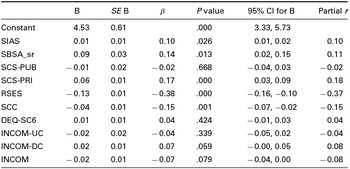
The regression model predicting depression was also significant, F(10, 511) = 52.63, p < .001, with around 51% of the variance in depression accounted for by the predictors in the model. Similar to social anxiety, high scores on the SBSA (indicating maladaptive self-beliefs) were uniquely and positively associated with depression scores, and high scores on self-concept clarity and self-esteem were uniquely and negatively associated with depression (see Table 3). However, high scores on private self-consciousness and social anxiety were also found to be uniquely and positively associated with depression scores, and both high scores on general and downward social comparisons approached significance. While maladaptive self-beliefs was identified as the strongest unique statistical predictor of social anxiety, self-esteem was found to be the strongest unique predictor of depression scores. Self-criticism and upward social comparisons were not found to be uniquely associated with either social anxiety or depression, while controlling for all other variables in the models.
Multiple Regression Model of Self-Related Constructs Predicting Depression

Note: R2 = 0.51. DEQ-SC6 = The Depressive Experiences Questionnaire — 6-item Self-Criticism subscale; NCOM = Iowa-Netherlands Comparison Orientation Measure; INCOM-DC = Iowa-Netherlands Comparison Orientation Measure — Downward Comparison; INCOM-UC = Iowa-Netherlands Comparison Orientation Measure — Upward Comparison; RSES = Rosenberg's Self-Esteem Scale; SBSA = Self-Beliefs Related to Social Anxiety — square root transformed; SCC = Self-Concept Clarity Scale; SIAS = Social Anxiety Interaction Scale; SCS-PRI = Self-Consciousness Scale — Private subscale; SCS-PUB = Self-Consciousness Scales — Public subscale.
Discussion
Self-related constructs feature prominently in both cognitive models of social anxiety (e.g., Clark & Wells, Reference Clark, Wells, Heimberg, Liebowitz, Hope and Schneier1995) and depression (e.g., Beck, Reference Beck1967). As a result, they have been the focus of a considerable amount of empirical research. To our knowledge, however, this is the first study to include a broad collection of key self-related constructs proposed in these models and simultaneously examine the unique relationship between self-related constructs and social anxiety and depression, while also controlling for the association between the two variables. Most hypotheses were supported. When examined independently, self-related constructs not only significantly correlated with social anxiety but also with depression and other self-variables. When examined simultaneously, maladaptive self-beliefs and depression scores were uniquely and positively associated with social anxiety scores, and self-concept clarity and self-esteem were uniquely and negatively associated with social anxiety. In contrast, maladaptive self-beliefs, private self-consciousness, and social anxiety were uniquely and positively associated with depression scores, and self-concept clarity and self-esteem were uniquely and negatively associated with depression. Inconsistent with our hypotheses, however, was the finding that the unique relationship between public self-consciousness and social anxiety only approached significance. Self-criticism and upward social comparisons were not found to be uniquely associated with higher scores of either social anxiety or depression.
The finding that self-esteem was uniquely and negatively associated with both social anxiety and depression is consistent with prior empirical research (see Sowislo & Orth, Reference Sowislo and Orth2013) and theoretical accounts.Footnote 3 Several theories suggest that higher self-esteem serves as a buffer against anxiety (see Crocker & Park Reference Crocker and Park2004), and the cognitive theory of depression (Beck, Reference Beck1967) suggests that negative beliefs about the self (particularly relating to self-worth) are not just a symptom of depression but a diathesis exerting causal influence in the onset and maintenance of depression (the vulnerability model; cf. Beck, Steer, Epstein, & Brown, Reference Beck, Steer, Epstein and Brown1990; alternatively, see the scar model; cf. Coyne, Gallo, Klinkman, & Calarco, Reference Coyne, Gallo, Klinkman and Calarco1998). While the present research does not speak to the temporality or causality between the constructs, past studies demonstrate that the effect of depression on self-esteem is significantly stronger than the inverse relationship (see Sowislo & Orth, Reference Sowislo and Orth2013). The present findings do underscore the possibility that low self-esteem may be a common underlying factor associated with both higher levels of social anxiety and depression. Findings are also consistent, however, with models and research describing how depression and anxiety may be differentially related to self-esteem. Both the tripartite model (cf. Clark, Watson, & Mineka, Reference Clark, Watson and Mineka1994) and cognitive content hypothesis (Beck, Steer, & Epstein, Reference Beck, Steer and Epstein1992) state that low self-esteem should be more strongly related to depression than anxiety. Consistent with this supposition, self-esteem was the strongest unique statistical predictor of depression levels in this study, accounting for around 37% of the variance in depression scores, while only 10% of the variance in social anxiety was accounted for by low self-esteem.
The finding that maladaptive self-beliefs, as measured by the SBSA (Wong & Moulds, Reference Wong and Moulds2009), was uniquely and positively associated with both social anxiety and depression was also not surprising. High levels of social anxiety (Hope et al., Reference Hope, Burns, Hayes, Herbert and Warner2010; Moscovitch et al., Reference Moscovitch, Rowa, Paulitzki, Antony and McCabe2015; Rapee & Abbott, Reference Rapee and Abbott2006; Stopa & Clark, Reference Stopa and Clark1993; Wong & Moulds, Reference Wong and Moulds2009; Wong et al., Reference Wong, Gregory, Gaston, Rapee, Wilson and Abbott2017) and depression (see Orth & Robins, Reference Orth and Robins2013) have often been characterised as constituting negative beliefs about the self. While the SBSA contains maladaptive self-beliefs that are positioned in a social-evaluative context, the unconditional belief subscale of the questionnaire contains items that may be considered more absolute, global, and conclusive (Wong & Moulds, Reference Wong and Moulds2009), which are the types of self-statements typically characteristic of depressive thinking. It is therefore possible that the relationship between self-beliefs and depression was mostly driven by greater endorsement on these particular items. High intercorrelations and multicollinearity between the SBSA subscales prevented simultaneous analyses with each subscale entered as potential unique predictors. However, when looking at part correlations for each subscale separately, it was found that while all three subscales of the SBSA were uniquely associated with social anxiety, only unconditional beliefs about the self was uniquely associated with depression scores (see also Wong & Moulds, Reference Wong and Moulds2011; however, see Wong et al., Reference Wong, Moulds and Rapee2014). These findings may suggest differential patterns in the types of self-beliefs that exist among individuals with social anxiety and depression (see also the cognitive content hypothesis; Beck et al., Reference Beck, Steer and Epstein1992), although unconditional beliefs about the self may be a transdiagnostic vulnerability factor linking the two conditions (see also Wong et al., Reference Wong, Gregory, Gaston, Rapee, Wilson and Abbott2017). Finally, the finding that maladaptive self-beliefs were the strongest unique statistical predictor of social anxiety scores, accounting for around 40% of the variance in social anxiety, may corroborate the proposition that maladaptive self-related beliefs form a central part of what maintains excessive levels of social anxiety (Clark & Wells, Reference Clark, Wells, Heimberg, Liebowitz, Hope and Schneier1995; Rapee & Heimberg, Reference Rapee and Heimberg1997).
While a considerable amount of research has considered the relationship between maladaptive beliefs about the self and social anxiety, relatively few studies have examined the role of structural features of the self and social anxiety (see Gregory et al., Reference Gregory, Peters, Rapee, Kyrios, Moulding, Nedeljkovic, Bhar, Doron and Mikulincer2016; Gregory & Peters, Reference Gregory and Peters2017; Stopa, Reference Stopa2009). Of the few studies that have examined the role of self-structure in social anxiety, however, most have provided converging evidence for the role of reduced clarity or certainty about the self in maintaining social anxiety (Moscovitch et al., Reference Moscovitch, Orr, Rowa, Reimer and Antony2009; Stopa et al., Reference Stopa, Brown, Luke and Hirsch2010; Wilson & Rapee, Reference Wilson and Rapee2006). Present results are consistent with this small body of research, suggesting that around 11% of the variance in social anxiety scores may be accounted for by self-concept clarity. Notably, the significance of this negative relationship remains even after controlling for shared variance with other important self-related constructs, such as self-focused attention, self-criticism, social comparison processes, and maladaptive self-beliefs. Research identifying positive associations with more general constructs like self-esteem and positive affectivity, and negative associations with neuroticism and chronic self-analysis (Campbell, Reference Campbell1990; Campbell et al., Reference Campbell, Trapnell, Heine, Katz, Lavallee and Lehman1996), suggests that uncertainty of the self-concept may be associated with psychopathology more generally. This uncertainty may also be particularly characteristic of disorders that involve negative self-evaluations. That self-concept clarity also uniquely accounted for significant variance in depression scores supports this proposition (see also Bigler et al., Reference Bigler, Neimeyer and Brown2001; Butzer & Kuiper, Reference Butzer and Kuiper2006; Campbell, Reference Campbell1990; Campbell et al., Reference Campbell, Trapnell, Heine, Katz, Lavallee and Lehman1996).
Interestingly, public self-consciousness was not found to be uniquely associated with social anxiety scores. This is a surprising finding given the substantial amount of empirical research linking self-focused attention and social anxiety (for a review, see Norton & Abbott, Reference Norton and Abbott2016; however, see Bögels, Rijsemus, & de Jong, Reference Bögels, Rijsemus and de Jong2002; Jakymin & Harris, Reference Jakymin and Harris2012). It could be argued that this result may be an artefact of using undergraduate, non-clinical participants; however, the sample reflected relatively high levels of social anxiety severity, with around 54% of participants scoring above the cut-off score for generalised social anxiety as measured by the SIAS (Heimberg, Mueller, Holt, Hope, & Liebowitz, Reference Heimberg, Mueller, Holt, Hope and Leibowitz1992).Footnote 4 Cognitive models of social anxiety suggest that socially anxious individuals develop a series of dysfunctional beliefs about themselves and the social world that, when activated in social situations, shift attentional focus to detailed monitoring of themselves. This increased self-focus, along with negative self-perception more generally, enhances awareness of feared anxiety responses and interferes with the processing of information inconsistent with dysfunctional beliefs (Clark & Wells, Reference Clark, Wells, Heimberg, Liebowitz, Hope and Schneier1995). It is therefore possible that once the variance shared with maladaptive self-beliefs was accounted for, the relationship between self-focused attention and social anxiety was dampened. Future research could examine more causal relationships between self-related constructs, particularly self-focused attention and negative self-beliefs, and how they relate to social anxiety over time. Importantly, present findings are supportive of the proposition that private and public self-consciousness are differentially related to anxiety and depression. Specifically, private self-consciousness (but not public self-consciousness) was uniquely and positively related to depression, whereas public self-consciousness (but not private self-consciousness) approached significance with social anxiety (Mor & Winquist, Reference Mor and Winquist2002).
Finally, present results seem to indicate that upward social comparison and self-criticism may account for little unique variance in social anxiety and depression scores. These findings appear to be inconsistent with previous studies supporting a relationship between self-criticism and social anxiety (Antony et al., Reference Antony, Rowa, Liss, Swallow and Swinson2006; Mitchell & Schmidt, Reference Mitchell and Schmidt2014) and depression (Beck, Reference Beck1967; Blatt et al., Reference Blatt, D'Afflitti and Quinlan1976; Cantazaro & Wei, Reference Cantazaro and Wei2010), and between upward social comparisons and social anxiety (Cox et al., Reference Cox, Rector, Bagby, Swinson, Levitt and Joffe2000; Cox et al., Reference Cox, Fleet and Stein2004; Kopala-Sibley et al., Reference Kopala-Sibley, Zuroff, Russell and Moskowitz2014) and depression (see Wheeler, Reference Wheeler, Suls and Wheeler2013). The majority of these studies do not take into account the variance shared between different constructs related to the self-concept, however, and therefore do not provide a direct test of the unique predictive utility of self-constructs. Notably, the association between downward social comparison and depression approached significance. Inconsistent findings in the literature exist on whether depression is more greatly associated with upward or downward social comparisons (see Wheeler, Reference Wheeler, Suls and Wheeler2013). Downward comparison theory (Wills, Reference Wills1981) predicts that low self-esteem individuals will choose to make downward comparisons as a self-enhancement strategy, while Beck (Reference Beck1967) suggests that individuals with higher levels of depression have a systematic bias against the self that is reflected in and maintained by their upward social comparisons. Present results appear to be supportive of the former proposition; however, we note that only around 11% of the sample had depression scores in the moderate range as measured by the DASS (Lovibond & Lovibond, Reference Lovibond and Lovibond1995). Replication of current findings using individuals with higher depression scores is therefore recommended.
While these findings are important in improving current understanding of the unique relationship between self-related constructs and social anxiety and depression, the research presents several caveats and future research suggestions. First, the primary limitation of the present study was the cross-sectional design of the research methodology, which prevents conclusions being made regarding the temporal association between predictors and outcomes, and the significance testing of potential indirect effects (see Maxwell & Cole, Reference Maxwell and Cole2007). Second, participants were undergraduate university students, calling into question the generalisability of these findings to clinical samples. Growing evidence now supports the existence of a continuum of social anxiety (Crome et al., Reference Crome, Baillie, Slade and Ruscio2010) and depression (Hankin et al., Reference Hankin, Fraley, Lahey and Waldman2005) severity, suggesting that social anxiety disorder and major depressive disorder may reflect only a difference in the degree of social anxiety and depression a person experiences in clinical and non-clinical presentations. Nevertheless, it would be important to establish whether the relationships between self-related constructs and social anxiety and depression found in the current research hold in a clinical sample. Third, while the self-related constructs examined here are key constructs implicated in maintaining social anxiety and depression in cognitive models (see Alden & Regambal, Reference Alden, Regambal, Hofmann and DiBartolo2010; Beck, Reference Beck1967; Gregory et al., Reference Gregory, Peters, Rapee, Kyrios, Moulding, Nedeljkovic, Bhar, Doron and Mikulincer2016), other variables that address various aspects of the self-concept (e.g., self-efficacy and self-imagery) were not addressed. Future research should therefore aim to explore the unique predictive utility of these variables while simultaneously controlling for the self-related constructs presented here and either depression or anxiety.
Notwithstanding these limitations, the current research appears to be mostly consistent with cognitive conceptualisations of social anxiety and depression and related empirical research. Results emphasise the importance of the relationships between maladaptive self-beliefs and social anxiety, and between self-esteem and depression. Findings also support the supposition that several key self-related constructs may represent transdiagnostic vulnerabilities between social anxiety and depression. Such findings may help explain why treatment studies have found an interactive process of change in social anxiety and depression during treatment. Specifically, treatment may tap shared elements of affective and cognitive stress related to the self in both anxiety and depression, leading to reciprocal changes in both (e.g., Persons, Roberts, & Zalecki, Reference Persons, Roberts and Zalecki2003). It is important that future research continues to uncover unique predictors of social anxiety and depression while simultaneously controlling for shared variance with other self-related constructs in both clinical and non-clinical samples.
Acknowledgments
All authors of this manuscript report no conflicts of interest related to this work. We would like to thank Mr Daniel J. Yee for his assistance reviewing this manuscript.