INTRODUCTION
Indo-Pacific originated alien foraminifer species are abundantly observed in the eastern Mediterranean (Meriç et al., Reference Meriç, Avşar and Yokeş2008; Koukousioura et al., Reference Koukousioura, Dimiza and Triantaphyllou2010; Çınar et al., Reference Çınar, Bilecenoğlu, Öztürk, Katağan, Yokeş, Aysel, Dağlı, Açık, Özcan and Erdoğan2011). Most of the alien foraminifers are suggested to be introduced via the Suez Canal (Zenetos et al., Reference Zenetos, Meriç, Verlaque, Galli, Boudouresque, Giangrande, Çınar and Bilecenoğlu2008). However, there are also alien foraminifer species observed on the Aegean coasts of Turkey, which show distribution in the western Pacific but are not yet recorded in the Indian Ocean or in the Red Sea (Meriç et al., Reference Meriç, Yokeş, Avşar and Bircan2010, Reference Meriç, Yokeş and Avşar2011). Thus introduction via ballast waters should also be considered.
In the framework of a biodiversity research conducted on the southern coasts of Samandag and Yayladagi coasts (Hatay, Turkey) alien benthic foraminiferal assemblages have been investigated. Indo-Pacific originated species were abundantly observed on the Mediterranean coasts of Turkey. Amphistegina lobifera Larsen was found to be the dominant alien species and Pararotalia calcariformata McCulloch which shows distribution in the western Pacific is recorded for the first time in the Mediterranean Sea.
MATERIALS AND METHODS
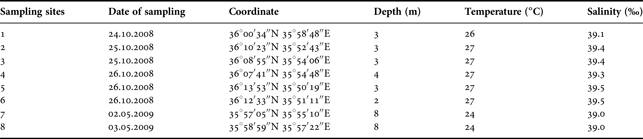
Eight recent sediment samples were manually collected by SCUBA diving in 2009. The depth of the stations ranged between 3.00 and 8.00 m (Figure 1; Table 1). Five grams of dried sediment samples were treated with 10% H2O2 for 24 hours and then washed over 0.063 mm sieve with pressurized water. After washing, the samples were dried in oven at 50°C and sieved with 2.00, 1.00, 0.500, 0.250 and 0.125 mm sieves. The foraminiferal content was investigated with binocular microscope.
Map of the study area.

Physical parameters of the sampling stations.

Foraminifer assemblages
Forty-one genera and 58 species of benthic foraminifers were identified according to Hatta & Ujiie (Reference Hatta and Ujiie1992), Hottinger et al. (Reference Hottinger, Halicz and Reiss1993), Loeblich & Tappan (Reference Loeblich and Tappan1994) and Meriç et al. (Reference Meriç, Avşar and Yokeş2008). Alien species Spiroloculina antillarum d'Orbigny, Hauerina diversa Cushman, Peneroplis arietinus (Batsch), Sorites orbiculus Ehrenberg, Cymbaloporetta plana (Cushman), Amphistegina lessonii d'Orbigny, Amphistegina lobifera Larsen, Pararotalia spinigera (Le Calvez) and Heterostegina depressa d'Orbigny were found to be abundant. In 6 out of 8 sediment samples a total of 305 Pararotalia calcariformata McCulloch individuals were found, which constitutes the first record of this species in the Mediterranean (Figures 1 & 2).
SYSTEMATICS
Superfamily ROTALIACEA Ehrenberg, 1839
Family ROTALIIDAE Ehrenberg, 1839
Subfamily PARAROTALIINAE Reiss, 1963
Genus Pararotalia Le Calvez, 1949
Pararotalia calcariformata McCulloch, Reference McCulloch1977
(Figure 2, 1–2, Figure 3, 1–12).
Pararotalia calcariformata: (1a) umblical side and (1b) detail view of the peripheral part, sample 6; (2) umblical side, sample 6; (3) umblical side, sample 2; (4a) umblical side and (4b) spiral side, sample 2; (5) umblical side, sample 3; (6) umblical side, sample 4; (7) spiral side, sample 4; (8a) spiral side and (8b) umblical side, sample 4; (9) umblical side, sample 4; (10a) umblical side and (10b) detail view of the peripheral part, sample 4; (11a) spiral side, (11b) detail view of the peripheral part and (11c) very detailed view of the same part, sample 4; (12a) spiral side and (12b) umblical side, sample 4.

Pararotalia calcariformata: (1a) umblical side, (1b) detailed view of the peripheral part and (1c) detailed view of the periphery, sample 4; (2) umblical side, sample 4.

DESCRIPTION
Test free, calcareous, auriculate, biconvex, trochospiral, periphery lobulate, carinate with usually on short spine per chamber; dorsally wall rather smooth semihyaline, finely perforate; dorsal side evolute showing less than three whorls of slightly inflated subrhomboidal chambers gradually increasing in size; sutures dorsally limbate darker hyaline flush to depressed curved bands; ventral side involute with prominent umbilical raised usually nodulous, hyaline to opaque umblical plug surrounded by nodulous umbilical flaps usually seven chambers in last formed whorl; keel shallow hyaline, acute with most of the tapering peripheral chambers forming a single short angular hyaline spine extending out and posteriorly from anterior half of each chamber of last formed whorl; sutures ventrally rather broad limbate depressed radiate; aperture interiomarginal, extraumblical umbilical with a narrow depressed rim outlining a low arch beginning at of close to periphery; no tooth-plate visible due to excess shell on most specimens (from McCulloch, Reference McCulloch1977).
Our specimens show all the morphological characteristics described by McCulloch (Reference McCulloch1977), except spine formations. None of the specimens analysed in this study had extending spines on chambers.
REMARKS
Pararotalia calcariformata have been described by McCulloch (Reference McCulloch1977) from the east Pacific. Loeblich & Tappan (Reference Loeblich and Tappan1994) have reported this species from the Timor Sea. It was known that Pararotalia calcariformata is common on the eastern coasts of Australia (www.foraminifera.eu) and in the Gulf of Carpentaria (north Australia) (Holt, Reference Holt2005).
CONCLUSIONS
A total of 305 Pararotalia calcariformata individuals were found in six sediment samples, indicating the presence of an established population on the eastern Mediterranean coast of Turkey. This species is distributed in the western Pacific; however, it is not yet recorded in the Indian Ocean and in the Red Sea. Some of the marine alien species, recorded in the eastern Mediterranean, such as Caulerpa spp., are also suggested to be introduced from the western Pacific via shipping (Çevik et al., Reference Çevik, Yokeş, Çavaş, Erkol, Osman and Verlaque2007; Klein & Verlaque, Reference Klein and Verlaque2008). Pararotalia calcariformata might have been introduced via a similar vector and shipping seems to be the most possible way of introduction of this species into the eastern Mediterranean Sea.
ACKNOWLEDGEMENTS
The authors thank the director of the project Professor Dr Hüsamettin Balkis, Cem Dalyan and Serdar Sakinan for their kind help in sample collection, Nihat Bozdoğan, Erhan Yilmaz and Physist Tuğrul Tüzüner (T.P.A.O. Research Center, Ankara) for their support in scanning electron microscope (Jeol. JSM-6490 LV) microphotography. This study was partially funded by the Istanbul University Research Fund (project number: 2924).