The COVID-19 pandemic disrupted people’s lives, leading to work and financial difficulties, confinement, social distancing, protective measures such as face masks, worry about infections and grief. This situation, which could be appraised as exceeding personal resources, and thus, stressful (Lazarus & Folkman, Reference Lazarus and Folkman1984), brought many challenges to the developmental contexts of children and adolescents. For example, the pandemic negatively affected the communication, organization, and belief systems of families (Walsh, Reference Walsh2015), including whole-family relationships and those between individual members, due to changes in routines caused by confinement. These challenges could have been especially pronounced in families with pre-existing vulnerabilities, such as low socioeconomic status or mental health conditions (Prime et al., Reference Prime, Wade and Browne2020). Additional changes were observed in school attendance and the way social relationships were maintained, among others.
To determine the extent of mental health impairment, numerous studies have examined the effects of the pandemic and the related restrictions on youth. Emotional symptoms during the lockdown, particularly anxiety and depression, have been widely documented (Amorós-Reche et al., Reference Amorós-Reche, Belzunegui-Pastor, Hurtado and Espada2022; Ma et al., Reference Ma, Mazidi, Li, Li, Chen, Kirwan, Zhou, Yan, Rahman, Wang and Wang2021; Nearchou et al., Reference Nearchou, Hennessy, Flinn, Niland and Subramaniam2020). Moreover, several risk factors for these symptoms have been identified, such as a lack of routines, excessive exposure to media, or a high virus incidence in the community, as well as sex and age (Panchal et al., Reference Panchal, Salazar de Pablo, Franco, Moreno, Parellada, Arango and Fusar-Poli2023). Specifically, anxiety and depression levels have generally been more elevated in girls compared to boys (Barbieri et al., Reference Barbieri, Wiedermann, Piccoliori, Mahlknecht, Plagg, Ausserhofer, Ravens-Sieberer and Engl2023b; Gohari et al., Reference Gohari, Patte, Ferro, Haddad, Wade, Bélanger, Romano and Leatherdale2024; Orban et al., Reference Orban, Li, Gilbert, Napp, Kaman, Topf, Boecker, Devine, Reiß, Wendel, Jung-Sievers, Ernst, Franze, Möhler, Breitinger, Bender and Ravens-Sieberer2023; Racine et al., Reference Racine, McArthur, Cooke, Eirich, Zhu and Madigan2021; Ravens-Sieberer et al., Reference Ravens-Sieberer, Devine, Napp, Kaman, Saftig, Gilbert, Reiß, Löffler, Simon, Hurrelmann, Walper, Schlack, Hölling, Wieler and Erhart2023) and in older children compared to younger children (Barbieri et al., Reference Barbieri, Piccoliori, Mahlknecht, Plagg, Ausserhofer, Engl and Wiedermann2023a; Martinsone et al., Reference Martinsone, Stokenberga, Damberga, Supe, Simões, Lebre, Canha, Santos, Santos, Fonseca, Santos, Gaspar de Matos, Conte, Agliati, Cavioni, Gandellini, Grazzani, Ornaghi and Camilleri2022; Racine et al., Reference Racine, McArthur, Cooke, Eirich, Zhu and Madigan2021). On the contrary, resilience, the process and result of successfully adjusting to challenging or adverse life situations (American Psychological Association, 2014), could be a key factor in understanding why some children and adolescents were better able to cope with these stressors compared to others.
Another important contextual factor could be the restrictive measures, which were mandatory in some countries and voluntary in others. Italy was the first European country affected by the pandemic and restrictions, followed by Spain. Both countries implemented the most restrictive measures to curb the spread of infections, while Portugal adopted less stringent regulations. The three countries, despite similarities in cultural aspects such as the age of leaving home (Eurostat, 2019), as well as similar routines during confinement (Coppinger et al., Reference Coppinger, Milton, Murtagh, Harrington, Johansen, Seghers, Skovgaard and Chalkley2020; Thorell et al., Reference Thorell, Skoglund, de la Peña, Baeyens, Fuermaier, Groom, Mammarella, van der Oord, van den Hoofdakker, Luman, de Miranda, Siu, Steinmayr, Idrees, Soares, Sörlin, Luque, Moscardino, Roch and Christiansen2022), showed different patterns of emotional outcomes. Since the beginning of the pandemic in 2020, cross-cultural research on children and adolescents in these three countries has provided insights into their emotional states at different times during the pandemic. Between the first 15 and 30 days of the lockdown following the outbreak of the pandemic, Spanish children and adolescents were more anxious, more concerned about parents leaving the house, and had greater physical complaints than Italians, who felt sadder and lonelier (Orgilés et al., Reference Orgilés, Morales, Delvecchio, Mazzeschi and Espada2020). Portuguese children and adolescents also felt sadder and lonelier but were less nervous and had fewer physical complaints than Spaniards, were more concerned about parents leaving home than Italians, and were more anxious than both Spaniards and Italians (Francisco et al., Reference Francisco, Pedro, Delvecchio, Espada, Morales, Mazzeschi and Orgilés2020). After determining the impact of the confinement situation on mental health, it was important to examine its relationship with coping styles. Overall, anxiety problems were related to coping strategies more directed at emotion and less at avoidance, a coping pattern similar to that of depressive symptoms, which were also slightly related to lower task-oriented strategies (Orgilés et al., Reference Orgilés, Morales, Delvecchio, Francisco, Mazzeschi, Pedro and Espada2021). Emotion-oriented coping was especially linked to poorer mood and increased anxiety in preschoolers, schoolchildren, and adolescents (Delvecchio et al., Reference Delvecchio, Orgilés, Morales, Espada, Francisco, Pedro and Mazzeschi2022). Comparing longitudinally two, five, and eight weeks after the start of the lockdown, the conditions of the pandemic seemed to play an important role in the emotional state of children and adolescents. The Portuguese did not suffer changes in mood and anxiety, given their less restrictive lockdown. On the other hand, Italians had a better initial adaptation, but their emotional problems increased as the lockdown progressed, becoming the most emotionally affected. However, coinciding with the opening of parks and the permission to visit relatives, this affectation was reduced. Spaniards maintained their mood, and although anxiety rose as the lockdown progressed, it decreased when they were allowed to take daily walks (Orgilés et al., Reference Orgilés, Francisco, Delvecchio, Espada, Mazzeschi, Pedro and Morales2022a). The impact of confinement conditions has also been observed in other large-scale studies, which showed increased emotional symptoms when the harshest restrictions were implemented (Creswell et al., Reference Creswell, Shum, Pearcey, Skripkauskaite, Patalay and Waite2021; Orban et al., Reference Orban, Li, Gilbert, Napp, Kaman, Topf, Boecker, Devine, Reiß, Wendel, Jung-Sievers, Ernst, Franze, Möhler, Breitinger, Bender and Ravens-Sieberer2023; Pearcey et al., Reference Pearcey, Shum, Raw, Waite, Patalay and Creswell2020; Wolf & Schmitz, Reference Wolf and Schmitz2024).
However, most research has focused on the effects of confinement and restrictions during the initial phase of the pandemic, with less attention given to long-term effects. Restrictions persisted from the detection of the first infections until September 2020, when children returned to school. While this was considered a step towards restoring normalcy, it also posed additional stressors for them. One study conducted during this academic year showed the majority of children experienced a reduction in social contact and an increase in parental stress, as well as academic stress and concern about the contagion of close friends, with these situations affecting more than 30% of the children. Children who experienced a reduction in social contact, and whose parents felt stressed and had conflicts, presented higher anxiety and mood symptoms (Orgilés et al., Reference Orgilés, Tomczyk, Amorós-Reche, Espada and Morales2023). Moreover, children who had contracted COVID-19 exhibited higher anxiety symptoms (Orgilés et al., Reference Orgilés, Serrano-Ortiz, Espada and Morales2024b).
In Spain, children returned to school in September 2020 with multiple safety measures. While there were no more national lockdowns, there were specific restrictions in some areas. Navarro-Soria et al. (Reference Navarro-Soria, Costa-López, Collado-Valero and de Mier2023) found an increase in both state and trait anxiety in Spanish children and adolescents from April 2020 to October 2020, with a decrease in state anxiety but no significant differences in trait anxiety by October 2021. There were also no significant differences in depression in Spanish children between April–May 2020 and February 2021 (Giménez-Dasi et al., Reference Giménez-Dasi, Quintanilla and López2023), nor in emotional problems between September 2020 and June 2021 (Alcover Bloch et al., Reference Alcover Bloch, Gatell Carbó, Balaguer Martínez, Pérez Porcuna, Salvadó Juncosa, Fortea Gimeno and Álvarez Garcia2023).
In Italy, the high number of COVID-19 cases in October 2020 led to strict restrictions on social contact and periods of distance learning during the school year. High schools conducted distance learning from November 2020 to February 2021, while primary and middle schools were closed for three weeks between March and April 2021. In April 2021, a new national lockdown coincided with Easter holidays (Martinsone et al., Reference Martinsone, Stokenberga, Damberga, Supe, Simões, Lebre, Canha, Santos, Santos, Fonseca, Santos, Gaspar de Matos, Conte, Agliati, Cavioni, Gandellini, Grazzani, Ornaghi and Camilleri2022; Pistellato et al., Reference Pistellato, Fonzo, Calzavara, Sorrentino, Selle, Sbrogiò and Bertoncello2023). Despite this, no significant differences in negative affect were observed between an Italian pre-pandemic sample and one from October–November 2020 (Matiz et al., Reference Matiz, Fabbro, Paschetto, Urgesi, Ciucci, Baroncelli and Crescentini2022). Apart from an increase in internalizing problems among male adolescents aged 14 to 16 years between October 2020 and May 2021, no significant differences were found in younger adolescents or females (Martinsone et al., Reference Martinsone, Stokenberga, Damberga, Supe, Simões, Lebre, Canha, Santos, Santos, Fonseca, Santos, Gaspar de Matos, Conte, Agliati, Cavioni, Gandellini, Grazzani, Ornaghi and Camilleri2022). Similarly, between June 2021 and March 2022, no significant differences were detected in symptoms of anxiety and depression (Barbieri et al., Reference Barbieri, Piccoliori, Mahlknecht, Plagg, Ausserhofer, Engl and Wiedermann2023a, Reference Barbieri, Wiedermann, Piccoliori, Mahlknecht, Plagg, Ausserhofer, Ravens-Sieberer and Engl2023b). However, a study in 2022 revealed that approximately 20% of parents of children and adolescents had perceived a worsening in children’s mental health due to the pandemic (Lo Moro et al., Reference Lo Moro, Scaioli, Conrado, Lusiani, Pinto, Rolfini, Bert and Siliquini2024).
In Portugal, after schools reopened in September 2020, a new lockdown with school closures occurred at the beginning of 2021. Parents perceived an increase in children’s quality of life as the lockdown ended and restrictions ceased (Mocho et al., Reference Mocho, Martins, dos Santos and Nunes2024). However, after these restrictions were lifted, Pedro et al. (Reference Pedro, Caldas, Penas and Marques2022) found a higher percentage of children and adolescents experiencing clinical levels of depression compared to previous studies in the Portuguese population. On the other hand, Martinsone et al. (Reference Martinsone, Stokenberga, Damberga, Supe, Simões, Lebre, Canha, Santos, Santos, Fonseca, Santos, Gaspar de Matos, Conte, Agliati, Cavioni, Gandellini, Grazzani, Ornaghi and Camilleri2022) found no evidence of changes in internalizing problems between October 2020 and May 2021.
Several international longitudinal studies provide insightful data to understand the emotional impact of the pandemic on children and adolescents. The meta-analysis by Miao et al. (Reference Miao, Liu, Zhang and Jin2023) reveals an initial increase in anxiety and depression during the first wave of the pandemic, followed by a decrease in subsequent months. Additionally, there was a small new increase in anxiety in 2021 and 2022, but not in depression. Similarly, the study by Rappaport et al. (Reference Rappaport, Mactavish, Mastronardi, Babb, Menna, Amstadter and Battaglia2023) with Canadian children and adolescents, using repeated monthly measurements, shows a decline in emotional symptoms from June 2020 to January 2021, followed by an increase in January and a gradual decrease throughout 2021. Using specific cut-off points, a multi-country meta-analysis conducted by Racine et al. (Reference Racine, McArthur, Cooke, Eirich, Zhu and Madigan2021) showed prevalences during the confinement of 20.5% for anxiety and 25.2% for depressive symptoms. Subsequently, Ravens-Sieberer et al. (Reference Ravens-Sieberer, Devine, Napp, Kaman, Saftig, Gilbert, Reiß, Löffler, Simon, Hurrelmann, Walper, Schlack, Hölling, Wieler and Erhart2023) observed an increase in anxiety (from 24.1% to 30.1%) and depression (from 18% to 24.3%) among German children and adolescents between May–June 2020 and December 2020-January 2021. These percentages progressively reduced to 24.8% and 14.2%, respectively, by September-October 2022.
However, to our knowledge, no study has been conducted to investigate the changes in anxiety and depression symptoms from the onset of the COVID-19 pandemic to the reopening of schools in September 2020, comparing between three southern European countries with different restrictions. Furthermore, there is currently no information available on the progression of these symptoms three years later, once normalcy has been reestablished. The objective of this exploratory study was to examine emotional symptoms in a sample of Italian, Spanish, and Portuguese children and adolescents aged 3 to 18 years following the COVID-19 pandemic. We aimed to compare their emotional well-being across different assessments. The specific objectives were: a) To assess the percentage of children exhibiting anxiety and depression symptoms based on a cutoff point at three time points (eight weeks, six months, and three and a half years after the onset of the pandemic); b) To analyze the levels of symptoms over time, examining differences among countries and across the three assessment periods; and c) To determine the influence of sex and age in these results. As stressors related to the pandemic diminished over time –e.g., lifting of wearing masks or social distancing–, and thus, more resources could be identified to cope with the situation –such as social contact (Pearce et al., Reference Pearce, Birken, Pais, Tamworth, Ng, Wang, Chipp, Crane, Schlief, Yang, Stamos, Cheng, Condon, Lloyd-Evans, Kirkbride, Osborn, Pitman and Johnson2023)–, according to Lazarus and Folkman (Reference Lazarus and Folkman1984), we anticipated observing fewer symptoms three and a half years after its onset compared to earlier assessments.
Methods
Participants
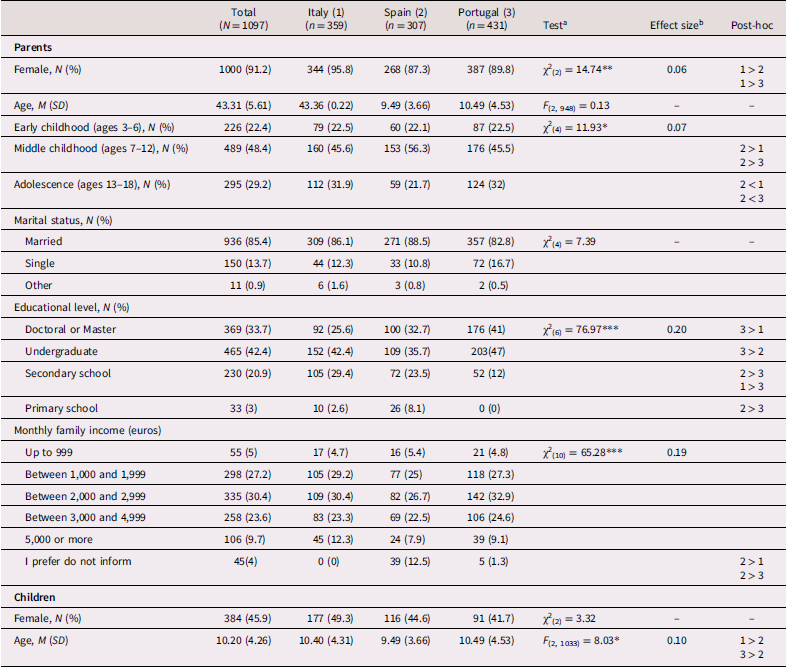
A total of 1097 children aged 3–18 from Italy, Spain, and Portugal were included in the study (Table 1), with the data provided by one of their parents. Participants were recruited during the initial lockdown period due to COVID-19 and followed up six months later and three years thereafter, with new sample recruitment in each timepoint. The average age of the children was 10.20 years (SD = 4.26), with 45.9% being girls. Across the three countries, the samples were equivalent, except for respondents’ sex, educational attainment, and monthly family income. Specifically, the Italian sample had a higher proportion of female respondents compared to the Spanish and Portuguese samples. In Spain, a greater percentage of respondents preferred not to disclose their family income compared to the Italian and Portuguese counterparts. In Portugal, individuals were more likely to possess doctoral or master’s level education than in Italy, while a larger proportion had completed undergraduate degrees compared to Spain. The Portuguese sample had a lower percentage of individuals with a secondary school education, compared to Spain and Italy. Additionally, a higher proportion of respondents with primary school education belonged to the Spanish sample, compared to the Portuguese sample. There were differences in age groups – Early Childhood (3–6 years), Middle Childhood (7–12 years), and Adolescence (13–18 years) – across countries. Spain had a higher proportion of children aged 7–12 (56.3%) compared to Italy (45.6%) and Portugal (45.5%). A higher proportion of adolescents were recruited in Italy (31.9%) and Portugal (32%), than in Spain (21.7%).
Sample characteristics and equivalence by country (N = 1097)

Note. M = Mean, SD = Standard Deviation. aCross-table (χ2) for categorical variables, and Kruskal–Wallis (χ2) for continuous variables. bEffect size = Cramer’s V for multi-categorical variables, and Epsilon-squared for continuous variables. ***p ≤ .001, **p ≤ .01.
Procedure
The research received approval from the Ethics Board of the authors’ institutions. The sample is part of a larger project in which psychological symptoms of children and adolescents during the lockdown due to COVID-19 were followed along five measures, in a parent-reported way. For this study, three of the five measures involved the evaluation of anxiety and depressive symptoms. Data was collected eight weeks (Time 1: April 2020) and six months after the start of lockdown (Time 2: September 2020), with a third follow-up three years later (Time 3: September 2023). Participants were enlisted through social media platforms at each assessment point, allowing new participants to enter the study even if they had not participated before, and completed assessment tools via an internet-based platform. In person assessment was not allowed at the beginning of the study, so all assessments were carried out online. Prior to survey completion, participants were briefed on the study’s aims and asked for their informed consent.
Measures
The data collected encompassed information regarding the sex and age of both parents and children. Additionally, respondents provided details regarding their marital status, educational background, and monthly family income. Moreover, the following measures, translated in the local language of each country, were used.
Anxiety symptoms were assessed utilizing the brief Spence Children’s Anxiety Scale-Parent Version (SCAS-P-8; Reardon et al., Reference Reardon, Spence, Hesse, Shakir and Creswell2018), consisting of 8 items rated on a four-point scale. This scale evaluates symptoms associated with Social Anxiety, Separation Anxiety, Panic/Agoraphobia, and Generalized Anxiety. The reliability was satisfactory in both the original version (α = .82) and the current sample (α = .87), and by country: Italy (α = .88), Spain (α = .82), and Portugal (α = .88).
Depressive symptoms were evaluated using the Short Mood and Feelings Questionnaire-Parent Version (SMFQ; Angold et al., Reference Angold, Costello and Messer1996), which measures affective and cognitive depressive symptoms through 13 items rated on a three-point scale (ranging from not true to true). The reliability was found to be satisfactory in both the original study (α = .87) and the current sample (α = .97), and by country: Italy (α = .94), Spain (α = .92), and Portugal (α = .94).
Data analyses
Data analysis was performed using the SPSS v28.00 software for Windows. Ordinal alpha was calculated for the measures employed in the current study. Due to the non-normal distribution of variables, non-parametric tests were utilized, as confirmed by the Kolmogorov–Smirnov test (p-value < .05). Equivalence of sociodemographic variables across samples from the three countries was assessed using chi-squared tests for categorical variables and Kruskal–Wallis tests for continuous variables. Effect sizes for statistically significant comparisons were determined using Cramer’s V for multi-categorical variables and Epsilon-squared (ε2) for continuous variables. Binary logistic regression analyses were conducted to explore differences between participants who dropped out of the study at any assessment point across the analyzed variables (anxiety and depression) compared to those who remained in the study. Dropout rates were also examined by country. Repeated measures models of generalized estimation (GENLIN) were utilized to analyze the progression of anxiety and depressive symptoms over time, considering the three temporal points. Country and time were introduced as independent variables, with variables exhibiting differences among the three countries included as covariates to control for their effects. When comparing times, Time 3 served as the reference category, while Italy was used as the reference category when comparing between countries. Estimated marginal means of anxiety and depression, considering independent categorical variables (time, country, and child’s sex), were computed. All participants’ measurements were included, even if they did not respond to all three assessments. Statistical significance was established at a p-value of < .05.
Results
Attrition
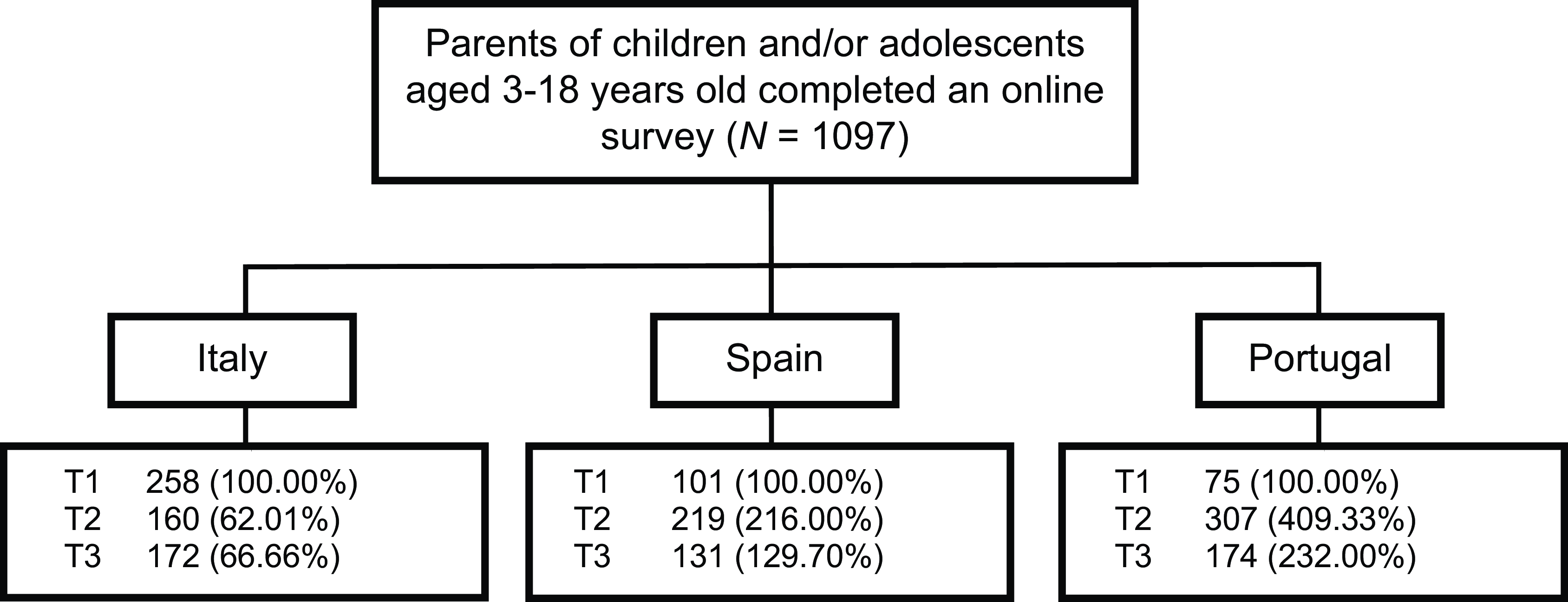
The study involved 1,097 parents of children aged 3 to 18 years across all timepoints. Figure 1 shows the flowchart of participants along this study. The retention rate in the second and the third assessment was 63.3% (N = 686) and 42.1% (N = 477), respectively. Retention rates differed by country. The retention rate was higher in Spain and Portugal, compared to Italy in T2 (χ2 = 75.28, p < .001, Cramer’s V = .26). No differences in the retention rate across countries were observed in T3. No statistically significant differences (p > .05) in anxiety and depressive symptoms were found between participants who dropped out of the study and those who continued across times.
Flowchart for participants of the study.
Note. Time 1 (T1): April 2020, during the lockdown; Time 2 (T2): September 2020, after the reopening of schools and Time 3 (T3): September 2023, three years later.

There were no differences in monthly family income between countries throughout the study, except in the final assessment (χ2 = 70.56, p ≤ 0.001, Cramer’s V = 0.23). A higher proportion of families with monthly incomes up to 999 euros dropped out of the study compared to those who did not (7.8% vs. 1.9%). Participants who indicated that they preferred not to report their monthly family income remained in the study at a higher rate than the rest (8.3% vs. 0%). Educational level was unrelated to retention in the current study.
Proportion of subclinical cases of anxiety and depression over time
The proportion of subclinical cases based on the proposed cut-off criteria for both the SCAS-P-8 (Anxiety) and SMFQ-P (Depression) scales demonstrates significant fluctuations over time.
According to the suggested cut-off score of 7.5 for the SCAS-P-8 (Reardon et al., Reference Reardon, Spence, Hesse, Shakir and Creswell2018), 160 children (37%) displayed anxiety symptoms during the initial assessment amidst the COVID-19 lockdown. This percentage surged to 44.3% (n = 304) in the second assessment after children resumed school activities. However, it declined to 41% (n = 188) in the third assessment, conducted three years later.
Differences between countries were found in anxiety. In the first assessment, the proportion of children who scored above the cutoff point in the SCAS-P-8 was higher in Spain and Italy than in Portugal (Spain: 55.1%; Portugal: 23.7% Italy: 34.1%; χ2 = 20.47, p < .001; Cramer’s V = .21). In the second assessment, the proportion of children who scored above the cutoff point in the SCAS-P-8 was higher in Italy than in the rest (Italy: 75%; Spain: 35.2%; Portugal: 34.9%; χ2 = 79.62, p < .001, Cramer’s V = .34). In the third assessment, no differences across countries were observed in the proportion of children who scored above the cutoff point in the SCAS-P-8 (Portugal: 43.8%; Spain: 42.3%; Italy: 37.1%; χ2 = 1.66, p = .43).
Using the proposed cut-off criteria of a mean score of 10.5 for the SMFQ-P scale (Angold et al., Reference Angold, Costello and Messer1996), 227 children (52.3%) exhibited depressive symptoms during the first assessment amid the lockdown. This rate drastically dropped to 13% (n = 89) in the second assessment, six months later, and further decreased to 12.1% (n = 56) in the third assessment, three years later.
Differences between countries were found in depression. In the first assessment, the proportion of children who scored above the cutoff point in the SMFQ-P was higher in Spain and Portugal than in the rest (Spain: 100%; Portugal: 100%; Italy: 19.8%; χ2 = 269.97, p < .001; Cramer’s V = .78). In the second assessment, the proportion of children who scored above the cutoff point in the SMFQ-P was higher in Spain than in the rest (Spain: 20.5%; Italy: 13.1%; Portugal: 7.5%; χ2 = 19.10, p < .001, Cramer’s V = .16). In the third assessment, no differences across countries were observed in the proportion of children who scored above the cutoff point in the SMFQ-P (Spain: 13.8%; Italy: 12.9%; Portugal: 9.9%; χ2 = 1.88, p = .55).
Longitudinal assessment of anxiety and depression symptoms
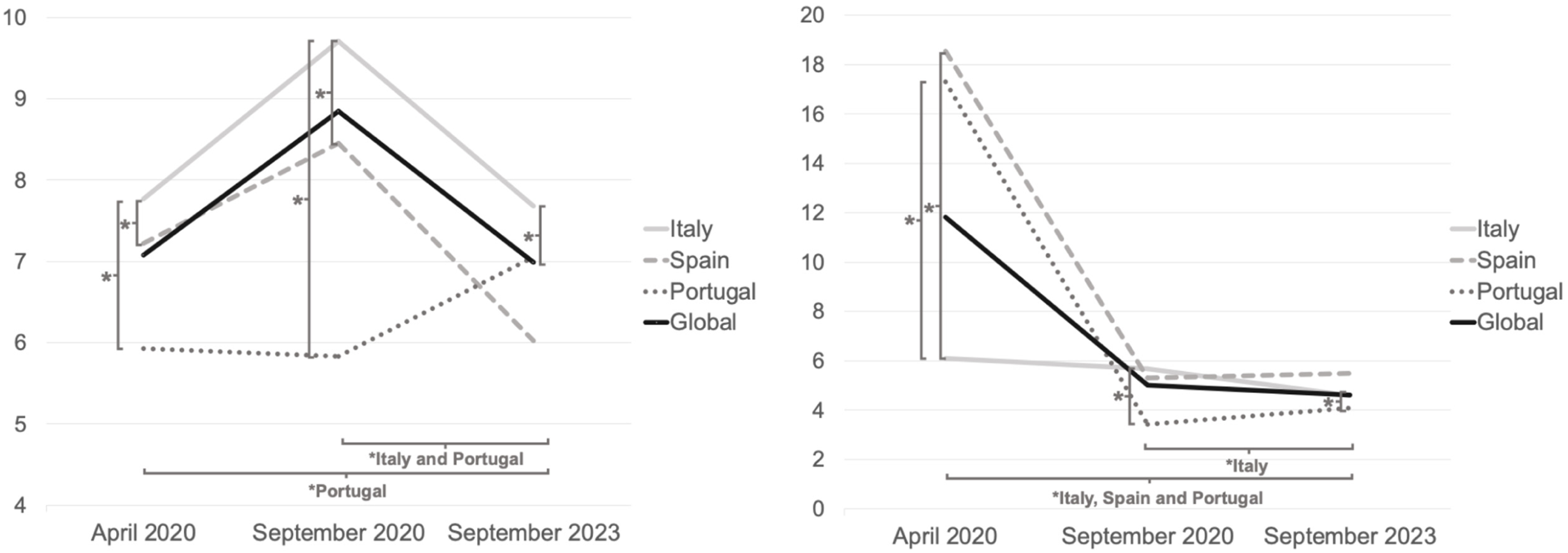
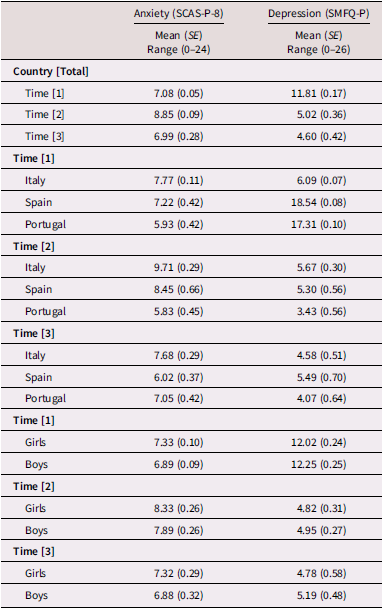
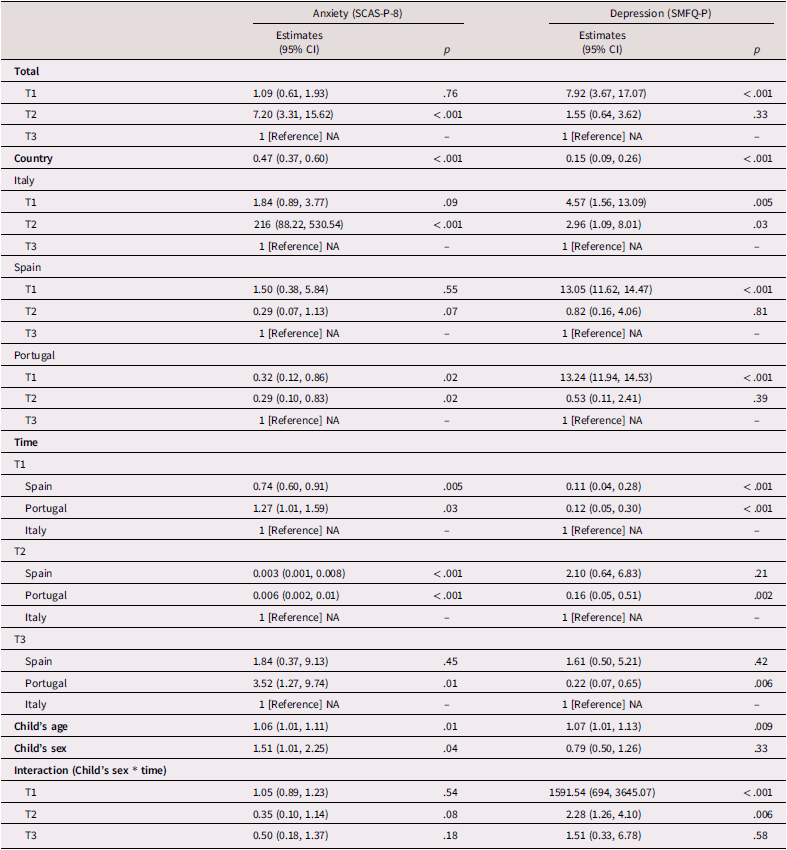
Tables 2 and 3, as well as Figure 2, reflect marginal means and the results of Generalized Estimating Equations (GEE) models of scores in anxiety and depression. In the global sample, anxiety scores (SCAS-P-8) showed an increase from T1 to T2 (OR = 0.47, CI 95%: 0.37, 0.60, p < .001) and a decrease from T2 to T3 (p < .001). This indicates a general decrease in anxiety levels three and a half years after the initial lockdown compared to T2. There were no statistically significant differences between T1 and T3. Depression scores (SMFQ-P) decreased from T1 to T2 (OR = 0.001, CI 95%: 0.0001, 0.003, p < .001) and between T1 and T3 (p < .001). This suggests that depression levels decreased significantly three and a half years after the start of the lockdown compared to 8-weeks post-lockdown. There were no statistically significant differences between T2 and T3.
Changes in anxiety (left) and depressive (right) symptoms across the three timepoints.
Note. Significance tests between countries based on GEE models are presented, with Italy as the reference country and T3 as the reference timepoint.

Estimated marginal means of anxiety and depression symptoms for total sample and child’s sex

Note. SE = Standard Error.
Child psychological reactions: repeated measures data analysis using the GEE model for total sample, countries, age and interactions between child’s sex * time

Italy
For anxiety, three and a half years after the lockdown (T3) there was a statistically significant reduction in anxiety symptoms compared to 6-months post-lockdown (T2) (p < .001). There were no statistically significant differences between T1 and T3. For depression, three and a half years after the lockdown (T3) there was a reduction in depressive symptoms compared to 8-weeks (T1) and 6-months post-lockdown (T2) (p < .05).
Spain
For anxiety, three and a half years after the lockdown (T3) there was a reduction in anxiety symptoms compared to 6-months post-lockdown (T2), although this was marginally significant (p = .07). There were no statistically significant differences between T1 and T3 in anxiety. For depression, three and a half years after the lockdown (T3) there was a statistically significant reduction in depressive symptoms compared to 8-weeks (T1) (p < .001). There were no statistically significant differences between T2 and T3.
Portugal
For anxiety, three and a half years after the lockdown (T3) there was an increase in anxiety symptoms compared to 8-weeks post-lockdown (T1) and 6-months post-lockdown (T2) (p < .05). For depression, three and a half years after the lockdown (T3) there was a statistically significant reduction in depressive symptoms compared to 8-weeks post-lockdown (T1) (p < .001). There were no statistically significant differences between T2 and T3.
Cross-country differences in anxiety and depression symptoms at specific time points
For anxiety, at T1, scores in Italy were significantly higher than in Portugal (p = .03) and Spain (p = .005). At T2, anxiety scores in Italy were also higher than in Spain and Portugal (p < .001). There were no differences in anxiety between Spain and Portugal at T2 (p = .83). At T3, differences remained significant between Italy and Portugal (p = .01), but there were no other statistically significant differences in anxiety between countries.
For depression, at T1, scores in Italy were lower compared to Spain and Portugal (p < .001). At T2, there were statistically significant differences only between Italy and Portugal (p = .002), with higher mean scores in Italy. At T3, statistically significant differences were again observed only between Italy and Portugal (p = .002), with higher mean scores of depressive symptoms in Italy. These findings confirm that anxiety and depression symptoms differed significantly across countries at specific time points, as reflected in Table 3.
Interaction between country and time in anxiety and depression symptoms
Anxiety
GEE analysis revealed a significant interaction between country and time (Wald Chi-square = 184.68; p < .001), indicating that changes in anxiety symptoms over time differed between countries. From T1 to T2, Italy showed an increase, being a more pronounced change compared to Spain, which also showed a less marked increase (p < .001), and Portugal, where symptoms remained relatively stable (p < .001). From T2 to T3, Italy experienced a significant reduction in anxiety symptoms, while Spain also showed a decrease, although less pronounced compared to Italy (p< .001). In contrast, Portugal showed an increase in symptoms, presenting an opposite trend and significantly different compared to Italy (p= .01). These differences in anxiety symptoms over time, reflected in the interaction terms time * country, confirm that countries showed significant differences in symptom levels at various time points throughout the study.
Depression
GEE analysis revealed a significant interaction between country and time (Wald Chi-square = 694.69, p < .001), indicating that changes in depression symptoms over time differed between countries. From T1 to T2, depression symptoms decreased in all three countries, but the reductions were more pronounced in Spain and Portugal, compared to Italy (p < .001). From T2 to T3, depression symptoms in Italy continued to decrease. In Spain and Portugal, symptoms increased slightly. However, no significant differences were found between the countries from T2 to T3 (p > .05). These results, reflected in the interaction terms time * country, confirm that countries showed significant differences in depression symptom levels considering various time points throughout the study, with Spain and Portugal showing more pronounced reductions during the first six months.
Sex and age differences
The relationship between the child’s sex and anxiety and depression levels was studied (see Tables 2 and 3). Specifically, girls exhibited higher levels of anxiety than boys at each time point evaluated, although the differences were only marginally significant at T2 (p = .08) and not significant at the other assessments. The difference in depression scores between girls and boys was significant at T1 and T2, but not at T3. Specifically, boys had significantly higher mean depression symptoms than girls eight weeks and six months after the beginning of the lockdown. Child’s age was significant in the model for both anxiety and depression. This means that older children exhibited higher levels of anxiety and depression symptoms at all three time points studied.
Discussion
The aim of this study was to investigate emotional symptoms among children and adolescents from three European countries three and a half years after the start of the COVID-19 pandemic, comparing them to two previous assessments. We examined anxiety and depressive symptoms during a phase when youth routines were fully restored, contrasting with the most stringent phase (eight weeks after the lockdown began) and the period when they returned to school six months after the lockdown.
The results showed that, during the most restrictive phase of the pandemic, 37% of children and adolescents exhibited elevated anxiety symptoms – a higher proportion than the 20.5% reported by the multi-country meta-analysis of Racine et al. (Reference Racine, McArthur, Cooke, Eirich, Zhu and Madigan2021)–. This percentage increased to 44% upon returning to school and then decreased to 41% three years later, when routines had largely normalized. The significant impact of mandatory confinement and strict lockdown measures aimed at reducing infections led to a high prevalence of anxiety symptoms among children compared to pre-pandemic studies (e.g., Costa et al., Reference Costa, Cunha, Ferreira, Gama, Machado-Rodrigues, Rosado-Marques, Nogueira, Silva and Padez2020; Mazzone et al., Reference Mazzone, Ducci, Scoto, Passaniti, D’Arrigo and Vitiello2007; Orgilés et al., Reference Orgilés, Méndez, Espada, Carballo and Piqueras2012). Factors such as fear of contagion and parental unemployment have been identified as contributors to increased anxiety symptoms (Garcia-Adasme et al., Reference García-Adasme, Cárdenas-Rebollo, Jiménez-Perianes, Lalinde, Jimeno, Ventura, Díaz and López-Escobar2021). Six months after returning to school, despite the resumption of activities, a higher percentage of children and adolescents exhibited anxiety symptoms. The return to school involved adhering to numerous preventive measures such as wearing face masks and maintaining social distancing, potentially exacerbating anxiety among children. During the initial weeks back at school, children had to adjust their behavior to a markedly different environment, facing challenges that may have been difficult for them to cope with, including concerns about COVID-19 infection (Orgilés et al., Reference Panchal, Salazar de Pablo, Franco, Moreno, Parellada, Arango and Fusar-Poli2023, Reference Orgilés, Delvecchio, Francisco, Mazzeschi, Godinho, Pedro, Espada and Morales2024b). Three and a half years after the pandemic began, the overall percentage of children experiencing anxiety symptoms decreased as the situation normalized and pandemic-related stressors diminished. However, the prevalence of anxiety symptoms remained notably elevated compared to pre-pandemic levels, with 41% still scoring above the cutoff point.
Differences among countries revealed a higher proportion of Spanish and Italian children and adolescents scoring above the anxiety cutoff in the first assessment. This may be attributed to stricter measures implemented in these countries compared to Portugal, where fewer restrictions were imposed. Consequently, Portuguese children may have experienced fewer disruptions to their lives and exhibited lower levels of anxiety. In terms of anxiety scores, Italian children and adolescents showed higher symptoms than Spaniards and Portuguese during this initial period. This pattern persisted when schools reopened in September 2020, a month before a new closure was decreed in Italy. The higher levels and prevalence of anxiety symptoms in Italy may be linked to the longer duration of full school closures until August 2020 compared to Spain and Portugal (UNESCO, 2022). Anxiety levels in Italy were reduced by September 2023 compared to September 2020, but with no significant differences compared to April 2020. Even after three years, anxiety levels in Italy remained higher than in Portugal. However, at this latest moment, no significant differences were observed in the proportion scoring above the cutoff across the three countries. Compared to Italians, Spanish children and adolescents exhibited a similar pattern of anxiety increase from April to September 2020 (Navarro-Soria et al., Reference Navarro-Soria, Costa-López, Collado-Valero and de Mier2023), followed by a decrease from September 2020 to September 2023. However, anxiety levels in Spain in September 2023 did not significantly differ from those in April 2020 or September 2020. These trends in anxiety in Italy and Spain could be explained by the easing of stringent restrictions they had previously experienced (Creswell et al., Reference Creswell, Shum, Pearcey, Skripkauskaite, Patalay and Waite2021; Orban et al., Reference Orban, Li, Gilbert, Napp, Kaman, Topf, Boecker, Devine, Reiß, Wendel, Jung-Sievers, Ernst, Franze, Möhler, Breitinger, Bender and Ravens-Sieberer2023; Pearcey et al., Reference Pearcey, Shum, Raw, Waite, Patalay and Creswell2020; Wolf & Schmitz, Reference Wolf and Schmitz2024). Interestingly, anxiety among Portuguese children and adolescents increased in the third assessment compared to the first and second assessments, when they had exhibited lower anxiety levels. Martinsone et al. (Reference Martinsone, Stokenberga, Damberga, Supe, Simões, Lebre, Canha, Santos, Santos, Fonseca, Santos, Gaspar de Matos, Conte, Agliati, Cavioni, Gandellini, Grazzani, Ornaghi and Camilleri2022) found no evidence of anxiety differences between the period of our second assessment and one year after in Portuguese children. Thus, this increase after the pandemic may be explained by developmental findings in cohorts of Portuguese children, showing an upward trend in anxiety symptoms in the early years of adolescence (LoParo et al., Reference LoParo, Fonseca, Matos and Craighead2024).
Regarding depressive symptoms, 52.3% of children scored above the cutoff point during the confinement phase, a higher percentage than reported in pre-pandemic studies (e.g., Babore et al., Reference Babore, Trumello, Candelori, Paciello and Cerniglia2016; Canals-Sans et al., Reference Canals-Sans, Hernández-Martínez, Sáez-Carles and Arija-Val2018; Costa et al., Reference Costa, Cunha, Ferreira, Gama, Machado-Rodrigues, Rosado-Marques, Nogueira, Silva and Padez2020) and the pandemic itself (Racine et al., Reference Racine, McArthur, Cooke, Eirich, Zhu and Madigan2021). Confinement disrupted physical and social activities (Ilari et al., Reference Ilari, Cho, Li and Bautista2022; Orgilés et al., Reference Orgilés, Delvecchio, Francisco, Mazzeschi, Godinho, Pedro, Espada and Morales2024a), leading to decreased opportunities for reinforcement and life satisfaction. However, the percentage of children with depressive symptoms drastically decreased in subsequent assessments, likely due to the resumption of more active lifestyles and routines associated with school attendance, despite reduced social contact (Orgilés et al., Reference Orgilés, Serrano-Ortiz, Espada and Morales2024b). In September 2020, the percentage of cases scoring above the cutoff for depression was at 13%, and three years later, it dropped to 12.1%.
Some differences were found among countries regarding depressive symptoms. Italy reported a lower percentage of children with symptoms and lower scores during the lockdown, possibly because the pandemic started earlier in this country, allowing children to adapt to the situation sooner. There was a decrease in depression scores observed in Portugal and Spain in September 2020. However, Spain reported the highest percentage of cases with depression symptoms during the second assessment, albeit with a small effect size. This finding may be due to stringent restrictions imposed upon returning to school, such as bubble groups, prohibitions on social activities, and mandatory face masks in classes and during physical activities. In the same vein, in September 2020, Italy showed significantly higher depression scores than Portugal, which could also be attributed to the longer duration of previous school closures in Italy (UNESCO, 2022). These differences between Italy and Portugal persisted in September 2023. A reduction in depressive symptoms among Italian children was observed in September 2023 compared to April and September 2020. While previous studies did not find differences in depressive symptoms among Italian children between June 2021 and March 2022 (Barbieri et al., Reference Barbieri, Piccoliori, Mahlknecht, Plagg, Ausserhofer, Engl and Wiedermann2023a, Reference Barbieri, Wiedermann, Piccoliori, Mahlknecht, Plagg, Ausserhofer, Ravens-Sieberer and Engl2023b), examining a broader period may have contributed to detecting these differences over time. Regarding Spain and Portugal, depressive symptoms had decreased by September 2023 compared to April 2020, with no evidence of differences compared to September 2020, following previous studies (Alcover Bloch et al., Reference Alcover Bloch, Gatell Carbó, Balaguer Martínez, Pérez Porcuna, Salvadó Juncosa, Fortea Gimeno and Álvarez Garcia2023; Martinsone et al., Reference Martinsone, Stokenberga, Damberga, Supe, Simões, Lebre, Canha, Santos, Santos, Fonseca, Santos, Gaspar de Matos, Conte, Agliati, Cavioni, Gandellini, Grazzani, Ornaghi and Camilleri2022). In September 2023, depression scores in the three countries showed reductions, with no significant differences across countries in the prevalence of depressive symptoms at that time.
These findings align with the meta-analysis conducted by Miao et al. (Reference Miao, Liu, Zhang and Jin2023), which concluded that depression decreased as the pandemic progressed, while anxiety exhibited fluctuations at specific periods. As anticipated, three and a half years after the beginning of the pandemic, levels of anxiety and depressive symptoms had decreased, likely due to increased social contact and the appraisal of the situation as less resource-demanding (Lazarus & Folkman, Reference Lazarus and Folkman1984; Pearce et al., Reference Pearce, Birken, Pais, Tamworth, Ng, Wang, Chipp, Crane, Schlief, Yang, Stamos, Cheng, Condon, Lloyd-Evans, Kirkbride, Osborn, Pitman and Johnson2023). Moreover, we examined sex and age as potential factors related to emotional symptoms. While girls displayed higher levels of anxiety symptoms, the differences compared to boys were not statistically significant. In contrast, boys consistently scored higher in depression symptoms across all assessments, with significant differences observed during the pandemic times (April and September 2020). These results regarding sex, particularly in depression, diverge from much of the existing literature, which generally indicates that girls have been more emotionally affected during various stages of the COVID-19 pandemic (Barbieri et al., Reference Barbieri, Wiedermann, Piccoliori, Mahlknecht, Plagg, Ausserhofer, Ravens-Sieberer and Engl2023b; Gohari et al., Reference Gohari, Patte, Ferro, Haddad, Wade, Bélanger, Romano and Leatherdale2024; Orban et al., Reference Orban, Li, Gilbert, Napp, Kaman, Topf, Boecker, Devine, Reiß, Wendel, Jung-Sievers, Ernst, Franze, Möhler, Breitinger, Bender and Ravens-Sieberer2023; Racine et al., Reference Racine, McArthur, Cooke, Eirich, Zhu and Madigan2021; Ravens-Sieberer et al., Reference Ravens-Sieberer, Devine, Napp, Kaman, Saftig, Gilbert, Reiß, Löffler, Simon, Hurrelmann, Walper, Schlack, Hölling, Wieler and Erhart2023). However, participants in the early stages of our study have exhibited a different pattern, with boys showing more pronounced mood disturbances than girls (Francisco et al., Reference Francisco, Pedro, Delvecchio, Espada, Morales, Mazzeschi and Orgilés2020). This suggests that the specific circumstances of the pandemic in these three countries may have contributed to this pattern in the distribution of depressive symptoms. Regarding age, the results underscore that older age predicts higher levels of both anxiety and depression symptoms, consistent with trends observed in studies of internalizing problems throughout the COVID-19 pandemic (Barbieri et al., Reference Barbieri, Piccoliori, Mahlknecht, Plagg, Ausserhofer, Engl and Wiedermann2023a; Martinsone et al., Reference Martinsone, Stokenberga, Damberga, Supe, Simões, Lebre, Canha, Santos, Santos, Fonseca, Santos, Gaspar de Matos, Conte, Agliati, Cavioni, Gandellini, Grazzani, Ornaghi and Camilleri2022; Racine et al., Reference Racine, McArthur, Cooke, Eirich, Zhu and Madigan2021).
The social disruption caused by the pandemic, along with pre-existing and/or pandemic-induced socioeconomic stressors, negatively affected families and, consequently, the mental health of children and adolescents (Prime et al., Reference Prime, Wade and Browne2020; Walsh, Reference Walsh2015). Although there was a general reduction in anxiety and depressive problems three and a half years later, this study highlights the fluctuations in symptoms across different timepoints. Therefore, in future pandemic-like situations, psychological interventions to promote resilience (Wendel et al., Reference Wendel, Bender, Breitinger, Coenen, Hummel, Immich, Kirschneck, Klünder, Kunzler, Lieb, Movsisyan, Li, Ravens-Sieberer, Rehfuess, Voss and Jung-Sievers2023) could be an effective way to facilitate adaptation and, consequently, prevent and mitigate peaks in anxiety and depressive symptoms. Despite the mental health laws and strategies implemented in the three countries studied, international organizations continue to issue recommendations: for Italy, to invest in and adopt a preventive approach concerning family, school, and community (UNICEF, 2023); for Spain, to implement a ‘National Mental Health Policy for Children and Adolescents’; and for Portugal, to reduce inequalities in access to healthcare services (Eurochild, 2023).
This study has some limitations, such as variations in parental participation across the three assessments and the use of sampling methods via social networks, as well as not having included other important sociodemographic variables –such as ethnicity or people living with the child–, nor personal or contextual factors possibly related to symptoms –such as coping responses or stressful conditions–. Furthermore, due to the broad age range included in the study, parent-reported measures may not fully capture the emotional symptoms of older children and adolescents (De Los Reyes et al., Reference De Los Reyes, Augenstein, Wang, Thomas, Drabick, Burgers and Rabinowitz2015). However, despite these limitations, this study has successfully documented the progression of anxiety and depressive symptoms across three samples from different countries at three distinct time points. To our knowledge, this is the only transcultural longitudinal study that compares pandemic-related periods to a later phase (September 2023), when routines were fully restored.
In conclusion, this study has delineated the patterns of anxiety and depression across three different time points in Italy, Spain, and Portugal. Overall, anxiety increased from eight weeks after the start of the pandemic to six months later, during the reopening of schools, with Italy and Spain being the most affected countries. Three and a half years after, by September 2023, anxiety decreased to values that were not significantly different from those observed during the lockdown, except in Portugal. Depression exhibited a different trajectory, peaking at high levels eight weeks after the pandemic began, particularly in Spain and Portugal, followed by a decrease six months later with the return to school routines. Apart from a reduction observed in Italy, no substantial variations in depression were noted by September 2023 compared to September 2020. These findings suggest that during periods of confinement, children may experience a sense of security and comfort with their families, yet a lack of reinforcement could contribute to depressive symptoms. Conversely, reintroduction to social activities, while initially anxiety-provoking due to new circumstances, may provide opportunities to alleviate mood disturbances. Older children exhibited higher levels of both anxiety and depression across all assessments, while boys showed elevated levels of depression during the pandemic phases. Despite reductions from peak levels, observed three and a half years later, anxiety and depression remain significant challenges posed by the COVID-19 pandemic for the emotional well-being of children and adolescents.
Data availability
Data, materials, and code are available upon reasonable request.
Funding statement
This work was supported by the Ministry of Science and Innovation of Spain and the European Regional Development Fund (PSI2017-85493-P).
Competing interests
The authors declare no conflict of interests.
Ethical standards
The research received approval from the Ethics Board of the authors’ institutions.
Consent
All parents participating provided informed consent.