Congenital cardiovascular malformations are the result of abnormal development of the heart and/or its major blood vessels. They are the most common form of birth defects in newborns, affecting approximately eight cases per 1000 live births in the United States of America and worldwide,Reference Van der Linde, Konings and Slager 1 , Reference Reller, Strickland and Mahle 2 but incidence estimates vary widely, ranging from three to over 50 cases/1000 live births depending on the study population and the degree of inclusion of minor malformations.Reference Ferencz, Rubin and McCarter 3 – Reference Mozaffarian, Benjamin and Go 5 In 2011, congenital cardiovascular malformations were responsible for 3166 deaths and were the leading cause of death among infants with birth defects in the United States of America, accounting for 23.8% of the total.Reference Mozaffarian, Benjamin and Go 5 Infants who survive contribute to an increasingly large group of adults living with congenital cardiovascular malformations, 6.12/1000 in 2010,Reference Marelli, Ionescu-Ittu and Mackie 6 many of whom are or have been inflicted with co-morbidities such as growth impairment, gross motor abnormalities, reduced exercise tolerance, and anxiety about their health.Reference Green 7
The aetiology of congenital cardiovascular malformations remains murky, although a number of potential genetic and environmental risk factors for congenital cardiovascular malformations have been identified over the last quarter century.Reference Gorini, Chiappa and Gargani 8 , Reference Jenkins, Correa and Feinstein 9 The percentage of cases associated with underlying genetic abnormalities is estimated to be around 15%.Reference Ferencz, Neill and Boughman 10 – Reference Hartman, Rasmussen and Botto 12 The proportion of cases attributable to environmental risk factors is also estimated to be around 15%.Reference Liu, Joseph and Lisonkova 13 , Reference Wilson, Loffredo and Correa-Villasenor 14 Examples of specific environmental risk factors associated with congenital cardiovascular malformations include pre-pregnancy obesity,Reference Waller, Shaw and Rasmussen 15 maternal diabetes coupled with inadequate periconceptional folic acid supplementation,Reference Correa, Gilboa and Botto 16 and paternal occupations associated with solvent exposure.Reference Desrosiers, Herring and Shapira 17
On the other hand, aetiological studies of congenital cardiovascular malformations often have conflicting findings.Reference Patel and Burns 18 This may be because of inconsistent exposure assessment and difficulty controlling recall bias and confounding – methodological problems inherent to retrospective, case–control designs. Reliable and consistent classification of congenital cardiovascular malformations across and within studies is also a challenge because of the wide variety of and subtle differences between types of congenital cardiovascular malformations. Diagnostic reliability may also be related to factors such as diagnosticians’ training and experience, varying usage and availability of diagnostic modalities, and neonatal characteristics that may make initial diagnoses challenging.
In this study, we investigated the consistency of primary congenital cardiovascular malformation diagnoses over time for case infants in the Baltimore-Washington Infant Study – one of only a few, large, population-based, aetiological congenital cardiovascular malformation studies.Reference Jenkins, Correa and Feinstein 9 , Reference Ferencz, Boughman and Neill 19 – Reference Yoon, Rasmussen and Lynberg 22 We did so by comparing congenital cardiovascular malformation diagnoses made near the time of birth and study registration – registration diagnoses – with follow-up diagnoses made at 1-year check-up – updated diagnoses. We then identified factors related to changes in diagnoses and examined the effect that diagnostic changes may have on odds ratios between congenital cardiovascular malformation types and potential risk factors. To our knowledge, no studies related to diagnostic changes of congenital cardiovascular malformations have been published to date.
Methods
The Baltimore-Washington Infant Study was a large, population-based, case–control study designed to examine the aetiology of congenital cardiovascular malformations. The study methods, data collection, and questionnaires have been previously publishedReference Ferencz, Rubin, Loffredo and Magee 23 , Reference Ferencz, Loffredo, Correa-Villasenor and Wilson 24 and are summarised below.
Study population
The Baltimore-Washington Infant Study recruited patients from 1981 to 1989 and covered a geographical area of 11,000 square miles including Northern Virginia, Washington, District of Columbia, and the entire state of Maryland. Nearly 100% regional ascertainment of live birth infants with congenital cardiovascular malformations during the study period was achieved through participation of all paediatric cardiology centres in the study region – University of Maryland, Johns Hopkins Hospital, Children’s National Medical Center, Georgetown University Children’s Medical Center, Howard University Hospital, and Fairfax Hospital – as well as 52 out of 53 regional hospitals with obstetric services. The study was approved by the University of Maryland’s Institutional Review Board and the ethics committees of all participating hospitals.
Cases (n=4390) were live-born infants confirmed to have a structural congenital cardiovascular malformation before their first birthday; infants born prematurely with patent ductus arteriosus were excluded. Sources of case ascertainment included pathology logbooks, medical examiner’s reports, and death certificates, in addition to participating paediatric cardiology centres. Initial diagnoses were made by cardiologists using echocardiography, cardiac catheterisation, surgery, or autopsy. Up to five different diagnoses for congenital cardiovascular malformations could be recorded on registration forms. The International Society of Cardiology coding system was used to record diagnoses. The diagnosis of earliest embryological origin was designated as the primary diagnosis for each case. Case infants were seen again at 1-year follow-up visits and received diagnostic testing to confirm registration diagnoses or to change the diagnoses based on new information.
Controls (n=3572) were annually and randomly chosen from all infants born without congenital cardiovascular malformations. Random sampling of controls was stratified by hospital and year of birth, so that the number of controls chosen from each hospital was proportionate to its contribution to total births in the study area that year. Researchers contacted parents of control infants and obtained informed consent. A control whose parents did not respond or were unwilling to participate was replaced by another infant born in the same hospital nearest in time. The final control population comprised 95% first or second selections.
Trained interviewers used a questionnaire to interview mothers – and in some cases fathers – of case and control infants at home. Information about environmental, occupational, and self-administered exposures such as drugs/pharmaceuticals/lifestyle substances, family socio-demographic characteristics, family history of birth defects and congenital cardiovascular malformations, and parental medical history was obtained. Only exposures from 6 months before the mother’s last menstrual period to delivery, deemed the reference period, were recorded. Within this time frame, the 3 months before and after the last menstrual period were specified as the critical period for cardiogenesis, allowing for uncertainty in the date of conception.
Of the 4390 ascertained cases, 3763 cases were selected for interview. Those selected for interview included all congenital cardiovascular malformation cases except for a random sample of 20% of mild cases – that is, small ventricular septal defects (<3 mm and/or <20% size of the aortic root), aortic stenosis (<25 mm gradient on Doppler), pulmonic stenosis (<25 mm gradient on Doppler), and bicuspid aortic valve without aortic stenosis diagnosed clinically or by Doppler. In addition, rare diagnoses including cor triatriatum, Uhl’s anomaly, aortic arch anomalies, sinus of Valsava defects, coronary vessel anomalies, minor pulmonary valve anomalies, and partial anomalous pulmonary venous return were excluded from our analysis. In 1988, a random sample of 25% of non-mild ventricular septal defect cases was also excluded to reduce interview numbers. Of the families of cases selected for interview, 3377 (90%) consented to participate (patient cases).
Study variables
The primary outcome variable in our analysis was change in diagnosis, defined as instances in which the primary registration diagnosis and the primary updated diagnosis differed – for example, if an infant was registered in the study with an initial diagnosis of a ventricular septal defect, but then at the 1-year update was diagnosed with coarctation of the aorta, this case would be considered to have a change in diagnosis in our analysis. If the final diagnosis included both ventricular septal defect and coarctation of the aorta, the latter malformation would be designated as the primary congenital cardiovascular malformation because it occurs earlier in embryonic cardiogenesis than does ventricular septal defect.
Data from interviews were used as independent variables in our analysis. Independent variables included two continuous variables – gestational age (weeks) and birth weight (grams) – and nine categorical variables – gender; race, white, black, or other; size for gestational age, small, normal, or large; type of non-cardiac malformations if present, not present, chromosomal, syndromic, or organ malformation; most invasive diagnostic mode at registration, from least to most: echocardiography, cardiac catheterisation, surgery, and autopsy; most invasive diagnostic mode at update; prematurity (gestational age <38 weeks); low birth weight (<2.5 kg); and time between birth and registration diagnosis (<1 week, <1 month, ⩾1 month). For the purpose of analysis, new dichotomous, categorical variables were created for race, white versus other, registration diagnostic mode, only echocardiography versus other modes, presence of non-cardiac malformations, presence versus absence, and diagnostic mode at the year 1 update, autopsy versus other.
Statistical methods
All analyses were performed for the total group of cases and a priori for two subsets that typically differed in phenotypic complexity: those malformations arising in the early period of cardiogenesis, such as laterality and looping defects, conotruncal defects, and atrioventricular septal defects, versus all other diagnoses. We used χ2-tests to identify independent variables significantly associated with changes in diagnosis and t-tests for continuous variables. To account for effect modification between variables, multivariable logistic regression, in which change in diagnosis was modelled as a function of multiple independent variables, was performed; the final model was selected through backward elimination of variables.
We also used registration diagnoses to re-calculate published odds ratios from the Baltimore-Washington Infant Study’s previous publications on potential risk factor associations to assess the magnitude and direction of any changes in these odds ratios due to change in diagnosis. χ2-tests were used to evaluate associations between questionnaire variables and change in diagnosis. Next, multivariable logistic regression with stepwise selection was used to calculate odds ratios and 95% confidence intervals for significant associations between selected variables and change in diagnosis. Further analysis included stratifying the data by patients born before 1985 and patients born after 1985 to look at the difference before and after color flow Doppler imaging was introduced in the region.
Bootstrapping was used to compare odds ratios calculated from diagnoses made at birth versus those made at the 1-year update. Random sampling with replacement was performed 1000 times on cases and controls as determined at birth and as determined at the update for each congenital cardiovascular malformation population. Relevant exposure factors were decided for each type of congenital cardiovascular malformation on the basis of previously published odds ratios.Reference Loffredo 25 For each congenital cardiovascular malformation, log odds ratios were calculated for the relevant exposure factors in each sampling using logistic regression models. For each exposure factor, the difference between the mean birth log odds ratio and mean updated log odds ratio was calculated, and a parametric 95% confidence interval was calculated for the distribution. For comparison, non-parametric 95% confidence intervals, defined as the ranges between the 2.5th and the 97.5th percentiles of the distributions, were determined. All statistical analyses and bootstrapping procedures were performed using SAS 9.3 (SAS Institute, Cary, North Carolina, United States of America).
Results
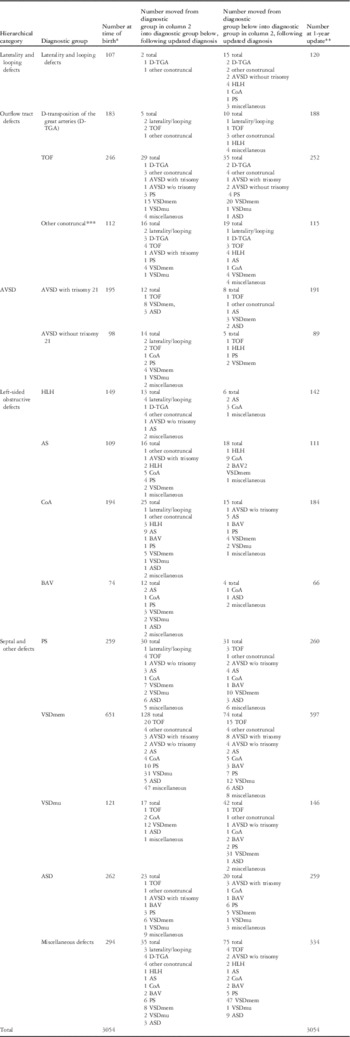
Of the 3377 patient cases in the Baltimore-Washington Infant Study, 3054 (90.1%) had both a registration and a year 1 update diagnosis recorded in the database. In total, 400 of these 3054 (13.1%) case infants had a different primary diagnosis at update than at registration. The mean elapsed time between registration and update for those whose diagnoses changed was 280.1 days and for those whose diagnoses did not change it was 255.5 days (t-test p=0.007). Of the 400 whose diagnoses changed, 114 (28.5%) maintained their original diagnoses but received additional congenital cardiovascular malformation diagnoses that outranked the originals in the classification hierarchy. Table 1 compares all 3054 congenital cardiovascular malformation case infants’ original diagnoses with their updated diagnoses – for example, there were 107 cases classified as laterality and looping defects at the time of registration in the study, two of whom were re-assigned to other diagnostic groups upon re-classification at the 1-year update; at the same time, 15 cases were moved to laterality and looping defects from other diagnoses, for a total of 120 cases in this category in the 1st year of life. The diagnostic groups with the fewest number of changes were laterality and looping defects and D-transposition of the great arteries (each with five or less), in contrast to tetralogy of Fallot, coarctation of the aorta, pulmonic valve stenosis, and membranous ventricular septal defects (each with 25 or more).
Original and updated diagnoses in the Baltimore-Washington Infant Study (BWIS), 1981–1989.

AS=aortic stenosis; ASD=atrial septal defect; AVSD=atrioventricular septal defect; BAV=bicuspid aortic valve; CoA=coarctation of the aorta; D-TGA=d-transposition of the great arteries; HLH=hypoplastic left heart; PS=pulmonic stenosis; TOF=tetralogy of Fallot; VSDmem=ventricular septal defect, membranous; VSDmu=ventricular septal defect, muscular
* At the time of registration in the BWIS, typically in the 1st few weeks of life
** At the child’s first birthday
*** Includes common arterial trunk, aortic-pulmonary window, double-outlet right or left ventricle, and supracristal ventricular septal defect
Some of the observed changes were expected: an example is an infant with some but not all four components of tetralogy of Fallot diagnosed at registration who later was found to have all hallmarks of the phenotype. On the other hand, we also observed true discordances between registration and updated diagnoses – for example, an infant classified as hypoplastic left heart at registration and D-transposition of the great arteries at update.
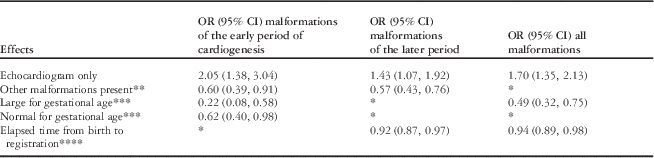
For malformations of early cardiogenesis – laterality and looping defects, conotruncal defects, and atrioventricular septal defects – we observed statistically significant associations between diagnostic change status and the following variables in unadjusted analyses: size for gestational age (p=0.01), original diagnostic modality (p=0.001), and non-cardiac malformation status (p=0.03). For all other malformations, original diagnostic modality (p=0.04) and non-cardiac malformation status (p<0.001) were significantly associated with changes of diagnoses. We also observed a statistically significant association between diagnostic change status and birth weight for malformations of both early and later periods of cardiogenesis. The average birth weights of infants with diagnostic changes versus those without diagnostic changes were 3059 and 2885 g (p=0.009), respectively, for early malformations and 3105 and 3000 g (p=0.02), respectively, for later malformations. A significant association was also observed for the later period malformations between diagnostic change status and time from registration to diagnosis. Gestational ages did not differ significantly between the cases with and without a diagnostic change. An average of 45.9 days (standard deviation 71.9) (95% confidence interval 37.4, 54.3) elapsed between birth and registration for cases whose diagnoses changed compared with 63.9 days elapsed (standard deviation 83.3) (95% confidence interval 59.9, 67.9) (p<0.001) for cases whose diagnoses did not change. Neither sex of infant nor race was significantly associated with change in diagnosis.
The multivariable logistic regression models identified three variables significantly associated with diagnostic change for both the early malformation subset and the later malformation subset. For the early subset, size for gestational age, the presence of any non-cardiac malformations, and original diagnostic modality – echocardiogram only versus other – were statistically significant (Table 2). For the late-period malformations subset, time elapsed from birth to registration, the presence of any non-cardiac malformations, and original diagnostic modality – echocardiogram only versus other – were significant. For all malformations combined, logistic regression showed that diagnoses for infants who were large for their gestational age and for those diagnosed at least a month after birth were less likely to change at update. Diagnoses made with only echocardiography were more likely to change at update. Of note, neonatal birth weight, which was significantly associated with change of diagnosis in univariate analyses, lost significance after accounting for other variables including a similar measure, size for gestational age.
Associations between diagnostic change and medical/infant variables (Multivariable analysis).

OR=odd ratio; CI=confidence interval
* Variable was not entered the model because of low significance
** Relative to infants with isolated cardiovascular malformations
*** Relative to infants small for gestational age
**** unit of time=4 weeks
Stratification by study period – that is, before 1985 versus 1985 and after, reflecting the advent of color flow Doppler technology in the region – showed similar rates of diagnostic change in each era. Before 1985, 47 of 437 (10.8%) infants with early gestational age, 118 of 869 (13.6%) with later gestational age, and 165 of 1306 (12.6%) total congenital cardiovascular malformation diagnoses changed. During the year 1985 and thereafter, 72 of 661 (10.9%) infants with early gestational age, 163 of 1087 (15.0%) with later gestational age, and 235 of 1748 (13.4%) total congenital cardiovascular malformation diagnoses changed. The difference in rates of diagnostic changes between the pre-1985 and the following era was not significant.
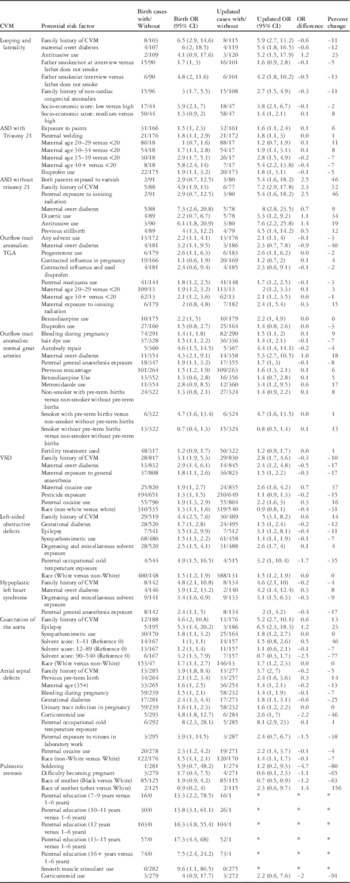
Odds ratios between potential risk factors and congenital cardiovascular malformation types computed using original diagnoses (birth odds ratios) differed to varying degrees compared with previously published odds ratios that used the updated diagnoses (Table 3). Variables most vulnerable to changes in odds ratios tended to be those with fewer than 10 cases exposed and those associated with malformations, such as pulmonic valve stenosis and atrial septal defect, which had relatively frequent diagnostic changes compared with other groups. Neither parametric nor non-parametric bootstrapped confidence intervals, however, showed evidence that differences in birth and updated odds ratios were statistically significant.
A comparision of odds ratios (OR) calculated using birth diagnoses and updated diagnoses for specified CVMs and potential risk factors.

ASD=atrial septal defect; CI=confidence interval; CVM=cardiovascular malformation; TGA=transposed great arteries; VSD=ventricular septal defect
*Unable to calculate odds ratio, difference, and percent change
Discussion
This study aimed to address the question of diagnostic changes of infants with congenital cardiovascular malformation in the 1st year of life, the factors associated with such changes, and their possible impacts on epidemiological associations with potential risk factors. The Baltimore-Washington Infant Study’s data set, with its large sample size and systematically collected diagnostic data from both at the time of registration and at the 1-year update, presented a unique opportunity to assess these questions. We found that 13% of the infants had a change in diagnosis, of which 58% were phenotypically consistent – that is, relatively minor modifications of the original diagnosis. Factors related to diagnostic changes included the exclusive use of echocardiogram for initial diagnosis, congenital cardiovascular malformation occurrence without other congenital malformations, small birth weight relative to gestational age, and a short length of time between birth and initial diagnosis. These diagnostic changes, however, were not found to significantly alter previously published odds ratios measuring the association between potential risk factors and congenital cardiovascular malformations.
To our knowledge, no previous studies comparing congenital cardiovascular malformation diagnoses made at birth with follow-up diagnoses have been published thus far. Some studies, however, have examined the frequency of undiagnosed congenital cardiovascular malformation. Kuehl et alReference Kuehl, Loffredo and Ferencz 26 found that, for one in 10 infants with congenital cardiovascular malformations in the Baltimore-Washington Infant Study who died in the 1st year of life, congenital cardiovascular malformation was not diagnosed before death, and low birth weight, younger gestational age, intrauterine growth retardation, and multiple congenital anomalies were factors related to undiagnosed deaths. Another study from the United Kingdom found that 56 of 185 (30%) infants who died of congenital cardiovascular malformation between 1985 and 1990 were undiagnosed before death.Reference Abu-Harb, Hey and Wren 27 Studies looking at rates of missed congenital cardiovascular malformation diagnoses on initial examination have reported that 44Reference Ainsworth, Wyllie and Wren 28 and 55%Reference Wren, Richmond and Donaldson 29 of cases were missed. In contrast to the single time point assessments of most previous studies and their reliance on echocardiography alone, the low rates of undiagnosed congenital cardiovascular malformation and of changed diagnoses in our study were likely due to the use of multiple modes of examination over a 12-month time period, including echocardiography, cardiac catheterisation, surgical inspection, and autopsy findings.
The accuracy of echocardiogram versus cardiac catheterisation has been studied previously. A prospective study of 2788 consecutive patients undergoing operations for congenital cardiovascular malformation at a European medical centre from 1986 to 1992 found echocardiography diagnoses to be correct for 96% of the cases when compared with catheterisation, surgical, or autopsy findings.Reference Marek, Skovránek and Hucín 30 This result may or may not support this study’s finding that only diagnoses made by echocardiogram were more likely to change during the 1st year of life.
Limitations of this study include those inherent to the Baltimore-Washington Infant Study as a retrospective case–control study, such as recall bias by parents of cases and difficulty measuring and recalling exposure assessment through interview and parental memory. These factors, however, were anticipated, and the Baltimore-Washington Infant Study’s design attempted to mitigate them through well-trained interviewers and in-person interviews. A difficulty in this study was the very low number of cases for some congenital cardiovascular malformations. This meant that odds ratios changed dramatically when any of the cases changed diagnoses. This problem was addressed by using bootstrapping to derive confidence intervals. The interpretation of results was limited by potential confounding of variables associated with change of diagnosis and of risk factors associated with congenital cardiovascular malformation diagnoses. In addition, stratified analysis seeking to compare the rates of change in diagnoses before and after introduction of color flow Doppler may not represent a true comparison of the technologies due to the lack of data on the timing of color flow Doppler implementation in the Baltimore-Washington Infant Study’s centres.
As data used in our study were collected ~30 years ago, the applicability of our results to modern diagnostic protocols may be questioned. Since then, new and improved cardiac windows and frequencies, transducers and probes, and technologies and clinician training, as well as the advent of three-dimensional ultrasound and fetal echocardiography, have re-shaped the way congenital cardiovascular malformations are diagnosed. Despite the fact that many malformations can now be made prenatally, a few such as coarctation of the aorta, pulmonary stenosis, aortic stenosis, and certain forms of atrial and ventricular septal defects are particularly difficult or impossible to detect prenatally because of fetal cardiac physiology or anatomy.Reference Sharland 31 Others may still be undetected or diagnosed incorrectly. A 2009 study found that only 36% of major cardiovascular malformations at three referral centres in Northern California in a 1-year study period were detected prenatally.Reference Friedberg 32 In light of these recent developments, our results and conclusions must be interpreted cautiously. In conclusion, a subset of congenital cardiovascular malformation diagnoses made at birth in this study was susceptible to change, especially those made shortly after birth, by echocardiogram only, for growth-retarded infants and for those without any other malformations. These changes, however, made in diagnoses after initial evaluation did not significantly alter risk estimates between potential risk factors and congenital cardiovascular malformation risk. These results may be instructive for future congenital cardiovascular malformation aetiology study designs. Clinically, our results provide support for the potential value of the paediatric cardiologist’s examination and repeat diagnostic imaging for affected infants at their first birthdays, especially those with risk factors found to be associated with diagnostic changes, including small size for gestational age, associated non-cardiac malformations, and diagnoses made initially with only echocardiography.
Acknowledgements
The authors thank Dr Karen S. Kuehl for advice and consultation on the study design and analysis.
Financial Support
The Baltimore-Washington Infant Study was funded by the NHLBI (NIH grant number R37HL25629; Dr Charlotte Ferencz, Principal Investigator).
Conflicts of Interest
None.
Ethical Standards
The authors assert that all procedures contributing to this work comply with the ethical standards of the relevant national guidelines on research involving human patients (United States Department of Health and Human Services (Federal regulation 45 CFR46.102(f)) and with the Helsinki Declaration of 1975, as revised in 2008, and was approved by the institutional review board of the University of Maryland and the ethics committees of all participating hospitals.