Introduction
The mosquito Culex quinquefasciatus Say has a widespread geographical distribution and is the vector of many pathogens (causing diseases such as lymphatic filariasis, Japanese encephalitis and West Nile fever) in both tropical and temperate regions (Sucharit et al., Reference Sucharit, Surathin and Shrestha1989; Godsey Jr et al., Reference Godsey, Nasci, Savage, Aspen, King, Powers, Burkhalter, Colton, Charnetzky, Lasater, Taylor and Palmisano2005; Rwegoshora et al., Reference Rwegoshora, Pedersen, Mukoko, Meyrowitsch, Masese, Malecela-Lazaro, Ouma, Michael and Simonsen2005). Gravid Cx. quinquefasciatus females lay clusters of eggs (egg rafts) on the surface of organically polluted standing water (Kirby & Spence, Reference Kirby and Spence1826; Subra, Reference Subra1981; Becker et al., Reference Becker, Boase, Dahl, Kaiser, Lane, Petric and Zgomba2003). Site selection for egg laying is influenced by an oviposition pheromone, (5R,6S)-6-acetoxy-5-hexadecanolide (Laurence & Pickett, Reference Laurence and Pickett1985), produced by Culex egg rafts and by other semiochemicals (behaviour and development-modifying chemicals) released from fermenting organic material in the water (Kramer & Mulla, Reference Kramer and Mulla1979; Millar et al., Reference Millar, Chaney and Mulla1992). Sampling populations of Cx. quinquefasciatus involves the use of traps, which exploit this oviposition preference of Culex by releasing semiochemicals to mimic an oviposition site, and hence act as odour baits for the blood-fed gravid female (Surgeoner & Helson, Reference Surgeoner and Helson1978; Reiter, Reference Reiter1983, Reference Reiter1987; Ritchie, Reference Ritchie1984). Natural infusions of organic material, such as grass or hay, with various modifications (Reiter, Reference Reiter1983; Ritchie, Reference Ritchie1984; Reisen & Meyer, Reference Reisen and Meyer1990; Barbosa et al., Reference Barbosa, Souto, Eiras and Regis2007; Muturi et al., Reference Muturi, Mwangangi, Shililu, Muriu, Jacob, Mbogo, John and Novak2007) are effective as odour baits; however, these formulations lack consistency in their chemical composition. Inherent variability in the organic constituents and the fermentation process means that the attractant properties of such odour baits may vary over time (Kramer & Mulla, Reference Kramer and Mulla1979; Isoe et al., Reference Isoe, Beehler, Millar and Mulla1995a; Sant'ana et al., Reference Sant'ana, Roque and Eiras2006), leading to inconsistent results in trapping surveys.
To remedy this problem, attempts have been made to develop protocols for the extraction and isolation of volatile semiochemicals from Culex breeding site waters, in order to develop an effective attractant or blend of attractants. Methods, such as air entrainment (Du & Millar, Reference Du and Millar1999) or solvent extraction (Millar et al., Reference Millar, Chaney and Mulla1992), have been used to extract small lipophilic molecules (SLMs) from fermented Bermuda grass infusions. When applied to oviposition water, SLMs extracted in this way (such as 3-methylindole (skatole) and 4-methylphenol (p-cresol)) have been shown to function as semiochemicals by attracting significantly more egg laying from gravid females than plain water controls (Millar et al., Reference Millar, Chaney and Mulla1992; Mordue et al., Reference Mordue, Blackwell, Hansson, Wadhams and Pickett1992; Beehler et al., Reference Beehler, Millar and Mulla1994). However, whereas the oviposition pheromone is now sold commercially, despite extensive research there is still no commercially available standard odour bait based on a behaviourally active SLM to accompany or synergize pheromone activity. Future studies which aim to address this issue are hampered by the complexity and labour intensive nature of current extraction protocols for breeding site waters, particularly in resource poor environments where mosquito-borne diseases are most prevalent and laboratory facilities are often limited. It is, therefore, a current research priority to identify technically straightforward novel methods for extraction and isolation of potential oviposition attractants in breeding site waters in the field, to be used in the development of a standardized odour bait. A simple, robust analytical technique known as stir bar sorptive extraction (SBSE) has been developed for the collection of SLMs in aqueous media (Baltussen et al., Reference Baltussen, Sandra, David and Cramers1999). SBSE has so far been used for purposes such as analysis of water quality (Serodio & Nogueira, Reference Serodio and Nogueira2005) and clinical samples (e.g. human urine (Kawaguchi et al., Reference Kawaguchi, Inoue, Sakui, Ito, Izumi, Makino, Okanouchi and Nakazawa2004)). The technique involves a magnetized bar (‘Twister™’; GERSTEL, Anatune, UK), which is coated in polydimethylsiloxane polymer. The stir-bar removes SLMs from a liquid and traps (‘sorbs’) them temporarily within its matrix for later extraction, either by thermal desorption or by a simple elution step using a high purity solvent such as diethyl ether. Thus, the purpose of the present study was to test the effectiveness of the SBSE technique as a tool for the extraction of putative volatile oviposition semiochemicals from mosquito breeding site water, specifically for Cx. quinquefasciatus in Tanzania, East Africa, for subsequent characterization by GC-EAG and GC-MS.
Materials and methods
Ethical approval
Ethical approval for field work in Tanzania was granted by the Research Ethics Committee at the London School of Hygiene and Tropical Medicine and the National Institute of Medical Research (NIMR), Tanzania.
Survey and identification of breeding sites in Tanzania
Field work was conducted at Amani Medical Research Centre, Muheza, Tanzania, E. Africa (5°10'S, 38°46'E) during June–August 2006. A preliminary survey was conducted in and around Muheza to locate aquatic breeding sites for Cx. quinquefasciatus, confirmed by dipping and identification of larvae and adult specimens. The sites chosen for the study were a domestic pit latrine in Muheza town, and a cess pool at Teule hospital (hereafter referred to in the text as Teule).
Stir bar sorptive extraction of breeding site water
Samples of breeding site water were sieved through 0.5 mm mesh to remove organic debris; 250 ml (a volume selected based on previous unpublished work by two of the present authors (M.A.B & J.G.L.)) was placed in a 300 ml Pyrex beaker and was subjected to extraction using a 20 mm stir-bar for three hours, using a magnetic stirrer set at 1100 rpm to produce a strong vortex in the liquid.
After extraction, the stir-bar was washed briefly in de-ionized water, patted dry on absorbent paper and placed into a glass Pasteur pipette. Redistilled HPLC grade diethyl ether (750 μl) at room temperature was run through the pipette to elute SLMs from the polymer matrix. The SBSE procedure was performed six times with a fresh 250 ml aliquot of water on each occasion, to generate sufficient volume of sample to conduct subsequent analysis. All six extracts were pooled and re-aliquoted into separate 1 ml glass vials with polytetrafluorethylene (PTFE) seals for storage at −20°C until required. Evaporation of diethyl ether that occurred during the pooling procedure reduced the total volume of the samples by around one third, leaving 3000 μl extract from 6×250 ml water. Thus, 200 μl of the final ether extract contained the volatiles extracted from approximately 100 ml breeding site water.
Bioassays of oviposition activity in response to natural breeding site water
These experiments aimed to determine whether caged gravid females of Cx. quinquefasciatus displayed an oviposition preference for natural breeding site water in comparison with clean dechlorinated tap water. Seventy-two hours prior to bioassays, female mosquitoes (3–7 days old) were provided with a bloodmeal using a live laboratory rabbit. Pair choice bioassays were conducted in nylon mesh cages of dimensions 50×50×30 cm3, using standard procedures (Laurence & Pickett, Reference Laurence and Pickett1985). Clean plastic tubs (15 cm Ø, 250 ml capacity) were placed side by side, two in each cage, 20 cm apart. The ‘test’ tub was filled with 100 ml breeding site water. The ‘control’ tub was filled with 100 ml clean dechlorinated tap water. The position of test and control tubs was alternated between replicates to control for position effects. Bioassays on pit latrine water were conducted using the MASIMBANI laboratory strain of Cx. quinquefasciatus, maintained in the insectary at Amani Medical Research Centre. Bioassays on Teule water were conducted using Cx. quinquefasciatus adult females which originated from this site; pupae had been collected from Teule hospital cess pool by dipping and reared to adult for use in bioassays. All mosquitoes were maintained at 26°C (±1°C) and 80% RH in a 12:12 h day:night cycle. Each bioassay was run from 18:00 h until 08:00 h, and results were recorded by counting the number of egg rafts deposited in test and control tubs. Six replicate tests were performed per bioassay, each using 50 gravid female mosquitoes. Previously untested mosquitoes were used for each replicate.
Bioassays of oviposition activity in response to SBSE extracts
These experiments, aimed to determine whether caged gravid females of Cx. quinquefasciatus, displayed a preference for oviposition in water-filled tubs baited with SBSE extracts of breeding site water in HPLC diethyl ether, in comparison with those baited with HPLC diethyl ether only. Bioassays were conducted using 200 μl of SBSE extract, equivalent to 100 ml breeding site water. The extract was pipetted onto a glass microscope coverslip using a capillary tube. The coverslip was floated with the extract uppermost, in a clean oviposition tub filled with 100 ml of dechlorinated tap water, supported by the surface tension of the water. The control was a coverslip treated with 200 μl diethyl ether and floated on 100 ml dechlorinated tap water. All other bioassay conditions were as described above.
Analysis of SBSE extracts by coupled gas chromatography – electroantennography (GC-EAG)
Extracts were transported to Rothamsted Research (Harpenden, UK) in 1 ml glass vials with PTFE seals. On arrival, samples were concentrated (×5) by evaporation of diethyl ether under a gentle stream of nitrogen. To locate electrophysiologically-active compounds within the pit latrine extract, coupled GC-EAG was used as described in previous research (Logan et al., Reference Logan, Birkett, Clark, Powers, Seal, Wadhams, Mordue Luntz and Pickett2008). Briefly, individual gravid females of Cx. quinquefasciatus MUHEZA (blood fed 72 h previously, from a colony maintained at LSHTM since 1985) were cooled on ice for 30 s before removing the head and the tips of both antennae for insertion of indifferent and recording electrodes, respectively. Preparations were held in a continuous, humidified and charcoal-filtered air stream. EAG-active compounds were located by replicating the GC-EAG experiments (n=6) and consistent responses were recorded. An HP 6890 GC was coupled to the electrophysiology set-up to separate components of extracts on a polydimethylsiloxane (HP1) column. Details of oven temperature setup were as described previously.
Gas chromatography (GC) and coupled gas chromatography-mass spectrometry (GC-MS)
To quantify the EAG-active compounds located within the pit latrine extract, an HP 6890 GC fitted with a non-polar polydimethylsiloxane (HP1) cross-linked capillary column and a polar DB-WAX column was used. For tentative identification of EAG-active compounds, an HP 6890 GC fitted with an HP1 column was coupled to a VG Autospec double-focusing magnetic sector mass spectrometer (Fisons Instruments, Manchester, UK) equipped with an integrated data system (MassLynx V. 4.0). Setup and experimental procedures using this equipment were performed as described by Logan et al. (Reference Logan, Birkett, Clark, Powers, Seal, Wadhams, Mordue Luntz and Pickett2008). Compounds were tentatively identified by comparison of mass spectra with those found in the NIST Standard Reference Database (Linstrom & Mallard, Reference Linstrom and Mallard2007). The identity of EAG-active compounds located in the pit latrine sample was confirmed by peak enhancement on GC using authentic samples of chemicals purchased from a commercial supplier (Sigma-Aldrich, Gillingham, UK).
Statistical analysis
Data from egg raft counts were loge(n+1) transformed before analysis by paired t-tests. All statistical analysis was performed using STATA v9.0 (Statacorp, USA).
Results and discussion
Results of bioassays
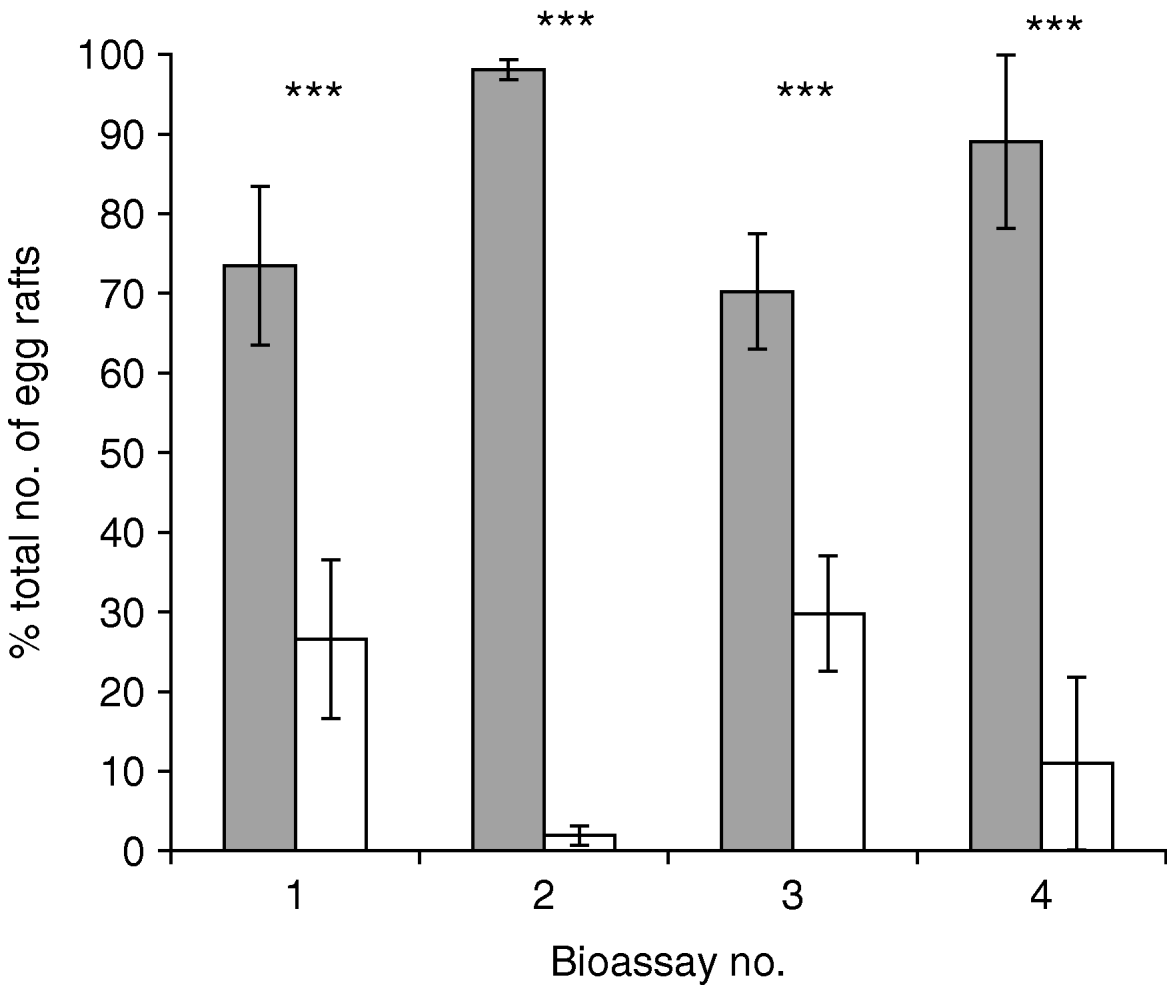
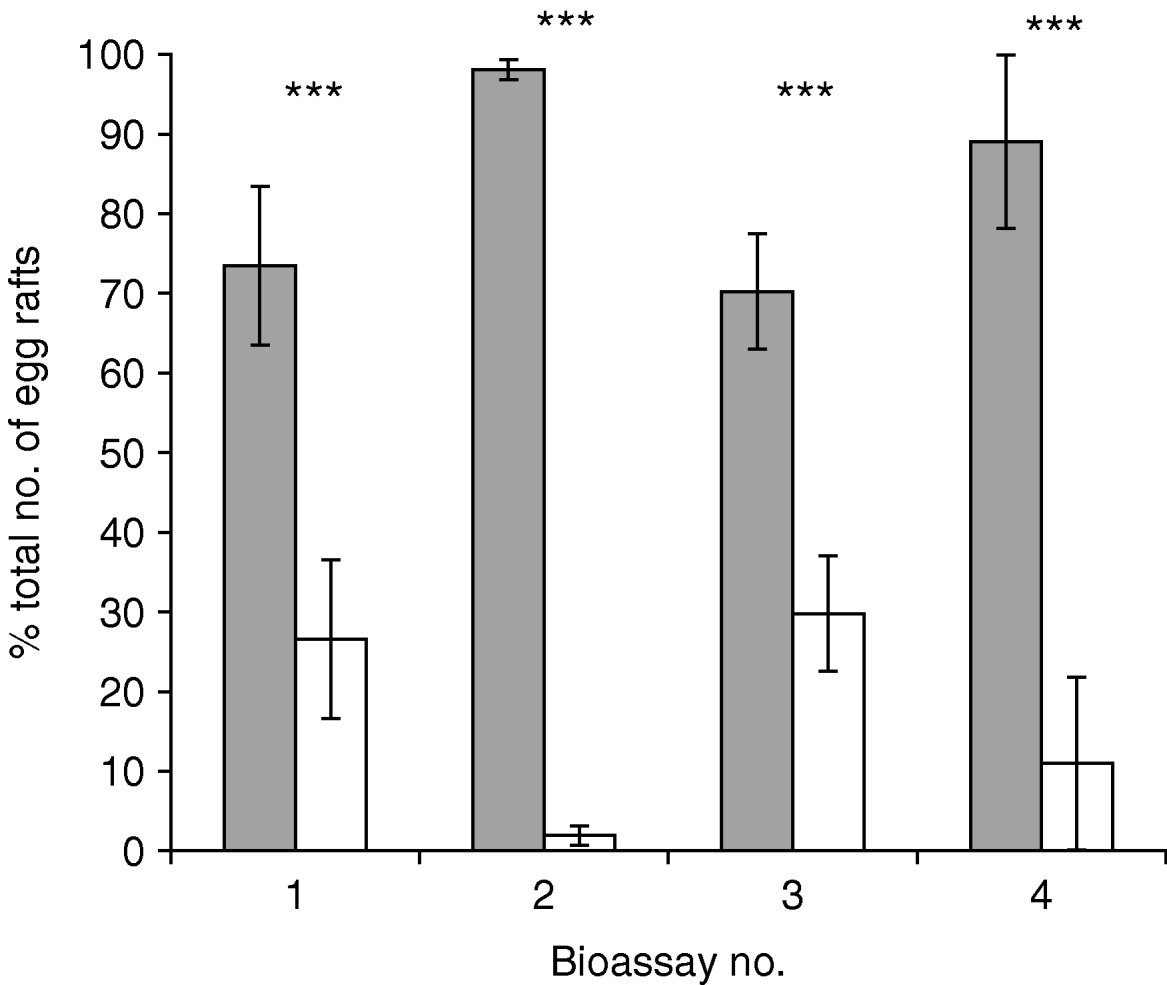
The mean percentage of total egg rafts in test and control oviposition tubs from each bioassay are displayed in fig. 1. Gravid Cx. quinquefasciatus MASIMBANI laid more egg rafts in pit latrine water than in dechlorinated tap water (t=8.38; P<0.001; n=6), and gravid Teule Cx. quinquefasciatus mosquitoes laid more egg rafts in Teule water than in dechlorinated tap water (t=57.60; P<0.001; n=6). Tubs filled with dechlorinated water baited with SBSE pit latrine extract had more egg rafts than water-filled tubs baited with diethyl ether control (t=10.81; P<0.001; n=6), and Teule mosquitoes responded to Teule SBSE extract by laying higher numbers of egg rafts in comparison with the diethyl ether control (t=10.19; P<0.001; n=6). These results show that SBSE extracts from Teule hospital cess pool and from the pit latrine site are more attractive to gravid Cx. quinquefasciatus than diethyl ether controls. The positive effect of these extracts demonstrates that SBSE is effective for extraction of behaviourally active oviposition semiochemicals from mosquito breeding site water. To our knowledge, this study is the first to demonstrate successfully the use of SBSE for this purpose.
Mean percentage of total egg rafts (with 95% confidence interval) in test and control tubs in bioassays of natural breeding site water and SBSE extracts from pit latrine and Teule hospital cess pool versus dechlorinated tap water controls (either with or without HPLC ether, as appropriate). 1, Pit latrine water vs. clean dechlorinated water; 2, Teule water vs. clean dechlorinated water; 3, Pit latrine extract in HPLC ether on clean dechlorinated water vs. control HPLC ether on clean dechlorinated water; 4, Teule extract in HPLC ether on clean dechlorinated water vs. control HPLC ether on clean dechlorinated water ( , test tub; □, control tub; ***, P<0.001).
Results of analysis of breeding site water SBSE extracts by GC-EAG and GC-MS
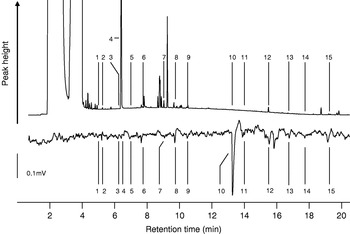
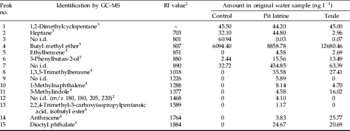
Coupled GC-EAG analysis located 15 compounds in the behaviourally active pit latrine SBSE extract which elicited EAG activity via the olfactory receptor neurones of gravid female Cx. quinquefasciatus. A GC-EAG trace for the pit latrine SBSE extract is shown in fig. 2. Identification of these compounds by coupled GC-MS and calculated levels present in the original breeding site waters are shown in table 1. Six of the chemicals detected in SBSE extracts were also present in the control HPLC diethyl ether sample (3-phenylbutan-2-ol, butyl methyl ether, heptane, 1,2-dimethylcyclopentane and two unidentified chemicals with R.I values of 890 and 801, respectively) and were considered likely to be contaminants. The identity of seven of the latrine-specific EAG-active compounds shown in table 1 was confirmed by GC peak enhancement using authentic samples of chemicals.
Results of coupled GC-EAG on pit latrine SBSE extract. The upper trace corresponds to the FID detector on the GC. The lower trace corresponds to the antennal response of the insect preparation. Numbered peaks correspond to the compounds listed in table 1.

Identification of electrophysiologically active fractions of SBSE extracts.

1 Retention index (RI), calculated by comparison of retention times for sample fractions with n-alkanes of known molecular weight co-injected with the sample.
2 m/z=mass (m) to charge (z) ratio measurement of ions in unidentified compound.
3 tentative identification only.
4 identification confirmed by GC peak enhancement.
Successful extraction and subsequent GC-EAG/GC-MS identification of the known oviposition attractant 3-methylindole (skatole) (Millar et al., Reference Millar, Chaney and Mulla1992; Mordue et al., Reference Mordue, Blackwell, Hansson, Wadhams and Pickett1992; Beehler et al., Reference Beehler, Millar and Mulla1994), an expected component of faecally contaminated waters such as those collected, provided a biologically plausible basis for attractant properties of these extracts in pair choice bioassays. The amount of skatole present in the behaviourally active pit latrine and Teule SBSE extracts corresponded to a concentration of 0.00458 μg l−1 and 0.01602 μg l−1, respectively, in the original breeding site water. These levels are much higher than the skatole concentration of 10−4–10−5 μg l−1, which was reported in previous research to elicit maximal oviposition activity (Blackwell et al., Reference Blackwell, Mordue, Hansson, Wadhams and Pickett1993; Olagbemiro et al., Reference Olagbemiro, Birkett, Mordue and Pickett2004), but much lower than that which was reported to cause a repellent effect (10 μg l−1) (Millar et al., Reference Millar, Chaney, Beehler and Mulla1994). Interestingly, the oviposition pheromone (5R,6S)-6-acetoxy-5-hexadecanolide was not detected in GC-MS analysis of extracts, which may indicate either that it was not present in water samples (perhaps since it evaporates directly into the atmosphere from the apical droplet of the egg) or that it was not extracted with other SLMs in the breeding site water by the SBSE procedure, a possibility that warrants further research. Loss of highly volatile fractions, by evaporation during processing of extracts or whilst performing concentration under nitrogen, is also possible. Other compounds detected in SBSE extracts were not of natural origin and may represent man-made contaminants, for example 1,3,5 trimethylbenzene, which is a product of petroleum contamination. In a previous study, a range of benzene derivatives were isolated from headspace odours of worn stockings, which were attractive to host-seeking females of Anopheles gambiae (Qiu, Reference Qiu2005). However, this class of synthetic chemicals may have been released from the nylon material itself, rather than forming a component of host odour. Phthalates could possibly originate from plasticizers used with PVC, whereas 1-methylnaphthalene can be derived from fossil fuels, such as petroleum and coal, or by pyrolysis of botanical material. The sources of these unexpected components of pit latrine and Teule cess pool extracts are unknown; for future research utilizing the SBSE procedure, it is important to distinguish between contaminants present in the original field breeding site water sample (e.g. due to disposal of automotive oil, cooking fuel (kerosene) or partially combusted organic matter thrown into latrines) and those present due to the sampling methodology (e.g. contaminants in ether or use of plastic receptacles for water collection). Such distinction is necessary because gravid mosquitoes may have adapted their oviposition behaviour to respond to non-natural cues in contaminated breeding site water through conditioning during their immature stages (McCall & Eaton, Reference McCall and Eaton2001). Thus, the search for oviposition attractants for Cx. quinquefasciatus should not necessarily be restricted to substances of natural origin.
Although this study represents an important step towards validation of a technique for the future isolation of attractants for use as gravid trap odour baits, it is necessary to be cautious in the interpretation of findings based on egg raft counting in laboratory pair choice bioassays. This methodology has been widely used to investigate the attractant properties of different chemicals for gravid female mosquitoes, but some investigators have questioned its validity (Isoe et al., Reference Isoe, Millar and Beehler1995b; Du & Millar, Reference Du and Millar1999). A behaviourally active semiochemical may function as an attractant (which induces gravid females to make oriented movements towards its source), an arrestant (which induces turning or hovering in the vicinity) or an oviposition stimulant (which promotes the act of oviposition) (Dethier et al., Reference Dethier, Browne and Smith1960). Bioassays which use counting of egg rafts as a measure of ‘attractiveness’ of an oviposition site are measuring the summation of all of the above effects. It, therefore, is not possible to state whether the SBSE extracts in this study functioned as long range attractants, short range oviposition stimulants or a combination of the two. The results of simple pair choice bioassays as used in this preliminary study require confirmation in future work, which should examine the effects of SBSE extracts on these behavioural responses in isolation, using techniques such as sticky screen bioassays (Isoe et al., Reference Isoe, Millar and Beehler1995b) and wind tunnel olfactometer trials (Pile et al., Reference Pile, Simmonds and Blaney1991).
In conclusion, the SBSE technique used in this study demonstrates for the first time an effective and technically straightforward method for extraction of behaviourally active volatile fractions from Cx. quinquefasciatus breeding site water and shows the practical feasibility of field collection of extracts for transportation and later analysis at a central laboratory facility. SBSE stir-bars will contribute to the future development of odour baits for gravid Cx. quinquefasciatus and other mosquito species, particularly in resource-poor environments where this simple and robust field technique has significant benefits over existing methods for extraction and isolation of volatile semiochemicals.
Acknowledgements
We thank Shahida Begum at LSHTM for providing mosquitoes used in GC-EAG work. Rothamsted Research receives grant-aided support from the Biotechnology and Biological Sciences Research Council (BBSRC) of the United Kingdom. This paper was published with permission of the Director General, National Institute for Medical Research. This paper is dedicated to the memory of Dr R.T. Rwegoshora, whose untimely death was a tragedy to his family and to those who knew him personally, and a great loss to the field of tropical entomology as a whole.