1. Introduction
The Centipede Game, first introduced by Rosenthal (Reference Rosenthal1981), provides a setting where rational self-interest conflicts with socially optimal cooperative behavior. Two players have to divide an increasing sum of money; to do this, they take turns choosing between taking the larger share of the money for themselves or passing the choice to the other player; every time a player passes on her opportunity the sum increases. The game ends when a player takes the larger amount of money or after a set number of turns, in which case the money is divided in a prearranged manner. It is set up such that if a self-interested player believes the game will end on the next round, she should take the money and end it on the current round. Several of the most popular solution concepts in traditional game theory tell us that we should expect to see absolutely no cooperation (passing) in the Centipede Game. However, experimental results deviate wildly from these expectations; subjects seem invariably to exhibit partial (though, not total) cooperation.
Rosenthal (Reference Rosenthal1981) initially argued that we should treat Centipede-like situations as pair of single person decision problems. And, from a decision-theoretic standpoint, if each player in the Centipede Game has certain views about the propensity of the other to deviate from the game-theoretic predictions, then it will be rational to pass in early rounds (96–97). But why should each expect the other to deviate from the game-theoretic solution? We could augment Rosenthal's analysis with the hypothesis that humans simply have a natural propensity to cooperate, at least partially, in situations like the Centipede Game. This leaves us with a puzzle: how can we explain this propensity?
For such a question, it is natural to turn to evolutionary game theory. However, the standard evolutionary models do not provide an answer, yielding the same solution as the traditional game-theoretic concepts and so do not aid us in explaining the existence of partial cooperation. However, the standard evolutionary setting assumes an infinite population, and recent studies into finite population evolutionary dynamics have revealed some important differences between these finite cases and their infinite counterpart. For instance, Imhof, Fudenberg, and Nowak (Reference Imhof, Fudenberg and Nowak2005) show that stochastic evolution in finite populations need not select for a strictly dominant strategy. And Taylor et al. (Reference Taylor, Fudenberg, Sasaki and Nowak2004) show that this evolutionary dynamic can even select against such strategies in
 $2\times 2$
games.Footnote 1
I will examine the evolution of partial cooperation in finite populations using the Moran process (Moran Reference Moran1962) with frequency-dependent fitness. Through the use of computer simulations, I find that, in finite populations, evolutionary paths often ‘get stuck’ in states where the population is exhibiting partial cooperation rather than the state of no cooperation, as seen in the infinite setting. This result illustrates a new potential explanation for the evolution of partial cooperation as well as providing a striking example of how finite population evolutionary models can differ radically from the traditional models. The frequently used and mathematically useful idealizations of the infinite population setting can lead us away from possible evolutionary explanations of partial cooperation. More generally, this suggests that one ought to be cautious when relying on such idealizations in evolutionary models.
I will begin by setting out two games of partial cooperation: the Centipede Game and the Quasi-Centipede Game. In Section 3, I will examine these games in the standard evolutionary setting using the traditional replicator dynamic. And, in Section 4, I will explore a model of evolution in finite populations and the effect of this finite setting on partial cooperation.
2. The Centipede and Quasi-Centipede Games
As mentioned above, the Centipede Game is a simple case where self-interest can interfere with more efficient, cooperative behavior. Imagine two players sitting at a table with a sum of money α between them, say $2. They take turns choosing either to pass (p) or to take a significant portion, leaving the rest to the other player (t). This continues for a fixed, and known, number of rounds or until someone takes the money. If a player chooses to pass, the sum increases by $2; if a player chooses to take the money, that player receives
 $\beta =1/ 2( \alpha ) +\$ 1$
and the other player receives the remaining money (
 $\alpha -\beta $
). If no player chooses to take the money, it is divided as if the player who would have gone next takes the money. The payoffs are such that if the game ends immediately after a player passes, then that player would have been better off taking the money and ending the game.
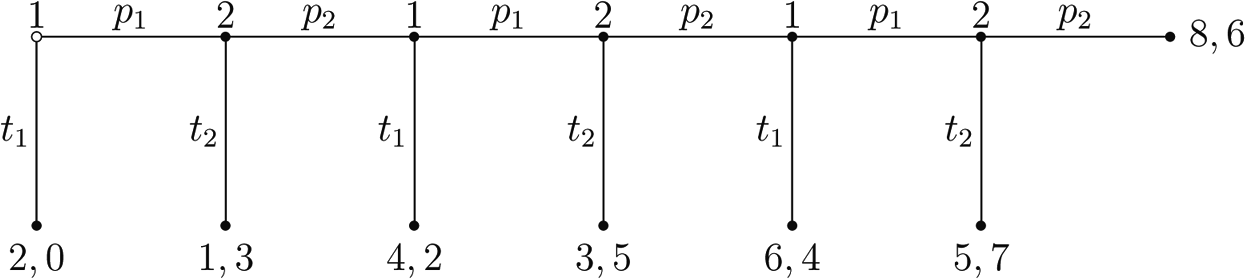
In the classical example, the game continues for one hundred rounds; hence the name. However, any game with the basic structure and payoff ordering is a Centipede Game. Figure 1 shows a six-stage version of this game.
A six-stage Centipede Game.

This can be easily generalized. Let the strategy sets be
 $S_{1}=\{ 1,\, 3,\, 5,\,\ldots ,\, N+1\} $
and
 $S_{2}=\{ 2,\, 4,\, 6,\,\ldots ,\, N+1\} $
, where N is the length of the Centipede Game.Footnote 2 And, let
 $s_{i}\in S_{i}$
denote the strategy chosen by player i; this number corresponds to the round on which the player decides to defect (if
 $s_{i}=N+1$
, then player i passes at every stage). Suppose
 $s_{i}=s_{j}-1$
; then the utility function for player i is such that
 $\pi _{i}( s_{i}+2,\, s_{j}) < \pi _{i}( s_{i},\, s_{j}) $
. In other words, if my opponent is going to defect on the next round, I am better off defecting now rather than passing. The payoff functions from the above six-stage Centipede Game can be generalized as


The Centipede Game is often used in game theory courses to introduce the concepts of backward induction and the iterated elimination of weakly dominated strategies. Suppose player 2 were to find herself at the last stage in the Centipede Game above; naturally she would prefer to take the money. But, given that player 2 would take the money at the last stage, player 1 should take the money on the second-to-last stage and given player 1's preference, player 2 should defect on the third-to-last stage. Iterating this reasoning leads to the conclusion that player 1 should take the money on the first stage. The unique subgame-perfect equilibrium of this game is for each player to opt out at any chance she gets. Every Nash equilibrium (Nash Reference Nash1950) in this game will share the feature of first-stage defection with the subgame-perfect equilibrium.Footnote 3 It is this uniquely ‘rational’ (and unintuitive) solution that traditional game-theoretic wisdom tells us to expect.
Given that the payoffs for a few rounds of cooperation (passing) are so much better than just taking the money immediately, it seems unlikely that people would actually conform to the ‘rational’ solution. The counterintuitive nature of the backwards induction solution has lead to debate over its rationality.Footnote 4 Furthermore, in experimental settings, subjects do tend to show some degree of cooperation. McKelvey and Palfrey (Reference McKelvey and Palfrey1992) studied the behavior of subjects in both four-stage and six-stage Centipede Games at varying stakes. They find that subjects display a substantial amount of cooperation, typically making it more than halfway down the centipede before one takes the money (808).Footnote 5 They also found that higher stakes slightly lowered the degree of cooperation, but by a relatively small amount.Footnote 6
The fact that people regularly deviate from the predictions of traditional game theory has led many scholars to look for alternative explanations. For instance, McKelvey and Palfrey show that if we assume that some individuals are altruists (unconditional passers), then it may be within the scope of ‘rational’ self-interest to pass in early rounds. McKelvey and Palfrey also look at models with errors in action or belief and show that partial cooperation could also arise in these settings. Nagel and Tang (Reference Nagel and Tang1998) look to various models of learning with the hope of providing some insight. They find that a model of simple reinforcement learning does fairly well in predicting partial cooperation. These explanations may certainly be part of the answer, but there may be alternative (or supplementary) explanations which do not rely on errors, preexistence of altruism, or specific learning mechanisms. Organisms of all kinds have solved cooperation problems, of which Centipede Games are a specific kind, and it would be worthwhile to investigate how partial cooperation could evolve in even the most basic settings. This is the aim of the models presented below.
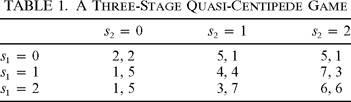
For the sake of illustration, the model that will be investigated below will largely focus on a simultaneous move and symmetric game similar to the Centipede Game, which I will call a ‘Quasi-Centipede Game’.Footnote 7 This game begins with a sum of money (say $4) between the players and at each round they simultaneously declare to ‘take’ or ‘pass’. If both players choose ‘take’ then they split the money and the game is over. If either chooses to ‘pass’ the amount of money will increase (at $2 for each ‘pass’ action). If one chooses ‘take’ and the other ‘pass’, the taker receives the majority ($4 more than the other player), leaving the rest to the other and ending the game. If they both choose ‘pass’ then the sum increases and they play again. This continues until one or both chooses ‘take’ or for a finite and known number of rounds, at which point the money is split equally. As with the standard Centipede Game, we will consider a restricted strategy set where the player simply decides which round to choose ‘take’. Table 1 shows a three-stage Quasi-Centipede Game; the possible strategies are simply the number of rounds that each player chooses to ‘pass’ before they ‘take’.

 $s_{2}=0$ |
 $s_{2}=1$ |
 $s_{2}=2$ |
|
|---|---|---|---|
 $s_{1}=0$ |
2, 2 | 5, 1 | 5, 1 |
 $s_{1}=1$ |
1, 5 | 4, 4 | 7, 3 |
 $s_{1}=2$ |
1, 5 | 3, 7 | 6, 6 |
The payoff function in this game can easily be generalized to the N-stage game, here is one example:

where
 $0\leq s_{i}< N$
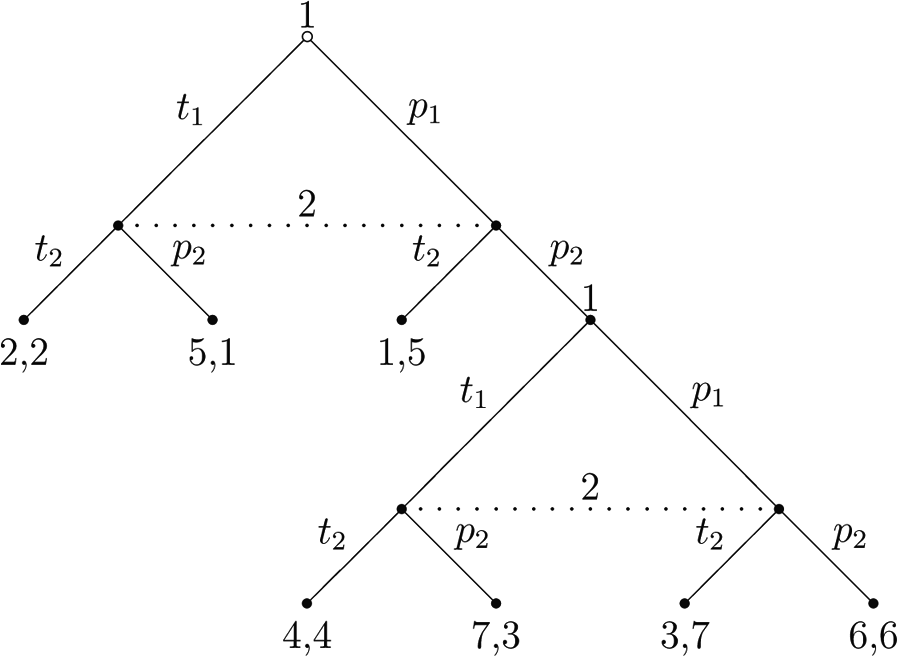
is player i's strategy; the payoff function for player two is similar. This payoff function will be used in the model examined below.Footnote 8 To see the relationship between the Centipede Game and Quasi-Centipede Game, it is helpful to see the Quasi-Centipede Game in the extensive form (Figure 2). Here
 $s_{i}$
represents the number of times the player chooses
 $p_{i}$
or ‘pass’. For the backward induction, begin at the end of the game and notice that player 2 should choose
 $t_{2}$
no matter what player 1 chose, and given that player 2 will choose
 $t_{2}$
, player 1 should choose
 $t_{1}$
and so on.Footnote 9
A three-stage Quasi-Centipede Game in extensive form.

Once again, the unique solution for this game is to take the money immediately, and this solution can be delivered by an iterated elimination of weakly dominated strategies. But, in some sense, the force of this solution is even stronger than in the Centipede Game since there is a unique Nash Equilibrium at
 $( s_{1}=0,\, s_{2}=0) $
. The standard Centipede Game permits some degree of cooperation from player 2 in the equilibria of the game, since when player 1 chooses ‘take’ right away, player 2 never has the opportunity to act. In the Quasi-Centipede with the restricted strategy set above, both players are strictly worse when they deviate from equilibrium behavior. Furthermore, if models of the Quasi-Centipede Game yield similar results to the Centipede Game, this can be taken as an indication that the results are robust across different games that have similar structures.
3. Evolution in the Centipede Game
For the evolutionary setting, we imagine an infinite population of players that are ‘hard-wired’ to cooperate for a certain number of rounds in the Centipede Game. Individuals are paired randomly to play the game and receive payoffs which function as the ‘fitness’ of using a particular strategy k. Let
 $0\leq x_{s}\leq 1$
represent the frequency of strategy s in the population (
 $\sum_{s\in S}x_{s}=1$
) and
 $X=( s_{0},\, s_{1\,},\ldots ) $
represent the state of the population. The fitness of type
 $s^{\prime }\in S$
(the set of individuals who use strategy
 $s^{\prime }$
) is calculated by

Let
 $\theta _{X}$
be the average fitness of the population in state X; the distribution of strategies evolves according to the standard replicator dynamic.Footnote 10 The differential equation governing the change in frequency of type s is

In words, types that have higher fitness increase proportionally to their fitness at the expense of those with lower fitness. The replicator dynamic is most directly interpreted as a model of biological evolution, but it can also be interpreted in terms of imitation rather than reproduction and hence be used to model a form of cultural evolution. For this cultural interpretation, ‘fitness’ would refer to a propensity for a strategy to be imitated rather than for an individual of that type to reproduce.
The replicator dynamic does not generally support the elimination of weakly dominated strategies, a fact that can lead to interesting results. For instance, Gale, Binmore, and Samuelson (Reference Gale, Binmore and Samuelson1995) and Skyrms (Reference Skyrms1996) show that weakly dominated ‘fair’ strategies can survive in evolutionary models of the Ultimatum Game. Thus, there may be some hope for promising results in the Centipede Game using the replicator dynamic. However, in both the Centipede Game and Quasi-Centipede Game the replicator dynamic yields a single result: a population of first-round defectors.
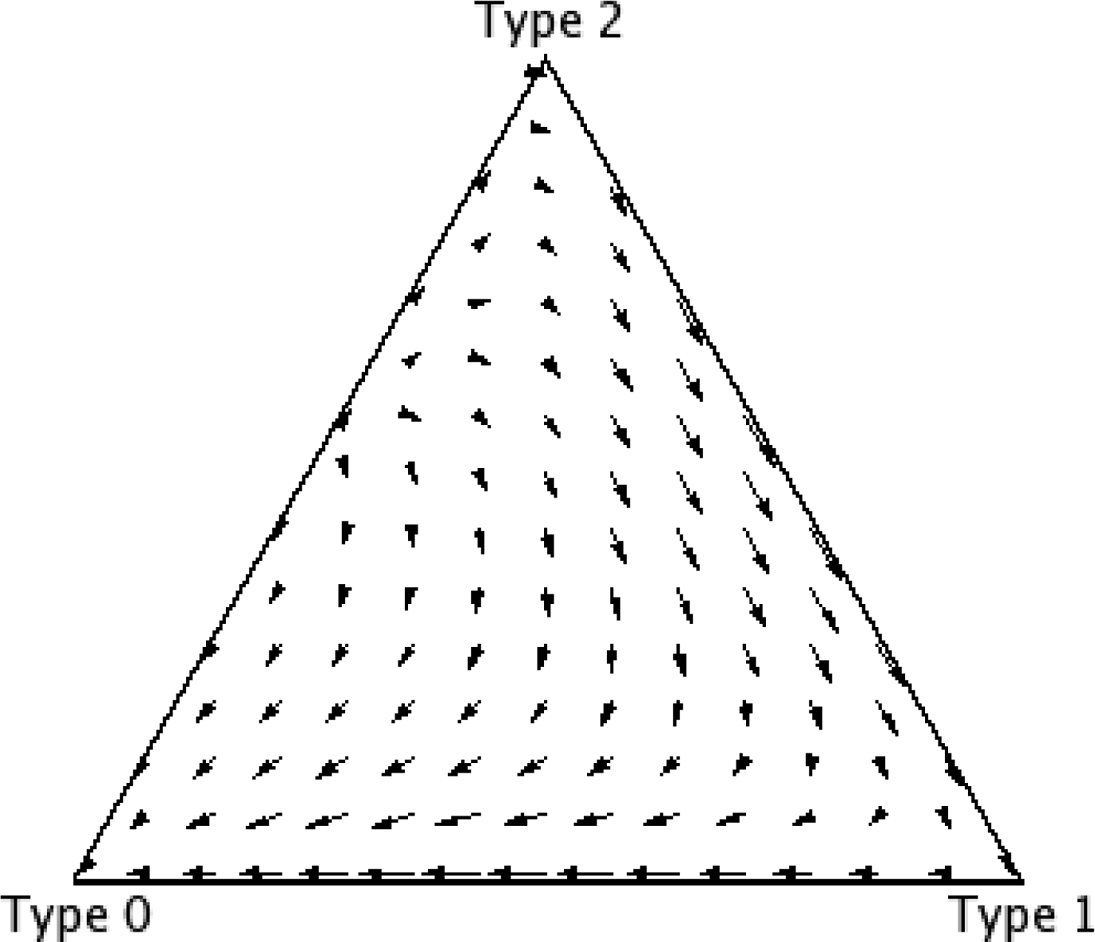
In the case of the three-stage Quasi-Centipede Game above, it is easy to see that there will be a unique evolutionary outcome from the replicator dynamic: everyone plays 0. If we suppose the population consists almost entirely of type 2, it will be invaded by individuals of type 1 and if the population consists of almost entirely type 1 then it will be invaded by individuals of type 0.Footnote 11 The same result holds for arbitrarily large Quasi-Centipede Games. Figure 3 shows the global dynamics for a three-stage Quasi-Centipede Game. It is interesting to note that the dynamics do not necessarily carry the population directly to the unique equilibrium. Instead, the dynamic sometimes seems carry the population through the stages of an elimination of dominated strategies, first to a predominance of type 2, then to type 1, and finally to the evolutionary equilibrium at all type 0.
Simplex of a three-stage Quasi-Centipede Game.

As seen in Figure 3, some paths of evolution in this three-stage game come close to a nonequilibrium edge of the simplex. The longer the N-stage Quasi-Centipede Game, the more likely it is to have an evolutionary path that gets close to a nonequilibrium edge of the simplex. The reason for this is that there is no direct route from type
 $s_{i}=k$
to type
 $s_{i}=k-2$
(for any
 $N\geq k\geq 2$
) and so, to evolve the unique solution as mentioned above, the population must evolve through the stages of backwards induction.
The evolutionary results for the standard Centipede Game are similar to the Quasi-Centipede Game.Footnote 12 In a sufficiently mixed population, types that show a high-degree of cooperation initially outperform those that do not and hence, increase in frequency. Then, those types that exhibit slightly less cooperation grow at the expense of the more cooperative type; and this process repeats until the population consists only of first-round defectors. In general, stable states of the replicator dynamic must also be Nash equilibria and all Nash equilibria in the Centipede Game have the property of first-round defection.Footnote 13 Ponti (Reference Ponti2000) shows that first round defection in the Centipede Game will be the result in a large class of dynamics that includes the replicator dynamic; proving that these dynamics will eventually carry the population to a state that is ‘outcome equivalent’ to the subgame perfect equilibrium (total first-round defection). Ponti also notes that populations often exhibit ‘unlearning’ of the solution (increasing in cooperation) before converging on first-round defection and he shows that as the length of the Centipede increases, the more likely populations are to exhibit ‘unlearning’.
At this point we can conclude that the standard evolutionary models (the replicator dynamic) cannot alone account for the evolution of partial cooperation. Even mindless replicators can evolve the backwards-induction solution to the Centipede Game. However, if we include some perturbation in the dynamics (which could be interpreted as either mutation in the case of biological evolution or experimentation in the case of cultural evolution), we no longer see the first-round defection result. In addition to his results mentioned above, Ponti also shows that with enough perturbation in the dynamic, a population can exhibit cycles between higher and lower degrees of cooperation.
The cyclic dynamical picture given by mutation in the Centipede Game provides one potential explanation for the existence and evolution of partial cooperation. In the following section I will examine a model that will provide another possible evolutionary explanation that does not rely on mutation.
4. Partial Cooperation in Finite Populations
In recent years, Taylor et al. (Reference Taylor, Fudenberg, Sasaki and Nowak2004) have developed a stochastic model of evolution in finite populations by incorporating frequency-dependent fitness into the Moran process (Moran Reference Moran1962).Footnote 14 Taylor et al. have shown that this process can deliver radically different results than the standard replicator dynamic.Footnote 15 I will use the Moran process to model the evolution of partial cooperation in the Centipede and Quasi-Centipede Games. The frequency-dependent Moran process provides a finite population evolutionary setting similar in nature to the standard evolutionary setting, which allows us to examine, in particular, the assumption of infinite populations. I find that without any mutation (or a very small amount), resulting populations will regularly exhibit partial cooperation.
On this model, the population consists of M individuals. Let
 $x^{t}_{s}\leq M$
denote the number of individuals of type s at time t; then
 $\sum_{s\in S}x^{t}_{s}=M$
. And let
 $X_{t}=( x^{t}_{s_{1}},\, x^{t}_{s_{2}},\,\ldots ) $
represent the state of the population at time t. The fitness to a given type
 $s^{\prime }$
at time t in the population is

The evolution is stochastic. At each step, one individual is chosen to reproduce with a probability proportional to her fitness and produces one identical offspring. Then, another individual is selected randomly to die. The probability for reproduction of type
 $s^{\prime }$
at time t is

and the probability for a death of a type s is simply
 $x^{t}_{s}/ M$
. We can also talk of selection favoring certain strategies at certain states of the population, we can say that selection favors
 $x_{s}$
in state
 $X_{t}$
if
 $R^{t}_{s}( X_{t}) > R^{t}_{s^{\prime }}( X_{t}) $
for all
 $s^{\prime }\neq s$
.
As the population size becomes very large (
 $M\rightarrow \infty $
) and time is appropriately adjusted, this process is similar, though not identical, to the standard replicator dynamic (Traulsen, Claussen, and Hauert Reference Traulsen, Claussen and Hauert2005).Footnote 16 But for finite populations, a population governed by the Moran process is effectively a very large finite-state Markov chain with as many absorbing states as there are types in the population. Once
 $x^{t}_{s}=M$
for some s, that type has completely overtaken the population and becomes the only type that can reproduce (
 $R^{t}_{s}=1$
); hence the population stays in this state. Also, if the frequency
 $x^{t}_{s}$
of some type s drops to
 $x^{t}_{s}=0$
, then it cannot increase because
 $R^{t}_{s}=0$
, and so extinction of a type is possible on this dynamic. As with the replicator dynamic, the Moran process can be interpreted as biological evolution in terms of reproduction (with a population at the carrying capacity of the environment) or as cultural evolution in terms of imitative behavior. I will intentionally remain ambiguous with respect to the interpretation since the target here is traditional idealizations and generic potential explanations rather than an explanation for a specific case of partial cooperation. Each ‘generation’ of the Moran process is just a single change in an individual, either through death and reproduction or though imitation.Footnote 17
We can now ask: what happens to partial cooperation in this evolutionary setting of finite populations? Moving to finite populations complicates the mathematics significantly, making analytical results difficult to achieve. Consequently, the one very effective way to investigate these models is through computer simulations. The advantage is a more realistic evolutionary setting, with respect to population sizes, but we are limited to examining the numerical results of specific models rather than the generality of mathematical proofs.
4.1. The Quasi-Centipede in Finite Populations
To answer this question, I will first focus on the Quasi-Centipede Game and then turn to the Centipede Game. I will assume that the Quasi-Centipede Game being played is the same as the generalized one mentioned above and will employ the use of simulations. Just as in the traditional evolutionary setting, we will not necessarily get a direct trajectory to the evolutionary equilibrium; instead, an appropriately mixed population will take a round-about path similar to some shown in Figure 3. However, under the Moran process we see several differences. First, the dynamic is discrete-time rather than continuous. Second, the step-direction is stochastic, only approximating the force of selection on average. Third, as a result of these differences, it is almost always possible for a type to go extinct in this setting.
The fact that extinction is possible and that the dynamic is stochastic can now cause ‘breaks’ in the evolutionary chain that follows the iterated elimination of dominated strategies. This can result in the population being absorbed into a state where every member is playing a partially cooperative strategy. Recall Figure 3; in this setting we can imagine an evolutionary path close to the Type 2–Type 1 edge of the simplex where Type 0 happens to go extinct.Footnote 18 In this case, the population will most likely be absorbed into a state where every individual is playing Type 1 (since Type 1 out performs Type 2 in this population). If extinction of strategies in the Quasi-Centipede Game is possible, then a population can ‘get stuck’ along its evolutionary path and end up playing a partially cooperative strategy. But, how likely is such an outcome?
The answer to this question depends on many factors: the size of the population, the length of the Quasi-Centipede, and the initial state of the population. I will begin with simulations in an example case. Suppose
 $M=1,000$
and suppose that each individual is given a random strategy, with equal probability for each strategy (equal initial weights); for a 10-stage Centipede Game, simulations show an overwhelming likelihood of resulting populations ending in an absorbing state with a substantial degree of cooperation. In 1,000 trials, there was not a single case of the unique equilibrium seen in the traditional setting and most ended in partial cooperation over the half-way point in the Centipede in an average of just over 150,000 generations (iterations of the Moran process).
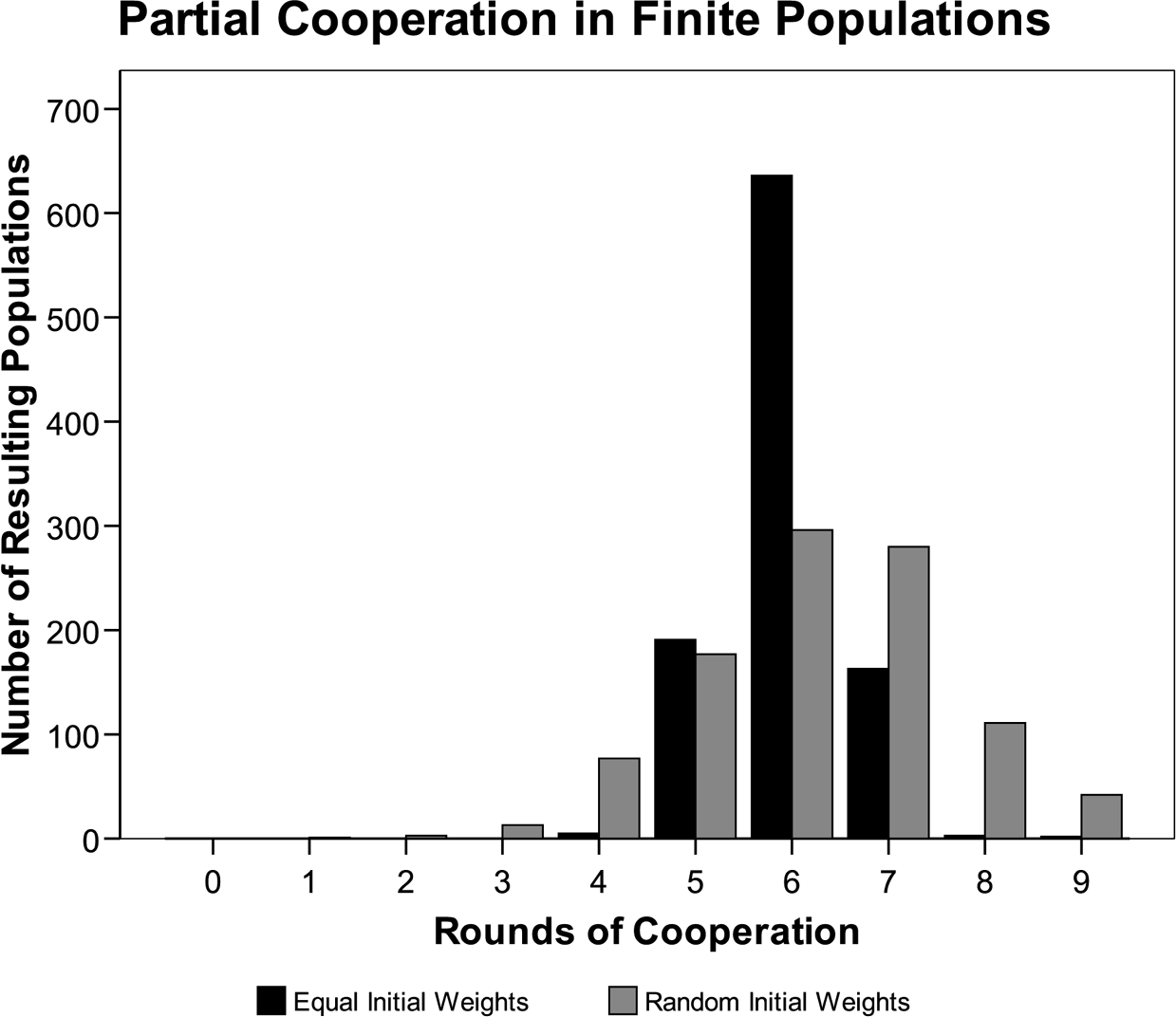
One may object that this method of assigning starting strategies is overly biased toward the center of the population's state-space. This can be remedied by selecting a random point on the simplex of strategies and assigning the weights accordingly (random initial weights).Footnote 19 This modification causes more variance in terms of which absorbing state is reached, but we still observe partial cooperation with very high frequency. Figure 4 gives a summary of the results for 1,000 trials under both styles of random initial conditions. In each case, we can see that it is very likely (probability greater than 0.99) that an evolving population will become absorbed into a state where every member exhibits partial cooperation.
The results of 1,000 simulations on a 10-stage Quasi-Centipede Game with a population of 1,000 evolving by the frequency-dependent Moran process.

As mentioned above, there are other key variables that affect the resulting degree of cooperation in a population: the length of the Centipede and the size of the population.Footnote 20 To gauge the degree of cooperation across different games we can assign it a number in
 $[ 0,\, 1] $
which is determined by the number of ‘passes’ by members of a population divided by the number of possible ‘passes’ in the game; call this the ‘level of cooperation’. If we increase the population size M, then the average level of cooperation seen in the resulting population decreases. The reason is that the step-size (
 $1/ M$
) of the evolution becomes proportionally smaller as M increases, and so the population is less likely to get extremely close to the edge of the simplex.
If, on the other hand, the size N of the Quasi-Centipede is increased, then we see the average level of cooperation in the resulting population increase. The reason is that, as N increases, the number of places extinction of strategies could occur increases. Since the evolution roughly follows the stages of iterated elimination of weakly dominated strategies, there will be
 $N-1$
edges of the simplex that correspond to steps in the elimination of dominated strategies. And, each time the evolution comes near an edge of the simplex, there is a chance of strategy extinction, and hence, a chance of becoming absorbed into a partially cooperative state.
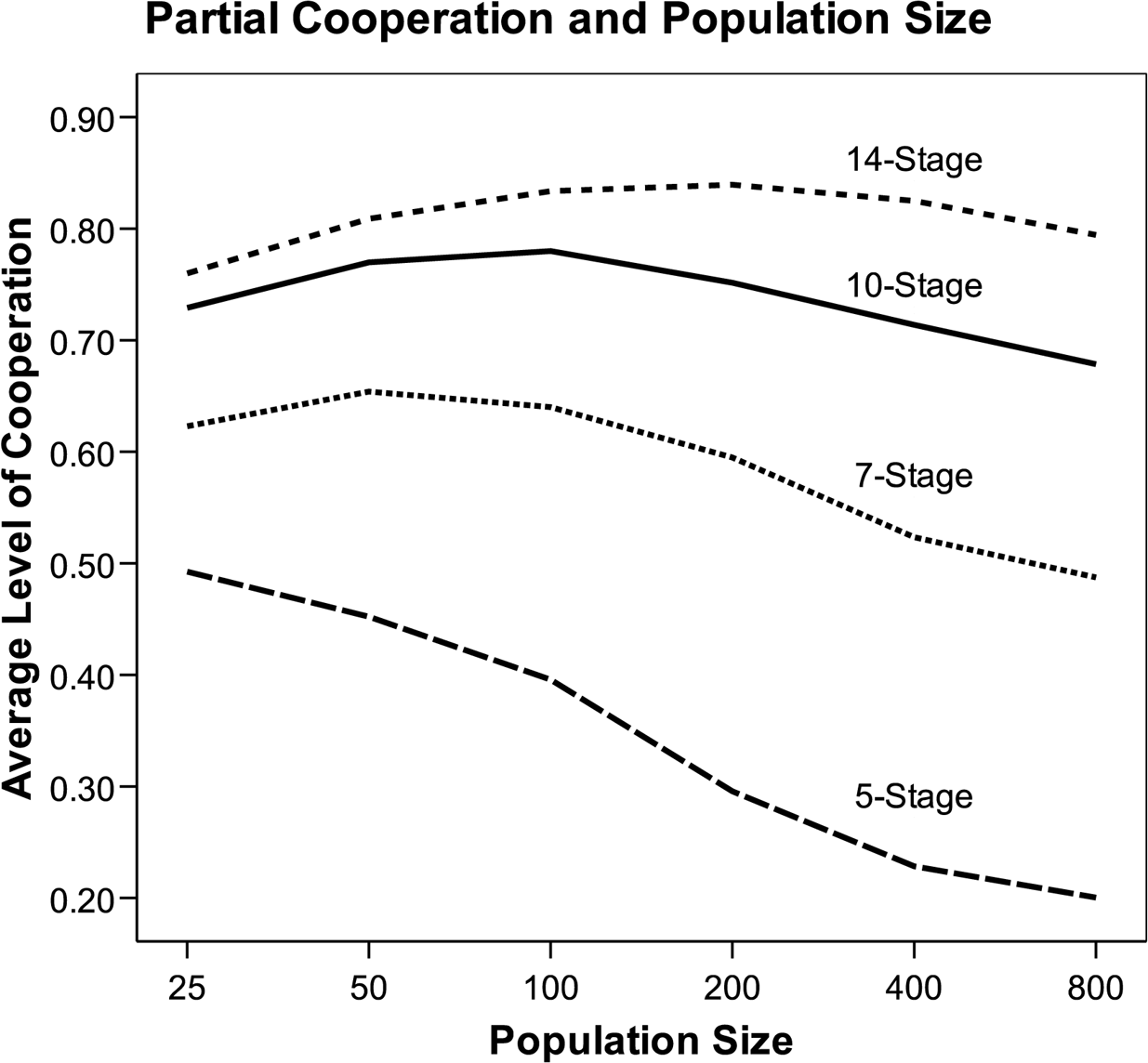
Figure 5 shows the average level of cooperation (normalized on
 $[ 0,1] $
where 0 corresponds to no cooperation and 1 to complete cooperation) as a function of the population on a logarithmic scale for 5-, 7-, 10-, and 14-stage Quasi-Centipede Games. These simulations show that the larger the population, the more the dynamics resembles the infinite case, as expected. And, the longer the Centipede the higher the expected degree of cooperation in the resulting population.Footnote 21 Given these results, it is reasonable to conjecture that for any finite population size M there will be some N-stage Centipede Game (with payoffs as specified above) that will result in partial cooperation with a probability arbitrarily close to 1.
The average resulting levels of cooperation in 5-, 7-, 10-, and 14-stage Quasi-Centipede Games as a function of population size.

4.2. The Centipede Game in Finite Populations
Thus far, I have focused on the Quasi-Centipede Game. Simulations on the Centipede Game using the Moran process show that the same qualitative results hold for this game. For these results, we imagine two populations playing the Centipede Game specified in Section 2, where members from one always take the role of player 1 and members from the other always take the role of player 2. The fitness for a type in a population is calculated by how well they do against the other population and the evolution within a population is governed by the Moran process.Footnote 22
In an eight-stage Centipede Game being played between two populations of
 $M=1,000$
, as in the case of the Quasi-Centipede, there were no resulting populations of first-round defectors in 1,000 trials.Footnote 23 And, the average level of cooperation was over the half-way point of the Centipede (the average node that resulting populations played ‘take’ was 6.12) with the average time to an absorbing state was just under 200,000 generations. We also find that the same general qualitative results hold as in the Quasi-Centipede Game, the average level of cooperation in resulting populations increases with the length of the Centipede and decreases as population size M increases. As before, these changes are due to the changes in likelihood of strategies going extinct.
Thus, in both the Centipede and Quasi-Centipede Games, the Moran process illuminates a new possibility for the evolution of partial cooperation. Since the evolution tends to follow the stages of elimination of dominated strategies, it is easy for certain strategies to become extinct. This can cause the population to become absorbed into a partially cooperative state, and these simulations have shown it is very likely to do so. Thus, the only reason certain levels of cooperation persist is because the ‘superior’ but slightly less cooperative strategies went extinct prior to arrival at the current state of the population.Footnote 24
Furthermore, given the nature of the standard infinite population replicator dynamic, as long as the initial population begins in the interior of the state-space (where every type is represented in the population), types will go extinct only in the limit of the process. Thus, it is impossible to observe outcomes in the Centipede or Quasi-Centipede Game similar to those seen with the frequency-dependent Moran process. The move to finite populations, in the case of the Centipede Game (and Quasi-Centipede Game), opens up new possibilities of explanation.
4.3. Mutation
Although the Moran process is stochastic, the models examined so far have not included any mutation. Indeed, the lack of mutation plays a key role in finite populations resulting in partially cooperative states since this result relies on the extinction of certain strategies. We can introduce a mutation probability μ into the reproduction process such that, with probability μ, a new individual picks a random strategy (with equal weights to each strategy) instead of adopting the strategy of the reproduced type.
By introducing a mutation rate, the process becomes ergodic: over time the system can reach any state from any other state. With a very small mutation rate, simulations show the results presented above tend to break down as the number of generations gets very large. In this setting, the population settles into a normal partially-cooperative state but eventually just the right mutation(s) will occur to cause a slightly less cooperative type to take over. However, for these very small mutation rates, it may take a very long time to reach the immediate-defection state. For instance, simulations in a 10-stage Quasi-Centipede Game with a population of
 $M=1,000$
and a mutation chance of 1-in-10,000, can take several million generations before reaching the immediate-defection state. Furthermore, if the mutation rate is high enough (say, 0.02 in the 10-stage,
 $M=1,000$
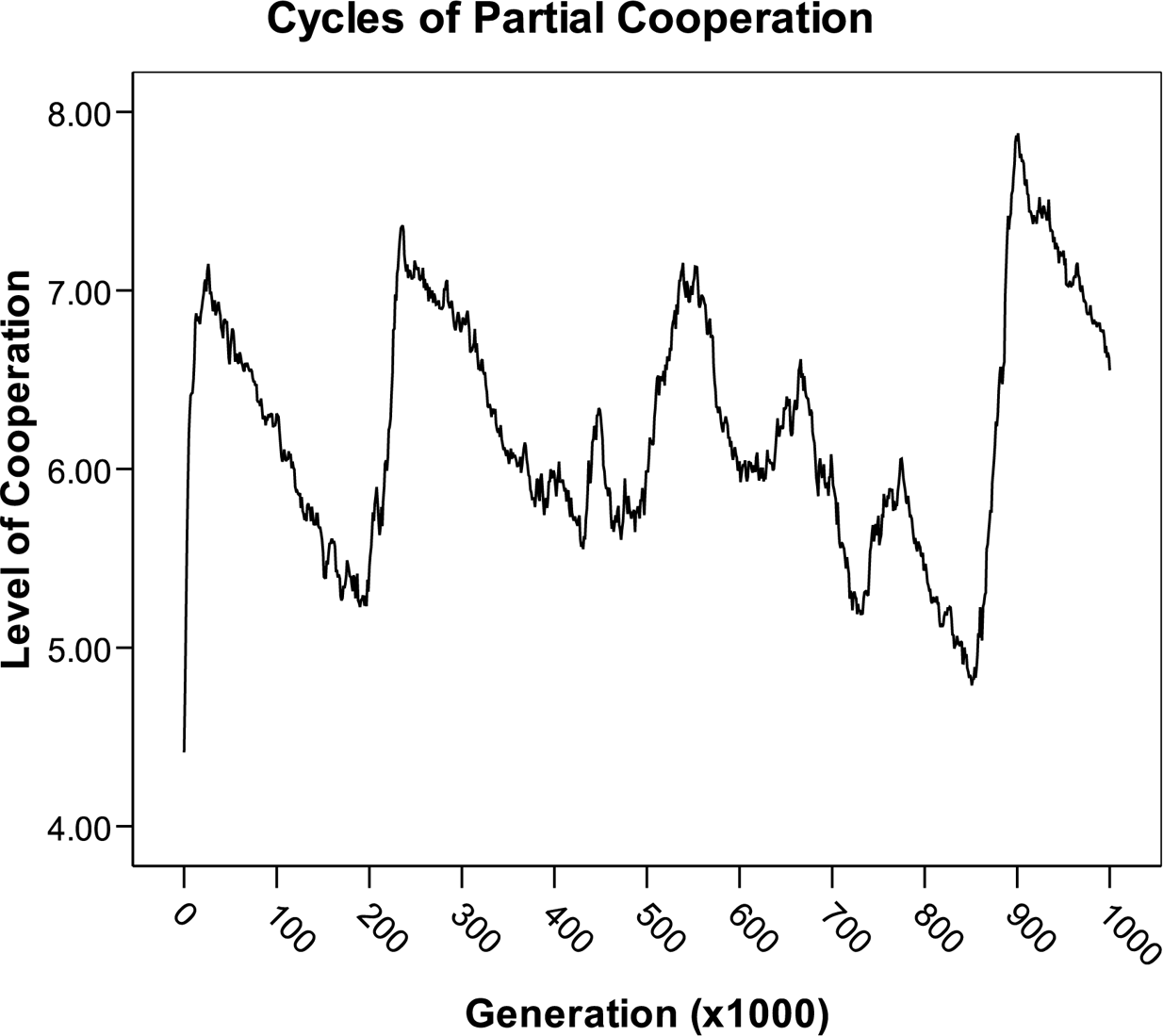
case), then simulations show a finite-population analogue to Ponti's (Reference Ponti2000) cycles of evolution seen in infinite populations with perturbation.Footnote 25 Figure 6 shows the average level of cooperation over time in such a cycling population through the first one million generations.
Cycles of partial cooperation in an evolving population of 1,000 individuals playing a 10-stage Quasi-Centipede Game with a mutation rate of
 $\mu =0.02$
.

Given that the evolution is stochastic, and the level of cooperation graphed in Figure 6 is an average of the members of a mixed population, some cycles appear more well behaved than others. The increase in level of cooperation tends to be more dramatic and the decrease in cooperation more gradual. This is due to the fact that one population is always invaded by any number of individuals that are slightly less cooperative, whereas for an invasion of more cooperative individuals there has to be several mutants that are substantially more cooperative. Increases in cooperation require several mutants so they can benefit from one and other, and they need to be substantially more cooperative otherwise they would benefit the native members more than mutants of their own kind. Similar cycles are seen in the standard Centipede Game.
Evolutionary cycles of cooperation have been seen in other games studied with the Moran process in finite populations. Imhof et al. (Reference Imhof, Fudenberg and Nowak2005) have examined the repeated prisoner's dilemma in this setting and have shown that mutation can cause cycles between cooperative, uncooperative, and discriminatory strategies. In the Centipede and Quasi-Centipede Games, cycles are possible with any mutation rate, but simulations show that as the mutation rate decreases, the regularity of cycles also decreases. There is a window of mutation that will tend to cause partial cooperation to break down and result in populations arriving at the immediately-defect solution (mimicking the infinite population setting without mutation). If
 $\mu =0$
or is very small, then the population will get stuck in states of partial cooperation indefinitely or for very long periods of time. If μ is large, then we see frequent and indefinite cycles of partial cooperation in the population. Of course, the exact place and size of this window will vary with population size and the length of the Centipede.
5. Conclusion
Moving from infinite population models to finite population models can have a radical effect on the results of evolution. The possibility of extinction and the stochastic nature of finite population models opens up new explanations for behavior in certain games. We have seen that this is certainly the case with the Centipede and Quasi-Centipede Games. In these games, the evolution roughly follows the stages of iterated elimination of weakly dominated strategies and in the standard infinite population models results in no cooperation. However, because of the nature of finite population evolutionary dynamics, certain strategies can go extinct, causing the population to ‘get stuck’ in partially cooperative states. The likelihood of establishing partial cooperation increases with the size of the game and decreases with the size of the population.
This result illustrates a new possible explanation for the evolution of partial cooperation: it may be that evolutionary paths, although leading in the direction noncooperative states, become absorbed into partially cooperative states due to the finite and stochastic nature of the evolutionary process. Although this explanation has not been shown to be more plausible than others, this result does provide a striking example of how evolutionary processes in finite settings can deviate significantly from those in the traditional infinite setting. The idealizations of the latter render such evolutionary outcomes as seen in finite cases impossible, and consequently, blind us to possible explanations for partial cooperation.
There are also several remaining questions that warrant further investigation. First, given that we see partial cooperation arise in both the Centipede and Quasi-Centipede, perhaps these methods could be applied to other games involving backwards induction. Second, how might different sorts of finite population dynamics affect the evolutionary picture in the setting of the Centipede Game or others? For instance, agent-based local interaction models may generate interesting results for the Centipede Game, and such models would enable further investigation of other idealizations in the traditional setting, in particular, random interaction within the population.
Appendix
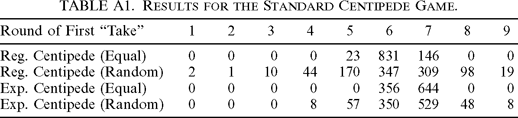
The aforementioned results of the standard Centipede Game are presented in Table A1. The results are qualitatively similar to the Quasi-Centipede Game presented above, but the model has some additional subtleties due to the asymmetric nature of the game. Summarized below are 1,000 simulations of two 1,000-member populations playing an eight-legged standard Centipede Game with the same payoff structure as in Figure 1 (Regular Centipede) as well as an eight-legged Centipede Game with exponentially increasing payoffs (Exponential Centipede).Footnote 26 Each pair of populations gets absorbed into a single pair of strategies and we can examine where these populations first choose to ‘take’ in the course of the game (Round of First ‘Take’). The initial weights for strategies are given in parenthesis. The numerical values in the table represent the total number of populations that resulted in that level of cooperation (or round of defection) out of 1,000 simulated populations.
The move to an exponentially growing payoffs does not change the qualitative results of the Quasi-Centipede Game either. Table A2 summarizes the results for 1,000 simulations of a 1,000-member population playing a 10-stage Quasi-Centipede Game with exponentially increasing payoffs.
In both settings, the average level of cooperation increases (slightly) with the change to exponential payoffs and the behavior becomes more regular (less variance). It is in this sense that the case of exponential payoff increase partial cooperation becomes easier.

| Round of First “Take” | 1 | 2 | 3 | 4 | 5 | 6 | 7 | 8 | 9 |
|---|---|---|---|---|---|---|---|---|---|
| Reg. Centipede (Equal) | 0 | 0 | 0 | 0 | 23 | 831 | 146 | 0 | 0 |
| Reg. Centipede (Random) | 2 | 1 | 10 | 44 | 170 | 347 | 309 | 98 | 19 |
| Exp. Centipede (Equal) | 0 | 0 | 0 | 0 | 0 | 356 | 644 | 0 | 0 |
| Exp. Centipede (Random) | 0 | 0 | 0 | 8 | 57 | 350 | 529 | 48 | 8 |

| Rounds of Cooperation | 0 | 1 | 2 | 3 | 4 | 5 | 6 | 7 | 8 | 9 |
|---|---|---|---|---|---|---|---|---|---|---|
| Exp. Quasi (Equal) | 0 | 0 | 0 | 0 | 0 | 0 | 844 | 156 | 0 | 0 |
| Exp. Quasi (Random) | 0 | 0 | 0 | 2 | 13 | 98 | 372 | 416 | 81 | 18 |