The present study seeks to update information on the relationships between the dimensions of well-being and the dimensions of job performance, as well as the variables associated with both constructs. We seek to provide updated information to theories that explain the relationship between well-being and job performance such as the happy-productive worker thesis (Staw, Reference Staw1986; Zelenski et al., Reference Zelenski, Murphy and Jenkins2008) that argue that happy workers are more productive than those who are not. This thesis has been called the “holy grail” of industrial/organizational psychology (Cropanzano & Wright, Reference Cropanzano and Wright1999) and consistent with this idea, human resources departments make large investments in employee job performance and well-being management, despite the uncertainty surrounding this topic (Zelenski et al., Reference Zelenski, Murphy and Jenkins2008). However, there are some doubts about which dimensions of well-being are related with job performance dimensions, and which conditions can affect this relationship (Courcy et al., Reference Courcy, Boudrias and Montani2018; Sonnentag & Frese, Reference Sonnentag, Frese and Sonnentag2002).
Well-being and job performance are topics of interest to researchers within the organizational sciences (Cropanzano & Wright, Reference Cropanzano and Wright1999), personal life, productivity, competitiveness and innovation of organizations (van Veldhoven & Peccei, Reference van Veldhoven, Peccei, van Veldhoven and Peccei2015). Scientific production on well-being and job performance continues to increase. For example, a review in the Web of Science database conducted in May 2020 applying the terms “Well-being” and “job performance” or “work performance”, showed four records in 2001 and 692 accumulated in 2020. However, to date, to our knowledge, no quantitative review of the relations between different types of well-being and job performance has been published. The reviews we found on this topic were involved in general forms of well-being and job performance (e.g., Cotton & Hartt, Reference Cotton and Hart2003; Ford et al., Reference Ford, Cerasoli, Higgins and Decesare2011; Lyubomirsky et al., Reference Lyubomirsky, King and Diener2005; Montano et al., Reference Montano, Reeske, Franke and Hüffmeier2017).
Given this limitation regarding existing reviews, in the current study, we summarize the literature on the relationship between types of well-being and job performance leading to a meta-analysis. Additionally, we carry out a scientific mapping of the topics studied with well-being and job performance to visualize the variables that can affect or facilitate them both.
Well-being
Well-being is a state in which individuals are aware of their abilities, can cope with the normal stresses of life, work productively and fruitfully, and contribute to their community (World Health Organization, 2004). Well-being conceptualizations date from Greek philosophy about happiness and hedonic and eudaimonic traditions have guided the measurement of well-being in psychology and social sciences (Ryan & Deci, Reference Ryan and Deci2001). The hedonic tradition refers to the fact that people search for pleasure and avoidance of suffering, while eudaimonic refers to the ideal in the sense of excellence, perfection toward our strives, and the meaning and direction of life (Ryff, Reference Ryff1989). Well-being research has been based on these traditions and has estimated three forms of well-being. Subjective well-being (Diener et al., Reference Diener, Suh, Lucas and Smith1999), takes up the hedonistic tradition, and psychological well-being (Ryff, Reference Ryff1989) and social well-being (Keyes, Reference Keyes1998), are based on the eudaimonic tradition.
Subjective well-being includes three components as well, positive affect, negative affect, and satisfaction with life (Diener et al., Reference Diener, Suh, Lucas and Smith1999); Psychological well-being is made up of the dimensions of self-acceptance, positive relationships with other people, autonomy, the domain of the environment, purpose in life, and personal growth (Ryff, Reference Ryff1989); and, social well-being groups the dimensions of social integration, social acceptance, social contribution, social updating, and social coherence (Keyes, Reference Keyes1998). Subjective well-being has been widely evaluated in the field of organizational and work psychology while psychological well-being has been studied recently (Ayala, Reference Ayala2017; Taris & Schaufeli, Reference Taris, Schaufeli, van Veldhoven and Peccei2015).
The complete state model of mental health (Keyes & Lopez, Reference Keyes, Lopez, Snyder and Lopez2002) included the three well-being perspectives mentioned above. This model was empirically validated and have shown that individuals characterized as being completely healthy reported the greatest productivity and the lowest health care use, by the contrast with individuals in incomplete health and complete ill-health (Keyes & Grzywacz, Reference Keyes and Grzywacz2005). Well-being can be evaluated as a global construct, from any of its three factors, or its dimensions. Recently, the model changed the term subjective well-being to emotional well-being, and well-being, as a general construct, was renamed to subjective well-being, made up of emotional, psychological and social well-being (Magyar & Keyes, Reference Magyar, Keyes, Gallagher and Lopez2019).
Well-being at work has been measured with context-free or work context measures and has also been measured from indicators such as job satisfaction, engagement, commitment, burnout, and work stress (Ayala, Reference Ayala2017; Sonnentag, Reference Sonnentag2015). However, in this review, we approach the three types of well-being (subjective, psychological, and social) to have a broader perspective of well-being, because it refers directly to well-being and not to its indicators, and because much of the primary studies used measures that corresponded to some of the dimensions of these types of well-being. For this review, emotional well-being will be equated with subjective well-being because the instruments used in some of the primary studies. We consider that this adjustment does not affect the methodology or the results of the review.
Job Performance
Job performance has been a way of evaluating worker productivity (Ayala, Reference Ayala2017). However, productivity can also be measured from the results contributed by the worker. To this extent, it is important to differentiate between job results and job performance. The results may depend on the performance of the worker, as well as on many other elements of the context, for example, the performance of the colleagues (van Veldhoven & Peccei, Reference van Veldhoven, Peccei, van Veldhoven and Peccei2015). Job performance as a global construct is the behaviour which contributes to the effectiveness and competitiveness of the organization (van Veldhoven & Peccei, Reference van Veldhoven, Peccei, van Veldhoven and Peccei2015; Wildman et al., Reference Wildman, Bedwell, Salas, Smith-Jentsch and Zedeck2011). Job performance is a multidimensional construct which includes task performance, contextual performance, adaptive performance, proactive performance, and counterproductive performance (Koopmans et al., Reference Koopmans, Bernaards, Hildebrandt, Schaufeli, de Vet and van der Beek2011; Ramírez Vielma, Reference Ramírez Vielma2013; Wildman et al., Reference Wildman, Bedwell, Salas, Smith-Jentsch and Zedeck2011). These types of job performance are described below.
Task performance consists of the development of behaviours for the execution of role activities that contribute to the productivity of the organization (Borman & Motowidlo, Reference Borman, Motowidlo, Schmitt and Borman1993; Campbell, Reference Campbell, Dunnette and Hough1990). Contextual performance refers to behaviours that help improve the organizational environment and that help achieve organizational objectives, such as helping others, defending the team and the organization (Borman & Motowidlo, Reference Borman, Motowidlo, Schmitt and Borman1993; Brief & Motowidlo, Reference Brief and Motowidlo1986; Organ, Reference Organ1997); contextual performance includes altruism, civic behaviour and organizational citizenship behaviour (Ayala, Reference Ayala2017; Ramírez Vielma, Reference Ramírez Vielma2013).
On the other hand, adaptive performance is the effective adjustment to changing situations and the skills to be competent in the face of new demands at work (Allworth & Hesketh, Reference Allworth and Hesketh1999; Pulakos et al., Reference Pulakos, Arad, Donovan and Plamondon2000). Likewise, proactive job performance includes the behaviours that promote initiating changes at work (Crant, Reference Crant1995; Frese et al., Reference Frese, Kring, Soose and Zempel1996). Finally, the counterproductive performance or counterproductive work behaviour, unlike the others, accounts for those voluntary behaviours that undermine the well-being or the interests of the organization (Gruys, Reference Gruys1999; Hollinger, Reference Hollinger1986). Job performance can be evaluated as a global construct or from any of its five types, depending on the author; In other words, there may be at least six possibilities for measures of job performance. Although the different types of performance point to a global job performance construct, the individual variables that predict each one are different (Sonnentag & Frese, Reference Sonnentag, Frese and Sonnentag2002) and therefore, investigations that relate job performance to well-being usually analyze each form of job performance separately.
Relationship between Well-being and Job Performance
The relationship between well-being and job performance has been studied since 1930 and different studies supported this relationship, generating the happy-productive worker hypothesis, measuring happiness with job satisfaction, lack of health, or different ways (Zelenski et al., Reference Zelenski, Murphy and Jenkins2008). The happy-productive worker thesis appears with Staw (Reference Staw1986), who argued that job satisfaction would be related to the productivity of workers. Zelenski et al. (Reference Zelenski, Murphy and Jenkins2008) revisited the theory and showed that positive affect would have greater weight than job satisfaction in relation to productivity.
Happy-productive worker thesis is a statistical way of understanding the relationship and has been supported by multiple studies that correlate some form of happiness or well-being with some dimension of job performance. However, it has been argued that affect can moderate the relationship between job satisfaction and job performance (Wright et al., Reference Wright, Cropanzano and Bonett2007) and also, it has been proposed that beyond a linear relationship there may be different profiles of workers such as the unhappy and productive worker, or happy and unproductive worker (Peiró et al., Reference Peiró, Ayala, Tordera and Rodríguez2014). Also, due to the logic of happy-productive worker hypothesis, job performance has been studied as a result of well-being (Courcy et al., Reference Courcy, Boudrias and Montani2018; Ramírez Vielma, Reference Ramírez Vielma2013; Sonnentag & Frese, Reference Sonnentag, Frese and Sonnentag2002). But well-being and job performance can be considered reciprocal influences because health is a resource that can help to perform well and in return, the worker creates or strengthens certain beneficial resources for health (Dose et al., Reference Dose, Desrumaux, Sovet and De Bosscher2018).
van Veldhoven & Peccei (Reference van Veldhoven, Peccei, van Veldhoven and Peccei2015) proposed a contextual model of individual work, well-being and performance, which theoretically and empirically explains the dynamics of the possible relationships between context and individual variables. This relationship may be distal and proximal with performance, efficiency and well-being both at work and in general terms. The different variables reported in the mapping presented here constitute a list of factors that can be located in the different groups of variables of the contextual model of individual work, well-being and performance (van Veldhoven & Peccei, Reference van Veldhoven, Peccei, van Veldhoven and Peccei2015) to achieve a repertoire of aspects of the context and the individual that can be controlled in management programs or human resources practices. Pawar (Reference Pawar2013) proposed other model that identifies broad categories of organizational behavior aspects based on six existing models and arranges them in a plausible sequence of interrelationships.
Many other theories provide explanations for this relationship, but we do not intend to list them all in this study. Previous reviews have studied the relationships between well-being and job performance, and have concluded that there is sufficient empirical evidence of the relationship between these two constructs; however, they did not focus on the relationships between the different dimensions of each one. For example, Lyubomirsky et al. (Reference Lyubomirsky, King and Diener2005) reviewed the relationships of positive affect with different aspects of success such as job performance. Likewise, Ford et al. (Reference Ford, Cerasoli, Higgins and Decesare2011) developed a meta-analysis of the relations between psychological well-being (subjective for this review), depression, general anxiety, and life satisfaction, and work performance criteria, and found a moderate to strong correlations. In this review, psychological well-being included the different dimensions of well-being without discriminating the results among them. Other reviews have theoretically addressed the issue such as Cotton and Hart (Reference Cotton and Hart2003), Daniels and Harris (Reference Daniels and Harris2000), Pawar (Reference Pawar2013), and Sonnentag (Reference Sonnentag2015), or from other indicators of well-being at work such as engagement (Kim et al., Reference Kim, Kolb and Kim2013), self-efficacy (Stajkovic & Luthans, Reference Stajkovic and Luthans1998; Judge & Bono, Reference Judge and Bono2001), burnout (Taris, Reference Taris2006), or depression (Lerner & Mosher, Reference Lerner and Henke2008).
The reviews have shown the relationship between well-being and job performance, and have also explained the existence of multiple organizational and worker variables that influence both well-being and job performance. In this sense, Nielsen et al. (Reference Nielsen, Nielsen, Ogbonnaya, Känsälä, Saari and Isaksson2017) conducted a review and meta-analysis to examine which types workplace resources at the individual, the group, the leader, and the organizational levels are related to both employees well- being and organizational performance. They determined that resources at either of the four levels were related to both employee well-being and performance and found no significant differences, suggesting that interventions may focus on any of these levels. This being the case, it is important to continue updating the information on the studies that disclose the resources that can help improve both constructs.
Given the previous context, this study is a contribution to the existing literature because it differentiates dimensions of well-being and job performance and adds qualitative/mapping part to other metaanalyses, which may offer a closer inspection of such relationship.
Method
Search Protocol
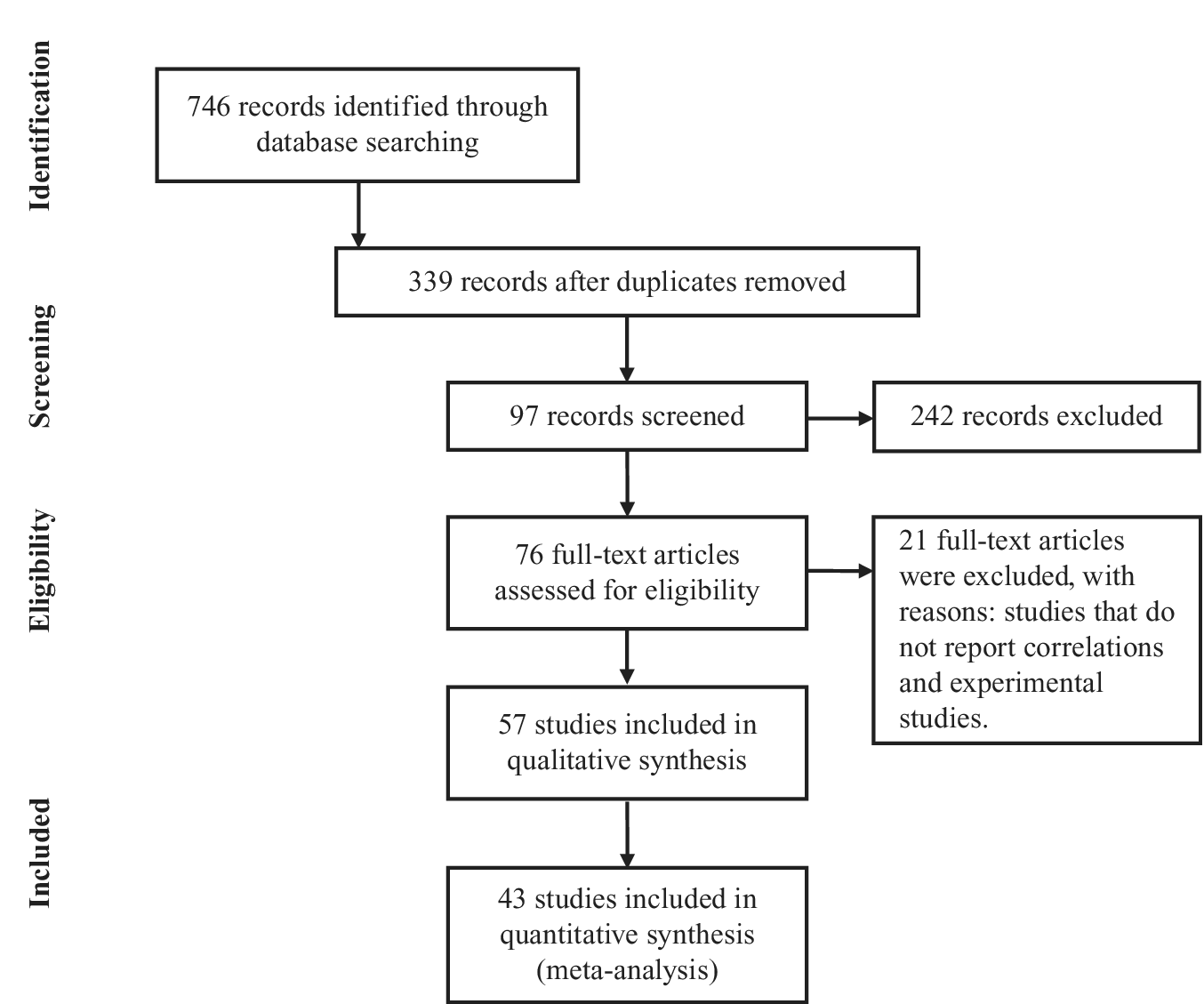
We followed The PRISMA statement for reporting systematic reviews and meta-analysis (Liberati et al., Reference Liberati, Altman, Tetzlaff, Mulrow, Gøtzsche, Ioannidis, Clarke, Devereaux, Kleijnen and Moher2009; Moher et al., Reference Moher, Liberati, Tetzlaff and Altman2009) for the development of a search protocol. Additionally, we based the protocol on literature review on well-being and job performance, reading other meta-analysis, consulting with experts in the area, testing searches in each database, and discussions among the authors in this study. The protocol used for the review shows eligibility criteria, search period, search terms, search strategy, inclusion criteria, and data extraction strategy (see Online Supplementary Material). The study selection steps in the selection process are described in detail in the flow diagram depicted in Figure 1.
Flow Diagram of Search Process

We searched in English in these databases: Web of Science, SCOPUS, Ebscohost, Proquest, and Jstor. We included only peer-reviewed journal articles in our research to account for a higher quality of input (Aguinis et al., Reference Aguinis, Pierce, Bosco, Dalton and Dalton2011) and only full text available. We look for the three types of well-being with its dimensions and global job performance with its five types; we based ourselves on the literature review of worker well-being and job performance such as Ayala (Reference Ayala, Peiró Silla, Tordera, Lorente and Yeves2017), Keyes and Grzywacz (Reference Keyes and Grzywacz2005), Sonnentag (Reference Sonnentag2015) and Ramírez Vielma (Reference Ramírez Vielma2013). Each database had a search strategy tailored to its particularities. We searched the databases several times during the years 2017, 2018, 2019, and 2020, to be sure of the search equations and the results. Additionally, alerts were activated from the databases to obtain new records.
We found more than 1,000 records in each database with de research terms, but we apply filters by area in each database until we reach 746 records. We removed duplicates and the sample was reduced to 339 records. We applied various inclusion criteria to ensure transparency in collecting our sample of eligible participants. Also, we filtered 97 records in this phase. Then, we examined the full text and excluded 21 more records from studies that showed no correlations, such as experimental studies (e.g., Niks et al., Reference Niks, de Jonge, Gevers and Houtman2013; Schelvis et al., Reference Schelvis, Oude Hengel, Wiezer, Blatter, van Genabeek, Bohlmeijer and van der Beek2013; Spoor et al., Reference Spoor, de Jonge and Hamers2010).
We inspected the sample characteristics of each primary study to reject studies that reported results that were derived from the same sample, but we did not find these cases. Likewise, information on the instruments and their classification according to the types and dimensions of well-being and job performance, based on the categorization of the present review. This classification was made because there is no standard regarding well-being and job performance, and so, for example, sometimes psychological well-being was measured with subjective well-being scales or subjective well-being was measured from the dimension of positive affect.
We identified a lack of studies for all the well-being and job performance types and dimensions. We found studies on subjective well-being, psychological well-being, task job performance, contextual job performance, proactive job performance, counterproductive job performance, and global job performance. There were studies on subjective well-being dimensions but not for psychological well-being dimensions. We did not found studies about social well-being or studies about adaptive performance. We carry out additional searches for each of the missing dimensions, including the Google Scholar database, but did not found results.
We incorporate for meta-analytical analyzes studies on the following variables. We put together the measures of context-free and well-being at work because we did not find differences to justify that they should be separated and because the number of correlations per dimension would decrease with this separation. For example, Staw et al., (Reference Staw, Sutton and Pelled1994) found a correlation between positive affect at work and global job performance (r = .30, p-value < .01), which closes the correlations between context-free well-being and global job performance, as can be seen in the results of this meta-analysis. We finally included (a) positive affect, (b) negative affect, and (c) satisfaction with life; we do not include composite subjective well-being, because the instruments that measured it correspond to the average of the three dimensions (positive and negative affect, and satisfaction with life), and there would be a compound variability. As well, we included studies on (d) psychological well-being, without its dimensions because there were no records about them.
Regarding the job performance, we included both the supervisor's evaluations and the self-evaluations without separating them. For example, Zelenski et al. (Reference Zelenski, Murphy and Jenkins2008) found a positive association between positive affect and self-reported job performance (r = .33, p-value < .01, N = 75), and similarly, Wright et al. (Reference Wright, Cropanzano and Bonett2007) found this relationships (r = .43, p-value < .01, N = 109). We established the following types of job performance (JP) : (a) Task performance, (b) contextual performance, (c) proactive performance, (d) counterproductive performance, and (e) overall/composite performance. Although it does not correspond to the sum of the other dimensions, we assume that it is made up of variability of these, but we consider it important to report it. We consider that this extensive review of each study was able to contribute to the reduction of bias within the studies. Also, our criteria to include studies in the present meta-analysis were strict, which we believe provided us with a relatively unbiased collection of studies from which we could draw stronger conclusions.
That phase was carried out by the first author of this study who reviewed the full-texts, and the second author reviewed the 10% of studies. Inconsistencies were resolved by discussion. We filtered 57 studies, of which 43 reported correlations that were used for the meta-analysis. In cases where an article reported effect sizes derived from multiple independent samples, we included each sample separately in the meta-analysis. In longitudinal studies, we only considered the first correlation, to maintain the same application conditions (e.g., Cropanzano & Wright, Reference Cropanzano and Wright1999; Staw et al., Reference Staw, Sutton and Pelled1994; Wright & Staw, Reference Wright and Staw1999). Finally, we identified 45 independent samples, 77 correlations, 34,221 participants, from 1994 to early 2020.
Statistical Analysis
We chose the random-effects meta-analysis method to derive the average correlations between well-being and job performance (Hedges & Olkin, Reference Hedges and Olkin1985) using the Meta-Essentials package (Suurmond et al., Reference Suurmond, van Rhee and Hak2017). The sampling error of individual correlations was estimated by Fisher’s z-transformation. Because the heterogeneity between the instruments and study participants was high (refer to the Results section), and far from a study is a replica of another, random-effects models were estimated (Borenstein et al., Reference Borenstein, Hedges, Higgins and Rothstein2009; Viechtbauer, Reference Viechtbauer2005). For models with only one correlation, we report the estimated confidence intervals. Thus, we used Q-test of homogeneity (Hedges & Olkin, Reference Hedges and Olkin1985) and the I2 measure of relative heterogeneity (Higgins & Thompson, Reference Higgins and Thompson2002), where a significant Q-test and high values of I2 suggest the presence of moderators (Higgins & Thompson, Reference Higgins and Thompson2002). The robustness of estimated correlations against publication bias was assessed by inspecting the funnel plots based on the trim and fill analysis of random effects models (Duval & Tweedie, Reference Duval and Tweedie2000). We assumed statistical significance at the p < .05 level for the meta-analysis of effect sizes.
Mapping Process
We implement the scientific mapping technique, which consists of analyzing and creating visual representations of topics and their relationship, through co-occurrence, grouping, and multidimensional scales (van Eck & Waltman, Reference van Eck and Waltman2010). We use the mapping technique to identify variables that academics associate with well-being and job performance, and, in this sense, complement the meta-analysis. Results help to know possible variables that may be intervening or accompanying the relationship between well-being and job performance.
We used The VOS software (van Eck & Waltman, Reference van Eck and Waltman2010) with the default settings. We use the 208 records founded in The Web of Science base in the search phase. We chose that base for the application of scientific mapping because it was the one that had the most articles in line with the other databases and its outputs can be analyzed by the software. For mapping, titles and summaries were required.
For the creation of the clusters, the terms of the search indicated above were taken into account and those referring to methodological aspects were withdrawn. The terms relevance was calculated and the relationship was evaluated using the measure of the strength of association, which refers to the relationship between the number of concurrences of two terms in relation concerning the expected number of co-occurrences of the two terms. The only adjustment to these system parameters consisted of requesting a minimum of two occurrences. This because methodological terms generate more occurrences, leaving the study variables outside the analysis. The strength measures of association were used as input to the VOS mapping technique, which is a two-dimensional representation of the terms’ relationship.
After the clusters were identified, a content analysis was conducted based on the reading of the articles that were part of each of the clusters. We nominated the clusters from the grouped terms and described each one, taking into account the main findings of the related studies.
Results
Meta-analysis of the Correlations between Well-being and Job Performance
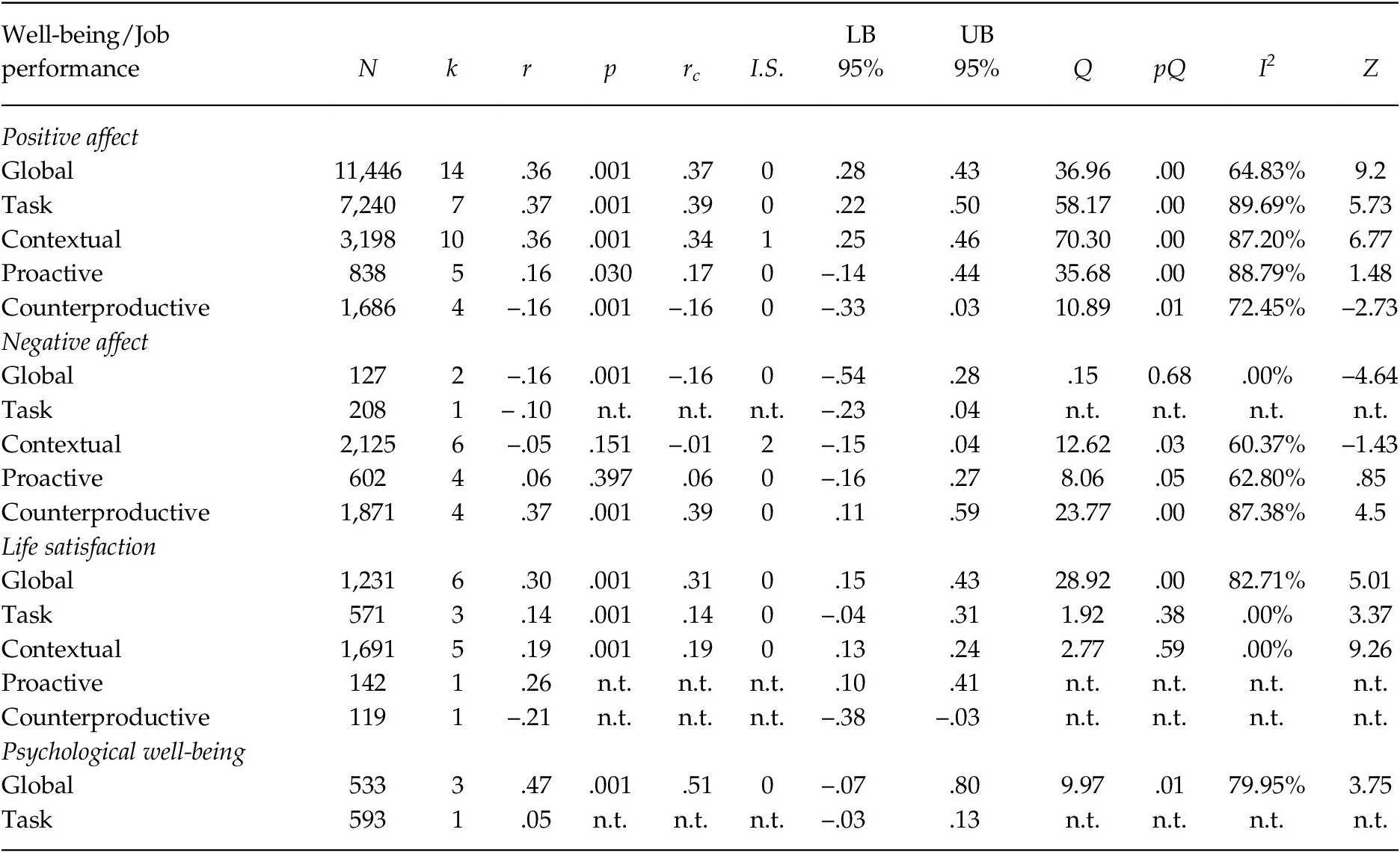
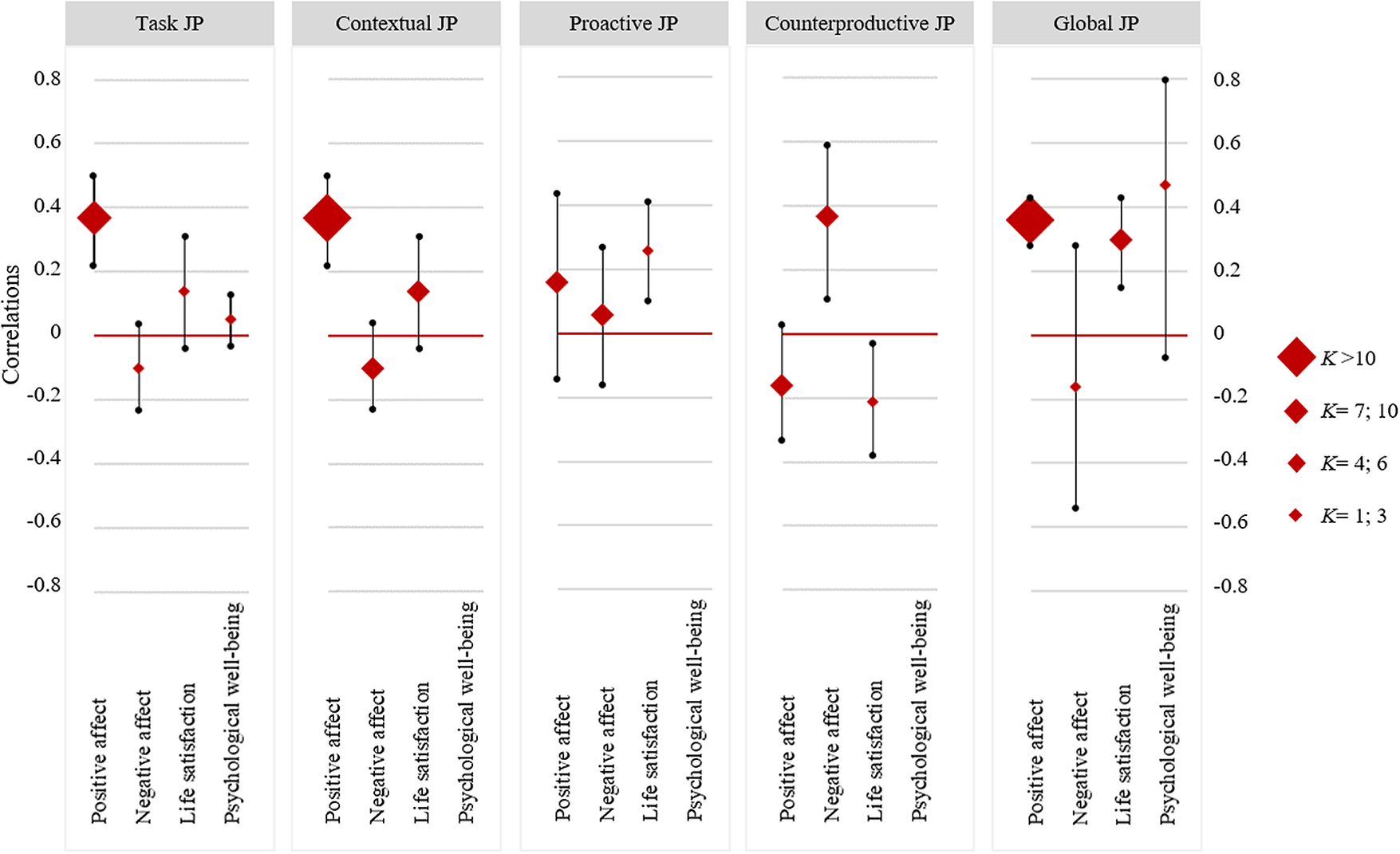
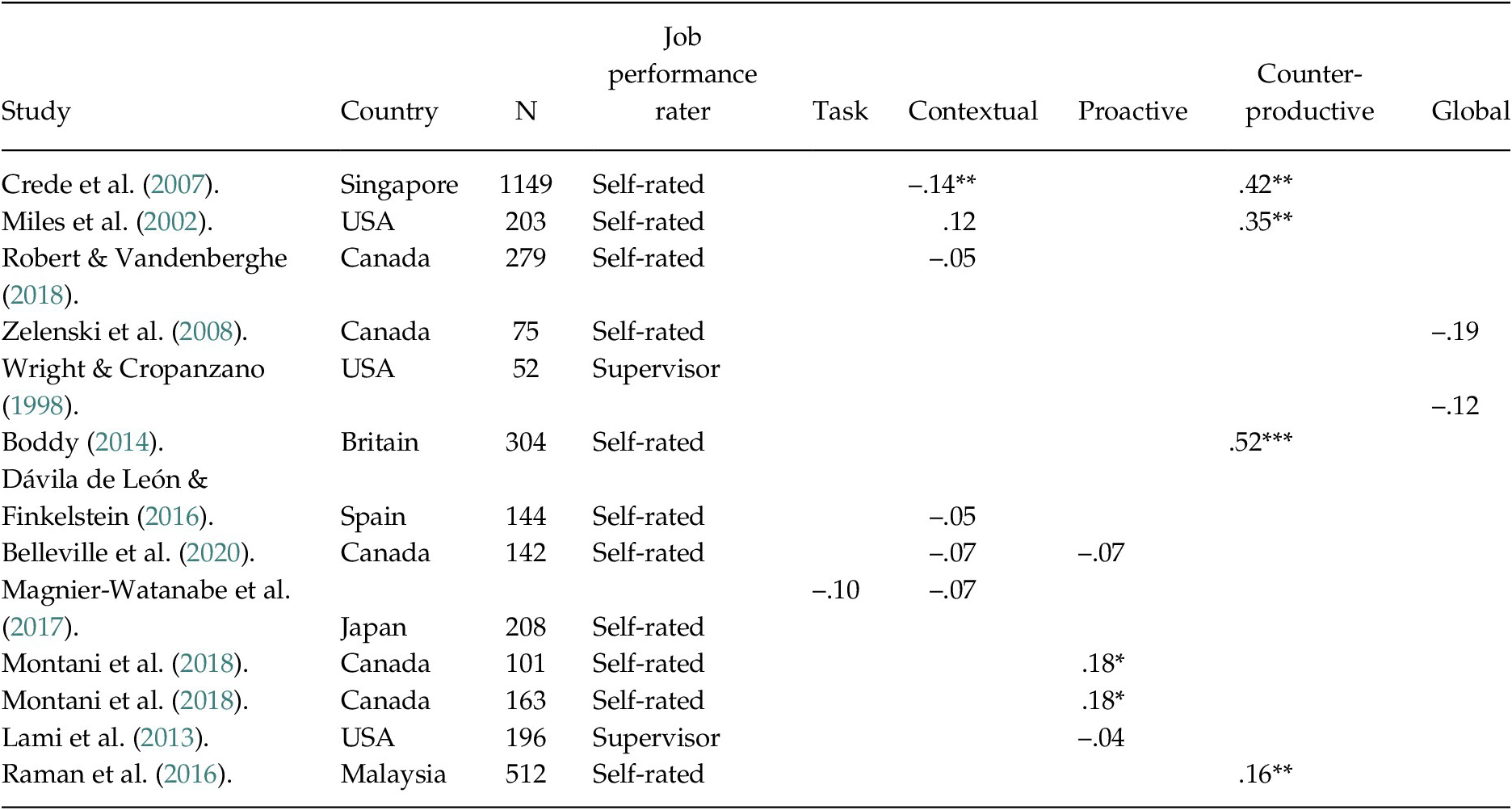
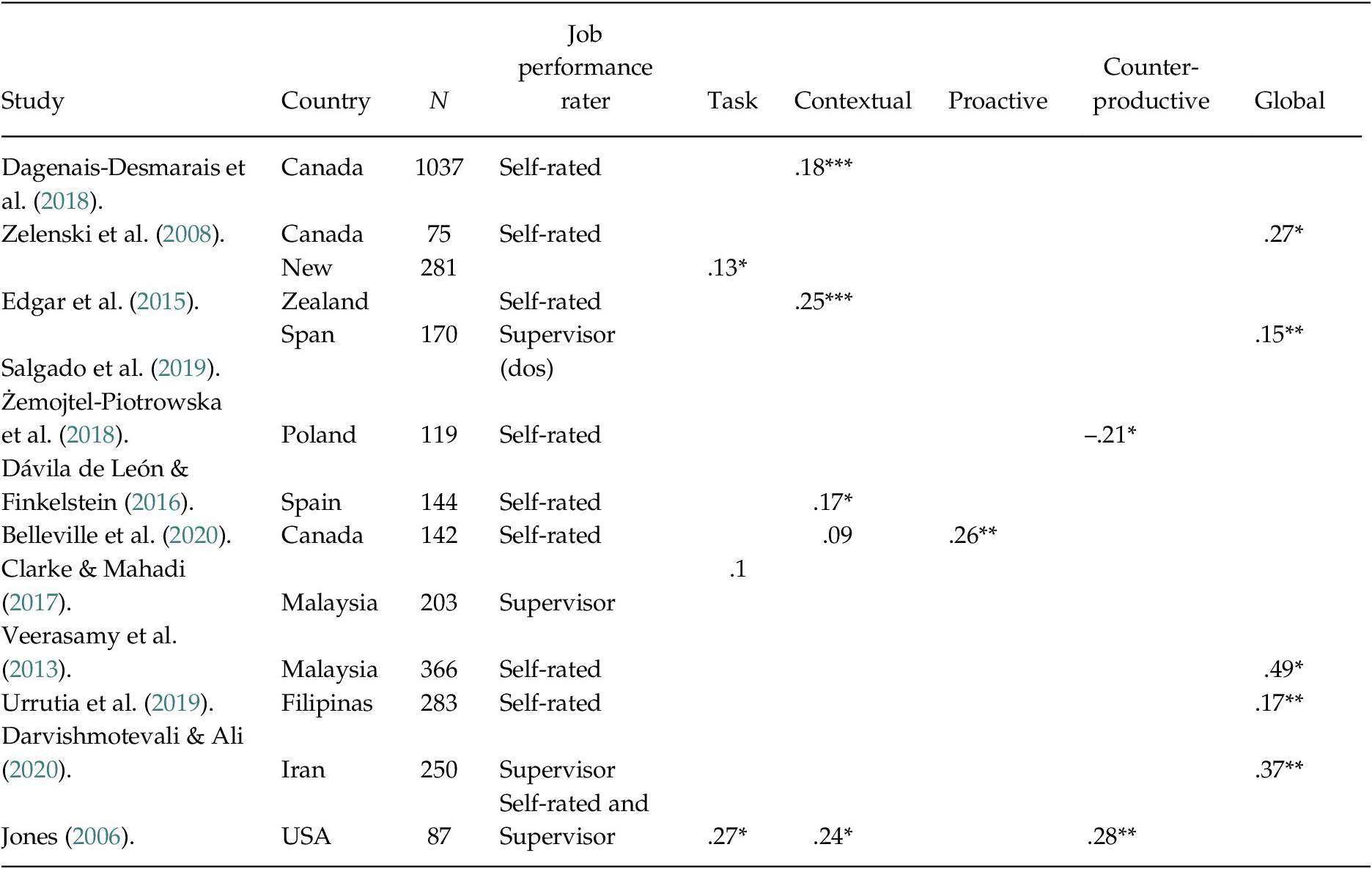
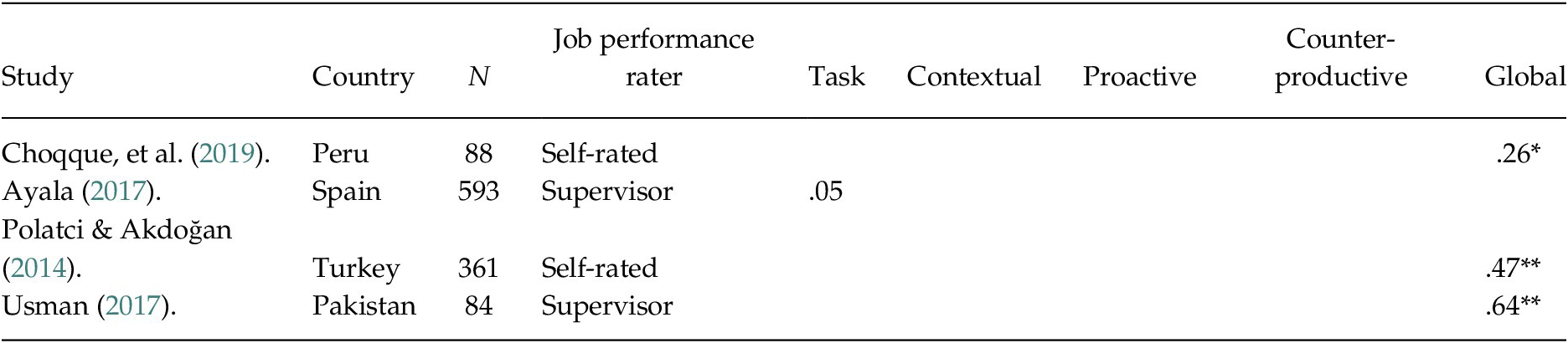
We found 23 relationships between forms of well-being and job performance, out of the 108 possibilities (21%). There would be a gap (79%) to be covered by scientific studies. The mean population correlation coefficients estimated by the meta-analytic random-effects models are reported in Table 1. Besides, the results of the adjusted models are summarized graphically in Figure 2. The list of all publications included in the meta-analyses and its characteristics are provided in Tables 4, 5, 6 and 7 (see Appendix). The mean population was N = 34.221 and we found 93 correlations between types of well-being and job performance.
Estimated Mean Population Correlations between Well-being and Job Performance

Note. N = Total sample size per model; k = Number of studies included; r = Unadjusted average correlation; LB 95% = 95% lower bound of the adjusted correlation r; UB 95% = 95% upper bound of the adjusted correlation r; Q = test statistic for residual heterogeneity of the adjusted models (k > 1); p-value Q = p-value for the test of residual heterogeneity in the adjusted models; I2 = test statistic for heterogeneity in random-effects model; Z = standardized correlation; n.t. = No testable; I.S. = Imputed studies in the fill and trill method. Total sample size across studies = 34,221.
Adjusted Mean Population Correlations and 95% Confidence Intervals for Each Predictor Outcome Combination. The area of the depicted diamonds is proportional to the number of studies K in each model

As can be seen in Table 1, all correlations were significant except for negative affect and contextual, task, and proactive job performance, and for psychological well-being and task job performance. Also, we found relationships supported by only one study that could not be meta-analyzed, limiting the generalizability of results.
Furthermore, the high cross-study variabilities within most of the investigated relationships (shown by the Q and I2 measures; see Table 1) suggest the presence of study characteristics as moderator variables. Otherwise, there is non-significant heterogeneity for the relationships between and negative affect and global job performance, and life satisfaction with task job performance, and life satisfaction with contextual job performance.
We check potential publication bias by the funnel plots based on the trim and fill method. The results suggest that albeit some outliers and wide 95% confidence envelopes, the distribution of estimates is rather symmetric. Trim-and-fill estimates for all variables were quite consistent with the raw zero-order estimates (Table 1). However, some caution must be taken when interpreting these findings, as this method has been noted to perform poorly when there is substantial between-study heterogeneity (Terrin et al., Reference Terrin, Schmid, Lau and Olkin2003).
Mapping on Well-being and Performance
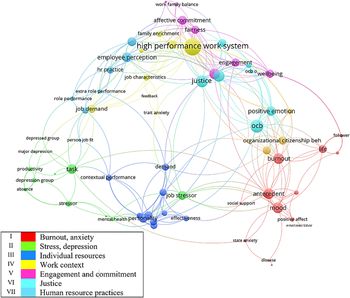
The mapping with VosViewer allowed us to organize the variables reported by the studies that have been related to well-being and job performance. The technique showed seven clusters and we reviewed each one to give it a name based on the literature (see Figure 3).
Clusters Map of the Well-being and Job Performance

The studies included in clusters I and II are usually specific symptoms of (un)well-being at work like burnout, anxiety, stress and depression (Sonnentag, Reference Sonnentag2015). Cluster III grouped studies about individual resources like personality traits and dispositions, while Cluster IV grouped studies about work distal or immediate context like employee’s perception about the work environment, family enrichment, feedback, high-performance work systems, job characteristics, and supervisor support (van Veldhoven & Peccei, Reference van Veldhoven, Peccei, van Veldhoven and Peccei2015). Cluster V, grouped positive aspects of work-related well-being, like work engagement and commitment (Sonnentag, Reference Sonnentag2015). Clusters VI and VII also grouped studies about work distal or immediate context like justice, human resources practices and person-job fit. In this line, we describe the main findings of the topics included in clusters III, IV, VI, and VII, which may be related both to the well-being classification that we use for the meta-analysis, and to the negative and positive symptoms of clusters I, II, and V.
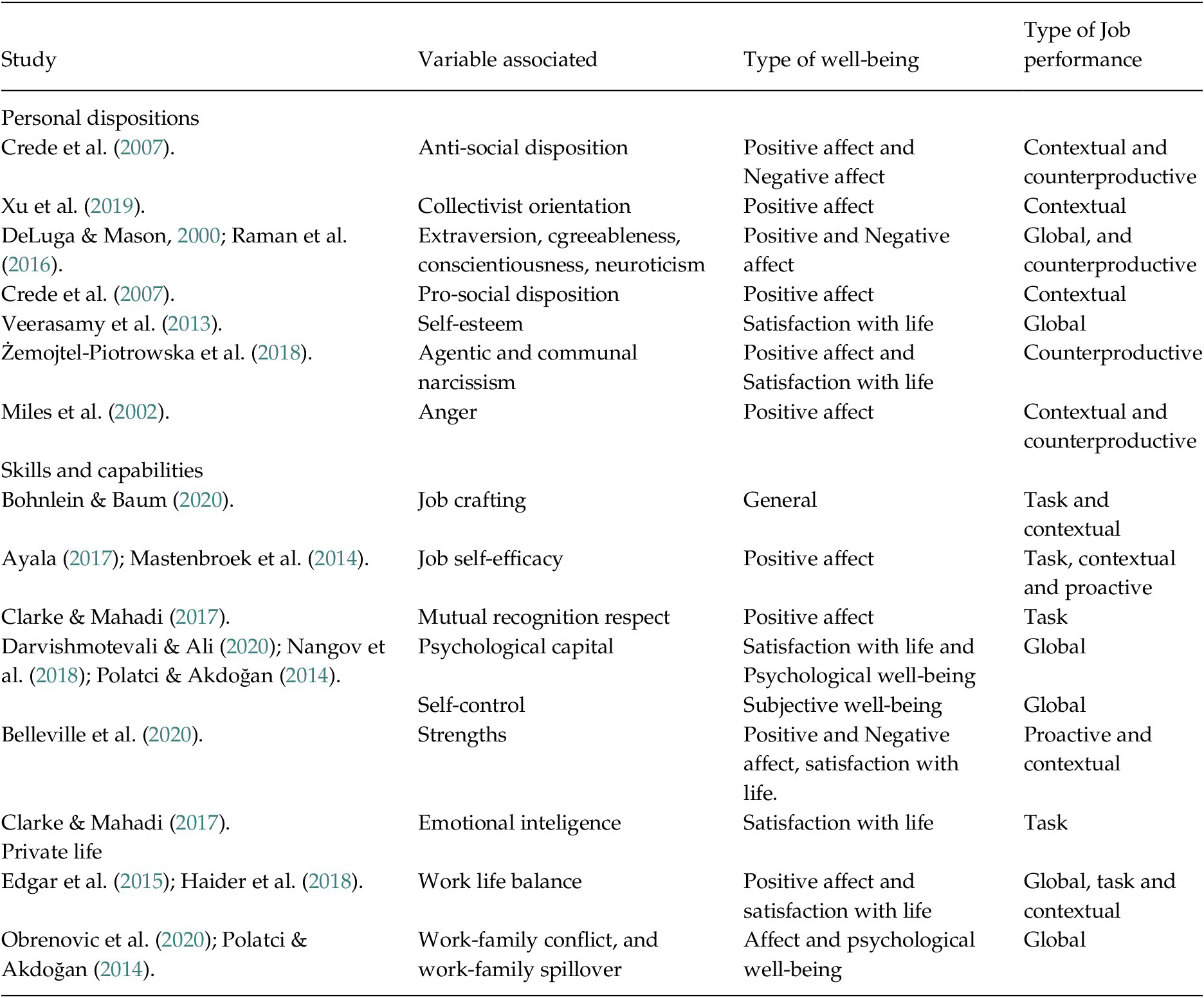
We based our analysis on two theoretical models. The Pawar (Reference Pawar2013) model that incorporates employee performance and employee well-being as outcomes based on six existing models. Likewise, the van Veldhoven & Peccei, (Reference van Veldhoven, Peccei, van Veldhoven and Peccei2015) contextual model of individual work well-being and performance that explain that well-being and job performance are predicted by individual and context variables, which can be distal or immediate. Table 2 summarizes the studies related to the individual at work variables, mostly those of them were grouped in cluster III of the mapping. We found in our review studies on, personal dispositions, skills and capabilities, as an individual at work variables. Also, studies on private life variables for distal/personal context. We could see some variables are related to some of the types of well-being and job performance, while others, have been related to other types.
Studies Related to the Individual at Work Variables

We identified that collectivist orientation, extraversion, agreeableness, conscientiousness, emotional intelligence, pro-social disposition, and self-esteem are positively related to positive affect, satisfaction with life, contextual performance, and global performance. And negatively related to negative affect and counterproductive performance. In contrast, personal dispositions such as agentic and communal narcissism, anti-social disposition, and neuroticism, have been associated with negative affect and counterproductive performance, and have negative relationships with positive affect, global performance, and contextual performance.
We identify skills and capabilities such as job crafting, job self-efficacy, mutual recognition respect, psychological capital, self-control, and strengths, that were related to positive affect, satisfaction with life, task performance, contextual performance, proactive performance and global performance; The relationship with negative affect was inverse in the case of strengths. Also, psychological capital has been linked to psychological well-being. We did not identify relationships of these skills and capabilities with counterproductive performance. Finally, within this group of the individual at work, the variables of private life were associated with well-being and job performance. Work-life balance was associated with positive affect and satisfaction with life as well as global, task and contextual job performances; while work-family conflict and work-family spillover were associated with affect, psychological well-being, and overall job performance. None of these variables of private life was related to counterproductive performance.
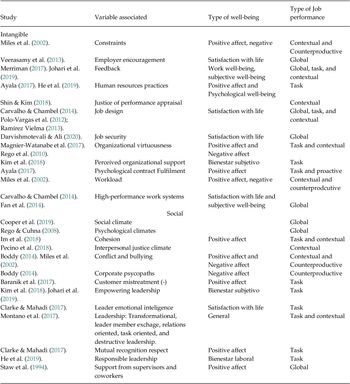
Table 3 shows studies of clusters IV, VI, and VII. Those studies correspond with variables of the immediate and distal work context, that van Venhoven and Peccei (Reference van Veldhoven, Peccei, van Veldhoven and Peccei2015) divided into tangible, social and physical variables. Variables such as employer encouragement, feedback, human resources practices, justice, job design, job security, organizational virtuousness, perceived organizational support, psychological climates, psychological contract fulfilment, high-performance work systems, cohesion, leadership, mutual recognition respect, and support from supervisors and coworkers, were positively related with positive affect and with satisfaction with life and with the job performance of the task, contextual, and global, some of them with proactive job performance. Instead, constraints, workload, conflict and bullying, and corporate psychopaths reacted with counterproductive performance and negatively with contextual performance.
Studies Related to the Work Context Variables

Review of the Linear Regressions Reported in the Studies
The objective of this study was to review the correlations reported by the studies where they associated well-being and job performance, however, we take advantage of the careful review of each study to update the information on the direction of the relationships between these constructs. We found 18 studies of which presented 24 linear regressions that were part of this analysis. In 22 cases well-being was a predictor of job performance and twice the contextual job performance was a predictor of well-being.
Affect was a predictor of overall performance in seven studies (for example, Cropanzano & Wright, Reference Cropanzano and Wright1999; Robertson et al., Reference Robertson, Jansen Birch and Cooper2012; Salgado et al., Reference Salgado, Blanco and Moscoso2019; Wright & Cropanzano, Reference Wright and Cropanzano1998; Wright & Staw, Reference Wright and Staw1999; Zelenski et al., Reference Zelenski, Murphy and Jenkins2008). Additionally, in one case affect predicted the withdraw intention and the counterproductive performance through job satisfaction (Crede et al., Reference Crede, Chernyshenko, Stark, Dalal and Bashshur2007).
Nine times positive affect was a mediator between a variable and some type of job performance. For example, among perceptions regarding the work environment, contextual performance and counterproductive performance (Miles et al., Reference Miles, Borman, Spector and Fox2002), work environment and global performance (Rego & Cunha, Reference Rego and Cunha2008). On the other hand, positive affect was a mediator between volunteerism with task and contextual performance (Im et al., Reference Im, Chung and Yang2018), as well as the use of strengths, contextual and proactive performance (Belleville et al., Reference Belleville, Dubreuil and Courcy2020). Similarly, organizational virtuousness predicts contextual performance through the mediating role of positive affect (Rego et al., Reference Rego, Ribeiro and Cunha2010). Affect also acted as a mediator between job satisfaction and global performance (Wright et al., Reference Wright, Cropanzano and Bonett2007) and between the balance of personal and work life with global performance (Haider et al., Reference Haider, Jabeen and Ahmad2018).
Psychological well-being predicted overall performance (e.g., DeLuga & Mason, Reference Deluga and Masson2000; Nangov et al., Reference Nangov, Sasmoko and Indrianti2018). General well-being, which includes subjective and psychological well-being, predicted on one occasion global performance (Jalali & Heidari, Reference Jalali and Heidari2016). Similarly, while satisfaction with life predicted global performance (Salgado et al., Reference Salgado, Blanco and Moscoso2019) and mediated the relationship between narcissism and counterproductive performance (Żemojtel-Piotrowska et al., Reference Żemojtel-Piotrowska, Piotrowski, Pers, Tomiałowicz and Clinton2018). In the case of job performance, only contextual one predicted well-being. Contextual performance predicted positive affect (Dávila de León & Finkelstein, Reference Dávila de León and Finkelstein2016), and subjective well-being through job satisfaction (Yurcu & Akinci, Reference Yurcu and Akinci2017).
Other variables that predicted Well-being (WB) and JP are shown below. Client abuse affected both WB and JP through rumination and peer relationships (Baranik et al., Reference Baranik, Wang, Gong and Shi2017); perceived organizational support and co-worker support mediated the relationship between empowering leadership and Subjective WB, but not the relationship between empowering leadership and JP (Kim et al., Reference Kim, Moon and Shin2018); and psychological capital had a positive and significant impact on JP as well as work WB (Nangov et al., Reference Nangov, Sasmoko and Indrianti2018). Feedback positively influenced WB, which served as a significant mediator in the relationship between feedback and JP (Johari et al., Reference Johari, Mohd Shamsudin, Fee Yean, Yahya and Adnan2019), and positive affect moderated the relationship between job satisfaction and JP (Wright et al., Reference Wright, Cropanzano and Bonett2007).
Likewise, leader emotional intelligence had direct effects on follower in-role JP, by contrast, follower emotional intelligence demonstrated direct effects on follower WB, and leader – member exchange was a predictor of follower in-role JP and WB (Clarke & Mahadi, Reference Clarke and Mahadi2017). On the other hand, human resources practices predicted the Performance of the task (Ayala, Reference Ayala2017); psychological WB mediated the link between the balance of personal and work life and work performance, and employee satisfaction with coworkers improved work performance, strengthening the effect of this balance on psychological WB (Haider et al., Reference Haider, Jabeen and Ahmad2018). There was a positive relationship between well-being-oriented Human Resource Management (WB-oriented HRM) practices and social climate, and social climate mediated the relationship between WB-oriented HRM practices and employee resilience, and employee resilience mediated the relationship between social climate and employee performance (Cooper et al., Reference Cooper, Wang, Bartram and Cooke2019).
Review of the Patterns of the Relationships Reported in the Studies
Other methods to analyze the well-being and job performance relationship focus on identifying profiles of happy and productive workers using multivariate analysis of covariance, discrimination, and cluster analysis. These methods establish that sub-groups can coexist in the same group of workers in terms of the relationship between well-being and job performance and that different variables could generate these sub-groups.
For example, Toyama and Mauno (Reference Toyama and Mauno2016) found that the highest overall scores on the emotional intelligence dimensions trait were associated with higher well-being and job performance profiles, while the group with lower emotional intelligence showed negative outcomes. Likewise, Ayala et al. (Reference Ayala, Peiró Silla, Tordera, Lorente and Yeves2017) found that over-qualification characterizes the unhappy-productive pattern, and Abdi et al. (Reference Abdi, Peiró, Ayala and Zappalà2019) showed that higher levels of job importance and lower levels of role ambiguity mainly differentiate the satisfied-healthy pattern. Abdi et al. (Reference Abdi, Peiró, Ayala and Zappalà2019) also found that overqualification and role overload differentiate the unsatisfied-healthy and satisfied-unhealthy patterns, and role conflict also characterizes the satisfied-unhealthy pattern.
In the same line, Peiró et al. (Reference Peiró, Kozusznik, Rodríguez-Molina and Tordera2019) found that women workers in the production sector, and management or highly qualified professionals were more likely to be included in the happy-productive profile, whereas men workers in the services sector, employees with low education level, and technicians/administrative workers were more likely to be included in the unhappy-unproductive cluster. They also identified that the high hedonic/low-performance pattern is populated more by employees from the services sector with professional training and technician-administrative jobs and that in the case of the high eudaimonic/low-performance pattern, it is mostly composed of women and employees in unqualified or technician/administrative jobs.
Variables in the Contextual Model of Individual Work, Well-being and Performance
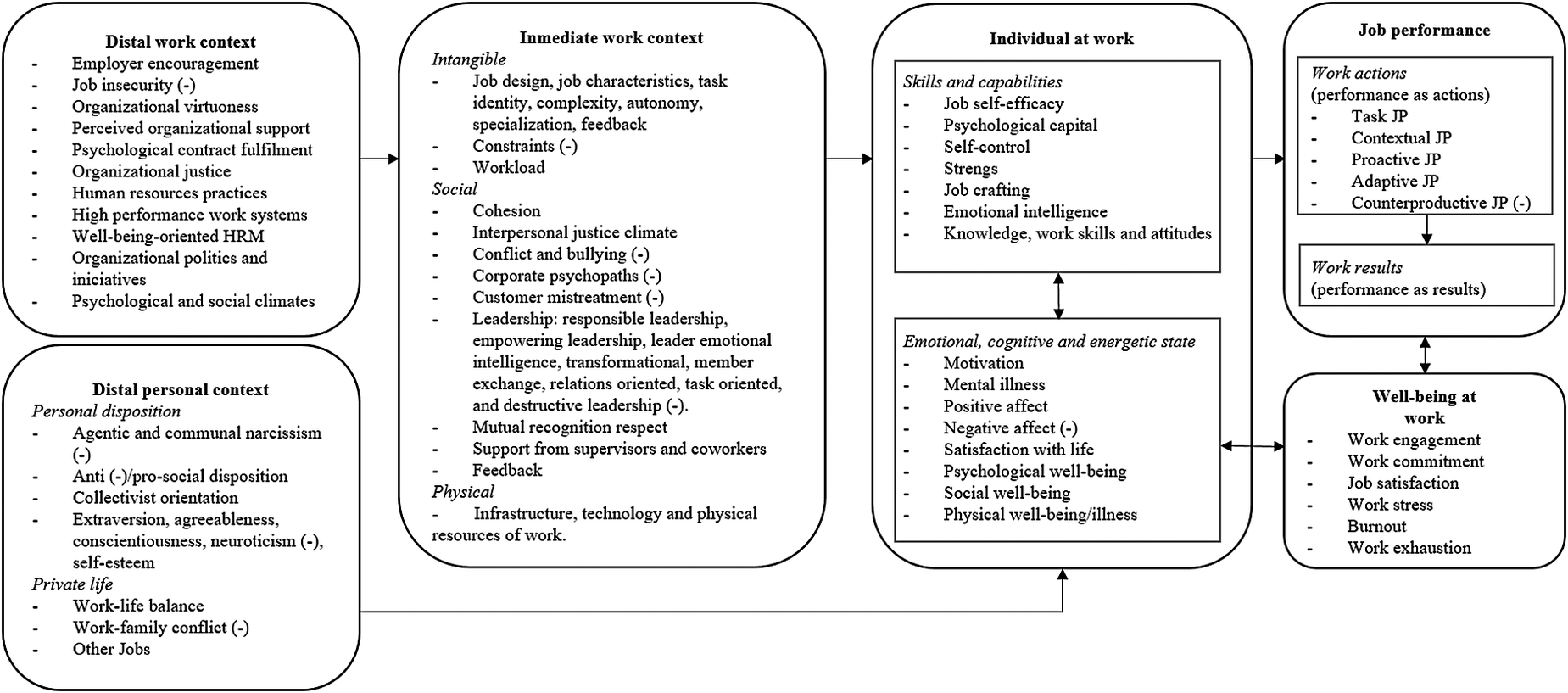
We organize the variables founded in the review from the logic of the contextual model of individual work, well-being and performance (van Veldhoven & Peccei, Reference van Veldhoven, Peccei, van Veldhoven and Peccei2015) (see Figure 4). Generally speaking, there is a tendency in which positive variables of the context and the person are associated with positive well-being and job performance. On the other hand, negative aspects of work context and person are associated with negative affect and counterproductive performance, as well as inversely associated with positive aspects of well-being and job performance. Well-being and job performance could be predicted from the configuration of variables present in collaborators, supervisors, coworkers, procedures, policies, among others. In this sense, productivity could be explained according to this configuration.
Variables in the Contextual Model of Individual Work, Well-being and Performance. Note. (-) = negative correlation

Discussion
The relationship between well-being and job performance was analyzed through meta-analysis and cluster mapping. This research achieved its objectives proposed, such as offering a summary of the status of the scientific publications on the topic and providing a theoretical and methodological overview of this relationship. Meta-analysis confirms that there are different relationships between well-being and job performance because they are multidimensional constructs; it even shows that some of its dimensions are not related. Likewise, the variability between studies warns of the presence of possible variables that can moderate relationships. For its part, mapping helped synthesize information on variables that are associated with the dimensions of well-being and job performance, or that can mediate or moderate the relationships between them.
We follow the structure of the PRISMA review to guide the quality of the review. We identified 746 studies that included well-being and job performance, of which 43 offered information on correlations between these two constructs. Specifically, we found relationships on the dimensions of positive and negative affect, life satisfaction, psychological well-being, Task job performance, contextual job performance, proactive job performance and counterproductive job performance. We used the random-effects model (Hedges & Olkin, Reference Hedges and Olkin1985) due to the high heterogeneity between studies, which was confirmed by the Q-test of homogeneity (Hedges & Olkin, Reference Hedges and Olkin1985) and the I2 measure of relative heterogeneity (Higgins & Thompson, Reference Higgins and Thompson2002).
We found different relationships between the dimensions of well-being and work performance as previously proposed by other authors (e.g., Courcy et al., Reference Courcy, Boudrias and Montani2018; Sonnentag, Reference Sonnentag2015; van Veldhoven & Peccei, Reference van Veldhoven, Peccei, van Veldhoven and Peccei2015). Overall performance was more closely related to psychological well-being, followed by positive affect and life satisfaction. This finding is consistent with the idea that positive affect is a form of well-being related to productivity, as stipulated by the thesis of happy-productive worker (Zelenski et al., Reference Zelenski, Murphy and Jenkins2008), but demonstrates that eudaimonic well-being is also highly relevant for productivity. Following the theory of self-determination, work facilitates the satisfaction of basic psychological needs such as personal relationships, autonomy, and competition, which are part of the logic of eudaimonic well-being; In this sense, we are motivated to work in a job to feel good about ourselves. Likewise, satisfaction with life gives us peace of mind to work and the fact of working and contributing to our work helps to satisfy our life.
In contrast, negative affect is inversely related to overall performance but is less than the other dimensions evaluated in this study. As I have already said (Zelenski et al., Reference Zelenski, Murphy and Jenkins2008), it is likely that in the samples of workers the levels of negative affect are lower than those of positive affect, and do not constitute pathological levels that may affect job performance. In this sense, the negative affect may show differences regarding its relationship with work performance compared to the positive affect. From a neuroscience perspective, it has been shown that at the neurobiological level two networks of brain structures are activated independently in the emotions related to each aspect of negative and positive affect (Edgar et al., Reference Edgar, Geare, Halhjem, Reese and Thoresen2015) and in this sense, both dimensions can function independently.
The task performance that could be said to be closest to the idea of productivity (Wildman et al., Reference Wildman, Bedwell, Salas, Smith-Jentsch and Zedeck2011) confirms the thesis of the happy-productive worker because it kept positive and stronger relationships with positive affect, and a relationship comes down with life satisfaction. In the case of contextual performance, similar findings were found, but additionally, the lack of relationship with negative affect was established. In this sense, feeling happy, calm, excited, and excited can facilitate our performance; in optimal conditions (Ayala, Reference Ayala2017). Due to the lack of studies, it was difficult to determine the relationship with psychological well-being.
The proactive performance showed stronger relationships with satisfaction with life, low relationship with positive affect, and no relationships with negative affect. These results can be explained by the fact that it has been shown to exhibit an inverted curvilinear U-ratio, so that the levels of proactive behaviors are the highest at an intermediate level of positive affect at work; while very low or high levels of positive affect would be associated with reduced levels of proactive performance (Lam et al., Reference Lam, Jimerson, Wong, Kikas, Shin, Veiga, Hatzichristou, Polychroni, Cefai, Negovan, Stanculescu, Yang, Liu, Basnett, Duck, Farrell, Nelson and Zollneritsch2014). Montani et al. (Reference Montani, Dagenais-Desmarais, Giorgi and Grégoire2018) found that low-activated negative affect can be associated with increased innovativeness, but only for employees with high levels of mindfulness, while high-activated negative affect is expected to have a positive, direct relationship with innovative work behaviour because provide the energizing potential for instigating innovative actions (Montani et al., Reference Montani, Dagenais-Desmarais, Giorgi and Grégoire2018). No studies were identified to establish the relationship between proactive performance, life satisfaction and psychological well-being.
The counterproductive performance has a stronger relationship with negative affect and a less strong but negative relationship with positive affect. Context variables such as workload (Miles et al., Reference Miles, Borman, Spector and Fox2002) and corporate psychopaths (Boddy, (Reference Boddy2014) have been identified to generate negative affects and counterproductive performances. This phenomenon has been explained from the social exchange theory (Gouldner, Reference Gouldner1960) which indicates that employees will respond negatively to unfair treatment. Social learning theory (Bandura, Reference Bandura1978) also explain that subordinates learn the negative behaviour of their unethical managers. No studies were identified to establish the relationship between proactive performance, with life satisfaction and psychological well-being.
Our findings confirm that each dimension of job performance is related differently to the dimensions of well-being, but also confirms that even the issue has gaps in knowledge. So far, positive affect has been the most studied, and studies on life satisfaction, psychological well-being, and social well-being are needed, of which no study was found. Social well-being is important because it has been found that it can be a determinant of subjective well-being (Diener et al., Reference Diener, Seligman, Choi and Oishi2018) and as part of a complete state of mental health, it contributes to productivity (Keyes & Gryswatz, Reference Keyes and Grzywacz2005). Likewise, it is important to have more knowledge about the relationships between the different dimensions of well-being and adaptive performance.
In any case, the relationship between well-being and job performance is not completely linear (Ayala, Reference Ayala2017), and it is important to encourage researchers to include other ways of analyzing relationships in their studies. For example, findings such as those of Lam et al. (Reference Lam, Jimerson, Wong, Kikas, Shin, Veiga, Hatzichristou, Polychroni, Cefai, Negovan, Stanculescu, Yang, Liu, Basnett, Duck, Farrell, Nelson and Zollneritsch2014), show that there could exist curvilinear relationships between these two variables. Although, other patterns of relations may exist, for example, Peiró et al. (Reference Peiró, Ayala, Tordera and Rodríguez2014) proposed the need to attend to not only the synergetic relations between performance and well-being but also to the antagonistic ones, thus extending the propositions of the Happy-productive worker.
We also find that there is high heterogeneity in the different relationships, announcing possible variables from the studies that act as moderators of the relationship. In that sense, we conducted a mapping of the literature to find out some of these variables, searching the titles of the Web of Science database and using VOS Viewer software (van Eck & Waltman, Reference van Eck and Waltman2010). We found a total of seven clusters were extracted. These clusters allow us to understand the framework of variables that are required to manage the well-being and job performance of workers. The clusters were named: (I) Burnout and anxiety, (II) Stress and depression, (III) Individual resources, (IV) work context (V), Engagement and commitment, (VI) Justice, and (VII) Human resources practices. Three clusters alluded to indicators of well-being at work, such as stress, anxiety, depression, engagement, commitment (Sonnentag, Reference Sonnentag2015). Of the other four, one relates individual variables and three, context variables.
It seems that theoretical models have guided the variables included in the literature that have been reviewed. For example, Conservation of resources theory (Hobfoll, Reference Hobfoll1989), whose principle is that people strive to obtain, retain, promote and protect the things they value centrally and, in this sense, workers are productive for keep what they value because it generates well-being. Another theory is the Job Demand-Resources Theory (Demerouti & Bakker, Reference Demerouti, Bakker, Peeters, De Jonge and Taris2014), which explains that well-being exists when there is a balance between the demands perceived by the worker and the existing physical, social and individual resources, generating less work stress, greater engagement and facilitating job performance.
Both Conservation of resouces (COR) and Job Demand-Resources (JDR) theories, have been formulated to explain stress at work, and therefore it is not surprising that most studies have focused on burnout, anxiety, stress, depression, resources, engagement, and commitment. Alternative, it seems that there is another research stream that comes from organizational behavior and human resources, and therefore the variables analyzed are more related to the work context, including justice, and human resources practices.
We based our analysis on the contextual model of individual work well-being and performance (van Veldhoven & Peccei, Reference van Veldhoven, Peccei, van Veldhoven and Peccei2015), where well-being and job performance are predicted by individual and context variables, to organize information and offer conclusions. We also based our analysis on Pawar (Reference Pawar2013) model that identifies broad categories of organizational behavior aspects based on six existing models and arranges them in a plausible sequence of interrelationships. We found agreement with both theoretical models and we support them with our findings.
The variables of the individual that the literature published in this database shows as related to work performance and well-being can be personal dispositions such as anti-social disposition, collectivist orientation, extraversion, agreeableness, conscientiousness, neuroticism, pro-social disposition, self-esteem, agentic and communal narcissism, anger. It can also be skills and capabilities, such as job crafting, job self-efficacy, mutual recognition respect, psychological capital, self-control, strengths, emotional intelligence. As well as others of the private life of the individual such as work-life balance, work-family conflict, and work-family spillover. We consider these findings important for research and applications on training and coaching, these skills and capabilities. Likewise, we consider it important to take into account aspects of private life to improve contractual conditions and make work more flexible.
On the other hand, the context variables were: Constraints, employer encouragement, feedback, Human resources practices, organizational justice, job security, organizational virtuousness, perceived organizational support, psychological contract fulfillment, workload, high-performance work systems, social and psychological climate, cohesion, conflict and bullying, corporate psychopaths, customer mistreatment, empowering leadership, leader emotional intelligence, leadership: Transformational, leader-member exchange, relations oriented, task-oriented, and destructive leadership, mutual recognition respect, responsible leadership, support from supervisors and coworkers. We consider that all these context variables can be managed from the training plans of the organizational leaders, the supervisors, and the workers, as well as the organizational efforts to make changes in the designs of the work, of the structures, and of the processes.
As indicated by Nielsen et al. (Reference Nielsen, Nielsen, Ogbonnaya, Känsälä, Saari and Isaksson2017), there are no significant differences in employee well-being between the levels of workplace resources, suggesting that interventions may focus on any of these levels. In this sense, we consider that organizations can evaluate the variables of the context and determine in which they could make improvements according to their possibilities, that is, according to the administrative processes and human resources they have. Likewise, researchers are encouraged to study the strategies that could be more effective in generating well-being in workers by intervening these context variables.
We review the directionality of the relationships between well-being and job performance. Results showed that the relationship may be bidirectional and in this sense, to have great well-being is important to perform well at work, and perform well contributes to our well-being. In most cases, well-being is the predictor of performance while just in two cases, job performance was the predictor of well-being (e.g., Dávila de León & Finkelstein, Reference Dávila de León and Finkelstein2016; Veerasamy et al., Reference Veerasamy, Sambasivan and Kumar2013).
Our results show that two routes of variables can coexist in organizations that can increase or decrease well-being and job performance. One path of the positive workplace and individual variables that guide employees to maintain or improve positive job performance (task, contextual, and proactive) and avoid counterproductive performance, and another path where counterproductive performance can be encouraged and discouraged positive job performance. We consider it important to evaluate and intervene in these variables to maintain happy-productive employee patterns.
Here are some considerations for future research: First, we believe that the result of the meta-analysis shows that the relationship between well-being and job performance is not a single one but depends on the types of well-being and the types of performance analyzed, this invites that researchers continue to organize their methods and results based on the types or dimensions used and try to include more than one dimension or type in their studies to clarify the happy-productive worker hypothesis and avoid biased generalizations. Second, we show that there is a knowledge gap about the relationships between psychological and social well-being, its dimensions, and adaptive performance. Third, we consider that the mapping result indicates that the resulting model can be followed to test each relationship in different samples and thus nurture the theory of organizational and work psychology. Four, it is important to continue investigating ways to evaluate and intervene for the two possible pathways of positive and negative variables to help workers have greater well-being and job performance. Five, we believe it is important to carry out studies with the use of technologies such as Big data and machine learning on these routes and encourage organizations to manage these variables. Six, we consider the context variables are especially important, given the natural conditions of current organizations where there is a high turnover of personnel and workers who work for more than one request, where investment in the organizational structure can be more stable and facilitate work for people that backwards.
However, this study has limitations. The first consists of the databases used, as it is probable that there is information at the university that has not been published in these databases or has not been published. In any case, we conducted searches for four years and activated alerts from the databases to try to reduce this limitation. Likewise, we used classifications of well-being and job performance that could limit the constructs, however, we consider that the current literature on the psychology of work and organizations is based on these new configurations of these topics. Other limitations are related to meta-analytical procedures where there is a margin of error, as well as the high variability that announces that these relationships may occur more or less strongly or simply not occur in certain organizations or groups of workers within of the same organization. Also, we identify as a limitation the fact that we identify large samples of studies for each relationship and that psychological and social well-being, as well as adaptive work performance, are in study debt.
In contrast to previous reviews, this is the first that takes into account the relationships between dimensions of well-being and job performance. Those reviews grouped the different perspectives of well-being and performance, but did not offer meta-analytical results of the relationships between the different dimensions of these two multidimensional constructs, nor a synthesis of the variables that could be affecting both well-being and job performance.
Supplementary Materials
To view supplementary material for this article, please visit http://dx.doi.org/10.1017/SJP.2020.40.
Appendix
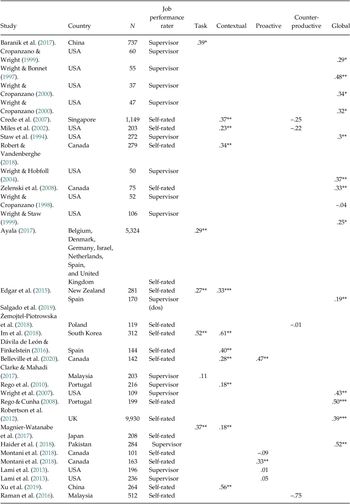
Studies with Positive Affect and Job Performance Correlations

N = Number of participants in the study.
* p < .05. ** p < .01. *** p < .001.
Studies with Negative affect and Job Performance Correlations

N = Number of participants in the study.
* p < .05. ** p < .01. *** p < .001.
Studies with Satisfaction with Life and Job Performance Correlations

N = Number of participants in the study.
* p < .05. ** p < .01. *** p < .001.
Studies with Psychological Well-being and Job Performance Correlations

N = Number of participants in the study.
* p < .05. ** p < .01. *** p < .001.