Implications
In tropical regions, most breeding programs desire to select animals for growth and sexual precocity. Therefore, traits that evaluate sexually precocious at 16 months in Nelore cattle should be increased. The results of this work showed that heifer exposure in the early breeding season can produce a fewer number of viable calves at birth, but sexually precocious heifers remain in the herd for a longer period and produce slightly heavier calves at weaning compared with the non-precocious heifers. Furthermore, the yearling weight influences on sexual precocity until a certain weight and after 240 kg heifers have practically the same pregnancy probability.
Introduction
Attempts to increase the productive and reproductive efficiency of beef cattle herds have been the objective of recent studies. Higher rates of fertility and sexual precocity result in a larger number of animals in the herds and, consequently, higher production turnovers. In addition, these herds can be submitted to higher levels of selection intensity, resulting in greater genetic progress (Martín Nieto et al., Reference Martín Nieto, Silva, Rosa and Gondo2003).
In tropical regions, most breeding programs use weight traits and scrotal circumference when selecting animals for growth and sexual precocity, whereas female reproductive traits are not included as a selection criterion. Scrotal circumference is an inherited trait that shows favorable correlations with male and female reproductive traits (Toelle and Robinson, Reference Toelle and Robison1985; Dias et al., Reference Dias, Faro, Fries and Albuquerque2000; Pereira et al., Reference Pereira, Eler and Ferraz2000 and Reference Pereira, Eler, Costa and Ferraz2001), and selection for this trait will result in genetic gains in reproductive traits. However, this trait is an indicator of sexual precocity that can only be measured in male animals.
The direct application of female sexual precocity traits in animal breeding programs may contribute to increase productivity. In addition, factors such as its easy measurement, possibility of obtaining measurements for all contemporary groups (CG) and the existence of moderate to high genetic variability justify the use of early heifer pregnancy as a selection criterion (Eler et al., Reference Eler, JAIIV, Ferraz, Dias, Oliveira, Evans and Golden2002; Silva et al., Reference Silva, Dias and Albuquerque2005).
In Brazil, important research groups are exposing heifers to bulls earlier during the breeding season. However, little is known about the effect of this management practice on the productive life of females and their progeny. The objectives of the present study were to investigate the influence of yearling weight on the occurrence of early pregnancy and to determine differences between precocious and non-precocious heifers in terms of pre- and postnatal calf mortality, calf weight and height, mature cow weight, and stayability of the cow in the herd.
Material and methods
Data
Data from females born between June–August and November–December, in the years 1984 to 2003 belonging to the livestock archive of a company located in the northwestern region of the State of Sao Paulo, Brazil, which is specialized in beef cattle farming using Nelore animals reared on pasture, were used. Feed management exclusively consists of pasture with the use of mineral salt.
There are two heifers breeding season. An early breeding season occurs from February to March, during which heifers are exposed to the bulls at an average age of 480.87 days (±47.32 days) in order to identify animals that present precocious puberty. If the heifers do not conceive during the early breeding season, they are again exposed to bulls or artificial insemination during the standard breeding season, from September to November, when they are, on average, 589.91 days old. The standard breeding season, has duration of 60 days for heifers and 90 days for cows. Animals that fail to become pregnant in this season are slaughtered.
After the first calving, precocious heifers are rebred in the standard breeding season with all the other females. Consequently, precocious heifers have a longer first calving to conception period (10 to 11 months) than non-precocious (3 to 5 months). From the second calving onwards all the females are bred in the standard breeding season. All females (precocious and non-precocious) that did not get pregnant in the subsequent breeding season were discarded.
All calves were weighed periodically, evaluated and selected. Weight recordings were obtained at birth, weaning (205 days of age) and at yearling (550 days of age). Scrotal circumference measurements were also obtained for males, at yearling age.
Traits
Pregnancy at 16 months of age (Pr16) was defined by heifers calving at <26 months of age (Pr16=1). These heifers were defined as sexually precocious. For non-precocious females, first calving occurred between 31 and 35 months of age (Pr16=0). The diagnosis of pregnancy was performed 60 days after the end of the breeding season by rectal palpation.
Prenatal mortality was defined as the diagnosis of positive pregnancy and the absence of a birth record. Postnatal mortality was considered as the females calved whose calves were not present at weaning. In addition, pre- and postnatal mortality were analyzed in three different manners: (i) mortality of offspring of the first calving only, (ii) mortality of offspring from the third calving and (iii) mortality of all offspring.
To verify the difference in progeny means between precocious and non-precocious heifers, calf weight and calf height at weaning produced by the heifers were used. Height was measured directly over the hooks (hip bones) with the animal standing on a level surface, in accordance with the Beef Improvement Federation Guidelines (BIF, 2002). Weight and height at weaning (205 days of age) for calves from precocious and non-precocious heifers were evaluated considering only offspring of the first calving; offspring of the third and subsequent calving; and all offspring of the females. To eliminate the effect caused by the two breeding season, the second calving was not included in the analyses to remove the differences in first calving to conception interval between precocious and non-precocious heifers. Mature cow weight, for precocious and non-precocious females, was obtained from only one record of females older than 4 years.
Three stayability (STAY) traits were analyzed. Each STAY (STAY5, STAY6 and STAY7) was defined as a binary variable indicating if a cow remained in the herd until 5, 6 or 7 years of age, respectively. Equivalently, each female with a positive STAY phenotype would have had 3, 4 or 5 calves. Failure (STAY_=0) was attributed to cows that did not meet these prerequisites.
Analysis
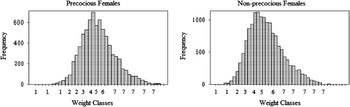
The influence of yearling weight on sexual precocity was evaluated using the GENMOD procedure (SAS Institute, 2000), assuming a binomial distribution of the data with a probit link function to a normal adjacent distribution. The probability of Pr16=1 is given by ϕ −1, where ϕ is a cumulative normal distribution function. The fixed effects included were year of birth of the heifer, age at entering in the breeding season, management group during breeding and weight class at yearling (1=<200 kg; 2=200 to 219 kg; 3=220 to 239 kg; 4=240 to 259 kg; 5=260 to 279 kg; 6=280 to 299 kg and 7=more than 300 kg). Figure 1 shows the distribution of weights for precocious and non-precocious females on a normal scale according to the seven weight classes.
Distribution of weights for precocious and non-precocious females on a normal scale according to weight class (1=<200 kg; 2=200 to 219 kg; 3=220 to 239 kg; 4=240 to 259 kg; 5=260 to 279 kg; 6=280 to 299 kg and 7=>300 kg).

For prenatal mortality, the fixed effects included in the model were year of breeding season and sexual precocity (heifer was precocious or non-precocious), and for postnatal mortality the fixed effects included were year of birth and weight class at birth of the calf (1=<27 kg; 2=28 to 30 kg; 3=31 to 34 kg and 4=more than 35 kg), calf sex and sexual precocity. For the analysis of mortality, calf weights of offspring from the third calving and calf weights of all offspring were included as fixed effects. In addition, age of cow at the beginning of the breeding season and at calving were included as fixed effects for pre- and postnatal mortality, respectively.
For stayability, the fixed effects included in the model were year and farm of birth of the females and sexual precocity (precocious and non-precocious females). Prenatal mortality, postnatal mortality, STAY5, STAY6 and STAY7 were analyzed using the GENMOD procedure (SAS Institute, 2000), assuming a binomial distribution of the data with a probit link function to a normal adjacent distribution. The probability of prenatal mortality=1, postnatal mortality=1, STAY5=1, STAY6=1 and STAY7=1 is given by ϕ −1, where ϕ is a cumulative normal distribution function. Odds ratios for success were calculated in order to obtain information regarding the relative risk of the occurrence of calf mortality and stayability of cows in the herd until a determined age. Odds ratios were estimated in relation to non-precocious heifers. For this fixed effect that contains two classes, an odds ratio of 1.0 indicates the absence of a difference between the two classes, that is, the probability of occurrence is the same for the two classes.
Differences between precocious and non-precocious heifers in terms of each of the following growth traits were estimated by contrast analysis in an animal model using the MTDFREML program (Boldman et al., Reference Boldman, Kriese, Van Vleck, Van Tassell and Kachman1995): weaning weight considering only offspring of the first calving (WW1), weaning weight considering offspring from the third calving (WW3), weaning weight considering all offspring (WW), weaning height considering only offspring of the first calving (WH1), weaning height considering offspring from the third calving (WH3), weaning height considering all offspring (WH) and mature cow weight. This approach permits the determination of the presence or absence of a significant effect of sexual precocity on weaning weights and heights of calves and on mature cow weight, with calculation of the error of the estimate by the t-test.
The model for weaning weight and height included CG and sexual precocity (precocious=1 and non-precocious=2) as fixed effects, age of cow at calving and age of calf at weaning as covariates (linear and quadratic effects), and direct and maternal genetic effects as random effects. For the analysis of weaning weight considering all offspring (WW) and weaning weight considering only offspring from the third calving (WW3), direct and maternal genetic and maternal permanent environmental effects were included as random effects, in addition to the fixed effects described above. As determined in a previous analysis, only direct genetic effects were included as random effects for the analysis of weaning height and mature cow weight.
The data were edited by eliminating measurements that were 3.5 standard deviations above or below the mean of the respective CG for each trait. CGs fewer than four animals were excluded. For traits measured at weaning, the CG consisted of animals of the same sex, year and month of birth, farm, and management group from birth to weaning. For mature cow weight, year and season (March to April and May to June) were included in the definition of the CG.
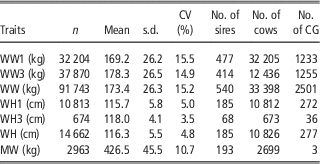
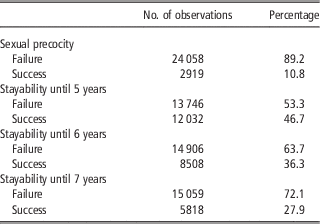
The structure of the data set is summarized in Table 1 for the growth traits and in Table 2 for the reproductive traits.
Number of animals (n), mean, standard deviation (s.d.), coefficient of variation (CV), number of sires and cows and number of contemporary groups (CG) for the growth traits

WW1=weaning weight considering only offspring of the first calving of each female; WW3=weaning weight considering only offspring after the third calving; WW=weaning weight considering all offspring of the females; WH1=weaning height considering only offspring of the first calving of each female; WH3=weaning height considering only offspring after the third calving; WH=weaning height considering all offspring of the females; MW=mature cow weight.
Number of observations and percentage observed for sexual precocity and stayability in the herd at different ages of Nelore heifers

Sexual precocity: pregnancy at 16 months of age (Pr16).
Results
All effects included in the model (year of birth of the dam, age at entering the breeding season, management group and yearling weight class) significantly affected (P<0.01) probability of pregnancy at 16 months of age (Pr16).
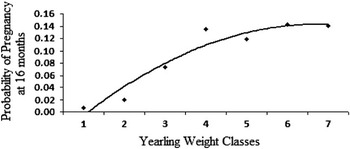
Figure 2 shows the trend in the probability of pregnancy at 16 months of age of Nelore heifers on a normal scale according to yearling weight classes. The results suggest that the probability of pregnancy at 16 months of age increases with increasing weight (y=−0.0045×2+0.0611×−0.0626; R²=0.9267). However, heifers weighing more than 240 kg (from the class 4 to 7) presented practically the same pregnancy probability.
Trend in the probability of pregnancy at 16 months of age of Nelore heifers on a normal scale according to yearling weight class (1=<200 kg; 2=200 to 219 kg; 3=220 to 239 kg; 4=240 to 259 kg; 5=260 to 279 kg; 6=280 to 299 kg and 7=>300 kg).

For pre- and postnatal mortality, all effects (year of breeding season, sexual precocity, year of birth and weight class at birth of the calf and calf sex) were statistically significant (P<0.05) using the different approaches, except for calf sex and sexual precocity in the analysis considering calves born from the third calving. Table 3 shows the relative risks and 95% confidence intervals for pre- and postnatal calf mortality and the different definitions of stayability in the herd comparing non-precocious and precocious Nelore heifers. Separate analysis of prenatal mortality of first conception calves showed a 26% higher relative risk of non-calving for precocious heifers compared to non-precocious heifers. Evaluation of data from the third conception, calves of heifers that entered the standard breeding season (non-precocious) presented a 55% higher chance of prenatal mortality. Considering all conceptions of dams showed a higher chance (30%) of liveborn calves for heifers that became pregnant at 16 months of age (precocious).
Relative risk and 95% confidence interval of pre- and postnatal mortality of precocious Nelore calves using non-precocious heifers as a reference

*Significant (P<0.05).
**Significant (P<0.01).
The relative risks of postnatal mortality of calves born to precocious heifers were close to one, but when considering the estimated confidence interval, the results indicate that there is a significant difference between precocious and non-precocious females for calf mortality (Table 3). The probability of death of the first calf born to precocious heifers is 10% higher than the offspring of females that calved at about 24 months of age. However, no difference in mortality rates between the two groups of females studied was observed from the third calving.
For the different definitions of stayability, heifers presenting precocious puberty showed 33% greater odds of stayability until 5 and 6 years of age and 28% greater odds of stayability until 7 years when compared with non-precocious heifers.
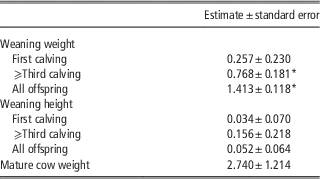
Table 4 shows the contrast estimates and their respective standard errors of calf weight and height at weaning and mature cow weight between precocious and non-precocious heifers. Analyzing only weaning weight of first offspring, the results showed no significant differences between calves born to precocious and non-precocious cows. However, the analyses considering weaning weight of all offspring and weaning weight of offspring from the third calving showed a significantly higher weight of 1.413 and 0.768 kg, respectively, for calves born to precocious heifers compared with non-precocious females.
Contrast estimates and standard errors and their respective t-values estimated for differences in the traits analyzed between precocious and non-precocious heifers

*Significant (P<0.01).
For weaning height, considering all measurements (WH1, WH3, WH) and for mature cow weight no significant differences were observed between precocious and non-precocious heifers, indicating that females presenting precocious puberty do not produce calves whose weaning height differs from that of calves born to regular heifers, and females that are precocious will not weigh more than females that are non-precocious (the opposite is also true).
Discussion
According to the trend in the probability of pregnancy at 16 months of age of Nelore heifers and yearling weight class, Wiltbank et al. (Reference Wiltbank, Gregory, Swiger, Ingalls, Rothlisberger and Koch1966) reported that, when a certain critical weight is reached, differences in weight gain have little influence on age at puberty. These authors observed that, when the postweaning gain was small, small differences in weight gain exerted an important effect on age at puberty. On the other hand, when postweaning gain was higher, differences in daily weight gain mean did not affect age at puberty. Short and Bellows (Reference Short and Bellows1971) observed that high weight gains obtained by high feeding levels resulted in advanced sexual precocity and higher weights at puberty. However, according to Greer et al. (Reference Greer, Whitman, Staigmiller and Anderson1983), from a biological point of view, age at puberty is not determined by weight but rather by a set of physiological conditions that also result in a certain weight. Wolfe et al. (Reference Wolfe, Stumpf, Wolfe, Day, Koch and Kinder1990) found that selection for the rate of weight gain did not influence age at puberty of Hereford females.
The results for pre- and postnatal mortality suggest that females that start their reproductive life early may produce a larger number of calves that are viable at birth than heifers that start their reproductive life later, especially from the third conception. It should be noted that the collection of prenatal calf mortality data is prone to errors because of mistakes in the diagnosis of pregnancy associated with the difficulty in identifying abortions due to the reproductive management adopted on each property.
The mortality rates of the first calf born to precocious heifers is 10% higher than that of offspring of females that calved at about 24 months of age. This result is expected considering that at 16 months heifers are still in a phase characterized by marked energy expenditure with maintenance and growth, whereas the same does not apply from the third calving. When all offspring of dams were analyzed, the probability of death was 9% higher for calves born to heifers starting their reproductive life about 16 months of age compared with those born to non-precocious females.
The pre- and postnatal mortality rates observed in the present study confirm that the main effect of sexual precocity occurs at the beginning of the productive life of these heifers, and differences between precocious and non-precocious females no longer exist by the third calving. The profitability of offspring production systems in commercial beef cattle farming directly depends on the number of calves weaned and, consequently, on the number of calves born. In this respect, exposure heifers in a breeding season at an early age, is a satisfactory management option to obtain a greater number of viable calves at birth.
Stayability is an economically important trait that has a marked impact on the production system as a whole, and the results of this study showed that precocious females may stay a longer time in the herd compared with non-precocious females. Probably, part of this advantage comes from the fact that precocious heifers are allowed to have a longer days open in the beginning of breeding season period than non-precocious females. For females kept on pasture, the first rebreeding is the most difficult since the heifer is still growing and nursing the calf. In the present work, precocious females enter the first rebreeding season, after weaning their calves. According to Pearson and Miller (Reference Pearson and Miller1981), dams that continue to produce over a prolonged period of time contribute to increase the fertility of the herd, in addition to reducing expenditure with heifer replacement. Moreover, these dams contribute to increase the number of females in the age group of highest milk production in which heavier calves are weaned, to reduce the amount of feed for heifers that are not producing, and to increase voluntary discarding, thus improving the profitability of the production system. Therefore, the early exposure of heifers may increase stayability rates in the herd, obtaining higher profits to the system.
There is a small difference between precocious and non-precocious females for weight at weaning. Thus, it is expected that exposure of heifers during an early breeding season may result in dams that wean slightly heavier calves. For mature cow weight, an increase is undesired for extensive production systems since larger animals have increased requirements for maintenance and reproduction rates will decrease in environments where food sources are limited (e.g. extensive systems used in tropical regions; Montaño-Bermudez and Nielsen, Reference Montaño-Bermudez and Nielsen1990; Jenkins and Ferrell, Reference Jenkins and Ferrell1994; Beretta et al., Reference Beretta, Lobato and Netto2002). Thus, the results of the present study show that the use of probability of pregnancy at 16 months as a selection criterion will not increase mature weight of the dams since no significant differences (P<0.01) in mature cow weight were observed between precocious and non-precocious cows.
Conclusions
Exposure of females in the early breeding season can produce a fewer number of viable calves at birth compared with females exposed in standard breeding season. The yearling weight influences on sexual precocity, however, heifers weighing more than 240 kg have practically the same pregnancy probability.
Sexually precocious females remain in the herd for a longer period and may produce slightly heavier calves at weaning compared with the non-precocious females. The sexually precocious heifers will have the mature weight similar to those non-precocious heifers.
Acknowledgments
The authors would like to thank the Fundação de Amparo à Pesquisa do Estado de São Paulo (FAPESP) for granting fellowships and to Agropecuária Jacarezinho for the use of the data set. The authors would like to thank the anonymous reviewers for their valuable comments and suggestions to improve the quality of this paper. They are also grateful to Dr Michael MacNeil for helping to correct this paper.