Introduction
Over time, some people diagnosed with autism spectrum disorder (ASD) in childhood experience an attenuation of their autistic traits, to the extent that they eventually cease to meet the criteria for a clinical diagnosis (Orinstein et al., Reference Orinstein, Tyson, Suh, Troyb, Helt, Rosenthal and Fein2015). Others appear to exhibit later-emerging traits than their peers (Ozonoff et al., Reference Ozonoff, Gangi, Hanzel, Hill, Hill, Miller and Iosif2018) and increasing adaptive difficulties over time (Szatmari et al., Reference Szatmari, Georgiades, Duku, Bennett, Bryson, Fombonne and Thompson2015). Scholars have therefore recently called for approaches to characterise the ‘chronogeneity’ of autism – that is to say, its heterogeneity over time (chrono-) (Georgiades, Bishop, & Frazier, Reference Georgiades, Bishop and Frazier2017). In a recent systematic review, we synthesised a growing body of evidence to support the chronogeneity of autism, and identified the need for large, general population studies using latent class growth modelling (LCGM) approaches (Pender, Fearon, Heron, & Mandy, Reference Pender, Fearon, Heron and Mandy2020) to improve the quality of the evidence base. At the time of publication, no such studies currently existed.
LCGM is a family of statistical approaches that maps chronogeneity by characterising heterogeneous longitudinal data as relatively homogeneous latent groups. Five of seven prior studies using LCGM to map the chronogeneity amongst young people diagnosed with autism converged on a similar representation (Gotham, Pickles, & Lord, Reference Gotham, Pickles and Lord2012; Kim et al., Reference Kim, Bal, Benrey, Choi, Guthrie, Colombi and Lord2018; Lord & Luyster, Reference Lord and Luyster2006; Lord, Luyster, Guthrie, & Pickles, Reference Lord, Luyster, Guthrie and Pickles2012; Venker, Ray-Subramanian, Bolt, & Weismer, Reference Venker, Ray-Subramanian, Bolt and Weismer2014). Each of these found that four classes best characterised the different trajectories of autistic symptomatology, showing (a) persistent high, (b) persistent low, (c) increasing and (d) decreasing traits.
Previous LCGM studies were limited to clinical samples (majority participants with ASD). Yet ASD is a dimensional condition that extends across the entire population with no natural cut-point (Constantino, Reference Constantino2009; Skuse et al., Reference Skuse, Mandy, Steer, Miller, Goodman, Lawrence and Golding2009). Subclinical autistic social and communication traits (ASTs) confer risk for social anxiety (Pickard, Rijsdijk, Happé, & Mandy, Reference Pickard, Rijsdijk, Happé and Mandy2017), emotional and behavioural difficulties (Saito et al., Reference Saito, Stickley, Haraguchi, Takahashi, Ishitobi and Kamio2017), attention difficulties (St Pourcain et al., Reference St Pourcain, Mandy, Heron, Golding, Smith and Skuse2011) and depression (Rai et al., Reference Rai, Culpin, Heuvelman, Magnusson, Carpenter, Jones and Pearson2018). Clinical samples are also likely to under-represent female participants – females with high levels of ASTs are less likely than equivalent males to be diagnosed with ASD (Loomes, Hull, & Mandy, Reference Loomes, Hull and Mandy2017). ASTs may also emerge later in adolescence for women (Bargiela, Steward, & Mandy, Reference Bargiela, Steward and Mandy2016; Kopp & Gillberg, Reference Kopp and Gillberg2011) and so purely diagnostic samples may miss these participants and any individuals with later-emerging traits. Therefore, we need to understand risk and development across the entire continuum of ASTs.
In a previous paper (Mandy, Pellicano, St Pourcain, Skuse, & Heron, Reference Mandy, Pellicano, St Pourcain, Skuse and Heron2018), it was observed that boys had higher mean ASTs than girls between 7 and 10 years. However, by 16 this difference was no longer present due to a sharp increase in mean ASTs for girls. It is important to explore whether a subset of girls with large increases in ASTs could be contributing to this trend. We therefore sought to characterise for the first time, the chronogeneity of ASTs in the general population using Growth Mixture Modelling (GMM), an LCGM approach.
Method
Sample
The Avon Longitudinal Study of Parents and Children (ALSPAC) is a large, longitudinal general population cohort measuring the health and development of children. Pregnant women resident in Avon, UK, with expected dates of delivery 1 April 1991 to 31 December 1992 were eligible for participation. The final cohort consisted of 15 454 pregnancies of which 14 901 births were alive at one year of age (Boyd et al., Reference Boyd, Golding, Macleod, Lawlor, Fraser, Henderson and Davey Smith2013; Fraser et al., Reference Fraser, Macdonald-Wallis, Tilling, Boyd, Golding, Davey Smith and Ring2012).
Of the data available, 9744 participants had at least one recorded measurement of ASTs, and so were eligible for inclusion. Participants in the present study were 49.1% female and 98% White. Odds of being excluded from the present study were significantly higher in participants whose mothers had less than A-Level education (OR 2.36, 95% CI 2.15–2.58) and for minority ethnic participants (OR 2.22, 95% CI 1.78–2.77).
Ethics
The authors assert that all procedures contributing to this work comply with the ethical standards of the relevant national and institutional committees on human experimentation and with the Helsinki Declaration of 1975, as revised in 2008. All procedures involving human participants were approved by the ALSPAC Ethics and Law Committee and the Local Research Ethics Committees. Written informed consent was obtained from all participants, and informed consent for the use of data collected via questionnaires and clinics was obtained from participants following the recommendations of the ALSPAC Ethics and Law Committee at the time.
Measures
Please note that the study website contains details of all the data that are available through a fully searchable data dictionary and variable search tool (http://www.bristol.ac.uk/alspac/researchers/our-data/)
Trajectory indicator
Social and Communication Disorders Checklist (SCDC) (Skuse, Mandy, & Scourfield, Reference Skuse, Mandy and Scourfield2005): The SCDC is a widely used and well-validated parent-report measure of ASTs. It was completed when ALSPAC children were aged 7, 10, 13 and 16 years. It displays excellent internal consistency (α = 0.93) and good test-retest reliability (ICC = 0.81) (Skuse et al., Reference Skuse, Mandy and Scourfield2005). The SCDC shows high sensitivity (0.88) and specificity (0.91) for ASD when a cut-point of 8 is used (Skuse et al., Reference Skuse, Mandy, Steer, Miller, Goodman, Lawrence and Golding2009). It exhibits good convergent validity (substantial correlations) against measures of ASD, peer difficulties and social cognition, and divergent validity against age, IQ, socioeconomic status and social anxiety (Pickard et al., Reference Pickard, Rijsdijk, Happé and Mandy2017; Skuse et al., Reference Skuse, Mandy and Scourfield2005).
Trajectory predictors and outcomes:
Autism spectrum disorder (ASD) diagnosis: We used the most comprehensive record of ASD diagnoses currently available in ALSPAC, the compilation of which has been described elsewhere (e.g. Guyatt, Heron, Knight, Golding, & Rai, Reference Guyatt, Heron, Knight, Golding and Rai2015; Rai et al., Reference Rai, Culpin, Heuvelman, Magnusson, Carpenter, Jones and Pearson2018). Briefly, it combines information from: (1) linkage to NHS records to identify children given an ASD diagnosis after multidisciplinary assessment (Williams, Thomas, Sidebotham, & Emond, Reference Williams, Thomas, Sidebotham and Emond2008); (2) linkage to Pupil Level Annual School Census (PLASC) data identifying ALSPAC children with ASD listed as a primary or secondary concern (Williams et al., Reference Williams, Thomas, Sidebotham and Emond2008); (3) mothers' answers to the question ‘Have you ever been told that your child has: autism, Asperger's syndrome or autism spectrum disorder?’ when their child was 9.5 years old; (4) free-text responses in ALSPAC surveys mentioning a participant having an ASD diagnosis; and (5) letters written to the study director stating a participant has been given an ASD diagnosis. This ASD diagnosis variable has strong associations with independent measures of autistic traits and with an ASD polygenic risk score derived from the Psychiatric Genomics Consortium genome-wide association study for autism (Rai et al., Reference Rai, Culpin, Heuvelman, Magnusson, Carpenter, Jones and Pearson2018).
Strengths and Difficulties Questionnaire (SDQ) (Goodman, Reference Goodman2001): The SDQ was completed by parents when ALSPAC children were aged 9, 11, 13 and 16. It is designed to measure emotional and behavioural difficulties over the past 6 months, across four subscales: ‘emotional problems’ (encompassing internalising difficulties), ‘peer problems’, ‘hyperactivity’ and ‘conduct problems’. The SDQ has strong psychometric properties when used as a measure of emotional and behavioural difficulties in epidemiological studies, both for identifying individuals at high risk of psychiatric disorder (Goodman, Reference Goodman2001) and as a dimensional index of symptom severity (Goodman & Goodman, Reference Goodman and Goodman2009).
Short Mood and Feelings Questionnaire (SMFQ) (Angold et al., Reference Angold, Costello, Messer, Pickles, Winder and Silver1995): The SMFQ was completed by ALSPAC children at ages 10, 12, 13 and 16. It is a short self-report screening tool for depression in young people aged 6 years and older. The MFQ has shown good reliability and validity in both childhood and adolescence, including in epidemiological samples (Angold et al., Reference Angold, Costello, Messer, Pickles, Winder and Silver1995; Thabrew, Stasiak, Bavin, Frampton, & Merry, Reference Thabrew, Stasiak, Bavin, Frampton and Merry2018; Turner, Joinson, Peters, Wiles, & Lewis, Reference Turner, Joinson, Peters, Wiles and Lewis2014).
Wechsler Intelligence Scales for Children, Third Edition, short form (WISC-III) (Wechsler, Reference Wechsler1991): The WISC-III was administered to ALSPAC children at age 8 years. It contains 10 subtests, yielding verbal, performance and full-scale IQ scores. It has been shown to be highly valid and reliable.
Missing data
Participants with missing data at all four time points (n = 5701, 28.4%) were excluded. Complete data were available for 45% of the remaining participants (n = 4380). Missing data were handled in MPlus 8.0 using Maximum Likelihood estimation with robust standard errors under the assumption of data being Missing at Random.
Analyses
In step one, we modelled trajectories of ASTs using GMM in MPlus. Firstly, a latent growth model was obtained (LGM; fitting a single trajectory for all participants). Linear and quadratic versions of the model were examined to obtain the best single representation of change in SCDC scores at 7, 10, 13 and 16 years (online Supplementary Table S1). Next, we carried out a Latent Class Growth Analysis (LCGA; online Supplementary Table S2). LCGA assumes no within-class variance for the growth factors, meaning that the slopes, intercepts and quadratic terms are assumed identical across individuals within each class. This was selected as a first model-building step prior to GMM due to the clearer identification of classes and reduced likelihood of convergence failure. Following this, we carried out a GMM. In this approach, the assumption of zero within-class variance is relaxed so that variances and covariances are obtained around the intercept, slope and quadratic growth factors (online Supplementary Table S3).
In step two, we selected the best-fitting model for further analysis. The use of a combination of substantive theory and statistical criteria has been recommended for selecting the optimal number of classes in GMM (Bauer & Curran, Reference Bauer and Curran2003; Grimm, Mazza, & Davoudzadeh, Reference Grimm, Mazza and Davoudzadeh2017; Muthén, Reference Muthén2003). A range of fit indices were compared (online Supplementary Table S3). Fit indices commonly conflict, and researchers have been urged to report a range of indices, describe their rationale, and convey the uncertainty involved in model selection (Grimm et al., Reference Grimm, Mazza and Davoudzadeh2017).
In step three, we sought to investigate the external validity of the observed groups by exploring the relationship between class membership and demographic variables, ASD diagnosis, IQ, and emotional and behavioural difficulties measured by the SDQ and SMFQ in mid-childhood and adolescence. We conducted a series of multinomial logistic regressions in SPSS using class modal assignments to explore the relationship with categorical household and demographic variables. We examined the odds of having received an ASD diagnosis in each of the observed groups, reporting odds ratios and 95% confidence intervals. We carried out analyses of variance and follow-up t tests to explore the relationship between class assignments and continuous scores on the SMFQ (mood) and SDQ (hyperactivity, emotional, conduct and peer difficulties).
Results
Step one: modelling autistic trait trajectories
Our quadratic LGM showed the best fit (online Supplementary Table S1), and we specified well-fitting quadratic LCGA models from two to six classes (online Supplementary Table S2). Fit indices showed the best-fitting GMM specification was our psi-invariant model (in which growth factors, variances and covariances were held equal across classes, but residuals were allowed to vary over time; see online Supplementary Table S3 footnote for further detail). This was also the most relaxed model to not produce convergence difficulties. We observed that BIC values continued to decrease (improve) with the addition of more classes. The Lo Mendell Rubin Test (LMR), one of the model selection tests, became significant with the addition of a fifth class, indicating the four-class model was the optimal choice. The Bootstrap Likelihood Ratio Test continued to show evidence of model improvement with the addition of further classes. While no model received unequivocal support, the four-class model was the best-evidenced, and also showed consistency with prior research (Gotham et al., Reference Gotham, Pickles and Lord2012; Kim et al., Reference Kim, Bal, Benrey, Choi, Guthrie, Colombi and Lord2018; Lord et al., Reference Lord, Luyster, Guthrie and Pickles2012; Lord & Luyster, Reference Lord and Luyster2006; Venker et al., Reference Venker, Ray-Subramanian, Bolt and Weismer2014). We opted to use modal class assignment (i.e. allocating individuals categorically to their most likely class) rather than proportional assignment (i.e. using probabilities of class membership as regression weights) (Heron, Croudace, Barker, & Tilling, Reference Heron, Croudace, Barker and Tilling2015). This reflected the high entropy statistics, indicating good fit and high probabilities of class assignment (see online Supplementary material).
Step two: investigating the four-class model
The four classes described by the model, which are shown in Table 1, were named Persistent Low (83.5% of the sample), Persistent High (2.3%), Increasing (7.3%) and Decreasing (6.9%). As can be seen from Fig. 1, Increasing and Decreasing trajectories remained relatively stable between 7 and 10 years of age, at which point they pivoted and began to follow a consistently-changing path over the following two timepoints (13 and 16 years; Figure 1). As Table 1 shows, at baseline the group mean score for individuals in the Increasing class was below the SCDC's clinical cut point of 8 [3.94 (3.04)] and only 12% of participants in this class exceeded this threshold at this time point. By follow-up at 16, the group mean exceeded the cut-off [10.98 (3.33)] and 91% of participants had scores greater than 8. By contrast, individuals in the Decreasing class were on average above the cut-off at baseline [9.84 (3.91)] with 74% exceeding the threshold, and by follow-up at 16 they were on average below [4.44 (3.00)] with only 16% above cut-off. The Persistent Low and High groups showed some minor variation over time (Table 1), with <2.5% and >89% of group members, respectively, exceeding thresholds across timepoints.
Autistic trait trajectories, four-class model.

Characteristics of autistic trait trajectories over time

Step three: initial investigation of external validity
Demographic and household variables
Table 2 shows the division of groups by sex. The Persistent Low group was evenly divided between males and females, while the Persistent High group contained 73% male participants (Table 2). The Decreasing class was majority male (63%). The Increasing class was, marginally, majority female (53%): female participants were twice as likely to be in the Increasing class as the Persistent High or Decreasing classes (OR = 2.2; CI 1.8–2.7).
Numbers of participants by group and sex

Demographic and household predictors are reported in the online Supplementary Table S4. Compared with the Persistent Low reference group, mothers of those in the other groups were more likely to have had lower levels of educational attainment. Mothers of individuals in the Persistent High and Decreasing groups were more likely to have never married and to have had teenage pregnancies.
ASD diagnosis
Data on ASD diagnostic status were available for 9540 of the overall sample of 9774. In the Persistent Low group, 37/7924 (0.005%) had an ASD diagnosis. Using this group as a reference, membership of the Persistent High group was strongly associated with an ASD diagnosis (OR = 58.6, 95% CI 37.1–92.5; 47/218 had ASD diagnosis). Also, membership of the Decreasing (OR = 11.3, 95% CI 7.1–18.1; 36/713 had ASD diagnosis) and Increasing (OR = 3.2, 95% CI 1.6–6.4; 10/685 had ASD diagnosis) groups was associated with higher odds of ASD diagnosis, compared to the Persistent Low group.
Mid-childhood IQ and emotional and behavioural difficulties measures
At 8 years, children completed the WISC. We compared total, verbal and performance IQ scores between groups (See online Supplementary Table S5). As expected, the Persistent Low group showed the highest mean scores across all tests, followed by the Increasing, Decreasing and then Persistent High groups. Individuals scoring within the ‘low’ to ‘exceptionally low’ IQ ranges were almost twice as likely to be in the Persistent High compared to the Persistent Low group (OR = 1.88, CI 1.07–3.28). Increasing and Decreasing groups appeared to show an intermediate profile in relation to IQ, yet were distinguished from each other by higher IQ scores in the Increasing group.
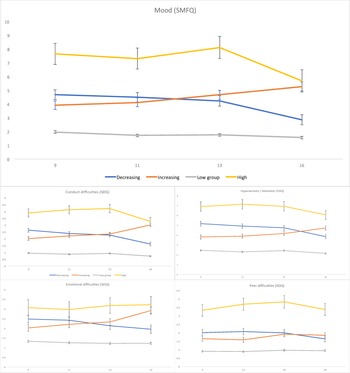
Table 3 details emotional and behavioural difficulties from ages 9 to 16, with the Persistent Low group as the reference. The Persistent High group showed the highest emotional and behavioural difficulties, followed by Decreasing and then Increasing groups across measures of conduct, hyperactivity, emotional and peer difficulties (SDQ) and mood (SMFQ). Between-group t tests, reported in the online Supplementary Table S6, showed groups were different from one another on all indicators. Visual representation of emotional and behavioural difficulty trajectories measured by the SDQ and SMFQ is shown in Fig. 2, revealing they followed a similar path to AST trajectories.
Longitudinal trajectories of emotional and behavioural difficulties, by autistic trait group.

Emotional and behavioural difficulties, age 9–16

SMFQ, Short Mood and Feelings Questionnaire; SDQ, Strengths and Difficulties Questionnaire.
Mid-adolescence emotional and behavioural difficulties measures
By the age of 16, the Increasing group showed increases in difficulties in mood, conduct and emotional problems such that they were similarly high as those found in the Persistent High group. Across all emotional and behavioural difficulties, there were reductions in differences between these groups by mid-adolescence (online Supplementary Tables S6 and S7). The Persistent High group showed reductions in difficulties with mood, hyperactivity and conduct during the same time period. Meanwhile the Decreasing group showed reduced difficulty across all measures, so that by 16 there were only small differences from the Persistent Low group.
In summary, indices of emotional and behavioural difficulties measured by the SDQ and SMFQ broadly reflected the paths of ASTs over the same time period. By 16 years, there was a coming-together of the Persistent High and Increasing groups such that they were no longer distinct on measures of mood, conduct problems and emotional difficulties. The Decreasing group showed dramatic reductions in emotional and behavioural difficulties, but scores remained elevated relative to the Persistent Low group.
Discussion
This is the first study to characterise chronogeneity across the full continuum of ASTs in general population participants. We used GMM to obtain four distinct subgroups of AST trajectories showing (a) Persistent Low, (b) Persistent High, (c) Increasing and (d) Decreasing trajectories. Our four-group model in a general population sample is comparable to the majority of GMM studies that have been conducted so far with clinical samples (Gotham et al., Reference Gotham, Pickles and Lord2012; Kim et al., Reference Kim, Bal, Benrey, Choi, Guthrie, Colombi and Lord2018; Lord et al., Reference Lord, Luyster, Guthrie and Pickles2012; Lord & Luyster, Reference Lord and Luyster2006; Venker et al., Reference Venker, Ray-Subramanian, Bolt and Weismer2014).
The Persistent Low group conformed to expectations of young people with typical neurodevelopment. They were evenly divided by sex and, compared to other groups, had very low rates of ASD diagnosis, and were less likely to come from families experiencing social and economic disadvantage. A number of recent European studies, in which access to diagnosis was unlikely to bias results, have shown higher SES to be associated with lower odds of autism (e.g. Delobel-Ayoub et al., Reference Delobel-Ayoub, Ehlinger, Klapouszczak, Maffre, Raynaud, Delpierre and Arnaud2015). Also in line with expectations for typically developing young people, the Persistent Low group consistently experienced the lowest rates of emotional and behavioural difficulties between 9 and 16 (Hull, Mandy, & Petrides, Reference Hull, Mandy and Petrides2017).
The Persistent High group showed characteristics consistent with individuals with very high autism traits, including those whose traits are high enough to warrant an ASD diagnosis. This group showed the highest rates of recorded ASD diagnosis, and was composed of 73% males, which is in line with the 3:1 male-to-female ratio for ASD in community samples (Loomes et al., Reference Loomes, Hull and Mandy2017). The 2.3% of the sample captured in this group is close to the 2.2% autism prevalence rate observed in the recent US National Health Interview Survey (Zablotsky, Black, Maenner, Schieve, & Blumberg, Reference Zablotsky, Black, Maenner, Schieve and Blumberg2015). In line with research on ASD and IQ, the Persistent High group showed the lowest IQ scores (Charman et al., Reference Charman, Pickles, Simonoff, Chandler, Loucas and Baird2011). Also in line with the autism literature, they had the highest levels of emotional and behavioural difficulties between 9 and 16. Decreases in levels of mental health challenges were observed between 13 and 16 in all but the emotional sub-scale of the SDQ, also in accordance with prior studies of autism (Murphy et al., Reference Murphy, Beadle-Brown, Wing, Gould, Shah and Holmes2005).
The Increasing group
The Increasing group, in which females were a slight majority, showed dramatically increasing ASTs between the ages of 10 and 16. What is more, by the age of 16, the emotional and behavioural difficulties experienced by this group reached equivalent levels to those showing high ASTs since early childhood. This is a novel and important discovery, and this group of participants would not have met inclusion criteria at baseline for a clinical sample. It now appears that one contributing factor to the sharp uptick in ASTs observed by Mandy et al. (Reference Mandy, Pellicano, St Pourcain, Skuse and Heron2018) in females aged 7–16 is that a subset of girls shows very large increases in AST scores during early adolescence.
The Increasing group did not consistently differ from the majority Low group on demographic and family indicators. It showed an intermediate IQ profile and intermediate ASTs and emotional and behavioural difficulties between 7 and 9. This is suggestive in light of Ozonoff et al.'s finding that a group of later-diagnosed (n = 14; mid-childhood) autistic children displayed an intermediate phenotype in early childhood (Ozonoff et al., Reference Ozonoff, Gangi, Hanzel, Hill, Hill, Miller and Iosif2018).
The female representation in this group is important in light of the well-established gender gap in autism prevalence (Loomes et al., Reference Loomes, Hull and Mandy2017). Our finding supports an ‘adolescent emergence’ hypothesis (Kopp & Gillberg, Reference Kopp and Gillberg2011; Mandy et al., Reference Mandy, Pellicano, St Pourcain, Skuse and Heron2018), which suggests that for some females, ASTs may emerge later than for males. Our finding additionally suggests that adolescent emergence may occur for a near-equal number of males, which requires further investigation.
At least three explanations could be posited for the parent-reported AST increases we observed. First, underlying social-communication differences may have always been present, but only become apparent in the more complex social ecology that adolescents encounter (Bargiela et al., Reference Bargiela, Steward and Mandy2016). Second, ASTs may have been entirely absent previously, and endogenously emerged in adolescence. There is some evidence to support this possibility, in the discovery that some genes' influence on social behaviour only begins in adolescence (St Pourcain et al., Reference St Pourcain, Eaves, Ring, Fisher, Medland, Evans and Davey Smith2018), although the role of sex in this process has not yet been investigated. Large increases in social withdrawal have previously been observed in adolescence in a subset of individuals with broader autism spectrum conditions who did not meet diagnostic thresholds (Anderson, Maye, & Lord, Reference Anderson, Maye and Lord2011). Future work is needed to clarify the role of puberty and to investigate environmental and biological causation.
Third, the rise in SCDC scores could reflect non-autistic social communication difficulties secondary to depression and anxiety. However, some evidence contradicts this possibility. The SCDC is a well-validated measure of ASTs, and continues to show high AST heritability through adolescence (St Pourcain et al., Reference St Pourcain, Skuse, Mandy, Wang, Hakonarson, Timpson and Davey Smith2014). It has been shown to measure ASTs independently of psychological or behavioural difficulties throughout childhood and adolescence (Skuse et al., Reference Skuse, Mandy, Steer, Miller, Goodman, Lawrence and Golding2009). Also, in a cross-lagged design, it has been shown that ASTs predict increases in anxiety, but not the other way around (Pickard et al., Reference Pickard, Rijsdijk, Happé and Mandy2017).
A genuine increase in ASTs during adolescence, which is driving consequent emotional and behavioural difficulties, is therefore a viable interpretation of our findings, worthy of future investigation.
It is notable that, whilst ASD diagnoses were more common in the Increasing group compared to the Persistent Low group (OR = 3.2), nevertheless, rates of ASD diagnosis were low in this group (1.5%). This likely partly reflects imperfections in the ALSPAC measure of recorded ASD diagnosis. In particular, this measure is optimal for detecting diagnoses made prior to the onset of adolescence, as three of the five sources of information on which it is based (health records, educational records, direct questioning of mothers about their child's diagnostic status) were collected when ALSPAC study children were 11 years or younger. Conversely, it is less well designed for systematically detecting ASD diagnoses made in adolescence and beyond, when young people in the Increasing group started to show high levels of ASTs. In the UK, a substantial minority of autistic young people only receive their diagnosis after the age of 11 years (Hosozawa et al., Reference Hosozawa, Sacker, Mandy, Midouhas, Flouri and Cable2020). It will be important to investigate what proportion of this late-diagnosed group show the adolescent-onset AST trajectory that we have observed. More generally, future work is needed to follow-up the Increasing group into late adolescence and emerging adulthood, to understand the nature of their social difficulties, and how frequently these correspond to the clinical entity of ASD.
The Decreasing group
The majority-male Decreasing group showed declining ASTs between 10 and 16 years of age. The group displayed a consistent difference from the Persistent Low group on demographic indicators, characterised by lower maternal education, lower socioeconomic status and greater likelihood of mothers never having married or having teenage pregnancy. Their rates of ASD diagnosis were lower than the Persistent High group, but nevertheless significantly and substantially higher than those in the Persistent Low Group (OR = 11.2). Group members exhibited an intermediate profile in IQ and emotional and behavioural difficulties relative to High and Low groups. Between 9 and 16, emotional and behavioural difficulties declined sharply, but remained elevated relative to the Low group.
The Decreasing group shows consistency with prior GMM studies highlighting subsets of autistic individuals experiencing declining difficulties during childhood and adolescence (Gotham et al., Reference Gotham, Pickles and Lord2012; Kim et al., Reference Kim, Bal, Benrey, Choi, Guthrie, Colombi and Lord2018; Lord et al., Reference Lord, Luyster, Guthrie and Pickles2012; Lord & Luyster, Reference Lord and Luyster2006; Venker et al., Reference Venker, Ray-Subramanian, Bolt and Weismer2014). Importantly however, prior research has noted a disconnect between decreasing autistic trait trajectories and trajectories of adaptive functioning (Szatmari et al., Reference Szatmari, Georgiades, Duku, Bennett, Bryson, Fombonne and Thompson2015), such that improvements in functioning were not markedly different between the high and decreasing autistic trait trajectories. Our findings partially replicated this disconnection, because both Persistent High and Decreasing groups showed declining emotional and behavioural difficulties throughout adolescence. It is important therefore that discussion of resilience remains focused on reductions in distress and difficulty and does not assume that a reduction in ASTs equates to a ‘good outcome’. Rather, more work needs to be done to define what counts as a good outcome in autism (Lounds Taylor, Reference Lounds Taylor2017).
It is possible that puberty or development, either alone or in interaction with environmental triggers, can lead to a natural change in ASTs over time. Another possible explanation for decreasing ASTs is ‘social camouflaging’, which has been defined as a collection of behaviours used to compensate for or mask ASTs in social situations (Hull et al., Reference Hull, Mandy and Petrides2017). Examples of these include imitation, and learning to approximate flexible eye-contact by looking between the eyes of others. There is emerging evidence that camouflaging is a prominent part of the experience of many autistic people, including children and adolescents (Bargiela et al., Reference Bargiela, Steward and Mandy2016; Lai et al., Reference Lai, Lombardo, Ruigrok, Chakrabarti, Auyeung, Szatmari and Baron-Cohen2017).
Limitations and future research directions
While our four-class solution was the best-evidenced model, it was not unequivocally supported by all indices. It is frequently observed that fit criteria do not agree on a single model, and researchers have been urged to be more transparent about the uncertainty involved in model selection (Grimm et al., Reference Grimm, Mazza and Davoudzadeh2017). Further, substantive theory should guide model selection (Muthén, Reference Muthén2003), so we drew on GMM research in clinical populations that repeatedly selected four-model solutions (Gotham et al., Reference Gotham, Pickles and Lord2012; Kim et al., Reference Kim, Bal, Benrey, Choi, Guthrie, Colombi and Lord2018; Lord et al., Reference Lord, Luyster, Guthrie and Pickles2012; Lord & Luyster, Reference Lord and Luyster2006; Venker et al., Reference Venker, Ray-Subramanian, Bolt and Weismer2014). A review of trajectories of alcohol use reported the striking frequency with which these four types of trajectories are observed (Sher, Jackson, & Steinley, Reference Sher, Jackson and Steinley2011). This highlights the importance of investigating the relationship between group membership, substantive theory and other outcomes (Muthén, Reference Muthén2003; Sher et al., Reference Sher, Jackson and Steinley2011). Future studies should apply GMM or other LCGM techniques to other general population AST data, using other measures, to investigate whether our model and findings are replicated.
A potential limitation of the use of GMM is that it could be used to produce well-fitting models that are not meaningfully linked to external reality (Bauer & Curran, Reference Bauer and Curran2003). That is to say, GMM alone does not establish the validity of the groups it defines. For this reason, we sought to investigate the internal and external validity of the groups we observed. Future studies replicating these relationships would help to increase confidence in the substantive meanings of groups. Future studies should also investigate data extending into adulthood.
A further limitation arose from this study's reliance on parent-report questionnaires, which may have inflated estimates of the associations between measures of ASTs and one of our measures of emotional and behavioural difficulties, the SDQ. Nevertheless, it is noteworthy that the SMFQ, which measures mood difficulties, was completed by the young people themselves and also showed a strong association with group membership and ASTs, consistent with our findings using parent-report (SDQ) measures. This limitation reflected the data available in the ALSPAC data, and future studies that incorporate a greater range of multi-informant measures and indicators of educational and functional outcomes would help to test these findings.
We were not able to attain service use data for the children in our study, and so we do not know which ones received help for autism-related problems and for emotional and behavioural difficulties. In the UK, autism and mental health services for children are a scarce resource that most families find hard to access (Jones et al., Reference Jones, Goddard, Hill, Henry and Crane2014). On this basis, we consider it unlikely that interventions will have had a significant impact on the trajectories of ASTs we observed. Nevertheless, in future this should be investigated, in particular to understand if interventions might have influenced the diminution of ASTs that characterise the Decreasing group. Such work, linking epidemiological and service use data, can also provide information on the validity of measures used.
Genetic influences for ASD are linked to the entire range of AST variability (Robinson et al., Reference Robinson, St Pourcain, Anttila, Kosmicki, Bulik-Sullivan, Grove and Daly2016). It will be valuable in future research to link polygenic risk scores to the AST trajectories we have identified. Of particular interest is the finding that genetic influences on ASTs in childhood are only partially overlapping with those on ASTs in adolescence (St Pourcain et al., Reference St Pourcain, Eaves, Ring, Fisher, Medland, Evans and Davey Smith2018). Potentially related to this is the ‘two-hit’ model of ASD, which posits that autistic people experience, first, early genetically-driven differences in neurodevelopment and then a second aetiological challenge in adolescence (Picci & Scherf, Reference Picci and Scherf2015). Within this framework, we hypothesise that individuals in our Persistent High group may have experienced both the early and adolescent ‘hit’; those in the Decreasing group had the early hit but not the adolescent one; and those in the Increasing group had the adolescent hit but not the early one. This idea can be tested using polygenic risk scores, with the early and adolescent hits being operationalised as the previously-identified and partially distinct childhood and adolescent genetic influences on ASTs (St Pourcain et al., Reference St Pourcain, Eaves, Ring, Fisher, Medland, Evans and Davey Smith2018).
Clinical implications
A majority-female group of young people (~7% of the population) shows marked escalation of autistic social difficulties during adolescence, accompanied by mental health problems. Difficulties by mid-adolescence were no longer distinct from those found in a group showing high levels of autistic traits since infancy. This may shed light on why autistic females are likely to go undiagnosed in childhood, and tend to receive their diagnosis later than do autistic males. Repeated brief assessment throughout adolescence should be considered. Educational and clinical services for autistic young people should be configured to be responsive to the fact that a subgroup will present with clinically-meaningful ASTs only after adolescence, possibly without an extensive childhood history of autistic features. Further work is needed to understand the prognosis for this Increasing group, so that their needs in adolescence and beyond can be met by services. It will also be important to investigate the measures of adaptation, for example in education, to understand the impact of changes in ASTs and emotional and behavioural difficulties on real-world functioning.
Another majority-male group (~7%) shows severe autistic social problems in childhood, but these abate during adolescence, becoming no longer clinically severe. It will be important to study the reasons for this decline in ASTs, including possible environmental factors that contribute. This could shed light on useful interventions that can help autistic people across late childhood and adolescence.
Supplementary material
The supplementary material for this article can be found at https://doi.org/10.1017/S0033291721002166.
Acknowledgements
We are extremely grateful to all the families who took part in this study, the midwives for their help in recruiting them, and the whole ALSPAC team, which includes interviewers, computer and laboratory technicians, clerical workers, research scientists, volunteers, managers, receptionists and nurses.
Financial support
The UK Medical Research Council and Wellcome (Grant ref: 217065/Z/19/Z) and the University of Bristol provide core support for ALSPAC. This publication is the work of the authors and they will serve as guarantors for the contents of this paper.
Conflict of interest
None.