Although the singer, in Susan Rutherford’s pithy phrase, ‘is the defining feature of opera’, serious engagement with ‘divas and divos’ is a relatively recent development within musical scholarship.Footnote 1 This study seeks to contribute to this process through an analysis of British opera, in itself a belated subject of academic scrutiny, exploring the geographical and social origins of British singers and the impact these exerted on the educational and early career routes that led to the operatic stage. Underpinning this specific agenda is a desire to examine the wider contexts in which British opera functioned and its relationship with the mainstreams of national musical culture. The notion of opera as an elitist activity divorced from ‘ordinary’ life hardened into cliché over the twentieth century, and John Potter’s view that it was ultimately seen as a ‘foreign art form that was extravagant and exotic’ – one that sat uncomfortably with many aspects of British musical and moral sensibility – can seem hard to challenge.Footnote 2 However, as Paul Rodmell and Alexandra Wilson have argued in important recent studies, opera did nevertheless enjoy a significant following amongst a broad-based public for much of the period under study. In terms of attendance at live performance this was especially the case from about 1880 to 1914 but even after that point, opera had a presence in a variety of musical settings and was firmly within the compass of the popular media.Footnote 3 What follows builds on this rethinking of operatic culture by shifting attention to singers in order to illuminate the substantial space for opera that could be generated within Britain’s daily musical life.
John Rosselli’s groundbreaking study of Italian opera established the importance of examining the social basis of the operatic profession and a number of subsequent writers, most notably Rutherford and Potter, have been alert to this topic.Footnote 4 As yet, however, there has been no attempt at systematic study and indeed singers are still generally denied an existence as social actors, as individuals with distinctive personal histories that exist alongside the career profiles (companies joined, parts sung and recordings made) that dominate scholarly concerns. This is at its most stark in encyclopaedias and collective biographies, where singers are frequently reduced to the sum of their professional parts and, beyond reference to birth and death, thereby decontextualised and detached from the social and spatial moorings that structured their careers. This is in absolutely no sense a criticism of the quality or overall value of such works; they are utterly indispensable tools of the trade and, as will be seen, this article could not exist without the data they provide. Rather, it is simply an observation on the impact of a particular, well-established way of organising knowledge. Nevertheless, while the singer as performer must always be the primary subject of analysis, personal biographies would benefit from a place somewhat nearer centre stage.
At the heart of this study is a prosopography, or collective biography, of 344 opera singers (211 male and 133 female) born in Britain between 1810 and 1945, that is concerned with the three simple but fundamental biographical questions alluded to above: where did singers come from; what were their social class backgrounds; and how, practically and financially, were they able to enter the small and highly specialised operatic world?Footnote 5 Those born from the late 1930s onwards were obviously too young to have launched an operatic career in the period under review but are included because the study is concerned with musical socialisation and training and not merely performance. While it had been hoped to meet Rutherford’s call for studies of singers beyond the elite few, those analysed were actually all soloists operating within the upper and middle reaches of the profession, in essence, those most likely to leave the clearest traces within the historical record.Footnote 6 Many of them began their careers at the humblest level and can to some extent speak for the rank and file, but detailed scrutiny of that sector – of individuals such as the suitably named Henry Handel, once a pipe importer but, by 1911, aged 56, an ‘operatic chorister’, or the Moody-Manners’ Lucien Gray, formerly a teacher at the Leeds College Music and summer-season baritone at Scarborough – must await.Footnote 7 The chronological boundaries of 1850 and 1960, while not suggesting a rigid periodisation, do nevertheless define a reasonably coherent era. Although fashion dictated that foreign-born singers dominated West End cast lists for much of the nineteenth century, opportunities for British performers were gradually expanding from mid-century and far more dramatically so from the 1870s and 1880s as touring companies grew in number and scale. The year 1960 usefully marks the point at which most Victorian and Edwardian operatic structures had ended, symbolised by the final collapse of the Carl Rosa Company in that year, but when the era of state-subsidised opera had still fully to emerge. More generally, it was also a time when the emergence of rock and roll and other new popular musical languages much reduced the purchase of the trained voice within the wider musical culture.
Defining what constitutes an ‘opera singer’ is difficult both aesthetically and organisationally: what types of music might constitute opera and just how frequently did a performer have to engage with them to earn this title? In terms of repertoire, the label was always used liberally. The 1881 Census of England and Wales, for example, records individuals terming themselves ‘opera/operatic vocalists’ performing grand opera with the Carl Rosa and Van Biene companies in Birmingham and Ashton-under-Lyne, Lancashire respectively, but also Gilbert and Sullivan with D’Oyly Carte companies in Preston and Leeds, and yet others who were probably involved in musical comedy and even music hall.Footnote 8 In this study, opera is defined as grand opera and while allowing for the substantial movement between genres, all those whose careers centred ultimately on comic opera, operetta or musical comedy have been excluded. This is partly a matter of convenience, but also stems from a wish not to treat as homogeneous groups that may have had their own social and geographical dynamics. Opportunities to sing grand opera have always been restricted and most performers have pursued portfolio careers, either combining operatic work with recitals, oratorio and other forms – film, broadcasting, musical theatre and even cabaret have also proved fruitful for some – or have moved between these fields at different points of their careers. It is telling that in 1911, when there were probably several hundred singers performing with British companies, only 150 chose to describe themselves in the Census of England and Wales as either ‘operatic’ or ‘opera’ singers; most opted instead for a more generic term such as ‘singer’ or ‘vocalist’ that presumably better captured their essentially varied professional life. In the light of this complexity, singers have only been included in the prosopography if they demonstrated a reasonably sustained engagement with opera through at least several seasons with one or more companies. For this reason, singers of great distinction, such as Clara Butt, often included in more generously minded operatic encyclopaedias despite making the most fleeting of appearances on the operatic stage, remain absent.
Singers have been identified from a variety of sources, with The Grove Dictionary of Opera (1992) providing the 149 British singers, elite artists who reached the very peak of their profession as the foundational building block.Footnote 9 It was initially intended that these singers would be the sole focus, but although they are sometimes used collectively to illustrate an argument, it was decided that they did not comprise a large enough sample to produce significant data.Footnote 10 The Grove list has therefore been extended from a variety of other dictionaries, most notably Kutsch and Riemans’s Großes Sängerlexicon (1997–2000); articles, especially obituaries, in newspapers and specialist magazines, most notably Opera (1950 onwards); theatre programmes and the extensive cast lists given by the invaluable website Opera Scotland.Footnote 11 Basic information thus gleaned has been augmented by newspapers and magazines, online operatic history sites, and biographies and autobiographies.Footnote 12 For singers active in the earlier part of the period, use has also been made of government census schedules (the documents recording key demographic data relating to the inhabitants of every household) that are now available electronically for each census from 1841 to 1911.Footnote 13 (Historians have long used census material of this type but it is its arrival in electronic form that has allowed for a speed and scale of data gathering that much expands its value. It will undoubtedly prove essential for all future occupational studies of the British music profession.Footnote 14 ) Singers have only been included in the study if it is has been possible to record one of three personal characteristics, namely, place of birth, father’s occupation and, if appropriate, the individual’s own occupation prior to undertaking an operatic career. This prosopography is offered as indicative and as a generator of research questions, and is in no sense definitive. For all the opportunities presented by Victorian and Edwardian census schedules, it is easier to find vital data for singers active in the twentieth century than the nineteenth and the fact that 40% of those analysed were born between 1920 and 1945 may have the potential to distort findings. Moreover, as it is impossible to measure the exact number of British-born soloists within the operatic profession between 1850 and 1960, the 344 singers discussed do not form a fully representative sample. Nevertheless, this body of information is far more substantial than any previously offered and is certainly sufficient to generate plausible argument.
While this is not the occasion for detailed engagement with the history of opera in Britain, it is important to outline the shifting landscape that determined career opportunities.Footnote 15 Until about the 1870s, most employment was to be found within the elite companies performing in London at the Royal Opera House and the Haymarket, and whose seasons were sometimes extended by short provincial tours. Given the dominance of foreign singers at these houses, most Victorian and Edwardian British singers forged careers within the touring companies that were for so long effectively the core of the British operatic experience.Footnote 16 In his pioneering study, Rodmell has identified thirty-four companies extant between 1865 and 1918 and there were doubtless other fleeting ventures. The Carl Rosa Company survived virtually continuously from 1873 until 1960, J.W. Turner’s from 1886 until the 1920s, and the Moody-Manners from 1898 to 1916, but most were relatively short-lived, with performers regularly forced to move around within this buoyant but unstable labour market. The number of touring companies reached a peak in the Edwardian period when ‘more people had an opportunity to see Grand Opera (albeit in a slightly modified form) at affordable prices than either before or since’.Footnote 17 Opera aimed at popular audiences also found an increasingly welcome home in London’s Royal Victoria Coffee-Tavern and Temperance Music Hall (the ‘Old Vic’) from 1881. Established under Emma Cons’s management, opera performances, albeit reduced by licensing constraint to extract and tableaux form, were well established at the venue by the 1890s and laid a crucial basis for what was eventually to emerge as English National Opera in 1968.Footnote 18
The encouragement of British talent was central to the practice of both the Beecham Opera Company (1916–20) and the British National Opera Company (BNOC) (1922–9) that emerged from its collapse, and together they undoubtedly boosted career opportunities. The inter-war period in general, however, saw a significant fall in the number of both touring companies and operatic performances in general, leading to a much-reduced employment market. By the 1950s, only the Royal Opera House, Carl Rosa and Sadler’s Wells (home for the Old Vic productions from 1931) survived as full-time organisations from the pre-1914 era. Glyndebourne Festival Opera, founded in 1934, certainly provided important opportunities during its relatively short summer seasons and a few new ventures were forthcoming after 1945, with Opera for All (1949–80) – which was Arts Council funded and staged operas with small casts, piano accompaniment and no scenery – a crucial seedbed for young talent.Footnote 19 While domestic opportunities were now clearly diminished, the growing internationalisation of the operatic market provided considerable compensation for the most talented. British singers had always gone to continental Europe to train or gain initial experience and some built their reputations there; sopranos Maggie Teyte (1888–1976), Miriam Licette (1885–1969) and Eva Turner (1892–1990) owed much to early successes in Rome, Paris and Milan respectively. However, as the status of British singers rose after 1945, foreign sojourns probably became far more common: the opera houses of Europe and the wider world were to provide a welcome change from the provincial Empires, Theatre Royals and town halls.Footnote 20
There was never a single fixed route into opera, although the piecemeal version of the professionalisation process visible across the wider elite musical sector was clearly structuring entry by the 1950s. Most performers appear to have entered immediately on, or shortly after, leaving education, although, as will be seen, a profession dependent on voices often not fully formed until early adulthood gave scope to older entrants; in an albeit extreme example, the Welsh mezzo-soprano, Menai Davies (b. 1935) began her career aged 39, after fifteen years as a schoolteacher.Footnote 21 Some began professional careers in the chorus, although soprano Victoria Sladen (1910–99), who avoided this option, was only one of a number who observed that this was categorically not the operatic equivalent of a junior post in a theatrical repertory company in terms of its value; the role it best provided for was often precisely that of chorister.Footnote 22 Although detailed enumeration is not possible, certainly until the 1920s and probably beyond, most singers began their careers in another branch of singing altogether before moving into opera. A small number of male singers had periods as professional cathedral and church choristers, while many more of both sexes had made reputations as concert and/or oratorio soloists. Popular modes including musical comedy, pantomime and even music hall provided yet another point of entry, with Sladen spending six years from 1936 in pantomime, revues and seaside shows.Footnote 23 Until the final decade of the nineteenth century, the paucity of college and conservatoire education in Britain meant that few opera singers had enjoyed advanced institutional education. Of the fifteen singers born before 1870 listed in Grove, only two – tenor Williams Harrison (1813–68) and bass Charles Manners (1857–1935) – had attended the Royal Academy of Music (RAM). However, those born after that point increasingly took advantage of the expansion of such facilities, even if not all of them studied singing as a major subject.Footnote 24 By the 1940s, a musical higher education had become obligatory with almost all of the twenty-one Grove singers born between 1940 and 1945 undertaking one. A form of quasi-postgraduate operatic training also emerged with the foundation of the London-based Opera Studio by Joan Cross and Anne Wood in 1948, although it only took only small numbers and was relatively restricted in its curriculum.Footnote 25
The origins of British opera singers
The operatic stage was never an obvious destination for an aspiring British musician. For all opera’s purchase within the wider culture, it had nothing resembling the visibility or familiarity of instrumental music, music hall, musical comedy and much else. Some careers were undoubtedly shaped by exposure either to full-scale operatic production – a visit to a Carl Rosa production of Il trovatore helped determine the ten-year-old Eva Turner to become an opera singer – or one of a range of institutions through which operatic extracts and the operatic voice reached the wider public.Footnote 26 Leading stars toured extensively in celebrity concerts, particularly in the period before 1939, with a teenaged Tom Burke (1890–1968) making a round-trip of thirty miles on foot to see Caruso perform in Blackpool in 1909.Footnote 27 Operatic overtures, along with larger selections, were central to the brass band repertoire and the performance of arias and longer operatic extracts by both individuals and larger troupes were relatively common on the music-hall stage from the late nineteenth century.Footnote 28 Working-men’s clubs and public houses sometimes featured singers who included popular arias in their repertoire and, indeed, some leading operatic artists worked in this environment at various stages in their careers. Rita Hunter (1933–2001) gained some of her earliest performing experience in Merseyside clubs where modest detours into the popular operatic repertoire proved successful, while, at the other end of a career, Tudor Davies (1892–1958), once a principal tenor of BNOC, Sadler’s Wells and Carl Rosa, was enjoying star billing at a working man’s club in Burnley, Lancashire in 1950.Footnote 29 From the early twentieth century gramophone records and wireless broadcasts became central to operatic education; Caruso 78s feature in many memoirs.
Some singers also performed opera as amateurs. Although the amateur operatic societies that emerged so strikingly from the last quarter of the nineteenth century drew mainly on repertoires beyond grand opera, many companies did occasionally mount one of the more popular works, while in the twentieth century a small but influential number of groups devoted themselves to the production of lesser-known works. The tenor John Coates (1865–1941) starred in an amateur production of Maritana in his native Bradford in 1890; Dermot Troy (1927–62) gained early experience with the specialist Dublin Operatic Society in the late 1940s; and John Brecknock (1937–2017) had his first lead role in an amateur Martha in Nottingham in the early 1950s.Footnote 30 Choral and other musical societies also often swelled the choruses of touring companies, with one local historian listing some 120 Bradford amateurs who had sung with BNOC during the company’s fortnight in the city in 1922.Footnote 31
Overall, however, it is probable that singers found opera rather more frequently than opera found them. Rather than consciously seeking out an operatic career (or even experiencing opera or expressing an interest in it), they gained access to one by first becoming unusually skilled owners of the ‘trained voice’ that was such a prominent, taken-for-granted aspect of daily musical life in Britain until about 1960. Possession of that voice was the result of a process of musical socialisation and education involving all or most of the following: a musical family, or, at least, one supportive of musical endeavour, access to private tuition (school music, while benefiting some, varied far too much in quantity and quality to be universally effective) and membership of church or chapel choir and choral or amateur operatic society. The key task, then, is to seek out musical ecologies that encouraged or inhibited the development of the vocal skills and experiences that might eventually enable the pursuit of operatic careers.
Geography
Because the key cultural resources they required were never entirely place-dependent, singers could and did come from almost anywhere in the British Isles. Church and chapel were universal, only the smallest communities failed to produce some form of voluntary musical society and, from the early twentieth century, the gramophone, wireless, cinema and even TV became important sources of musical knowledge that dissolved the specificities of place. However, important hierarchies of opportunity clearly did exist both between different types of community and different regions. The following discussion is based on analysis of birthplace, identifiable for almost all singers in the sample. Birthplace is obviously not necessarily equivalent to place of upbringing, the crucial site of musical training and experience. In some cases, as with Benjamin Luxon’s annoyance that the accident of maternity-unit location should result in a proud son of Bodmin having Redruth on his birth certificate, little is at stake beyond an enjoyable excursion into the theatre of English localism.Footnote 32 Luxon remains a Cornishman and can be claimed for the west, south-west or whatever wider regional label is preferred. Where an individual has been known to have moved in infancy, place of upbringing has been recorded. More difficult to determine are individuals such as Josephine Barstow, born in Sheffield in 1940 but resident in London by the end of the decade, or Norman Stanley, born in Birmingham in 1933 but raised in north London and Scotland before moving to South Africa.Footnote 33 Given that evidence at this level of detail is not generally available, especially for those active earlier in the period, birthplace data is used in full acceptance that it can only generate broad patterns. A small number of notable British-born singers including Mary Garden (b. Aberdeen, 1874) and Alfred Piccaver (b. Long Sutton, Lincolnshire, 1884), have, however, been excluded from the study on the grounds that emigration to North America in early childhood meant that their brief experiences in their native countries had little meaningful impact on their musical development.Footnote 34
One of the most striking points is that singers were almost exclusively from communities that could in some way be classed as urban: rural-dwellers such as the tenor Edgar Evans (1912–2007), raised on a farm in mid-Wales, were rare exceptions indeed.Footnote 35 One-third of all singers were born in large cities, with London, birthplace of sixty-seven artists, producing by far the largest number, followed by Liverpool with ten, Birmingham nine and Dublin seven. The dominance of urban locations in general and London and other big cities in particular is unsurprising given the enhanced opportunities they offered for gaining familiarity with opera and the technical skills required to perform it. While the West End remained largely beyond the budgets of most opera-goers, London suburbia was well-served by touring companies – Rodmell’s comment that beyond the West End, the London opera experience was essentially ‘provincial’ is a shrewd one – while the Old Vic provided an important location for working-class patrons in its immediate neighbourhood; the move to Sadler’s Wells in the 1930s rather weakened those links.Footnote 36 At least until the early 1920s, those within comfortable reach of major regional centres were also guaranteed regular access to opera, with Manchester, Liverpool and Dublin probably the leading providers; in 1895, Dublin hosted productions for twenty-two weeks of the year, Manchester for seventeen.Footnote 37 Smaller companies ensured that live operatic performance could be available even in quite isolated towns. In 1895, for example, the Neilson Company criss-crossed the country performing in Aberystwyth, West Hartlepool, Dumfries, Workington and Whitehaven, among other places.Footnote 38 As will be discussed later, cities and larger towns also offered a ready supply of teachers, including large number of vocal specialists, while the presence of theatres, concert halls and of communities of musicians may well have generated a heightened sense of career possibilities amongst local residents.
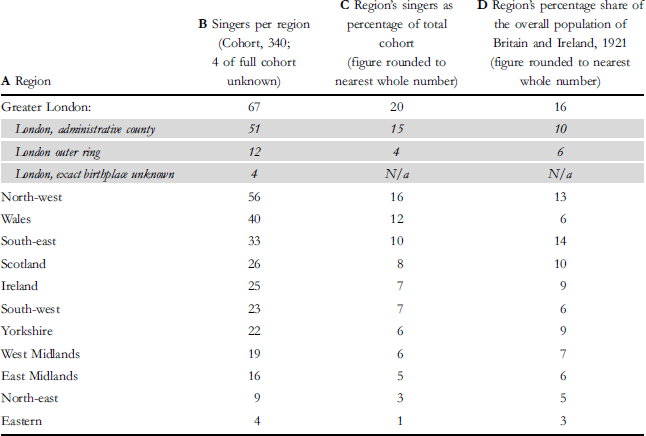
As the especially large presence of London-born singers suggests, some noteworthy patterns of regional variation are observable. English-born singers have been placed in one of the nine regions listed in Table 1, while those born elsewhere in the British Isles have simply been enumerated according to their country of origin.Footnote 39 Given the huge variations in the size of these units (the north-west, for example, has almost four times the population of Eastern England), rather than merely record the raw numbers of singers born within each of them, it is necessary to establish the proportion of singers produced by each region in relation to its population. Only in this way can levels of over- or under-production be identified. Given that this analysis is diachronic rather than synchronic, establishing regional populations is problematic. The method used here is to take the regional (and other national populations) as they stood in 1921, approximately the halfway point in the period studied, and use these as a fixed point against which birthplace data from across the whole period can be set. Regional population balances obviously changed over the period but the shifts were not marked enough to alter at least the major inter-regional variations discussed below (see Table 1).Footnote 40
Distribution of birthplaces of British opera singers active 1850--1960, by region and nation
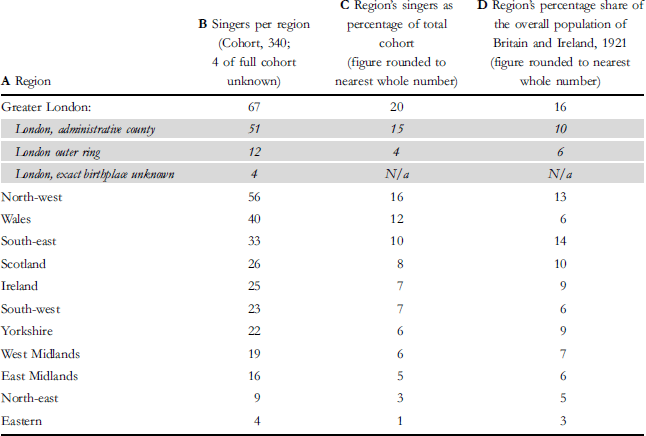
As comparison between columns C and D in Table 1 demonstrates, singers appear to have emerged broadly in accordance with population size in eight of the twelve units. However, in Wales, London, the North-west and Yorkshire, there are interesting discrepancies. The most striking feature is the over-production of singers in Wales where a country comprising only 6% of the population of the British Isles was responsible for 12% of singers, most, although certainly not all, drawn from the industrial and mining communities of the south.Footnote 41 London falls only slightly behind Wales, while the North-west also shows discernible levels of over-production. At the other extreme, Yorkshire, exhibited a modest but notable under-production, a county with 9% of the nation’s population producing only 6% of its singers.
Wales and London were two markedly different locations that attained their importance as seedbeds for operatic performers in markedly different ways, with Wales drawing on the strength of its deeply rooted vocal and choral tradition and London upon rich resources of specialist professional skill, educational institutions and long-embedded cultural authority. Taking the capital first, it is important to appreciate that ‘Greater London’ was a highly complex city-region containing often widely differing cultural environments.Footnote 42 As the shaded section of Table 1 shows, it was the inner administrative county that was critical to the production of singers, with an area containing 10% of the national population being birthplace to 15% of its operatic performers.Footnote 43 The outer suburban core, however, generated singers at much lower rates very much in keeping with those in much of the so-called provinces: Rodmell’s comments concerning differences between West End and suburbia once again seem apposite.Footnote 44 It was in the central districts that the capital’s key cultural assets were to be found. The longevity and scale of London’s dominance of the British musical profession has been frequently commented upon, with Rohr stating that over half of the 5,500 musicians in her collective biography of musicians active in the century from 1750 pursued their careers in the capital. Although other provincial centres increasingly developed their own professional musical communities, London’s remained (and remains) comfortably the nation’s largest.Footnote 45 Some future singers were simply following in the family’s professional footsteps. Of the eighteen singers with fathers in the musical or theatrical professions, nine were born in the capital. More generally, what was especially important to the training of singers was London’s exceptionally high number of music teachers. The capital was home to 39% of the nation’s music teachers in 1861 and although its share of the profession fell, as late as 1921, it still housed roughly six times as many as Birmingham and Liverpool, its nearest challengers.Footnote 46 Crucially, their number included many specialist vocal teachers, some combining work in London conservatoires with private tuition, others setting up their own studios in the central boroughs. Of the twenty-four Grove singers born in London, at least seventeen received college or private teaching in the capital in their formative years; this kind of opportunity was simply not available elsewhere, a situation for which the well-trodden path taken by so many young singers from the provinces to London stands testimony.
Wales’s reputation, both internally and externally, as the ‘Land of Song’ is long established and the role of its opera singers as powerful cultural ambassadors has long been acknowledged. John Potter has suggested quite plausibly that it ‘may have produced more tenors per head of population than any territory of similar size on earth’.Footnote 47 Even against this well-rehearsed narrative, however, it is hard not to be impressed by the statistical expression of its musical proclivity given above. Much Welsh musical life was driven by a vigorous culture of Victorian non-conformity (although the Established Church also made its contribution) that drew deeply from within working-class communities. Chapels became cultural almost as much as religious centres, allowing the local industrial workforce ‘to acquire in a small, and often humble enough way, the intellectual accomplishments and enjoyment, prestige and status of a more cultured society’.Footnote 48 By the late nineteenth century a dense, interrelated network of chapel choirs, choral societies, concerts and fiercely contested eisteddfodau and other musical competitions had emerged, flavoured by deep-seated and sometimes aggressively expressed rivalries between small, highly partisan neighbouring communities.Footnote 49 Choirs, both secular and sacred, provided an immersive, intense training, while competition gave successful singers a profile allowing them access to external musical worlds. Second place in the 1913 National Eisteddfod helped take tenor Tudor Davies from the coalface to Cardiff University, the RAM and the operatic stage, while first prizes opened similar opportunities for tinplate worker and baritone Tom Williams in 1931, coal miner and bass Trevor Anthony in 1934, secretary and soprano Gwyneth Jones in the early 1950s and schoolteacher and tenor Stuart Burrows in 1959.Footnote 50 This remarkable culture weakened as chapel life in general weakened in the inter-war period, although there seems to have been little discernible impact on the supply of Welsh opera singers.Footnote 51
Passage from Welsh voluntary musical culture to opera was by no means secure or universally welcomed. Peter Stead has noted that religious mores and a strong belief in the value of ‘improving’ recreation meant that many were deeply suspicious of the professional stage, preferring their songsters to sing in recitals and oratorio rather than the more exotic opera on visits home, while Richard Fawkes reports that even in the mid-1940s, members of the fledgling (and, at that time, amateur) Welsh National Opera had to contend with chapel-based opposition to appearing in greasepaint.Footnote 52 For many families, however, it is likely that economic imperatives ultimately triumphed over such concerns. On the death of the bass Howell Glynne, fellow Welshman Redvers Llewellyn recalled how ‘the beauty of voice’ brought Glynne, ‘direct from unemployment in the mines of south Wales. … Had it not been [for] the depression of the 1930s I much doubt whether he would ever have taken the initial step into opera to which he contributed so much.’Footnote 53 Tin-plate worker Tom Williams was another, who at this time chose a musical career in the face of long-term unemployment. The 1930s was admittedly an exceptionally difficult decade for the small industrial and mining communities of south Wales, with some 45% of the Rhondda district workforce having been unemployed for five or more years by 1938.Footnote 54 Nevertheless, for those raised in what were often effectively single-industry towns vulnerable to economic vicissitudes and offering limited opportunity for social mobility, ‘beauty of voice’ was always a resource of particular economic value within Wales.
London and Wales did not inhabit entirely disparate musical universes. London had sacred and secular choirs (it was a strong centre of amateur operatics); Wales had educational institutions and skilled teachers. However, while chapel, church and choral societies loom large in the biographies of Welsh opera singers, they feature far less prominently in those of their London counterparts. School may have played more of a part in the capital than elsewhere, with Joan Cross (1900–93), much influenced by her classes at St Paul’s Girls’, albeit then as a violinist, and Victoria Sladen (1910–99) first stimulated by classes at Hendon Convent School. Popular music may even have played a role with Eric Shilling (1920–2006) much engaged by hearing music-hall song in the family home and Janet Howe (b. 1910) and Gladys Ripley (1908–55) gaining their first experience of performing at such events as the Beckton Gasworks Boilermakers’ Conversazione.Footnote 55 The albeit significantly different opportunities provided in London and Wales also reinforce earlier arguments concerning the limits imposed in other less urban and/or industrial areas. The eastern region, for example, provided only four singers for this prosopography. Although Norwich, a cathedral city and regional capital, was always relatively well stocked with music teachers and musicians, its resources were never remotely comparable to London while the region generally lacked the industrial–urban structure and concomitant popular culture that underpinned Welsh amateur musical life.
While London was truly exceptional in its level of educational provision, Wales was by no means the only part of Britain to enjoy an unusually developed amateur musical life marked by strong, often religious-based choral cultures and fiercely contested competitive activity. Regions that at first sight might have come close to matching the principality, however, made markedly differing contributions. The presence of seven Cornish singers within the twenty-three hailing from the wider south-west region stands as an impressive contribution, while a not insignificant level of overproduction is certainly discernible in the north-west, especially within Lancashire. The county was the birthplace of forty-eight of the north-west region’s fifty-six singers, resulting in its producing 14% of the singers recorded here from only 10% of the overall population. Choral music was deeply embedded in the musical life of Manchester and its immediate hinterlands: Norman Allin (1884–1973), born in Ashton-under-Lyne and bass soloist with both Beecham and BNOC, swore never to perform in Messiah again after making a 270th career appearance in 1932.Footnote 56 It was surely this powerful tradition that allowed opera singers to emerge from Oldham, Rochdale, Wigan and other initially unlikely locations.
At the same time, however, while repeating warnings about acknowledging the small samples involved here, the industrial regions of north-east England and Yorkshire also exhibited strong amateur vocal traditions and yet did not produce singers at a comparable rate. That four of the nine north-eastern singers were born in the 1940s, and all in small, largely working-class communities, suggests that the region was only really able to contribute to the national operatic stock once funded higher education became readily available. Yorkshire’s slight underproduction is far more unexpected given that the textile districts of its West Riding had one of the richest, perhaps the richest, of all popular participatory musical traditions in England, as well as a socio-economic structure very similar to Lancashire’s.Footnote 57 In fact, the textile communities in and around Bradford, Leeds, Halifax and Huddersfield produced only seven of the biography’s singers, most of whom, including John Coates, Edna Thornton and Olga Haley (1895–1989), were ultimately best known as performers in concert and oratorio.
Explanation of this particular inter-regional variation can only be speculative but the presence in Lancashire of the Royal Manchester College of Music and neighbouring Yorkshire’s lack of a comparable institution is likely to be a part of it. At various times, the college staff included such operatic luminaries as Marie Brema, Norman Allin and Frank Mullings, as well as an opera class that from as early as 1900 gave an annual performance of a major work, and two consecutive principals in R.J. Forbes (in post-1929–53), and Freddie Cox (1953–70) who were profoundly interested in the form.Footnote 58 While the majority of college-trained singers from the north-west actually undertook their education outside the region, the RMCM played an invaluable role in providing opportunities to those of modest financial backgrounds for whom residence away from home was problematic. Bass Norman Walker worked in a cotton mill for several years before enrolling in 1929, while tenor Richard Lewis endured nine ‘hated years’ as a clerk with the Calico Printers Association before his arrival there ten years later.Footnote 59 At the same time, college staff offered private tuition within the region. Other factors including a strong preference for oratorio over opera or traditions of religious hostility to the theatre may have also operated to create differences between the two adjacent counties. Although personal circumstance rather than wider cultural trends may have been at work, it is suggestive that Walter Widdop, the Yorkshire-born singer most associated with opera before the 1950s, had no involvement with organised singing until he joined a chapel choir aged about twenty and was perhaps thereby freer than most of any local anti-operatic prejudices that may have existed.Footnote 60 Whatever the dynamics of regional difference, however, those differences clearly did exist. The spatial production of British opera singers was the product of local and regional circumstance that generated advantages and disadvantages that may well have been hidden from even the most engaged participants but which could have a profound impact on career paths.
Class
The class background of opera singers has received some thoughtful attention but no sustained study. Examining the history of the prima donna in Europe and America, Susan Rutherford has suggested that over the course of the nineteenth century, singing as a career became something that called ‘to many women regardless of social situation’, but adds the caveat that while ‘exceptional talent occasionally triumphed over the barriers of class and financial hardship, few singers from poor backgrounds had equivalent opportunities of educational and vocal tuition to those of their wealthier counterparts’. This is in interesting contradistinction to Rosselli’s observation that Italian tenors increasingly came from ‘poor artisan families’. Within a specifically British context, I have also previously stressed the problems faced by those from poorer backgrounds and suggested that Lancashire working-class tenor Tom Burke (1890–1968) was probably the only individual from such a background to make a ‘passage to genuine stardom’ within opera. However, John Potter has drawn attention to the number of ex-miners in the operatic ranks, noting how ‘many early twentieth-century tenors began their careers underground’.Footnote 61
In order to explore these issues, this study analyses singers’ class backgrounds through the standard social scientific procedure of categorising their father’s occupation and, where appropriate, the full-time occupations they themselves pursued before the commencement of an operatic career. Placing individuals into occupational and social categories is a challenging activity.Footnote 62 Most occupational classification involves the creation of apparently objective categories the peopling of which then immediately demands some degree of subjectivity; defining ‘skill’ when apportioning the ‘skilled’, ‘semi-skilled’ and ‘unskilled’ working class, for example, is notoriously problematic. When, as it usually does, occupation becomes the basis for identification of social class, further difficulties arise, with rigid boundaries between classes frequently impossible to define. Along perhaps the most fiercely contested boundary within the period studied here, that between upper-working and lower-middle class, might be found not only skilled artisans who equated themselves in status terms with the clerks and other white-collar workers that they lived among but, conversely, publicans, small shopkeepers and tradesmen whose roots and sensibilities placed them within the very working class that neat academic categorisation would deem them to have left. Problems managing fine detail also accompany these larger framing issues. Parental occupations were certainly not always static. Charles Santley’s father was, respectively, a book-binder, a rates collector and a teacher of music and thus followed a trajectory that took him from the skilled working class to the lower reaches of the middle class ‘proper’. Florence Easton’s father was a compositor but later the proprietor of a fruit wholesalers, Owen Brannigan’s a colliery faceworker turned insurance agent. Again, the nature and standing of certain occupations was subject to change with, for example, a graduate-trained secondary schoolteacher of the 1950s enjoying higher status than their predecessors in a Victorian elementary school.
Acknowledging that any neat labelling satisfactory to both twenty-first-century scholars and the historical actors involved is impossible, the approach taken here is simply to allot individuals to four categories recognisable to contemporaries. The labels chosen here are ‘upper-middle class’, comprising higher professionals such as lawyers, doctors and clergymen, along with large-scale employers and proprietors; ‘middle class’, including lesser professionals, senior managers and administrators, higher-ranked members of the teaching profession, higher-status musicians and medium-scale employers; ‘lower-middle class’, which embraces clerks, shopkeepers, independent tradesmen, elementary schoolteachers, foremen and other supervisory workers; and ‘working class’ which covers all manual workers.Footnote 63 While many individuals can be placed quite straightforwardly within these boundaries, for some, final choices have been based on deductions concerning their wider lifestyle; census returns noting such factors as servant-keeping and the ‘social tone’ established by the occupations of other family members and immediate neighbours have proved useful guides. Wherever doubt exists, the individual has either been excluded from the analysis altogether or, more typically, placed in the higher of the categories under consideration.
Looking initially at paternal occupation, details can be provided for 173 singers (103 male, seventy female) and these are recorded in Table 2. Table 3 records the class nature of full-time occupations pursued by singers before they commenced a singing career. Although entry into an operatic career often involved far more than a seamless transition from education, many singers clearly did enter at that stage and, therefore, had had little opportunity to pursue employment. As a result, those tabulated here represent a rather smaller group of 114 individuals. Because of both the low participation rates of women in the full-time workforce for much of the period and the strong likelihood that marriage would often end the prospects of a professional musical or any other career, just eighteen of these are women.
Occupations of fathers of British opera singers, 1850--1960

Occupations of British opera singers before stage career, 1850--1960

Both tables immediately highlight two significant patterns. Perhaps most obviously, whether defined by paternal or individual occupation, approximately two-thirds of singers were drawn from one of the three segments of the middle class. This represents a marked level of over-representation for these groups, with non-manual workers comprising only some 20% of the total working population for most of the period; as late as 1961, they still formed only slightly more than 30% of the workforce.Footnote 64 At first sight, then, opera clearly seems to deserve its reputation, at least in sociological terms, as ‘unpopular’ culture. However, the lower-middle class and, at least, the upper reaches of the working class have always shared many characteristics in relation to income levels, lifestyle and leisure habits; indeed, they could often be found in the same family, living in the same house. If singers from the lower-middle and working class are combined, their contribution almost exactly matches that of the middle class and suggests a far more popular social tone for the British operatic profession: 63% of singers were born into one of these two ‘lower’ categories, while 72% had pre-operatic occupations that fell within their boundaries. Both interpretations capture essential truths. Opera represented an unusual career choice demanding high levels of expertise, time and expense and it is hardly surprising that those with relatively high levels of cultural and economic capital should produce so many of its performers. However, the fact that such large numbers were able to enter the profession from lower in the social scale suggests a range of routes into the profession that were not all dependent on social and economic advantage. Inclusivity is as apparent as exclusivity.
It is certainly noticeable how few singers were drawn from the highest echelons of British society; that is, from the social groups that attended Covent Garden and provided opera with its highly elitist public image. None were born into the aristocracy and gentry and only fourteen into the highest echelons of the middle class.Footnote 65 Even here, singers rarely emanated from its most prestigious sectors. While Sumner Austin’s (1888–1981) father was a senior Indian civil servant and Jennifer Vyvyan’s (1925–74) an officer in the Royal Engineers and her stepfather a barrister, the upper-middle-class elements represented in this survey were largely drawn from its lower provincial reaches – non-conformist clergymen, accountants and civil engineers. No senior Church of England clergyman appears in the record and the only child of a doctor identified is the Irish tenor John O’Sullivan (1877–1955), although his father’s early death meant that O’Sullivan actually grew up (in France) experiencing considerable financial hardship. These findings are consistent with the picture drawn by many historians of upper and upper-middle classes happy to consume music in an appropriate setting and to allow themselves and their offspring to pursue active amateur careers, but too status-conscious to encourage entry into a music profession that had, at best, limited cultural cachet, and, at worst, carried a decided moral taint.Footnote 66 The middle class that opera singers emerged from was generally, then, a more modest one: the fathers of Fanny Moody (1866–1945), Edith Coates (1908–83) and Michael Langdon (1920–91) were respectively, the proprietor of a photographic shop and studio, an antique dealer and a landlord (both in the sense of owning a public house and renting out domestic property). Importantly, gender differences can be identified amongst singers born into the upper-middle and middle classes. Some 46% of all those women whose parental background can be recorded fall into this category, as opposed to only 31% of males, statistics suggestive that, for all its problematic elements, an operatic career could be a desirable (and sufficiently respectable) prospect for women born into a social class that provided only modest opportunities for paid employment.
At the next level came the lower-middle class from whose offices (Arthur Cranmer, b. 1885, father a cashier), classrooms (Olive Gilbert, b. 1898, father an elementary schoolteacher), shop counters (Forbes Robinson b.1926, father a grocer) and tradesman’s workshops (Philippine Siedle, b. 1850, father a clockmaker) so many singers emerged. Here was a group containing many only too willing to enjoy the benefits that a musical career might bring. If limited financial resources prevented full membership of the middle class, then artistic success brought compensatory cultural capital and, for some, enormous monetary reward. This social grouping, often a byword for conservatism and conformity in national comic discourse, was in its quiet way a dynamic artistic force.Footnote 67 Perhaps the most striking challenge to the idea of opera as elite culture comes from the forty-nine singers (28% of the total) born into the working class and the forty-seven (41%) who undertook manual work at some stage in their early working lives. Moreover, it is probable that the strict categorisation used here somewhat underplays the working-class presence. Amongst the fathers termed ‘lower-middle class’ are recorded foremen, supervisory workers, clerks and small tradesmen who had clearly begun life as manual workers and whose children still experienced what were essentially working-class upbringings. Sir Thomas Allen (b. 1944) grew up in the Durham village of Seaham Harbour, where virtually every male in his family earnt a living from mining; it was this that shaped his sense of identity rather than the white-collar occupation his father pursued as a result of losing a leg in a motorcycling accident. His fellow singer Robert Tear described him as ‘a good working-class chap’ and Allen himself told an interviewer that he could not describe his childhood without it sounding ‘like a Catherine Cookson novel’.Footnote 68 Contrary to my assertion in earlier writing noted above, Tom Burke was clearly not the exception to the rule; talent from the lower orders rise to the forefront in Britain as easily as in Italy. Simply looking at Grove tenors, Joseph Hislop (1884–1977) was a photoengraver and the son of a housepainter, Walter Widdop (1892–1949) a textile worker and the son of a quarryman, Walter Hyde (1875–1951) followed his father into the joinery trade, Charles Craig (1919–97) was a tailor and warehouseman, Heddle Nash (1894–1961) a joiner in the family construction business, John Brecknock (b. 1937) an engineer and Kenneth Collins (1935–2013) originally a painter and decorator.
The term ‘working class’ describes a large and highly stratified occupational sector. Approximately thirty-five separate parental trades have been recorded, with the twelve involved in mining trades forming the biggest single group, followed by eight who worked in some form of engineering.Footnote 69 Those involved in mining also formed the largest group amongst those who were manual workers before undertaking a singing career, with fifteen involved in pit work of some form; Potter’s observation was well founded. Of the parental trades, about twenty could be termed skilled and most of the others semi-skilled. A small number of singers were drawn from unskilled and labouring backgrounds; Teresa Cahill’s (1944–) father was a stevedore, that of Alberto Remedios (1935–2016) and brother Ramon’s (born 1940) cleaned railway carriages and Rita Hunter’s (1933–2001) was a gas stoker. However, such a background was unusual, reflecting the wider structures of working-class musical life and the economic forces that dictated them. Church and chapel attendance, for example, was generally lowest amongst the poorest members of society and exclusion from the wider world of organised religion removed or limited access to many of the sub-cultural worlds, including musical ones, extant within it. Again, the unskilled and even some sections of the semi-skilled working class found the financial costs, regularity of attendance and often quite formal dress codes required to be powerful barriers to membership of the amateur musical organisations that offered much initial training.Footnote 70
Gender also appears to have influenced opportunities. Women from working-class families entered the singing profession in very early adulthood at roughly the same rate as their male peers. However, while many males from such backgrounds were able to turn to a professional singing career in their twenties and thirties, prevailing attitudes to gender roles made this harder for women. Although, as noted, the number of women pursuing pre-stage occupations was very small, most of the eighteen identified who did so were either born into the middle class and/or undertook employment of a lower professional nature (Valerie Masterson (b. 1937) trained as a radiologist) or held lower-middle class occupations typical of their respective eras: Fanny Moody was briefly a music teacher, Janet Baker (b. 1933) and Gwyneth Jones (b. 1936) clerical and secretarial workers. Only five singers – Edith Clegg (b. 1885), who was a skirt-machinist, Kathleen Ferrier (1912–53), who worked as a telephonist, and Louise Kirkby Lunn (1873–1930), Edna Thornton (1875–1964) and Ava June (1931–2013), all dressmakers – had jobs normally classified as working class. The domestic ideology that so often structured the lives of adult working-class women exerted an influence here and its power was made all the more apparent on those occasions when it was challenged. In the case of Eva Turner, it was her father’s determination that she should be free to pursue her musical training that led to his curtailing a serious relationship she had begun aged sixteen, while the twenty-year-old Dora Labette (1898–1984), daughter of a railway guard, walked away from a marriage to an army officer that threatened her independence and career ambitions.Footnote 71 For these women, access to the operatic stage carried high personal costs.
Finally, it is noteworthy that the social structure of the operatic profession adhered closely to that of Britain’s amateur choral movement. The composition of choral and other vocal societies certainly varied according to both location – with dominant occupational structures often exerting influence – and their musical function. Smaller competition choirs, for example, tended to be more popular in structure than both their larger, concert-giving counterparts and amateur operatic societies. Overall, however, British amateur vocal culture was typified by a broad social mix dominated ultimately by a combined lower-middle and upper-working class majority.Footnote 72 As the earlier analysis of regional contributions demonstrates, the exact strength of the link between amateur and professional stage varied considerably, but it was, overall, a powerful one. While the role of amateur brass band movement has long been recognised as a fundamental source of supply for the world of professional orchestral music, the role of choral and related societies in the production of professional singers has been left, if not unacknowledged, then too frequently implicit. The obvious sometimes needs stating. Certainly, the transition to opera was not always successful in artistic terms. John Lucas has claimed that many of BNOC’s soloists failed ‘to break the bonds of the oratorio tradition from which they sprang’, while John Potter has catalogued the technical, intellectual and emotional shortcomings that limited the achievements of some British tenors.Footnote 73 Nevertheless, British operatic culture would have been a far more modest affair without the contribution of those trained in the amateur choral tradition.
From singer to opera singer
The singers gathered in this biography are among the small minority of trained voices who, whether as the result of a teacher’s recommendation, the discovery of an aptitude while at conservatoire or college, or simply a greater engagement with opera, chose to undertake one of the most highly specialised, physically demanding, unusually lengthy and, crucially, extremely expensive forms of artistic training imaginable. Fees had to be found, whether for conservatoire education or the essential private lessons that continued deep into individual careers, and some level of income guaranteed in order to sustain the inevitable fallow periods. Moreover, early career paths were hard to navigate and help was often required in the search for auditions, agents and bookings. Increasing state intervention, especially in the form of publically funded musical higher education, undoubtedly proved critical, at least in the initial training process. Many early college grants were institutional or private endowments for which competition was intense. Louisa Kirkby Lunn and Agnes Nicholls were among the fourteen individuals to receive open, free scholarships to the RCM in 1894 from a field that originally numbered 419.Footnote 74 It is not clear whether financial need was taken into consideration in such schemes, although some colleges clearly operated both formal and informal hardship funds, with the RAM paying a quarter of Eva Turner’s fees from a student aid fund. This payment was continued after graduation on the order of College Principal Sir Alexander MacKenzie, in order to assist her in further study.Footnote 75 Funding for later generations was rather less arbitrary. Whereas only some 5% of students at the Royal Manchester College received public funding in 1897, that figure had risen to over 70% by 1958. There is no doubt that many careers of sometimes stellar nature would simply not have been possible without the educational ladders that the state constructed.Footnote 76
For all this, as Rutherford has noted, private patronage and acts of philanthropy played an extremely important role in singers’ lives; indeed, it is hard to think of another cultural form quite so dependent upon them.Footnote 77 For most of those born before about the 1920s and for many after, it was this extensive and varied repertoire of benevolent practice that proved key. Virtually all singers, irrespective of social position, needed practical intervention and assistance at some time, but it was inevitably the lower-middle class and, more especially, working-class singers who most benefited. Help came in many guises and at many stages, with some singers funded for their general musical education, others specifically for operatic training. Corporate sponsorship was not common but scholarships provided by the American cigarette company Peter Stuyvesant certainly funded a number of places at the National Opera Studio in the 1950s, while in 1952 the MGM film company sponsored ‘The Great Caruso Competition’ in conjunction with the British premiere of the Mario Lanza film of the same name, thereby launching the international careers of Forbes Robinson and Dermot Troy, winner and runner-up respectively.Footnote 78 Individual patrons from within the middle and upper-middle classes were certainly influential in some careers and no more so than in that of Tom Burke, whose discovery does feel a little as though lifted from a Lanza film script. Burke was apparently overheard by a local musical enthusiast as he and a group of friends sang Verdi on their walk home from their colliery. She arranged an audition for him at the Manchester Theatre Royal, the manager of which, in turn, found a place for Burke to study at the RMCM. Several years later when Burke’s nascent London career was threatened by the war-time internment of impresario Hugo Gorelitz, Bond Street tailor and opera aficionado Mark Richardson took over the financial commitments Gorelitz had made to Burke, thus allowing him to study in Italy and lay the basis for an international career in the 1920s.Footnote 79
In other cases, employers played the vital philanthropic role. The dyeworks that employed the Yorkshire tenor Walter Widdop paid the £400 he required for membership of BNOC in 1922 as a symbol of respect for his achievements, while some thirty years later the National Coal Board funded a scholarship at the RAM for William McCue, then one of their pit electricians.Footnote 80 On many occasions, however, help came from within the working-class communities that had nurtured the initial talent. Widdop’s workmates had collectively paid for some of his earliest singing lessons, the Cymmer Colliery band gave money to help Tudor Davies study at Cardiff University in 1913, a local male voice choir held a fund-raising concert to assist Tom Williams’s period of study at the RAM in 1931, while the Ammanford Choral Society and a local colliery agent established a £200 fund for Trevor Anthony to attend the same institution in 1935. In the latter case, collierymen throughout the district gave support, suggesting that a wider occupational pride ran alongside local musical patriotism.Footnote 81
Yet further help came from within the music profession itself. Sympathetic college staff made allowances for technical shortcomings, with John Brecknock, unable to read music, spared the exam that would otherwise have prevented his entry to the Birmingham School of Music in the early 1960s. Sir Thomas Beecham was so impressed by the potential of Covent Garden chorus tenor Charles Craig that he ordered him to leave the chorus and funded his operatic training.Footnote 82 A young Rita Hunter was given the job as housekeeper to the conductor Edgar Renton and his wife in the early 1950s, in return for lessons and career guidance; a contract in the chorus at Sadler’s Wells soon followed.Footnote 83 Again, teachers were often willing to compromise on advertised fees. Janet Baker (b. 1933), newly arrived in London in the mid-1950s from her bank clerk’s post in Leeds, was unable to pay her eminent teacher, Helene Isepp, ‘for all [my] lessons so I just gave her what I could’; Isepp quietly accepted the arrangement.Footnote 84 Obviously, there were varying elements of self-interest in all these cases, with those in the music profession fully aware that supplies of talent had to be maintained and that their own reputations were enhanced by the success of their students and protégées. Nevertheless, kindness and understanding were never far away.
It is important to stress that these forms of assistance were invariably dependent upon, and often prefaced by, both high levels of family support and considerable self-sacrifice by the recipients. Parental validation or encouragement of what were often potentially hazardous career moves were often critical. Charles Santley’s decision to leave a steady but tedious job as a book-keeper and journey to Milan for training in the 1850s stemmed from a suggestion of his father’s, while, in the early 1930s, Victoria Sladen’s mother encouraged her to exchange a safe secretarial post for full-time musical study.Footnote 85 On other occasions, assistance came in financial form. Tudor Davies was one of twelve children born into a Welsh mining family and identified by his parents as the one most likely to benefit from the limited amount they could offer for musical education. Childhood violin and singing lessons provided a crucial basis for his later development. In yet another variant, John Brecknock benefitted not only from the Birmingham School’s flexibility but also from his wife’s willingness to work full time to support their young family so that he could leave his job in an engineering factory.Footnote 86 Singers themselves took risks and placed heavy demands upon themselves. Santley endured considerable deprivation while in Milan and had to return to Britain, Widdop sold his Halifax back-to-back house and all his furniture to fund a year’s study in London, while in the 1930s, Edgar Evans took on a physically demanding milk round to pay for his singing lessons.Footnote 87 It is no surprise that some talented singers opted for pragmatism. Two promising Halifax-born performers, Herbert Teal and Fred Sutcliffe, rejected the chance to join BNOC in favour of combining full-time careers as skilled tradesmen with paid singing engagements, while in the 1950s, talented amateur Welsh mezzo Zoe Cresswell placed family commitments before auditions with Sadler’s Wells and Covent Garden.Footnote 88 Talent could not always be fulfilled.
Conclusions and future work
While acknowledging that the findings presented here will be challenged or refined in the light of further research, a reasonably secure set of conclusions do emerge. British and Irish singers were most likely to have been born and raised in urban settings, which provided at least some of the interest, education and skills necessary for the eventual pursuit of an operatic career. Certain places, most notably Wales, London and Lancashire, seem to have produced a significantly higher proportion of opera singers than others, with all three exhibiting an over-production of performers in relationship to their population bases. In London, highly sophisticated cultural and specialist educational structures proved the critical ingredient while in Wales, Lancashire and probably some other sub-regions, amateur and religious-based choral cultures played the key role. Throughout the period, singers were disproportionately drawn from a widely defined middle class, but very few emerged from elite social backgrounds and a significant minority were born into the manual working class, their path into opera made possible (as indeed it was for some of their higher-born colleagues) by innumerable acts of individual and collective philanthropy and, eventually, by the benefits of a state-funded higher education system. For all these wider contextual factors, it must not be forgotten that without personal sacrifice, both by aspirant singers and their family and friends, little might have been achieved. It is to be hoped that these findings will serve as a basis for the exploration of the post-1960 period (or periods). In the light of recent warnings of an apparent shrinkage of opportunity within the theatrical profession for those from working-class backgrounds, it will be especially important to ascertain whether similar forces are at work within the structures of recruitment to the twenty-first-century operatic profession.Footnote 89 Many of the individuals discussed here are testimony to the obvious but too easily forgotten truth that artistic (and other talent) knows no social bounds.
Whatever the results of such work, in the century from 1850, while opera singers may sometimes have sung in strange tongues and adopted exotic or uncustomary stage personae, they spoke in the regional and class accents familiar to the majority of the population. They were in many senses, commonplace people. Set against this, however, was a widely held view of opera as cultural form predicated on a decidedly antithetical standpoint. While this is not the place for detailed discussion of opera’s wider role in British society, it is helpful to use this lack of congruence between the singers’ social and geographical backgrounds and opera’s social standing as a vehicle for helping open up useful speculation on the subject. Although it would be simplistic to assume the existence of one, unchanging view of opera’s image within British culture, especially from the inter-war period it has undoubtedly often been suffused with the languages of privilege, social exclusion and cultural snobbery. In 2012, the historical sociologist Mike Savage noted that during the course of fieldwork relating to contemporary attitudes to class, a research question concerning attendance at opera, ‘was always embarrassing for everybody, interviewers and interviewees alike, since everyone knew what was really being asked: whether they could claim to be middle or upper class’.Footnote 90 The ideological roots of such embarrassment run deep. Although the national press happily gave space to gala first nights and the doings of well-paid stars, opera, particularly when associated with Covent Garden, has generated deep-seated social antagonisms. The Labour government’s provision of an extremely modest subsidy for opera of some £22,500 over five years in November 1930 was the occasion for an especially virulent outbreak of hostile media commentary. Speaking two years later, while conducting with the Covent Garden Opera Company on a provincial tour, John Barbirolli satirised, only slightly unfairly, press depictions ‘of a government taking the bread out of the mouths of the unemployed to feed the already over-fed and self-indulgent parasites of the operatic world’.Footnote 91
Why has an image that is in many particulars inaccurate survived so effectively? Obviously, it was an operatic culture of a certain type, ‘The Opera’ as elite social construct, rather than ‘opera’ as moderately democratic art form, which drew the sharpest barbs.Footnote 92 Even the Musical Mirror, a bitter critic of the dominant press reaction to the subsidy issue was far from sympathetic to West End opera, describing it as a ‘rendezvous for Mayfair and “Tantivy”’ and referring to Covent Garden as ‘Society’s pet Pekinese’.Footnote 93 The role of singers in this process – so many of whom came from modest working- and lower-middle-class provincial backgrounds (for all London’s importance) – is complex. At one level, their usually far-from privileged backgrounds disappeared as soon as they joined the operatic profession. For most audiences, individuals undoubtedly cast off their social being when onstage and opera has been no exception. Moreover, by joining a profession that had such a distinctive image they could easily become associated with it. Their lifestyles, both as lived and as reported, were unsurprisingly often those of the middle class that they had moved into, with Hampstead addresses, golf club memberships and quiet suburban tastes to the fore. Some appear to have hidden their origins, with bass David Franklin, whose father was a joiner in Camberwell, choosing to begin his autobiography at the point of his Cambridge Choral Exhibition.Footnote 94 Others adopted an artistic sub-cultural style that distanced them, deliberately or not, from their backgrounds. The photographs of Alfred Deller in Michael and Mollie Hardwick’s biography – depicting him with distinctive thick goatee beard, paisley shirts and, on one occasion, bow-tie – is hard to link with the young man whose father had been a horse-omnibus driver, soldier and self-employed P.T. instructor and who had himself left school at fifteen to work as an apprentice furniture salesman.Footnote 95
Yet for all such de-classing and upward social mobility, opera singers born outside the middle class were equally capable of preserving some or all of their distinct biographies. The press was fond of ‘rags to riches’ narratives and in 1919 one paper greeted the success of Tom Burke and Margaret Sheridan, once a Dublin street child and brought up by Protestant clergy, in the Royal Opera House’s 1919 La bohème with the phrase ‘street orphan and pit boy [charm] “Garden” devotees’. In 1930, Burke published an autobiography in a Sunday newspaper under the title ‘From Pit Boy to Grand Opera Star’ in which he or his ‘ghost’ not only gave full and detailed background concerning his early life but indulged fully in a classic populist critique of Covent Garden, an institution than Burke felt had never served him justly. Drawing on powerful existing narratives, Burke talked of opera as ‘a function, a social function, not a musical one, and, like Ascot Week, it is not the races which matter but the fashion display. Latest creations and jewels mean more than opera itself.’Footnote 96 The social origins of less self-conscious figures than Burke were also made apparent. Writing in 1933, the monthly Windsor Magazine described Eva Turner’s journey from ‘obscurity to international operatic fame’ as a ‘Cinderella’ story, albeit one involving hard work rather than the wave of a wand, and in this and many subsequent versions, her roots in working-class Lancashire were never disguised.Footnote 97 Similar acknowledgement of popular origin was continually recognized, even celebrated, in various media settings. Opera stars were not a natural target for the popular commercial television biographical programme This is Your Life (1955–2003), but it is interesting that most of those who did appear (Turner featured twice, in 1959 and 1983) were from relatively humble backgrounds openly acknowledged.Footnote 98
In the final analysis, it is tempting to suggest that the concept of opera as elitist has simply proved too powerful to be discarded, a convenient populist discourse that everyone outside of the wealthiest in the country could unite in using as a convenient shorthand with which to confer and condemn patrician and/or supposedly pretentious lifestyles. Like many such devices, it has ignored or cut across other more interesting or inclusive narratives and had the unfortunate consequence of appearing to place opera beyond the cultural reach of all but a privileged few. In terms of its performers at least, opera, far from being exotic and thinly rooted, has often looked decidedly familiar and ordinary.
Dave Russell taught in schools in Bradford and Leeds, at the University of Central Lancashire and at Leeds Metropolitan University from where he retired in 2010; he is now an independent scholar. He is the author of Popular Music in England, 1840–1914. A Social History (Manchester University Press, 1997, second edition), Football and the English (Carnegie, 1997) and Looking North: Northern England and the National Imagination (Manchester University Press, 2004), as well as numerous essays and articles on the history of popular culture. His current interests focus on the history of the music profession and opera as popular music.
Appendix: Regional and class origins of British and Irish opera singers active c. 1850– c. 1960
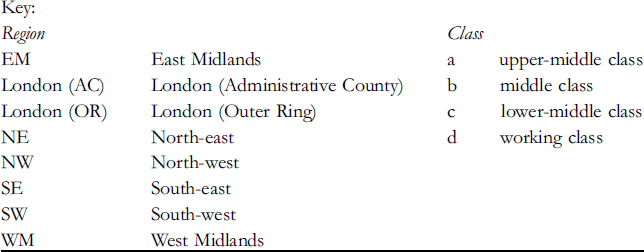
Please note that all singers are listed under their professional names.