




No CrossRef data available.
POLITICAL INCORPORATION AND CRITICAL TRANSFORMATIONS OF BLACK PUBLIC OPINION
Published online by Cambridge University Press: 01 September 2004
Abstract
The 2000 presidential election was unprecedented not only because of the lengthy dispute over the results, but also because both the Republican and Democratic Party presidential candidates directed their campaign appeals to minority voters. Because Black public opinion has moderated over time, Blacks are closer ideologically to the Democratic and Republican parties. Whereas in the 1970s and early 1980s Blacks believed the Democratic Party to be to the right of their position on issues such as government aid to Blacks and minority groups, today they see little difference, placing the Democratic Party slightly to the left of themselves on average. Black attitudes have moderated, I argue, because of the coercive dynamic of their incorporation into mainstream, electoral politics. And, indeed, the greatest force behind the newfound unity between Blacks and the Democratic Party is, ironically, the exogenous expansion of Black members' opportunities for political power and advancement in the United States House of Representatives. However, in contrast to other structural accounts, my analysis still leaves open the possibility that Black opinion could re-radicalize in the future.Note: Earlier versions of this paper were presented at a May 2003 conference on “New Perspectives on the Study of Race and Political Representation” at the University of Rochester organized by Fredrick C. Harris and Valeria Sinclair-Chapman, and at the 2002 annual meeting of the American Political Science Association meeting in Boston. The author thanks the participants at these events and Emory Denise Christian for their comments, and UCI's Center for the Study of Democracy for its financial support.
Information
- Type
- STATE OF THE ART
- Information
- Du Bois Review: Social Science Research on Race , Volume 1 , Issue 2 , September 2004 , pp. 345 - 359
- Copyright
- © 2004 W.E.B. Du Bois Institute for African and African American Research
George W. Bush lost the popular vote to Al Gore in 2000, and a Supreme Court ruling determined the election's outcome, permanently marking the outcome of the 2000 presidential election as historic. And yet I will argue in this paper that 2000 may have had even greater historical significance. This election is the first in which both major parties were careful not to alienate the “new minorities” in American elections. Not only did the Republican and Democratic parties direct their presidential campaigns to Blacks and to women, but to Latinos, Asians, gays and lesbians as well. Both political parties were attentive in a way that I believe is historically new. The 2000 election was not a contest of winning back the “alienated White male” who had abandoned the Democrats to join the Reagan Revolution, or exploiting further America's existing racial divide through carefully worded, racially coded messages that played to racial conservative voters (Mendelberg 2001). Instead, in an extended era of economic prosperity under the Clinton administration, which would have made muckraking and racial scapegoating especially appealing to the Republican Party, the major parties' presidential candidates made direct appeals to minority groups for their votes.
This courtship was evident in the display of female and minority faces at the GOP National Convention, including the televised portion in which a Black Baptist minister gave a lengthy sermon praising Governor Bush. To address the concerns of liberal female voters, there was a careful, less polarized debate on gun control and on abortion rights during the 2000 campaign. Vice President Al Gore supported affirmative action, and his running mate, Senator Joseph Lieberman, downplayed a record critical of affirmative action. The ongoing prosecution of Dr. Lee in the Los Alamos espionage trial was not made an issue in the campaign. Its absence in the campaign is all the more noteworthy when contrasted to GOP attacks on campaign finance abuses in the 1998 House races, and especially the Democratic National Committee's receipt of foreign, and notably, Chinese money. Indeed, in contrast to the Whitewater and “sex gate” scandals that dominated the media's coverage of the 1992 and 1996 presidential elections, there was strikingly less muckraking as engineered by party strategists in the 2000 campaign.
This courtship of minorities and women was carried through to the Bush administration. Roughly 30% of President Bush's appointments for top government posts have been women, while 20 to 25% are minorities. This figure matches that achieved in the Clinton Administration, one that until now had the most women and minorities serving in a presidential administration in American history. Notable as well was Bush's choice of two African Americans for highly visible and important posts, Colin Powell for Secretary of State, and Condoleezza Rice for National Security Advisor. Moreover, while President Bush has denounced racial quotas and racial preferences, his administration announced plans to defend a federal affirmative action program for minority and female contractors in a scheduled Supreme Court case, which was subsequently dismissed. In the University of Michigan affirmative action Supreme Court lawsuit, however, the Bush administration filed a brief on behalf of the plaintiffs against Michigan's affirmative action programs. The Court narrowly upheld affirmative action in Michigan's law school admissions practices in its ruling, but declared its undergraduate admissions affirmative action policies unconstitutional. On affirmative action, Bush may very well favor set-aside programs for minority federal contractors as President Nixon did. Bush, however, clearly opposes affirmative action in public education.
Why did the Republican and Democratic parties and their candidates court minorities in the 2000 election? There are several possible explanations to consider. One obvious explanation lies in the shrewd leadership skills of George W. Bush as the Republican Party's national leader. Bush won having lost the popular vote to his Democratic opponent. Lacking, therefore, a clear electoral majority to represent and from which to govern in Washington, Bush was compelled to embrace the coalition of liberal women, minorities, and the young that Clinton had empowered through his presidency. Furthermore, having obtained the presidency under extremely contested circumstances, Bush needed to reconstitute his authority as president. As Stephen Skowronek pointed out, “Claims to authority in the exercise of power are embedded in a political context” (1993, p. 28). In this regard, embracing members of the electorate who had voted for Al Gore, at least, symbolically, was a skillful way in which Bush could recover regime legitimacy. Bush's presidency was further strengthened as the tragic terrorist attacks on September 11, 2001 on American soil and the increased violence in the Middle East then redirected the public's attention from the questionable circumstances surrounding his election.
Theories of critical mass present an alternative way of understanding why the two major parties today are courting minority voters. Critical mass suggests that as a minority reaches a certain threshold of numerical representation, the minority group is empowered and group interactions are transformed (Browning, Marshall, and Tabb, 1984). Thus, one plausible argument is that given the growth and maturation of minority populations in this country, parties and their candidates can no longer afford to ignore minority voters in their pursuit of public office. America is at a turning point, and the 2000 Census with its new racial classification measure pushes this country closer to the California model of rich racial and ethnic diversity. In August 2000, California emerged as the first state in which Whites became the numerical minority.
There are problems, however, with both a leadership and critical mass approach, not the least of which is the implied inevitability of party courtship for American minorities. In Uneasy Alliances (1999), Paul Frymer argues that the two-party system tends to be less responsive to minority voters than multi-party systems. In order to attract racially conservative and moderate White voters, major party candidates distance themselves politically from African American voters whose interests lie outside of the mainstream (Huckfeldt and Kohfeld, 1989; Pinderhughes 1986). Thus, the timing of the GOP's new interest in minorities is difficult to explain. While President Bush's appointments of women and minorities appear logical in light of the political context that he inherited, his early courtship of minority voters in the 2000 campaign remains puzzling, beyond representing a pattern that he had established as Texas's governor. Bush had campaigned hard in the Latino community during his gubernatorial bids and won a sizeable share of that state's Latino electorate.
In this paper I argue that the new courtship of minorities was brought about by changes in the nature of Black public opinion, and specifically that Black political incorporation has helped moderate Blacks' policy attitudes over the past two decades. Bush made overtures to Black and minority voters in fact because the racial polarization that his Republican predecessors—presidents Nixon and Reagan—exploited in the 1970s and 1980s had significantly diminished. Why Black attitudes have moderated, I argue, is because of their shift from protest to politics and the coercive dynamic of their incorporation into mainstream, electoral politics (Smith 1981; Tate 1994). As Martin Shefter (1994) notes, political incorporation is a “two-sided process.” And yet many analysts generally have only covered one side, namely, the mobilization and movement of new groups into the electorate. The other side of political incorporation represents the new group's struggle for inclusion and integration within the confines of existing institutions and organizations. As Shefter (1994) points out, “unacceptable” political leaders are excluded as groups win incorporation, or, in my analysis, these same leaders must ultimately compromise and moderate their positions to maintain their new political positions. Having penetrated these organizations, minority leaders logically seek advancement and bargaining power. Political parties using institutional rules and norms coercively mold elite preferences and behavior, which, in turn, can shape their constituents' political preferences.
This theoretical account assumes a reciprocal back-and-forth flow of information between political elites and citizens, emphasizing, in fact, that opinion change originates most decisively among the elites, impacting the masses. Most empirical studies of public opinion focus on the transfer of opinion from citizens to political elites (e.g., Alverez and Brehm, 2002; Hutchings 2003; Page and Shapiro, 1992; Zaller 1992). However, as Erikson, MacKuen, and Stimson note, the transfer of opinion from the elite to the masses is not necessarily undemocratic because after all “the public chooses which [elite opinions] to endorse” (2002, p. 79). Elites can still powerfully constrain choices through their framing of the issue as well as in exercising a monopoly over critical information, particularly in the realm of foreign affairs. In this manner, political elites can strongly affect mass opinion.
The paper is divided into two parts. In the first half I document the rightward shift in Black policy attitudes and the increase in their perceived closeness to the Democratic Party. In the second half I examine the behavior of the Black political elite, sketching out a set of arguments linking Democratic control of the presidency as well as the growth in Black elected officials to the new moderation of Black policy attitudes. And indeed, the greatest force behind the newfound unity found between Blacks and the Democratic Party is, ironically, the exogenous expansion of Black members' opportunities for political power and advancement in the U.S. House of Representatives. I conclude by commenting directly on Robert Michels' (1958) theory of parties as coercive organizations, and on how political incorporation necessarily compels political moderation from political insurgents.
THE RISE AND DECLINE IN PARTISAN POLARIZATION
The Great Depression was the catalyst for the fifth party system, causing the end of Republican domination in national government and the rise of the Democratic Party. Blacks, along with new urban, ethnic immigrants, formed the basis of the New Deal Democratic coalition. However, while Blacks voted massively Democratic in the 1932 presidential election, and in subsequent elections, the full majority did not identify with the Democratic Party until the 1960s (Tate 1994). Approximately 64% of Blacks claimed to be Democrats in 1962. That figure shot up by 20% after the 1964 presidential election. In 1968 a full 80% of Blacks identified themselves as Democrats, a figure comparable to the 83% of Blacks claiming to be Democrats in the 2000 National Election Study. Black Republicans who once constituted 22% among National Election Study respondents in 1960 would dramatically fall to less than 10% of the sample by 1964, where it would remain over the next successive decades.
The staunch pro-Democratic affiliation of Blacks, however, masked a period of intense dissatisfaction with the party. Increasingly Blacks voiced the opinion that the Democratic Party took their votes for granted. The Reverend Jesse Jackson capitalized on this frustration in his bid for the party's presidential nomination in 1984 and 1988 (Tate 1994). However, in spite of Blacks' rebellious support for Jackson in the parties' primaries and caucuses, Black voting for the Democratic nominees remained high in the general elections. It remained high in large measure because Black Democrats felt that other than an independent presidential bid by Jackson, they lacked a credible alternative to the Democratic presidential contenders. While Blacks felt insufficiently represented by the Democratic Party's centrist positions, they saw the Republican Party as even further away from their left-liberal policy preferences. Thus, Blacks lacked the option of simply transferring their allegiance over to the Republican Party (Pinderhughes 1986; Walters 1988).
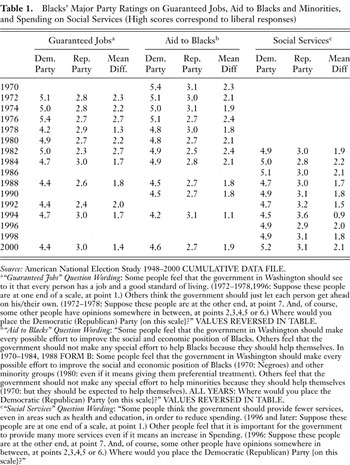
Blacks' perceptions of where the parties stood in relationship to their interests can be documented by national public opinion data. When asked to rate the Democratic and Republican parties on key policy matters, including the principle of guaranteed employment, government assistance to Blacks and minorities, and spending on social services, starting in the 1980s, Blacks placed the Democratic Party squarely in the center of the seven-point ideological scale. In contrast, Blacks placed the Republican Party at the conservative end of the scale, and during the 1980s, they pushed this placement further and further to the right. For example, on the principle of jobs, the GOP was rated 4.8 in 1972 by Blacks (see Table 1). In 1982, the average GOP rating on jobs was 5.1, and in 1984, it was 5.7. Similarly, on government aid to Blacks and minority groups, in 1970 Blacks placed the GOP at 4.9 on average. By 1980, the GOP position on minority aid had increased to 5.3. Because the data on spending on social services begins in 1980, a similar trend could not be detected. The ideological distance between the two parties expanded as a result of Blacks' perceptions that the Republican Party had become more conservative. Thus, ironically, while not quite happy in their relationship with the Democratic Party, Blacks suffered from an even more profound sense of alienation with the GOP. This polarized view of the two major parties contributed to the high margin of Black support for national Democratic candidates.
Blacks' Major Party Ratings on Guaranteed Jobs, Aid to Blacks and Minorities, and Spending on Social Services (High scores correspond to liberal responses)

The perceived differences between the major parties on policies would narrow by the end of the 1980s, however, as shown in Table 1. Whereas once Blacks saw differences of more than two points on average between the two parties on their position on a guaranteed job and a good standard of living for every American in the 1970s, by the 1990s, that difference had steadily diminished. In 2000, the average difference between the two major parties on “guaranteed jobs” had fallen to 1.4.
The ideological convergence between the two parties is equally pronounced on questions of race, which had been critical to the pro-Democratic swing in Blacks' party affiliations during the peak years of the civil rights struggle. Whereas Blacks saw policy differences on government assistance to Black and minorities between the two parties amounting to two points or more on the seven-point scale, that difference steadily narrowed. In 1994, it dropped to 1.1, only to rebound in 2000 to 1.9 (see Table 1). In contrast to these two policy measures that include data from the 1970s, perceived policy differences between the two major parties on social service spending from 1982 to 2000 have fluctuated, but remain at about two percentage points.
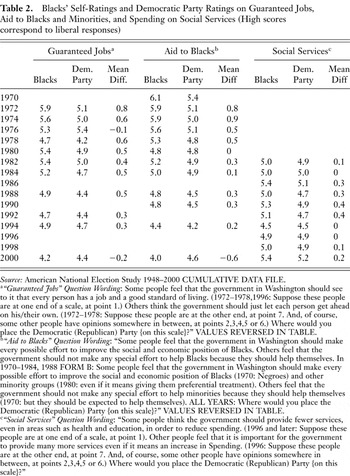
While Blacks generally see fewer ideological differences between the two major parties today, they also see less divergence between their own ideological position and the Democratic Party as well. Table 2 presents the average rating of the Democratic Party as well as the Black respondent's position on the three policy matters. As shown in Table 2, whereas once Blacks saw almost a one-point difference between their position on guaranteed jobs and the Democratic Party, with Blacks to the left of the party, in 2000 the gap had narrowed to −0.2, where the Democratic Party is now slightly to the left of Blacks! The same pattern is repeated on the issue of government aid to Blacks and minorities. Whereas once Blacks stood to the left of the Democratic Party on this issue, separated by nearly one point in 1974, by 1994 the difference had narrowed to 0.2. In 2000, Blacks perceived themselves slightly to the right of the Democratic Party on the question of government support for Blacks and minorities.
Blacks' Self-Ratings and Democratic Party Ratings on Guaranteed Jobs, Aid to Blacks and Minorities, and Spending on Social Services (High scores correspond to liberal responses)

In sum, the public opinion data indicate that the ideological rift that had emerged during the 1980s between Blacks and the Democratic Party has mended, largely because Black opinion has swung closer to the mainstream. Blacks' images of the two parties are somewhat less polarized as well, in part because they see the Democrats as having moved closer to the Republican party, notably on matters such as government assistance to Blacks and minorities.
BLACK AND DEMOCRATIC PARTY UNITY AT THE TOP
The discord between Blacks and the Democrats made public by the Jackson candidacies appears mended, not only at the level of the electorate, but at the top as well. The rapprochement can be seen in Jesse Jackson's behavior at the national conventions of the Democratic Party. Jackson's ringing endorsement of the Gore-Lieberman ticket at the 2000 Democratic National Convention in Los Angeles skillfully contrasted the difference between Gore and Bush, but only briefly alludes to “points of disagreement” between himself and the party. Jackson mentions these points of disagreement without specifying their nature. The words left, liberal, or liberalism are strikingly missing from the text of his 2000 convention speech. Most important, Jackson claimed “within [the] party, we can fight for the right to do what's right,” adding, “We can change. We can challenge. We can agree to disagree. We can agree to be agreeable. But we're a family.” The general theme of Jackson's 2000 address was of “one big tent in America,” or inclusiveness, so that the poor, the uninsured, and children, for example, are not left out of the party's political agenda and interests. Strikingly, Jackson's plea for “inclusiveness” was not articulated as part of an alternative more progressive agenda or even specifically a Jackson-for-president agenda. One other notable feature of Jackson's 2000 address was in his reference to his son, Jesse Jackson, Jr., now a member of the U.S. House of Representatives from Chicago.
In 2000, however, the Democratic Party did not give Jackson a prime-time slot in contrast to all other past conventions. Despite this, Jackson's 2000 address was quite similar to his prime-time 1996 Democratic convention address. In both the 1996 and 2000 Jackson addresses, the overarching theme was party unity. In the 1996 address, he pointed out that thirty years earlier, Democrats were divided and lost the election to the Republicans. Claiming that the “stakes are high,” because the Republicans now control Congress, Jackson praised President Clinton at the 1996 convention for his support for an assault weapons ban, a higher minimum wage and earned income tax credit, affirmative action, and voting rights. Jackson concluded that Clinton deserved another four years.
Jackson's 2000 and 1996 convention addresses are striking departures from his 1984, 1988, and 1992 addresses. In his 1992 speech, for example, Jackson had given Clinton an indifferent endorsement; he also publicly rebuked those in the party, like Clinton, who had engineered the party's move to the political center, stating, “History will remember us not for our positioning, but for our principles. Not a move to the political center, left or right, but rather for our grasp on the moral and ethical center of wrong and right.” He saved the rest of his speech to outline a liberal policy agenda, one that corresponded with the liberal interests of most Black Democrats, but one that the majority of delegates had pointedly rejected in the drafting of their party's platform. In his 1988 convention speech Jackson had credited Michael Dukakis for having run a “well managed and dignified campaign,” and for not having stooped to “demagoguery.” Jackson had been perhaps the most critical of Walter Mondale in his 1984 convention address. In it he made no mention of Walter Mondale by name, tersely pledging at the beginning of his the speech that he would be “proud to support the nominee of this convention for the Presidency of the United States.”
Jackson's shift to full and unqualified support for the Democratic Party's presidential tickets in 1996 and 2000 may reflect external forces outside of the coercive pull of the national party organization. The GOP's ascension to power in the legislative branch of government in 1994 may have compelled Jackson to give Clinton his unqualified support in 1996. Another external factor is personal. In 2000, the media revealed Jackson had fathered a child out of wedlock. In response to this revelation, Jackson informed the press that he intended to seek a lower public profile.
Others would argue that what has happened to Jackson is only what has happened to countless insurgent leaders of the past; they become co-opted by the mainstream (Piven and Cloward, 1977; Smith 1981). The process of co-optation, however, remains analytically ambiguous. Direct primaries and candidate-centered campaigning have stripped American parties of much of their coercive power over party leaders. For Shefter (1994) parties have controlled leaders through “witch hunts,” but this was not so in Jackson's case. Party coercion is achieved through the subtle re-ordering of Black party leaders' strategic calculations. Jackson's radicalism occurred when the Democrats were effectively locked out of the White House during the 1980s during the Reagan-Bush administrations. In agitating from the left, there was little for Jackson to lose as the undisputed leader of the party's most left-liberal faction, Blacks. The Democrats then gained control of the executive branch in 1992 under Bill Clinton. Having developed a reputation as an outsider, Jackson had entrée to the inside of power in Washington. This was a circle that now included a son who likely harbors his own set of ambitions within the Democratic Party's leadership ranks. When Jackson likens the Democratic Party to one big family, he speaks comfortably as one of its recognized sons and no longer as an illegitimate one. It was likely the possibility of wielding influence and power under a Democrat-led presidential administration that cooled Jackson's convention floor rhetoric.
In contrast to candidates over whom modern American parties lack much control, parties reign supreme as a central organizing force in government. Parties, after all, control committee assignments, chairmanships, and congressional leadership posts, including Speaker of the House. The coercive control of political parties can be seen in its effect on the Congressional Black Caucus (CBC). Black members remain the most liberal generally in Congress, even as their growth in numbers has also led to increases in their ideological diversity (Tate 2003). Harold Ford, Jr. (Democrat-TN) and Sanford Bishop (Democrat-GA), for example, belong to the “Blue Dogs” House coalition, a small group of Democrats who consider themselves economic conservatives and who endorse bipartisan cooperation with the Republican Party. However, the fact that the vast majority of Black House members of Congress are unabashed liberals can be easily misinterpreted. In a review of their roll-call votes, one finds that Black Democrats in the House are no less supportive of the moderate public policy agendas of Democratic presidents, and sometimes more so, than Democrats generally. The impression that Black members of Congress are policy radicals and tend to be obstructionist in the same manner as conservative Democrats from the South, thus, needs to be corrected.
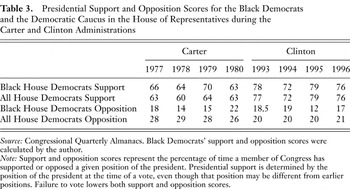
Table 3 presents the percentage of time Black Democratic House members and Democratic House Caucus members supported or opposed President Jimmy Carter's and President Bill Clinton's legislative positions. As one can see, in spite of their liberal politics, Black House representatives have supported the legislative agendas of these two centrist Democratic presidents. Overall, Democratic House support for Carter's legislative objectives was low. Democrats supported President Carter's legislative agenda barely two-thirds of the time from 1977 to 1980. A full quarter of the Democrats routinely opposed legislation endorsed by President Carter. Black opposition to Carter's legislative preferences was actually less than that for the Democratic Caucus as a whole. During 1977 to 1979, approximately 18% to 14% of Carter-backed bills were vetoed by Black House members. Democratic opposition to Carter was more than a reflection of his leadership skills as outside influences. Carter found it difficult to lead post-Vietnam, post-Watergate, having inherited an overgrown, unstructured, executive bureaucracy (Neustadt 1990, pp. 234–243). Yet this son of the South Democrat found that Black House members were less hostile to his agenda on the floor than were southern Democrats.
Presidential Support and Opposition Scores for the Black Democrats and the Democratic Caucus in the House of Representatives during the Carter and Clinton Administrations

Bill Clinton won notably higher levels of support and markedly less opposition from Democrats during 1993 to 1996 in his first administration as president than did Jimmy Carter. Strong Democratic support for the President's agenda, again, was no less true for Black Democrats than for members of the Democratic caucus as a whole. Democratic House members supported Clinton's legislative agenda 72% to 79% of the time. Black Democrats were only marginally less likely to vote for Clinton legislation in 1993 than were Democrats generally, and no more or less likely to favor or block Clinton-favored legislation in 1994. Black opposition tended to be less than that found among the Democratic House caucus or during the Clinton presidency. In 1995, Black Democrats voted against 12% of Clinton-backed legislation on average as opposed to the 20% figure for Democrats as a whole.
The empirical reality of the CBC's voting behavior—that it was in fact quite in line with a moderate Democratic president's policy agenda—nonetheless masks a transformation in the organization's political style. As membership in the CBC increased from sixteenth in the 95th Congress to thirty-ninth (including the nonvoting District of Columbia House delegate) in the 103rd, the CBC has become less openly critical of the executive branch. The early history of the CBC shows members engaging in grandstanding and vocal opposition to the agendas of both President Nixon and President Carter. In fact, the early CBC's organizational style has been characterized as combative (Singh 1998). For example, rebuffed by President Nixon in their efforts to set up a meeting, members of the CBC boycotted Nixon's State of the Union address. The stand-off continued through the second year of President Nixon's second administration, and at the President's 1971 State of the Union address, only Senator Ed Brooke, then the only Black Republican member of the U.S. Congress, attended. After finding much to fault with President Carter's policies at a May 1979 regional event, divisions erupted between those CBC members who wanted to “dump Carter” publicly in 1980, such as Representative John Conyers, and those who did not, such as Congressman Harold Ford. Recounting this event, one founding member of the CBC, former Congressman Bill Clay writes: “Congressman John Conyers announced on opening night that he was organizing a ‘dump President Jimmy Carter campaign.’ He told a local reporter, ‘The facts are that President Carter has not lived up to his promise. He double-crossed us.’ Congressman Diggs characterized Conyers' remarks as ‘premature,’ and Congressman Harold Ford announced, ‘I'm emphatically against such a move. Furthermore, I'm a supporter of the president’” (Clay 1992, pp. 303–304). Bill Clinton was never threatened by such a rebellion from Black Democrats, even during the most vulnerable phase of his presidency, when the Congress considered his impeachment.
The nature of political power in the U.S. House of Representatives is such that it affords members great individual autonomy. CBC members voted in line with the president's agenda, but did not hesitate to criticize presidents publicly on public policy grounds. Rule changes adopted by the House since 1975, however, have made it easier for the party to control its legislative members, or, at least, bring the most rebellious ones back in line (Rohde 1991). Such rule changes led to greater homogeneity and public policy consensus among Democrats in the House. Moreover, since parties function to “keep the peace” by providing their members meaningful opportunities to influence the legislative process (Sinclair 1983), party leaders wised up and began to integrate Blacks better. Bill Gray's elevation to chair the Budget Committee in 1985 was momentous in the transformation of the CBC's political style (Singh 1998; Tate 2003). Legislative votes are not merely products of the member's own ideology, but reflect a set of strategic concerns as well. Having greater access to power and influence finally, Black members had more reasons to support the party's policy agenda in the legislative process. Today there are very senior CBC members, such as Charles Rangel of New York, who, if control of the House reverts back to the Democratic Party, are next in line to chair important House committees. Black House members work under the assumption that they can be more effective legislators working in a symbiotic fashion with the Democratic Caucus. Thus, Black House members have adopted for a more conciliatory working style in part as the party has permitted them to move up its and the House's ranks through seniority, and in part as the party has achieved tighter discipline through House reforms.
Another coercive party mechanism is provided by role that presidents play in the policymaking process. Divided control of the government has had the effect of suppressing Black Democratic dissent from President Clinton's legislative agenda. While Black members supported President Clinton's legislative agenda overall, there were key bills that they opposed, but surprisingly, with little public rancor. Few Black House members, for example, supported Clinton's omnibus crime bill. The crime bill won only one-fourth of the CBC votes, but three-quarters of the votes among White Democrats. Blacks along with Hispanic Democratic legislators sought to preserve an amendment in the House allowing defendants in capital cases to use statistical evidence to argue that the death penalty is imposed in a racially discriminatory fashion. Different members of Congress have pursued passage of a racial justice law since 1988. The Senate rejected it that year, again in 1989, and again in 1990. Attempts in 1991 also failed, but by then a clear majority in favor of such legislation had coalesced in the House. The House floor vote had been 212 to 217 against striking the provision, a victory that had not been possible three years earlier. Republicans along with a sizeable minority of Democrats opposed the provision claiming that it would lead to “racial quotas” in sentencing. Threatening to tie up the legislation through filibuster if the bill retained its racial justice provision in the Senate, President Clinton dropped his support of it. Thus, the final bill emerged shorn of the “Racial Justice Act.”
Black members' steadfast loyalty to their party's policy agenda (seen in the roll-call voting behavior of the House's two Black Republicans as well) was tested more severely in the Republican-controlled 104th Congress. President Clinton in his “triangulation” strategy supported bills that already had strong Republican backing, and this included welfare reform. Twice earlier President Clinton had vetoed welfare reform bills that ended the sixty-year guarantee of government support for poor families with children because they were considered too draconian. While these bills imposed the five-year limit that Clinton approved of, they did not provide much financial support to states to help welfare recipients find jobs. However, the third welfare reform bill that cleared Congress was not much different from the first two. All CBC members, with the exception of Sanford Bishop of Georgia, voted against it. Nevertheless, welfare reform would receive majority support among White and other minority Democratic legislators—a full 60%. This support, along with 98% of the Republican vote and the President's promise not to veto this version, enabled it to become national law on August 22, 1996. Even with their recorded votes against welfare reform, no Black Democrat stood up, as, for example, retiring Senator Daniel Patrick Moynihan did, to denounce publicly the President's move to eliminate the federal safety net.
On welfare reform, perhaps because their votes were not critical to the bill's passage, nearly every Black member lined up against it. And yet they did not wage a public campaign against the president's welfare reform initiative. Several reasons account for this. First, the president's move to eliminate the entitlement was popular, even among the majority of African Americans, 60% of whom approved in a national survey a five-year limit. If members find themselves voting against the popular will, few seek to publicize such acts. Secondly, in contrast to the crime control bill or even free trade, CBC support for welfare reform was not critical for its passage. Had it been so, given the individualistic nature of members of Congress, the CBC's voting pattern would have likely been more divided, as individual members bargained with the administration over specific aspects of the bill or leveraged promises for support for future legislation that they intended to pursue later on. Finally, the quiet opposition to welfare reform by nearly all members of the CBC, however, reflects the institutional norms of the U.S. legislative process. One lone member cannot derail the passage of legislation except, perhaps, through filibuster in the U.S. Senate, or as chairs of committees, which no Black Democrats had in the 104th Congress. Lacking such power, therefore, members rarely seek to antagonize other actors, including the president and fellow members, through public opposition when they are clearly going to lose. Such behavior undermines future efforts toward assembling the large coalition to win passage of other bills that members care about.
Finally, in addition to institutional rules and norms, the political context provided a compelling reason not to oppose openly the president. Black Democrats are more likely to tow the party line under divided government, when their dependence on a Democratic president for aggressive policy leadership is great. The incentives to “fight to live another day,” as opposed to engage in entrenched and open warfare with the President are very compelling. Losing the fight gracefully on one bill leaves open the possibility to negotiate for the successful passage of another. The fact that Black members must negotiate with the party caucus as well as with the president is often overlooked as scholars tend to emphasize the “safeness” of districts that supposedly give Black legislators higher levels of political independence than other members (Swain 1993).
Thus, ironically, it is the expansion of political opportunities for members of the CBC under House reforms and divided government that has silenced them. They prefer to act as other members of Congress have, working through back channels and trading favors privately as opposed to making a noisy and disagreeable fuss. This is generally the way of doing business in the U.S. Congress. Furthermore, getting along as a legislative tactic is much preferred by the public anyway. Research by John Hibbing and Elizabeth Theiss-Morse (1995) shows that it is the endless debating, bickering, mudslinging, confusion, and bargaining that explain the public's lack of confidence in Congress.
THE NEW DEMOCRATIC PARTY LINE IN BLACK POLITICS
The empirical evidence paints a picture where Blacks and their elected Black representatives are now under the umbrella of the Democratic Party's public policy agenda. Black House leaders no longer denounce the cautious and wobbly support that Democrats show affirmative action. Black Democrats did not aggressively counter the party's move to end welfare as a federal entitlement to poor families in the Clinton administration. Democratic control of the presidency, the chief executive's great role as policymaker, Clinton's high popularity ratings in addition to the institutional rules governing legislative behavior are all factors accounting for the absence of forceful opposition to Clinton's domestic policies by Black House members. This institutionalization has had a great effect on Black public opinion. As a result, Black public opinion is more moderate and closer in line with the party's moderate policy stands.
The argument I have advanced is that the institutionalization of Black politics has compelled Black leaders to support the Democratic party's mainstream political agenda. Ambitious Black legislators know that they must support the Democratic Caucus if they expect to serve as committee chairs and as party leaders. Black legislators' quiet embrace of President Clinton's centrist agenda follows less the more sinister account of legislators abandoning their constituents' interests in exchange for private gain than for collective ends that may well be short of the interests these legislators represent. Thus, as Michel insightfully points out, the party itself becomes another interest that representatives must accommodate as well (Michels 1958). To represent their constituents effectively, Black members of Congress must work cooperatively with their party. In a two-party system, Black Democratic leaders find themselves working for an organization pursuing middle-of-the-road public policies. In short, it is a mix of political ambition under the institutional logic of a two-party system as well as coercive House rules that govern the strategic voting behavior of minority leaders.
The structural constraints on Black legislators that have produced this effect on Black public opinion can be easily overstated. The American Congress provides its members with great individual autonomy, and Black leaders can break outside of the institutional confines to point the nation in another direction after all. As much as the institution shapes individual behavior, history shows that individual actors can change institutions (Mayhew 2000). Congress will forever have its share of renegades such as the late Adam Clayton Powell (Democrat-NY) who single-handedly desegregated the dining facilities in Congress and gave the House its “Powell Amendments” (Hamilton 1991). Today, the House has Barbara Lee (Democrat-CA) who alone dissented from the popular House resolution authorizing the use of armed force against the terrorists who attacked America on September 11, 2001. Members of Congress carry great influence for the actions that they take as individual actors within the public sphere. Nonetheless, collectively in their relationship to President Bill Clinton, Black members of Congress chose less to challenge systematically than to accommodate their party's policy agenda. The strategic behavior of minority legislators logically follows the norms and rules conferring political parties and presidents great coercive power in the legislative process.
The fact that institutions and the political context constrain and shape Black political behavior at the top, which then feeds into Black opinion at the bottom, still leaves open the possibility of change. And, in fact, what separates my analysis most from other structural accounts, including Frymer's (1999), is this possibility of change. Black opinion has moderated since the end of the Civil Rights Movement, but it could radicalize in the future. First, the set of reforms that increased the centralization of the policymaking process in the House and prompted greater party unity could be reversed. In 1995, House Speaker Newt Gingrich imposed term limits on committee chairs, but Democrats may or may not adopt such term limits if they regain majority control of the House. Without term limits, committee chairs, and notably Black committee chairs, will have power and great freedom to dissent from the party line, if necessary.
Still, the conservative trend in Black public opinion is unlikely to snap back radically and reverse itself overnight if only because trends in public opinion rarely have shown such abrupt change. Party leaders are but one source of mass opinion. Citizens, after all, are fully capable of judging the performance of politicians based on their own set of interests independently of elite actors through their own issue networks, or “black counterpublics” as Michael Dawson (2001) describes them. Voters, after all, are not “fools,” as V. O. Key famously stated. African Americans rely on non-political institutions for their political information, and these alternative and independent institutions include churches, barbershops, and BET. As Melissa Harris-Lacewell (2004) explains, Blacks talking to one another in such venues constitutes serious “everyday talk.” Thus, President Clinton's centrist policies were perhaps more palatable as debated in these alternative issue networks, given the reduction in Black joblessness and in the poverty rate during his presidency, advantages that President Reagan lacked in his own assault on the welfare program. Whether today's Republican-led national government acts in a conciliatory and integrative fashion toward Blacks, or in a reactive fashion against them will undoubtedly influence Black public opinion. While voters may not follow legislative politics at the national level closely, Vincent L. Hutchings's (2003) scholarship provides a detailed account of how the media's coverage of political issues, notably its coverage of how legislators vote on key bills, is carefully followed by groups such as union members and Christian fundamentalists, who then can mobilize and transform the political process in surprising and effective ways. Thus, Black voters could react against social welfare and racial policies advocated by their political leaders, based on their own judgments rooted in experience, as they did during the civil rights era (Lee 2002). Forming strong policy positions independently of their elected party leaders could then set into motion a liberalizing trend in Black public opinion that flows upward to their leaders. After all, even as Black opinion has moderated, Africian Americans' interests remain staked to a government that is progressive and egalitarian as well as purposively engaged in combating racial inequality in America.
References
REFERENCES
Alverez, R. Michael and
John Brehm
(2002).
Hard Choices, Easy Answers.
Princeton, NJ:
Princeton University Press.
Barker, Lucius J.,
Mack Jones, and
Katherine Tate
(1999).
African Americans and American Political System,
4th Ed.
New York:
Prentice Hall.
Browning, Rufus P.,
Dale Rogers Marshall, and
David H. Tabb
(1984).
Protest is Not Enough.
Los Angeles and Berkeley, CA:
University of California Press.
Clay, William L.
(1992).
Just Permanent Interests: Black Americans in Congress,
1870–1991.
New York:
Amistad Press.
Dawson, Michael C.
(2001).
Black Visions: The Roots of Contemporary African-American Political
Ideologies.
Chicago, IL:
University of Chicago Press.
Erikson, Robert S.,
Michael B. MacKuen, and
James A. Stimson
(2002).
Public opinion and policy: Causal flow in a macro system
model.” In
Jeff Manza,
Fay Lomax Cook, and
Benjamin I. Page (Eds.),
Navigating Public Opinion, Polls, Policy, and the Future of
American Democracy.
New York:
Oxford University Press.
Frymer, Paul
(1999).
Uneasy Alliances: Race and Party Competition in America.
Princeton, NJ:
Princeton University Press.
Hamilton, Charles V.
(1991).
Adam Clayton Powell, Jr.: The Political Biography of an American
Dilemma.
New York :
Atheneum.
Harris-Lacewell, Melissa
(2004).
Barbershops, Bibles, and BET : Everyday Talk and Black Political
Thought.
Princeton, NJ:
Princeton University Press.
Hibbing, John R. and
Elizabeth Theiss-Morse
(1995).
Congress as Public Enemy.
New York:
Cambridge University Press.CrossRef
Huckfeldt, Robert and
Carol Weitzel Kohfeld
(1989).
Race and the Decline of Class in American Politics.
Urbana and Chicago, IL:
University of Illinois Press.
Hutchings, Vincent L.
(2003).
Public Opinion and Democratic Accountability: How Citizens Learn
about Politics.
Princeton, NJ:
Princeton University Press.
Lee, Taeku
(2002).
Mobilizing Public Opinion: Black Insurgency and Racial Attitudes in
the Civil Rights Era.
Chicago, IL:
University of Chicago Press.
Mayhew, David R.
(2000).
America's Congress: Action in the Public Sphere, James Madison
through Newt Gingrich.
New Haven, CT:
Yale University Press.
Mendelberg, Tali
(2001).
The Race Card, Campaign Strategy, Implicit Messages, and the Norm
of Equality.
Princeton, NJ:
Princeton University Press.CrossRef
Michels, Robert
(1925).
Political Parties: A Sociological Study of the Oligarchical
Tendencies of Modern Democracy.
Glencoe, IL:
The Free Press.
Michels, Robert
(1958).
Political Parties.
Glencoe, IL:
The Free Press.
Neustadt, Richard E.
(1990).
Presidential Power and the Modern Presidents: The Politics of
Leadership from Roosevelt to Reagan.
New York:
The Free Press.
Page, Benjamin I. and
Robert Y. Shapiro
(1992).
The Rational Public: Fifty Years of Trends in Americans'
Policy Preferences.
Chicago, IL:
University of Chicago Press.CrossRef
Pinderhughes, Dianne
(1986).
Political choices: A realignment in partisanship among Black
voters? In
The State of Black America.
New York:
National Urban League.
Piven, Frances Fox and
Richard A. Cloward
(1977).
Poor People's Movements: Why They Succeed, How They Fail.
New York:
Pantheon Press.
Rohde, David W.
(1991).
Parties and Leaders in the Postreform House.
Chicago, IL:
University of Chicago Press.CrossRef
Sapiro, Virginia,
Steven J. Rosenstone, and
the National Election Studies
(2002).
AMERICAN NATIONAL ELECTION STUDIES CUMULATIVE DATA FILE,
1948–2000
(Computer file).
11th ICPSR version.
Ann Arbor, MI:
University of Michigan, Center for Political Studies.
Ann Arbor, MI:
Inter-university consortium for Political and Social Research.
Shefter, Martin
(1994).
Political Parties and the State: The American Historical Experience.
Princeton, NJ:
Princeton University Press.
Sinclair, Barbara
(1983).
Majority Leadership in the U.S. House.
Baltimore, MD:
The Johns Hopkins University Press.
Singh, Robert
(1998).
The Congressional Black Caucus: Racial Politics in the U.S.
Congress.
Thousand Oaks, CA:
Sage Publications, Inc.
Skowronek, Stephen
(1993).
The Politics Presidents Make, Leadership from John Adams to George
Bush.
Cambridge, MA:
Belknap Press of Harvard University Press.
Smith, Robert C.
(1981)
Black power and the transformation from protest to politics.
Political Science Quarterly,
96:
431–443.CrossRefGoogle Scholar
Swain, Carol M.
(1993).
Black Faces, Black Interests: The Representation of African
Americans in Congress.
Cambridge, MA:
Harvard University Press.
Tate, Katherine
(1994).
From Protest to Politics: The New Black Voters in American
Elections,
Enlarged Ed.
New York and Cambridge, MA:
the Russell Sage Foundation and Harvard University Press.
Tate, Katherine
(2003).
Black Faces in the Mirror: African Americans and their
Representatives in the U.S. Congress.
Princeton, NJ:
Princeton University Press.
Walters, Ronald W.
(1988).
Black Presidential Politics in America: A Strategic Approach.
Albany, NY:
State University of New York Press.
Zaller, John R.
(1992).
The Nature and Origins of Mass Opinion.
New York:
Cambridge University Press.CrossRef
Blacks' Major Party Ratings on Guaranteed Jobs, Aid to Blacks and Minorities, and Spending on Social Services (High scores correspond to liberal responses)
Blacks' Self-Ratings and Democratic Party Ratings on Guaranteed Jobs, Aid to Blacks and Minorities, and Spending on Social Services (High scores correspond to liberal responses)
Presidential Support and Opposition Scores for the Black Democrats and the Democratic Caucus in the House of Representatives during the Carter and Clinton Administrations
 You have
Access
- 6
- Cited by