Introduction
As political science faculty at East Central University, a small teaching-oriented state school located in rural Oklahoma, we are constantly challenged to provide our students with novel approaches to learning. Oklahoma's traditionalistic political culture is demonstrated to us daily as our students seem to envision themselves as subjects of an inscrutable system rather than potent democratic actors. To enhance understanding of issues related to campaigns and elections, we developed a six-week simulation in which upper-level political science students participated as a candidate for the U.S. Senate, as a member of a campaign team, or as a member of the media. Approximately 200 of our Introduction to American Government students were called upon to be the voters in our simulation, a role for which many of our students cast the first ballots of their lives.
The “Running for Your Grade” simulation challenges upper-level political science students to apply general knowledge about the campaign process. Students must apply political science theory and develop a working understanding of the issues of the day. The simulation includes all major campaign roles, including candidates, managers, pollsters, and campaign and media personnel to produce a wide range of educational experiences and a high level of participation and competition.
Surveys of the participants, as well as our own reflections, show that this simulation is worthwhile to non-majors and majors alike because it provides valuable political socialization to voting and “hands-on” realism. For example, one student wrote, “The simulation became so real that it was a great learning experience.” The simulation is a way to educate students about campaigns and elections while diverging from the traditional lecture format.
Simulations are cited again and again as effective teaching tools (Kathlene and Choate 1999; Endersby and Webber 1995; Dougherty 2003). Rosenthal (1999), applying Kolb's theory of experiential learning to her experiences teaching Women in Politics, finds that assigning her students to interview female politicians helps move them beyond their original resistance to the material. In short, making students active participants in their learning provides them with realistic experiences and deepens their capacity to understand complex material.
Additionally, in their seminal article, Chickering and Gamson (1987) lay out seven principles for good practice in undergraduate education. Hands-on simulations embody several of these principles. For example, good practice develops reciprocity and cooperation among students, uses active learning techniques, and respects diverse talents and ways of learning. Because our students must function as teams without direction from their professor, they really do have to develop consensual norms of learning. Simulations embody active learning because students actually complete complex tasks rather than just passively reading about them. Our students spoke to potential voters about their candidates, wrote campaign literature and public opinion surveys, questioned political experts, and shaped campaign strategy. Finally, simulations are ideal for respecting different ways of learning. One student wrote, “Every student was able to contribute something different to the campaign.” These diverse strategies are particularly efficacious in meeting the educational needs of our female students, many of whom may prefer consensual group-centered learning to the traditional lecture format (Gallos 1995).
In designing our simulation, we relied heavily on the model provided by Kathlene and Choate (1999) in which students assumed professor-assigned roles in a 10-week mock election. Their excellent article provides many suggestions and helpful hints for simulations. For evaluation tools, we created surveys based on questions developed by Endersby and Webber (1995) and Chickering and Gamson (1987).
Simulation Design
We mounted a mock U.S. Senate campaign in which upper-level political science students campaigned for the votes of students in Introduction to American Government classes. In contrast to the election simulation described by Kathlene and Choate (1999), the rivalry was between classes, rather than intra-class. The principal participants in the simulation were students in Political Parties and Elections (Professor X), and Women in Politics (Professor Y). We each had about 10 students, and three students were enrolled in both classes.1
The three “overlap” students who were in both the targeted classes were assigned to perform the role of the media and write objective reports about the state of the campaign.
Avoiding traditional party labels, we used our school colors and assigned the Women in Politics class to be the Black Party and the Political Parties class to be the Orange Party. We chose a Senate race because we wanted the campaigns to develop messages and issue stances on national as well as local issues that might affect the state of Oklahoma. We believed that this broad approach would best serve the goal of educating students on the issues.
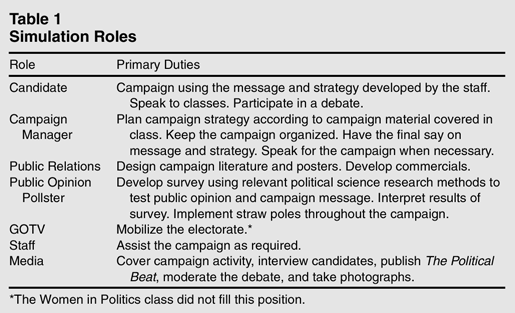
The students were asked to fulfill campaign roles that we defined, although Professor Y's roles became more flexible and open to modification once students became more deeply involved in the process. Table 1 displays the various roles used in the simulation. Each class voted for their candidate, with both classes having a runoff election to choose the final candidate. This process was particularly interesting in the Women in Politics class because students had to evaluate how effective a female candidate could be in a very traditionalistic rural area.
After the candidate spot was filled, each class divided up the other roles as delineated by the faculty in a process that was informal and consensual (see Table 1).2
The candidates took their roles seriously and the competition between them was quite interesting. The Black Party candidate was a female honors student from Albania with experience in international diplomacy. The Orange Party candidate was a well-known male athlete heading to law school.
Neither the candidates nor their staffs mirrored any actual political figure; we believed the exercise would be more valuable if the participants developed their own personas and characteristics. In the Political Parties class in particular, the small number of upper-division students proved an asset for participation, but also negatively impacted the ability to define and develop a broad array of duties and responsibilities because students had to fill so many roles.
Schedule of Events
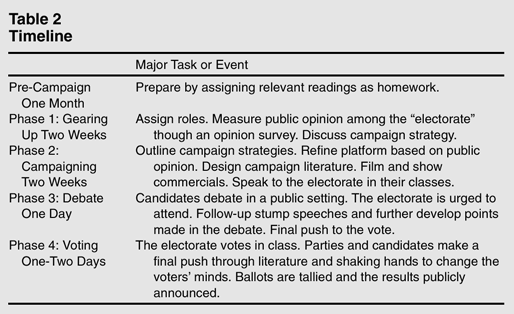
The simulation is most effective when students are given information with which to prepare for their campaign roles weeks before the simulation begins. For example, the Women in Politics class focused on campaign strategies for women candidates in the weeks preceding the simulation. The Political Parties class studied the organizational aspects of a campaign on which parties tend to focus. For example, the Political Parties class devoted part of the simulation to GOTV efforts.
Phase 1
Select the candidate and allocate other campaign roles and duties. Design a public opinion poll for use in subsequent issue development, stances on issues, and the location of targeted members of the electorate and administer it to the voting population. Also, inform the voters that they are taking part in a campaign simulation and that their opinions will shape campaign debate. We combined each campaign's questions into a single questionnaire which we administered to the 200 or so students in our Introduction to American Government classes who played the role of voters. Direct each campaign to compile the data and determine their campaign's focus. Begin producing substantive messages in campaign literature, signs, and brochures based on the findings of the public opinion surveys.
During this phase the media is assigned to follow and report on both camps' activities. They gather biographical information on the candidates and report on the issue development of each campaign. We asked our media to write a newsletter titled The Political Beat, and post it in classrooms.
Phase 2
Campaigning is the focus of Phase 2. Road-test and finalize campaign messages by meeting with voters in their classes for the first time. These stump speeches force the candidate to communicate directly with the electorate and to be responsive to its questions on a wide variety of topics. Produce campaign materials. Our students produced an array of tri-fold flyers, signs, and brochures with a variety of target audiences. Begin writing and filming TV ads.3
We were pleased with the use of TV, but lack of equipment may be a problem. We alternated between using our school's AV department's camera and a personal camcorder. The students particularly enjoyed designing the ads. In order to test their understanding of real-world campaigning, the candidates and their organizations were asked to produce three ads: introductory, issue, and negative.
The media should continue with its production of
The Political Beat.
Phase 3
The candidates debate in front of the electorate. The format of the debate is initiated by the members of the media; length of time for responses, type of questions, and order of questioning are all worked out through negotiation between the two camps. It is a good idea to provide the actual debate questions or topics to the campaigns a day or two ahead of the debate so that each campaign can prepare their answers, as well as cull from the results of the public opinion questionnaire. The debate between the candidates is the largest and most high-profile task for the candidates. This assignment in particular illustrates each campaign's need to think strategically in analyzing the questions, preparing for possible responses from the opposing candidate, and deciding where in the exchange to limit or control their candidate's rebuttal. The event creates an environment of uncertainty for both candidates as both campaigns become aware of the difficulties in controlling the candidate once he or she has “assumed the podium.”
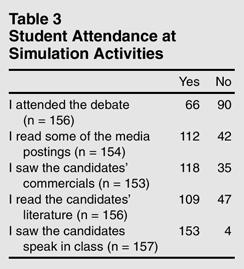
Our debate was advertised across campus by members of the media. Attendance for the event was about 90, including the candidate's parents and other members of the community. The event provided spontaneity with which the candidates and their organizations had to cope. The Orange Party scored an early victory against the Black Party at the debate. The Orange Party's in-depth knowledge of campaign tactics gleaned from review of their pre-simulation lessons served them well; they came to the debate as a well-oiled campaign team with literature to distribute. The Black Party had done no such preparation, which gave the electorate the impression that the Women in Politics class was disorganized and unprofessional.
After the debate, the camps debriefed the voters during their next class period. This session enables voters to ask questions they could not ask during the debate, while informing students who did not attend the debate about the topics that were discussed. Debriefing also provides the organizations an opportunity to criticize the opposing candidate and to make adjustments in message communication.
Our experience suggests that an additional debate may be a good idea. Another debate would ensure that more students could attend. The themes of “add another debate” or “allow for a rematch, especially for balance” were somewhat common responses in student surveys. We would also encourage letting the electorate ask questions of the candidates because their inability to do so during this simulation was a disappointment to many.4
The media designed the format of our debate and did not include questions from the audience.
Phase 4
The final phase is voting. To heighten the political socializing impact for the electorate, we recruited a ballot company (Royal Printing Company of Oklahoma City) to design a professional-looking ballot, but any sort of duplicated ballot will do. On voting days, candidates and their staffs make a final Get Out the Vote push to shake as many hands as possible, but be clear about your electioneering laws. We did not allow the candidates into the classrooms. Both groups distributed a final round of handbills, and the Black Party passed out candy with campaign messages attached, a tactic suggested by a former politician who had visited the class. An air of excitement hung in the air on Election Day. Of the approximately 200 members of the electorate, 157 (78.5%) cast ballots and completed our surveys. After the voting, we convened a special joint class with both of the campaigns to announce the winner of the election. Getting the students together helps mend any potential rifts that may have emerged between the two campaigns. To celebrate their participation, we presented both parties with medallions commemorating the simulation.
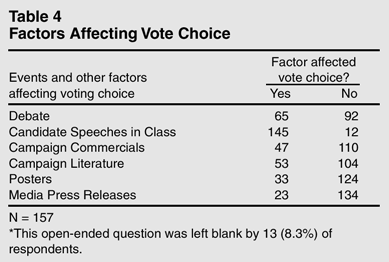
In the end, the Black Party, representing the Women in Politics class, won by just 10 votes. Table 3 indicates that the overwhelming factor in determining the election was the candidates' in-class stumping. From these results, it is difficult to see what affect a candidate's gender may gave had on the outcome, but gender-related concerns motivated every decision taken by the Black Party, from the candidate's issue stances to what she wore when addressing the voters. Concern regarding personal appearance was not unfounded; on one ballot a voter marked in “She is too hot!”
Student Evaluation
One of the simulation requirements calls for upper-division student assessment of their own role, as well as of the simulation as a whole. Students will be more aware of what they learned from the simulation if they reflect on it themselves, and their evaluations will prove useful in assessing their performance. Going a step further, the parties class (Professor X) required the students to maintain a daily journal of impressions, tasks, and a general evaluation of the activity.
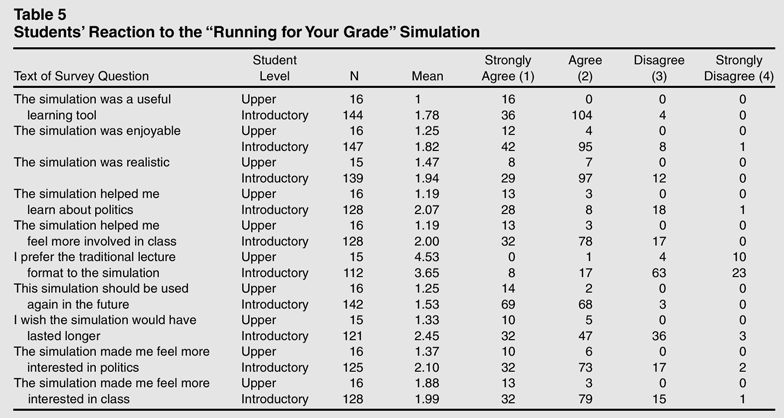
We assessed student outcomes further by administering surveys to all of the upper-level and introductory-level participants. We drew on research by Endersby and Webber (1995) and Chickering and Gamson (1987) to develop these surveys. Table 5 indicates that the introductory students considered the activity to be useful in all of the categories we developed. Especially high mean averages were indicated in the categories dealing with the usefulness of the activity as a learning tool and for using the stimulation again in the future. Table 5 also shows that upper-class students found the exercise very useful; every single student agreed that this exercise was a useful learning tool.
The qualitative responses of the upper-class students were also very helpful in evaluating student outcomes. Students were required to answer questions on several evaluative measures. We were particularly pleased that our simulation met many of the good practices of education identified by Chickering and Gamson (1987). For example, students particularly emphasized that the simulation helped develop “reciprocity and cooperation among the students.” One student wrote, “I was amazed at the Orange Party's group interaction and teamwork.” Another stated, “We had to work together to achieve our goal. We had to put ideas together.”
Students noted that the simulation also promoted active learning: “I felt that this election gave myself and everyone involved an experience that no textbook could offer, as well as providing the government students with an active role in an educational simulation.” Because the simulation required so many skills, it was impossible not to respect diverse talents and ways of learning. One participant wrote, “Throughout the campaign each person seemed to identify the contribution that they could make and where they could best put their talents to good use.”
Lessons Learned
First, “Running for Your Grade” was a terrific experience. One student wrote, “I think it is great!” The students enjoyed it and learned more about the politics of campaigning because they were placed in an experiential setting. The upper-level students felt that the simulation encouraged their interest in both politics in general and this class specifically. In an era when colleges are seeking ways to increase student retention, developing this kind of connectedness with students is invaluable. One student wrote, “It made me feel more involved.” The socializing effect for the Introduction to American Government class is also significant; we witnessed students who had never spoken before in class probing the candidates. Although it is not “real” voting, increased civic engagement may be a real outcome of this exercise.
Second, simulations are fun but can be a lot of work. We spent hours ironing out wrinkles in our plans and making sure that the students were on the right track. However, the costs certainly outweighed the benefits for us and for our students.
Third, flexibility is the key to success. We often juggled the rules and pushed back deadlines in order to ensure better outcomes. In fact, a general lengthening of the simulation may be welcome. The surveys indicated that every upperdivision student wished the simulation was longer, although fewer American Government students felt this way.
If your simulation is a joint effort, it is important for both instructors to stay on the same page and communicate the same rules to all students. Perhaps because of the element of competition, our students seemed to perceive that the other party had more information than they did. Though we tried to appear neutral, several upper-division students complained that “Both professors were too involved.”
Fourth, students appreciate special touches. The authentic ballots, as well as the medallions that each upperdivision participant earned, seemed to make it all more special and real.
Fifth, simulations allow for varying degrees of participation so it is difficult to ensure that all group members are pulling their weight in the campaign. When answering our survey, the upperclass students claimed to have spent an average of 5.7 hours outside of class working on the simulation (N = 9), and several students did not answer this question at all. One of the candidates wrote, “Too many [hours] to count,” but we think others could have indicated “too few to detect.” One student suggested we assign everyone in the simulation a set amount of work, but even that stricture would be hard to meet when people's tasks are asymmetrical and the learning situation is designed to be flexible. Perhaps some degree of peer grading would encourage everyone to get and stay involved.
Finally, assessment is imperative. Documenting your successful teaching strategy benefits you (and your tenure or promotion file) and your students.
Conclusion
Our experience with the “Running for Your Grade” simulation was overwhelmingly positive. Almost all of our upperlevel and introductory-level students enjoyed the active learning aspects of its activities, and it garnered much attention around the university. Many students who were not in our classes wished to vote and were regretful to find out that they were not part of the electorate, and our colleagues and the chair of our department were pleased with our activities. The simulation received heavy coverage in the college newspaper and both of the candidates now express interest in seeking office sometime in their political careers. This template outlines our experiences and may be easily adapted for use in other classrooms. An important point is that the simulation addresses diverse modes of student learning, which results in productive and satisfied students. One student wrote, “I wouldn't have imagined when we began that the simulation would be so applicable to the real thing.”